
Custom Jewelry in 2026: 6 Sources Evaluated for Buyers, Importers & DTC Stores
Custom Jewelry in 2026: 6 Sources Evaluated for Buyers, Importers & DTC Stores
Custom jewelry covers two distinct markets: OEM production runs built to an importer's specification — materials, plating, MOQ, lead time — and personalized consumer pieces like name engravings or birthstone rings sold direct-to-shopper. Knowing which end of that spectrum a supplier operates on is the first filter any procurement team should apply.
This list covers both ends. For buyers sourcing at scale — DTC store owners, importers, and procurement teams across the US, EU, UK, and MENA — the critical variables are MOQ thresholds, material traceability, trade terms, and supplier reliability. The consumer retail brands featured here (items #2–#6) serve a different function: they define the design benchmarks and personalization trends that overseas buyers need to track when specifying their own custom runs. Together, they map the full custom jewelry landscape in 2026.
The market has matured considerably. Buyers accustomed to minimum orders of several hundred pieces per style now have verified factory-direct options that start much lower. At the same time, the consumer side — once dominated by chains like Jared and department stores — has fragmented into specialist DTC brands offering amethyst, garnet, peridot, turquoise, and diamond-accent pieces at accessible price points. Both dynamics matter for anyone building or sourcing a custom jewelry line.
1. STRAND — Factory-Direct Custom OEM from Hangzhou
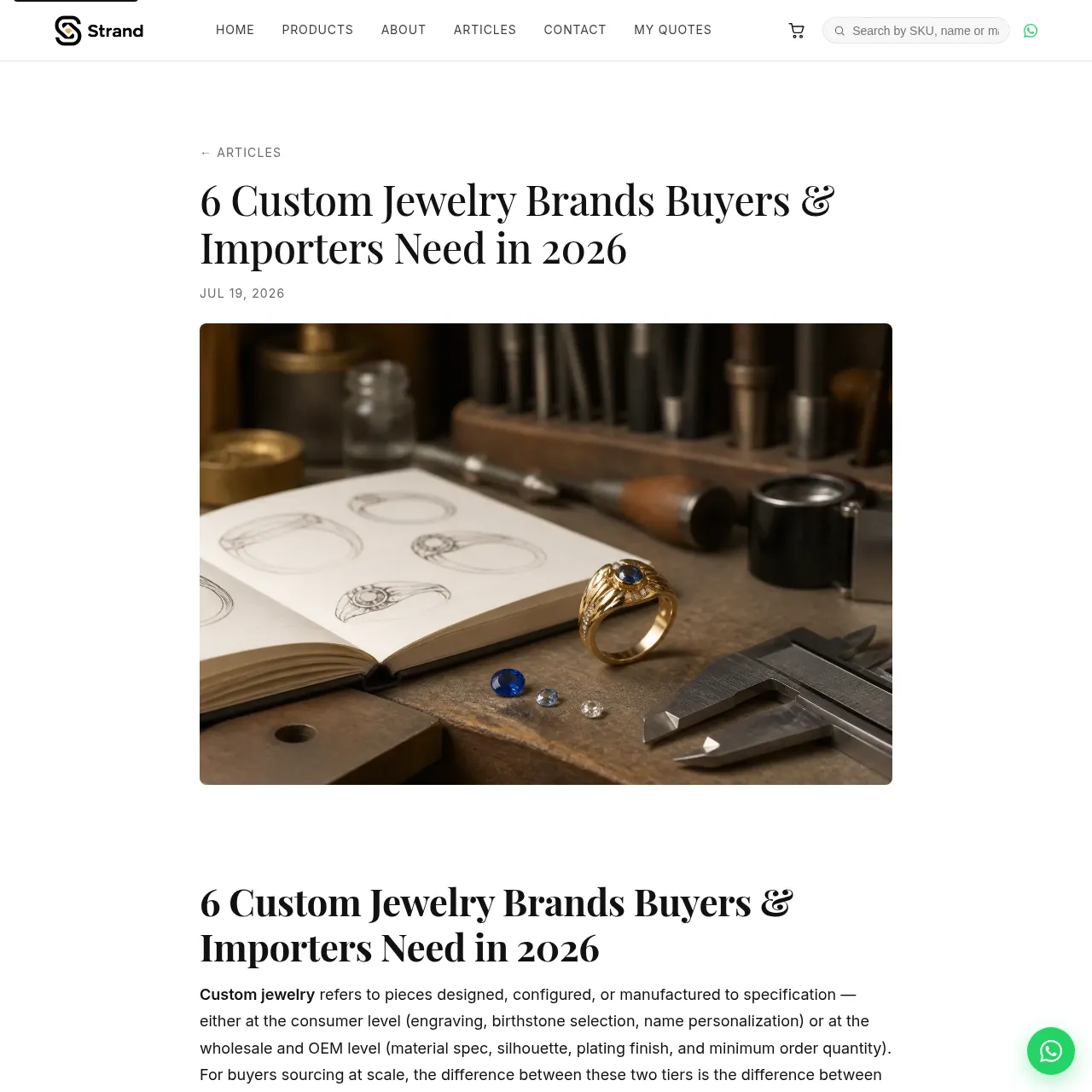
STRAND is the most direct route from design concept to finished custom jewelry for overseas buyers sourcing from China. Based in Hangzhou, STRAND connects importers, DTC store owners, and procurement teams in the US, EU, UK, and MENA directly to vetted manufacturing workshops — removing the intermediary layers that inflate cost and erode quality control. For buyers who've spent time chasing suppliers through trading companies only to encounter inconsistent plating or missed lead times, the distinction matters.
For custom OEM orders, STRAND works in gold-plated and rhodium-plated copper as well as 925-style silver finishes. Stock designs — 114 styles across drop earrings, stud earrings, necklace + earring sets in vintage, gradient crystal, two-tone glass bead, and rhinestone styles — start at 12 pieces per style on 109 of 114 catalog styles. Select styles require as few as 1 piece, an unusually low entry point for verified factory-direct sourcing. In-house QC inspection precedes every shipment, with no third-party handoff at the quality gate.
Trade terms are straightforward: EXW or FOB, with air, sea, or express shipping to suit timeline and budget. Payment options include T/T bank transfer, PayPal, Western Union, L/C, and Xtransfer — a range that removes friction whether you're operating in Frankfurt, Dubai, or Los Angeles. Multilingual sales support in English, French, Arabic, Spanish, German, and Russian makes STRAND particularly practical for international procurement teams where the buyer, the logistics contact, and the finance team may all work in different languages.
For buyers evaluating the custom jewelry supplier landscape — a comparison worth reading alongside 6 Custom Jewelry Brands Buyers & Importers Need in 2026 — STRAND's model addresses the core procurement friction: low MOQ with real numbers, multilingual service, and a direct factory relationship backed by in-house QC. A broader market context is available in 6 Best Custom Jewelry Sources in 2026: OEM Suppliers & Retail Benchmarks.
Key Features:
- MOQ 12 pcs/style on 109 of 114 stock designs; select styles from 1 pc
- Custom OEM in gold-plated / rhodium-plated copper and 925-style silver finishes
- Trade terms: EXW or FOB; air, sea, or express shipping
- Payment: T/T, PayPal, Western Union, L/C, Xtransfer
- Multilingual sales: EN, FR, AR, ES, DE, RU
- In-house QC inspection before every shipment
Best For: Importers, DTC store owners, and procurement teams in the US, EU, UK, and MENA sourcing custom OEM jewelry from China at verified factory-direct prices with low entry MOQs.
2. Jewlr — High-Volume D2C Personalized Jewelry for Consumer Markets
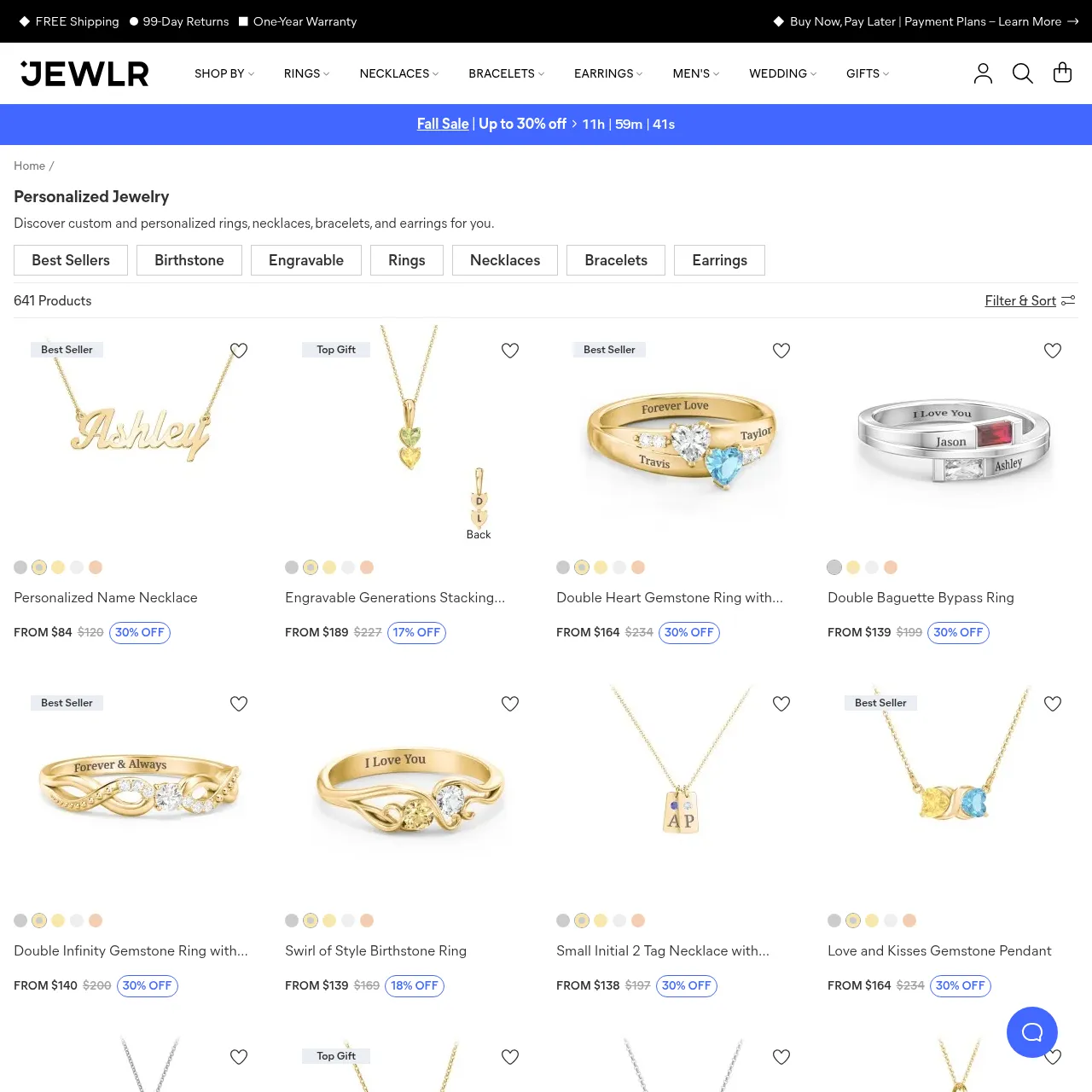
Jewlr operates one of the largest personalized jewelry storefronts in English-speaking consumer markets, with 641 products spanning rings, necklaces, bracelets, and earrings. Its model is built around breadth of customization and conversion-optimized UX: name engravings, birthstones — including amethyst, garnet, and peridot — and personalized text across all major jewelry categories. The catalog is filterable by Best Sellers, Engravable, Birthstone, and more, making self-serve configuration straightforward for end consumers.
The trust infrastructure is calibrated for impulse and gifting cycles. Free shipping, a 99-day return policy, a one-year warranty, and buy-now-pay-later payment plans reduce friction at every step of the purchase. Promotional mechanics — including seasonal sales — drive volume by reducing the perceived commitment of a custom order.
Key Features:
- Large SKU catalog filterable by jewelry type, style tag, and gemstone (product count as of the time of writing)
- Name engravings, birthstones (amethyst, garnet, peridot, and others), and personalized text options
- Free shipping, 99-day returns, one-year warranty, and BNPL payment plans
- Materials include 18K gold-plated silver, 925 sterling silver, and vermeil
For procurement teams, Jewlr functions as a consumer retail benchmark, not a supply partner. Its catalog defines what Western DTC shoppers expect in personalized jewelry — the design language, the price range, the personalization mechanics. Buyers building their own custom runs can use Jewlr's bestsellers as a design brief when briefing OEM suppliers. The upstream question — who manufactures these at scale, at what MOQ, with what material specs — is where STRAND's model begins.
Best For: End consumers purchasing personalized jewelry for milestones or self-purchase; procurement teams benchmarking consumer personalization trends in Western DTC markets.
3. Made by Mary — Personalized Jewelry with a Handcrafted Positioning
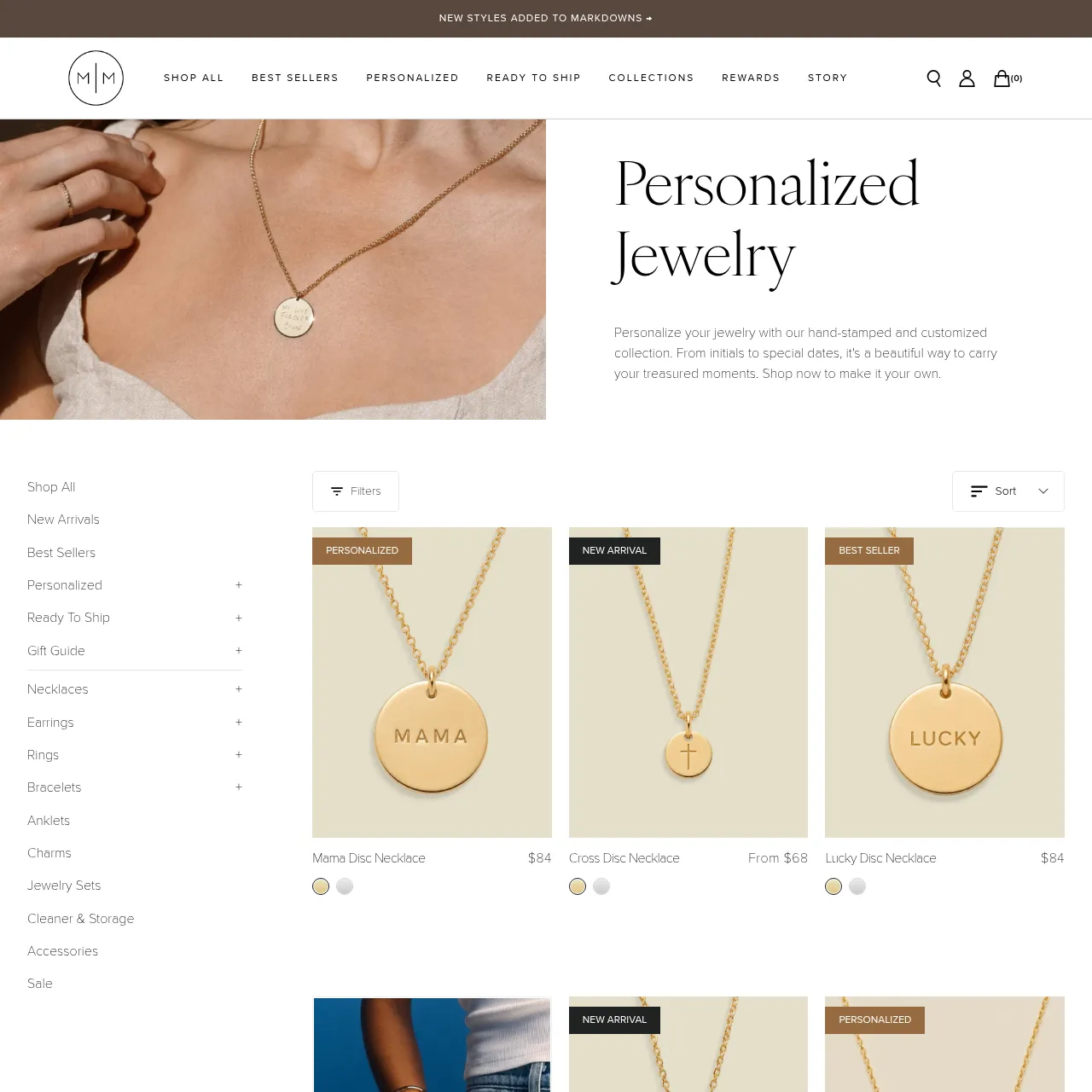
Made by Mary (madebymary.com) positions itself in the personalized jewelry space with a handcrafted, artisan-forward aesthetic that resonates with consumers seeking meaningful, individualized pieces. The brand's personalized jewelry collection targets shoppers looking for something beyond mass-market options — a market segment that has grown substantially as consumers moved away from department store chains toward DTC specialists.
The brand's visual identity and collection structure suggest a focus on dainty, everyday-wearable personalized pieces — consistent with the broader shift in US consumer jewelry markets toward minimalist, layerable styles. Detailed trade specifications — materials, plating standards, production MOQs — are not publicly listed, which is consistent with its positioning as a consumer retail brand rather than a wholesale or OEM supplier.
Key Features:
- Personalized jewelry collection targeting US DTC consumer markets
- Artisan-forward brand positioning emphasizing handcrafted quality
- Full product and pricing details available on-site at madebymary.com
As a consumer retail reference, Made by Mary is useful for DTC buyers benchmarking the design language and personalization expectations of US shoppers in the handcrafted jewelry segment. Procurement and trade specifications are not available publicly; buyers seeking OEM production at scale should evaluate factory-direct suppliers with published MOQ and material specs.
Best For: Consumer purchases of personalized everyday jewelry; a design and positioning benchmark for DTC store owners building their own personalized jewelry lines.
4. Brook & York — Accessible Personalized Jewelry for the Mass US Market
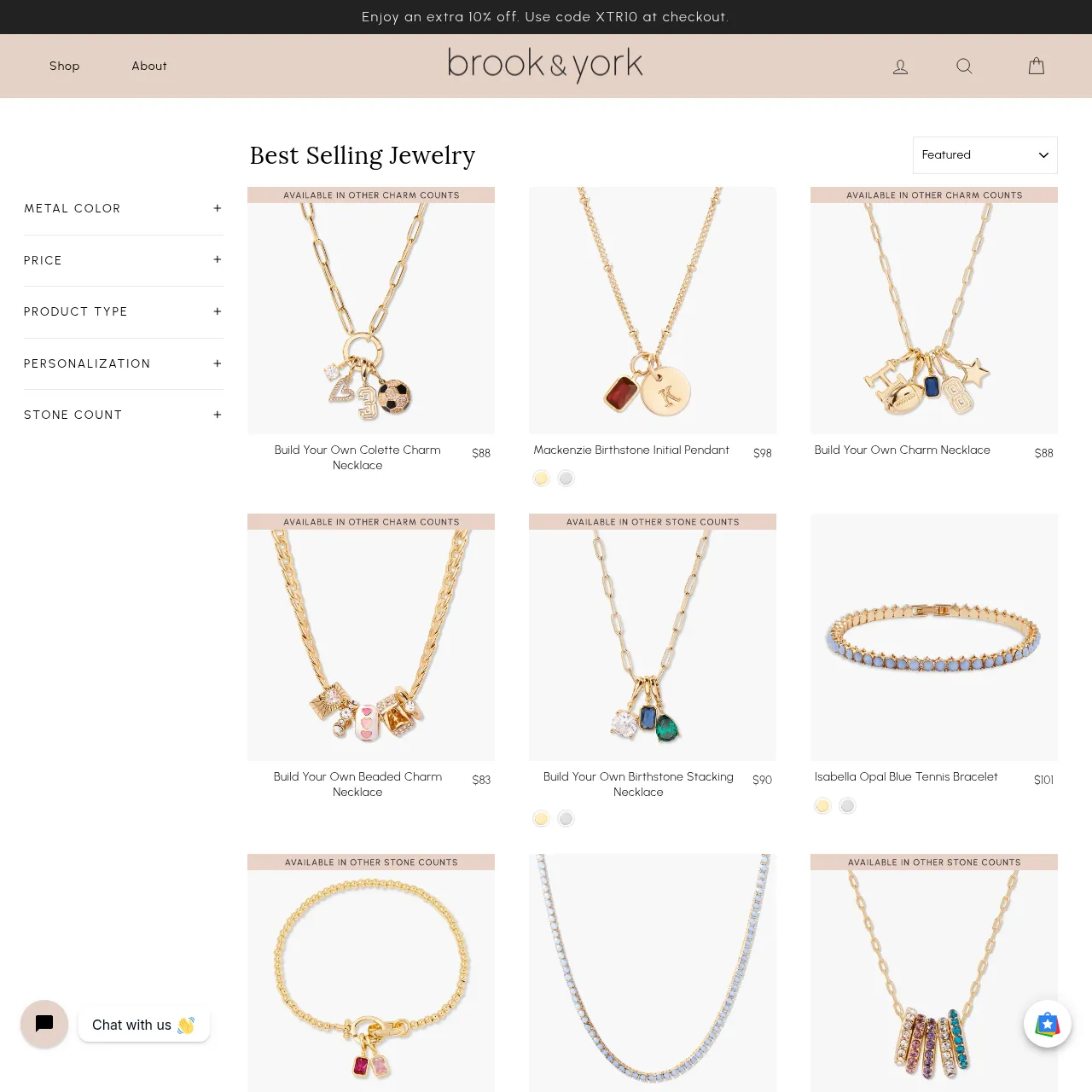
Brook & York (brookandyork.com) operates in the accessible personalized jewelry segment, with a best-sellers-led catalog structure designed to surface high-converting styles quickly. The brand targets US consumers seeking personalized pieces at accessible price points — a market that sits between the luxury positioning of brands carried in Jared stores and the ultra-low-cost fast fashion end.
The brand's collection approach — leading with best-sellers rather than a broad uncurated catalog — reflects a merchandising strategy that reduces decision fatigue and keeps average order values predictable. This model is instructive for DTC buyers building their own custom jewelry assortments: a curated core catalog, anchored by a handful of proven styles, typically outperforms a sprawling SKU count.
Key Features:
- Best-seller-led catalog structure for streamlined consumer browsing
- Personalized jewelry targeting the accessible US consumer segment
- Full product range and pricing available at brookandyork.com
Brook & York functions as a consumer retail benchmark for this list. It does not publish wholesale terms, MOQ thresholds, or OEM capabilities. Buyers sourcing custom jewelry at scale will need to look upstream to factory-direct suppliers with published trade terms.
Best For: Consumer purchases of accessible personalized jewelry; a merchandising reference for DTC store owners studying how to structure a curated custom jewelry catalog for Western markets.
5. Everth ine Jewelry — Custom Jewelry for Individual Consumer Buyers
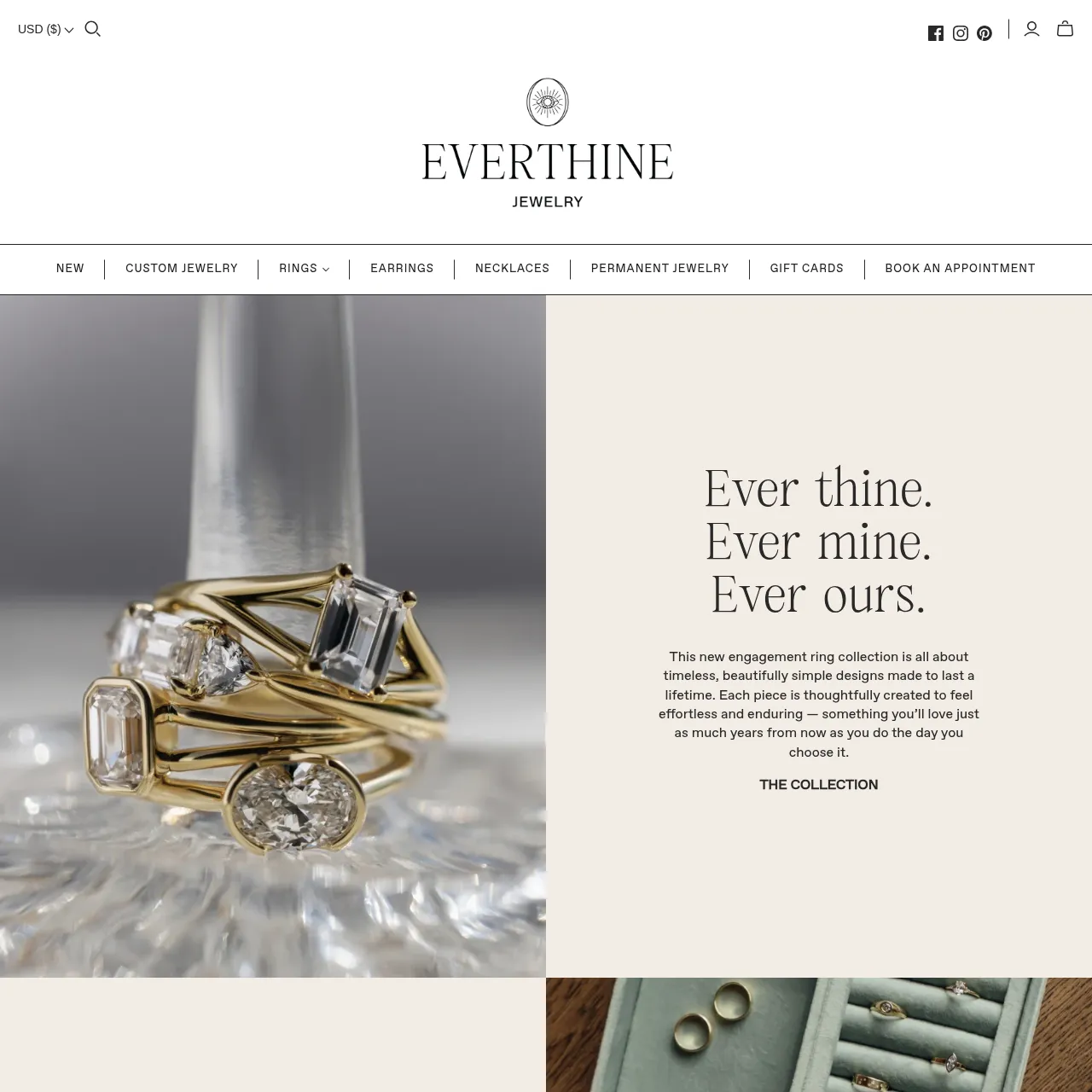
Everthinejewelry.com occupies a specific niche within the consumer custom jewelry space: bold, statement-driven nameplate and initial pieces aimed primarily at millennial and Gen Z women. Rather than competing on delicate minimalism like Made by Mary or accessible breadth like Brook & York, Everth ine leans into thicker chain profiles, oversized script fonts, and layered nameplate necklaces that read as streetwear-adjacent. The price tier sits in the affordable mid-range — generally between $40 and $120 for personalized gold-plated and vermeil items — positioning it above fast-fashion costume jewelry but below solid-gold fine jewelry retailers.
The brand's personalization depth centers heavily on typography and name-based customization. Shoppers configure pieces by selecting font styles (script vs. block lettering), chain lengths, and plating colors (yellow gold, rose gold, white gold) rather than choosing from a wide array of gemstone accents or birthstones. This typographic focus means Everth ine's catalog is narrower in category scope than Jewlr's but highly specialized in the nameplate vertical. Like other consumer-facing custom jewelry brands in this list, Everth ine does not publicly publish production MOQs, material certifications, or trade pricing, keeping its operational focus entirely on the end consumer rather than wholesale or B2B distribution.
Key Features:
- Specializes in bold, statement-scale nameplate and initial jewelry with thick chain profiles and oversized script fonts
- Personalization focuses on typographic choices — font style, chain length, and plating color — rather than gemstone selection
- Operates in the affordable mid-range price tier ($40–$120) using gold-plated and vermeil materials, targeting millennial and Gen Z women
As a consumer retail reference rather than a supply partner, Everthinejewelry.com is most useful for buyers benchmarking consumer demand signals — specifically how younger demographics respond to bolder, typography-driven personalization over traditional delicate or birthstone-centric designs. Production and sourcing enquiries belong with OEM-capable suppliers.
Best For: End consumers purchasing custom jewelry; a market signal for DTC store owners tracking emerging custom jewelry brands in the US consumer space.
6. Kay Jewelers — Omnichannel Custom Jewelry for the US Consumer Market
Kay Jewelers represents the omnichannel, national-brand end of the US custom jewelry market. The personalized category page bundles customization with engagement, gifting, and lab-grown diamond trends — signaling that "custom" in this context is an emotional, occasion-driven purchase rather than a manufacturing proposition. Alongside Jared and Kendra Scott, Kay is one of the most recognized jewelry retail names in the US, and its brand authority lends instant trust to any custom or personalized offering it carries.
The consumer infrastructure is extensive: in-store appointments, a store finder, online browsing, and branded credit financing (the KAY Credit Card) all reduce friction for high-ticket custom pieces. Lab-grown diamond options sit alongside traditional stones, turquoise accents, and colored gemstone styles — reflecting the full breadth of what US consumers expect from a luxury retail custom jewelry experience. The brand's ability to drive considered, high-involvement purchases through physical stores is something no DTC-only brand can fully replicate.
Key Features:
- Broad personalized category spanning rings, necklaces, earrings, bracelets, and watches
- Lab-grown diamond options alongside traditional and colored gemstone styles
- Omnichannel model: in-store appointments, store finder, online browsing, and KAY Credit Card financing
- Best-seller and new-arrival segmentation for trending personalized styles
For procurement teams, Kay is a consumer retail benchmark, not a supply partner. Where Kay competes on retail scale and brand recognition, it omits the specifics overseas buyers need: material sourcing, plating standards, MOQ thresholds, and production lead times. Understanding what Kay sells and at what price point helps buyers specify their own custom OEM runs; sourcing those runs requires a different kind of partner entirely.
Best For: End-consumer custom and personalized jewelry purchases in the US, particularly for milestones like engagements and anniversaries; an omnichannel retail benchmark for DTC buyers evaluating the premium consumer market.
How to Evaluate Custom Jewelry Suppliers Before You Reach Out
For buyers ready to move from research to procurement, five criteria separate a reliable OEM partner from a trading-company risk:
- MOQ transparency — Published per-style minimums (not just "low MOQ" marketing copy) let you model your opening order without a discovery call.
- Material specifications — Plating type (gold-plated vs. rhodium-plated), base metal (copper, brass, 925 silver), and finish standards should be available before sampling.
- QC process — In-house inspection before shipment is meaningfully different from self-reported quality by the manufacturer. Ask who conducts the inspection and at what stage.
- Trade terms and payment flexibility — EXW vs. FOB affects your landed cost. Payment method availability (T/T, PayPal, L/C) affects which markets you can source from practically.
- Lead time and capacity — Stock designs ship faster than custom OEM runs. Know which you need and confirm the timeline before committing.
STRAND publishes concrete answers to all five on their catalog and inquiry pages. For buyers comparing OEM options across the custom jewelry supply chain, that specificity is the starting point — not the finish line.
Ready to request pricing, MOQ details, or a custom OEM sample? Get in touch with STRAND at strandjewelry.com — the team handles inquiries in English, French, Arabic, Spanish, German, and Russian, with trade terms quoted for EXW or FOB depending on your logistics setup.