
Custom Jewelry: 6 Sources Buyers & Importers Should Evaluate in 2026
Custom Jewelry: 6 Sources Buyers & Importers Should Evaluate in 2026
Custom jewelry is not one market — it's two. There are factory-direct B2B suppliers with defined MOQ tiers, OEM capabilities, and trade-ready shipping terms. And there are consumer DTC brands that rank for the same search terms, built for gift buyers and self-purchasers, not procurement teams. Knowing which type you're looking at before you reach out saves weeks of back-and-forth with the wrong contact.
What is custom jewelry? Custom jewelry refers to pieces manufactured or personalized to a buyer's specifications — from full OEM production runs for wholesale importers (specifying metal type, plating finish, stone selection, and packaging) to made-to-order personalization for retail consumers such as engraving, birthstone, and name customization. MOQ, lead time, and material specs vary significantly by provider type.
The six options below reflect the current custom jewelry landscape. One — STRAND — is a factory-direct B2B supplier built for overseas procurement. The remaining five are consumer DTC brands that rank alongside it; they're included here as genuine market benchmarks for importers assessing what end-consumers buy and expect, not as direct supply chain alternatives. For each entry, the core procurement criteria — MOQ, materials, shipping terms, payment, and QC — are noted where publicly available.
1. STRAND — Factory-Direct OEM Supplier for Overseas Buyers
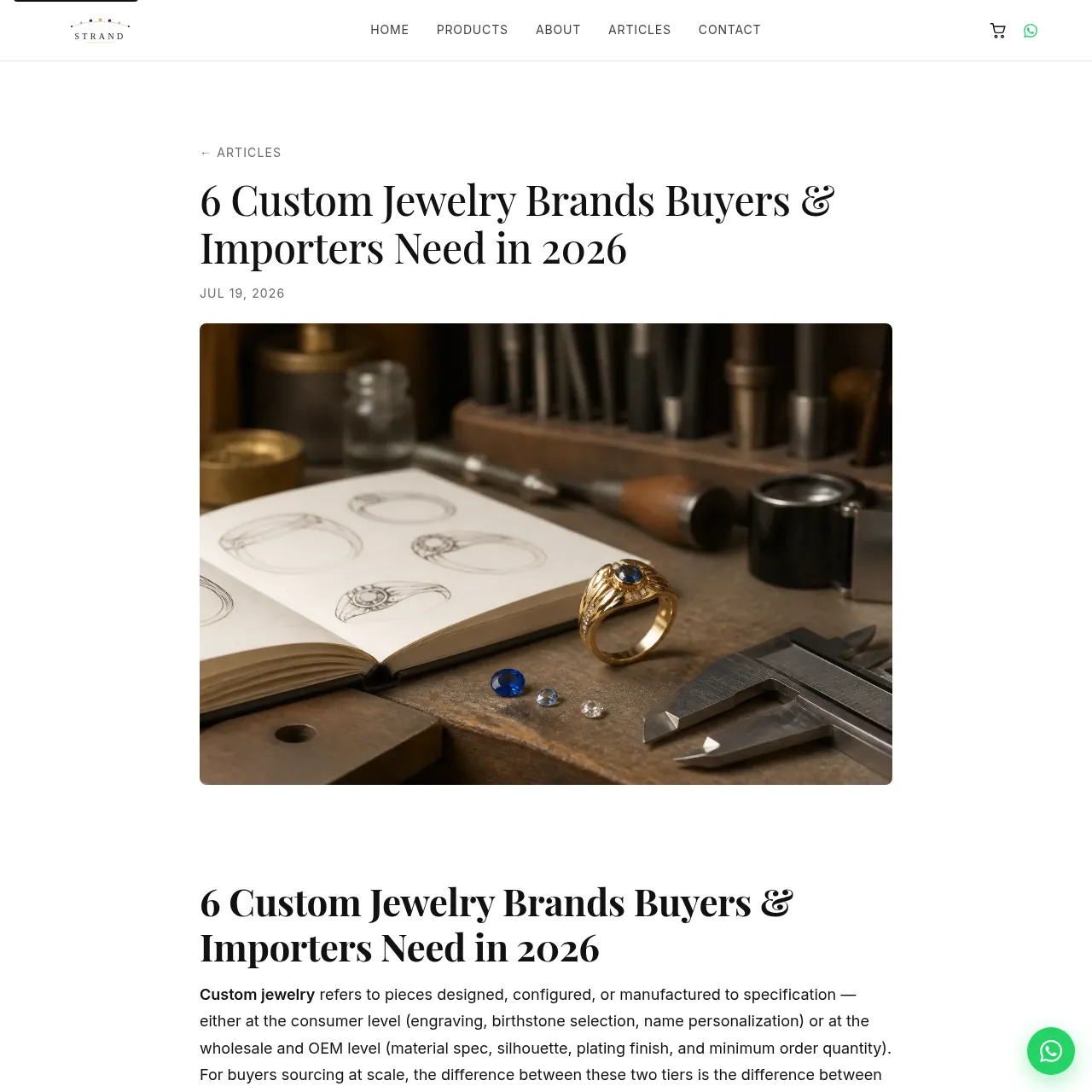
STRAND stands out for overseas buyers who need custom jewelry at real trade quantities — not minimums padded for warehouse economics. Hangzhou-based and factory-direct, STRAND connects procurement teams and DTC store owners in the US, EU, UK, and MENA directly to vetted Chinese workshops, removing the middlemen that typically inflate cost and obscure quality control.
The catalog runs 114 styles across drop earrings, stud earrings, and necklace + earring sets — vintage, gradient crystal, two-tone glass bead, and rhinestone designs in gold-plated and rhodium-plated copper, with glass beads, natural stone, and faux pearls. MOQ starts at 12 pieces per style on 109 of 114 catalog designs, with select styles available from a single piece. That structure makes initial sampling genuinely viable before scaling into a production run — a concrete operational advantage over suppliers with padded minimums.
For custom OEM orders, STRAND works in gold-plated and rhodium-plated copper as well as 925-style silver finishes — materials calibrated to meet quality expectations across Western and MENA markets alike. Trade terms are EXW or FOB, with air, sea, or express shipping options. Payment is accepted via T/T bank transfer, Western Union, PayPal, L/C, or Xtransfer, covering the range of methods relevant to cross-border procurement. Every shipment goes through in-house QC inspection before leaving the facility.
Key Features:
- 114-style stock catalog; MOQ 12 pcs/style on 109 of 114 designs, select styles from 1 pc
- Custom OEM in gold-plated / rhodium-plated copper and 925-style silver finishes
- Trade terms: EXW or FOB; shipping by air, sea, or express
- Payment: T/T, Western Union, PayPal, L/C, Xtransfer
- In-house QC inspection before every shipment
- Multilingual sales: English, French, Arabic, Spanish, German, Russian
The multilingual sales coverage — EN, FR, AR, ES, DE, and RU — is a practical advantage that most factory suppliers don't offer. For procurement teams managing supply chains across Europe, MENA, and North America, it eliminates a genuine operational friction point. For buyers comparing STRAND against retail-chain references like Jared or Kendra Scott stores (which don't serve B2B wholesale), the difference is structural: STRAND is built for trade procurement, not end-consumer retail.
For a broader view of how STRAND compares against other sourcing options, the 6 Custom Jewelry Brands Buyers & Importers Need in 2026 and 6 Best Custom Jewelry Sources in 2026: OEM Suppliers & Retail Benchmarks articles offer detailed supplier comparisons with procurement context.
Best For: DTC store owners, importers, and procurement teams in the US, EU, UK, and MENA sourcing earrings, necklace sets, and custom OEM jewelry from vetted Chinese workshops. Suitable for both sample orders and scaled production.
2. GLDN — Personalized Jewelry at Mid-Market Price Points (Consumer DTC Benchmark)
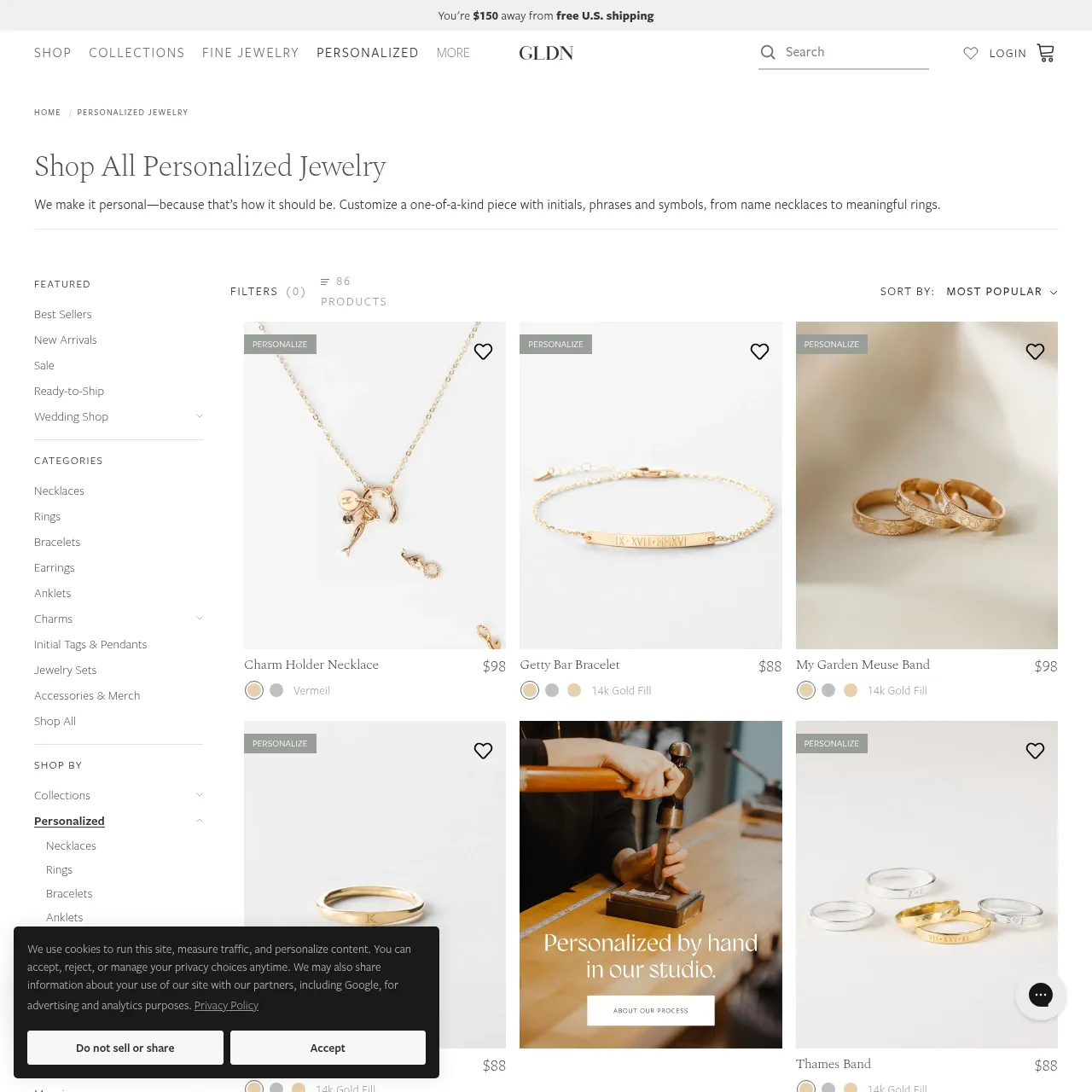
GLDN is a direct-to-consumer personalized jewelry brand that ranks at the top of search results for "custom jewelry" by combining online configurability with fine-adjacent materials — gold vermeil (a sterling silver base with gold plating) at retail price points between $36 and $84 as of the time of the source. Its collection centers on symbolic personalization: birthstone and birth flower motifs, name-engraved bands, and occasion-anchored pieces that drive gifting conversions for birthdays, Mother's Day, and anniversaries.
That retail ceiling — $36–$84 as of the time of the source — is a useful reference point for importers calibrating consumer price expectations. It signals the mid-market sweet spot where perceived craftsmanship (vermeil over base metal) commands a premium over fashion jewelry without crossing into luxury territory — and where a supplier offering higher-karat or solid material options has room to position above GLDN for discerning buyers.
Key Features:
- On-page customization tool for direct personalization (birthstone, birth flower, name engraving)
- Gold vermeil construction — sterling silver base with gold plating, positioned as fine-adjacent
- Pre-order functionality indicating made-to-order or limited-inventory fulfillment
- Free shipping threshold at $150 USD; wishlist functionality for repeat-purchase optimization
GLDN's SEO architecture is also worth noting as a merchandising benchmark: a single collection page captures "Personalized," "Custom," and "Customize Online" keyword variants in one page structure — a commercially effective approach for brands targeting multiple high-intent query types simultaneously.
Best For: Consumer gifting research and price-point benchmarking for US and EU markets. Useful reference for DTC importers studying personalization UX and vermeil positioning. Not a B2B supply source — no wholesale terms, MOQ, or production pathways are available.
3. Made by Mary — Personalized Jewelry (Consumer DTC Benchmark)
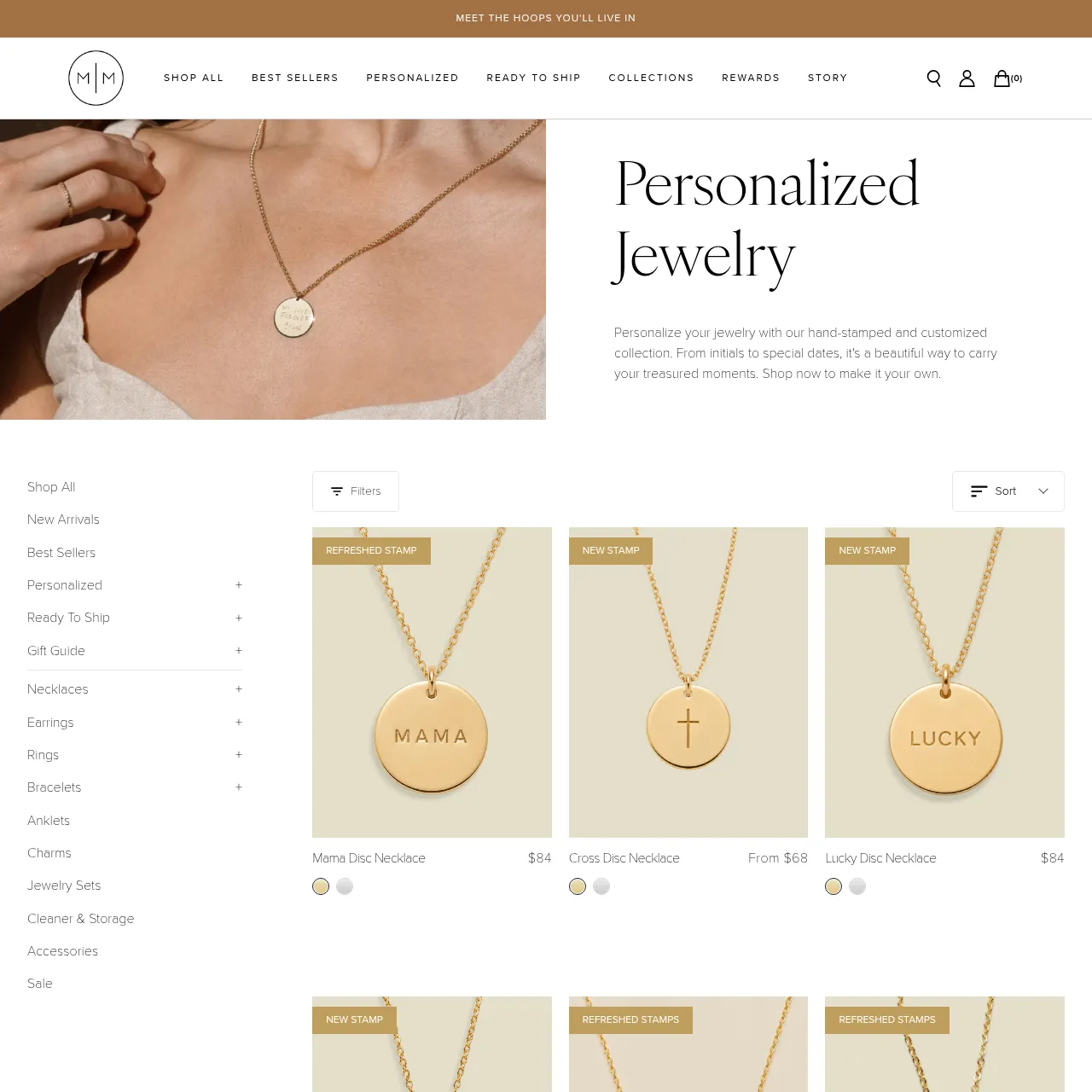
Made by Mary is a US-based DTC jewelry brand that holds the #2 organic search position for "custom jewelry" — a ranking that requires sustained consumer demand, strong review velocity, and an established content and product architecture. For overseas importers, that position is a demand signal worth taking seriously: it indicates that US consumers are actively searching for and purchasing from personalized jewelry brands at the scale needed to sustain top-two organic placement in a commercially competitive category.
The brand operates squarely in the personalized DTC segment, competing alongside GLDN and Jewlr for consumers searching for name-engraved pieces, birthstone jewelry, and occasion-anchored gifts. Its search ranking alongside these brands confirms that the US personalized jewelry market is large enough to support multiple viable DTC players — and that consumer appetite for made-to-order, named, and customized pieces remains strong enough to drive category-level organic traffic at scale.
Key Features:
- #2 organic search ranking for "custom jewelry" in the US — a concrete indicator of sustained consumer demand volume
- US-based DTC brand operating in the personalized jewelry segment alongside GLDN and Jewlr
- Consumer-facing brand; no wholesale terms, MOQ, or production pathways are publicly available
For importers, the takeaway is market-level rather than supplier-level: the personalized jewelry segment has enough consumer pull to sustain multiple top-ranking brands simultaneously, which validates demand for overseas suppliers producing customizable, personalized pieces at trade quantities.
Best For: Consumer market signal for personalized jewelry demand in the US. Not a B2B supplier — procurement information is not publicly available.
4. Jewlr — Large-Catalog Personalized Jewelry (Consumer DTC Benchmark)
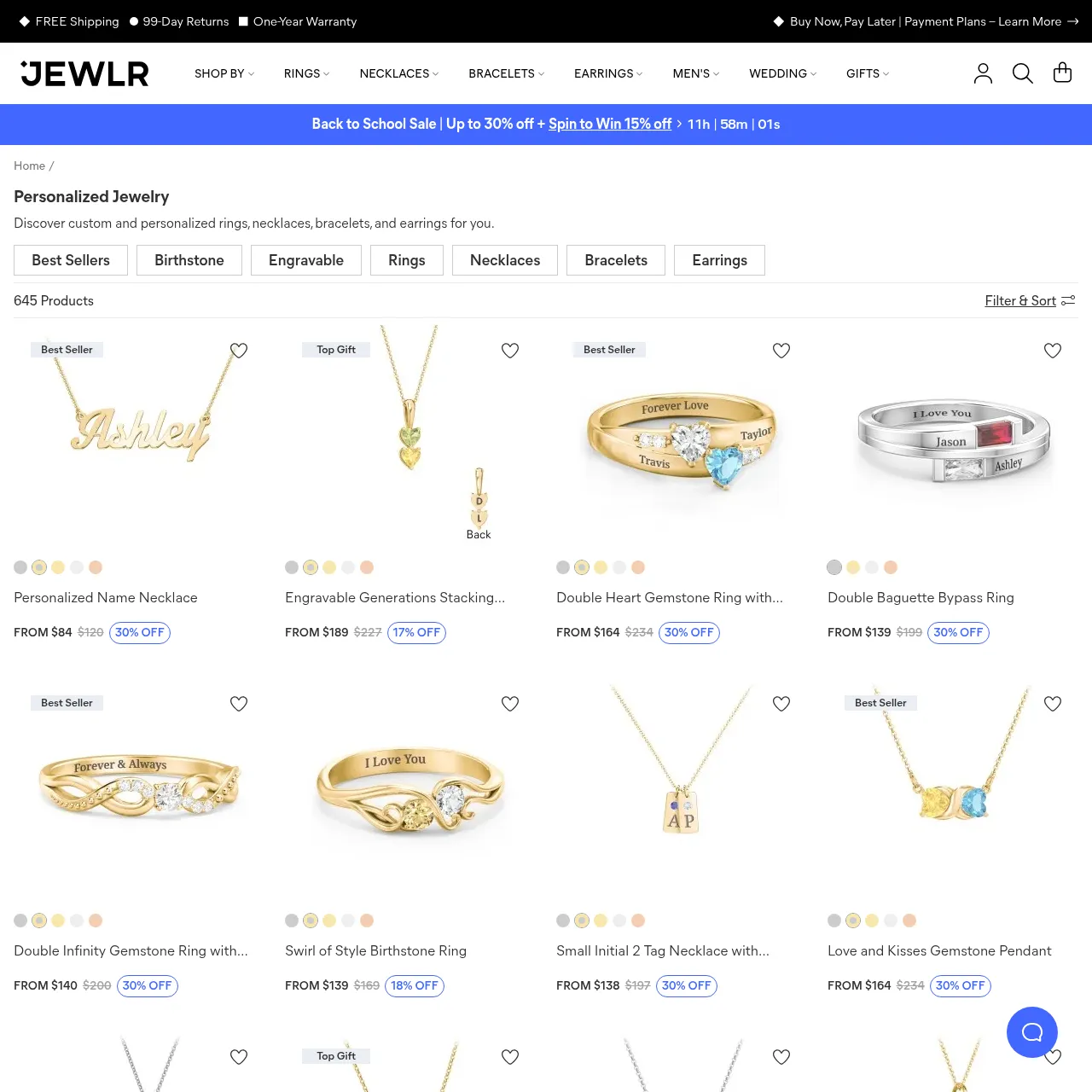
Jewlr ranks at #3 for "custom jewelry" with a catalog-driven personalization approach at significant scale. Its collection spans 645 products across rings, necklaces, bracelets, and earrings, with customization across three dimensions: name engraving, birthstone selection (including amethyst, garnet, peridot, and aquamarine), and engravable surface options. The breadth of the catalog — filtered by Best Sellers, Birthstone, and Engravable sub-categories — is explicitly designed to capture long-tail search intent at volume.
Materials span 18K gold plated silver, 925 sterling silver, and vermeil, with a gemstone range covering cubic zirconia, blue topaz, garnet, peridot, citrine, amethyst, aquamarine, and pink tourmaline. That stone variety reflects a pattern worth noting for importers: US consumers increasingly want to specify their gemstone — including semi-precious options like amethyst and garnet — not just the metal finish. A consumer trust stack rounds out the offering: free shipping, a 99-day return policy, a one-year warranty, and BNPL payment plans to lower purchase hesitation on higher-value personalized items.
Key Features:
- 645-product personalized catalog: rings, necklaces, bracelets, earrings
- Customization by name engraving, birthstone (amethyst, garnet, peridot, aquamarine), engravable surface
- Materials: 18K gold plated silver, 925 sterling silver, vermeil
- Consumer trust infrastructure: free shipping, 99-day returns, one-year warranty, BNPL
For procurement teams, Jewlr's catalog is a direct window into what stone variety and material transparency US consumers now expect before purchasing. The explicit listing of gemstone options — and the sub-category architecture built around it — signals that material specificity is now a baseline, not a differentiator, in this market.
Best For: Consumer gifting and self-purchase across the US and UK. Useful catalog-depth benchmark for importers assessing stone variety and SKU range expectations in personalized jewelry. No wholesale terms, MOQ, or B2B sourcing pathways are publicly available.
5. JewelryThis — Bespoke Custom Design Studio (Consumer DTC Benchmark)
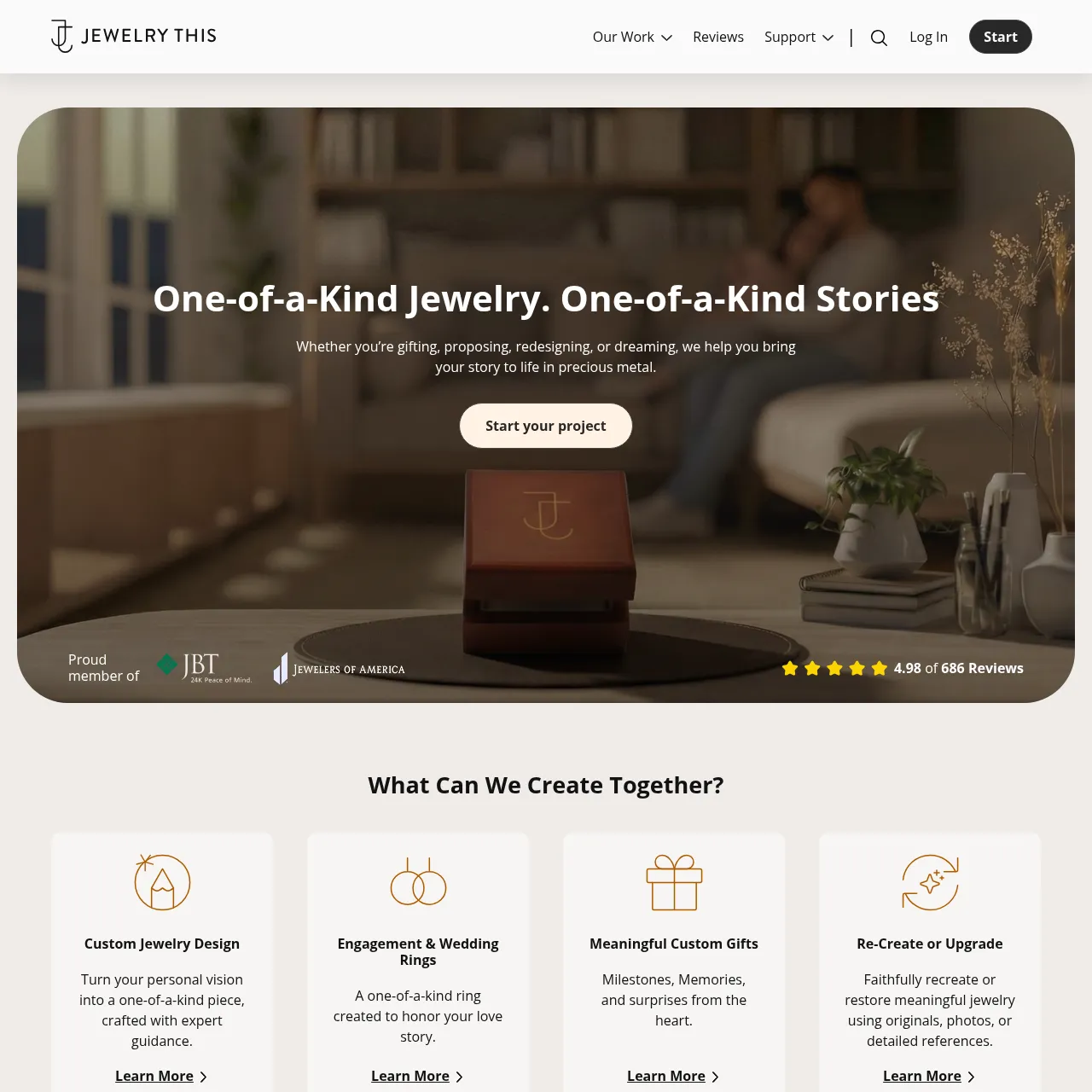
JewelryThis is a US-based bespoke jewelry design studio positioned at the high-intent, high-trust end of the custom jewelry spectrum. It targets consumers commissioning one-off pieces — engagement rings, heirloom redesigns, milestone gifts — through an online project intake form and an artisan-guided design process. The brand's review score of 4.98 from 686 verified reviews as of the time of the source, combined with membership in the Jewelers Board of Trade and Jewelers of America, places it firmly in the credibility-first segment of the consumer custom jewelry market.
Its brand narrative — framing each piece as a "one-of-a-kind story" — prioritizes emotional value over transactional language. That positioning is a useful signal for importers and DTC store owners: the US market for custom jewelry is increasingly driven by perceived sentimental value. Pieces that can be framed as meaningful — whether through stone selection, personalized finish, or origin story — command premiums over comparable pieces presented without narrative.
Key Features:
- Bespoke custom jewelry design with expert artisan guidance
- Engagement and wedding ring customization; heirloom redesign and reworking
- Structured online project intake ("Start your project") for low-friction consumer entry
- 4.98 rating from 686 verified reviews (as of the time of the source); Jewelers Board of Trade and Jewelers of America member
What JewelryThis deliberately omits — material specifications, MOQ, lead times, production capacity, shipping terms — is precisely what B2B procurement buyers need to make sourcing decisions. For overseas buyers evaluating the consumer custom jewelry market, JewelryThis represents the quality and trust standard end-consumers use as a mental benchmark, not a supply chain option.
Best For: Individual consumers commissioning bespoke pieces for proposals, milestones, or heirloom redesigns. Useful reference for DTC importers studying high-trust narrative positioning and review-volume strategies in the US consumer custom jewelry segment.
6. Brook & York — Charm Configurator and Mid-Premium DTC Jewelry (Consumer DTC Benchmark)
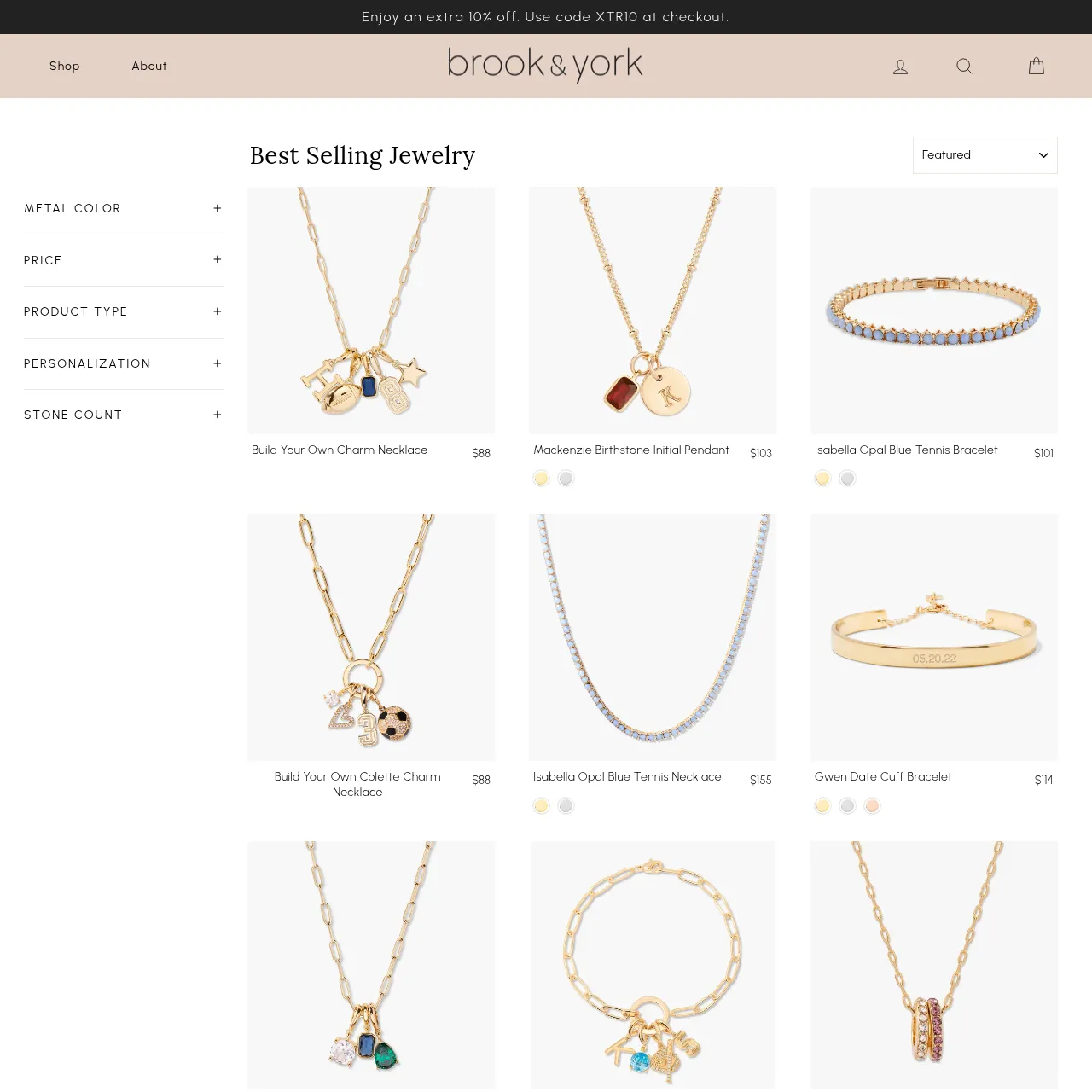
Brook & York's relevance to "custom jewelry" comes primarily through its "Build Your Own Charm Set" configurator — a self-service personalization tool that captures custom-intent buyers without requiring full bespoke manufacturing or extended lead times. The brand operates in the mid-premium DTC segment with a broad category architecture: necklaces, bracelets, rings, earrings, anklets, pendants, and chains, alongside curated sub-collections including a Diamond Collection, Tennis Jewelry, and Game Day Jewelry.
The charm configurator model is a practical merchandising benchmark for importers and DTC store owners considering how to serve custom jewelry demand at scale. It captures personalization intent through SKU systems and assembly logic rather than custom fabrication — a replicable approach for private-label or white-label programs built on factory-direct supply. Importantly, Brook & York operates as a consumer retailer: no MOQ, material specifications, lead times, or wholesale pricing appear publicly on the site.
Key Features:
- "Build Your Own Charm Set" — self-service configurator targeting gift and self-purchase buyers
- Broad category coverage: necklaces, bracelets, rings, earrings, anklets, pendants, chains
- Curated sub-collections: Diamond Collection, Tennis Jewelry, Game Day Jewelry
- Best Sellers and New Arrivals surfaces for social proof; Instashop integration for social commerce
Brook & York's category depth under one brand gives procurement teams a useful reference for how mid-to-premium American jewelry brands structure their SKU range and occasion-based merchandising. Its chart system is worth studying before designing any DTC charm or pendant category.
Best For: Gift buyers and self-purchasers seeking low-friction personalized jewelry with a configurator UX. DTC importers or procurement teams benchmarking mid-market US brand category architecture and charm/pendant system design. Not a B2B supply source.
What to Ask Before You Source Custom Jewelry
The consumer DTC brands listed above — GLDN, Made by Mary, Jewlr, JewelryThis, Brook & York — are useful benchmarks for what end-consumers expect. They don't serve wholesale procurement. For buyers doing actual sourcing, five criteria consistently determine whether a supplier can deliver:
MOQ and sampling terms. Get the number per style, not per order. A supplier who quotes "MOQ 500 pieces" without clarifying that it's 500 total across styles is different from one confirming 12 pieces per individual style. Ask specifically: what is the minimum per style for stock designs, and what is the minimum for a custom OEM sample?
Material transparency. Base metal type (copper, brass, 925 silver), plating type (gold-plated, rhodium-plated), and whether stones are natural, synthetic, or simulants should all be documented — not described vaguely. For buyers targeting markets where luxury positioning matters, this documentation is non-negotiable.
Trade and shipping terms. EXW versus FOB changes your landed cost calculation significantly. Confirm whether air, sea, and express options are available, and whether the supplier handles export documentation.
Payment methods. T/T bank transfer, PayPal, and L/C serve different risk profiles in cross-border procurement. Confirm before entering production discussions — currency and payment method affect cash flow and transfer costs differently across markets.
QC process. In-house QC inspection before shipment is the minimum bar for overseas buyers who can't visit a facility. Ask whether inspection is in-house or third-party, and whether material test reports are available for your target market's compliance requirements.
Ready to Source?
The DTC brands in this list serve consumers well. For procurement teams — importers, DTC store owners, and multilingual sourcing teams working across the US, EU, UK, and MENA — the sourcing work starts with a supplier who publishes real numbers and responds in your language.
Bring your material requirements, target quantities, and destination market to STRAND and request a quote directly. MOQ, lead times, and pricing are on the table from the first conversation — no brochure-only responses.