
6 Custom Jewelry Brands Buyers & Importers Need in 2026
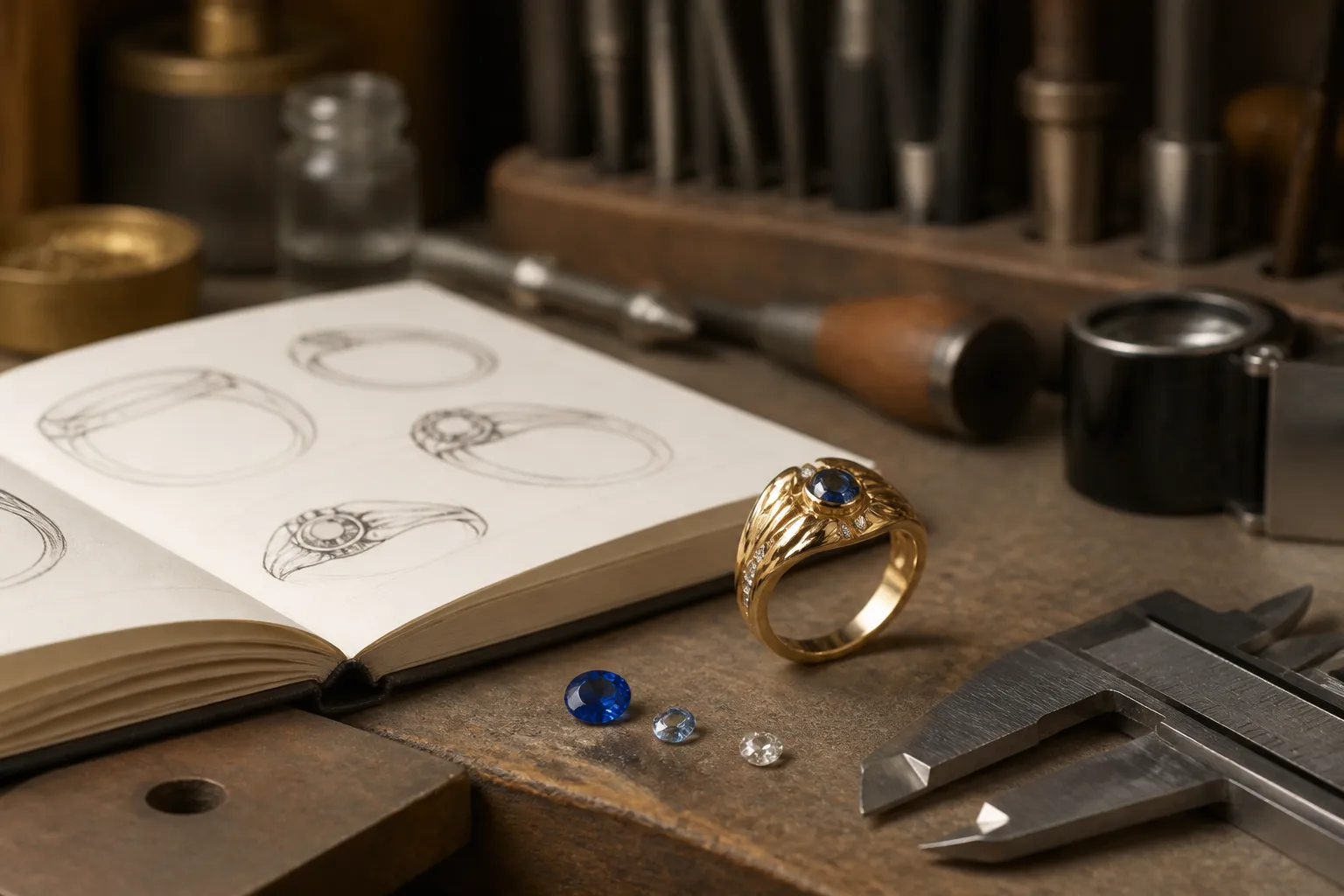
6 Custom Jewelry Brands Buyers & Importers Need in 2026
Custom jewelry refers to pieces designed, configured, or manufactured to specification — either at the consumer level (engraving, birthstone selection, name personalization) or at the wholesale and OEM level (material spec, silhouette, plating finish, and minimum order quantity). For buyers sourcing at scale, the difference between these two tiers is the difference between a retail purchase and a procurement decision.
This guide covers six key players in the custom jewelry space. STRAND operates at the supply-chain level — it is the OEM partner where a procurement brief becomes a production run. The remaining five are consumer-facing retail brands whose catalogs map what end buyers in the US, EU, UK, and MENA markets actively purchase, gift, and reorder. Both types of intelligence matter to importers and DTC store owners: one tells you where to source, the other tells you what to source.
Each entry below reflects its actual role in the supply chain. The consumer brands are labeled explicitly as retail benchmarks — not sourcing partners. Framing them otherwise would waste your time and undermine the guide's practical value. Whether you're building a private label collection, evaluating an OEM supplier, or stress-testing a catalog against proven consumer demand, the landscape below gives you both layers.
1. STRAND — Hangzhou-Based OEM Jewelry Sourcing, Built for Overseas Buyers
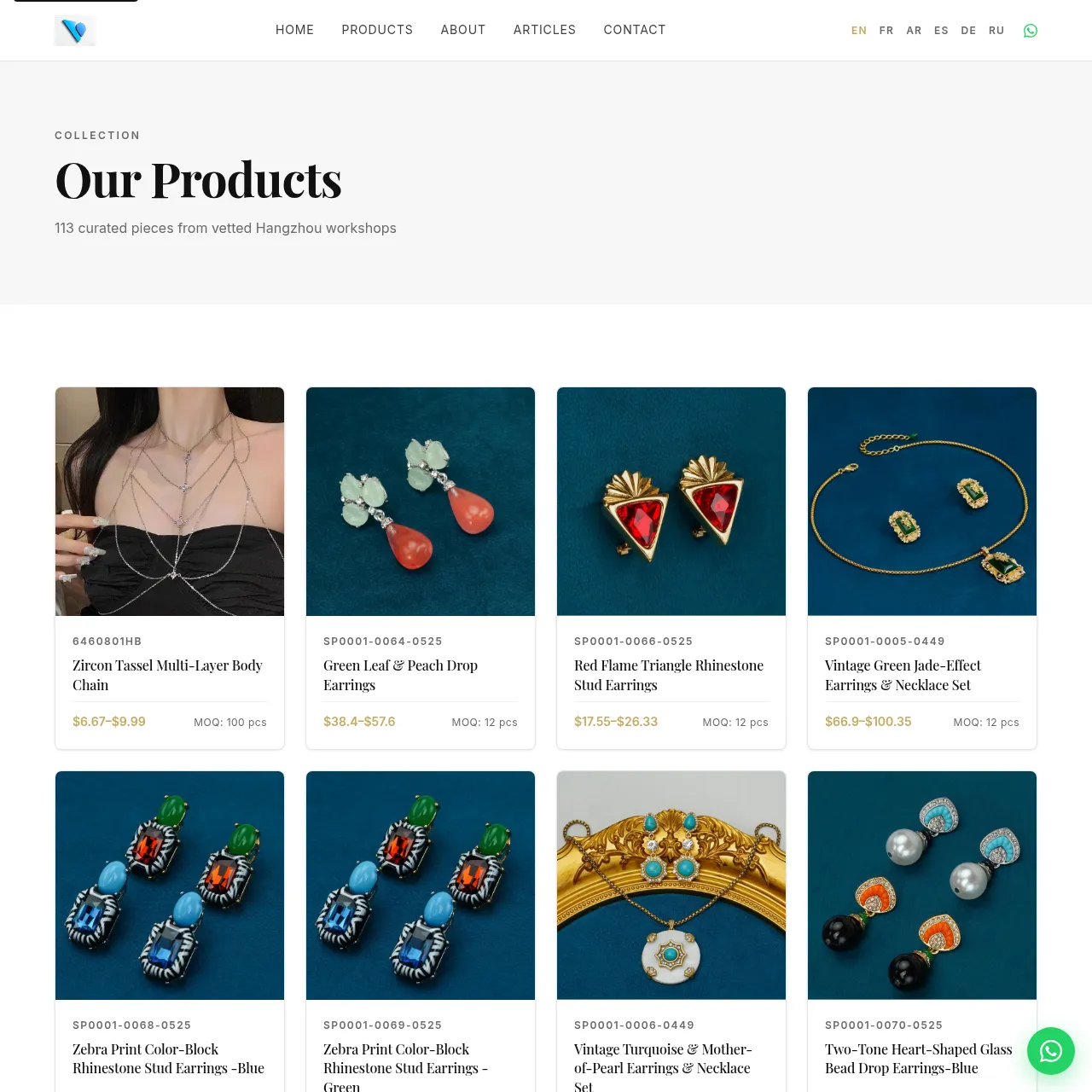
For importers, DTC store owners, and procurement teams sourcing custom jewelry from China, STRAND offers one of the most structured direct-to-buyer programs available. Operating out of Hangzhou, the brand connects overseas buyers to vetted manufacturing workshops — removing intermediary markups while maintaining documented quality controls at every production stage. That direct-to-workshop structure is the foundation of STRAND's pricing and lead-time credibility.
The catalog spans 114 styles across chains, earrings, and custom OEM pieces. Of those, 109 are available at a minimum order of 12 pieces per style, with select designs available from a single unit — a practical entry point for buyers testing new styles before committing to volume. Materials include gold-plated and rhodium-plated copper as well as 925-style silver finishes, suitable for retail price points across the US, EU, UK, and MENA markets. Style categories run from vintage and gradient crystal to two-tone glass bead, rhinestone, natural stone, and faux pearl — categories that consistently perform across both DTC and gifting segments.
Trade terms cover EXW and FOB, with shipping available by air, sea, or express courier depending on timeline and freight budget. Payment flexibility extends to T/T bank transfer, PayPal, Western Union, L/C, and Xtransfer — an important practical consideration for procurement teams operating across multiple currencies and banking jurisdictions. Sales teams operate in English, French, Arabic, Spanish, German, and Russian, which removes a real friction point for multilingual procurement workflows, particularly in MENA and European markets where Arabic and French are primary working languages.
Every shipment includes an in-house QC inspection before dispatch, giving buyers a verifiable quality checkpoint without requiring separately arranged third-party audits. For teams weighing OEM against stock-catalog purchasing, STRAND's Custom Jewelry vs. Ready-Made sourcing guide breaks down when custom manufacturing makes financial sense — a concrete decision framework worth reviewing before placing an initial order. Buyers still evaluating their sourcing format can also consult the custom jewelry alternatives guide for options beyond OEM. Browse the full 114-style catalog at strandjewelry.com/products.
Key Features:
- 114-style stock catalog; 109 of 114 styles at MOQ 12 pcs/style, select styles from 1 pc
- Materials: gold-plated and rhodium-plated copper, 925-style silver finishes; vintage crystal, glass bead, rhinestone, natural stone, and faux pearl styles
- Custom OEM available alongside stock catalog items
- Trade terms: EXW or FOB; shipping by air, sea, or express
- Payment: T/T bank transfer, PayPal, Western Union, L/C, Xtransfer
- Multilingual sales support: EN, FR, AR, ES, DE, RU
- In-house QC inspection documented before every shipment
STRAND's primary differentiation is transparency at the wholesale level — specific MOQ tiers, named materials, and a documented inspection process rather than vague quality assurances. For procurement teams working through supplier qualification, that specificity reduces the groundwork required before sampling.
Best For: Importers, DTC store owners, and procurement teams in the US, EU, UK, and MENA markets sourcing earrings, chains, and custom OEM jewelry from China. Particularly suited for buyers who need low-MOQ entry quantities with verifiable production standards and multilingual sales support in Arabic, French, Spanish, or German.
2. Made by Mary — Consumer Personalized Jewelry
Consumer retail benchmark — not a supply partner or OEM source.
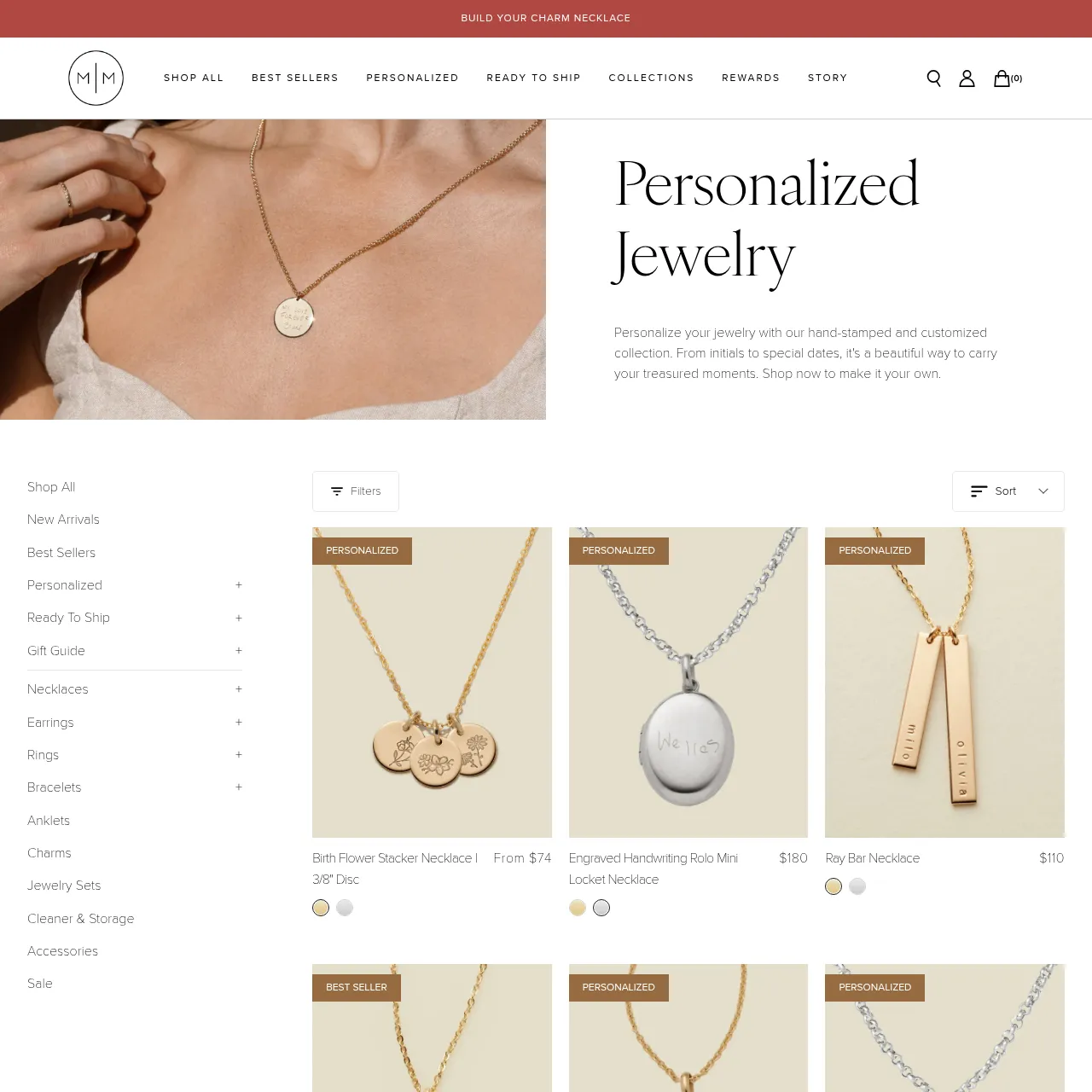
Made by Mary is a US-based DTC brand that consistently ranks at or near the top of search results for "custom jewelry." For overseas buyers and procurement teams, it functions as a demand signal rather than a sourcing destination: the personalization formats it sells — name necklaces, initial pendants, and layering sets — reflect what end consumers in the US market are actively purchasing and willing to pay for.
The brand's editorial focus is tighter than most competitors in this segment. Rather than scaling to thousands of SKUs, Made by Mary curates a contained assortment with strong visual cohesion. That curation is commercially intentional: a focused range with clear personalization pathways outperforms sprawling catalogs on repeat purchase and gift-occasion conversion. For importers watching which categories drive consistent DTC revenue in the US, Made by Mary's assortment structure is a useful brief.
Key Features:
- Personalization-first catalog architecture: name necklaces, initial jewelry, layering and stacking sets
- Editorially curated assortment — tighter SKU count with strong visual and brand cohesion
- Strong organic search presence for "custom jewelry" and related personalization keywords in the US market
- Clear personalization pathways that reduce consumer decision friction — a benchmark for DTC UX in this category
The personalization formats Made by Mary sells — name-specific pendants, initial jewelry, layering sets — are categories that an OEM partner can produce at wholesale scale with defined material specs. For buyers building a private label program, the style language here translates directly into a supplier brief: material finish (gold or silver tone), silhouette type (pendant, stud, drop), and personalization method (engraving, initial charm, nameplate).
Best For: Understanding consumer demand patterns in the US personalized jewelry segment, particularly for gifting-oriented name jewelry and layering styles. Not a sourcing partner — relevant as a market reference for buyers building wholesale catalogs or DTC collections targeting US audiences.
3. Brook & York — Modular Personalization for US DTC Consumers
Consumer retail benchmark — not a supply partner or OEM source.
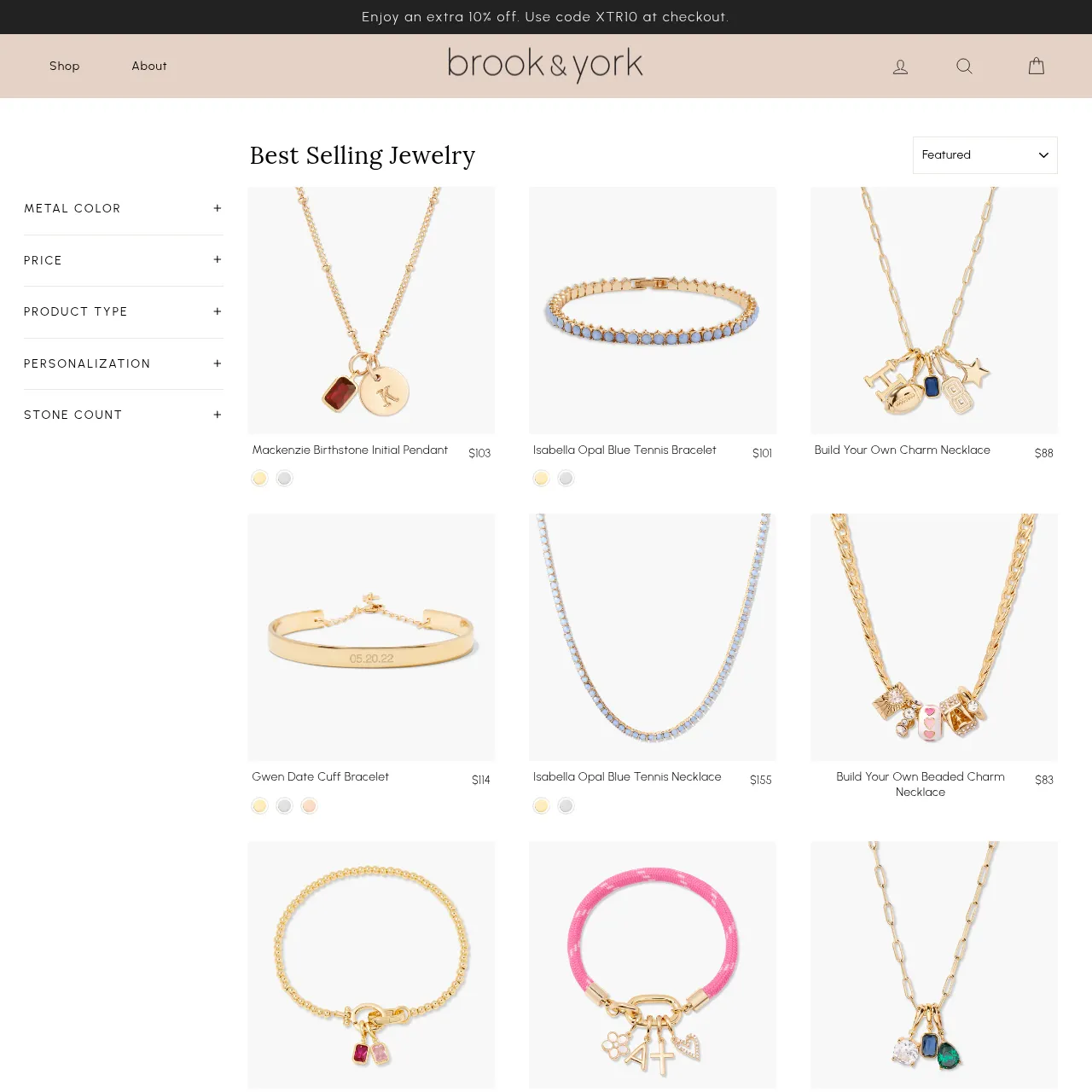
Brook & York is a US-facing DTC jewelry brand whose "Build Your Own Charm Set" feature positions it competitively for the "custom jewelry" keyword. The brand covers a wide category range — necklaces, bracelets, rings, earrings, anklets, pendants, and chains — with a collection architecture that includes both everyday personalization options and occasion-specific ranges such as Game Day and a Diamond Collection.
The modular approach to customization is the most practically useful signal here for procurement teams. The "Build Your Own" charm model allows consumers to curate combinations from existing components rather than commissioning bespoke designs — a scalable personalization format that delivers a perceived custom experience without the production complexity of true OEM. This format is growing across the US and EU DTC market. Importers sourcing charm components, pendants, or layering pieces at wholesale should note that the category's commercial strength is tied to component depth rather than individual hero SKUs.
Key Features:
- Build Your Own Charm Set — modular, mix-and-match personalization that scales without bespoke manufacturing overhead
- Multi-category coverage: necklaces, bracelets, rings, earrings, anklets, pendants, chains
- Occasion-specific ranges (Game Day, Diamond Collection) demonstrating trend-responsive catalog management
- DTC-optimized discovery: Wishlist and Instashop features designed for repeat purchase and social discovery
- Collection architecture organized by Best Sellers, New Arrivals, and Sale — signals consistent inventory replenishment cadence
Brook & York's catalog structure shows that a relatively broad assortment, organized around modularity and occasion, sustains both new customer acquisition and repeat purchase in the US DTC segment. For importers evaluating wholesale categories, charm components and stackable pieces perform differently from hero SKUs: lower per-unit AOV, higher reorder frequency.
Best For: Understanding how modular personalization drives repeat purchase in US DTC jewelry. Not a sourcing partner — useful as a design format reference for buyers evaluating which personalization models to replicate through an OEM program.
4. Jewlr — Configurable Consumer Personalization Across Multiple Material Tiers
Consumer retail benchmark — not a supply partner or OEM source.
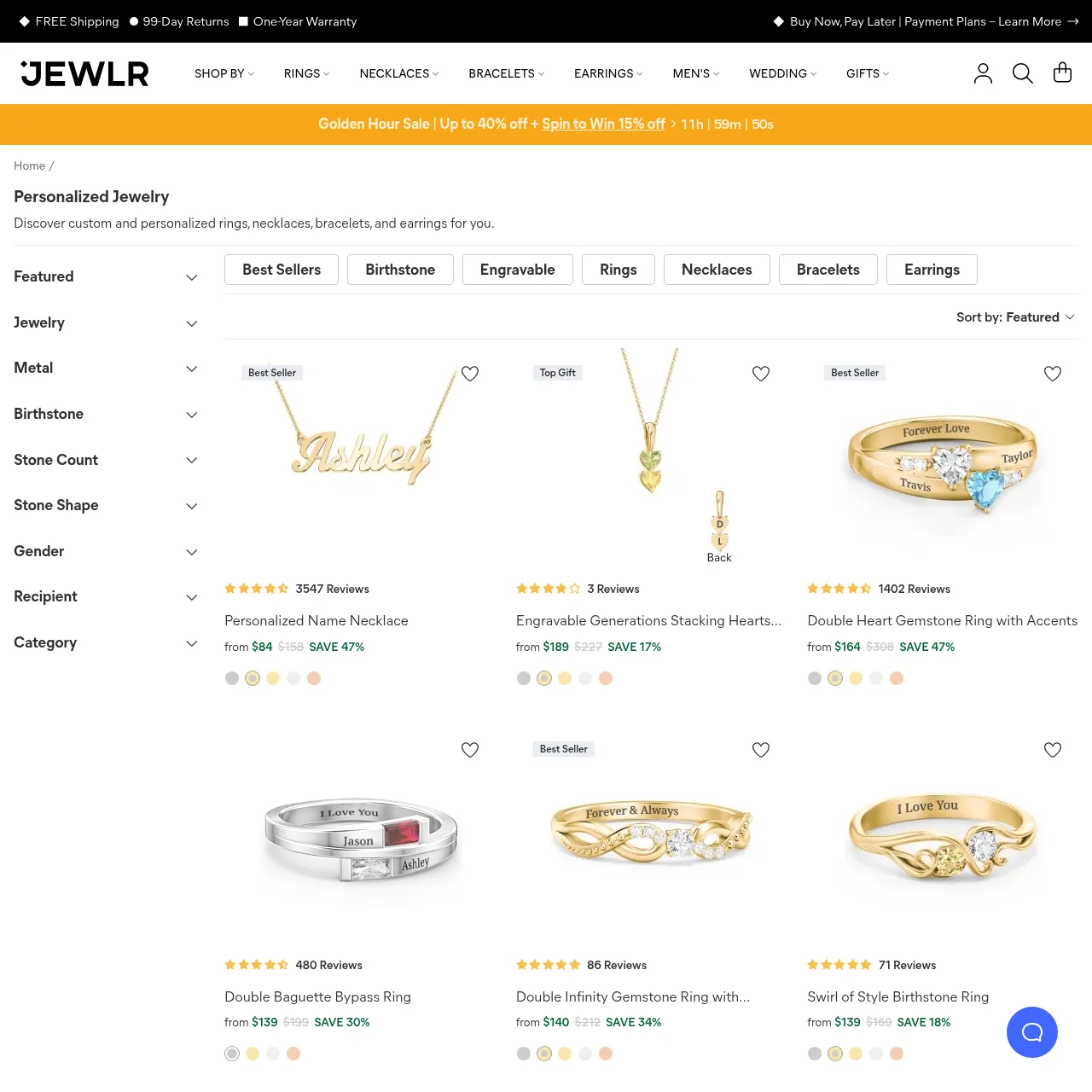
Jewlr is a DTC personalized jewelry brand with one of the deepest consumer product configurators in this segment. The configuration model allows buyers to specify metal type — sterling silver, stainless steel, white gold, gold plated, and vermeil — alongside birthstone (covering all 12 months), stone count ranging from zero up to six or more stones per piece, and stone shape across eight options: round, heart, princess, oval, baguette, pear, marquise, and cushion.
That material and specification depth is practically significant for procurement teams, though not as a sourcing destination. Jewlr demonstrates the level of configuration that US consumers now engage with — which translates directly into the spec documentation an OEM supplier must be able to receive and execute. Metal type, plating method, stone shape, and stone count aren't just consumer-facing options; they're the same variables that a custom jewelry procurement brief needs to define with precision.
Key Features:
- Multi-axis product configurator: metal type, birthstone (all 12 months), stone count (0–6+), stone shape (8 options)
- Broad category coverage extending beyond traditional jewelry types: keychains and anklets alongside rings, necklaces, bracelets, earrings, charms, and sets
- Consumer trust infrastructure: free shipping, 99-day returns policy, one-year warranty, and buy-now-pay-later payment plans
- Occasion and recipient taxonomy — Wedding, Engagement, Promise, Mothers, Family — mapping where personalized jewelry demand concentrates by gifting context
- Quick Ship designation on select SKUs indicating tiered fulfillment options for time-sensitive purchase occasions
Jewlr's trust-signal stack — extended return window, multi-year warranty, BNPL — represents the consumer-level expectation benchmark in the US and North American market. DTC store owners importing wholesale personalized jewelry should understand that their end customers are calibrated to these policies, which in turn affects the quality bar a wholesale supplier needs to clear.
Best For: Understanding the depth of consumer personalization demand in the US and North American markets. Useful for buyers evaluating which configuration variables — metal, stone, count, shape — to include in a custom OEM brief when approaching a supplier.
5. Catbird NYC — Designer-Positioned Personalized Jewelry
Consumer retail benchmark — not a supply partner or OEM source.
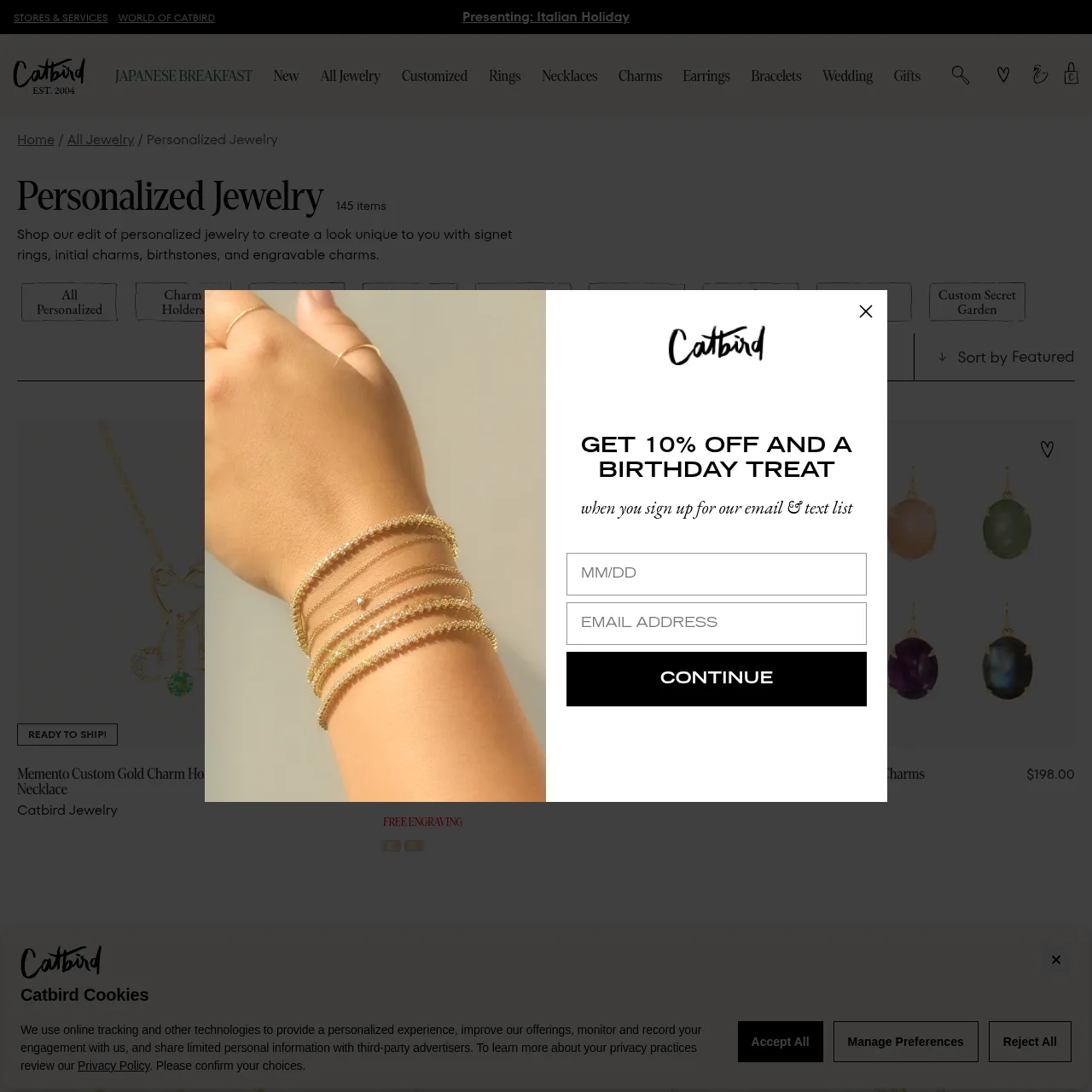
Catbird is a Brooklyn-based jewelry brand with strong organic authority for personalized and custom jewelry in the US DTC segment. Its personalized category — rings, pendants, and charms — sits within a /designer-jewelry/ URL path, a deliberate positioning signal that separates the brand from mass-market personalization and places it in the accessible-luxury tier. That URL architecture reflects and reinforces premium positioning for both search engines and buyers who recognize the distinction.
The catalog includes pieces in gold and silver metals, with lab-grown diamonds also part of the offering. Catbird has collaborated on jewelry collections with artists including Japanese Breakfast, Clairo, Laufey, Jenny Slate, and Vito's Gems — a model that uses limited-edition angles to refresh a personalized catalog without promotional discounting. This is a commercially intelligent approach: artist collaborations maintain brand distinctiveness and prevent the race-to-discount that erodes perceived value in mass personalization. The brand also maintains a "Our Studio & Sustainability" section and a Catbird Giving Fund charitable program, sustainability credentials increasingly relevant for EU buyers operating under ESG procurement considerations.
Key Features:
- Personalization across rings, pendants, and charms — the three highest-velocity SKU types in consumer custom jewelry
- Designer-tier URL architecture (
/designer-jewelry/) differentiating from commodity personalization - "Build Your Own" jewelry option enabling consumer-driven curation
- Artist collaborations (Japanese Breakfast, Clairo, Laufey, Jenny Slate, Vito's Gems) used to drive catalog freshness without promotional discounting
- Lab-grown diamond offering and documented sustainability credentials via "Our Studio & Sustainability" section and the Catbird Giving Fund
Catbird's approach — editorial, curated, and brand-identity-driven rather than purely configurable — shows what the premium segment of the US consumer market responds to. Importers building private label collections targeting accessible-luxury positioning in the US or EU DTC market can use Catbird's design language as a quality and tone benchmark when briefing an OEM supplier.
Best For: Understanding the designer and accessible-luxury tier of US personalized jewelry. Relevant as a design and positioning reference for importers developing OEM collections that will retail at mid-to-high price points and target values-conscious buyers in the US, EU, or UK markets.
6. Kay Jewelers — Mass-Market Custom Jewelry at National Scale
Consumer retail benchmark — not a supply partner or OEM source.
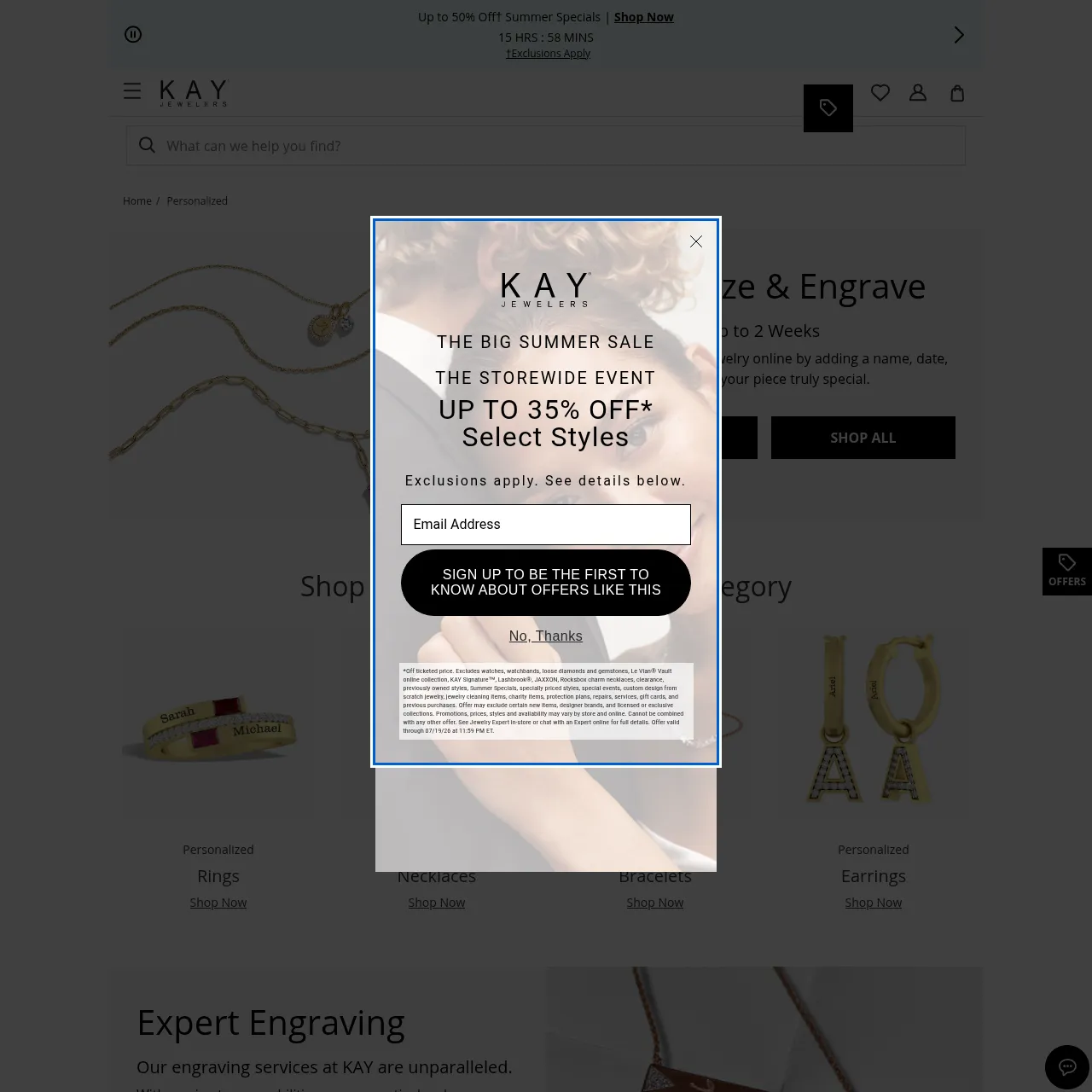
Kay Jewelers represents the mass-market ceiling for custom jewelry in the US consumer segment. The brand operates through an integrated online and in-store model, offering engraving and personalization services across rings, necklaces, and bracelets alongside an in-store custom design service that buyers can schedule by appointment. An online engagement ring configurator covers nine stone shapes — princess, round, oval, pear, emerald, marquise, cushion, radiant, and heart — and a "Compare Custom Design Options" feature helps consumers navigate between customization paths. That decision-support layer signals that consumer demand in this category is wide enough, and complex enough, to require structured guidance even at the mass-market level.
For overseas buyers, Kay's value as a benchmark is primarily in scale and category validation: the brand lists personalized jewelry under "Trending Now," confirming sustained commercial relevance rather than trend-cycle status. Lab-grown diamond engagement ring options are available alongside natural stones, reflecting the same material-tier diversification visible across the consumer custom jewelry segment more broadly.
Key Features:
- In-store custom design service with appointment scheduling — an omnichannel personalization model covering both digital and physical purchase journeys
- Online engagement ring configurator with nine stone shape options
- "Compare Custom Design Options" feature structuring consumer decision-making across customization tiers
- Lab-grown diamond options alongside natural stones
- National retail brand presence driving high organic search authority for "custom jewelry" in the US market
Kay's positioning highlights a gap that MENA-focused importers will recognize immediately: the brand is US-centric and lacks the gold-weight specifications, Arabic-language support, and modesty-aligned design options that regional procurement teams require. Suppliers with multilingual capability, MENA-specific design range, and documentation in Arabic or French hold a structural advantage in markets that Kay's catalog was never built to serve.
Best For: Understanding the mass-market US consumer benchmark for custom jewelry in terms of category scale and demand confirmation. Useful as a volume and policy reference for importers assessing the size of the personalized jewelry opportunity before entering the segment.
What B2B Buyers Should Evaluate Before Contacting a Custom Jewelry Supplier
The five consumer retail brands above collectively define the style categories, personalization formats, and quality tiers that end consumers currently spend on. That demand-side context shapes the brief you bring to an OEM supplier. What follows is the supplier-side evaluation framework — five dimensions to confirm before moving from inquiry to sample.
MOQ and catalog structure. Establish whether the MOQ applies per style or per total order. STRAND's 12-piece-per-style minimum on 109 of its 114 catalog styles is a concrete, verifiable benchmark. Suppliers who won't state this number with specificity are worth scrutinizing before sampling.
Material documentation. Gold-plated and rhodium-plated copper, 925-style silver, glass bead, and natural stone sit at different retail price ceilings and carry different care requirements. Ask for material spec sheets, not verbal descriptions. For MENA markets in particular, gold tone, purity representation, and design modesty are not aesthetic preferences — they are purchasing criteria.
Lead time and production capacity. Stock designs and custom OEM orders have different timelines. Get both numbers in writing, alongside monthly production capacity — a figure that matters when planning a seasonal launch or a first order with a hard in-market date.
Quality assurance documentation. In-house QC checklists and pre-shipment inspection reports are the minimum standard for verifiable production quality. Third-party audits add an independent layer. Ask what a supplier provides as standard versus what incurs additional cost.
Trade terms and payment flexibility. EXW and FOB carry meaningfully different cost and logistics implications depending on your freight setup. Payment method availability — T/T, PayPal, L/C, Xtransfer — affects operational feasibility for procurement teams working across different banking markets. Confirm both before negotiating volume pricing.
Ready to Source? Start With the Right Questions
The custom jewelry market spans a wide arc — from mass-market engraving services at national retail chains to vetted OEM programs built for overseas buyers who need documented materials, defined MOQs, and multilingual sales support. For procurement teams and DTC store owners, the practical decision is not which consumer brand to study — it's which supplier can deliver the styles those consumer brands have proven to sell.
STRAND is built specifically for buyers in the US, EU, UK, and MENA markets sourcing earrings, chains, and custom jewelry from China. Sales teams operate in six languages. Shipments leave with QC documentation. MOQ starts at 12 pieces per style on 109 catalog designs.
Request a Quote or get MOQ and pricing from STRAND at strandjewelry.com — where craftsmanship meets the world, one strand at a time.
Frequently Asked Questions About Custom Jewelry Sourcing
What is the typical MOQ for custom jewelry from a Chinese manufacturer?
MOQ varies significantly by supplier and product type. For stock catalog designs, reputable suppliers commonly offer minimums between 10 and 50 pieces per style. True OEM — where you're specifying silhouette, material, and finish from scratch — typically requires higher volume commitments to offset tooling and sampling costs. STRAND's 12-piece-per-style minimum on stock designs is a useful benchmark when evaluating other suppliers' MOQ claims.
What materials should I specify in a custom jewelry brief?
At minimum, your brief should define the base metal (copper, brass, stainless steel, or 925 silver), the plating method and finish (gold-plated, rhodium-plated, vermeil), and any accent materials (glass bead, natural stone, crystal, faux pearl). For markets where gold purity representation matters — particularly MENA — clarify whether the finish is described as gold-plated copper or gold vermeil, and confirm the micron thickness of the plating. Vague material descriptions are a leading cause of quality disputes on first orders.
What trade terms should I negotiate when sourcing jewelry from China?
EXW (Ex Works) places logistics responsibility on the buyer from the factory gate — lower unit pricing, but you manage freight forwarding and export clearance. FOB (Free on Board) means the supplier covers costs to the departure port and handles export customs. For first-time importers without an established freight forwarder, FOB often reduces operational complexity. For experienced procurement teams who have negotiated preferred freight rates, EXW typically lowers landed cost. Both terms should be confirmed in writing with the supplier before placing an order.
How do I verify a custom jewelry supplier's quality claims?
Request documentation rather than relying on verbal assurances. A credible supplier should be able to provide pre-shipment QC inspection reports, material certificates for claimed metals (especially for 925 silver or gold vermeil), and either in-house or third-party inspection records. Asking to review a past inspection report before sampling is a reasonable request — suppliers with documented quality systems treat it as routine. If a supplier resists sharing inspection documentation, treat that as a screening signal before committing to a sample order.
What payment methods are standard for international jewelry sourcing?
T/T (telegraphic transfer / bank wire) is the most common method for B2B jewelry sourcing from China. PayPal is widely available but typically carries a fee premium that suppliers often pass back to buyers. L/C (letter of credit) is standard for larger volume orders where both parties need documentary security. Newer platforms like Xtransfer serve procurement teams operating across multiple currencies in MENA, Europe, and Southeast Asia. Confirming payment method availability before entering into commercial discussions avoids operational friction at the point of order.
How long does custom OEM jewelry production typically take?
Sample production and stock catalog orders carry different timelines. Stock designs generally have shorter lead times since materials and tooling already exist. Custom OEM — where the supplier is producing to a new specification — requires a sampling phase (design approval, material confirmation, plating review) before bulk production begins. When evaluating a supplier, ask for both the sample lead time and the bulk production lead time separately, then build shipping time on top of both. For seasonal buying cycles, working backwards from your in-market date is the most reliable way to determine whether a supplier's timeline is viable.
Looking for a vetted OEM jewelry sourcing partner with documented MOQ tiers, multilingual sales support, and in-house QC? Visit STRAND at strandjewelry.com to browse the catalog or request a sourcing conversation.