
Custom Jewelry vs. Stock: Which Sourcing Path Fits Your Brand?
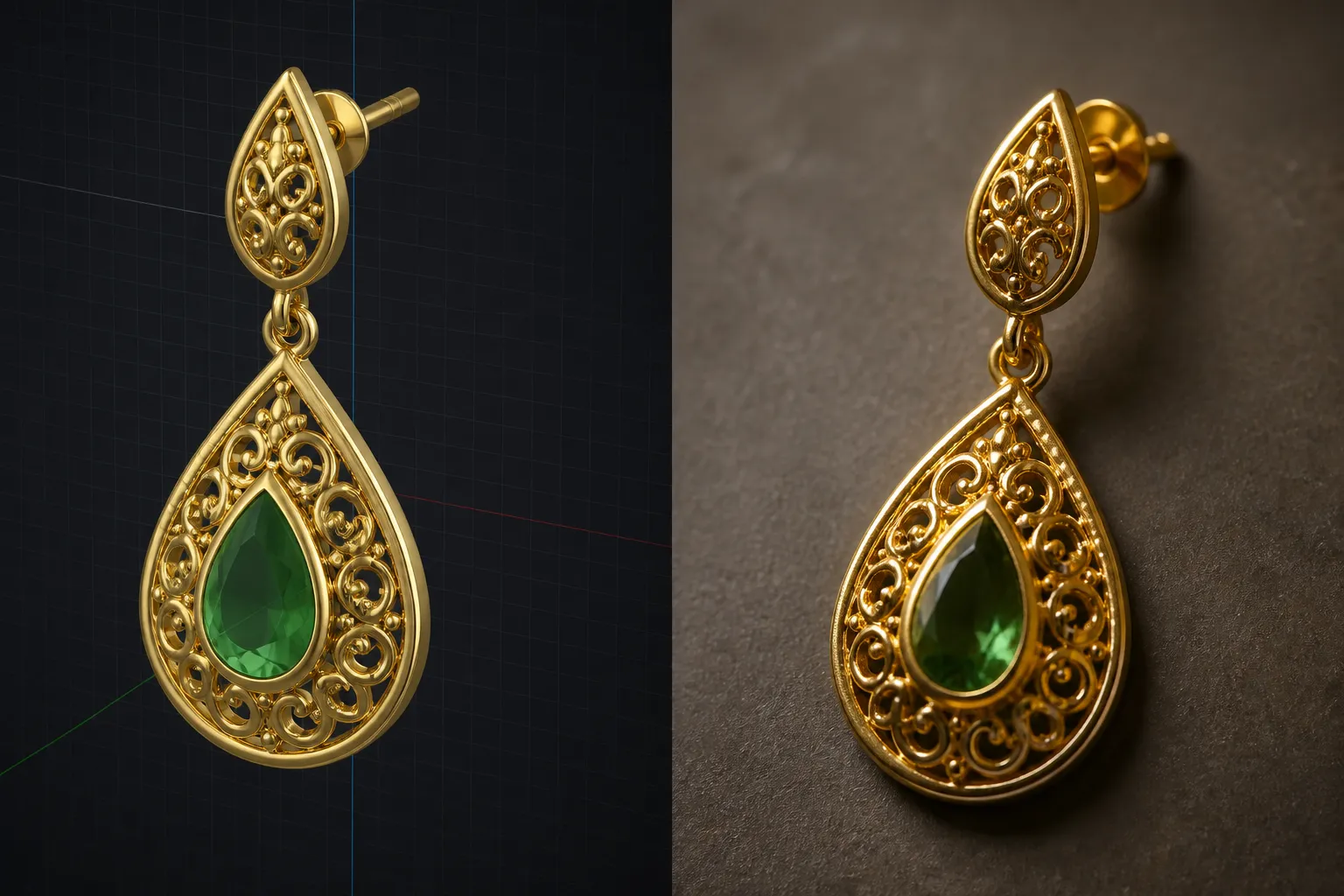
Custom Jewelry vs. Stock: Which Sourcing Path Fits Your Brand?
Custom jewelry gives you brand control and design exclusivity; stock alternatives give you speed and lower upfront risk. For most DTC store owners and importers building a differentiated product line, the right answer depends on where you are in your growth curve — and whether your customers can tell the difference between a piece made for you and one selling on ten other storefronts.
This article breaks down both paths across the dimensions that matter at the procurement stage: MOQ, lead time, pricing structure, branding control, and quality assurance.
TL;DR / Quick Verdict
Custom OEM jewelry is the stronger long-term choice for buyers who want exclusive designs, private-label branding, and scalable margins — particularly when sourcing from vetted Chinese manufacturers with multilingual support. Stock alternatives (ready-made catalogs, Alibaba wholesale, domestic distributors) suit buyers who need fast inventory with minimal upfront commitment. If you're placing repeat orders above a few dozen units per style and building a recognizable brand, custom is almost always the better investment.
At-a-Glance Comparison Table
| Dimension | Custom Jewelry (OEM/Bespoke) | Stock Alternatives (Ready-Made Wholesale) |
|---|---|---|
| Design exclusivity | Fully exclusive to your brand | Identical pieces available to any buyer |
| Typical MOQ | 12–50 pcs/style (factory-dependent) | 1–100 pcs/style (platform-dependent) |
| Lead time | 3–8 weeks (sampling + production) | 1–7 days (in-stock) |
| Branding / packaging | Custom logo, tags, packaging available | Generic or supplier-branded |
| Unit pricing | Lower at scale; higher per-unit at low volumes | Fixed catalog price; limited negotiation |
| Quality control | In-house QC at source before shipment | Variable; depends on supplier reputation |
| Design input | You own the design brief | You choose from existing catalog |
| Trade terms | EXW, FOB, air/sea/express | Varies; often DDP/DDU on platforms |
| Payment options | T/T, PayPal, Western Union, L/C, Xtransfer | Credit card, Alipay, platform escrow |
| Best for | DTC brands, private-label importers, growing retailers | Test orders, trend-chasing, fast restock |
Custom Jewelry Overview
Custom jewelry — in the B2B context — means OEM (original equipment manufacturer) production: a supplier manufactures pieces built to your specifications, using your design files, your color choices, your logo, and your packaging. The finished goods belong exclusively to your brand.
This model originated with high-end fine jewelry ateliers but has expanded dramatically at the fashion jewelry tier. Hangzhou-based suppliers like STRAND now bridge vetted Chinese workshops directly to overseas buyers across the US, EU, UK, and MENA — with multilingual sales teams (English, French, Arabic, Spanish, German, Russian) handling procurement from first inquiry through shipment.
Who it's built for: DTC store owners building a private label, importers supplying multi-door retail accounts, and buyers who've already validated demand in a category and want to own the design rather than rent it from a catalog.
Standout strengths: Design exclusivity, margin control, and the ability to iterate on product based on customer feedback. When a two-tone rhinestone set or a vintage crystal drop earring carries your name on the tag, you're building equity — not just moving units.
Alternatives Overview
"Alternatives" covers the range of sourcing paths that don't involve custom design: stock catalogs from fashion jewelry wholesalers, ready-made listings on B2B platforms, domestic distributors, and retail-style personalization services.
At the retail end, custom design services like Mystique Jewelers — with locations in Old Town Alexandria, Middleburg, and at Salamander Resort & Spa — offer bespoke fine jewelry experiences for individual consumers, including tools like their Benchmark Ring Lab for building wedding bands and a Locket Bar for necklace customization. These are consumer-facing services, not wholesale sourcing channels, and they operate at a fundamentally different price point and volume tier.
For the B2B buyer, "alternatives" more practically means: pulling designs from a supplier's existing catalog, sourcing from marketplace platforms, or working with domestic distributors who hold inventory.
Who it's built for: Buyers in early testing mode, pop-up retailers who need fast turnaround, or accounts with irregular demand that doesn't justify the lead time of custom production.
Standout strengths: Speed, zero design effort, and low commitment. When you need 20 units of a trending style by next week, stock wins every time.
Feature-by-Feature Breakdown
Pricing and MOQ
Custom OEM pricing is tiered: the more units per style, the lower the per-unit cost. STRAND's stock catalog runs 12 pcs/style on most of its designs, with select styles available from 1 piece — which makes it accessible for buyers who want to test a custom direction before scaling.
Stock alternatives often look cheaper per unit on the surface, especially from marketplace platforms. But the "cheap" unit price rarely accounts for inconsistent finishing, no brand packaging, and the competitive risk of selling the same piece as a dozen other storefronts. The true cost comparison requires including post-purchase QC effort, return rates, and brand dilution.
Verdict on pricing: Stock wins on upfront unit cost at very low volumes. Custom OEM becomes more cost-effective at consistent repeat order quantities, where margin improvement and reduced competition justify the production lead time.
Design Flexibility and Exclusivity
Custom OEM is the only path that delivers a piece no one else can buy. Suppliers like STRAND offer production in gold-plated and rhodium-plated copper, 925-style silver finishes, glass beads, natural stone, and faux pearls — giving buyers a real material palette to work from, not just a finish option on a pre-existing mold.
Stock alternatives offer none of that exclusivity. The Two-Tone Rhinestone Fireworks Jewelry Set is a striking set on its own merits — but if you're sourcing it as a ready-made stock item, another buyer on a different continent can source the identical piece.
For DTC brands where product photography, packaging, and story are part of the value proposition, exclusivity has direct revenue implications.
Lead Time and Production Capacity
Stock: 1–7 days from order to ship (in-stock items). Custom: typically 3–8 weeks from design confirmation, covering sampling, approval, and production run.
The custom timeline isn't a flaw — it's a planning discipline. Buyers who build 6–8 week procurement cycles into their calendar unlock better unit economics and design control. Those running reactive inventory strategies will find the lead time genuinely limiting.
Custom OEM suppliers with in-house QC (like STRAND's pre-shipment inspection process) add a step that stock suppliers skip entirely. That step matters when you're importing 500 units of a new earring style: catching a plating defect at origin is a different problem than catching it after customs clearance.
Branding and Packaging
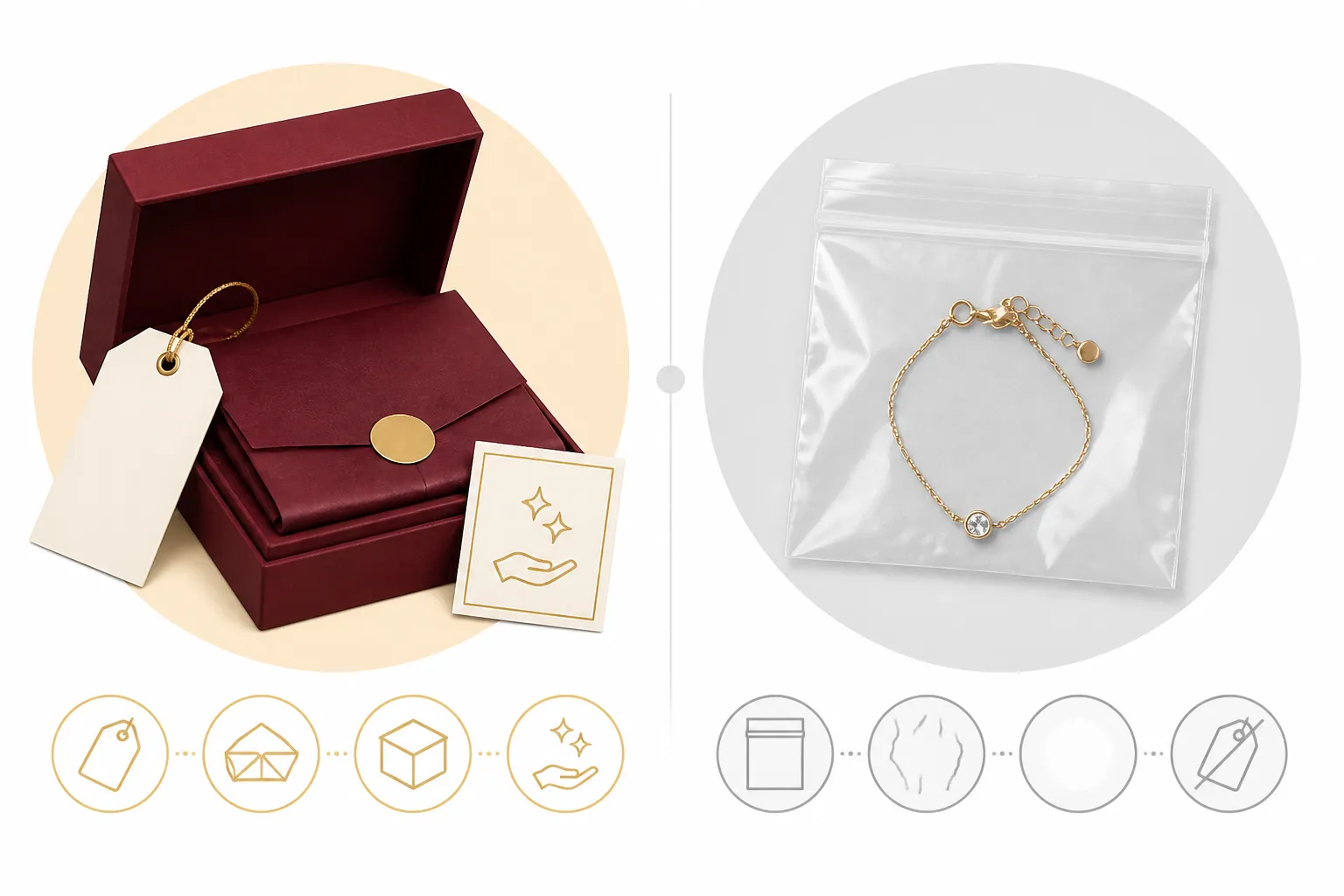
Custom OEM includes the full packaging stack: hang tags with your logo, branded boxes, care cards, poly bags, and any retail-ready compliance labeling you need for your target market (US, EU, UK, or MENA).
Stock alternatives ship in generic supplier packaging — sometimes in polybags with the factory's own label. Repackaging adds labor cost and potential inconsistency. For DTC sellers where the unboxing experience is a documented driver of repeat purchase, this matters more than many buyers initially account for.
Quality Assurance
The most underrated dimension in cross-border jewelry sourcing. A gold-plated copper earring from five different factories may look identical in a product photo and perform completely differently after six months of wear.
In-house QC before shipment — STRAND's standard practice — means defects are caught and resolved before the buyer bears the customs and freight cost of returning goods from overseas. Stock platforms vary enormously: some offer buyer protection, some don't, and dispute resolution in cross-border trade is slow and costly.
Custom OEM with a defined quality specification (plating thickness, finish standard, stone setting tolerance) gives buyers documentation they can hold a supplier to. Stock catalog sourcing rarely comes with that paper trail.
Support and Communication
Multilingual procurement support is a concrete differentiator in cross-border trade, not a marketing nice-to-have. A buyer in a French-speaking country or a MENA importer coordinating in Arabic faces real friction when their supplier can only respond in English and with a 12-hour time lag.
STRAND's sales team operates in EN, FR, AR, ES, DE, and RU — which directly reduces miscommunication on spec details, shipping terms, and customs documentation. Stock platforms typically offer platform-level dispute resolution, not account-level relationship support.
Pros and Cons
Custom Jewelry (OEM/Bespoke)
Pros:
- Full design exclusivity — no one else sells your piece
- Private-label branding from hang tag to outer box
- Scalable unit economics at repeat order volumes
- In-house QC before shipment reduces post-arrival defect risk
- Defined material and finish specifications
- Trade terms flexibility (EXW, FOB) and multiple payment methods
- Multilingual support for non-English procurement teams
Cons:
- 3–8 week lead time requires advance planning
- Higher upfront commitment (sampling costs, minimum production runs)
- Design iteration adds time if initial samples need revision
- Not suitable for fast-trend restocking
Stock Alternatives (Ready-Made Wholesale)
Pros:
- Immediate availability — ship same week in many cases
- No sampling phase or design investment
- Lower per-unit commitment at micro-volumes
- Good for testing a new category before committing to custom production
Cons:
- Zero design exclusivity
- Inconsistent quality between batches and suppliers
- Limited or no branding/packaging customization
- Competing directly on price against buyers sourcing the same piece
- Platform-level support rather than account-level relationship
When to Choose Custom Jewelry
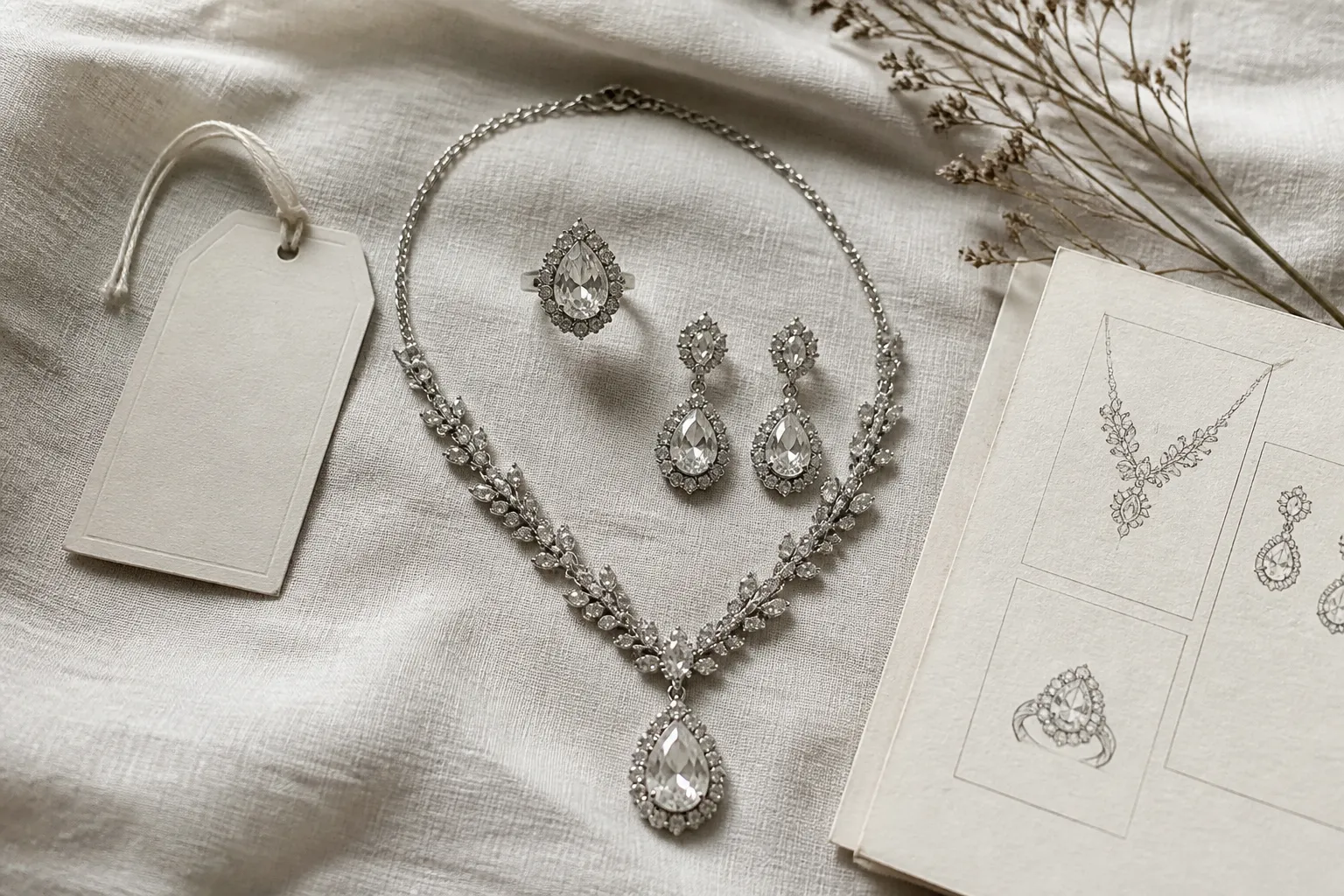
You're building a private-label brand. If your business model depends on customers recognizing your product line — not just buying a trending earring — custom OEM is the only path that lets you own the aesthetic. The Vintage Green Crystal Geometric Jewelry Set is an example of the kind of full-set design (ring, earrings, necklace) that carries brand identity when it ships with your logo.
You're supplying multi-door retail accounts. Wholesale buyers for boutique chains or department store buyers need exclusivity guarantees. Stock catalog pieces don't come with that guarantee.
You've validated demand and want to build margin. If a style is already selling for you from stock, custom production at higher volumes will lower your per-unit cost while removing the competitive risk of easy duplication.
You operate in a regulated import market. The EU, UK, and US all have nickel, lead, and cadmium compliance requirements for jewelry. Custom OEM with a defined specification lets you request compliance documentation upfront. Stock sourcing often requires you to self-test after the fact.
Your procurement team is multilingual. Buyers coordinating in French, Arabic, Spanish, or German will cover ground faster with a supplier whose team actually speaks those languages.
When to Choose Alternatives
You're testing a new category with no sales history. Committing to a custom run of a style you've never sold is a real inventory risk. Stock catalog sourcing — even from the same supplier's existing designs — lets you validate demand at low commitment before investing in bespoke production.
You need product on shelf in under two weeks. For seasonal trend drops, pop-up events, or fast-fill situations, stock is the only answer. Custom production timelines simply don't accommodate same-week needs.
Your volume is genuinely micro-scale. If you're ordering 3–5 units of a style for a small boutique or early-stage Etsy operation, the economics of custom production (sampling, tooling, minimum runs) don't make sense yet.
You're sourcing a commodity category. For basic stud earrings in standard finishes where design differentiation isn't your strategy, stock sourcing at competitive prices may serve the business model better than custom development investment.
Final Verdict
Custom OEM jewelry is the better choice for any buyer whose business competes on brand, design, or exclusivity — and who places orders at volumes where the lead time and minimum quantities make economic sense. Stock alternatives are a legitimate starting point, not a permanent strategy.
The practical question isn't which model is superior in the abstract; it's where you are on the volume and brand-maturity curve. Most serious importers and DTC operators end up running both in parallel: stock catalog for fast-turning basics, custom OEM for hero products and seasonal launches.
For buyers sourcing fashion jewelry — drop earrings, stud sets, crystal necklace sets — from China with multilingual procurement support, low MOQ thresholds (12 pcs/style on most stock designs), flexible trade terms, and in-house QC, STRAND is worth a direct conversation before you default to a marketplace platform.
Request a quote, MOQ details, or a sample inquiry at strandjewelry.com. Bring your design reference, target market, and volume range — the team works in EN, FR, AR, ES, DE, and RU.