
Custom Jewelry vs. Ready-Made Stock: The B2B Sourcing Guide
Custom Jewelry vs. Ready-Made Stock: The B2B Sourcing Guide
Custom jewelry puts your brand's exact specifications into production — specific metals, finishes, silhouettes, and private-label packaging — but demands more lead time and typically higher order commitments. Ready-made stock jewelry from an established catalog delivers proven designs immediately, with lower MOQs and faster time-to-shelf.
If you're a buyer, importer, or DTC store owner deciding between these two sourcing paths, the right answer depends on your brand stage, cash position, and how differentiated you need your product line to be.
TL;DR / Quick Verdict
Choose custom OEM jewelry if you're building a private-label brand, need exclusive designs that competitors can't copy, or have volume to justify longer production cycles. Choose stock catalog jewelry if you need inventory quickly, want to test new styles with minimal commitment, or are early-stage with limited capital. STRAND's sourcing model — with MOQs starting at 12 pcs/style on the majority of its catalog styles (109 of 114 as of this writing), and full custom OEM available from the same Hangzhou-based workshops — means you don't have to make a permanent choice between the two.
At-a-Glance Comparison Table
| Dimension | Custom OEM Jewelry | Stock Catalog Jewelry |
|---|---|---|
| Design control | Full — your spec, your silhouette | Curated selections; minor variation possible |
| MOQ | Higher (negotiated per project) | As low as 12 pcs/style (STRAND catalog) |
| Lead time | Longer (sampling + production cycles) | Shorter — ready-to-ship or fast turnaround |
| Unit cost | Lower per unit at scale; higher at low volume | Predictable, catalog-priced |
| Private label / branding | Yes — packaging, tags, finishes to spec | Limited; off-the-shelf branding |
| Trend risk | Higher — you own the design decision | Lower — supplier has tested the market |
| Capital requirement | Higher upfront | Lower entry point |
| Best for | Established DTC brands, white-label retailers, gift companies with exclusive ranges | New entrants, test-and-learn buyers, multi-SKU catalog builders |
Custom Jewelry: What It Is and Who It's Built For
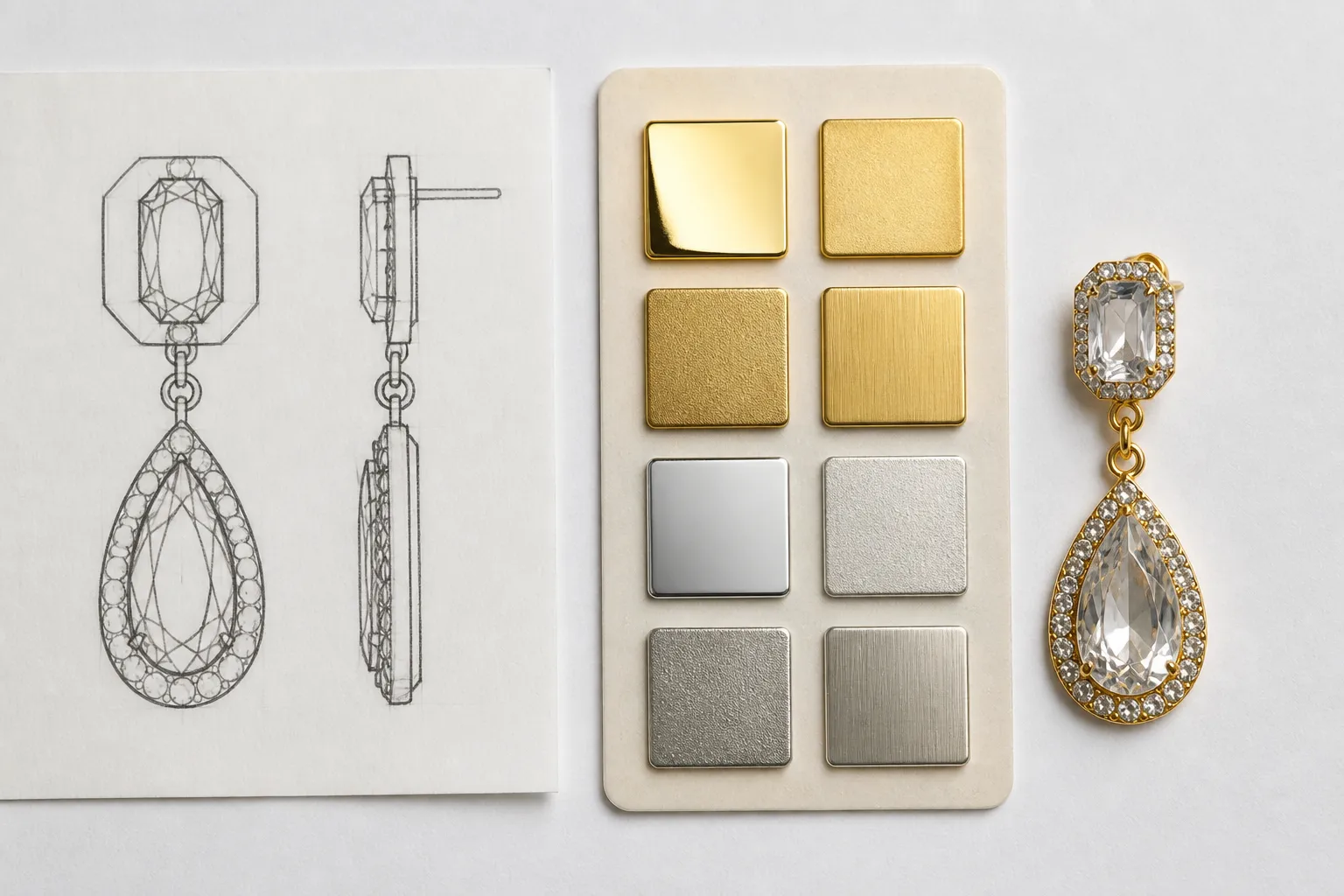
Custom jewelry — in a B2B sourcing context — means commissioning a manufacturer to produce pieces to your own design brief. That includes specifying metal base (copper, brass, 925 silver), plating (gold, rhodium, two-tone), stone type and color, silhouette, finish, clasp hardware, and packaging. You own the mold or pattern. The factory produces to your standard.
This path suits brands that compete on differentiation. A US-based DTC earring brand launching a vintage-crystal aesthetic doesn't want to stock the same rhodium-plated hoops as three competitors. A European gift retailer building a private-label jewelry range for department stores needs exclusivity built into the supply chain. Custom OEM delivers that.
The sourcing conversation looks different too. Mystique Jewelers, a multi-location fine jewelry retailer with studios in Old Town Alexandria, Middleburg, and Salamander Resort & Spa, operates their custom design service through appointment-based consultations — a model suited to retail customers, not wholesale volume. B2B buyers working with Chinese OEM workshops operate in a different register: CAD files, sample approval rounds, plating thickness specs, and production scheduling.
STRAND's custom OEM service covers gold-plated and rhodium-plated copper, 925-style silver finishes, glass bead and natural stone settings, and faux pearls. The multilingual sales team (English, French, Arabic, Spanish, German, Russian) means procurement teams across the US, EU, UK, and MENA regions can communicate specs without translation loss.
Stock Catalog Jewelry: What It Is and Who It's Built For
Stock catalog jewelry is pre-designed, pre-produced, and available for order against established MOQs. The supplier carries the design risk. You pick from tested styles, place an order, and receive finished goods — no sampling rounds, no mold fees, no waiting for a prototype.
For buyers who are test-and-learn by nature — running a Shopify store that needs 15 SKUs to validate a new category, or a marketplace seller adding a jewelry vertical to an accessories brand — catalog sourcing is the rational choice. The downside is that any other buyer can order the same styles from the same supplier.
STRAND's stock catalog spans 114 styles as of this writing, across drop earrings, stud earrings, and necklace + earring sets. Styles include vintage crystal, gradient crystal, two-tone glass bead, and rhinestone in gold-plated and rhodium-plated copper. At the time of this article, 109 of those 114 styles carry an MOQ of 12 pieces per style, with select styles available from as low as 1 piece — relevant for buyers building assortment samples before committing to a full run. Trade terms are EXW or FOB, with payment accepted via T/T bank transfer, Western Union, PayPal, L/C, and Xtransfer.
A set like the Two-Tone Rhinestone Fireworks Jewelry Set (Earrings & Necklace) illustrates what catalog buying delivers: a finished, photographed, market-ready product with known specifications and defined packaging — ordered in units, not engineered from scratch.
Feature-by-Feature Breakdown
Pricing and MOQ
Custom OEM pricing depends on three variables: material spec, volume, and complexity of the design. A simple gold-plated copper stud with a single stone type costs far less to tool than a multi-element articulated drop earring with mixed stone settings. Because tooling costs are amortized across the production run, unit economics improve sharply with volume. Buyers should request a detailed cost breakdown covering material, plating, assembly, QC, and packaging separately — not just a per-piece landed cost.
Stock catalog pricing is simpler. At STRAND, most catalog styles start at MOQ 12 pcs/style, making it accessible for buyers running tight initial orders across many SKUs. The trade-off is that you pay a per-unit price that may be higher than a custom run at volume — but you eliminate mold fees and sample costs entirely.
Neither path has a universal price advantage. At low volumes and high SKU diversity, stock wins on unit economics. At high volumes on a single exclusive design, custom OEM almost always delivers lower cost per piece.
Design and Differentiation
This is where the gap between the two paths is widest. Custom OEM gives you full ownership of the design. Your silhouette, your stone colorway, your plating combination — and critically, your exclusivity. No other buyer on the same platform can order that piece.
Stock catalog jewelry is shareable. Any buyer who accesses the same supplier catalog can stock the same styles. If your brand's competitive positioning depends on product uniqueness, that's a structural problem that stock sourcing can't solve. If your positioning is price, curation, or service, stock sourcing works fine.
Partial customization — taking a catalog base and modifying the plating, adding a branded hang tag, or requesting a small stone color change — is a middle path some suppliers offer. Ask your supplier whether modifications are available on stock styles and what the MOQ threshold is for triggering a modified run.
Lead Time and Production Capacity
Stock catalog orders move faster. No sample cycle, no design approval, no tooling. If a supplier holds inventory or runs short production cycles, stock orders can ship within days to a few weeks depending on destination and shipping method (air, sea, or express).
Custom OEM involves at least two stages: sample approval and production. The sample round catches specification errors before full production begins — skipping it is a false economy. Buyers should build sample lead time, review time, and a potential revision round into their project timeline. High-capacity workshops in Hangzhou — where STRAND's partner factories operate — can run parallel production lines, but they schedule against existing commitments. Buyers entering peak season (Q3 for MENA Eid sourcing, Q4 for Western holiday retail) should initiate custom projects well in advance.
Quality Assurance and Compliance
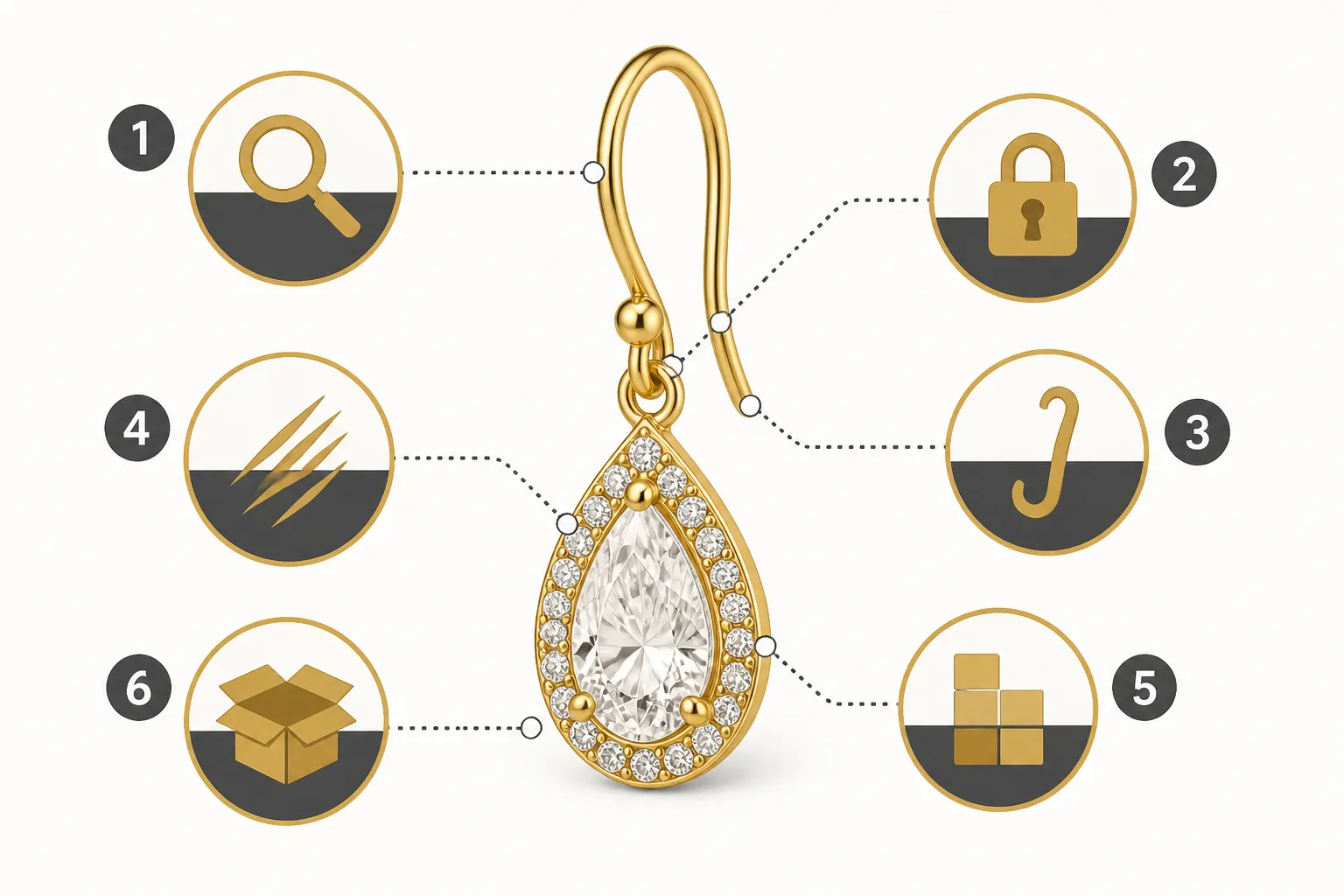
In-house QC before shipment is non-negotiable for cross-border transactions. Returns and re-manufacturing across 8,000+ km are expensive. STRAND runs in-house QC inspection before every shipment on both stock and custom orders — a checkpoint that catches plating inconsistency, stone setting failures, and packaging defects before they become a landed-goods problem.
For regulated markets (EU REACH, UK cosmetics regulation, California Prop 65), buyers should verify that their supplier's plating processes meet the relevant nickel-release and heavy-metal standards. Request documentation, not verbal assurances. This applies equally to custom OEM and stock catalog sourcing.
Supplier Reliability and Communication
Multilingual sourcing teams reduce specification errors. STRAND's sales support covers EN, FR, AR, ES, DE, and RU — meaning a French importer and an Arabic-speaking Gulf buyer can both communicate product specs and order adjustments without relying on translation software that misinterprets material terminology.
For custom OEM projects, clear communication at the spec stage prevents costly errors in production. Buyers should insist on written spec sheets, approved sample sign-off (with signature or email confirmation), and production quantity confirmations before any deposit transfer.
Local retail custom jewelers like Mystique Jewelers offer a different service model — in-person consultations, appointment booking, and white-glove design services that suit one-of-a-kind fine jewelry commissions. That model doesn't translate to B2B wholesale volume, but it illustrates what best-in-class custom service looks like at the consumer end of the market.
Scalability
Stock catalog sourcing scales sideways — you add SKUs. Custom OEM scales vertically — you increase volume on proven winners. Neither is inherently more scalable, but they scale differently.
A DTC store building a wide assortment fast benefits from catalog depth. A brand that has validated a hero SKU and wants to manufacture 500+ units per style with its own branding benefits from custom OEM infrastructure. Some buyers use catalog sourcing as a product discovery tool — test at 12 pcs/style, identify the top performers, then brief a custom OEM run at volume to lock in exclusivity on the winning designs.
Pros and Cons
Custom OEM Jewelry
Pros
- Full design exclusivity — competitors cannot stock the same piece
- Private-label branding across product and packaging
- Lower unit cost at production scale
- Spec'd to your target market's preferences (stone color, finish, weight)
- Stronger brand positioning in premium and D2C segments
Cons
- Higher MOQ requirements to justify tooling investment
- Longer lead time including sample rounds
- Upfront mold or tooling fees on new designs
- More supplier communication bandwidth required
- Design risk sits with the buyer — wrong silhouette means unsellable inventory
Stock Catalog Jewelry
Pros
- Low MOQ — 12 pcs/style on most STRAND catalog designs, with select styles available at even lower minimums (verify current thresholds on the catalog)
- Fast turnaround — no sample cycles
- Proven designs that have been produced before (fewer manufacturing surprises)
- Lower capital requirement for market entry
- Ideal for testing new categories before committing to custom development
Cons
- Shared access — other buyers can stock identical products
- Limited branding options
- Less control over materials and finish specifications
- Unit cost at low volume may exceed custom OEM cost at scale
- Catalog size constrains SKU range to what the supplier offers
When to Choose Custom Jewelry
You're building a private-label brand. If your retail positioning depends on exclusive product, catalog sourcing is a ceiling. Custom OEM removes that ceiling.
You have a specific aesthetic that existing catalogs don't cover. A gradient-crystal colorway in a particular pantone doesn't appear in any existing catalog? Brief a custom run.
You're scaling a validated hero SKU. You tested a crystal drop earring from a stock catalog. It converted at 4x the rate of other styles. Now you want 600 units with your own branding, a specific chain length adjustment, and a custom card insert. That's a custom OEM brief.
You're sourcing for a major retail account. Department stores and gift chains typically require private-label or exclusive designs. Stock catalog product with another brand's name on the packaging won't clear a buyer review.
Your target market is MENA or EU with specific compliance requirements. Custom OEM lets you specify nickel-free plating and request documentation to meet REACH or Gulf standard requirements by design, not as an afterthought.
When to Choose Ready-Made Stock Alternatives
You're launching and need product in 60 days. Custom OEM with sample rounds won't meet that window. Stock catalog jewelry can.
You're testing a new category with limited buy. 12 pcs/style lets you run a real-world test without $5,000 in excess inventory if the style doesn't resonate with your audience.
You operate a multi-channel catalog with high SKU turnover. Marketplace sellers and multi-category gift retailers need breadth, not exclusivity. Catalog sourcing delivers both.
Your customer isn't buying your brand — they're buying the piece. Price-sensitive segments often don't reward private-label differentiation. If your customer's decision is driven by aesthetics and value rather than brand story, stock jewelry sourced cleanly beats a custom run on unit economics.
You're a first-time jewelry importer. Start with stock. Learn the import process, QC dynamics, and category performance before committing to the longer cycle and higher stakes of custom OEM.
Final Verdict
Custom OEM jewelry is the right call for brands competing on identity and exclusivity. Stock catalog jewelry is the right call for speed, low minimum risk, and category testing. These aren't competing philosophies — they're different tools for different stages of a jewelry business.
The practical move for most buyers entering or expanding into fashion jewelry: source stock first to validate category performance, then use that data to brief a custom OEM run on the winning styles. The Vintage Green Crystal Geometric Jewelry Set is the kind of catalog style that functions as exactly this test vehicle — low MOQ, defined specs, immediate availability.
What makes the STRAND model worth evaluating for cross-border buyers is the combination under one roof: a broad stock catalog (114 styles as of this writing) with MOQs starting at 12 pcs/style, full custom OEM capability from the same Hangzhou workshops, in-house QC, and multilingual procurement support across six languages. That structure lets a buyer graduate from catalog to custom without switching suppliers, renegotiating trade terms, or restarting a supplier qualification process.
If you're ready to discuss MOQs, request samples, or brief a custom OEM project, get your sourcing conversation started at strandjewelry.com.