
Custom Jewelry vs. Ready-Made: Which Sourcing Path Wins for Your Brand?
Custom Jewelry vs. Ready-Made: Which Sourcing Path Wins for Your Brand?
For buyers, importers, and DTC store owners evaluating their next jewelry sourcing decision
TL;DR / Quick Verdict
Custom jewelry (OEM/ODM production) is the right move if you need brand differentiation, own-label packaging, and control over design — especially when sourcing at volume from vetted manufacturers. Ready-made stock jewelry (catalog wholesale or retail-adjacent sourcing) suits buyers who need speed-to-market and zero tooling investment, but comes at the cost of exclusivity and margin. For B2B buyers in the US, EU, UK, and MENA who are building a recognizable brand or private label line, custom OEM almost always wins on long-term economics once you've crossed the MOQ threshold.
At-a-Glance Comparison Table
| Dimension | Custom OEM Jewelry | Ready-Made / Stock Wholesale | Retail-Sourced / White-Label |
|---|---|---|---|
| Design exclusivity | Full — your design, your brand | None — same SKUs available market-wide | Minimal — logo swap only |
| MOQ | Low-to-mid (varies by supplier) | Often 1 unit (dropship) to 10–50 pcs | Varies; often no minimum |
| Unit cost | Lower at volume; tooling cost upfront | Higher per-unit; no tooling | Highest per-unit |
| Lead time | 30–60 days typical (production) | 3–14 days (in-stock) | 1–7 days |
| Brand control | Full (packaging, tags, materials) | None | Partial |
| Quality consistency | High (with vetted manufacturer + QC) | Variable by platform | Consistent but not proprietary |
| Scalability | High — scales with reorders | Limited by supplier inventory | Limited by retail availability |
| Multilingual support | Available from specialist suppliers | Rarely | Rarely |
| Certifications | Negotiable (REACH, CPSC, etc.) | Varies widely | Typically retail-compliant |
| Best for | DTC brands, importers, private label | Quick-launch, low-risk testing | Gift/boutique resale |
Custom Jewelry Overview
Custom jewelry, in a B2B context, refers to OEM (Original Equipment Manufacturing) or ODM (Original Design Manufacturing) production — where a manufacturer produces pieces built to your specifications, under your brand identity, at agreed volumes and quality standards.
This is the dominant sourcing model for DTC store owners scaling a branded line, importers supplying regional retail chains, and procurement teams building exclusive product ranges for corporate gifting or fashion retail.
What you're actually buying: Not just a piece of jewelry, but a production relationship. You specify the design (or co-develop it with the factory), approve samples, agree on materials, MOQ, and lead time, and receive finished goods ready for your market — including custom packaging, hang tags, and compliance documentation if required.
Who it's built for:
- DTC brands in the US, EU, UK, and MENA who need catalog exclusivity
- Importers and buyers sourcing earrings, necklaces, and sets at repeatable volume
- Procurement teams managing multilingual supplier relationships across time zones
- Boutique owners who have outgrown generic wholesale and need margin protection
Standout strengths of the custom OEM model:
- Margin control — your cost is set at production, not retail markup
- Brand lock-in — competitors cannot list identical products on the same marketplace
- Design iteration — you shape the product, not just pick from what exists
- Long-term supplier alignment — good OEM partners grow with your volume
STRAND, headquartered in Hangzhou, operates directly within this model — linking vetted Chinese workshops to overseas B2B buyers with multilingual service (English, Arabic, Spanish), in-house QC before shipment, and transparent trade terms designed for cross-border procurement teams.
Alternatives Overview
"Alternatives" in this comparison covers three practical sourcing paths that buyers consider before committing to custom OEM:
1. Ready-Made / Catalog Wholesale
Platforms and suppliers selling pre-designed, in-stock jewelry in bulk. Think Alibaba wholesale listings, US-based costume jewelry distributors, or fashion jewelry platforms where you pick SKUs from a shared catalog.
Who it's for: Businesses testing a new product category, pop-up retailers, or buyers who need inventory within days, not weeks.
Key limitation: Every competitor using the same supplier sells the same product. On Amazon or Etsy, price becomes the only differentiator.
2. White-Label / Private Label (Minimal Customization)
Some suppliers offer logo placement or basic packaging changes on existing designs. This sits between stock wholesale and true custom OEM — you get some brand identity without full design control.
Who it's for: Buyers who want branded packaging but lack the volume or design resources for full custom tooling.
Key limitation: The underlying product is still shared. A sophisticated buyer can identify the base SKU.
3. Retail-Adjacent Sourcing
Buying from consumer-facing brands (personalized jewelry retailers, boutique brands) at wholesale or for resale. Examples include personalized jewelry platforms that offer bulk pricing for resellers.
Who it's for: Gift box curators, boutique resellers, or buyers who value a known brand's consumer cache over margin.
Key limitation: You're selling someone else's brand story. Margins are compressed, and you have no leverage on pricing, materials, or availability.
Feature-by-Feature Breakdown
Pricing & Cost Structure
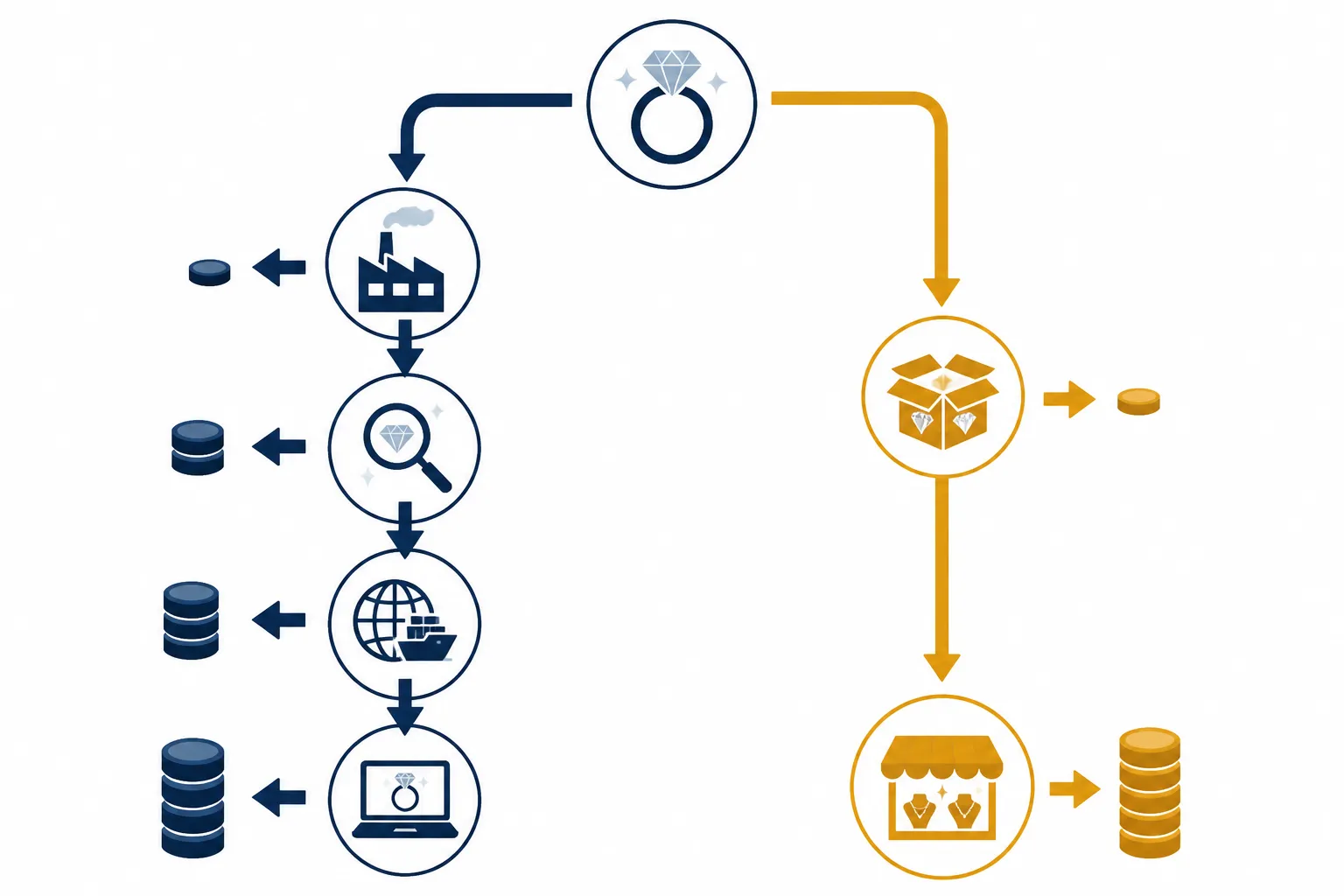
Custom OEM jewelry: Involves upfront tooling or sample costs, then a per-unit cost that drops significantly at volume. The economics favor buyers who can commit to reorder cycles. Total landed cost typically includes tooling (one-time or amortized), production, QC, and shipping — all of which a transparent supplier should itemize.
Ready-made wholesale: No tooling cost; you pay a flat per-unit price that is usually higher than OEM at equivalent volume. Easy to model, but the margin ceiling is lower because the supplier's price already includes their design and inventory risk premium.
Retail/white-label sourcing: Highest per-unit cost. Appropriate only when the brand equity of the supplier justifies the premium — which rarely applies in B2B resale contexts.
What to ask a custom OEM supplier: Request a tiered price sheet across volume breaks. Ask whether tooling costs are waived after a threshold reorder, and confirm whether prices are FOB, CIF, or DDP — the difference matters significantly for US and EU importers managing customs.
Design Flexibility & Product Range
Custom OEM: Maximum flexibility. For buyers sourcing drop earrings, stud earrings, necklace + earring sets in vintage, gradient crystal, two-tone glass bead, or rhinestone styles, the OEM path allows you to specify colorway, stone type, hardware finish, and clasp type. You can adapt an existing design or develop a new one from scratch.
STRAND's product range — which spans earring styles (drops, studs) and coordinated sets — is a practical example of the range available when a factory partner has both in-house design capability and vetted workshop access.
Ready-made wholesale: You pick from what exists. Trend-responsive suppliers update catalogs seasonally, but you're always reacting to their design decisions, not driving your own.
White-label: Limited to packaging and logo changes. Color and material decisions are fixed.
Minimum Order Quantity (MOQ) & Scalability
MOQ is often the deciding factor for buyers evaluating custom OEM for the first time.
Custom OEM: MOQ varies by factory and product complexity. Some workshops require hundreds of pieces per SKU; others — particularly those configured for cross-border DTC clients — offer lower MOQs designed for boutique importers. Always negotiate MOQ alongside reorder terms: a low initial MOQ with flexible reorder increments is more valuable than a one-time low threshold.
STRAND specifically offers low MOQ with fast lead time — relevant for buyers who want to test a custom design before scaling.
Ready-made wholesale: Effectively zero barrier. Some platforms offer single-unit purchasing, making it accessible for testing but expensive for volume.
Scalability note: Custom OEM scales linearly — as your volume grows, unit cost drops and the supplier can dedicate more production capacity. Ready-made sourcing hits a ceiling when the supplier's stock runs out; you cannot guarantee continuity of supply on someone else's inventory.
Quality Assurance & Compliance
Custom OEM (with in-house QC): The strongest model for quality consistency. Buyers should confirm that the supplier conducts pre-shipment inspection — checking plating durability, stone setting security, clasp function, and packaging integrity. For US and EU markets, ask specifically about nickel compliance (EU REACH Annex XVII), California Prop 65 requirements, and CPSC guidelines for products that may contact skin.
STRAND's model includes in-house QC before shipping — a meaningful differentiator from brokers or trading companies that pass through goods without inspection.
Ready-made wholesale: Quality is batch-dependent. Without a pre-shipment inspection you own, you're relying on the supplier's self-reported standards. Returns and replacements from overseas wholesale are logistically expensive.
Retail-sourced: Typically retail-compliant for the supplier's home market, but compliance documentation may not transfer to your target market.
Supplier Communication & Multilingual Support
This dimension is underrated in procurement evaluations but critical for cross-border teams.
Custom OEM (specialist suppliers): Suppliers configured for cross-border B2B should offer clear communication in your business language, structured RFQ (Request for Quotation) processes, and documented terms. STRAND's multilingual service — English, Arabic, and Spanish — directly addresses the procurement reality for MENA, US, and Latin American buyers who negotiate with Chinese factories.
Ready-made wholesale: Typically English-only, with transactional rather than consultative communication.
White-label/retail-sourced: Customer service oriented, not procurement oriented. Lead time and customization discussions are often outside their standard workflow.
Lead Time & Production Capacity
| Path | Typical Lead Time | Notes |
|---|---|---|
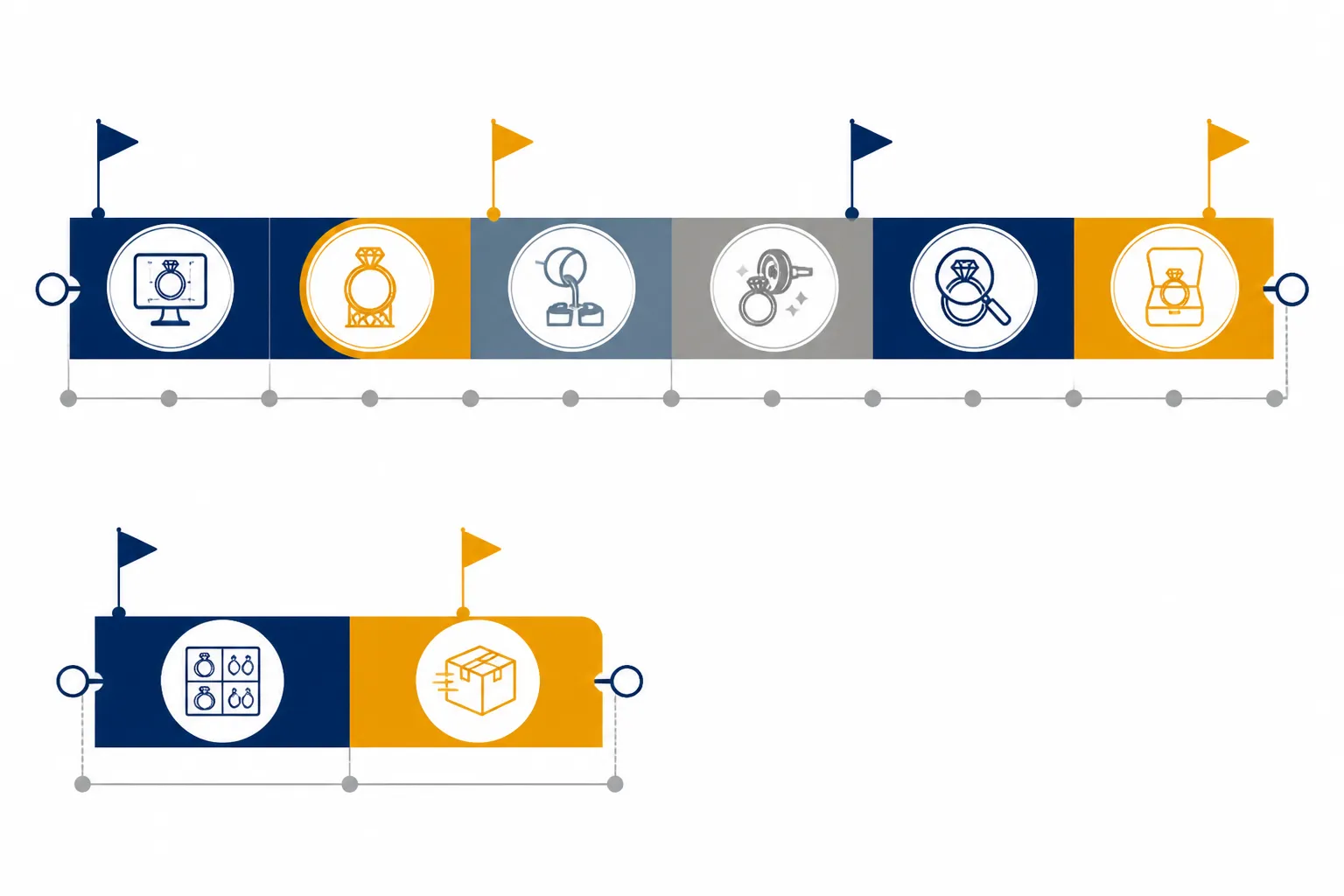
| Custom OEM (new design) | 30–60 days | Includes sample approval; faster for repeat styles |
| Custom OEM (repeat order) | 20–35 days | Faster once tooling and specs are approved |
| Ready-made wholesale (in-stock) | 3–14 days | Depends on shipping method |
| White-label | 14–30 days | Packaging customization adds time |
For seasonal buyers (Valentine's Day, Eid, Christmas gifting cycles), lead time planning is non-negotiable. Custom OEM requires a longer planning horizon — but the exclusivity payoff is worth it for brands that plan ahead.
Pros and Cons
Custom OEM Jewelry
Pros:
- Full design exclusivity — competitors cannot list your SKU
- Lower unit cost at volume vs. wholesale markup
- Brand-building asset: packaging, tags, certificates in your name
- Scalable — reorder at production cost
- Compliance documentation negotiable with the right supplier
- Multilingual procurement support available from specialist suppliers
- Strong QA possible with pre-shipment inspection
Cons:
- Longer lead time (30–60 days for new designs)
- MOQ commitment required
- Upfront tooling or sample cost for new designs
- Requires a reliable supplier relationship — vetting takes time
- Not suitable for last-minute inventory needs
Ready-Made / Stock Wholesale and Alternatives
Pros:
- Fast: inventory ships within days
- No minimum commitment
- No tooling cost or sample approval process
- Good for trend testing before committing to custom production
- Lower upfront risk for new categories
Cons:
- Zero exclusivity — identical products available to every competitor
- Higher per-unit cost at volume
- No brand control over materials, packaging, or quality standards
- Cannot guarantee supply continuity
- Margins compress as competitors race to the same lowest price
When to Choose Custom Jewelry (OEM/ODM)
You're building a branded DTC line and need catalog differentiation on your own Shopify store or Amazon brand registry — custom OEM is the only path that delivers this.
You're an importer supplying regional retail chains who require exclusive SKUs per territory — stock wholesale fails this requirement by definition.
You're a procurement team managing volume orders for corporate gifting or fashion retail and need branded packaging, compliance docs, and QC sign-off before shipment.
You've tested a ready-made style and it sells — now you want to own the design and improve the margin. Custom OEM is the logical next step after proof-of-concept on wholesale.
You're sourcing for MENA, US, or EU markets and need a supplier who communicates clearly in your business language, provides trade terms you can share with finance, and holds inventory QC accountable pre-departure.
You're planning for seasonal peaks (Eid, Christmas, Mother's Day) with enough lead time — custom OEM rewards buyers who plan 8–12 weeks ahead.
When to Choose Alternatives
You need product within 2 weeks — no custom OEM supplier can responsibly deliver new production in this window. Ready-made wholesale is the only practical answer.
You're in early-stage testing with no validated demand data — committing to custom MOQ before you've proven a style sells is a cash flow risk. Use stock wholesale to test, then migrate to OEM on proven winners.
Your order volume is genuinely too small for any factory's minimum — white-label or retail-adjacent sourcing may be your only option until you scale.
You're reselling an established brand's product where the brand cache is the value proposition — a jewelry gift set from a recognized name may command a premium in your channel that a custom-branded equivalent cannot.
Final Verdict
For the buyer who is genuinely close to a purchasing decision — an importer building a private label, a DTC operator scaling from Etsy to Shopify, or a procurement team sourcing earrings and sets for a retail chain — custom OEM jewelry is the correct long-term model. The economics improve with every reorder, the brand equity compounds, and the supplier relationship becomes a competitive asset rather than a commodity.
The alternative paths (stock wholesale, white-label) are not wrong — they are appropriate for different stages and risk profiles. But they are often a bridge, not a destination. Buyers who start on stock wholesale and build demand data are in the best position to transition to custom OEM: they know which styles work, what their volume looks like, and what a reasonable MOQ commitment means for their cash flow.
The critical variable is supplier quality. Custom OEM is only as strong as the factory relationship behind it. Vetting for in-house QC, transparent trade terms, multilingual communication, and verifiable workshop partnerships is not optional — it's the work that separates a successful custom jewelry program from an expensive lesson.
STRAND's model — Hangzhou-based, directly connected to vetted workshops, with multilingual procurement support and pre-shipment QC — addresses precisely the friction points that make cross-border custom jewelry sourcing difficult for US, EU, UK, and MENA buyers.
Ready to Evaluate Custom OEM for Your Next Collection?
If you're comparing sourcing paths for drop earrings, stud earrings, necklace and earring sets, or other fashion jewelry styles — in vintage, gradient crystal, two-tone glass bead, or rhinestone finishes — the next step is a structured supplier conversation, not more research.
Before reaching out to any supplier, prepare the following:
- Your target styles and approximate quantities
- Your destination market and any compliance requirements (REACH, Prop 65, etc.)
- Your seasonal timeline and when product needs to land
- Your packaging requirements (own-brand tags, poly bags, gift boxes)
STRAND's team handles inquiries in English, Arabic, and Spanish — with MOQ details, production lead times, and QC terms provided upfront so your procurement team can evaluate against your criteria without back-and-forth.
This article is intended for B2B buyers evaluating sourcing options. Specific MOQ, pricing, and lead time figures vary by product and volume — contact suppliers directly for confirmed figures relevant to your order.