
Best Alternatives to Custom Jewelry for Buyers & DTC Brands
Best Alternatives to Custom Jewelry for Buyers & DTC Brands
Custom jewelry is often the instinct — but it's rarely the most efficient sourcing decision. For buyers running volume, lead times of 6–12+ weeks, high per-design MOQs, and sampling costs that eat into margins before a single piece sells make full custom production a significant operational risk. If you're actively looking for a smarter path, the alternatives below cover the full range: from low-MOQ ready-to-ship catalogs to OEM private label and personalized platforms.
Why Look for Alternatives to Custom Jewelry?
The first friction point is time. Genuinely custom jewelry — whether sourced from a local bench jeweler or an overseas OEM factory — typically requires multiple rounds of sampling before production approval. CAD revision cycles, plating spec sign-offs, and stone selection reviews can stretch pre-production alone to 4–8 weeks. Add production and shipping, and a seasonal collection can miss its window entirely.
Cost is the second barrier. Custom tooling fees, sampling charges, and small-batch production premiums stack up fast. For DTC store owners testing a new category or importers building a diversified catalog, committing significant capital to unproven designs — before you know what your market actually buys — is a structural disadvantage. A design that underperforms can't be unmarked; you're carrying that inventory.
The third problem is reorder reliability. Many artisan and small-factory custom suppliers can't guarantee consistent restocking. A piece that sells out in two weeks may take three months to restock, or may never match the original spec exactly. For B2B buyers who need inventory consistency, multilingual sourcing support, and suppliers who operate across time zones, custom-only sourcing creates operational gaps that compound as you scale.
What to Look for in a Custom Jewelry Alternative
Before committing to any alternative, evaluate each option on these dimensions:
- MOQ flexibility: Can you order 12 units per style, or are you locked into 500+? Lower MOQ means lower risk when testing designs.
- Lead time: Stock catalog items ship within days; OEM production takes weeks. Match lead time to your sell cycle and seasonal windows.
- Design variety: How many styles, finishes (gold-plated, rhodium-plated, silver-finish), and material options are available without going fully custom?
- Quality assurance: Does the supplier conduct in-house QC before shipment, or do you absorb that inspection risk yourself?
- Pricing transparency: Are unit costs, tooling fees, and sampling charges clearly disclosed upfront?
- Trade terms & payment methods: EXW vs. FOB affects your landed cost calculations. Confirm payment options — T/T, PayPal, L/C, Xtransfer — before shortlisting.
- Multilingual support: If your procurement team operates across markets, supplier communication in your working language reduces misspecification errors and speeds up sampling cycles significantly.
Top Alternatives to Custom Jewelry
1. STRAND — Low-MOQ Stock Catalog Fashion Jewelry with OEM Option
Best for: DTC store owners and importers in the US, EU, UK, and MENA who need production-ready designs with minimal order commitment and a clear path to branded OEM when demand is proven.
Pricing: Competitive wholesale pricing; EXW or FOB Hangzhou. Request a quote at strandjewelry.com.
Key strengths vs. custom jewelry:
- 114-style stock catalog with MOQ of 12 pcs/style on 109 of those styles — and select styles available from 1 piece, so testing is genuinely low-risk
- No tooling fees, no sampling revision cycles, no CAD sign-offs — designs are production-ready and in stock
- Custom OEM available in gold-plated and rhodium-plated copper, glass beads, natural stone, and faux pearl finishes when branded exclusivity is the goal
- In-house QC inspection before every shipment; multilingual sales in EN, FR, AR, ES, DE, and RU; payment via T/T, Western Union, PayPal, L/C, or Xtransfer
Limitations / trade-offs:
- Stock designs are shared catalog items — not brand-exclusive unless you move to OEM
- OEM minimums sit above the stock 12 pcs/style floor; request specifics when quoting
- Product range centers on earrings, necklace + earring sets, and chains — not bridal, fine jewelry, or diamond-set pieces
How it compares to custom jewelry: Where fully custom sourcing locks you into long lead times and high per-design commitments, STRAND's catalog model lets you place a mixed order across multiple styles at 12 units each without tooling, sampling, or design risk. When you've identified which styles convert, the OEM program layers on through the same supplier relationship — so you're not switching factories as you scale. The Two-Tone Rhinestone Fireworks Jewelry Set illustrates the kind of production-ready, trend-forward design you can stock immediately, without a single revision round.
2. Kay Jewelers — Personalized & Custom Jewelry (Consumer Channel)
Best for: End consumers or retail strategists benchmarking a national-brand personalization program with in-store support and a wide configurator.
Pricing: Retail pricing varies by material and configuration; periodic promotions have included up to 35% off select styles (exclusions apply — verify current terms before citing to customers).
Key strengths vs. custom jewelry:
- Online ring configurator supports nine center stone shapes — Round, Princess, Oval, Pear, Emerald, Marquise, Cushion, Radiant, Heart — including lab-grown diamond options
- In-store custom design appointments remove communication gaps that plague online-only custom sourcing
- Engraving service adds a personalization layer without full bespoke production lead times
- Neil Lane Wedding Ring Set creation available for buyers focused on co-branded bridal
Limitations / trade-offs:
- This is a consumer-direct channel, not a wholesale or trade sourcing path
- Pricing reflects national retail margins; reseller economics are unfavorable
- Center stone sizes top out at 5–7 carats, which limits ultra-high-end bespoke requests
How it compares to custom jewelry: Kay's model is streamlined personalization built on preset configurations — faster and more reliable than a local bench jeweler for engraved or stone-set pieces, but not a path for genuinely open-ended design. For wholesale buyers, it's not a sourcing channel. But studying what drives its personalized jewelry category tells you what end consumers associate with the word "custom" — often something far simpler than what full custom production actually delivers.
3. Made By Mary — Personalized DTC Jewelry
Best for: DTC operators studying the aesthetic and positioning of the personalized jewelry market; not a trade or wholesale supply channel.
Pricing: DTC retail; no B2B purchasing path available.
Key strengths vs. custom jewelry:
- Clear brand identity around dainty, everyday-wearable personalized pieces — name bars, initial discs, birthstone accents — signals what volume segments of the market actually buy
- Simplified personalization keeps production fast and quality consistent
- High community-driven repeat purchase behavior shows the retention value of "personal" jewelry
- Demonstrates concretely that "personalized" and "custom" are not the same category — a distinction worth understanding before sourcing decisions
Limitations / trade-offs:
- No wholesale or import purchasing path
- Product range is narrow by design; not a viable supply source for catalog building
- Personalization depth is preset, not genuinely open-ended
How it compares to custom jewelry: Made By Mary occupies the "feels personal, isn't fully custom" niche effectively. For buyers building their own DTC store, their category — personalized name jewelry, layering sets, minimalist gold — reveals where actual consumer demand lives vs. what people say they want when they ask for "custom." That's a useful calibration before you commission a custom production run.
4. Jewlr — Online Personalized Jewelry Builder
Best for: Operators benchmarking the UX mechanics of online personalization configurators and conversion-oriented jewelry buying flows.
Pricing: DTC retail pricing; not a trade or wholesale channel.
Key strengths vs. custom jewelry:
- Real-time 3D configurator lets shoppers see their design before ordering — a conversion mechanic that removes the uncertainty buyers feel with traditional custom jewelry
- Broad metal and stone combinations without the commitment (or wait time) of full bespoke fabrication
- Turnaround measured in days, not the weeks typical of custom production
- Gifting use case (names, birthstones, significant dates) drives purchase occasion clarity — useful category intelligence
Limitations / trade-offs:
- Consumer platform only; no OEM, private label, or wholesale path
- "Personalization" options are combinations of presets, not genuinely open-ended custom design
- Margins prohibitive for resale
How it compares to custom jewelry: Jewlr's key lesson for wholesale buyers is strategic: most end consumers don't need fully custom jewelry. They need the feeling of personalization with the speed of a standard order. For importers and DTC operators, that means stocking ready-made pieces with personalization-adjacent design cues — layering sets, birthstone colors, two-tone finishes — can capture the same consumer demand without the production complexity of a true custom run.
5. Icebox — Luxury Custom Jewelry & Statement Pieces
Best for: High-end retail buyers sourcing luxury, diamond-set, or premium custom pieces where full bespoke is justified by margin and clientele.
Pricing: Premium; quote-based for custom work. Not a fashion jewelry or volume channel.
Key strengths vs. custom jewelry:
- Specializes in high-value statement pieces where full custom is genuinely the right call — grillz, diamond-set pendants, custom chains
- Established brand reputation in the luxury and streetwear-adjacent market
- In-house design capability for complex, high-specification builds
Limitations / trade-offs:
- Price point inaccessible for mass-market or mid-tier fashion jewelry sourcing
- Not a scalable wholesale channel for trend-led or seasonal catalog needs
- Long lead times are inherent to diamond setting and high-karat gold fabrication
How it compares to custom jewelry: Icebox represents the high end of the custom spectrum — genuine bespoke fabrication where the unit economics justify the investment. For buyers sourcing fashion jewelry or volume accessories, it's not a direct alternative. Its value here is definitional: it clarifies why full custom is appropriate for a narrow set of use cases, and why catalog-based wholesale is the practical path for everything else.
6. Mystique Jewelers — Local Custom Jewelry Studio
Best for: Buyers who need a physical consultation, artisan provenance for a premium retail narrative, or single-piece fabrication for high-margin boutique or gallery contexts.
Pricing: Studio pricing per project; no published wholesale rates.
Key strengths vs. custom jewelry:
- Face-to-face design process eliminates the communication gaps common in overseas custom sourcing
- Artisan credibility and provenance support a premium retail story — useful for gallery stores and independent boutiques
- No MOQ constraint: genuinely single-piece fabrication for one-of-a-kind retail or gifting
Limitations / trade-offs:
- No scalability — output is limited by the studio's bench capacity and personnel
- Per-unit cost is high; economics break down quickly at volume
- Reorder consistency is not guaranteed; individual craftsmanship introduces natural variation
How it compares to custom jewelry: Local custom jewelers fill a genuine need for single-piece or very small-batch work — prototypes, samples, trophy pieces, or proof-of-concept designs before commissioning a factory OEM run. But the economics don't survive volume. A buyer sourcing 40 styles for a seasonal launch can't build a business on studio capacity. That's where catalog-based wholesale — with OEM for hero SKUs — becomes the operationally rational choice.
7. OEM Private Label Jewelry Manufacturing (Direct Factory)
Best for: Established importers and wholesale buyers ready to invest in brand-exclusive designs at medium-to-large MOQ, with full control over spec, finish, and packaging.
Pricing: Factory-direct; depends on materials, tooling complexity, and run size. Always request itemized quotes including sampling, tooling, and per-unit production.
Key strengths vs. custom jewelry:
- Full brand exclusivity — your designs, your packaging, not shared with competitors on any catalog
- Complete spec control: metal gauge, plating thickness and micron count, stone grade, box type
- Unit cost drops significantly at scale compared to artisan or small-batch custom
- A single OEM supplier relationship can cover earrings, necklace sets, bracelets, and rings simultaneously
Limitations / trade-offs:
- Tooling fees and sampling rounds add upfront cost before a single production unit ships
- MOQ is typically higher than stock catalog alternatives — ask explicitly what the production floor is per design
- Vetting factories for QC consistency, ethical sourcing, and delivery reliability requires due diligence that takes time and, sometimes, failed orders
How it compares to custom jewelry: OEM manufacturing is custom jewelry at the factory level. The distinction is whether you navigate that process alone or through an established supplier with vetted workshops and in-house QC already operational. Working through a supplier like STRAND for OEM means factory access without the vetting overhead — existing QC infrastructure, documented trade terms, and multilingual procurement support across your key markets.
8. Vintage & Specialty Crystal Jewelry Sets (Ready-Made Collection Sourcing)
Best for: DTC store owners and boutique buyers who need distinctive, trend-forward aesthetics immediately — without custom production timelines or OEM minimums.
Pricing: Wholesale catalog pricing; confirm MOQ and per-style minimums with your supplier.
Key strengths vs. custom jewelry:
- Ready-to-ship — no lead time beyond logistics
- Trend-forward styles (gradient crystal, two-tone glass bead, rhinestone, natural stone) photograph well and drive organic social engagement
- Sets (earrings + necklace, ring + earrings + necklace) increase average order value without requiring complex product development
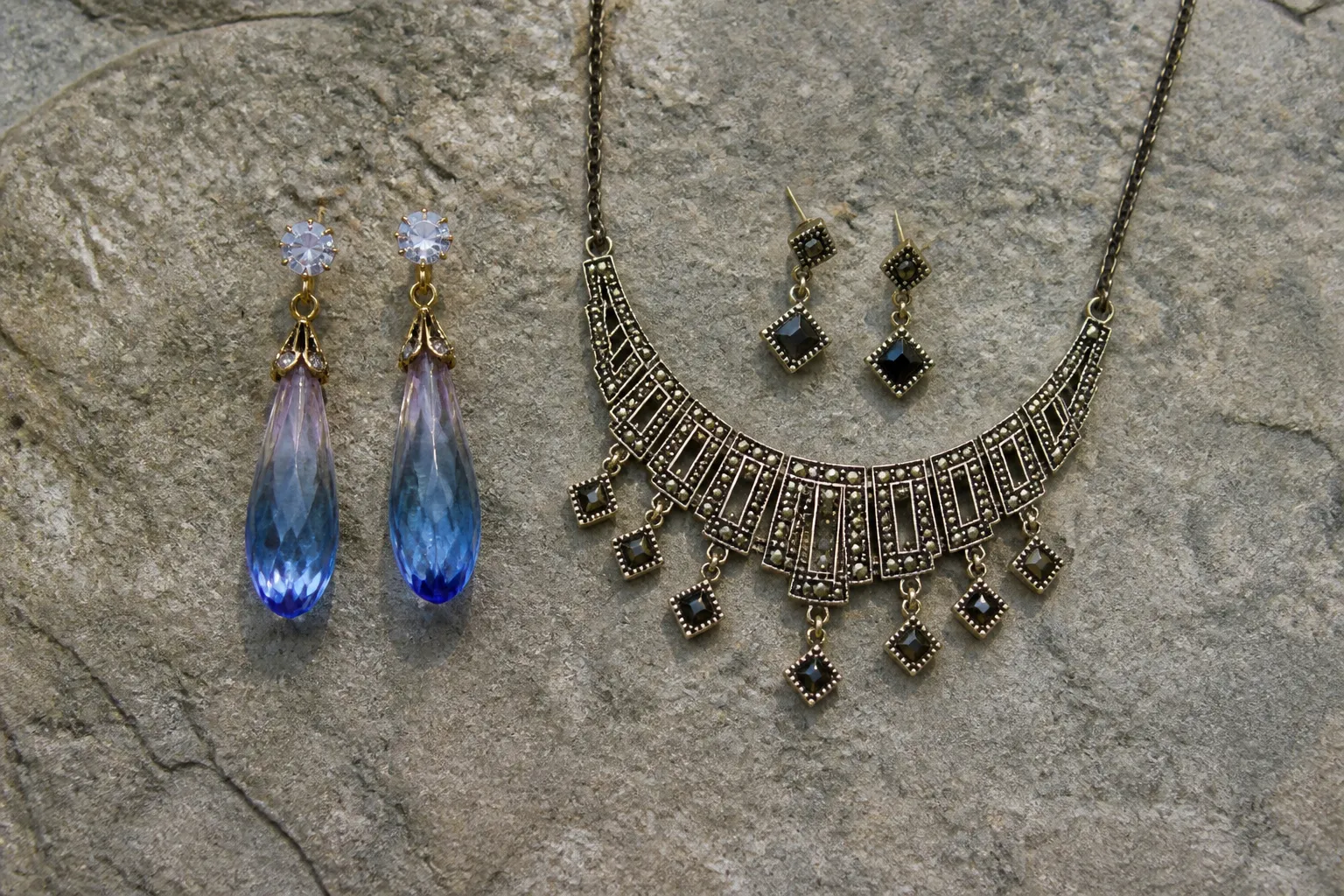
- Designs like the Vintage Green Crystal Geometric Jewelry Set demonstrate how ready-made pieces can carry the visual richness buyers typically associate with custom work — without the wait
Limitations / trade-offs:
- Not brand-exclusive unless sourced via OEM route
- Style selection is constrained to current catalog availability
- The "made for us" marketing narrative requires the OEM path, not stock sourcing
How it compares to custom jewelry: Specialty sets occupy the sweet spot between generic wholesale and expensive custom: distinctive design, immediate availability, proven market fit. For buyers filling seasonal assortment gaps or testing new aesthetics, they carry far less risk than a custom run with a 90-day lead time and a tooling invoice.
Side-by-Side Comparison Table
| Dimension | Custom Jewelry (Bespoke) | STRAND Stock Catalog | Kay Jewelers Personalized | OEM Private Label | Icebox Luxury Custom | Local Studio (Mystique) |
|---|---|---|---|---|---|---|
| MOQ | 50–500+ per design | 12 pcs/style (most styles; 1 pc on select) | N/A — consumer DTC | 100–500+ per design | N/A — single piece | N/A — single piece |
| Lead Time | 6–12+ weeks | Days (in-stock) | Days–weeks | 8–14 weeks | 4–10 weeks | 2–8 weeks |
| Design Exclusivity | High | Shared catalog; OEM for exclusivity | Preset configurations | High | High | High |
| Unit Cost | High | Low–mid (wholesale) | Mid–high (retail) | Low at scale | Very high | Very high |
| B2B / Wholesale Path | Often yes (factory-dependent) | Yes — core model | No | Yes | Limited | No |
| Multilingual Support | Varies by factory | EN, FR, AR, ES, DE, RU | English-primary | Varies | English-primary | Local language only |
| QC Process | Varies by vendor | In-house pre-shipment | Retail brand standards | Varies; audit separately | In-house | Artisan standard |
How to Pick the Right Alternative
The right choice depends on where you are in your business cycle and what problem you're actually solving — not which option sounds most premium.
You're a DTC store owner testing a new jewelry category. Start with a stock catalog supplier at low MOQ. Twelve units per style is a test, not a commitment. Prove demand before you invest in OEM tooling or custom design fees.
You're an importer building a private label brand. Stock catalog buying gives you breathing room. Use the first season to identify which styles convert, then commission OEM versions of your top performers under your brand. If your supplier already offers both catalog and OEM through the same relationship, you're not switching factories — just changing the production instruction.
You're sourcing for a boutique or gallery that markets provenance. Local custom jewelers or luxury bespoke suppliers are worth the premium — your customers are buying the story as much as the piece. Don't expect scalability; plan for it accordingly.
You're a wholesale buyer for a mid-market retailer. Skip full custom entirely for your core assortment. A vetted catalog with 100+ styles, reliable restocking, and in-house QC is more operationally sound than custom production for trend-driven, seasonal inventory. Reserve OEM for your two or three hero SKUs per season.
Your procurement team works across multiple languages. Supplier communication is a real operational cost that most buyers underestimate. A misspecified plating call or a stone size misunderstanding costs you a sampling round and six weeks. Prioritize suppliers with documented multilingual support in your team's working languages before shortlisting on price.
You want personalization without custom complexity. Study what Made By Mary and Jewlr actually sell — name bars, birthstone accents, layering sets — then find catalog equivalents or OEM suppliers who produce in that aesthetic. Most end consumers don't need bespoke. They need personal-feeling.
The Right Call for Your Buyer Profile
Full custom jewelry earns its place for a narrow set of use cases: single-piece commissions, high-margin bespoke retail, and established brands with the volume and budget to justify tooling and long lead times. For everyone else — DTC store owners, importers building catalogs, wholesale buyers managing seasonal inventory — the alternatives are faster, lower-risk, and easier to scale.
The most practical starting point for most B2B buyers is a low-MOQ stock catalog supplier with an OEM option built in: test at 12 units, scale what works, commission branded versions of proven performers when the data supports it. Add multilingual procurement support, in-house QC, and flexible trade terms, and you've removed the three biggest operational friction points that make custom-only sourcing so costly.
Browse the full catalog, get current MOQ and pricing, or request a sample order at strandjewelry.com — the minimum to start is 12 pieces per style.