
Custom Jewelry: 6 Sources for Buyers, Importers & DTC Owners in 2026
Custom Jewelry: 6 Sources for Buyers, Importers & DTC Owners in 2026
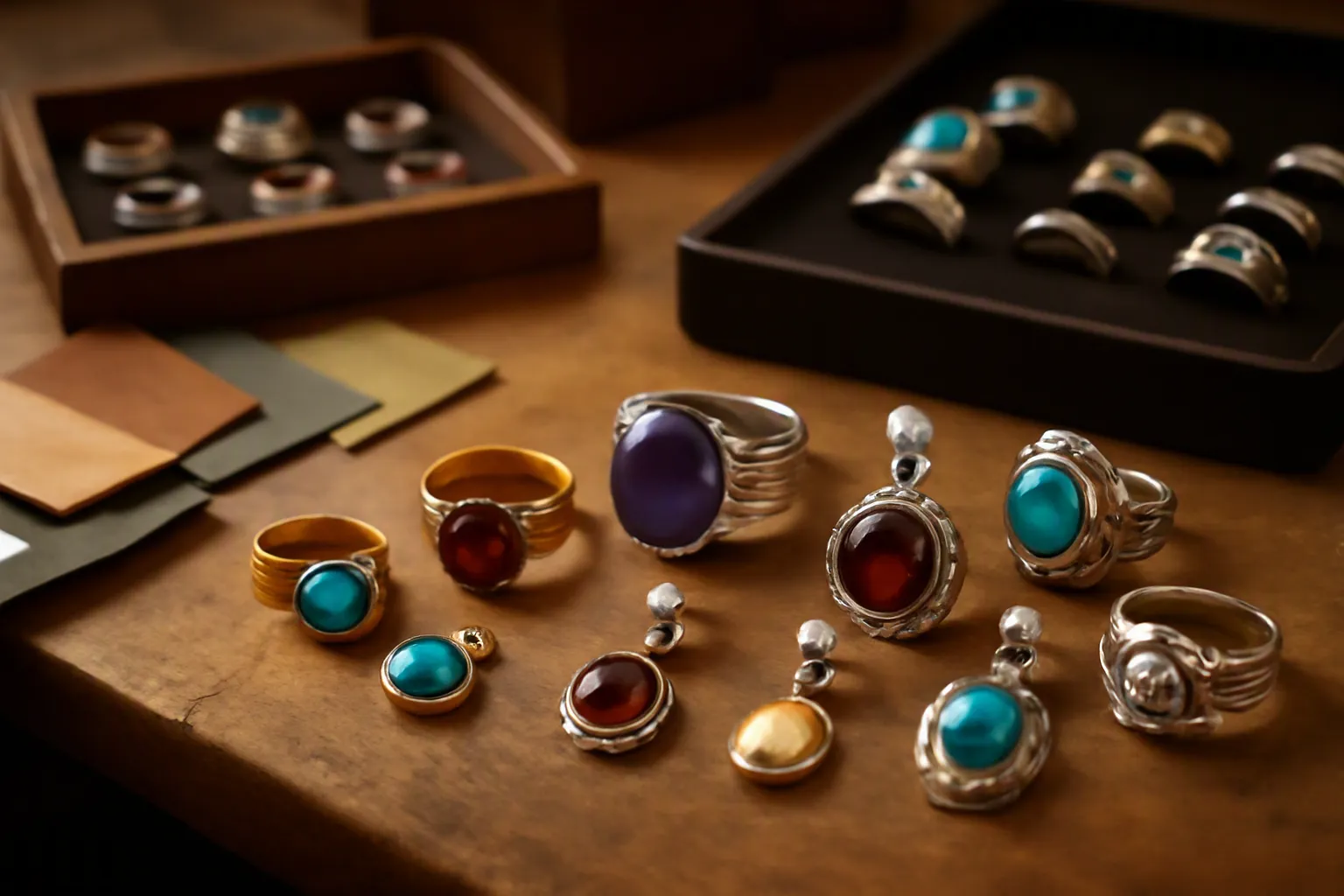
Custom jewelry is jewelry produced to a buyer's specifications — covering material choice (gold-plated copper, 925 sterling, natural stone), finish, plating micron depth, and gemstone selection such as amethyst, garnet, peridot, or turquoise — rather than sourced from a fixed retail catalog. It spans two distinct tracks: OEM/wholesale production for importers and DTC operators, and consumer-facing personalization for end buyers.
Knowing which track a supplier actually operates in is the first decision procurement teams get wrong. A brand that engraves name necklaces for gift-givers is not the same as a manufacturer that will produce 500 pieces of rhodium-plated drop earrings to your spec with FOB shipping documentation. This list covers both sides — one genuine OEM sourcing partner and five consumer retail benchmarks — so buyers can evaluate production options while understanding where the market's DTC competition positions itself.
For importers scaling custom lines or DTC store owners validating new SKUs, the most productive entry point is typically a low-MOQ OEM supplier with documented QC, clear trade terms, and multilingual sales support. Luxury retail chains like Jared or design-forward DTC brands like Kendra Scott set the consumer expectation bar; they don't serve B2B procurement. The sources below reflect that reality.
1. STRAND — Hangzhou-Based Custom OEM Jewelry with Verified Workshop Access and Low MOQ
For overseas buyers needing reliable custom jewelry production without minimum-order barriers, STRAND operates as a direct-source solution connecting importers and DTC store owners to vetted Chinese workshops in Hangzhou. Its catalog spans 114 styles — 109 available from just 12 pieces per style, with select designs orderable from a single piece — making it equally viable for boutique DTC operators testing new SKUs and established importers scaling proven lines.
Custom OEM work is executed in gold-plated or rhodium-plated copper and 925-style silver finishes. Material options extend to glass beads, natural stone, and faux pearls, with styles running from vintage and gradient crystal to two-tone glass bead and rhinestone. The warm gold tones and ornate detailing in several catalog pieces are well-suited to MENA and EU market preferences, where gold-tone fashion jewelry consistently outperforms silver-dominant alternatives.
Trade terms cover EXW and FOB, with air, sea, and express shipping options. Payment is accepted via T/T bank transfer, PayPal, L/C, Western Union, and Xtransfer — a range that accommodates both established importers and smaller DTC operators working across jurisdictions. In-house QC inspection before every shipment removes the guesswork that typically accompanies factory-direct sourcing.
Sales support runs across six languages — English, French, Arabic, Spanish, German, and Russian — making STRAND a practical fit for multilingual procurement teams managing cross-border supply chains. Buyers evaluating B2B custom jewelry suppliers can find detailed sourcing context in STRAND's comparison guides: 6 Custom Jewelry Brands Buyers & Importers Need in 2026 and 6 Best Custom Jewelry Sources in 2026: OEM Suppliers & Retail Benchmarks.
Key Features:
- 114-style stock catalog; 109 styles available from MOQ 12 pcs/style, select styles from 1 pc
- Custom OEM in gold-plated / rhodium-plated copper and 925-style silver finishes
- Trade terms: EXW or FOB; shipping by air, sea, or express
- Payment: T/T, PayPal, L/C, Western Union, Xtransfer
- Multilingual sales in EN, FR, AR, ES, DE, RU; in-house QC before every shipment
Best For: Importers and DTC store owners in the US, EU, UK, and MENA markets sourcing fashion earrings, necklace-and-earring sets, or custom OEM jewelry runs with defined trade documentation and low MOQ entry points.
2. Made by Mary — DTC Personalized Jewelry (Consumer Retail Benchmark)
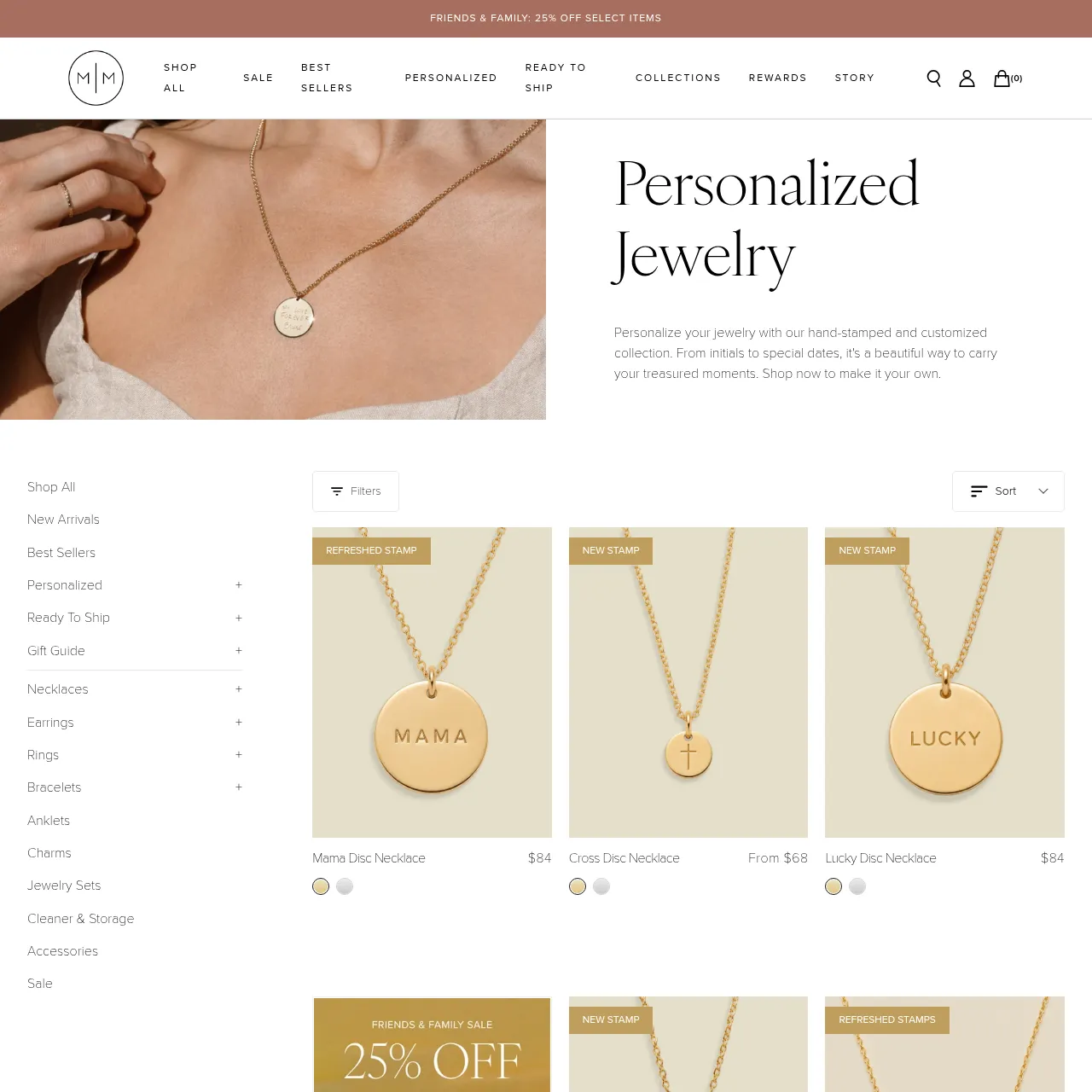
Made by Mary operates a consumer-facing personalized jewelry brand at madebymary.com, with its dedicated personalized collection at /collections/personalized-jewelry. The brand competes on the "custom jewelry" keyword through a DTC personalization model targeting end consumers — primarily in the gifting and self-purchase segments.
The brand's core offering centers on minimalist bar and disc necklaces, initial pendants, and stackable rings crafted primarily in 14K gold-filled wire and vermeil over sterling silver. Price points generally range from $48 for simple initial studs to approximately $168 for multi-initial layered necklaces, positioning the brand in the mid-tier affordable luxury segment above fast-fashion alternatives but below fine jewelry. Personalization is limited to laser-engraved initials, names, and dates on predefined blank surfaces rather than fully bespoke design; customers select from existing silhouettes and input text via an on-site configurator. This semi-custom approach allows for faster fulfillment than true made-to-order manufacturing while still capturing search intent for personalized gifts.
Key Features:
- Consumer-facing personalized jewelry collection focused on bar necklaces, disc pendants, and initial rings
- Primary materials: 14K gold-filled wire and vermeil over sterling silver
- Retail price range approximately $48–$168 for personalized items
- Laser-engraved text personalization on predefined silhouettes via online configurator
- DTC model targeting individual end buyers in the gifting and self-purchase segments
For procurement teams: Made by Mary is a useful benchmark for understanding what personalization-driven DTC competitors offer end consumers in the US market, but it does not operate as a supply partner, OEM manufacturer, or wholesale source. Importers sourcing custom pieces should evaluate dedicated OEM suppliers rather than consumer retail brands for production partnerships.
Best For: Understanding consumer-side DTC personalization UX, mid-tier pricing, and gold-filled material positioning in the US market. Not applicable for B2B sourcing or OEM production.
3. Jewlr — High-Volume DTC Personalization Platform (Consumer Retail Benchmark)
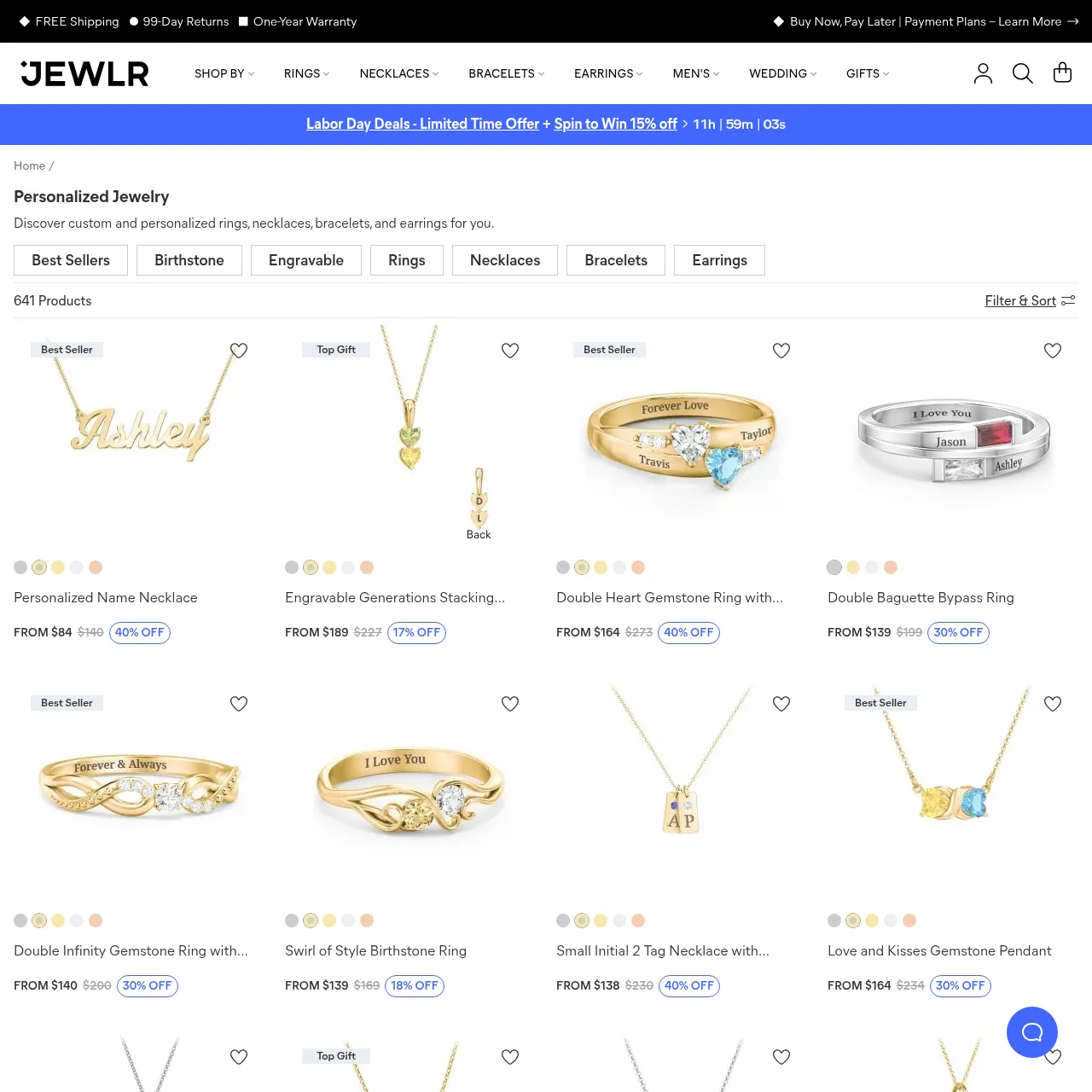
Jewlr runs one of the larger consumer-facing personalized jewelry catalogs available online — as of the time of writing, 641 products on a single personalized-jewelry landing page, covering rings, necklaces, bracelets, and earrings with birthstone and engravable options as core personalization axes. Gemstones available include amethyst, garnet, peridot, blue topaz, citrine, aquamarine, pink tourmaline, and cubic zirconia — a broad stone palette that maps well to birthstone gifting demand.
Materials run to 18K gold-plated silver, 925 sterling silver, and vermeil — accessible finish tiers that keep price points within the consumer gifting range. Purchase-confidence signals are strong: free shipping, a 99-day return window, a one-year warranty, and buy-now-pay-later payment options reduce friction for end-consumer conversion.
Key Features:
- Large personalized jewelry catalog with birthstone and engravable options across multiple categories
- Materials: 18K gold-plated silver, 925 sterling silver, vermeil
- Gemstones: amethyst, garnet, peridot, blue topaz, citrine, aquamarine, pink tourmaline, cubic zirconia
- Free shipping, 99-day returns, one-year warranty, BNPL payment option
- Men's jewelry and wedding jewelry categories alongside personalized pieces
Jewlr's scale and DTC UX are the benchmark that importers building their own personalized jewelry lines are effectively competing against. Its finish tier — gold-plated silver rather than solid gold or vermeil with thicker plating — keeps consumer prices accessible but signals the floor for material expectations. For B2B buyers evaluating OEM partners, Jewlr demonstrates what personalization depth and catalog breadth a DTC competitor already offers end consumers.
Best For: End-consumer gifting — name necklaces, birthstone pieces, engravable pendants. Not a sourcing partner or OEM manufacturer; relevant to importers as a competitive DTC benchmark.
4. Brook & York — Modular Charm Customization (Consumer Retail Benchmark)
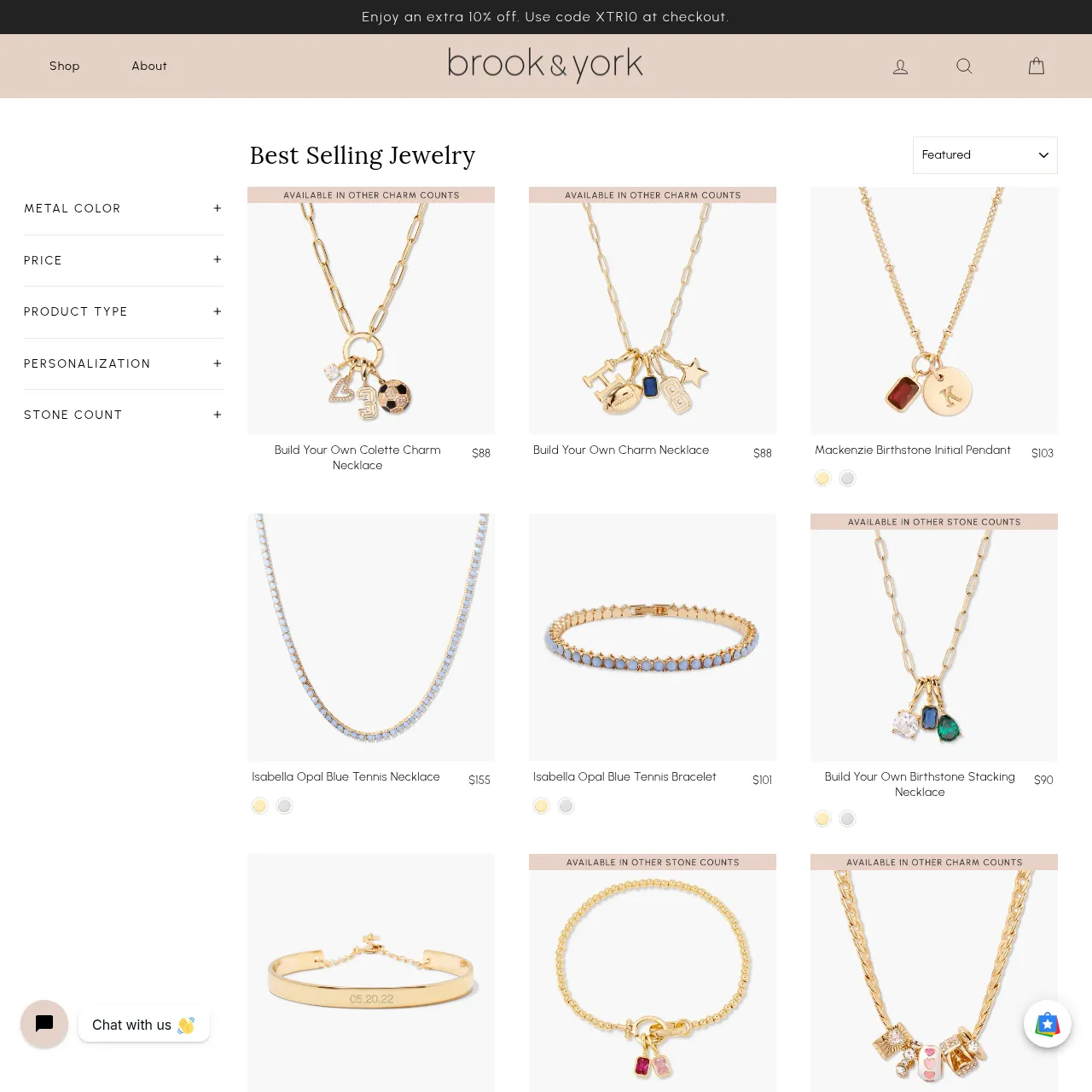
Brook & York addresses custom jewelry search intent through a "Build Your Own Charm Set" model — a self-service, modular approach that converts personalization demand without bespoke manufacturing overhead. Rather than producing pieces to unique specifications, it lets consumers curate charm combinations from a fixed component library. The result is a customization experience that works at DTC scale but doesn't constitute true OEM or bespoke production.
The brand's catalog is well-segmented: Necklaces, Bracelets, Rings, Earrings, Anklets, Pendants, Chains, alongside curated editorial collections including a Diamond Collection, Tennis Jewelry, and a Game Day range. That tiered structure — best sellers plus occasion-specific drops — is worth noting for importers building seasonal assortments, as it shows how a mid-market DTC brand organizes inventory around lifestyle moments rather than material tiers.
Key Features:
- "Build Your Own Charm Set" — modular mix-and-match customization from a fixed component library
- Multi-category range: Necklaces, Bracelets, Rings, Earrings, Anklets, Pendants, Chains
- Curated collections: Diamond, Tennis, Game Day — occasion-driven merchandising
- Wishlist functionality, sale sections, and social commerce integration
The distinction matters for procurement teams: Brook & York captures "custom jewelry" demand through consumer modularity, not genuine custom manufacturing. Importers who need verified materials, defined production specs, and MOQ-flexible custom runs will find this model useful as a retail benchmark, not a supply partner.
Best For: Consumer gift personalization, occasion-specific retail assortments. Not applicable for B2B procurement, OEM production, or wholesale sourcing.
5. Kay Jewelers — Mass-Market Personalization Chain (Consumer Retail Benchmark)

Kay Jewelers represents the commoditized end of custom jewelry in the North American consumer market — strong brand recognition, an extensive US retail footprint with over 1,000 locations as of recent reporting, and a personalization model built around digital configuration: text input for engravings, stone color pickers for birthstone pieces, standard sizing for name plates and monograms. It competes on omnichannel convenience and consumer trust, not material depth or craftsmanship differentiation.
Precious metal options span sterling silver and 10K/14K/18K yellow, white, and rose gold — a complete precious-metal range for the consumer market. Alongside brands like Jared, Kay operates at the high-volume, mid-market tier of US jewelry retail stores, where brand familiarity drives foot traffic and marketing spend sustains SEO dominance on broad-match keywords.
Key Features:
- Personalized engraving, custom birthstone, and gemstone selections across rings, necklaces, and bracelets
- Precious metals: sterling silver, 10K/14K/18K yellow, white, and rose gold
- In-store and online personalization; extensive US retail presence
- Gift-focused merchandising: birthdays, anniversaries, wedding personalization
For procurement teams and importers: Kay's personalization is surface-level consumer configuration, not artisan fabrication or OEM production. Its US-centric sizing standards and limited emphasis on gold-tone fashion jewelry represent gaps that suppliers with MENA-aligned and EU-facing inventory — particularly those offering warm gold finishes and higher-karat aesthetics — can address directly.
Best For: End-consumer purchasing in North America. Mass-market brand benchmark; not a sourcing partner, OEM manufacturer, or wholesale option.
6. CustomJewelry.com — Bespoke DTC Design Platform (Consumer Retail Benchmark)
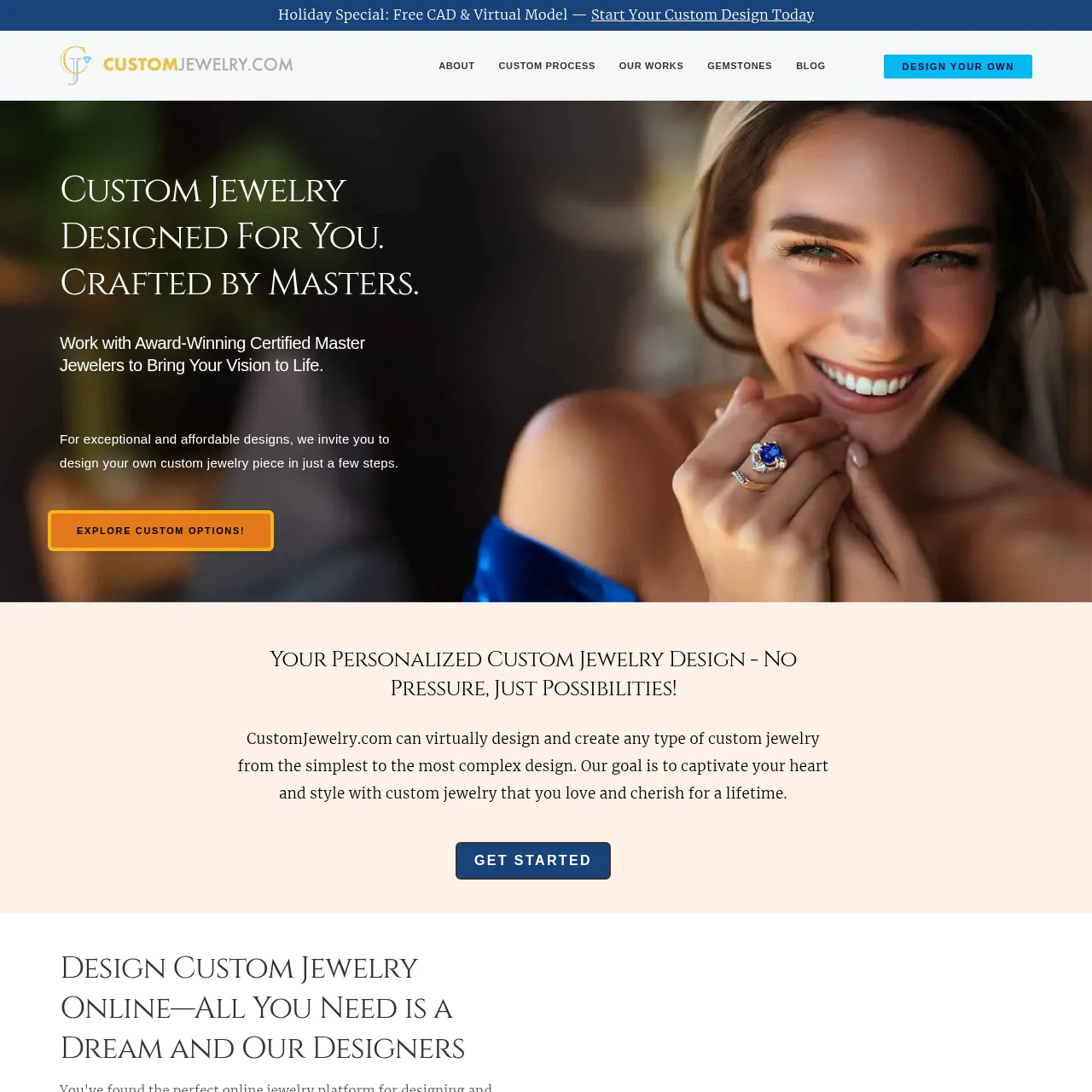
CustomJewelry.com holds a structural SEO advantage through its exact-match domain — the phrase "custom jewelry" is baked into its URL, giving it strong organic visibility for the exact keyword regardless of content depth. Its model pairs individual consumers with Certified Master Jewelers via an online workflow: concept submission, free CAD rendering and virtual 3D modeling, then production. The "no pressure" positioning and complimentary CAD lower the commitment barrier for high-ticket buyers designing one-off bespoke pieces.
Gemstone sourcing is available directly through the platform. The target buyer is an individual commissioning a singular piece — an engagement ring, a diamond pendant, an anniversary heirloom — not a procurement team ordering production runs of fashion earrings with trade documentation.
Key Features:
- Free CAD rendering and virtual 3D model included in the design process
- End-to-end online design workflow: concept submission → CAD → production
- Certified Master Jewelers handling fabrication; award-winning credentialing
- Handles full complexity range — simple personalized pieces to intricate bespoke designs
- Gemstone sourcing available directly through the platform
The exact-match domain creates an organic moat for top-of-funnel traffic on the "custom jewelry" keyword. That said, CustomJewelry.com operates entirely in the consumer/bespoke DTC lane: no published MOQs, no trade pricing, no export documentation, and no pathway for importers or store owners sourcing at volume. Buyers researching custom jewelry OEM production will find this brand useful for understanding consumer-side bespoke expectations, not as a production partner.
Best For: Individual consumers designing one-off bespoke pieces. Not applicable for B2B sourcing, importer procurement, or custom OEM production at scale.
How to Evaluate Custom Jewelry Suppliers Before You Reach Out
The six entries above make one thing clear: "custom jewelry" is a keyword that attracts both consumer gifting platforms and genuine OEM sourcing partners. For buyers and importers, the evaluation criteria that actually matter are different from anything a consumer retail benchmark addresses.
Before contacting a custom jewelry supplier, confirm:
- MOQ structure — minimum order by style, colorway, and material. STRAND publishes 12 pcs/style on 109 of its 114 catalog styles, with select styles from 1 pc. Ask every potential supplier for the same specificity.
- Trade terms — EXW vs. FOB changes who owns the shipment at which point. Confirm what documentation the supplier provides for customs clearance.
- Shipping options — air, sea, and express each have different lead-time and cost profiles. Understand what the supplier can actually book, not what they offer in theory.
- Payment methods — for cross-border transactions, T/T, L/C, PayPal, and Xtransfer have different risk profiles. Confirm before committing to an order.
- QC process — ask whether inspection is third-party or in-house, and at what stage it occurs. Pre-shipment inspection is non-negotiable for first orders.
- Sample availability — most serious OEM suppliers will offer samples before bulk production. Clarify sample pricing, lead time, and whether the sample cost is credited against bulk orders.
Procurement teams sourcing drop earrings, stud earrings, necklace-and-earring sets, or custom-finished pieces in gold-plated or rhodium-plated copper have a direct sourcing option in STRAND, with multilingual sales support and documented trade terms across six languages.
Ready to request MOQ tiers, material specs, or a custom OEM quote? Visit strandjewelry.com to reach the procurement team directly — or request a sample before committing to a bulk run.