
8 Best Alternatives to Custom Jewelry for DTC Brands in 2026
8 Best Alternatives to Custom Jewelry for DTC Brands in 2026
Custom jewelry promises a lot — pieces built to your exact spec, your finish, your customer's name or stone. The reality for many buyers is different: supplier communication breaks down, MOQs land higher than expected, and timelines stretch from "six weeks" into months. For DTC store owners and importers who've hit those walls, the question isn't whether to look for alternatives — it's which one fits.
This guide covers eight of the best alternatives to custom jewelry for buyers at every scale, from B2B OEM sourcing to retail personalization platforms. Each option is assessed on the criteria that matter at the purchasing stage: pricing, MOQ, customization scope, lead time, and support.
Why Look for Alternatives to Custom Jewelry?
Custom jewelry sourcing, at its worst, is a series of compounding friction points. The first is MOQ. Many custom jewelry manufacturers — particularly workshops accepting small B2B accounts — set minimum order quantities that make sense for them but kill margin for DTC brands just starting to scale. You may need 200 pieces per style when you wanted to test 30.
Pricing opacity is the second issue. Custom quotes often surface hidden tooling fees, sample charges, and per-revision costs that don't appear until you're two weeks into negotiations. By contrast, alternatives like stock catalog suppliers or DTC personalization platforms display pricing upfront — which matters when you're planning a product launch with real margin targets.
Lead time is where many custom orders lose buyers. Standard custom jewelry production timelines can run 30 to 60 days for a first order, often longer when sampling rounds are required. For buyers who need to respond to seasonal demand or restock quickly, that window is too wide. Alternatives with ready-to-ship inventory or pre-engineered personalization can reduce fulfillment to days.
What to Look for in a Custom Jewelry Alternative
Before shortlisting suppliers or platforms, define what "custom" actually means for your use case. Here's what to evaluate:
- MOQ and scalability: Does the supplier offer a low entry MOQ for testing, with clear volume tiers for scaling up?
- Customization depth: Can you adjust materials, finishes, dimensions, and packaging — or only add an engraving?
- Pricing transparency: Are tooling fees, sample costs, and revision rounds priced upfront?
- Lead time: What are realistic timelines from order to delivery, including sampling?
- QC and quality assurance: Does the supplier conduct in-house inspection before shipping, or does the buyer absorb that risk?
- Payment and trade terms: Are EXW/FOB, T/T, PayPal, or other buyer-friendly payment methods on the table?
- Multilingual support: For cross-border procurement, can the team communicate in your procurement team's language?
Top 8 Alternatives to Custom Jewelry
1. STRAND (Hangzhou OEM Direct)
Best for: DTC brands, importers, and buyers sourcing custom OEM or stock fashion jewelry from China at low MOQ
Pricing: MOQ 12 pcs/style on most stock designs; OEM custom pricing on request via strandjewelry.com
Key strengths vs custom jewelry:
- 12 pcs/style MOQ on 109 of 114 catalog styles — materially lower than most custom jewelry workshops requiring 100–500 pcs; select styles available from 1 pc
- In-house QC inspection before every shipment; no third-party inspection cost passed to the buyer
- Multilingual sales support in EN, FR, AR, ES, DE, and RU — a rare advantage for procurement teams managing cross-border vendor relationships
- Trade terms EXW or FOB; payment via T/T, Western Union, PayPal, L/C, and Xtransfer
Limitations / trade-offs:
- OEM custom designs require a separate design brief, sampling round, and lead time discussion — not instant-to-order
- Catalog focused on earrings, necklaces, and sets (vintage, gradient crystal, rhinestone, two-tone glass bead styles) — not fine jewelry or diamond pieces
- Air, sea, or express shipping adds logistics planning for first-time importers unfamiliar with Hangzhou-to-port flows
How it compares to custom jewelry:
STRAND sits at the intersection of stock catalog efficiency and OEM flexibility. Where a typical custom jewelry arrangement forces buyers to commit to large runs and absorb tooling costs upfront, STRAND lets buyers test 109 catalog styles at 12 pcs/style before committing to OEM production. Gold-plated and rhodium-plated copper designs — drop earrings, studs, and necklace-earring sets in natural stone, faux pearl, and faux crystal — are production-ready, which removes the sampling delay entirely for buyers who can work within existing styles. For DTC brands evaluating the OEM path, the 6 Custom Jewelry Sources Ranked guide on the STRAND blog covers supplier selection criteria in depth before you commit to a quote.
2. Jewlr
Best for: Consumer-facing gifting, DTC brands needing a personalized jewelry range without custom production overhead
Pricing: Personalized name necklaces from $84; engravable pendants from $104; gemstone rings from $139–$189 (per Jewlr's personalized jewelry catalog)
Key strengths vs custom jewelry:
- 646 personalized jewelry products across rings, necklaces, bracelets, and earrings — broad selection without custom production lead time
- Birthstone and engravable options cover the most common personalization requests without custom tooling
- Materials include 18K gold plated silver, 925 sterling silver, and vermeil — mid-tier quality positioning
- Gemstone options span amethyst, garnet, peridot, aquamarine, and citrine, covering the full birthstone calendar
Limitations / trade-offs:
- Designed for end consumers; no B2B bulk pricing, wholesale accounts, or MOQ tiers publicly available
- No OEM or private-label capability — pieces ship branded as Jewlr, not your label
- True custom design (unique silhouettes, proprietary finishes) isn't available; personalization is limited to the existing catalog
How it compares to custom jewelry:
Jewlr trades customization depth for speed and price transparency. Custom jewelry can take weeks to produce a single approved sample; Jewlr ships a personalized piece in days. For DTC store owners who want personalization as a product feature — engraved initials, birthstones, date stamps — platforms like Jewlr eliminate supplier development entirely. The trade-off is brand ownership: your customers receive the piece, but they'll know the maker isn't you.
3. Kay Jewelers
Best for: US consumers and retail buyers seeking in-store custom design for engagement rings and fine jewelry
Pricing: Engagement rings across multiple carat configurations; promotional pricing varies (see Kay's personalized section)
Key strengths vs custom jewelry:
- In-store Custom Design Center with appointment scheduling — hands-on consultation replaces the email back-and-forth of remote custom orders
- Online "Create Your Own" ring configurator supporting center stone shapes including princess, round, oval, pear, emerald, marquise, cushion, radiant, and heart cuts
- Lab-grown diamond options alongside mined stones — relevant for buyers with sustainability or budget constraints
- Established US retail network; no import logistics, no language barrier
Limitations / trade-offs:
- US in-store required for custom design; no international shipping on custom orders
- Price points carry luxury retail markup — not competitive for importers or B2B buyers managing margin
- Strictly consumer-facing; no OEM, wholesale, or private label
How it compares to custom jewelry:
Kay is the right alternative when the buyer is a US consumer needing a ring or pendant with specific stone choices — and wants to physically see it before purchasing. For a B2B importer or DTC brand, Kay's retail model doesn't scale. But its diamond and gemstone configurator sets a useful reference point for what personalization features US consumers increasingly expect from any jewelry brand, custom or not.
4. Jared
Best for: Luxury custom jewelry in the US; high-ticket fine jewelry with in-store consultant service
Pricing: Luxury tier; in-store design consultations required for custom pieces
Key strengths vs custom jewelry:
- Premium in-store experience across Jared stores with dedicated jewelry consultants guiding the design process
- Full range of luxury stones including turquoise accents, gemstone clusters, and diamond settings
- Strong brand trust for high-value purchases — relevant when the end consumer is spending at engagement or anniversary gift levels
- Financing options that a standalone custom jewelry workshop typically can't offer
Limitations / trade-offs:
- Highest price tier of all alternatives reviewed here; cost-sensitive buyers are priced out entirely
- US stores only — no B2B, OEM, or wholesale capability
- Customization is consultant-led and primarily centered on fine jewelry and engagement rings; fashion jewelry isn't the focus
How it compares to custom jewelry:
Jared competes in the luxury end of custom jewelry — the same space as bespoke ateliers and high-end commission work. The difference is retail infrastructure: walk-in accessibility, brand trust, and financing options that a standalone custom jewelry workshop rarely offers. For importers or DTC brands, Jared's value isn't as a supplier but as a benchmark for what luxury buyers expect in terms of service experience and presentation.
5. Made by Mary
Best for: DTC buyers seeking sentimental, handcrafted-feel personalized jewelry with a lifestyle brand narrative
Pricing: Mid-to-premium consumer DTC; personalized necklaces, charms, and layering pieces
Key strengths vs custom jewelry:
- Strong brand identity and lifestyle positioning that converts well for the gifting and sentimental jewelry segment
- Personalization built into the product experience — names, birthstones, meaningful symbols on pre-designed silhouettes
- Ready inventory with personalization applied at order — significantly faster than custom production
- Appeals to the gifting segment without requiring made-to-order production delays
Limitations / trade-offs:
- No B2B, wholesale, or OEM offering — strictly consumer DTC
- Limited to existing design catalog; no silhouette customization
- Brand-forward model; not suitable for white-label or private-label buyers
How it compares to custom jewelry:
Made by Mary is custom jewelry for the consumer who doesn't want to wait. The personalization here is adding names and stones to pre-designed silhouettes — faster, more predictable, but less flexible than true custom production. For DTC brand owners evaluating whether to develop proprietary custom jewelry or carry a third-party personalization brand, the Custom Jewelry vs. Retail Personalization: The B2B Buyer's Guide covers that trade-off in detail.
6. Brook & York
Best for: Minimalist personalized jewelry for consumers; DTC brands benchmarking a clean, modern aesthetic
Pricing: Mid-range DTC consumer pricing; necklaces, rings, and charm jewelry
Key strengths vs custom jewelry:
- Clean, minimalist design aesthetic that appeals to a broad US and EU consumer base
- Personalization through initials, birthstones, and engravings on established styles — no production wait
- Strong brand photography as a reference point for DTC brands building their own creative assets
Limitations / trade-offs:
- No B2B or wholesale capability; no MOQ pricing
- Design aesthetic is narrow — works for minimalist brands, not for rhinestone, crystal, or statement jewelry categories
- No OEM or private-label path
How it compares to custom jewelry:
Brook & York resolves the speed problem of custom jewelry — personalized pieces ship without a 30-day production queue — but doesn't solve the brand ownership problem. For a DTC importer who needs their label on the product, this doesn't work. For a retailer benchmarking consumer expectations around personalized jewelry aesthetics, it provides a concrete stylistic reference.
7. Kendra Scott
Best for: Retail personalization at the consumer level; fashion-forward buyers benchmarking in-store customization models
Pricing: Mid-to-premium fashion retail; in-store Color Bar customization available
Key strengths vs custom jewelry:
- In-store Color Bar lets consumers choose metal finish and stone — including amethyst, turquoise, garnet, and peridot — creating a personalized piece on the spot
- Strong brand recognition in the US fashion jewelry segment with a large retail footprint across stores nationwide
- Consistent finish quality across a wide design range in gold and silver tones
- Available in stores and online; wide accessibility for end consumers
Limitations / trade-offs:
- Strictly consumer retail — no B2B, wholesale, or OEM
- Customization limited to stone color and metal selection within existing silhouettes; no new design creation
- Price carries a brand premium; not cost-effective for resellers
How it compares to custom jewelry:
Kendra Scott's Color Bar is a retail-level answer to the customization demand that custom jewelry tries to solve at the manufacturing level. For buyers developing their own fashion jewelry line, it illustrates what "light personalization" looks like at retail scale — and sets a clear benchmark for quality and presentation. The insight for DTC brands: consumers don't always need fully custom. They need meaningful, visible choice.
8. Ready-to-Ship Stock Catalog Jewelry
Best for: Buyers who prioritize speed, price consistency, and zero production risk over exclusive custom specs
Pricing: Lowest entry cost of all alternatives; volume discounts available through direct sourcing relationships
Key strengths vs custom jewelry:
- No sampling rounds or tooling fees — what's in the catalog is production-ready and orderable immediately
- Fastest fulfillment path: air or express shipping from stock eliminates production lead time entirely
- Price predictability across repeat orders; no per-unit cost variation between batches
- Lets DTC brands validate which styles sell before investing in OEM custom development
Limitations / trade-offs:
- No proprietary design ownership — competitors can order identical styles from the same source
- Finished goods may not match specific brand positioning, packaging, or finish requirements
- MOQ still applies per style; not all catalog styles have the same entry point
How it compares to custom jewelry:
Stock catalog jewelry is the fastest path from idea to inventory — and for many DTC brands in the early growth stage, it's the strategically correct one. The trade-off with custom jewelry is design exclusivity: a custom OEM piece is yours; a catalog piece is available to anyone who finds the same supplier. For buyers building brand equity over time, stock catalog styles can serve as the market-testing foundation while OEM custom development runs in parallel with lower financial risk.
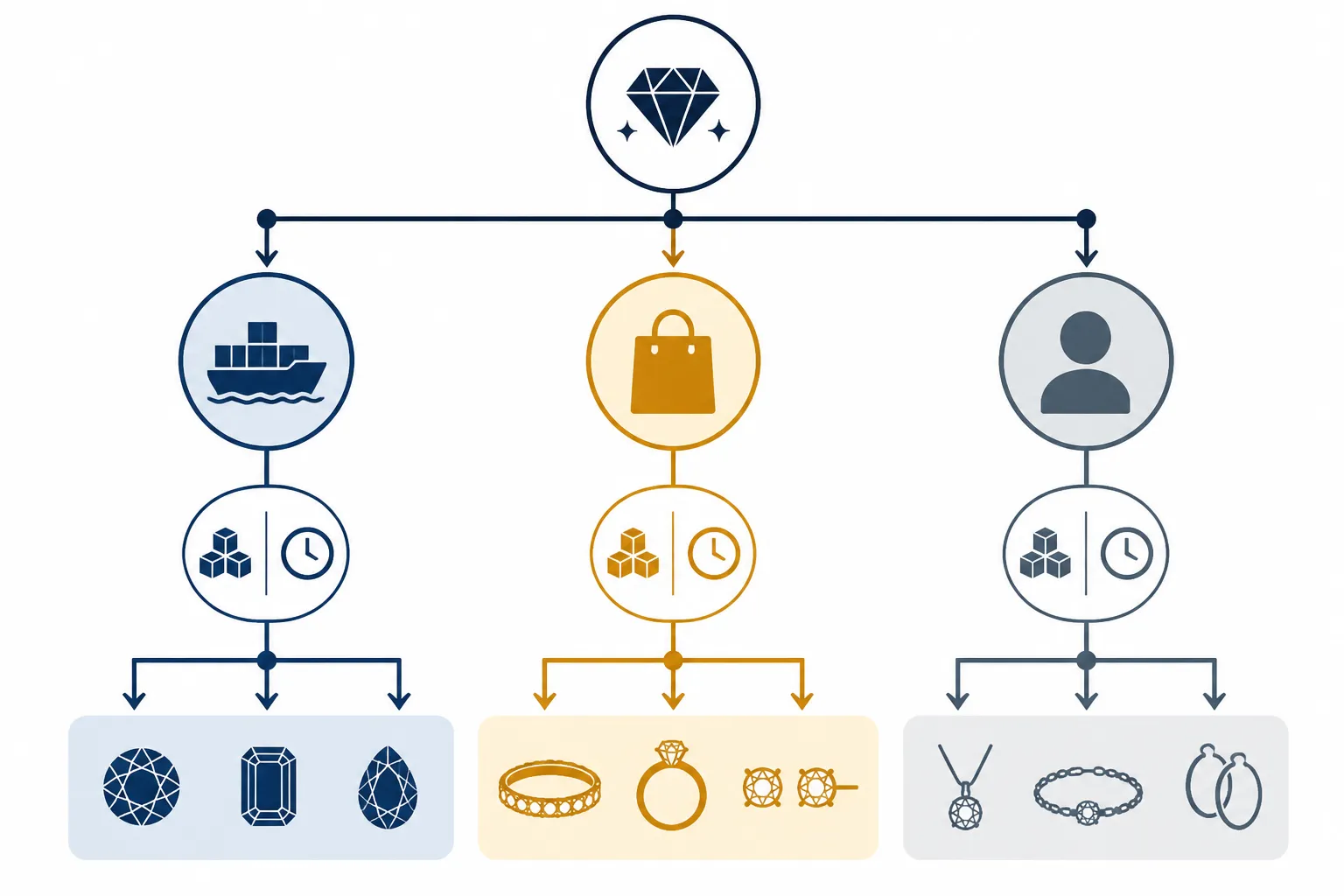
Side-by-Side Comparison Table
| Dimension | STRAND | Jewlr | Kay Jewelers | Jared | Made by Mary | Kendra Scott |
|---|---|---|---|---|---|---|
| Best for | B2B OEM / bulk import | Consumer personalization | US in-store custom | Luxury fine jewelry | DTC sentimental gifting | Fashion retail customization |
| MOQ | 12 pcs/style (most styles) | 1 pc (consumer) | 1 pc (consumer) | 1 pc (consumer) | 1 pc (consumer) | 1 pc (consumer) |
| Customization depth | High (OEM + stock catalog) | Medium (engrave + birthstone) | High (ring configurator) | High (fine jewelry design) | Low–medium (name + stone) | Low (stone + metal choice) |
| Price tier | Trade / wholesale | Consumer mid | Consumer premium | Consumer luxury | Consumer mid-premium | Consumer mid-premium |
| B2B / wholesale | Yes | No | No | No | No | No |
| Lead time | Stock: fast; OEM: quote-based | Days | In-store: days; custom: weeks | Weeks | Days | Days (in-store) |
How to Pick the Right Alternative
If you're a DTC brand or importer sourcing 50–500 pieces per style: STRAND's 12-pcs MOQ on stock catalog styles and OEM capability makes it the most practical entry point. Test stock designs first, validate which convert, then scale into custom OEM with data backing your decisions.
If you need personalized jewelry for end consumers — gifting, birthstones, engraving — and brand ownership isn't a requirement: Jewlr's catalog of 646 personalized products in sterling silver and gold-plated finishes covers that use case efficiently, with no production wait.
If you're a US consumer or small retailer sourcing engagement rings or one-off luxury pieces: Kay Jewelers' Custom Design Center and Jared's in-store consultant experience are purpose-built for this segment. The online ring configurator at Kay supports every major center stone cut and lab-grown diamond options — a reference point for what today's fine jewelry buyer expects.
If your target consumer is in the US fashion jewelry segment and you need catalog or competitor benchmarking: Kendra Scott's Color Bar model — where customers select their stone (amethyst, garnet, peridot, turquoise) and metal finish in-store — shows what meaningful light personalization looks like at retail scale.
If you need the fastest possible time to market with zero production risk: Ready-to-ship stock catalog jewelry eliminates every delay associated with custom production. Trade design exclusivity for speed and margin predictability — then graduate to OEM when volume justifies it.
Conclusion
Which alternative you choose comes down to one question: what's the actual bottleneck in your current custom jewelry sourcing?
If it's MOQ, STRAND's 12 pcs/style entry point on 109 catalog styles removes it — and the OEM path scales from there. If it's lead time, stock catalog or DTC personalization platforms like Jewlr get product in hand in days. If it's consumer experience in the US market, Kay or Jared's in-store design infrastructure handles that better than any remote alternative.
For B2B buyers and importers, the comparison table above is a starting point. Real terms — OEM pricing, sampling lead times, custom finish options, payment flexibility — only emerge from a direct conversation with the supplier.
Request a catalog or OEM quote from STRAND at strandjewelry.com. Include your target styles, required quantities per style, and destination market. The multilingual team (EN, FR, AR, ES, DE, RU) responds to procurement inquiries with actual numbers, not ballpark estimates.