
6 Best Alternatives to Custom Jewelry for Brands in 2026
6 Best Alternatives to Custom Jewelry for Brands in 2026
Custom jewelry can solve a genuine problem — distinctive product, brand differentiation, pieces that don't look like every other catalog. The trouble is that fully bespoke production comes loaded with costs, timelines, and minimums that quietly erode those advantages. This guide maps out six alternatives worth serious consideration, whether you're a consumer looking for personalized pieces without the bespoke price tag, or a procurement team building out a fashion jewelry vertical.
Why Look for Alternatives to Custom Jewelry?
Custom jewelry — truly made-to-spec from scratch — sounds compelling in theory. The friction appears early and compounds quickly.
Cost and minimum order pressure. A fully custom production run involves tooling fees, sampling rounds, revision cycles, and minimums that rarely accommodate small-scale testing. For a DTC brand validating a new direction, committing to 500 units of an untested design ties up cash that could be deployed across a broader range. Many wholesale buyers find that custom quotes only pencil out at volume — meaning they're either over-ordering inventory or paying a premium per unit on small runs that kills the margin math.
Lead times that don't match trend cycles. Custom OEM production typically runs 30–90 days from brief to finished goods, exclusive of sampling. Fashion jewelry categories driven by seasonal demand and social commerce move faster than that. By the time a custom run clears production, QC, and freight, the window for the trend that inspired it may have closed. Stock catalog programs exist precisely because speed-to-market is often worth more than originality.
Consistency and compliance risks. Custom doesn't automatically mean consistent. Without robust supplier-side QC, second and third production runs frequently drift from the approved sample — plating thickness, stone color, finish. Buyers in the EU and UK face additional pressure as nickel-release directives and labeling requirements tighten; those compliance needs must be baked into supplier selection, not addressed after the first container arrives.
What to Look for in a Custom Jewelry Alternative
Before shortlisting a supplier or platform, test candidates against these criteria:
- MOQ flexibility: Can you open with 12–50 pieces to validate demand, or are minimums in the hundreds?
- Personalization depth: Does the alternative support engraving, stone substitution, finish selection, or private labeling — or is it strictly off-the-shelf?
- Lead time: What is the realistic door-to-door timeline for your destination market?
- Quality assurance: Is pre-shipment QC documented and performed at the supplier level, or does the inspection burden fall on you?
- Trade terms and payment options: Are T/T, PayPal, L/C, and both EXW and FOB available?
- Compliance documentation: Can the supplier provide EU REACH, nickel directive, or US import compliance records?
- Reorder reproducibility: Can the supplier match plating color, finish, and stone appearance across multiple production runs?
Top 6 Alternatives to Custom Jewelry
1. STRAND — Best for B2B Buyers, Importers, and DTC Store Owners
Best for: Wholesale buyers, DTC brands, and importers in the US, EU, UK, and MENA who need a combination of ready-to-ship stock jewelry and genuine custom OEM capability, without the entry barriers of large bespoke programs.
Pricing: Stock catalog at MOQ 12 pcs/style on 109 of 114 catalog styles; select styles from 1 piece. Custom OEM pricing available on request via strandjewelry.com.
Key strengths vs. custom jewelry:
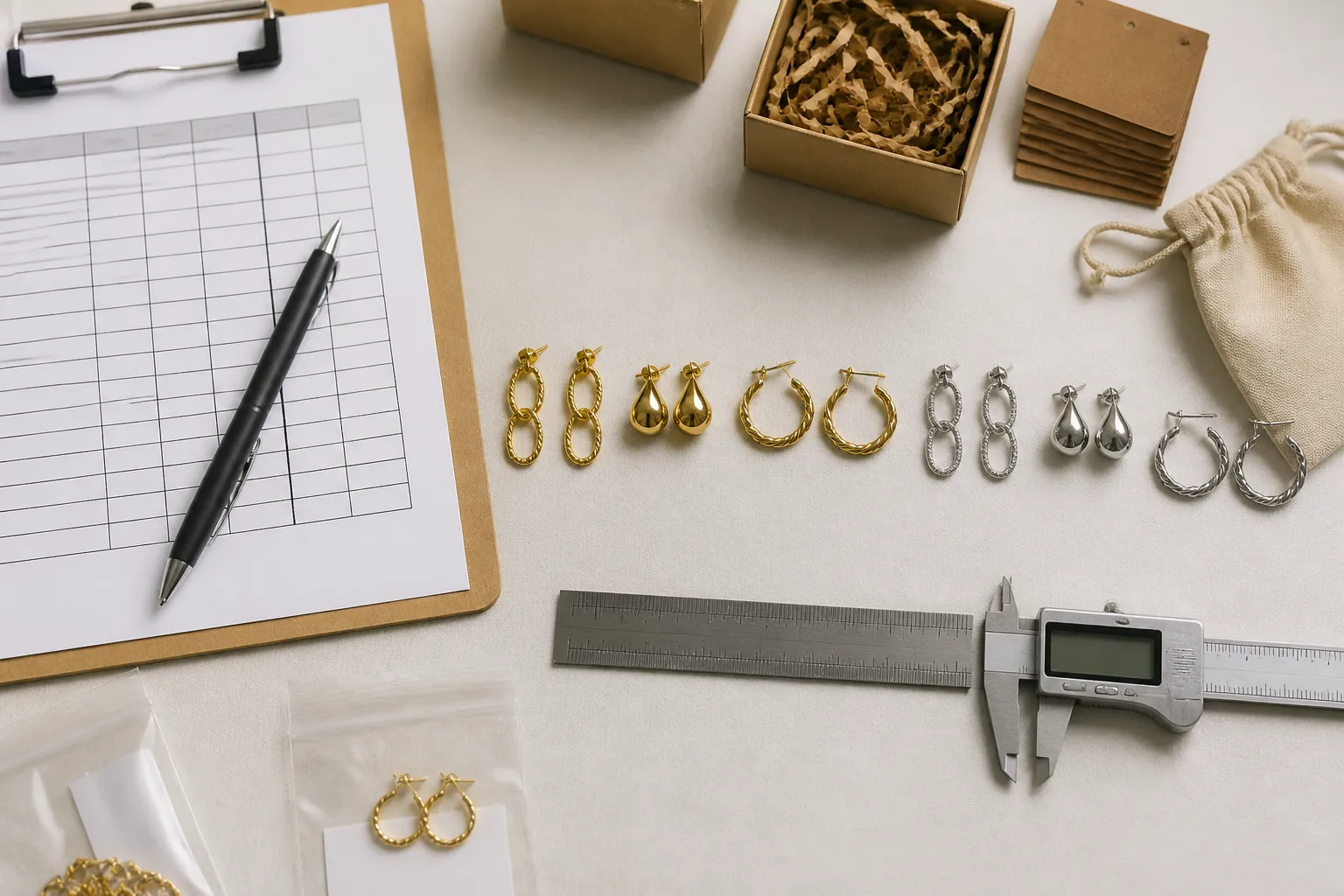
- 114-style stock catalog covering drop earrings, studs, and necklace + earring sets in vintage crystal, gradient, two-tone glass bead, and rhinestone styles — ships without tooling delays, so buyers can fill catalog gaps now rather than in 90 days
- Custom OEM in gold-plated and rhodium-plated copper, 925-style silver finishes, glass beads, and natural stone addresses genuine differentiation needs once demand is proven at the stock level
- In-house QC inspection before every shipment; trade terms include EXW and FOB with air, sea, or express shipping — buyers control their freight cost structure
- Multilingual sales (EN, FR, AR, ES, DE, RU) removes translation friction for procurement teams managing relationships across US, EU, and MENA markets simultaneously
Limitations / trade-offs:
- Fashion jewelry category (gold/rhodium-plated copper, glass, natural stone) — not a fit for buyers requiring solid gold or diamond-grade fine jewelry
- Custom OEM involves sampling rounds and production lead time; not a solution for same-week fulfillment
- Catalog is strongest in earrings and sets; buyers whose primary need is rings or bracelets should confirm current availability before planning assortments
How it compares to custom jewelry: Where fully bespoke custom requires a single large upfront commitment before a single unit sells, STRAND's hybrid approach lets buyers start with stock pieces at MOQ 12 per style to test market response, then scale into custom OEM once winning directions are identified. That staging reduces inventory risk materially. The Hangzhou-based sourcing model also links buyers directly to vetted workshops rather than adding a trading-company layer — relevant for buyers who've been burned by quality drift when the original supplier subcontracted production.
The Two-Tone Rhinestone Fireworks Jewelry Set illustrates the dual-finish rhinestone styling that consistently performs across US and EU market segments — a good reference point for evaluating stock depth versus what a full custom brief would require.
2. Jewlr — Best for Online-First Personalized Jewelry (Consumer)
Best for: Consumers wanting engraved or birthstone-customized pieces delivered fast, with strong buyer protections and transparent online pricing.
Pricing: Personalized name necklaces start from $84 (as listed on jewlr.com); gemstone rings from $139 (as listed on jewlr.com). Seasonal sales have run up to 40% off on select styles (as listed on jewlr.com).
Key strengths vs. custom jewelry:
- Metal options span Sterling Silver, Stainless Steel, White Gold, Gold Plated, and Vermeil — five distinct price points within a single platform
- 99-day return policy and a one-year warranty on every order; unusually protective for personalized goods where most retailers exclude custom items from returns entirely
- Buy now, pay later payment plans lower the upfront commitment on mid-range pieces
- Catalog organized by recipient (Mom, Girlfriend, Boyfriend, Dad, Kids) and occasion (Wedding, Engagement, Promise) — cuts browsing time significantly compared to large department-store assortments
Limitations / trade-offs:
- Personalization is template-based — engraving, birthstone swaps, initial tags — not open-brief custom design
- No B2B, wholesale, or volume pricing program; strictly consumer DTC
- International availability and shipping costs vary by destination
How it compares to custom jewelry: Jewlr trades customization depth for speed and confidence. A traditional custom jewelry commission involves back-and-forth on specs, sampling, and a production wait measured in weeks. A Jewlr personalized piece delivers a known price, a known timeline, and a buyer safety net (the 99-day return window is a meaningful differentiator). For consumers whose personalization needs fit the template — a name, a birthstone, an initial — Jewlr is faster and less expensive without a meaningful quality sacrifice.
3. Kay Jewelers — Best for In-Store Custom Design and Bridal
Best for: Consumers and couples building custom engagement rings or bridal sets who want in-person consultation and the reliability of a national retail chain.
Pricing: Price range varies by metal and stone choice. Seasonal promotions have included up to 35% off select styles and up to 50% off Summer Specials (as listed on kay.com).
Key strengths vs. custom jewelry:
- "Create Your Own" online ring configurator supports nine center stone shapes: Princess, Round, Oval, Pear, Emerald, Marquise, Cushion, Radiant, and Heart
- In-store Custom Design Center with schedulable appointments — physical consultation reduces the miscommunication risk that derails many bespoke commissions
- Lab-grown diamond options provide a cost-efficient path to custom bridal without natural-stone pricing
- National retail footprint means customers can view and approve finished pieces in store before accepting final delivery
Limitations / trade-offs:
- In-store overhead is built into pricing; not competitive against direct-factory or DTC-only alternatives on a per-piece basis
- Fully custom pieces still run 4–8 weeks production; the custom experience is more guided than faster
- Primarily bridal and occasion-wear focus; not relevant for fashion jewelry or commercial wholesale sourcing
How it compares to custom jewelry: Kay's Custom Design Center is the closest mainstream equivalent to the traditional custom jewelry experience — consultation, specification sign-off, production, delivery. The critical advantage over an independent custom jeweler is institutional consistency: national quality standards, financing options, and a return infrastructure that individual workshops rarely match. Buyers who want creative latitude beyond Kay's configurator options will still need an independent jeweler or OEM supplier; for bridal within established design parameters, Kay reduces execution risk.
4. Made by Mary — Best for Dainty, Everyday Personalized Jewelry
Best for: Consumers wanting minimal, wearable personalized pieces — initial charms, subtle name necklaces, birthstone accents — in a format optimized for daily layering.
Pricing: Mid-range DTC retail; current pricing at madebymary.com.
Key strengths vs. custom jewelry:
- Refined base designs built for everyday wear, not occasion-only pieces — a different use case than most custom jewelry addresses
- Personalization (initials, names, birthstones) layered across a focused catalog rather than scattered across a sprawling assortment
- Gifting positioning for milestone moments (new mothers, graduations, friendships) — clear occasion anchors reduce decision paralysis
- Aesthetic cohesion across the full catalog; pieces layer together without styling effort
Limitations / trade-offs:
- Personalization is additive — you're modifying an existing design, not creating from a blank brief
- No B2B or wholesale program; consumer retail only
- Limited metal variety compared to multi-metal personalized jewelry platforms
How it compares to custom jewelry: Made by Mary represents the accessible entry point of the personalized spectrum. Custom jewelry starts with a blank canvas and builds outward; Made by Mary starts with a considered base design and adds one personal detail. For buyers who want something that registers as personal without commissioning original work — and who primarily want to wear it every day, not display it on a special occasion — that trade-off is typically the right call.
5. Brook & York — Best for Premium Personalized Gift Giving
Best for: Consumers shopping for elevated personalized jewelry as a gift, where presentation and brand experience matter as much as the piece itself.
Pricing: Mid-to-upper DTC range; current pricing at brookandyork.com.
Key strengths vs. custom jewelry:
- Gift-ready packaging and presentation treated as a product feature alongside the jewelry — relevant for buyers sourcing for gift boxes or subscription box assortments
- Broader personalization range than many competitors, including layering sets and monogram pieces
- Gift-occasion filtering (by milestone, by recipient, by price) makes navigation fast under time pressure
- Clean visual identity that photographs consistently — an advantage for buyers using product imagery in marketing
Limitations / trade-offs:
- Higher price point than budget personalized options with no volume or wholesale pricing
- All customization is template-based; no structural design flexibility
- Primarily US-focused shipping and customer service
How it compares to custom jewelry: Brook & York solves the gifting problem that custom jewelry sometimes complicates — when the buyer wants something personal but the recipient hasn't specified preferences. Custom jewelry works best when both parties know exactly what they want; Brook & York works when the buyer needs something polished, personal-feeling, and deliverable on a gift timeline.
6. Catbird — Best for Fine Personalized Jewelry with Artisan Credentials
Best for: Consumers seeking crafted-feel personalized pieces in fine metals, particularly buyers drawn to the independent, design-forward end of the market.
Pricing: Upper-mid to fine jewelry range; solid gold options available. Current pricing at catbirdnyc.com.
Key strengths vs. custom jewelry:
- Fine metal options (solid gold, solid silver) for buyers who want longevity over fashion cycles
- Strong ethical sourcing and sustainability positioning — relevant for conscious consumers and brands with ESG commitments
- Curated catalog with strong design identity; pieces feel considered rather than mass-produced
- Initial charms, birthstone rings, and name pieces available within a design-forward framework
Limitations / trade-offs:
- Fine metal pricing puts it out of range for budget buyers; not competitive with fashion jewelry alternatives on price
- Artisan-scale production means limited availability on popular pieces; stock can run out
- No commercial or wholesale sourcing option
How it compares to custom jewelry: Catbird delivers the closest consumer analog to custom in terms of craftsmanship perception — but at a fraction of the lead time and without the sampling process. The trade-off is selection from a curated set rather than starting from a brief. For buyers who value the feeling of custom (individual, crafted, meaningful) over the technical definition (designed to your specification), Catbird often produces a better experience at lower time cost.
Side-by-Side Comparison Table
| Feature | STRAND | Jewlr | Kay Jewelers | Made by Mary | Brook & York | Catbird |
|---|---|---|---|---|---|---|
| Best use case | B2B wholesale, DTC sourcing | Consumer personalized | Custom bridal / engagement | Everyday personalized | Personalized gifting | Fine artisan personalized |
| MOQ / minimum | 12 pcs/style (most); 1 pc select | 1 piece | 1 piece | 1 piece | 1 piece | 1 piece |
| Customization depth | OEM custom + stock range | Template-based | Configurator + in-store design | Template-based | Template-based | Template-based |
| Price tier | Wholesale (quote-based) | Mid-range retail | Mid-to-high retail | Mid-range retail | Mid-to-high retail | High retail / fine |
| B2B / wholesale | Yes | No | No | No | No | No |
| Lead time | Stock: fast; OEM: production schedule | Days–weeks | Weeks (custom) | Days–weeks | Days–weeks | Days–weeks |
| Materials | Gold/rhodium-plated copper, glass, natural stone | Sterling silver, gold plated, stainless | Gold, silver, lab diamonds | Gold plated, sterling | Gold plated, sterling | Solid gold, silver |
| International support | EN / FR / AR / ES / DE / RU | Limited | US-focused | US-focused | US-focused | US-focused |
How to Pick the Right Alternative
The decision branches cleanly by buyer type and use case.
DTC store owners and importers testing a jewelry vertical. Start with a stock supplier where low MOQ lets you test market response before committing to custom production. Twelve pieces per style is a meaningful difference from five hundred — it's the difference between a market test and a warehouse commitment. Once you identify which styles and finishes convert, commission OEM runs from an established supplier relationship rather than cold-briefing a workshop. STRAND's hybrid stock-plus-OEM model is structured for exactly this sequencing.
Consumers buying a personalized piece as a gift. Jewlr's template personalization, 99-day return window, and clear online pricing make it a low-friction default. For premium gifting — milestone anniversaries, significant birthdays — Brook & York's packaging and presentation add perceived value that justifies the price step.
Buyers building an engagement ring or bridal set. Kay Jewelers' online configurator and in-store Custom Design Center cover the full range of stone shapes and metal choices with the accountability of a national retail brand. Schedule an in-store appointment on pieces above a certain budget — reviewing the finished piece in person before final acceptance eliminates the most common source of post-purchase friction.
Consumers wanting fine-metal longevity with artisan credentials. Catbird's solid gold options and curated catalog deliver craftsmanship perception without the 6–12 week custom production cycle. Expect to pay fine jewelry prices and check availability early on popular styles.
Procurement teams managing multilingual supplier relationships. Supplier language capability is an underrated operational factor. A sales team that can handle negotiations, spec clarification, and QC communication in French, Arabic, Spanish, German, or Russian removes real risk from the procurement process — translation errors on technical specs (plating thickness, stone size, finish codes) are a common and avoidable source of production defects.
Final Recommendation by Buyer Profile
The right alternative isn't universal — it's the one that matches your actual procurement situation.
For consumers: Jewlr handles everyday personalization with the best buyer protections in the category. Catbird is the right call when longevity and craftsmanship matter more than price. Kay Jewelers owns bridal and engagement.
For DTC brands and importers: The fully custom route is high-risk until demand is proven. A stock catalog with real, low MOQs — where you can put 12 units of a style in front of customers before committing to a full run — is the more defensible starting position. STRAND's 114-style catalog, OEM capability, multilingual support, and flexible payment terms (T/T, PayPal, L/C, Western Union, Xtransfer) are built for buyers who need product that works in real markets, not just samples that look good in a showroom.
The next step is straightforward: pull together your style references, target price point, and destination market, then request a quote at strandjewelry.com. The team responds in your preferred language and can confirm current MOQ, lead times, and OEM options without a lengthy back-and-forth.