
Custom Jewelry vs. Retail Personalization: The B2B Buyer's Guide
Custom Jewelry vs. Retail Personalization: The B2B Buyer's Guide
Buyers sourcing fashion jewelry for retail, wholesale, or DTC brands face a fork: commission fully custom OEM pieces from a manufacturer, or source from retail personalization platforms and established brand resellers. The right answer depends almost entirely on your order volume, margin targets, and how much product differentiation your market demands.
TL;DR / Quick Verdict
Custom OEM jewelry — working directly with a manufacturer like STRAND — is built for importers, wholesale buyers, and DTC operators who need catalog-ready inventory at factory margins with their own branding. Retail personalization platforms (Jewlr, Made by Mary, Catbird) serve end consumers buying one or two pieces with name engravings or birthstone picks. If you're comparing these two paths for a procurement decision, you're almost certainly in the custom OEM camp — but understanding the retail alternative helps you benchmark product specs, pricing ceilings, and consumer expectations.
At-a-Glance Comparison Table
| Dimension | Custom OEM Jewelry (e.g., STRAND) | Retail Personalization Platforms (e.g., Jewlr) |
|---|---|---|
| Pricing Model | Factory wholesale; quote-based per style | Retail consumer pricing, $84–$308+ per piece |
| MOQ | 12 pcs/style (most catalog); select styles from 1 pc | 1 piece |
| Customization Depth | Full OEM: silhouette, finish, stones, packaging, logo | Name/date engraving, birthstone swap, metal choice |
| Materials Available | Gold/rhodium-plated copper, 925-style silver, glass beads, natural stone, faux pearls | 18K gold plated silver, 925 sterling silver, vermeil |
| Gemstone Options | Gradient crystal, rhinestone, natural stone, turquoise, glass bead | Amethyst, garnet, peridot, aquamarine, cubic zirconia |
| Lead Time | Confirm per order with supplier | Made-to-order; ships within days |
| QC Process | In-house inspection before every shipment | Consumer warranty (1-year at Jewlr) |
| Target Buyer | Importers, wholesalers, DTC brand owners | End consumers |
| Payment Methods | T/T, Western Union, PayPal, L/C, Xtransfer | Credit card, BNPL |
| Multilingual Support | EN, FR, AR, ES, DE, RU | English |
| Trade Terms | EXW or FOB; air, sea, express | Domestic shipping; free shipping offered |
| Returns Policy | Negotiated trade terms | 99-day consumer return window |
Custom Jewelry Overview
Custom OEM jewelry means working with a manufacturer to produce pieces built to your spec — your silhouette, your finish, your packaging — rather than reselling someone else's branded product. For importers supplying boutiques in the US, EU, UK, or MENA, or DTC operators building a private-label brand, this is the path that creates margin and defensibility.
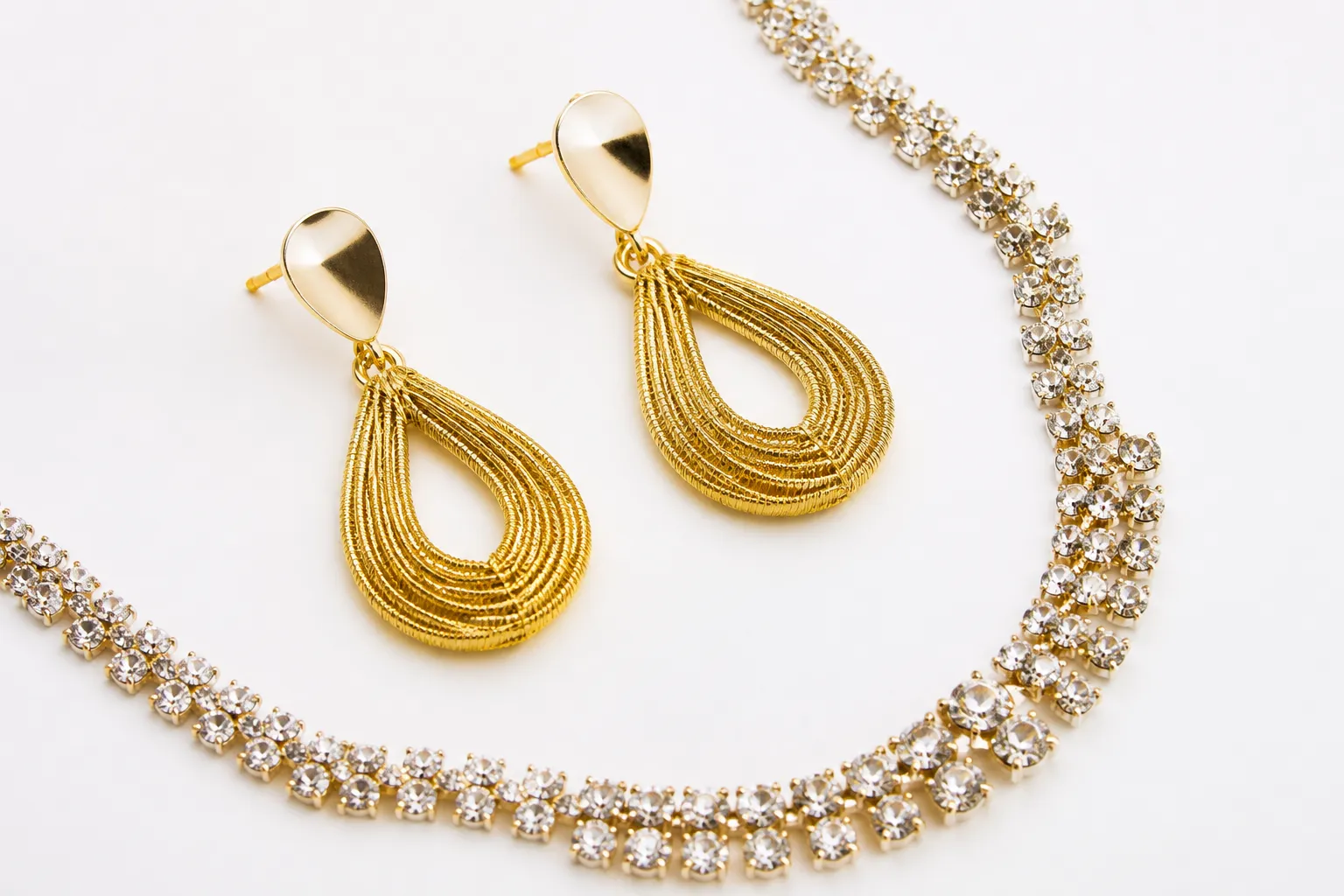
STRAND is a Hangzhou-based supplier that connects overseas buyers directly to vetted Chinese workshops. Their stock catalog runs 114 styles — covering drop earrings, stud earrings, necklace-and-earring sets, and multi-piece looks in vintage crystal, two-tone glass bead, rhinestone, and gradient crystal finishes — with 109 of those 114 styles available at 12 pcs/style MOQ. Select styles ship from 1 piece, which makes range-testing viable before committing to full runs.
What distinguishes a factory-direct supplier from a distributor isn't just price — it's the ability to modify. Custom OEM at STRAND covers metal finish (gold-plated or rhodium-plated copper, 925-style silver finishes), stone selection (glass beads, natural stone, faux pearls), silhouette adjustments, and private-label packaging. For a DTC brand trying to avoid Amazon-style commoditization, that product exclusivity matters more than the per-piece cost difference.
Multilingual sales support across six languages — English, French, Arabic, Spanish, German, and Russian — means procurement teams across markets can negotiate and specify without translation friction. Trade terms are EXW or FOB, with shipping by air, sea, or express carrier depending on timeline and volume.
For deeper sourcing benchmarks across supplier types, 6 Best Custom Jewelry Sources in 2026: OEM Suppliers & Retail Benchmarks maps the competitive landscape worth reading before you shortlist factories.
Alternatives Overview
The primary alternative to custom OEM sourcing is buying through retail personalization platforms — services where an end consumer (or a buyer testing the market) can configure a piece with their name, a birthstone, or a significant date. Jewlr is representative of this category: their personalized jewelry collection spans 646 products across rings, necklaces, bracelets, and earrings in materials including 18K gold plated silver, 925 sterling silver, and vermeil.
The personalization depth at platforms like Jewlr is meaningful for consumer gifting — gemstone options include amethyst, garnet, peridot, aquamarine, and citrine, and engravable products cover pendants, lockets, and stacking rings. That's the kind of product specificity that resonates with direct-to-consumer gifting audiences. Jewlr also offers a 99-day return window and a one-year warranty, both strong signals for a consumer trust stack.
The other alternative tier is luxury retail: chains like Jared stores, or fashion-forward brands like Kendra Scott, which stock semi-precious stones including turquoise and amethyst across their brick-and-mortar and online storefronts. These aren't sourcing options for a wholesale buyer — they're benchmarks. Checking what Jared or Kendra Scott prices for a garnet drop earring tells you what your end customer's reference price is, which directly informs your target landed cost from a manufacturer.
For buyers who need diamond-equivalent sparkle at fashion price points, established luxury retailers also set the bar for what a consumer considers "premium" — and factory-direct suppliers like STRAND produce rhinestone and crystal styles engineered to hit that visual register at a fraction of the retail comparison.
Feature-by-Feature Breakdown
Pricing and Unit Economics
Retail personalization platforms price at consumer margins. A personalized name necklace on Jewlr starts from $84 (discounted from $158), while a gemstone stacking ring starts from $119–$164. Those are retail price points — appropriate for a DTC store owner to understand as the consumer ceiling, not as a sourcing benchmark.
Factory-direct OEM pricing operates on a completely different curve. Per-unit costs at STRAND scale with order quantity and finish complexity; the correct comparison is to request a quote with your target style and volume, then map the landed cost against your retail price ceiling. The margin gap between factory-direct and retail sourcing is typically the business case for custom OEM.
MOQ and Scalability
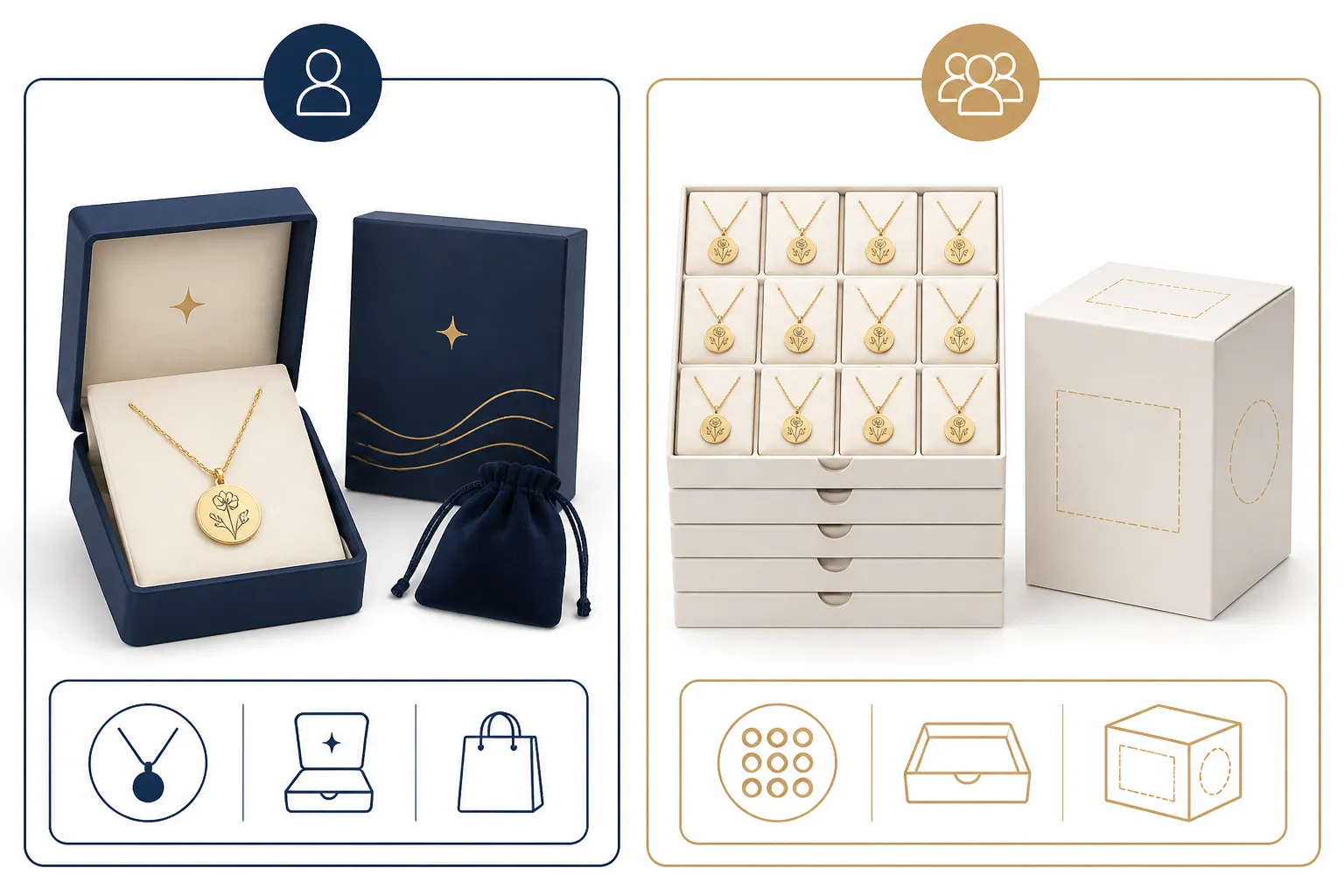
This is where the two paths diverge most sharply. Retail platforms have no meaningful MOQ — Jewlr sells one piece at a time. That's useful for a buyer who wants to order samples to photograph for their store, but it doesn't support wholesale economics.
STRAND's MOQ of 12 pcs/style on 109 of 114 catalog styles is genuinely low for factory-direct sourcing, and select styles ship from 1 piece — making style testing possible without a full production commitment. When you're ready to scale, the same supplier handles larger runs without a platform change.
Customization and Product Differentiation
Retail personalization = light surface customization. You choose from pre-set options: a name, a birthstone (amethyst, garnet, peridot, turquoise), a metal tone, an engraving. The underlying silhouette is fixed.
Custom OEM = product ownership. At STRAND, OEM engagements cover finish selection, stone spec, silhouette adjustment, and packaging — meaning your product can't be found on a competitor's shelf. For a DTC brand building catalog defensibility, that distinction is the entire value proposition.
Quality Assurance
Consumer platforms rely on returns and warranties for quality accountability — Jewlr's 99-day return policy and one-year warranty are the backstop. That works at retail scale but doesn't translate to B2B procurement, where returns on a 500-unit order aren't practical.
STRAND runs in-house QC inspection before every shipment. For an importer receiving goods from China, that pre-shipment check is a critical risk mitigation step — it's the difference between discovering a plating defect in your warehouse and catching it before goods leave the factory floor.
Payment and Trade Terms
Retail platforms accept consumer payment methods — credit cards, BNPL (Jewlr offers Buy Now, Pay Later). International B2B buyers need different infrastructure: T/T bank transfer, Western Union, PayPal, L/C (letter of credit), and Xtransfer. STRAND supports all of these, which matters for buyers in EU, MENA, and other regions where T/T or L/C is standard procurement practice.
Support and Communication
Retail personalization platforms operate in English. For a multilingual procurement team — Arabic-speaking buyers in MENA, French-speaking teams in West Africa or Europe, Spanish-speaking importers in Latin America — that's a real friction point during specification and negotiation.
STRAND's multilingual sales support in EN, FR, AR, ES, DE, and RU removes that friction at the sourcing stage, where misunderstandings about finish specs or stone selection are most costly.
Pros and Cons
Custom OEM Jewelry (STRAND)
Pros
- Factory-direct pricing with wholesale margin potential
- Low MOQ (12 pcs/style on most catalog styles) for market testing
- Full OEM customization: finish, stones, silhouette, packaging
- In-house QC before every shipment
- Multilingual support (EN, FR, AR, ES, DE, RU)
- Flexible trade terms (EXW/FOB) and payment methods including L/C
- 114-style stock catalog ready to ship; custom runs available
Cons
- Requires a procurement process — quotes, sampling, lead times
- Less suited to one-off consumer gifting orders
- Minimum commitment per style (12 pcs) even at the low end
Retail Personalization Platforms (Jewlr and peers)
Pros
- No MOQ — one piece, shipped fast
- Consumer-familiar interface for individual customization (birthstones, engraving)
- Established returns (99-day) and warranty (1-year) policies
- BNPL options accessible to end consumers
- Broad gemstone selection at retail: amethyst, garnet, peridot, aquamarine
Cons
- Consumer pricing, not wholesale — margins are compressed or inverted for resale
- No silhouette-level customization; pre-set product designs only
- English-language support limits utility for international procurement teams
- No in-factory QC accountability; returns are the correction mechanism
- Not built for volume ordering or private-label branding
When to Choose Custom Jewelry (OEM)
- You're an importer sourcing for wholesale distribution across multiple retail accounts and need consistent inventory at defensible margins.
- You run a DTC brand and need product exclusivity — pieces that won't appear on a competitor's Shopify store or Amazon listing.
- Your procurement team operates across multiple languages or your payment infrastructure runs on T/T or L/C rather than consumer cards.
- You're building a catalog with 5–20+ styles and need a supplier who can hold stock specifications across reorders.
- You want fashion-forward styles — vintage crystal, two-tone glass bead, rhinestone, gradient finishes — at factory price points, not Kendra Scott retail prices.
When to Choose Alternatives
- You need a single piece for photography, gifting, or a consumer test before approaching a manufacturer.
- Your customer base wants genuine personalization — their name, a significant date, a birthstone like turquoise or peridot — that requires individual configuration.
- You're comparing product specs and retail price ceilings before setting a factory cost target (checking what Jared or Jewlr charges for a comparable garnet or amethyst piece is legitimate market research).
- You sell on a marketplace where consumer-packaged, retail-branded jewelry is a competitive advantage over private label.
Final Verdict
For importers, wholesalers, and DTC store owners making a sourcing decision, retail personalization platforms are benchmarks, not suppliers. They tell you what a consumer will pay for an amethyst ring or a diamond-look rhinestone set — they don't give you the margin structure to build a business around it.
Custom OEM jewelry through a factory-direct supplier is the path that creates product ownership, sustainable margins, and catalog scalability. The key evaluation criteria before choosing a manufacturer: confirm MOQ tiers against your launch volume, request samples across the finishes you plan to carry, verify QC process and lead time commitments, and check that trade terms match your payment infrastructure.
STRAND's 114-style catalog, 12 pcs/style MOQ on most designs, in-house QC, and multilingual sales team make it a practical starting point for buyers across the US, EU, UK, and MENA markets. Request a quote, sample a style in gold-plated and rhodium-plated finishes, and get your landed cost before you benchmark against retail alternatives.