
Custom Jewelry vs. Retail Alternatives: The Importer's Procurement Guide
Custom Jewelry vs. Retail Alternatives: The Importer's Procurement Guide
Custom OEM jewelry sourcing from a vetted manufacturer gives importers and DTC brands the unit economics, design control, and scalability that no retail personalization platform can match. If you are comparing factory-direct custom jewelry against retail-oriented alternatives like Jewlr or Kay Jewelers, you are likely evaluating the wrong tier — those are B2C tools, not wholesale channels. This article cuts through that confusion and maps each route to the buyer it actually serves.
TL;DR / Quick Verdict
For importers, private-label brands, and DTC store owners in the US, EU, UK, and MENA markets, factory-direct custom OEM jewelry — sourced from a supplier like STRAND — is the only route that offers negotiable MOQs, branded differentiation, and genuine trade terms. Retail personalization platforms serve end consumers efficiently and are useful as competitive price benchmarks, but they are not procurement channels. Choose retail alternatives only if you need a single gift-grade piece; choose custom OEM when you need to build a catalog.
At-a-Glance Comparison Table
| Dimension | Custom OEM Jewelry (Factory-Direct) | Retail Personalization Platforms |
|---|---|---|
| Unit pricing | Ex-works factory pricing, tiered by volume | Consumer retail: $84–$189+ per piece at current sale pricing; MSRP can reach $308+ (as of July 2026) |
| MOQ | 12 pcs/style on most designs; select styles from 1 pc | 1 unit (no wholesale tier) |
| Design scope | Full OEM: shapes, finishes, stones, packaging | Template-based name/date/birthstone engraving |
| Metal options | Gold-plated, rhodium-plated copper; 925-style silver | Sterling silver, stainless steel, gold-plated, vermeil |
| Stone options | Glass beads, natural stone, faux pearls, rhinestones, crystal | Garnet, amethyst, diamond, aquamarine (birthstone set) |
| QC process | In-house pre-shipment inspection by supplier | Brand-level QC; buyer has no inspection access |
| Trade terms | EXW or FOB | Consumer DTC only (no trade terms) |
| Shipping | Air, sea, or express (buyer-negotiated) | Standard consumer shipping |
| Payment | T/T, Western Union, PayPal, L/C, Xtransfer | Credit card, buy-now-pay-later |
| Returns | Negotiated with supplier | Jewlr offers a 99-day return window |
| Target buyer | Importers, wholesalers, DTC store owners | End consumers |
| Language support | EN, FR, AR, ES, DE, RU | English (primary) |
Custom OEM Jewelry: What It Is and Who It's Built For
Custom OEM jewelry sourcing means working directly with a manufacturer — or a brand that bridges vetted workshops to overseas buyers — to produce pieces built around your specifications, not a platform's templates. STRAND operates from Hangzhou and connects importers and DTC store owners directly to Chinese workshops, covering drop earrings, stud earrings, necklace-and-earring sets, and coordinated jewelry collections.
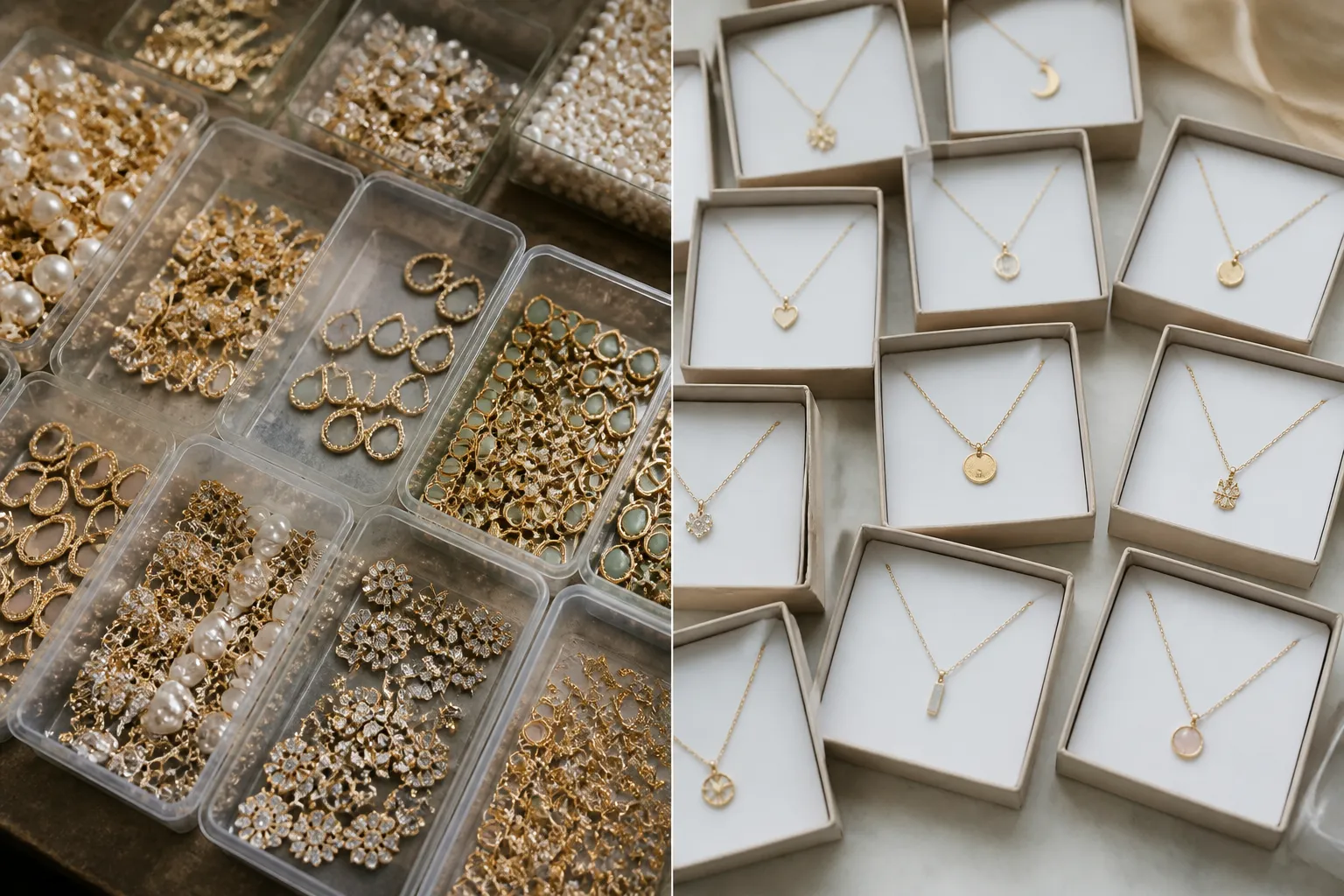
The catalog spans 114 styles across vintage, gradient crystal, two-tone glass bead, and rhinestone aesthetics, finished in gold-plated and rhodium-plated copper, glass beads, natural stone, and faux pearls. MOQ sits at 12 pieces per style on 109 of 114 catalog designs, with select styles available from 1 piece — a threshold low enough for DTC brands testing new SKUs without tying up inventory capital.
OEM orders go further: buyers can submit custom designs in gold-plated or rhodium-plated copper, 925-style silver finishes, glass bead combinations, and natural stone arrangements including turquoise and peridot variants popular in Western markets. Shipping moves via air, sea, or express freight, under EXW or FOB trade terms — both standard enough for freight forwarders and customs brokers in the US, EU, and MENA to process cleanly.
For multilingual procurement teams, STRAND handles inquiries in English, French, Arabic, Spanish, German, and Russian — a genuine operational advantage when sourcing chains involve non-English-speaking intermediaries.
Alternatives: What Retail Personalization Platforms Offer
Retail personalization platforms — including Jewlr and Kay Jewelers — are the consumer-facing end of the jewelry market. They are well-built for gifting and personal purchases, but their pricing structure, lack of trade terms, and consumer-only checkout make them non-starters for import or wholesale use.
Jewlr's personalized catalog covers rings, necklaces, earrings, bracelets, charms, anklets, and sets, with engraving and birthstone configuration across garnet, amethyst, diamond, and other stones. Metal options include sterling silver, stainless steel, white gold, gold-plated, and vermeil. The service includes free shipping and a one-year warranty, and pricing as of July 2026 ranged from approximately $84 for a name necklace to around $164–$189 for multi-stone rings at current sale pricing, with MSRP reaching over $300.
Kay Jewelers carries a dedicated "Personalize & Engrave" section, an in-store custom design center (appointment-based), and an online engagement ring configurator with center stone shapes including princess, oval, emerald, and marquise cuts. Their STUDIO BY KAY proprietary line and a custom Neil Lane Wedding Ring Set builder target the luxury gifting and bridal segments. These are consumer experiences, not procurement workflows.
For B2B buyers benchmarking retail price floors before setting their own DTC pricing, these platforms are genuinely useful reference points. For sourcing inventory, they are the wrong tool entirely.
Feature-by-Feature Breakdown
Pricing & Unit Economics
Factory-direct pricing is not published on a retail shelf — it is negotiated based on order volume, finish selection, and complexity. For stock designs with standard gold-plated or rhodium-plated finishes, STRAND's EXW pricing gives buyers a working cost basis before freight, duty, and landed-cost calculations. Custom OEM orders carry sampling and tooling costs that factory-retail does not, but those are one-time investments amortized over production runs.
Retail platforms price per unit for end consumers. A personalized necklace on Jewlr starts around $84 at current promotional pricing — a number useful for understanding what your end customer expects to pay at retail, not what you should pay as an importer.
MOQ and Scalability
The MOQ question is where factory-direct sourcing separates sharply from retail alternatives. STRAND's 12-piece-per-style threshold on most catalog designs makes it accessible to DTC brands testing new earring or necklace SKUs before committing to a full production run. For custom OEM orders, MOQs are negotiated based on the design brief.
Retail platforms have no minimum — you can buy one piece — but there is also no maximum-quantity pricing, no trade pricing, and no ability to resell without margin compression.
Design Flexibility and Stone Options
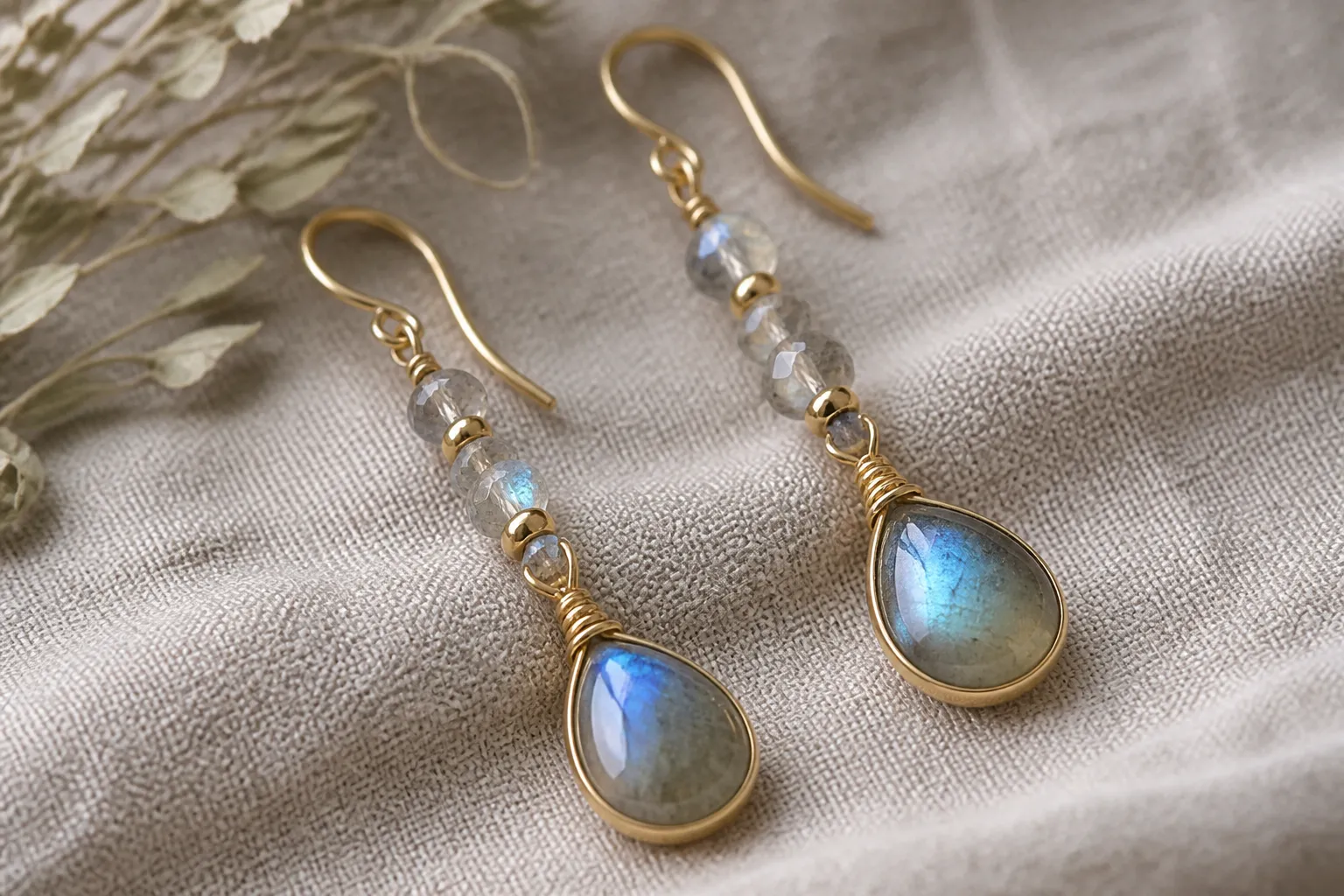
Custom OEM is the clear winner on differentiation. Buyers can specify stone types (glass beads, faux pearls, natural stone, rhinestone, crystal), finish (gold-plated, rhodium-plated), and silhouette — covering everything from minimalist two-tone pieces to vintage-style amethyst or garnet drops that sit in the same aesthetic territory as premium brands like Kendra Scott or brands stocked at Jared stores.
Retail personalization platforms offer meaningful but narrow configuration: name engraving, birthstone selection (garnet, amethyst, aquamarine, diamond, and other calendar stones), and stone shape choices like round, heart, baguette, or cushion. That is fine for a personalized gift but leaves no room for a retailer to build a proprietary aesthetic.
Quality Control
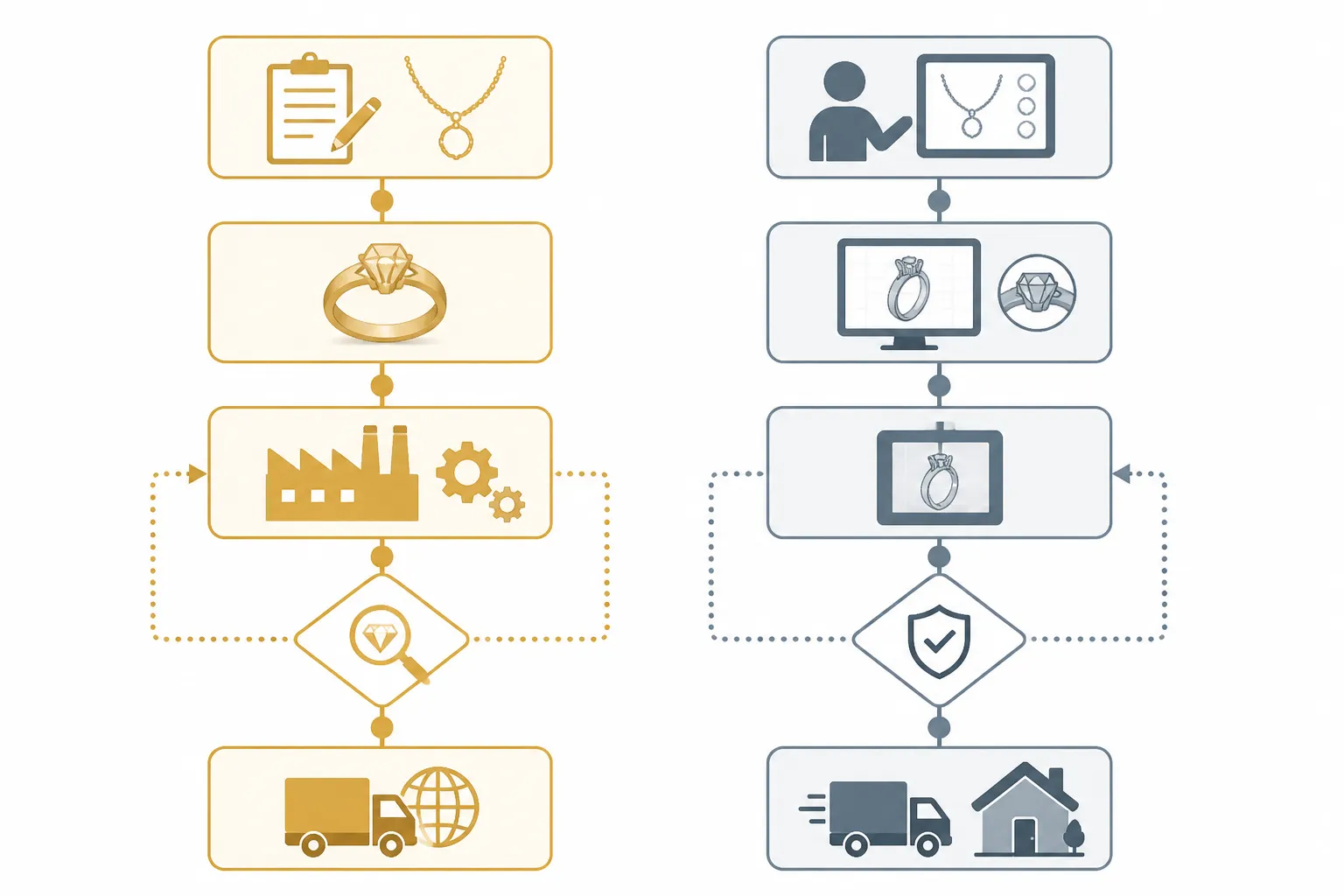
Factory-direct OEM sourcing through STRAND includes an in-house QC inspection before every shipment. Buyers can specify standards, request inspection reports, and — for larger orders — arrange third-party pre-shipment inspection. This level of control is standard in cross-border procurement and expected by buyers who resell to end consumers in regulated markets.
Retail platforms maintain their own QC processes, which are designed for consumer satisfaction (return windows, warranty coverage) rather than importer-grade consistency across batches. There is no mechanism for a wholesale buyer to specify or verify batch quality on a retail platform.
Logistics and Trade Terms
STRAND ships via air, sea, or express courier under EXW or FOB terms — both compatible with standard freight forwarding workflows and duty drawback calculations. Payment options include T/T bank transfer, Western Union, PayPal, L/C, and Xtransfer, covering virtually every payment workflow used by importers from the US to MENA.
Retail platforms ship via consumer courier with consumer-level insurance. There are no trade terms, no commercial invoices structured for customs declarations, and no FOB pricing for freight calculations.
Support and Communication
For multilingual procurement teams — a genuine operational reality for importers working across EU, MENA, and US markets — STRAND's support in English, French, Arabic, Spanish, German, and Russian removes a friction point that generic wholesale platforms often ignore.
Retail platforms support English-speaking consumers. Jewlr's UI allows filtering by recipient (mom, girlfriend, kids) and occasion (wedding, Mothers' Day) — a consumer-oriented taxonomy that tells you nothing about B2B supplier reliability.
Pros and Cons
Custom OEM Jewelry (Factory-Direct)
Pros
- Full design control — silhouette, stone, finish, packaging
- Negotiable MOQ (12 pcs/style on most STRAND stock designs)
- In-house pre-shipment QC
- Trade-grade payment and logistics terms
- Multilingual procurement support
- Scalable from small test runs to high-volume repeat orders
Cons
- Lead time is longer than retail (samples and production runs require planning)
- Upfront sampling cost for custom OEM designs
- Requires procurement experience — trade terms, freight, customs
- No published price list; quotes must be requested
Retail Personalization Platforms (Jewlr, Kay, etc.)
Pros
- No minimum order quantity — one piece available
- Fast turnaround for individual pieces
- Consumer-grade warranty and returns (Jewlr's 99-day return window is above industry average)
- Ready-made personalization tools (engraving, birthstone, stone shape selection)
- Useful retail price benchmarks for resellers
Cons
- Consumer retail pricing — no wholesale margin available
- No trade terms (no EXW, FOB, or commercial invoice)
- No batch QC access
- No design customization beyond platform templates
- English-centric support
When to Choose Custom OEM Jewelry
You are building or expanding a product catalog. If your DTC store or import business needs a range of earrings, necklaces, or sets with a consistent aesthetic — say, vintage crystal drops, two-tone rhinestone styles, or natural stone pieces — custom OEM sourcing gives you the control and unit economics to build a real margin stack.
You need differentiation from marketplace commodities. Buying generic off-the-shelf jewelry puts your product next to identical pieces from competing sellers. Custom OEM with proprietary color combinations, finishes, or stone arrangements — turquoise in gold-plated copper, peridot in rhodium-plated settings — gives your catalog something Jared-level luxury stores or Kendra Scott-inspired independent boutiques cannot replicate with the same piece.
Your MOQ threshold is low but not zero. At 12 pieces per style, STRAND's floor MOQ is accessible for DTC brands that need enough units to photograph, list, and test a SKU without committing to a large pre-buy. For sourcing context on how this stacks against other suppliers, see 6 Best Custom Jewelry Sources in 2026: OEM Suppliers & Retail Benchmarks.
You operate across multiple geographies. Importers moving goods between China and the US, EU, UK, or MENA need FOB pricing, commercial invoices, proper HS codes, and payment methods that work across banking systems. Custom OEM suppliers are built for this. Retail platforms are not.
When to Choose Retail Personalization Alternatives
You need a single piece, fast. A personalized gift, a sample for photo shoots, or a one-off piece for a brand shoot does not justify a factory order. Jewlr's individual pieces ship quickly with consumer-grade returns.
You want a retail price floor reference. Before setting your own DTC prices for gold-plated drop earrings or rhinestone necklace sets, checking what comparable pieces sell for at Kay or Jewlr gives you a defensible upper bound for your own retail pricing. That is legitimate research, not sourcing.
Your product is a one-time personalized gift item. If the use case is a single diamond-birthstone ring or an engraved necklace for a specific recipient — not inventory — retail personalization platforms deliver the experience well.
Final Verdict
The comparison between custom OEM jewelry and retail personalization platforms is not really a product comparison — it is a procurement-model comparison. Retail platforms like Jewlr and Kay Jewelers are consumer experiences. They are competently built for end buyers, and their pricing and reviews are genuinely useful competitive intelligence for resellers. But they cannot serve as a supply chain.
For importers and DTC brand owners in the US, EU, UK, and MENA who need a real sourcing partner — negotiable MOQs, in-house QC, trade-grade logistics, multilingual support, and the design latitude to build a proprietary catalog — factory-direct OEM sourcing is the only logical route.
If your next step is building or refreshing a jewelry catalog, the procurement conversation starts with an inquiry, not a checkout page. Request a quote or sample from STRAND at strandjewelry.com — include your target styles, required finishes, and volume range to get a response in your preferred language with current MOQ and pricing terms.