
6 Best Alternatives to Custom Jewelry for Every Order Size
6 Best Alternatives to Custom Jewelry for Every Order Size
Custom jewelry costs more, takes longer, and locks you into higher minimums than most buyers realize until they're already mid-negotiation. The six alternatives below cover every sourcing tier — from 12-piece wholesale OEM to one-off consumer personalization — so you can match the right channel to your actual order size and margin requirements.
Why Look for Alternatives to Custom Jewelry?
The biggest shock for first-time custom jewelry buyers is the minimum order quantity. Most bespoke workshops won't accept a run below 200–500 pieces per style — which means a DTC brand testing three new earring designs is looking at a 1,500-piece commitment before a single unit has sold. That's not a sourcing strategy; it's a cash-flow bet.
Lead time is the second constraint. True custom production — brief, design approval, sample, revision, bulk run — regularly spans 8–14 weeks. Add ocean freight, customs clearance, and inbound warehousing, and a new SKU can take five to six months to reach your fulfillment center. Fashion jewelry doesn't work on that timeline. Gradient crystal earrings and rhinestone statement sets have seasonal windows; a style that arrives late ships at markdown pricing.
The third pain point is quality without recourse. Custom production ties you to a specific workshop's tooling and process. When quality slips — and it does, especially on plated finishes after QC-free bulk runs — switching costs are high: you've already spent on tooling, sampling, and packaging. Without in-house inspection before shipment, defect rates erode margin quietly and complaints arrive long after the payment clears.
What to Look for in a Custom Jewelry Alternative
- MOQ that matches your sales velocity — Can you sell through the minimum order at your current run rate? Low-MOQ options (12–50 pcs/style) let you test before scaling.
- Customization depth — Full OEM (your design, your branding, your packaging) versus semi-custom (stock design with color or material variation). Know which one you actually need.
- Lead time versus margin tradeoff — Stock catalog items ship faster; custom OEM requires a sampling cycle. Decide which constraint is more expensive for your business.
- Material and market certifications — US, EU, and UK markets require nickel-free, RoHS-compliant finishes. Confirm before sampling, not after bulk production.
- Quality assurance process — Who inspects before shipment? In-house QC is meaningfully different from supplier self-certification.
- Trade terms and payment flexibility — EXW versus FOB changes your true landed cost. Payment method availability (T/T, PayPal, L/C, Xtransfer) matters for cross-border procurement teams.
- Language support — Multilingual communication (EN, FR, AR, ES, DE, RU) removes friction across international buying teams; it's not a luxury, it's an operational requirement.
Top Alternatives to Custom Jewelry
1. STRAND — Low-MOQ OEM Wholesale Directly from Chinese Workshops
Best for: B2B buyers, importers, and DTC store owners who need OEM flexibility without factory-scale minimums
Pricing: Stock catalog from MOQ 12 pcs/style; custom OEM pricing available on request at strandjewelry.com
Key strengths vs. custom jewelry:
- 114-style stock catalog — 109 of those styles available at 12 pcs/style, with select styles available from 1 piece — no 500-piece commitment to test a design
- Full OEM path: gold-plated and rhodium-plated copper, 925-style silver finishes, glass beads, natural stone, and faux pearls; bring your own design files or brief
- In-house QC inspection before every shipment — a hard differentiator from unvetted custom workshops where inspection is self-reported
- Multilingual sales team in EN, FR, AR, ES, DE, and RU; trade terms EXW or FOB; shipping by air, sea, or express; payment via T/T, Western Union, PayPal, L/C, or Xtransfer
Limitations / trade-offs:
- Hangzhou-based production means shipping lead times vary by mode — not suitable for same-week emergency restocking
- Custom OEM requires a design brief and sampling cycle; not an off-the-shelf solution for buyers who need product in two weeks
- Cross-border payment setup (T/T bank wire, L/C) requires some administrative lead time for buyers new to international procurement
How it compares to custom jewelry: Traditional custom jewelry workshops gate access behind 200–500 piece minimums and 8–14 week production cycles. STRAND's 12-piece MOQ on most stock designs — covering drop earrings, stud earrings, necklace-and-earring sets in vintage, gradient crystal, two-tone glass bead, and rhinestone styles — lets buyers test market demand before committing to a full custom run. The OEM path is available when a style proves out and you're ready to brand it as your own. That's a fundamentally different risk profile from traditional custom jewelry.
2. Jewlr — Online Personalized Jewelry for DTC Competitive Intelligence
Best for: Benchmarking DTC personalization pricing and consumer expectations in rings, necklaces, and birthstone jewelry
Pricing: Name necklaces from $84; rings from $139; engravable pendants from $104 (as of current Jewlr listings)
Key strengths vs. custom jewelry:
- 646 products in its personalized category spanning rings, necklaces, bracelets, and earrings — broad reference range for DTC buyers studying market positioning
- 99-day return policy and a one-year warranty — consumer trust signals worth studying if you're building your own DTC return framework
- Engravable and birthstone options including amethyst, garnet, peridot, and turquoise across multiple price tiers — useful data on what consumers will pay for stone personalization
- Free shipping and Buy Now, Pay Later plans — standard DTC conversion toolkit, worth benchmarking
Limitations / trade-offs:
- No B2B, wholesale, or resale pricing — every transaction ships to a single consumer address at full retail margin
- Zero OEM or private-label path; Jewlr's design assets and branding stay proprietary
- Price structure built for direct-to-consumer margin, not resale unit economics
How it compares to custom jewelry: Jewlr is the DTC personalization benchmark, not a sourcing alternative for volume buyers. Traditional custom jewelry gives you design ownership and IP control; Jewlr keeps those proprietary. For a buyer using Jewlr as competitive intelligence — studying price anchors on amethyst and garnet pieces, or tracking which personalization formats (engraving, birthstone, initial) generate the most SKU depth — it's genuinely useful data. As a wholesale supply chain, it's the wrong tool entirely.
3. Kay Jewelers — Retail Chain with In-Store Custom Design Appointments
Best for: US consumers buying custom engagement rings, lab-grown diamond pieces, or personalized bridal jewelry with in-person consultation
Pricing: Promotional pricing varies; up to 35% off engagement and wedding rings during active promotions at Kay stores
Key strengths vs. custom jewelry:
- In-store custom design appointments available at Kay locations — physical consultation for high-stakes, high-dollar purchases
- Online engagement ring configurator supporting nine center-stone shapes: Princess, Round, Oval, Pear, Emerald, Marquise, Cushion, Radiant, and Heart
- Lab-grown diamond options for custom engagement rings — lower cost entry to diamond customization vs. mined stones
- Branded collections including Le Vian, Neil Lane, and STUDIO BY KAY add designer cachet within a retail framework most US consumers trust
Limitations / trade-offs:
- Retail markup built into every piece — not viable for resale, wholesale, or any B2B sourcing scenario
- No OEM, private label, or bulk ordering; Kay is a consumer channel
- Design flexibility limited to Kay's stone inventory and in-house setting catalog; truly bespoke work requires a private goldsmith, not a chain
How it compares to custom jewelry: Kay is the mass-market retail path for consumers who want a custom-feeling piece without finding a bespoke jeweler. The configurator and appointment system reduce friction for engagement ring buyers who want input on the design without managing a goldsmith relationship. For a DTC brand owner or importer needing 50–500 units of a style, Kay offers nothing at the supply chain level — it is a retail channel, full stop.
4. Jared — Luxury Retail Custom with Diamond and Colored Stone Focus
Best for: US luxury consumers sourcing bespoke engagement or anniversary pieces where a diamond or turquoise center stone and in-store consultation justify the premium
Pricing: Luxury retail tier; custom bridal pieces typically start above $1,000 depending on stone selection and setting
Key strengths vs. custom jewelry:
- Jared stores sit a tier above Kay in the Signet retail family — wider selection of luxury settings and designer collaboration pieces
- Solid colored stone selection including turquoise, garnet, and amethyst accent options across its personalized and semi-custom lines
- In-store design consultants for custom bridal work; higher-touch service than most chain retail
- Established warranty and service plans for long-term ownership — relevant for high-ticket pieces that need maintenance
Limitations / trade-offs:
- Full retail markup — cost per piece is multiples of what a comparable wholesale OEM source delivers
- No B2B, trade, or wholesale pricing path
- Design flexibility constrained by Jared's in-house stone and setting inventory
How it compares to custom jewelry: Jared sits between chain retail and true bespoke custom jewelry — more curated than Kay, less fully bespoke than a private goldsmith. For a DTC brand benchmarking luxury price positioning on diamond or gemstone styles, Jared's pricing architecture is informative reference data. As a sourcing solution for volume buyers, it simply isn't structured for that use case.
5. Kendra Scott — Designer Brand with In-Store Color Bar Customization
Best for: US fashion jewelry consumers who want accessible semi-precious stone customization in a brand-controlled retail environment
Pricing: Mid-market fashion jewelry; Color Bar customization is an in-store experience at Kendra Scott retail locations nationwide
Key strengths vs. custom jewelry:
- The Color Bar lets consumers swap stones — amethyst, turquoise, garnet, peridot, and other semi-precious options — across standard settings in-store, delivering a personalization experience without bespoke production
- Strong brand recognition and wide US retail presence including department store partnerships — useful benchmark for fashion jewelry DTC positioning
- Semi-precious gemstone focus at accessible price points reflects real consumer demand signals for stone-centered jewelry
- Kendra Scott stores operate as experiential retail; the Color Bar creates dwell time and social media content that pure e-commerce can't replicate
Limitations / trade-offs:
- Color Bar is stone-swapping within fixed Kendra Scott settings — not a design-your-own experience in any meaningful sense
- No wholesale, trade, or OEM program accessible to external buyers; brand-owned exclusively
- You cannot replicate the Kendra Scott aesthetic under your own label through any legitimate channel
How it compares to custom jewelry: Kendra Scott addresses exactly one dimension of custom jewelry — stone selection — without touching material, form, or structure. For buyers researching what US consumers actually want in semi-precious stone fashion jewelry (garnet drop earrings, amethyst pendants, turquoise statement cuffs), Kendra Scott's best-selling Color Bar combinations are a reliable consumer trend signal. As a supply chain, it's irrelevant to any wholesale buyer.
6. Made by Mary — Artisan DTC Personalized Jewelry
Best for: US gift-buyers and lifestyle consumers seeking handcrafted personalized pieces with engraving and birthstone options at a mid-to-high price point
Pricing: Mid-to-high consumer range; individual pieces typically $60–$200+ depending on material and personalization
Key strengths vs. custom jewelry:
- Handcrafted positioning resonates strongly with US gift buyers — meaningful purchase trigger for DTC brands studying emotional marketing angles
- Personalization via engraving and birthstone selection (amethyst, garnet, turquoise among available stones) across necklaces, rings, and earrings
- High editorial quality in product photography and lifestyle imagery — benchmark for DTC store owners studying creative direction in the personalized jewelry category
- Focused SKU range with deep personalization options per style — a different strategic choice from broad catalog depth
Limitations / trade-offs:
- No wholesale, OEM, or bulk pricing; every purchase is consumer-direct at full retail margin
- Artisan production limits reorder speed and SKU depth compared to factory-scale sourcing
- Price reflects a handcraft premium that doesn't translate to resale margin math
How it compares to custom jewelry: Made by Mary operates at the premium end of DTC personalization — it's the benchmark for artisan-brand positioning in the US market, not a supply chain option. A DTC store owner competing in this space needs to either match the creative quality (expensive) or undercut the price with better-sourced product at better unit economics. That's the gap a low-MOQ OEM wholesale supplier fills: comparable aesthetic at wholesale pricing, with the ability to add your own branding. Our Custom Jewelry vs. Retail Personalization: The B2B Buyer's Guide walks through exactly this cost-structure comparison.
7. Brook & York — Classic Personalized DTC for Gift Benchmarking
Best for: US consumers buying personalized gifts (name necklaces, initial discs, birthstone jewelry) in gold-fill or sterling silver at mid-market prices
Pricing: Mid-market consumer range, broadly comparable to Jewlr pricing tiers
Key strengths vs. custom jewelry:
- Clean, classic aesthetic — nameplate necklaces, disc pendants, and initial jewelry in gold-fill and sterling silver; strong reference point for minimalist DTC brand positioning
- Reliable delivery timelines and gifting-forward presentation — relevant for DTC buyers studying seasonal purchase behavior
- Engravable and birthstone options across the catalog; standard personalization toolkit for the gift segment
- Established customer review base — useful for reading consumer sentiment on personalized jewelry quality expectations
Limitations / trade-offs:
- Consumer-only channel; no trade, wholesale, or resale pricing available
- Narrower material range than OEM sourcing — no plated copper, glass bead, rhinestone, or statement styles in the catalog
- Limited style depth compared to a full catalog supplier with 100+ designs
How it compares to custom jewelry: Brook & York competes in the personalized gift segment rather than the bespoke design segment. For buyers researching what a clean, well-positioned DTC personalized jewelry brand looks like — product photography approach, price anchoring, naming conventions — it's a useful reference. For sourcing volume fashion jewelry or launching an OEM program, you need a different supply chain entirely.
Side-by-Side Comparison Table
| Dimension | Traditional Custom Jewelry | STRAND OEM | Jewlr | Kay Jewelers | Kendra Scott | Made by Mary |
|---|---|---|---|---|---|---|
| MOQ | 200–500+ pcs/style | 12 pcs/style (stock); 1 pc select styles | 1 pc (consumer) | 1 pc (consumer) | 1 pc (consumer) | 1 pc (consumer) |
| Lead Time | 8–14+ weeks | Stock: shorter; OEM: sampling + production | 1–3 weeks | 2–6 weeks custom | 1–2 weeks | 2–4 weeks |
| Price Level | Factory pricing + sampling costs | Wholesale OEM | $84–$300+ retail | $300–$3,000+ retail | $50–$400 retail | $60–$200+ retail |
| Customization Depth | Full OEM (design, material, branding) | Full OEM or 114-style stock catalog | Engraving + birthstone | Center stone + setting | Stone swap only | Engraving + birthstone |
| B2B / Wholesale Path | Yes (workshop-dependent) | Yes — core offering | No | No | No | No |
| QC / Assurance | Varies by workshop | In-house inspection before shipment | 1-year warranty | Retail warranty | Retail warranty | Artisan QC |
| Multilingual Support | Depends on factory | EN, FR, AR, ES, DE, RU | EN | EN | EN | EN |
How to Pick the Right Alternative
DTC store owner launching a fashion jewelry line: You need low-MOQ access to trend-relevant styles — drop earrings, rhinestone sets, gradient crystal necklaces, two-tone glass bead designs — without committing to a full custom production run before validating demand. A stock catalog supplier with 12-piece minimums lets you test 10 styles for the cost of a single custom sampling run. As individual styles prove out, layer in OEM for best-sellers with your own branding. This sourcing path also gives you the flexibility to explore gemstone-accented styles in amethyst and garnet finishes without diamond-tier pricing. For a detailed breakdown of how to evaluate this by revenue stage, the 6 Custom Jewelry Sources Ranked: OEM Suppliers & Retail Benchmarks for 2026 covers the full comparison.
Importer sourcing for retail store networks: Predictable quality, reliable reorder availability, and trade terms that work across multiple currencies matter more than creative flexibility at this stage. Evaluate suppliers on their pre-shipment inspection process and reorder lead times before you care about catalog depth. EXW versus FOB pricing and payment method flexibility (T/T, L/C, Xtransfer) should be confirmed in your first conversation with any supplier.
Buyer benchmarking pricing for a DTC launch: Study what Jewlr, Kendra Scott, Made by Mary, and Brook & York are selling — and at what price points — before setting your own margin structure. These retail brands show you what US consumers will pay for personalized, gemstone-accented, and engraved jewelry. Then work backward to find a wholesale source that delivers comparable aesthetics at unit economics that support resale margin.
Consumer buying a one-off piece: Kay Jewelers and Jared make sense for high-ticket engagement or anniversary jewelry where in-store consultation justifies the luxury retail premium. For fashion jewelry and statement earrings, DTC brands like Jewlr or Made by Mary offer better selection at more accessible price points than most traditional custom jewelers.
Buyer needing full OEM at volume: Your supplier needs actual OEM infrastructure — design-to-sample capability, material flexibility across gold-plated copper, rhodium-plated copper, 925-style silver finishes, and natural stone — plus production capacity to match your scale. Request physical samples before bulk commitment, confirm certifications for your target market (nickel-free for EU retail, Prop 65 documentation for California), and establish a clear pre-shipment inspection protocol. Never skip the sample stage on a new style, regardless of supplier reputation.
Conclusion
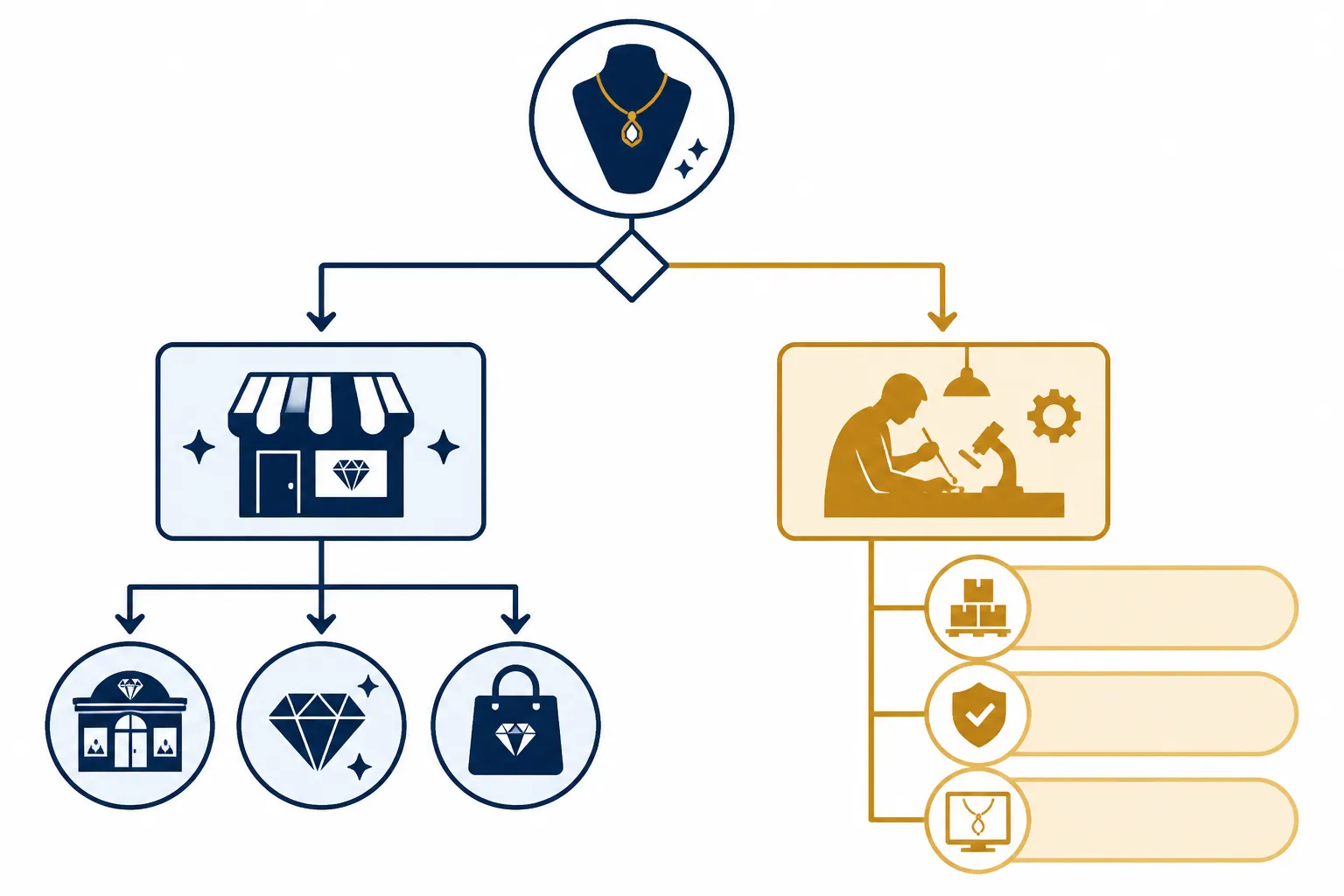
The alternatives to custom jewelry split cleanly into two tracks. Retail personalization — Jewlr, Kay, Jared, Kendra Scott, Made by Mary, Brook & York — serves consumers who want a one-off piece with their name, stone, or initials on it. These are your competitors to benchmark, not your supply chain.
Wholesale OEM sourcing is the other track. For DTC store owners and importers buying fashion earrings, necklace sets, and rhinestone or crystal styles for markets in the US, EU, UK, and MENA, the retail alternatives on this list cannot serve your needs. They weren't built to.
If your business needs low-MOQ access to tested styles with OEM capability standing behind them, the next step is straightforward: request a sample catalog and MOQ pricing before your next collection deadline. STRAND's sourcing team handles inquiries in EN, FR, AR, ES, DE, and RU, with EXW and FOB trade terms, and payment via T/T, Western Union, PayPal, L/C, or Xtransfer.