
How to Choose a Fashion Jewelry Supplier That Actually Works
How to Choose a Fashion Jewelry Supplier That Actually Works
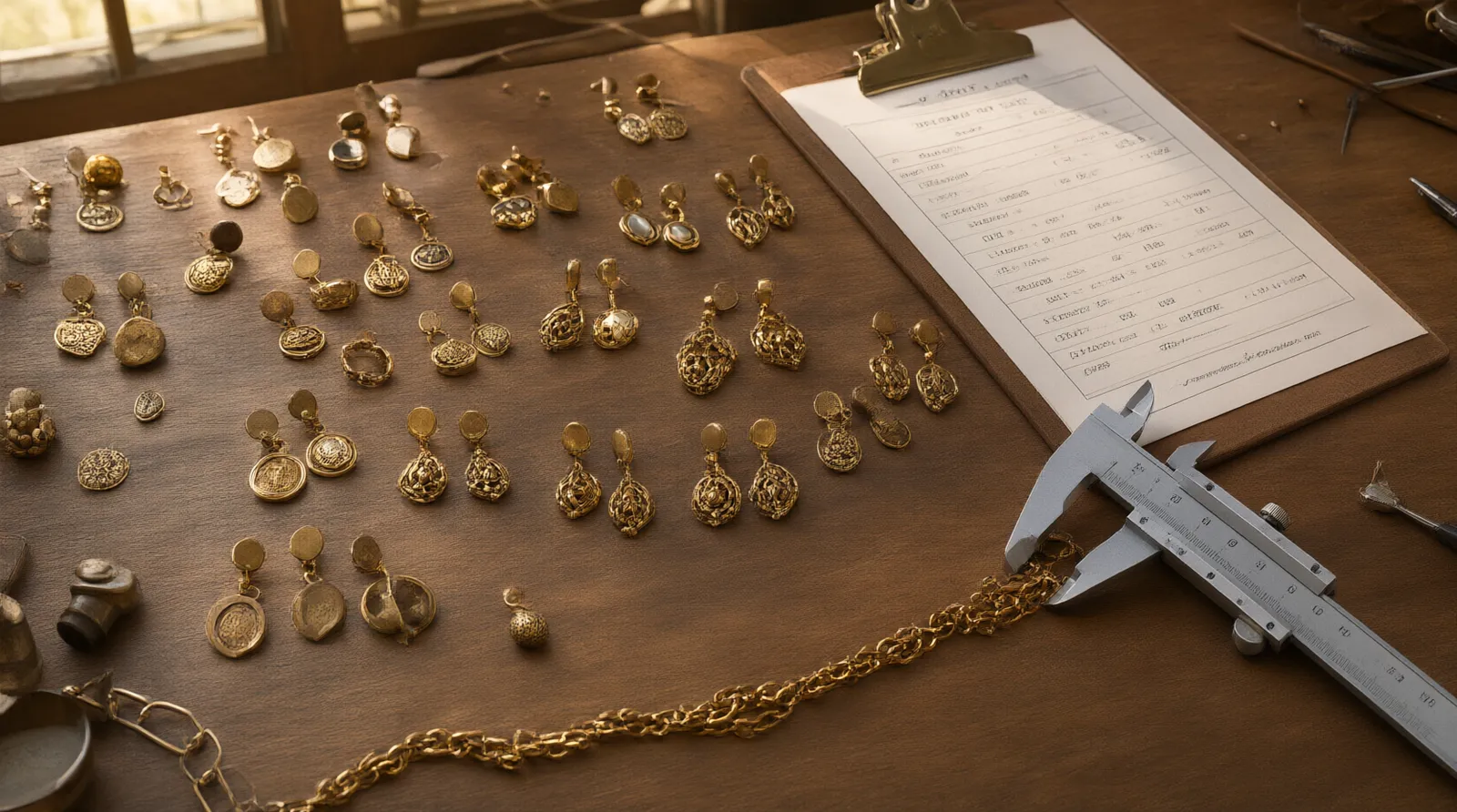
A fashion jewelry supplier is a manufacturer or distributor producing non-precious metal accessories — earrings, necklaces, bracelets, and rings — typically from brass, zinc alloy, or stainless steel bases with gold or rhodium plating. They serve DTC brands, importers, and procurement teams looking for trend-responsive styles, consistent quality, and scalable production.
Finding the right supplier separates a brand that controls its margins and product story from one that chases stock on Alibaba and hopes for consistency. The criteria are specific: material specs, plating thickness, MOQ tiers, lead times, and the supplier's ability to hold quality across re-orders. This guide walks through each one so you can make a sourcing decision you won't need to revisit six months later.
Before placing a first order, many buyers also find it useful to understand how fashion jewelry fits within a broader sourcing strategy — including custom and private-label options. Our article Custom Jewelry: 6 Sources Buyers & DTC Brands Need in 2026 covers that fuller picture.
What Is a Fashion Jewelry Supplier?
Fashion jewelry suppliers sit in a distinct tier between costume jewelry manufacturers (high volume, minimal quality control) and fine jewelry makers (precious metals, gemstones, higher price floors). What defines them is the combination of accessible base materials — most commonly brass or 316L stainless steel — with surface finishes that range from 0.5-micron gold flash to 3-micron 18K gold vermeil-adjacent plating.
Fashion vs. Fine vs. Costume
| Category | Base Metal | Plating | Typical Buyer |
|---|---|---|---|
| Costume | Zinc alloy, ABS plastic | Minimal or paint | Mass retail, fast-fashion |
| Fashion | Brass, stainless steel, copper | 1–3 micron gold/rhodium | DTC brands, importers, boutiques |
| Fine | Sterling silver, gold | N/A (solid metal) | High-end retail, luxury |
The fashion tier is where most DTC jewelry brands operate: the materials have enough durability to support a brand promise, plating quality is testable and contractually specifiable, and production MOQs are achievable without a warehouse commitment.
How a Fashion Jewelry Supplier Operates
Suppliers in this category fall into three models. A trading company aggregates from multiple factories — lower MOQs, wider styles, but less direct control over production. A factory with a trading arm manufactures in-house and can go deeper on customization. A dedicated private-label supplier focuses on OEM/ODM work for brands, often with design capabilities.
Knowing which model a supplier runs tells you a lot about lead times, quality consistency, and your ability to request spec changes mid-production.
Why Your Supplier Choice Shapes Your Brand
The supplier you choose is embedded in every product review your customers write. A piece that tarnishes after two weeks isn't a returns problem — it's a brand reputation problem. Conversely, a supplier that delivers consistent plating, accurate dimensions, and on-spec packaging makes your storefront defensible.
For DTC brands especially, supplier reliability translates directly into revenue: if re-order lead times are unpredictable, you run out of bestsellers at the worst moments. If quality varies batch to batch, your return rate climbs and your customer service costs follow.
There's also a compliance dimension many buyers underestimate. Jewelry entering the EU, US, or GCC markets is subject to material safety standards — nickel-release limits under EN 1811 in Europe, California Prop 65 in the US, and similar frameworks in Gulf markets. A supplier without documentation for these can create customs and liability exposure regardless of how the pieces look.
Key Evaluation Criteria Before You Commit
Working through these four dimensions before requesting samples will filter out mismatched suppliers early and make your first conversation more productive.

Materials, Plating & Quality Standards
Base metal and plating are the two specs that determine how long a piece stays wearable — and they're also where most suppliers cut corners when not held to written standards.
For base metal, brass (copper-zinc alloy) is the industry workhorse: it machines cleanly, takes plating well, and has predictable weight. 316L stainless steel costs more to work but offers better corrosion resistance — relevant for pieces that will see moisture (earrings, bracelets). Zinc alloy (Zamak) is cheaper and allows more complex casting shapes, but requires more plating thickness to perform comparably.
Plating thickness is measured in microns. As a reference point:
- 0.3–0.5 micron: standard flash plating, short wear life
- 1–1.5 micron: industry fashion standard
- 2–3 micron: extended-wear fashion, approaches vermeil territory
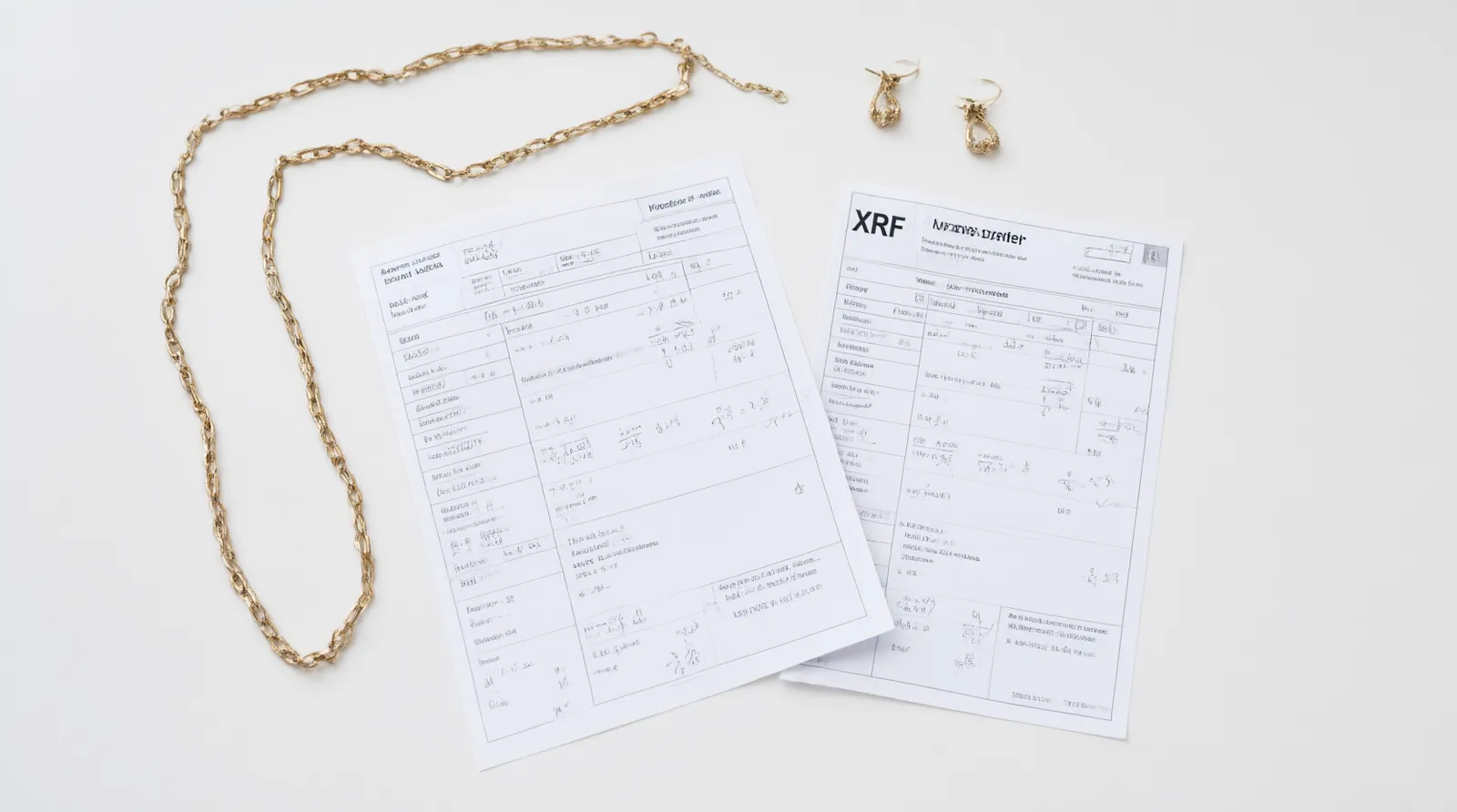
Any supplier worth working with should be able to provide an X-ray fluorescence (XRF) test report confirming plating thickness. Ask for it. If they can't produce one, that's informative.
For chemical compliance, ask for a REACH-compliant test certificate covering nickel, cadmium, and lead limits. STRAND, as an example of a vetted supplier in this space, builds compliance documentation into their standard sample process — this is the baseline to expect, not an upgrade.
MOQ, Pricing Tiers & Sample Policies
MOQ (minimum order quantity) structures vary significantly. A trading company might offer 30–50 pieces per style; a factory with direct manufacturing relationships often requires 100–300 pieces per design to make a production run cost-effective.
Before committing to a supplier, clarify:
- Per-style MOQ vs. per-order MOQ (you can combine styles to hit a floor)
- Whether samples are charged at cost or offered free above a threshold
- Whether the production unit price steps down at 500, 1,000, or 5,000 units
If you're sourcing for multiple SKUs, a supplier who offers mixed-MOQ orders gives you much more flexibility in building a first collection without over-investing in any one style.
Pricing itself should be compared on a landed cost basis — unit price plus freight, duties, and any import fees — not just the factory FOB price. Two suppliers with identical FOB prices can land at very different per-unit costs depending on shipping method and your import duty rate.
Lead Times & Production Capacity
Standard production lead times in the fashion jewelry segment run roughly 30–45 days from order confirmation for stocked designs, and 45–60 days for custom or modified pieces. Sample lead times typically run 7–15 days.
What you're actually evaluating here isn't just the number — it's the supplier's track record of hitting it. Ask for references from buyers who've done multiple re-orders. A supplier who delivers on time for a first order and then slips on re-orders is a supply chain risk hiding behind a good first impression.
Capacity matters if you're scaling. Ask directly: what is their maximum monthly output? What happens during Chinese New Year (a 2–4 week production pause that catches first-time importers off guard)? If your brand has seasonal peaks, factor in a buffer.
Shipping, Logistics & Import Compliance
Most fashion jewelry suppliers offer FOB (Free on Board) pricing, meaning freight is your responsibility. Your options break into:
- Air freight: 5–10 days, higher per-kg cost, practical for small first orders or urgent re-orders
- Sea freight (LCL/FCL): 25–40 days to most markets, lower unit cost at volume
- Express courier (DHL/FedEx): fastest for samples and small orders, expensive at scale
For buyers in the MENA region, confirm the supplier is experienced with Gulf Cooperation Council (GCC) import documentation, including certificate of origin requirements and material safety declarations — these can hold shipments if missing.
When to Work With a Fashion Jewelry Supplier
Three scenarios make sourcing from a dedicated fashion jewelry supplier the right call:
Launching or scaling a DTC jewelry brand. If you're building a product line with a defined aesthetic — minimalist gold, statement pieces, pearl-accented, or region-specific styles — a supplier who can produce consistently across re-orders is non-negotiable. A trading company works for testing; a direct supplier relationship works for building.
Importing for retail or wholesale distribution. Importers buying for multi-door distribution need consistent quality across batches and reliable documentation. A supplier who treats compliance as an afterthought creates risk at every customs point.
Supplementing a custom or fine jewelry line. Some buyers source fashion accessories to complement higher-ticket items — extending average order value without extending production complexity. In this context, the fashion jewelry supplier relationship is about flexibility and speed.
If you're evaluating whether custom manufacturing makes more sense for your program, Custom Jewelry: 6 Sources Buyers & DTC Brands Need in 2026 lays out the sourcing models in detail.
5 Benefits of Working With a Vetted Fashion Jewelry Supplier
1. Consistent quality across re-orders. A vetted supplier maintains production records and QC checkpoints that make batch-to-batch consistency achievable, not accidental.
2. Contractually defined material specs. Unlike sourcing from aggregator platforms, direct supplier relationships allow you to specify base metal, plating thickness, and finish in writing — and hold them to it.
3. Scalable MOQ tiers. Good suppliers grow with your order volume. Starting at a lower MOQ to test sell-through and scaling up on winning styles is a standard arrangement.
4. Compliance documentation included. REACH, Prop 65, and nickel-release test reports protect you at customs and reduce product liability exposure in your target markets.
5. Faster iteration on trends. A supplier with an active design library and short sample lead times lets your brand respond to trend cycles rather than waiting three months to test a new style.
How to Vet and Onboard a New Fashion Jewelry Supplier
The vetting process doesn't require a factory visit for every supplier — though one visit is worth more than ten video calls when a relationship scales. A practical remote vetting sequence:
- Request a capability profile: factory type, production capacity, current brand clients (even anonymized), and certifications they hold.
- Order paid samples of 3–5 styles from their existing line — styles similar to what you want to source. Evaluate plating consistency, stone setting security, clasp function, and surface finish quality.
- Request compliance documentation for the samples: XRF test report, REACH certificate, and any relevant market-specific certifications.
- Place a small trial order (at their stated MOQ) before committing to a larger run. Evaluate against the samples.
- Assess communication quality: response time, accuracy of answers to technical questions, and whether they flag problems proactively or wait for you to find them.
Communication quality is underrated as a vetting criterion. A supplier who answers "yes" to every question — lead time, customization, compliance — without any caveats is telling you what you want to hear, not what's actually possible.
Questions to Ask Before Placing Your First Order
These are the specific questions that separate buyers who avoid expensive surprises from those who don't:
- What base metal do you use, and can you confirm alloy grade in writing?
- What is your standard plating thickness, and can you provide XRF test reports?
- Do your products meet REACH nickel-release limits? Can you provide documentation?
- What is your per-style and per-order MOQ?
- What is your standard production lead time, and how has that held across the last 6 months?
- How do you handle quality issues discovered after delivery?
- What are your payment terms for first-time buyers?
- Do you have experience shipping to [your target market] and can you provide the relevant import documentation?
The answer to the quality issue question is particularly telling. A supplier who has a clear process — photos upon receipt, replacement or credit within a defined window — has dealt with this before and built a protocol. Vague reassurances are a yellow flag.
Conclusion: Source Smarter, Scale Confidently
The difference between a fashion jewelry supplier that works and one that causes problems isn't always visible in a first sample. It shows up in the third re-order, the compliance audit, or the moment you need to turn around a bestseller in six weeks. The criteria above — materials, plating specs, MOQ structure, lead time track record, and compliance documentation — give you a framework to evaluate suppliers before you're dependent on them.
If you're at the beginning of your sourcing journey, start with samples from two or three candidates, compare them on spec rather than just aesthetics, and let the documentation tell you as much as the product.
To take the next step, [Contact the supplier] with your target styles, estimated monthly volume, and any market-specific compliance requirements. A reputable fashion jewelry supplier will respond with specific answers, not just enthusiasm.
Frequently Asked Questions
What is fashion jewelry supplier?
A fashion jewelry supplier is a manufacturer or wholesaler that sources, produces, and distributes trend-driven jewelry pieces — typically crafted from materials such as brass, sterling silver, stainless steel, or zinc alloy with finishes like 18K gold plating, rhodium, or PVD coating — to retailers, importers, and DTC brands worldwide. Unlike fine jewelry suppliers, they focus on seasonal styles with accessible price points, offering structured MOQs (commonly 50–300 units per SKU), standard lead times of 30–60 days, and flexible shipping via sea or air freight. STRAND operates in this space with a vetted-supplier model, connecting overseas buyers to quality-assured producers with full material transparency and consistent craftsmanship standards.
How to fashion jewelry supplier?
To source fashion jewelry through a vetted supplier like STRAND, start by defining your product requirements — materials (brass, sterling silver, 14K gold-fill), stone types, dimensions, and target price points — then request samples before committing to a bulk order (typical MOQ ranges from 50–200 units per SKU). Evaluate suppliers on lead times (usually 30–45 days for custom pieces), packaging options, and shipping terms (FOB, CIF, DDP) to ensure landed costs align with your margins. For MENA markets especially, confirm material certifications and opt for gold-tone or yellow-gold finishes, which align with regional preferences for crafted, elevated aesthetics.
Why is fashion jewelry supplier important?
A reliable fashion jewelry supplier is the foundation of a consistent, scalable product line — giving DTC stores and importers access to vetted materials, repeatable quality, and predictable lead times that protect their brand reputation. For procurement teams, the right supplier reduces sourcing risk by consolidating MOQ negotiations, compliance checks, and logistics into a single, trusted relationship. STRAND connects buyers with crafted pieces — not commodity bulk — so your catalog reflects genuine design value rather than disposable trend cycles.
When should I use fashion jewelry supplier?
Use a fashion jewelry supplier when you're sourcing trend-forward, non-fine pieces — such as brass, stainless steel, or alloy designs with gold/silver plating — to refresh your DTC store's collection seasonally without the capital commitment of fine jewelry inventory. It's the right move when you need flexible MOQs (typically 50–300 units per SKU), manageable lead times (15–45 days), and consistent quality across repeat orders. STRAND is particularly well-suited when your buyers require vetted craftsmanship, documented material specs, and reliable international shipping options rather than commodity-grade volume sourcing.
What are the benefits of fashion jewelry supplier?
Working with a vetted fashion jewelry supplier like STRAND gives overseas buyers access to curated, trend-aligned collections with transparent material specs (e.g., 18K gold-plated brass, 925 sterling silver, hypoallergenic alloys), consistent quality control, and reliable MOQs that suit both boutique and large-scale procurement. A trusted supplier streamlines sourcing by consolidating lead times — typically 15–30 days production plus tracked international shipping — reducing the risk of inconsistent stock or compliance issues. For importers and DTC operators, this means faster inventory turns, predictable landed costs, and a product range crafted to meet the aesthetic and quality expectations of discerning end customers.