
Custom Jewelry vs. Stock Alternatives: Which Sourcing Path Wins?
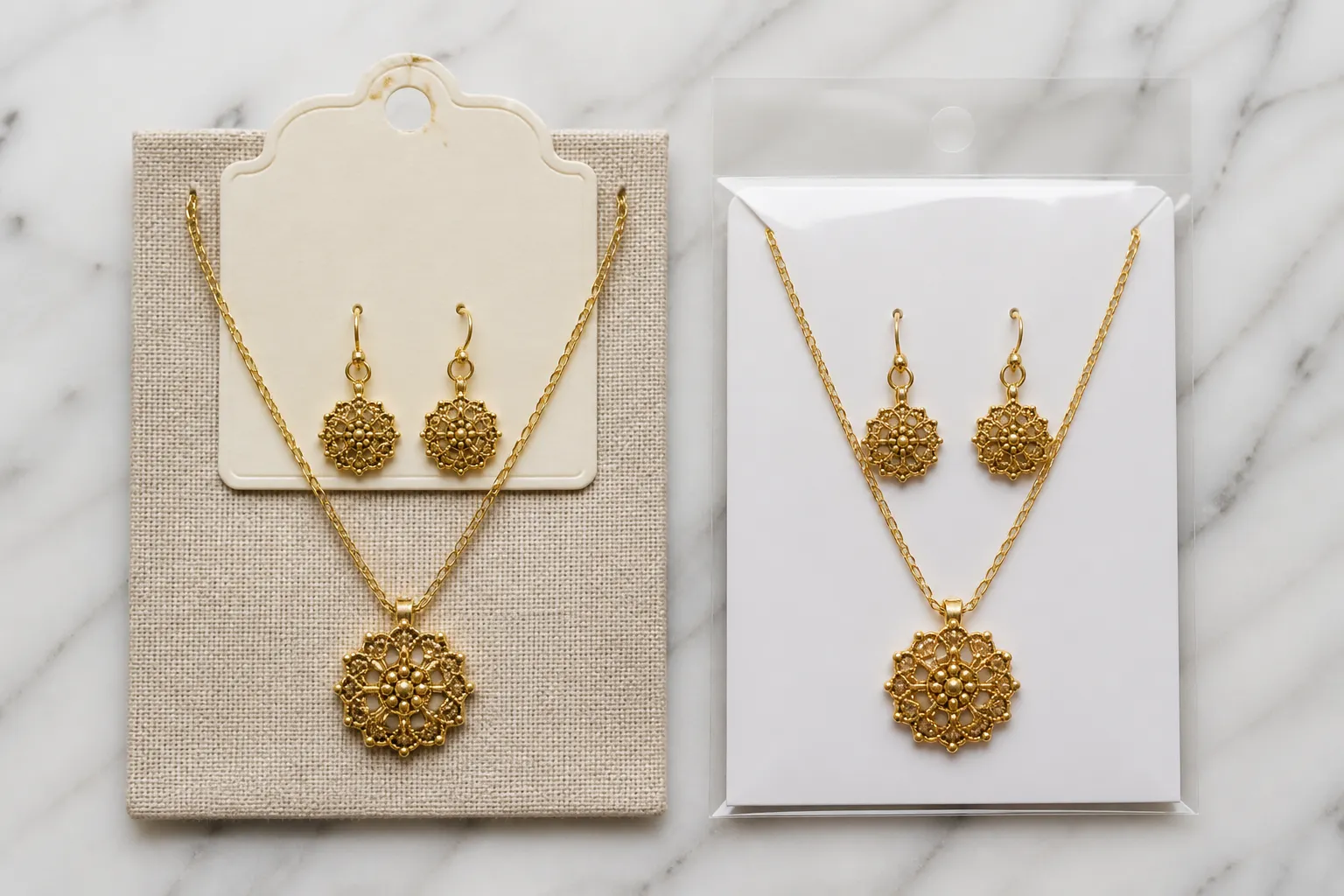
Custom Jewelry vs. Stock Alternatives: Which Sourcing Path Wins?
Custom jewelry gives you brand differentiation and exclusivity; stock alternatives get product to market faster with less upfront risk. For buyers and importers deciding between a custom OEM program and ready-made catalog pieces, the right choice depends almost entirely on your volume, timeline, and how much margin you're willing to trade for speed.
TL;DR / Quick Verdict
If you're building a private-label brand, launching an exclusive seasonal collection, or need pieces that carry your own logo and finish, custom jewelry production is the stronger path — provided you can meet MOQ thresholds and absorb a longer lead time. If you're testing a new market, filling gaps in an existing assortment, or operating on a tight launch window, stock catalog jewelry with rapid fulfillment beats custom on nearly every logistical dimension. Most serious B2B buyers eventually use both in tandem.
At-a-Glance Comparison Table
| Dimension | Custom OEM Jewelry | Stock Catalog Alternatives |
|---|---|---|
| MOQ | Higher (varies by supplier; STRAND starts from 12 pcs/style on most designs) | As low as 1–12 pcs on ready stock |
| Lead Time | 30–60+ days (sampling + production) | Days to 2 weeks (air/express) |
| Unit Price | Lower at volume; higher sampling cost upfront | Fixed price per piece, no tooling fees |
| Branding | Full private label, proprietary design | Generic or supplier brand, limited variation |
| Minimum Variety | One SKU at a time, deep customization | Broad range, 100+ styles available |
| Risk Profile | Higher (capital tied up before selling) | Lower (test small, scale fast) |
| QC Touchpoints | In-house supplier QC + pre-shipment inspection | Supplier QC on batch; less buyer control |
| Shipping Options | EXW / FOB; air, sea, express | Same, but faster due to stock availability |
| Payment Flexibility | T/T, PayPal, L/C, Western Union, Xtransfer | Varies by supplier |
| Best For | Private label, seasonal drops, brand exclusivity | Market testing, assortment fill, speed |
Custom Jewelry: What It Is and Who It's Built For
Custom jewelry — in the B2B sense — refers to OEM or ODM production where a buyer specifies design elements: metal finish (gold-plated, rhodium-plated, 925-style silver), stone type (glass bead, natural stone, rhinestone, faux pearl), dimensions, packaging, and brand marks. The supplier manufactures to spec, not from an existing catalog.
This model is built for DTC store owners who want exclusive SKUs, importers building private-label assortments, and buyers in the US, EU, UK, and MENA who need differentiation on their product pages rather than competing on the same generic pieces their rivals carry.
STRAND's custom OEM program, based in Hangzhou, connects buyers directly to vetted Chinese workshops. Their catalog covers 114 styles — drop earrings, stud earrings, necklace-and-earring sets in vintage crystal, gradient glass bead, two-tone rhinestone, and pearl finishes — with custom production available in gold-plated and rhodium-plated copper, 925-style silver finishes, glass beads, and natural stone. Buyers working in French, Arabic, Spanish, German, or Russian can engage sales teams in their language, which matters for procurement teams across multilingual sourcing operations.
The key buyer question is always MOQ. STRAND's stock catalog carries an MOQ of 12 pcs/style on 109 of 114 designs, with select styles available from 1 piece. Custom OEM runs higher — exact thresholds depend on design complexity and finish — but the floor is lower than many comparable China-based suppliers.
For style inspiration on what's producible in custom formats, the Vintage Green Crystal Geometric Jewelry Set (Ring + Earrings + Necklace) shows the kind of multi-piece cohesion that OEM buyers often want reproduced in their own colorway or finish.
Stock / Personalized Jewelry Alternatives: What They Are and Who They Serve
"Alternatives" to custom OEM covers two distinct categories that buyers often conflate:
1. Stock Catalog Wholesale — Pre-manufactured pieces available to order immediately, with minimal or no customization. This is where speed-to-market buyers live. You get known styles, predictable quality, and rapid fulfillment. The tradeoff: your competitors can source the same pieces.
2. Personalized Retail-Style Jewelry — Consumer-facing brands like Kay Jewelers that offer engraving, name personalization, and online ring configurators. Kay operates a Kay Custom Design Center for in-store consultations and allows customers to build custom engagement rings with lab-grown diamond options through their online configurator. This model is B2C, not B2B — relevant as a competitive context for DTC store owners who want to understand what end consumers are already exposed to, but not a direct procurement alternative for importers.
For B2B buyers comparing sourcing routes, the practical alternative to custom OEM is stock catalog sourcing — either from the same supplier offering both (like STRAND's 114-style catalog) or from a different supplier entirely.
Feature-by-Feature Breakdown
Customization Depth
Custom OEM gives buyers control at the component level: choose the alloy base, plating type and thickness, stone or bead material, clasp style, chain length, and packaging. STRAND's OEM program supports gold-plated and rhodium-plated copper, 925-style silver finishes, glass beads, and natural stone — meaning a buyer can specify a two-tone rhinestone earring in a specific colorway that doesn't appear in anyone else's catalog.
Stock alternatives offer surface-level variation — colorway swaps, stone substitutions — but the underlying mold or design is shared. Personalization services like engraving (offered by Kay Jewelers as a core service) add names or dates but don't change the product structure.
For a brand building an identity around a specific aesthetic — say, a vintage-gradient crystal look that pairs with a necklace set — custom production is the only path to genuine exclusivity. Stock sourcing works when differentiation comes from curation, pricing, or marketing rather than the product itself.
MOQ and Entry Threshold
This is where stock alternatives win clearly. At 12 pcs/style (and 1 pc on select STRAND designs), a buyer can test 10 different styles with minimal capital exposure. Custom OEM requires tooling investment, sample approval rounds, and higher per-run commitments before a single piece ships.
The smart approach most importers take: validate demand with stock catalog units at low MOQ, then convert winning styles into custom OEM runs once sell-through data justifies the volume.
Lead Time and Production Cycle
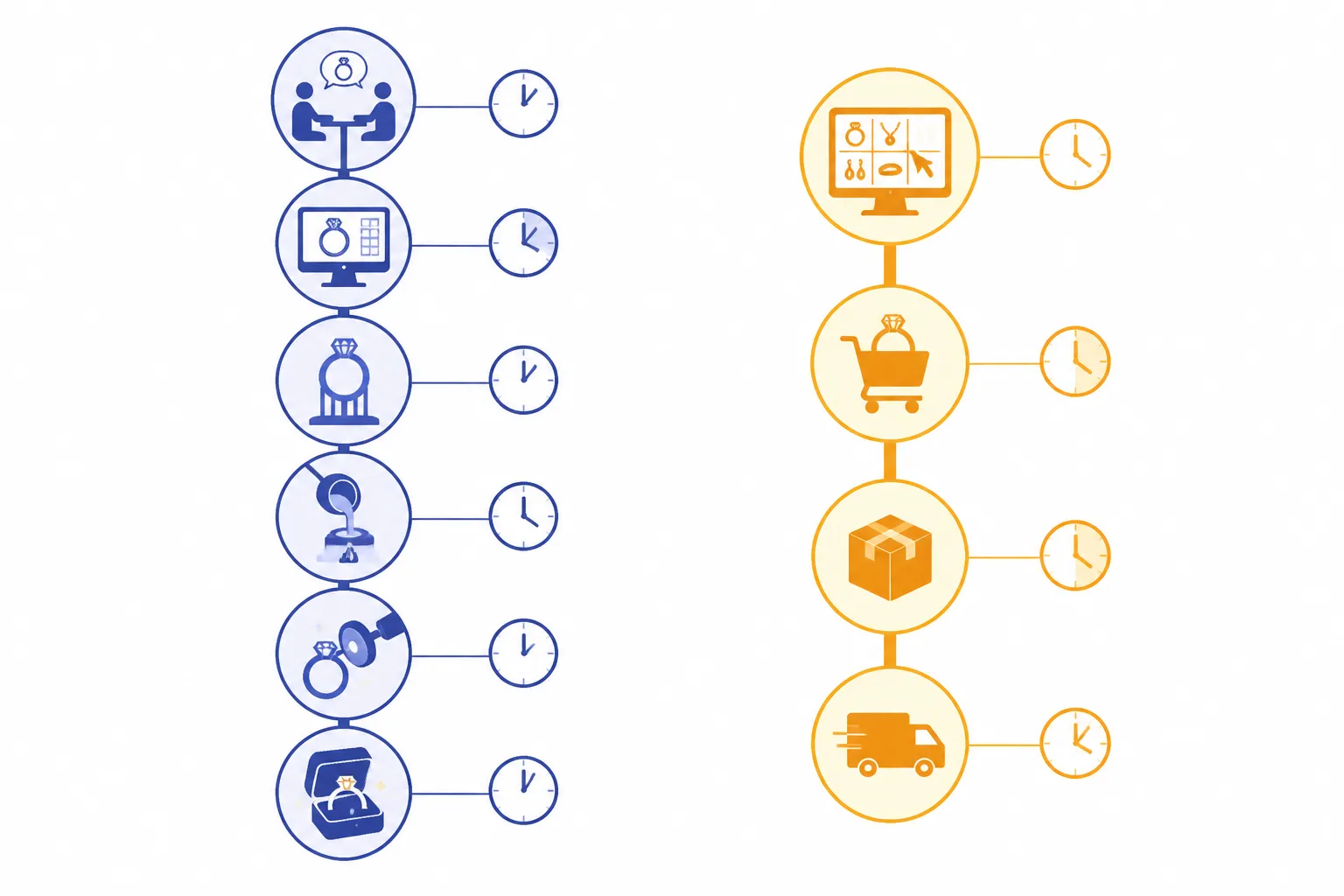
Stock pieces ship in days to roughly two weeks depending on shipping method (STRAND offers air, sea, and express on EXW or FOB terms). Custom OEM adds sampling rounds — typically 2–4 weeks for first samples — plus production time before shipment. Total custom lead times of 30–60+ days are standard depending on complexity.
For seasonal drops with hard deadlines (holiday windows, trade show deadlines), stock catalog sourcing is the risk-managed choice. Custom OEM requires planning 8–12 weeks ahead of need date.
Pricing and Cost Structure
Custom OEM carries tooling or sampling costs that stock sourcing skips. Unit costs at volume tend to be lower for custom (the supplier quotes per-piece price inclusive of margin, with no retail markup layer), but upfront investment is higher.
Stock catalog pricing is transparent and immediate, but you're paying into a supplier's margin structure that also serves your competitors.
Payment flexibility matters at both tiers. STRAND accepts T/T bank transfer, Western Union, PayPal, L/C, and Xtransfer — which covers most international payment scenarios buyers encounter across US, EU, and MENA operations.
Quality Assurance
Custom OEM gives buyers leverage: you set the spec, approve the sample, and can require pre-shipment QC inspection before goods leave the factory. STRAND conducts in-house QC inspection before every shipment — a meaningful step that reduces the rate of defective units arriving in-market.
Stock alternatives still involve QC, but buyers have less visibility into what's being inspected against. The spec is the supplier's own, not yours, so "passing QC" means conforming to generic tolerances rather than your specific requirements.
Support and Communication
For international buyers, language is a real friction point in supplier relationships. Misunderstandings in specs at sample stage are expensive. STRAND's multilingual sales in English, French, Arabic, Spanish, German, and Russian addresses this directly — procurement teams in the EU and MENA don't have to manage translation risk on top of production risk.
Stock sourcing from platforms or generic wholesalers often means English-only support at best, and asynchronous response times that slow down exception handling.
Pros and Cons
Custom Jewelry (OEM Production)
Pros
- Exclusive product — competitors can't carry the same SKU
- Full control over spec: finish, materials, packaging, brand marks
- Lower unit cost at scale
- Builds proprietary product catalog over time
- In-house QC inspection on your spec
Cons
- Higher upfront investment (tooling, sampling)
- Longer lead times (30–60+ days minimum)
- Higher MOQ per style than stock alternatives
- Risk tied to a single design until market validated
- Requires clear design briefs and approval bandwidth
Stock / Catalog Alternatives
Pros
- Immediate availability, fast fulfillment
- Low entry MOQ (as low as 1–12 pcs/style)
- No tooling or sampling costs
- Test multiple styles with minimal capital
- Predictable quality from known designs
Cons
- No exclusivity — same pieces available to competitors
- Limited or no branding customization
- Less leverage on QC spec
- Price is supplier's margin-inclusive, not cost-plus
- Personalization options (engraving, configurator) are B2C constructs, not useful for wholesale assortments
When to Choose Custom Jewelry
You're building a private-label brand. If the goal is a cohesive product line that carries your name, your aesthetic, and your packaging, stock sourcing creates a ceiling on what you can build. Custom OEM removes that ceiling.
You've already validated demand with stock. The proven move: test with catalog pieces at low MOQ, identify your top sellers by style and category, then commission custom versions of those validated winners in your colorway and finish.
Your buyer is in a market where originality commands premium. EU and UK DTC buyers especially face pressure from sophisticated consumers who recognize generic wholesale pieces. A custom two-tone rhinestone set — like the kind of design exemplified by the Two-Tone Rhinestone Fireworks Jewelry Set — becomes a differentiating SKU rather than a commodity item when it's produced to your spec.
You need supplier-side QC to protect your brand. When you're importing at volume and selling under your own brand, a returned shipment with quality issues is your reputational problem, not the supplier's. Custom OEM with pre-shipment inspection — specified in your terms — shifts accountability appropriately.
Your volume justifies the MOQ. If you're ordering 200+ units per style per season, the per-piece economics of custom OEM beat stock pricing handily. The crossover point depends on supplier and design — request a quote with your specific volumes to see where the math lands.
When to Choose Stock Catalog Alternatives
You're entering a new market and need to move fast. Testing a US or MENA market with 12 pcs/style across 10 catalog designs costs less and ships faster than a custom run. You learn what sells before you commit to producing it.
Your launch window is under 30 days. Custom OEM cannot compress its production cycle below sampling time plus production time plus shipping. If you have a hard deadline inside that window, stock is your only option.
You need breadth, not depth. Carrying 50 SKUs across multiple style categories to fill a broad assortment is more efficiently done through a supplier's existing catalog than through 50 custom runs.
Budget is constrained. Tooling, sampling, and higher minimum runs require capital allocation that early-stage buyers may not have. Stock sourcing lets you generate revenue and margin before investing in custom production.
You're testing a supplier relationship. Many experienced importers start with a stock catalog order to evaluate a supplier's actual QC execution, lead time reliability, and communication quality before committing to a custom OEM program. That's prudent due diligence, not a limitation.
Final Verdict
Custom jewelry production and stock catalog sourcing aren't competing options so much as sequential stages in how most successful jewelry importers build their operations. Stock gets you to market. Custom builds the brand.
For buyers sourcing drop earrings, stud earrings, and necklace-and-earring sets for US, EU, UK, or MENA distribution: start with a supplier who offers both — low-MOQ stock catalog access (12 pcs/style on most designs) alongside a real custom OEM program. That way your test order and your eventual private-label program run through a single relationship with consistent QC standards.
The supplier questions worth asking before you commit to either path: What's the exact MOQ for the custom finish I need? What are the sampling lead times and costs? Can you share QC documentation from a recent batch? What payment terms are available for my market?
STRAND's team handles procurement inquiries in English, French, Arabic, Spanish, German, and Russian — and their catalog and custom OEM specs are available directly through their site.