
Custom Jewelry vs. Retail Alternatives: B2B Sourcing Guide 2026
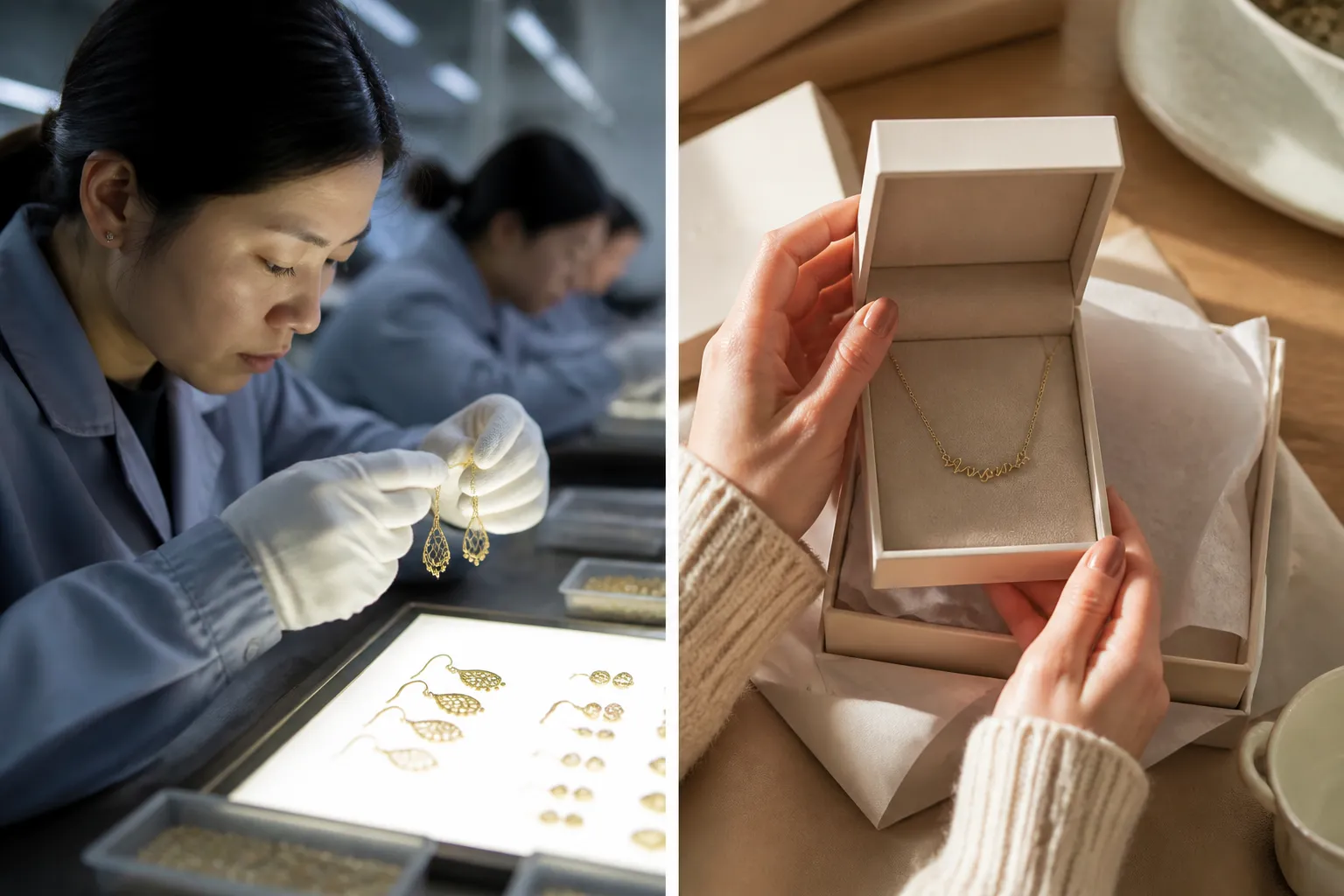
Custom Jewelry vs. Retail Alternatives: B2B Sourcing Guide 2026
Custom OEM jewelry gives importers and DTC brands proprietary product lines, factory-direct pricing, and full branding control — none of which retail personalization platforms can match. Retail alternatives like Jewlr or Kay serve end consumers well, but they're the wrong tool for a buyer sourcing 500 units of branded earring sets for a boutique chain.
TL;DR / Quick Verdict
Choose custom OEM jewelry if you're building a differentiated product catalog, need branded packaging, and can commit to per-style minimum orders. Choose retail personalization platforms (Jewlr, Kay, Kendra Scott) only for gifting or consumer-facing one-offs — they have no wholesale path. Choose stock catalog jewelry if speed-to-market matters more than exclusivity and you need units in days, not weeks.
At-a-Glance Comparison Table
| Dimension | Custom OEM Jewelry (e.g., STRAND) | Retail Personalization (Jewlr, Kay) | Stock Catalog |
|---|---|---|---|
| Target buyer | Importer, DTC brand, boutique chain | End consumer | Retailer needing quick replenishment |
| MOQ | From 12 pcs/style (most styles) | 1 unit | Varies; often 50–500 pcs |
| Lead time | 30–60 days (production) | 3–14 days (consumer shipping) | Days to 2 weeks |
| Design ownership | Full OEM/ODM — your IP | Platform's design, minor personalization | Pre-set supplier designs |
| Branding & packaging | Custom labels, boxes, tags | None | Minimal or none |
| Pricing model | Factory/wholesale | Retail (consumer markup built in) | Wholesale |
| Customization depth | Material, finish, stone, silhouette | Engraving, birthstone swap, name | None |
| Payment terms | T/T, PayPal, L/C, Western Union, Xtransfer | Credit card, BNPL | Varies |
| Quality assurance | In-house QC before shipment | Platform return policy | Supplier-dependent |
| Multilingual support | EN, FR, AR, ES, DE, RU | EN-primary | Varies |
Custom OEM Jewelry: What It Is and Who It's Built For
Custom OEM jewelry is manufactured to your spec — shape, metal finish, stone type, packaging, and branding are all negotiable before a single unit is produced. The model is built for buyers with a product vision, not a single piece to purchase.
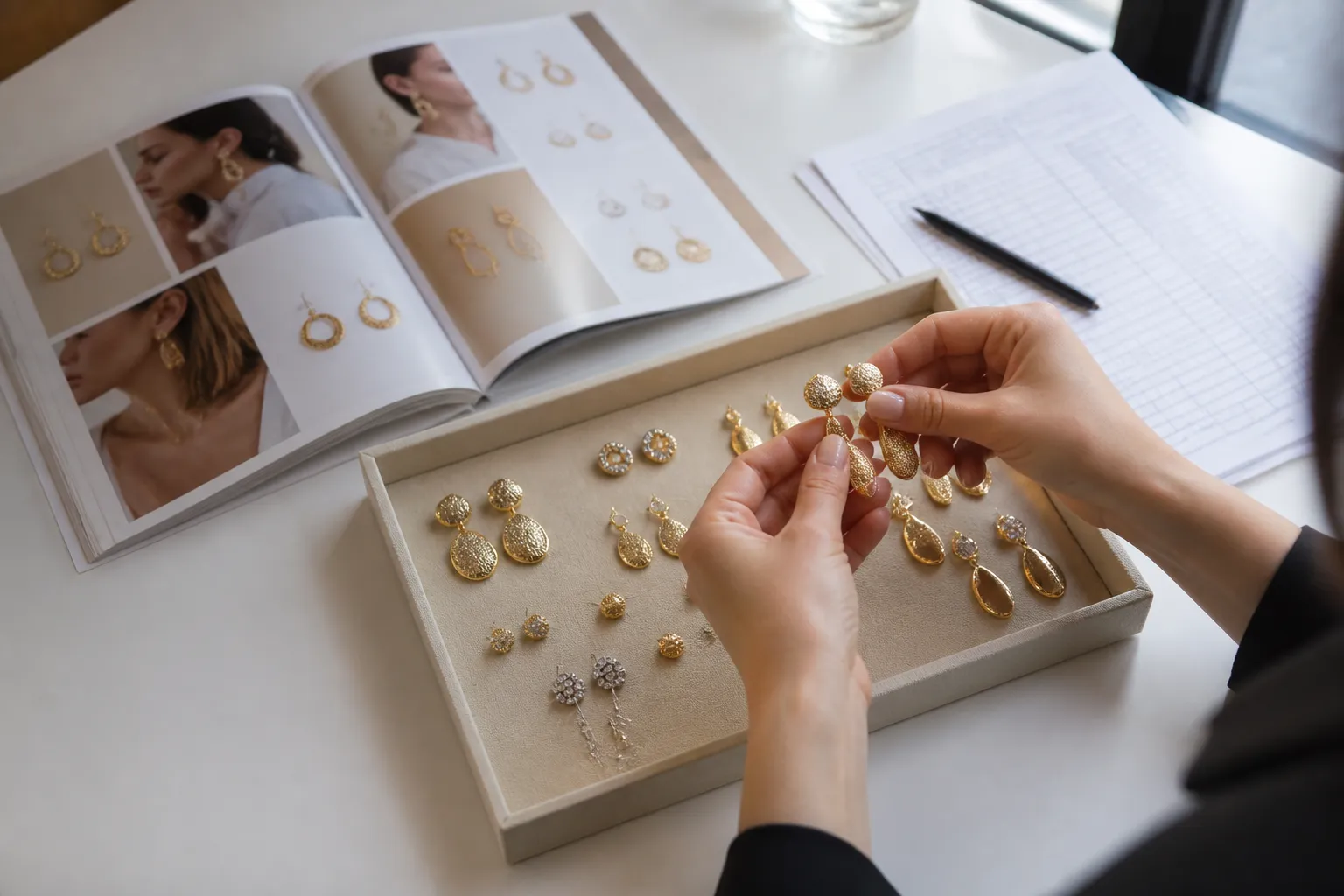
STRAND, a Hangzhou-based supplier linking vetted Chinese workshops to overseas buyers, is a concrete example of how this works at scale. Their 114-style stock catalog lets buyers start with proven silhouettes — vintage crystal drops, two-tone glass bead styles, rhinestone studs, gradient-effect pendants — while the OEM track lets brands replace those silhouettes entirely with proprietary designs. Finishes run across gold-plated copper, rhodium-plated copper, and 925-style silver; stones include glass beads, natural stone, and faux pearls.
What makes this viable for smaller brands: 109 of the 114 catalog styles carry a 12-piece-per-style MOQ, with select styles starting from a single piece. That's a materially lower threshold than most Chinese factories quote — and it means a DTC store owner can test four colorways of a gradient amethyst drop earring without committing to hundreds of units.
Trade terms (EXW or FOB), shipping (air, sea, or express), and payment (T/T, Western Union, PayPal, L/C, Xtransfer) are all covered. The multilingual sales team — English, French, Arabic, Spanish, German, Russian — matters for procurement teams operating across the US, EU, UK, and MENA.
For a deeper look at how OEM suppliers stack up against retail benchmarks, see 6 Custom Jewelry Sources Ranked: OEM Suppliers & Retail Benchmarks for 2026.
The Alternatives: Retail Personalization and Stock Catalog
Retail Personalization Platforms
Jewlr and Kay represent the consumer end of "custom jewelry" — they personalize within fixed product templates. Jewlr's personalized category spans 645 products across rings, necklaces, bracelets, and earrings, with materials in 18K gold-plated silver, 925 sterling silver, and vermeil. Personalization options are engraving, birthstone selection (peridot, garnet, amethyst, aquamarine, among others), and name insertion — not structural changes to the piece itself.
Kay goes further on the fine jewelry side, offering an online ring configurator for engagement rings (nine center stone shapes: Princess, Round, Oval, Pear, Emerald, Marquise, Cushion, Radiant, Heart) and in-store custom design appointments. Lab-grown diamond options and Neil Lane collaborations are available. This is luxury-adjacent consumer retail — not a wholesale sourcing channel.
Kendra Scott stores, Jared, and comparable US chain jewelry retailers operate on similar logic: high-margin, consumer-facing, personalization as a premium feature, no B2B trade terms.
Stock Catalog / Off-the-Shelf
Stock catalog suppliers — whether domestic distributors or overseas factories selling pre-made runs — offer speed and simplicity. Units are available immediately, no design work required. The tradeoff is zero differentiation: your boutique carries the same turquoise bead necklace as five other stores sourcing from the same factory. Margins are also compressed, since stock designs tend to be widely available and easily price-compared.
Feature-by-Feature Breakdown
Pricing and MOQ
Custom OEM pricing scales with complexity — material, stone grade, plating microns, and order volume all move the unit cost. STRAND's 12-pcs/style MOQ on most catalog designs represents a low entry bar for testing new SKUs. Retail personalization platforms price at consumer retail: as of their current sale period, Jewlr's personalized name necklaces start from $84 (18K gold-plated silver), while engravable pendants and gemstone rings run $104–$189. These are consumer unit prices — no wholesale tier exists.
Stock catalog suppliers typically quote better per-unit costs than retail, but MOQs often start at 50–500 pieces per style, which creates inventory risk when testing new designs.
Design Control and IP Ownership
This is where OEM wholesale has no peer. A custom OEM order means the design brief, the silhouette, the stone placement, and the finish are all specified by the buyer — and the resulting product is proprietary. Retail personalization gives consumers a name engraved or a birthstone swapped, but the underlying product design belongs to the platform.
For a DTC brand building a coherent aesthetic (say, a gradient crystal drop earring line that coordinates with a gold-plated necklace set), stock catalog designs scatter the look. Custom production is the only path to visual coherence across a catalog.
Quality Assurance and Compliance
Custom OEM suppliers with in-house QC — STRAND runs inspection before every shipment — reduce the risk of receiving a batch where plating is inconsistent or clasps fail. This matters because end-customer returns trace back to the brand, not the factory.
Retail platforms offer consumer-facing warranties (Jewlr provides a one-year warranty and a 99-day return policy) and free returns, but these are B2C protections, not B2B risk management tools.
Lead Time and Scalability
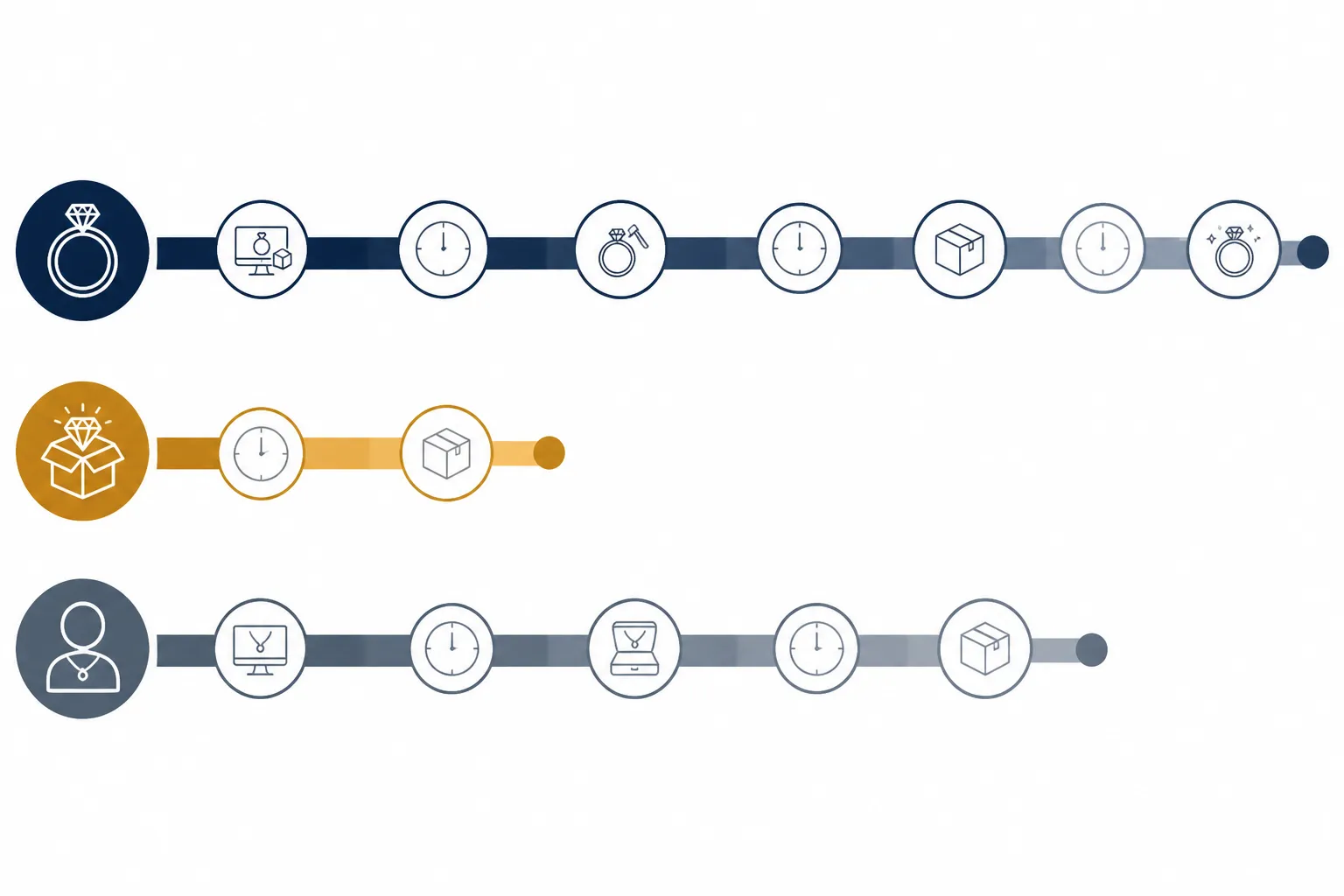
Retail platforms ship to consumers in days. Custom OEM production runs 30–60 days from approved sample to shipment, depending on complexity and factory capacity. That lead time is a real planning requirement — buyers sourcing for seasonal launches (holiday jewelry sets, Valentine's Day drops) need to build it into their calendars.
Stock catalog orders ship faster than custom but still require transit time from overseas suppliers. The scalability question: stock designs cap your volume at whatever the factory has pre-produced; OEM production scales with factory capacity and your purchase order.
Payment and Trade Terms
This is a material distinction for procurement teams. Consumer platforms (Jewlr, Kay) accept credit cards and BNPL options — no L/C, no T/T bank transfer, no Xtransfer. For an importer moving containers, that's a non-starter. STRAND supports T/T bank transfer, Western Union, PayPal, L/C, and Xtransfer — the full range of international trade payment instruments.
EXW and FOB shipping terms let buyers control freight arrangements, which matters for buyers with preferred freight forwarders or consolidation programs.
Support and Communication
Multilingual procurement support is underrated. A French buyer or Arabic-speaking importer navigating a factory relationship in English-only adds friction at every stage — sampling, revision rounds, QC sign-off. Suppliers with native-language sales contacts reduce miscommunication risk on spec sheets and reduce turnaround time on revision cycles.
Pros and Cons
Custom OEM Jewelry
Pros
- Full design ownership and brand differentiation
- Low MOQ entry points (12 pcs/style on most STRAND catalog designs)
- Factory-direct pricing with negotiable trade terms
- In-house QC inspection before shipment
- Multilingual support for international procurement teams
- Scalable from sample to production run
Cons
- 30–60 day production lead time requires advance planning
- Requires a design brief or reference samples to initiate
- Minimum per-style commitment, not per-order
- Communication and logistics managed across time zones
Retail Personalization (Jewlr, Kay, Kendra Scott, Jared)
Pros
- Consumer-friendly UX; no MOQ
- Fast delivery (days, not weeks)
- BNPL and credit card payment
- Strong return policies for end buyers
- Established luxury and diamond offerings for consumer gifting
Cons
- No wholesale or B2B pricing tier
- Personalization is surface-level (engraving, stone swap)
- Design IP belongs to the platform
- No branded packaging or OEM option
- Unsuitable for resale or private-label retail
When to Choose Custom OEM Jewelry
You're launching or expanding a branded jewelry line. If your DTC store needs earring collections that look coordinated — drop earrings, studs, and necklace sets in matching finishes — stock catalog designs won't hold that visual identity. Custom OEM does.
You're importing for multi-door retail. A boutique chain placing the same SKU across 20 doors needs reliable reorder capability, consistent QC, and pricing that supports a retail markup. Consumer platforms don't offer this.
Your buyers speak Arabic, French, or Spanish. Procurement teams working in MENA or francophone markets need suppliers who can communicate spec changes and QC feedback without a translation step.
You want to test new designs with limited capital exposure. At 12 pcs/style, a buyer can validate four new silhouettes — say, a gradient garnet drop, a turquoise bead style, a rhinestone stud, and a two-tone glass bead set — before committing to a full production run.
For a side-by-side view of how OEM suppliers compare to retail personalization channels across more sourcing scenarios, the Custom Jewelry vs. Retail Personalization: The B2B Buyer's Guide covers procurement criteria in detail.
When to Choose Retail Personalization Alternatives
You're buying a single gift. A consumer purchasing an engravable heart pendant or a birthstone ring for a birthday — Jewlr's 99-day return policy and free shipping make the experience low-risk.
You need a certified diamond or fine jewelry piece. Kay's in-store design center and ring configurator — with lab-grown diamond options and nine center stone shapes — serve buyers who want GIA-quality provenance documentation that OEM fashion jewelry doesn't offer.
You need units in 48 hours. Retail platforms ship consumer orders in days. If you're replenishing display stock for an event next week, OEM production timelines don't work.
Your customer expects a luxury brand name. Jared, Kay, and similar stores carry brand equity that a private-label earring set can't replicate at point of sale.
Final Verdict
Retail personalization platforms are consumer tools. They're well-built for their purpose — gifting, engagement ring shopping, birthstone jewelry — but they aren't sourcing channels for importers, boutique chains, or DTC brands building a catalog.
Custom OEM jewelry is the correct comparison for B2B buyers. The real decision there is between suppliers: which factory or sourcing partner offers the MOQ, QC, communication, and trade terms that match your operation. For buyers prioritizing low entry MOQs, multilingual support, and direct factory access, STRAND's model — 12 pcs/style on 109 of 114 catalog styles, in-house QC, EXW/FOB terms, six-language sales team — is worth requesting a quote on.
Stock catalog is the middle path: faster than OEM, less differentiated, appropriate when brand exclusivity isn't the priority.
Don't start with the platform that looks easiest. Start with what your business actually needs — owned designs, consistent QC, and pricing that supports your margins.