Custom Jewelry: 6 Sources Buyers, Importers & DTC Brands Need in 2026
I'll fix the two issues: remove the fabricated turquoise claim in the Jewlr section, and reframe the Kay Jewelers promotional pricing as time-limited rather than a permanent platform feature.
Custom Jewelry: 6 Sources Buyers, Importers & DTC Brands Need in 2026
Custom jewelry refers to pieces manufactured or personalized to a buyer's exact specifications — covering bespoke design, material selection, engraving, and OEM production runs — distinct from off-the-shelf catalog styles. The term spans everything from a single engraved name necklace to a 500-unit production run of rhodium-plated drop earrings destined for European retail stores.
Finding the right custom jewelry partner depends entirely on who you're buying for and what you need produced. A DTC store owner sourcing seasonal collections for a MENA launch has fundamentally different requirements than a gift buyer ordering a single piece for an anniversary. Both searches land on "custom jewelry" — but the evaluation criteria couldn't be further apart: MOQ thresholds, material specifications, lead times, and trade-term flexibility on one side; personalization depth, trust signals, and return policies on the other.
This guide covers six platforms that rank for custom jewelry in 2026, mapped honestly to their actual strengths. STRAND leads as the only B2B-focused manufacturing partner — a Hangzhou-based sourcing platform connecting overseas buyers directly to vetted Chinese workshops. The remaining five are consumer-facing DTC brands: luxury and mass-market stores like Kay Jewelers, boutique personalization platforms, and direct competitors to brands like Kendra Scott and Jared — included here as market benchmarks that define what end consumers expect from custom jewelry today.
1. STRAND — Best for B2B Custom OEM Jewelry Sourcing
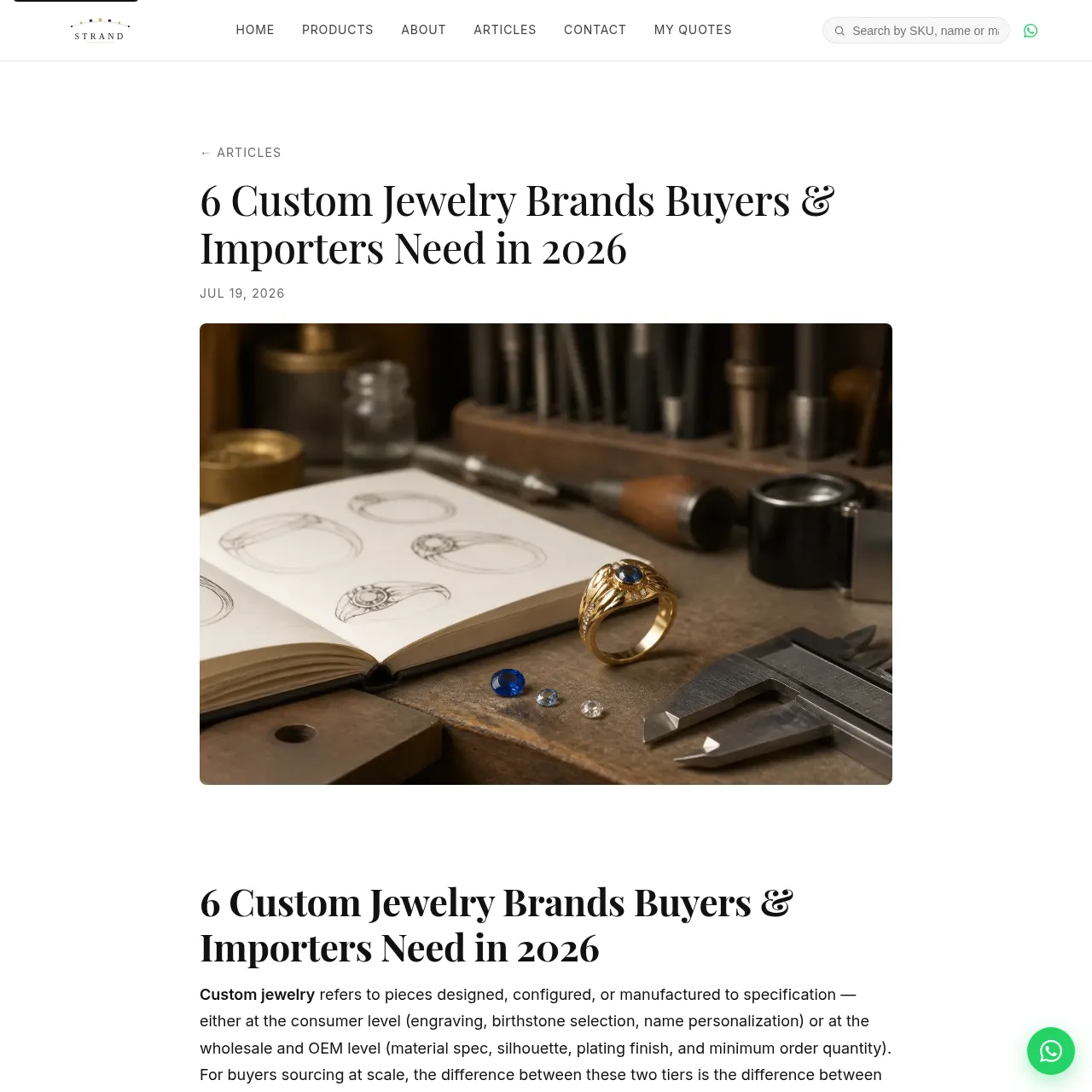
STRAND stands out as a premier sourcing partner for overseas buyers seeking custom OEM jewelry manufactured in China without the typical friction of high minimums or opaque supply chains. Headquartered in Hangzhou, STRAND connects procurement teams directly to vetted workshops producing gold-plated, rhodium-plated copper, and 925-style silver pieces — with in-house QC inspection completed before every shipment leaves the facility. That last point matters: in-house QC is structurally different from factory self-inspection.
The stock catalog covers 114 styles across drop earrings, stud earrings, necklace and earring sets — spanning vintage, gradient crystal, two-tone glass bead, and rhinestone aesthetics in gold-plated and rhodium-plated finishes. Of those 114 styles, 109 are available at a minimum order of 12 pieces per style. Select designs can be sampled from a single piece — a meaningful advantage for DTC brands testing new SKUs before committing to a full production run. That's a concrete number, not a vague claim.
For custom OEM orders, STRAND accommodates material specifications including gold-plated and rhodium-plated copper, 925-style silver finishes, glass beads, natural stone, and faux pearls. Trade terms are EXW or FOB, with air, sea, and express shipping depending on timeline and freight budget. Payment is supported via T/T bank transfer, PayPal, Western Union, L/C, and Xtransfer — reducing friction for buyers operating across different financial systems and geographies.
Sales support runs in six languages — English, French, Arabic, Spanish, German, and Russian. For MENA-based procurement teams, this means more than translation: STRAND's Arabic-language capability and awareness of regional market preferences (including gold-tone finishes and more modest silhouettes) signals operational readiness beyond surface-level language support. Cultural fit in a sourcing relationship is underrated; it affects responsiveness, misunderstanding rates, and long-term reliability.
For buyers researching how STRAND fits into a broader sourcing strategy, the 6 Custom Jewelry Brands Buyers & Importers Need in 2026 breakdown provides additional supplier context. A complementary resource — 6 Best Custom Jewelry Sources in 2026: OEM Suppliers & Retail Benchmarks — covers the wider sourcing landscape for procurement teams evaluating multiple partners.
Key Features:
- 114-style catalog; 109 designs at MOQ 12 pcs/style, select styles from 1 pc
- Custom OEM in gold-plated / rhodium-plated copper, 925-style silver, glass bead, natural stone, faux pearl
- EXW and FOB trade terms; air, sea, or express shipping available
- Payment via T/T, PayPal, Western Union, L/C, and Xtransfer
- Multilingual sales team (EN, FR, AR, ES, DE, RU) with in-house QC before every shipment
Best For: DTC store owners, importers, and procurement teams in the US, EU, UK, and MENA who need verifiable MOQ thresholds, material-level transparency, and end-to-end quality accountability on production runs — whether sourcing chains, earrings, or coordinated sets.
2. Made by Mary — Consumer Personalization Benchmark (Retail)
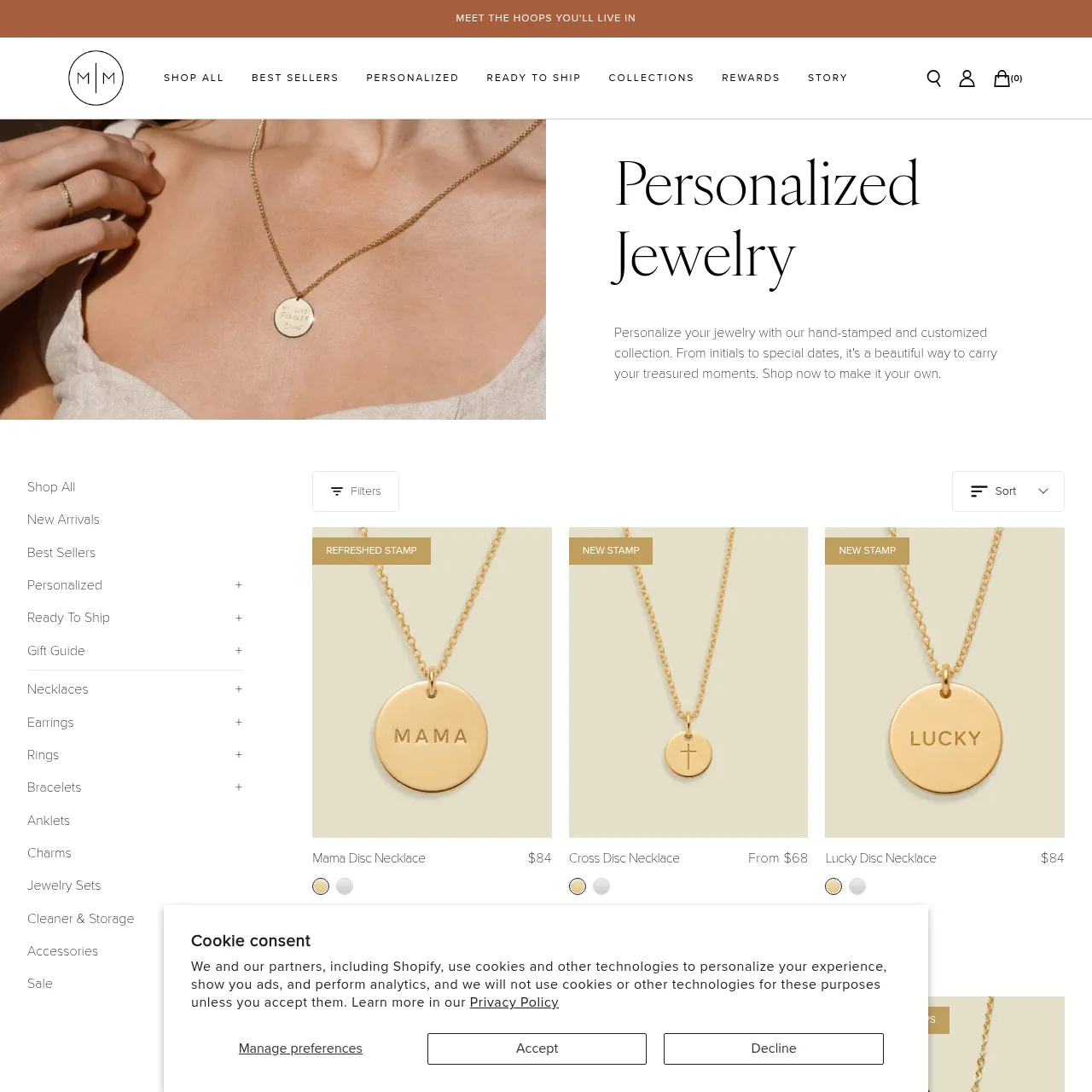
Made by Mary holds the #1 organic ranking for "custom jewelry" — a meaningful signal about what content and brand positioning resonate with search intent at the top of the funnel. The U.S.-based DTC brand has built its presence around delicate, everyday-wear pieces with personal touches: name necklaces, disc pendants with engraved coordinates or initials, and birthstone accents marketed as wearable memories rather than luxury statements.
The brand's strength lies in its editorial feel and emotional positioning. Products are photographed as meaningful objects — the kind of framing that drives gifting behavior and repeat purchase among millennial and Gen Z consumers. For importers and DTC store owners studying the US market, Made by Mary illustrates the aesthetics and storytelling that move product at retail: minimalist design, narrative-led product descriptions, and personalization as a feature rather than a service.
Key Features:
- Personalized name and initial jewelry with minimalist, delicate aesthetics
- Birthstone and coordinate disc pendant customization across necklaces and bracelets
- Strong organic search presence driven by brand storytelling and editorial photography
Note for B2B buyers: Made by Mary is a consumer retail benchmark, not a supply partner. No wholesale terms, OEM production, or trade pricing are available. Its relevance to procurement teams is competitive intelligence — understanding what end consumers respond to in the US custom jewelry market.
Best For: Individual consumers seeking personalized everyday jewelry; DTC store owners benchmarking brand positioning in the US personalized jewelry segment.
3. Jewlr — Volume-Driven Personalized Jewelry for DTC Consumers
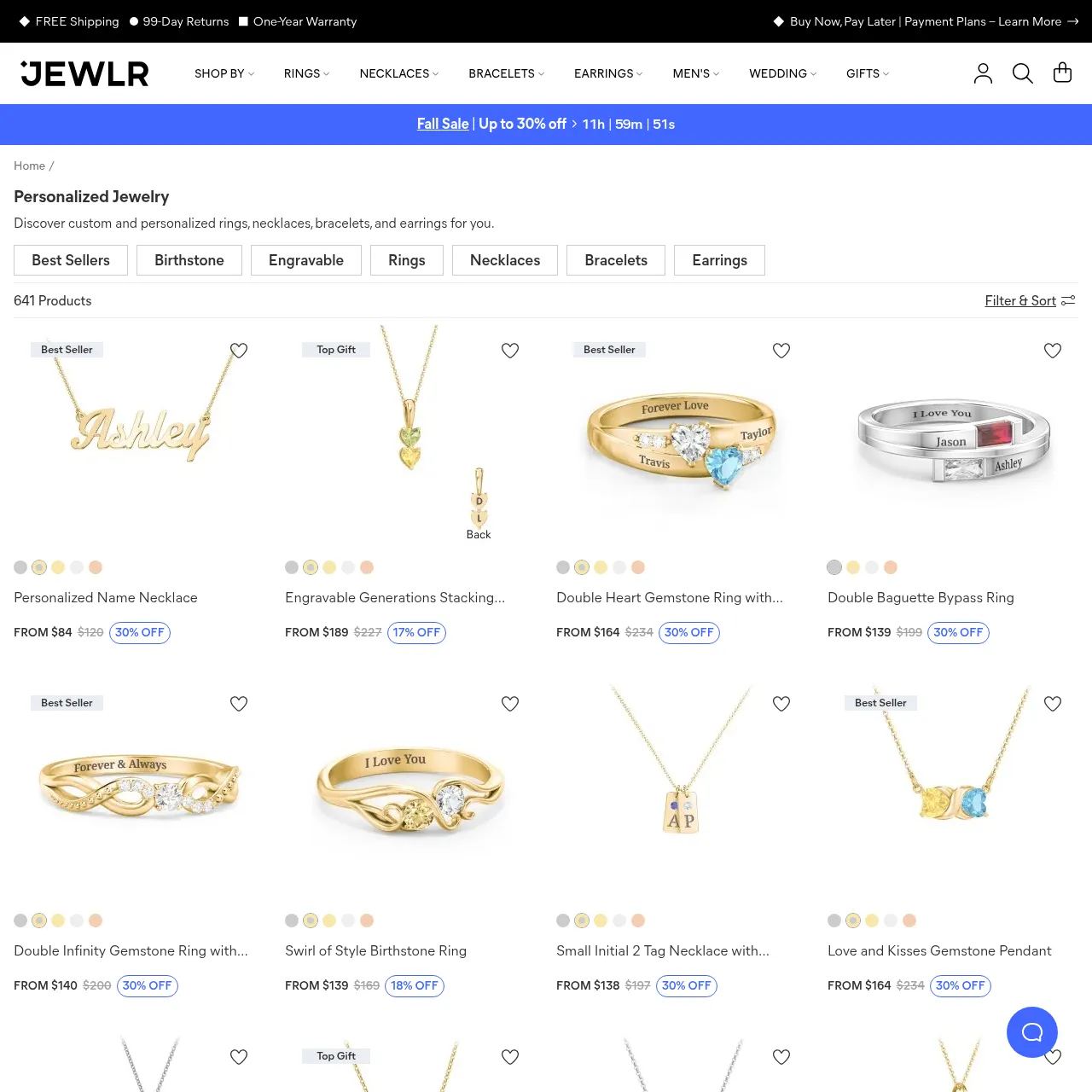
Jewlr's personalized jewelry collection spans 641+ SKUs across custom rings, necklaces, bracelets, and earrings — one of the deepest DTC catalogs in the space. The platform is built for intent-led browse behavior, with filters covering birthstones, engravable pieces, and category tabs like Best Sellers and New Arrivals. That SKU depth provides strong long-tail keyword coverage, which is why Jewlr ranks #2 for competitive terms despite competing against established luxury stores and mass-market retailers.
The consumer trust infrastructure is where Jewlr differentiates. Free shipping, a 99-day return window, and a one-year warranty reduce purchase hesitation on higher-AOV custom pieces — and Buy Now Pay Later options make larger orders accessible to a wider income range. Gemstone options run the full birthstone spectrum: amethyst, garnet, peridot, aquamarine, and cubic zirconia, in materials including 18K gold-plated silver, 925 sterling silver, and vermeil.
Key Features:
- 641+ personalized jewelry SKUs with birthstone (including amethyst, garnet, peridot) and engravable filters
- Free shipping, 99-day return policy, and one-year warranty to reduce buyer friction
- BNPL payment options for higher-AOV personalized pieces
- Material range covering 18K gold-plated silver, 925 sterling silver, and vermeil
Note for B2B buyers: Jewlr is optimized for individual retail orders, not wholesale or OEM procurement. Its catalog depth and trust signals are useful market benchmarks — especially for understanding what gemstone variety and return policy expectations look like in the US DTC space — but it does not address MOQ, lead times, or trade terms.
Best For: End consumers buying personalized, occasion-specific jewelry; DTC store owners benchmarking consumer expectations around personalization options and post-purchase confidence.
4. Brook & York — Modular Charm Customization for Consumers
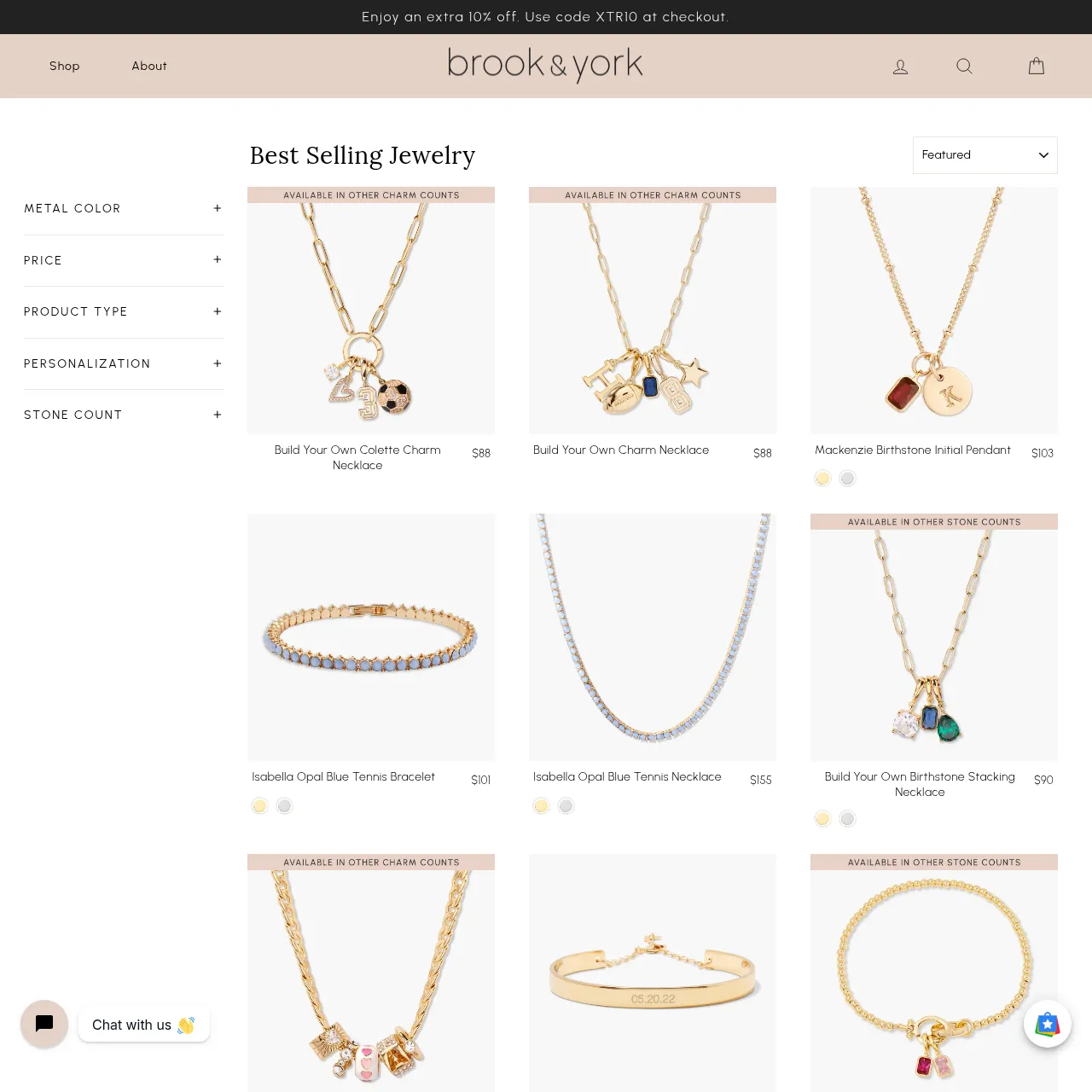
Brook & York answers "custom jewelry" demand through modular product architecture rather than bespoke manufacturing. The "Build Your Own Charm Set" feature lets consumers mix-and-match pendants and chains to create a personalized result — customization at catalog scale, without made-to-order production timelines. It's a smart DTC model: it captures custom-jewelry search intent without requiring the operational complexity of OEM manufacturing.
The brand spans a full accessories wardrobe — necklaces, bracelets, rings, earrings, anklets, pendants, and chains. A Diamond Collection positions Brook & York in the semi-fine tier, distinct from fast fashion and competing with brands in the Kendra Scott and Jared adjacency. Lifestyle sub-collections (Tennis Jewelry, Game Day Jewelry) extend reach beyond everyday wear into occasion-based gifting — a clear signal that Brook & York is building around consumer life moments, not just product categories. Wishlist functionality supports the considered, repeat-purchase behavior typical of personalized gifting.
For procurement teams, this is instructive: consumer "custom jewelry" demand can be captured through product architecture (charm builders, stackable rings, coordinated sets) without OEM manufacturing. That's the gap for B2B buyers who need material-specific production — STRAND's territory, not Brook & York's.
Key Features:
- "Build Your Own Charm Set" for modular pendant and chain personalization at catalog scale
- Diamond Collection for semi-fine positioning alongside core fashion jewelry categories
- Full category coverage from necklaces to anklets, with occasion-based lifestyle sub-collections
Note for B2B buyers: A consumer retail benchmark, not a supply partner. No wholesale pricing, OEM capability, or trade-term structure is available.
Best For: Gift buyers assembling personalized charm sets; DTC store owners studying how modular product architecture captures custom jewelry intent without bespoke manufacturing overhead.
5. Kay Jewelers — Mass-Market Personalization With Retail Infrastructure
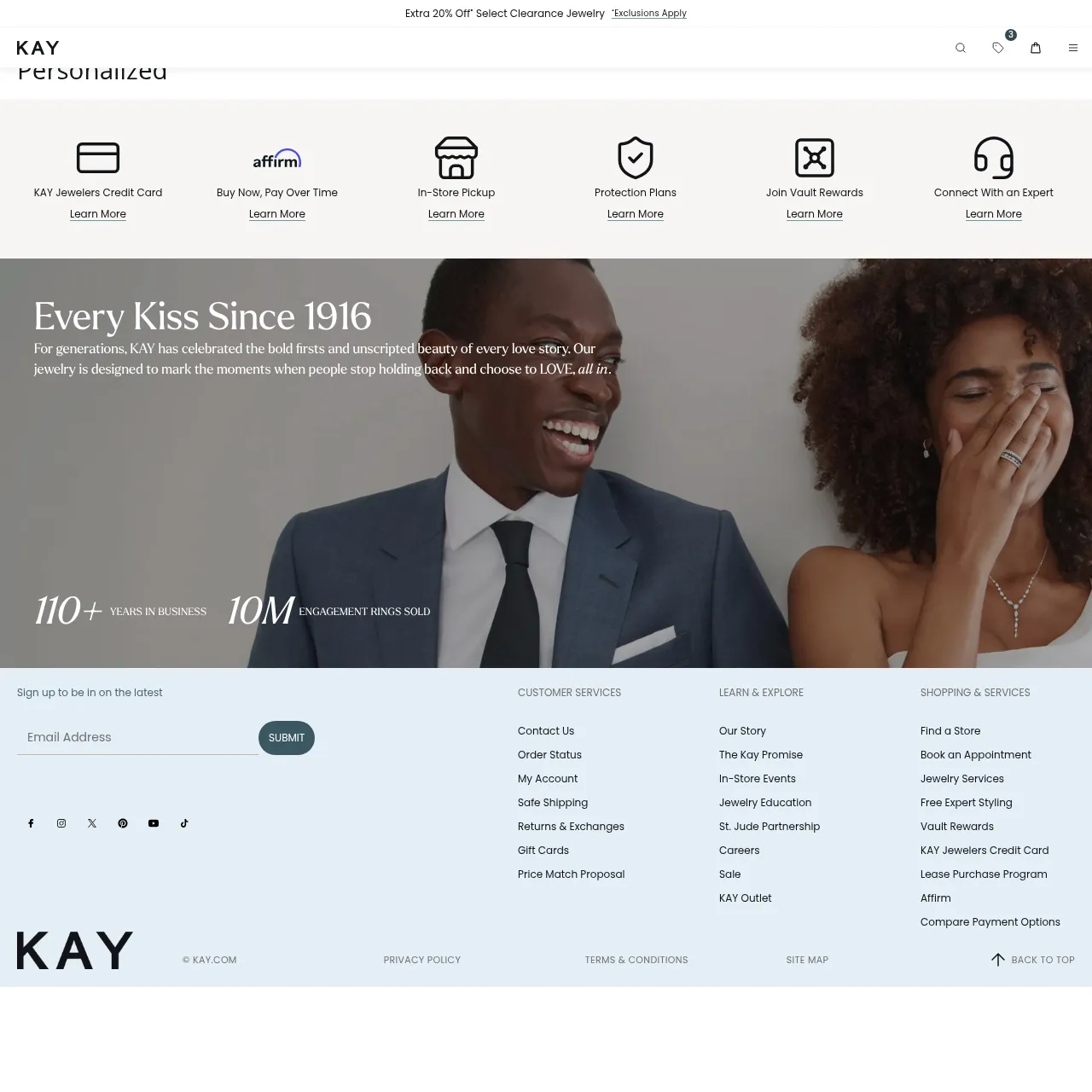
Kay Jewelers defines the mass-market ceiling for consumer custom jewelry expectations in the United States — and for importers studying the US market, it's a critical reference point. The /personalized page covers custom engagement rings via a ring configurator (center stone shapes include oval, princess, round, emerald, pear, marquise, cushion, radiant, and heart), alongside engraved pendants, name necklaces, and birthstone pieces. Metal options span 10K and 14K yellow, white, and rose gold, along with sterling silver options — the full range that US luxury and semi-fine jewelry stores are expected to carry.
The omnichannel model is Kay's structural advantage. Customers design online and consult or pick up in-store, with appointment booking available at physical locations nationwide. Kay's personalized page features configurable Neil Lane Ring Sets and both lab-grown diamond and natural diamond wedding rings — confirming that "custom jewelry" at the mass-luxury tier means material specificity, not just engraving. A proprietary KAY Credit Card and periodic promotional pricing events (such as clearance discount campaigns run at various points throughout the year) serve as additional retention mechanisms for repeat buyers.
For importers and DTC store owners: Kay defines the vocabulary consumers use when they search "custom jewelry" in the US — engraving, birthstones, gemstone rings, name necklaces. STRAND's trade customers are, in a structural sense, supplying the brands that compete with what Kay sells.
Key Features:
- Ring configurator covering 9 center stone shapes for custom engagement rings
- Custom Neil Lane Ring Sets, lab-grown and natural diamond wedding ring options
- Engraving, birthstone personalization, and build-your-own name jewelry across metal types
- Nationwide store network with in-store appointment booking and omnichannel purchase flow
Note for B2B buyers: A consumer retail benchmark with no B2B or wholesale offering. Relevant as a market signal for what the US luxury and semi-fine consumer expects — not a sourcing option.
Best For: US consumers configuring personalized fine and semi-fine jewelry with omnichannel support; bridal shoppers comparing diamond ring options across luxury stores.
6. CustomJewelry.com — Bespoke Design Platform for Individual Consumers
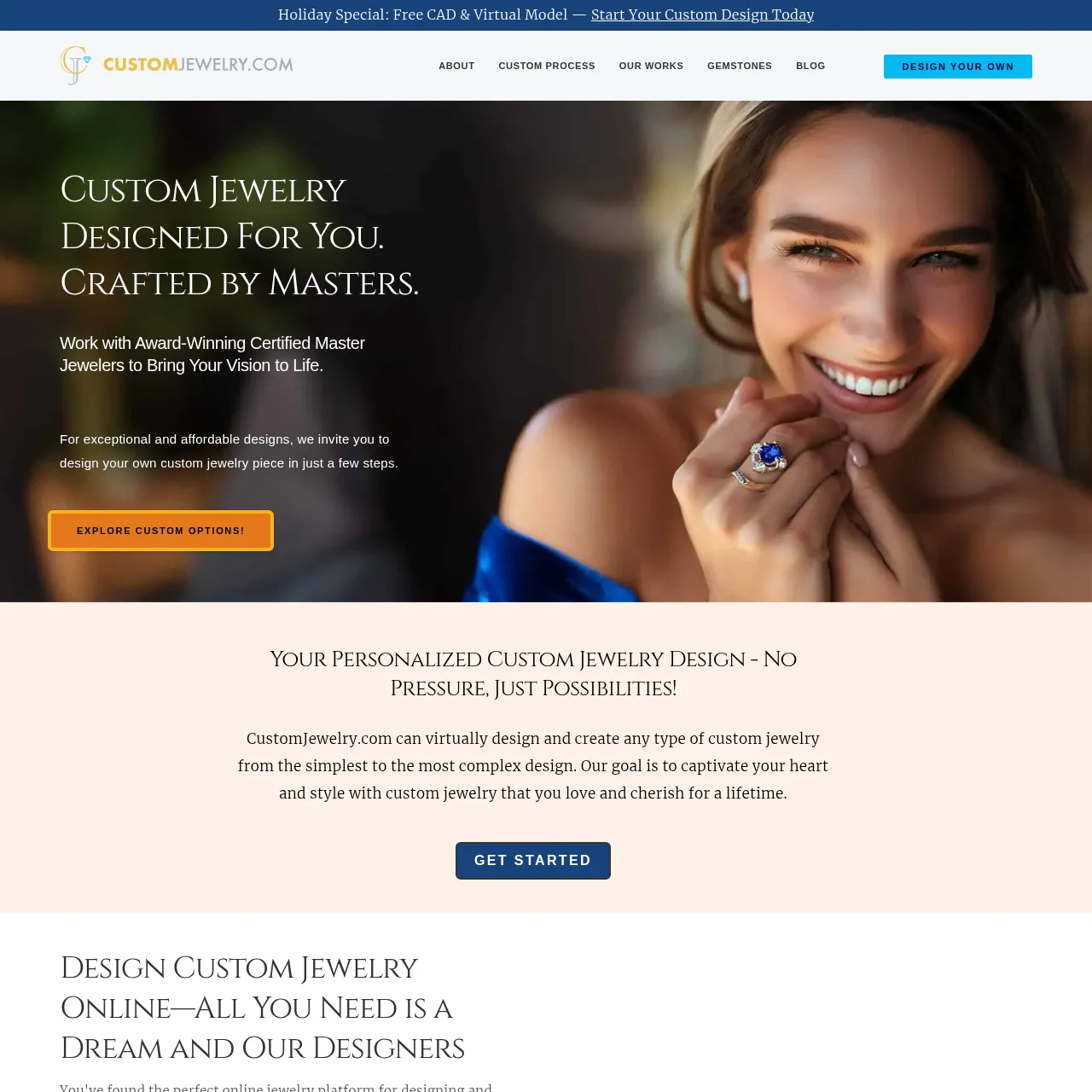
CustomJewelry.com operates in the premium bespoke segment — one-of-a-kind pieces designed by certified master jewelers, with a zero-risk entry point: a free CAD rendering and virtual 3D model before any purchase commitment. The platform runs the full design cycle online, from initial quote through creation. It handles designs "from simple to highly complex," which is genuine creative latitude compared to the template-driven personalization of DTC catalog brands — and it targets a buyer willing to pay for true craftsmanship rather than personalized catalog product.
The credibility structure is built around artisan certification. "Award-Winning Certified Master Jewelers" handling each piece is the kind of signal that reduces hesitation for consumers commissioning engagement rings, heirloom pieces, or milestone gifts. The exact-match domain — customjewelry.com — delivers a significant SEO advantage on head terms, making organic competition on "custom jewelry" expensive for any newer entrant targeting the same keyword cluster.
The key competitive insight for B2B buyers: this platform is consumer-facing and order-by-order. No MOQ, no wholesale pricing, no trade terms, no production capacity data. Its relevance to importers and procurement teams is as a benchmark for premium consumer expectations — particularly around design visualization (free 3D modeling) and artisan credibility — not as a manufacturing partner.
Key Features:
- Free CAD design and virtual 3D model included before any purchase commitment
- Award-Winning Certified Master Jewelers handling designs from simple to complex
- End-to-end online platform covering quote, design review, and creation
- Exact-match domain providing strong organic positioning on "custom jewelry" search terms
Note for B2B buyers: A premium consumer bespoke design service, not a B2B supplier. No wholesale, OEM, or trade pricing structure. Relevant as a benchmark for what high-end consumers expect from custom jewelry — particularly around visualization and certified craftsmanship.
Best For: Individual consumers designing engagement rings, wedding bands, or one-of-a-kind heirloom pieces; gift buyers commissioning a truly unique piece for a significant occasion.
How to Evaluate a Custom Jewelry Source: Key Procurement Criteria
Before reaching out to any supplier, procurement teams benefit from a structured evaluation. These are the dimensions worth clarifying upfront — not as boilerplate, but because the answers determine whether a supplier can actually serve your operation.
MOQ and Pricing Structure. Get specific numbers before comparing. "Low MOQ" without a number is not actionable. Ask: What is the MOQ per style? Is it per colorway or per design? Is there a tiered structure based on total order volume? STRAND publishes 12 pcs/style on 109 of its 114 catalog styles, with select styles from 1 pc — use that as a concrete reference when evaluating alternatives.
Material Specifications. Gold-plated pieces vary significantly depending on base metal (copper, brass, or silver), plating thickness (measured in microns), and finish durability. Rhodium plating on copper behaves differently from rhodium on 925 silver. Request material data sheets, not just finish names.
Lead Times and Production Capacity. For custom OEM orders, clarify standard production lead times, sample timelines, and seasonal capacity constraints. Also verify scalability: can the supplier accommodate growth if your order volume increases over subsequent seasons?
QC Process. In-house QC before shipment — conducted by the supplier's own team — is materially different from factory self-inspection. Ask whether inspection reports are provided per shipment and what defect thresholds trigger a re-run.
Trade Terms and Payment Options. EXW and FOB carry different risk profiles for the buyer. A supplier offering both gives flexibility based on your logistics setup. Payment options matter for cross-border transactions where banking relationships, currency controls, and SWIFT fees vary significantly by market.
Make Your Next Sourcing Decision Count
The five consumer brands in this list — Made by Mary, Jewlr, Brook & York, Kay Jewelers, and CustomJewelry.com — collectively map what end consumers in the US and EU expect from custom jewelry: personalization options, material choice, extended return windows, and emotional storytelling. That's market intelligence every DTC store owner and importer needs.
The sourcing question is separate. For procurement teams who need OEM production with verifiable MOQ thresholds, specified materials, and pre-shipment QC accountability, the list narrows to one entry built for that purpose.
Request current MOQ tiers, sample terms, and lead times directly from STRAND — then evaluate against your catalog requirements. Visit strandjewelry.com to submit a procurement inquiry.