
Best Alternatives to Custom Jewelry for Buyers & Store Owners
Best Alternatives to Custom Jewelry for Buyers & Store Owners
Custom jewelry sounds ideal on paper — but the reality often involves long lead times, high minimum orders, and costs that don't scale when you're building or expanding a catalog. Whether you're sourcing earrings and sets for a DTC store or importing fashion jewelry for redistribution, there are smarter paths to on-brand pieces that don't require starting from scratch every order.
Why Look for Alternatives to Custom Jewelry?
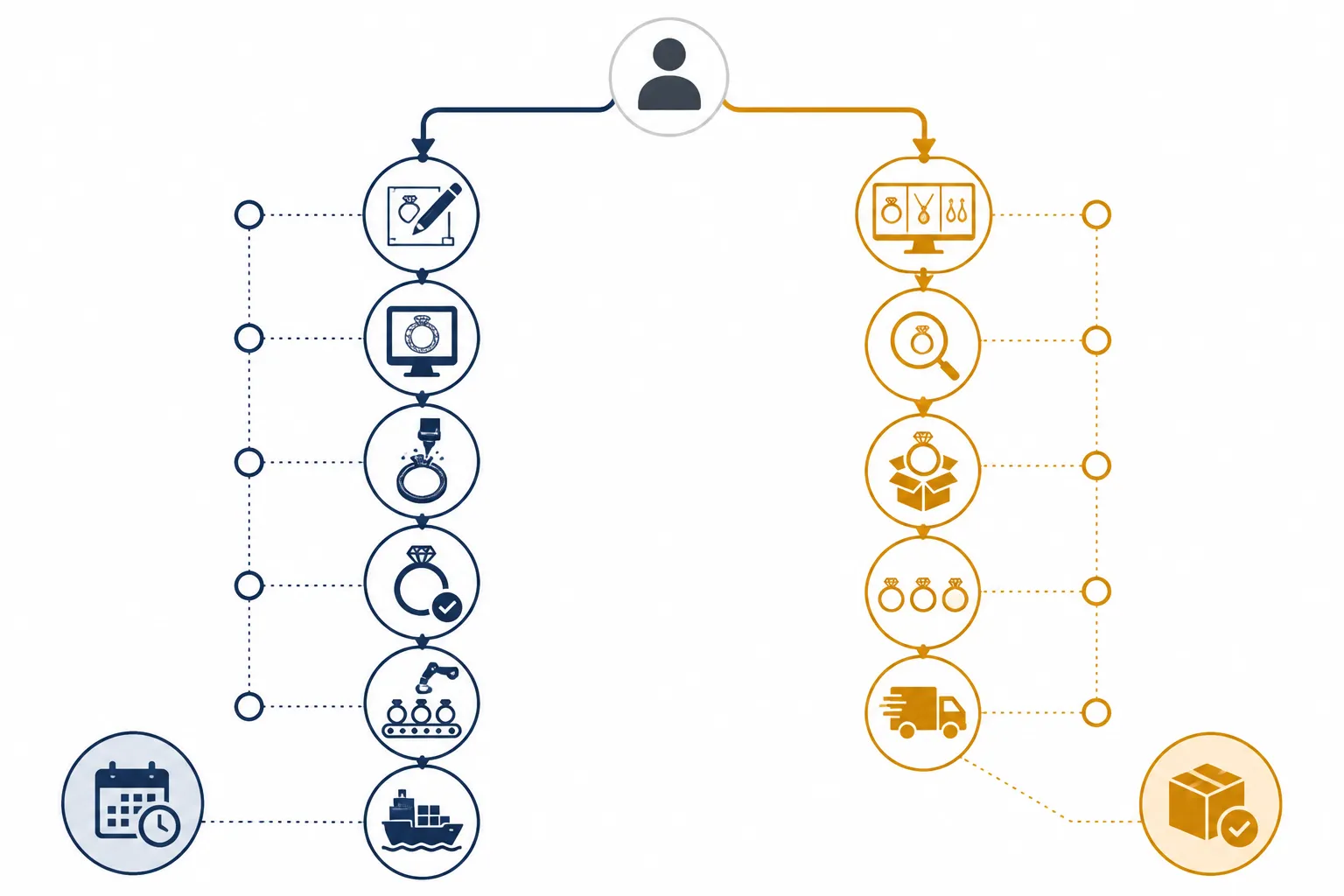
Custom jewelry carries costs beyond the quoted price. Design fees, sample rounds, tooling charges, and production lead times — often 60–120 days for a net-new piece — add up fast. For small-batch importers or DTC brands scaling their catalog, this friction erodes margin before the product ships.
MOQ is the other major barrier. Factories that accept truly bespoke work typically require large minimum quantities to justify setting up dies and plating lines. A buyer wanting 12 pieces of a new earring style cannot meet a 500-unit custom tooling minimum. That pushes buyers toward stock designs they can order in small runs while reserving custom work for proven bestsellers only.
Then there's risk. A custom run locks capital into an untested design. Miss the trend window and you're holding inventory. Stock catalog jewelry from suppliers with wide style ranges and low MOQ lets buyers test new markets with limited exposure, iterate on what actually sells, and scale with confidence — rather than betting the season on a single custom commission.
What to Look for in a Custom Jewelry Alternative
Before comparing options, set your evaluation criteria:
- MOQ flexibility: Can you order 12 pieces per style, or does the supplier require 200+ to start? Low MOQ is critical for trend-testing.
- Finish and material quality: Look for gold-plated or rhodium-plated copper, 925-style silver finishes, or glass bead construction with documented QC processes.
- Style catalog breadth: 100+ styles lets you build a cohesive collection from a single supplier without juggling multiple factories.
- Trade terms and payment options: B2B importers need T/T, L/C, or Xtransfer; consumer-style payment-only suppliers are a poor fit.
- Shipping and logistics: EXW and FOB options give importers flexibility; air, sea, and express freight under one roof simplifies the chain.
- Customization depth: Even "stock" suppliers may offer color swaps, OEM packaging, or logo engraving — evaluate how far they can go before you need fully bespoke tooling.
- Multilingual support: International procurement teams lose time when supplier communication is single-language only.
Top Alternatives to Custom Jewelry
1. STRAND — Stock OEM Catalog with Full Custom Capability
Best for: Importers, DTC store owners, and wholesalers in the US, EU, UK, and MENA who want low-MOQ ready-to-ship jewelry with an optional OEM path for branded or custom styles.
Pricing: B2B trade pricing with EXW and FOB terms — request a quote at strandjewelry.com.
Key strengths vs. custom jewelry:
- 114-style stock catalog with MOQ of 12 pcs/style on 109 of those styles; select styles available from 1 pc, making genuine market testing possible at minimal capital risk
- Custom OEM in gold-plated and rhodium-plated copper, 925-style silver finishes, glass beads, natural stone, and faux pearls — bespoke capability is available once designs prove themselves
- Multilingual sales in English, French, Arabic, Spanish, German, and Russian — procurement teams in MENA, EU, and beyond communicate in their own language
- In-house QC inspection before every shipment; trade payment options include T/T bank transfer, Western Union, PayPal, L/C, and Xtransfer
Limitations / trade-offs:
- Primarily a B2B supplier — not designed for single-unit retail consumers
- Hangzhou-based, so delivery timelines vary by shipping mode; air is fastest, sea is most cost-effective at scale
- Core catalog is earring and necklace-set focused; ring and bracelet depth is narrower
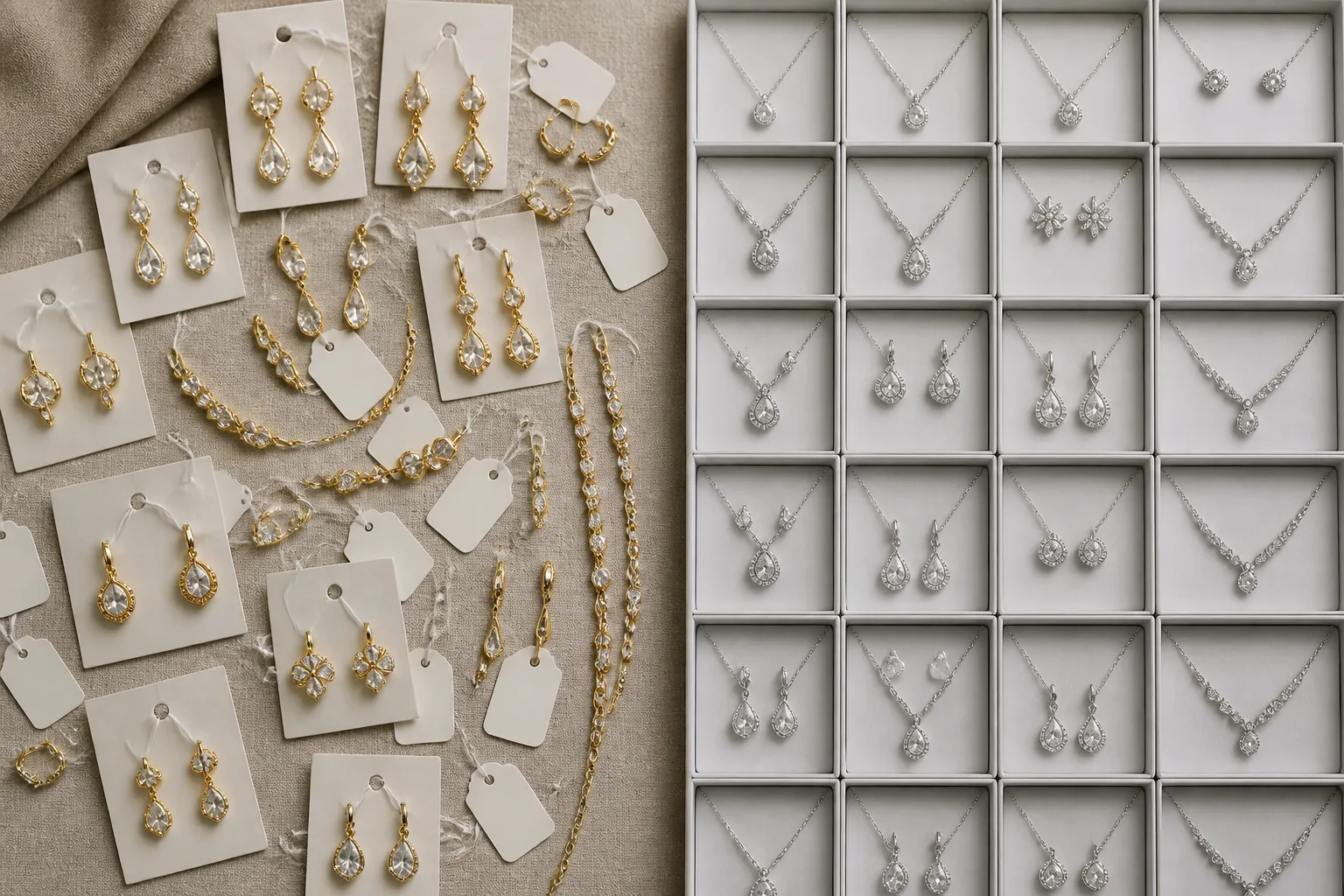
How it compares to custom jewelry: Where fully custom jewelry demands tooling time, multiple sample rounds, and large MOQs to offset development costs, STRAND's stock catalog lets buyers launch a cohesive collection immediately. The 12-pc/style MOQ removes the capital lock-in of custom runs entirely — and the OEM path means branded, custom pieces are still accessible once a design proves its market. Buyers who find custom jewelry too slow and expensive for iterative sourcing get direct operational relief here. The Vintage Green Crystal Geometric Jewelry Set is a good example of finish depth available without custom tooling: vintage gradient crystal in geometric settings, available across earring, necklace, and ring formats from stock.
2. Kay Jewelers — Retail Custom Design Center
Best for: US consumers and retail gift buyers who want in-store design consultation and national-brand assurance behind their purchase.
Pricing: Consumer retail; varies by metal, stone selection, and carat weight.
Key strengths vs. custom jewelry:
- Kay's dedicated Custom Design Center supports in-store appointments — useful for consumers who want a guided, hands-on design session
- Online configurator covers nine center stone shapes (Princess, Round, Oval, Pear, Emerald, Marquise, Cushion, Radiant, Heart) plus lab-grown diamond options
- Custom engagement rings available from 1 through 7 carats, spanning everyday luxury to high-investment purchases
- Neil Lane Wedding Ring Set and Studio by Kay collections offer elevated design tiers for premium buyers
Limitations / trade-offs:
- Retail pricing structure — not suited for B2B importers, wholesalers, or bulk procurement
- Customization is bounded by Kay's in-house design language; no true OEM or white-label output
- US-centric; limited utility for EU, UK, or MENA procurement teams
How it compares to custom jewelry: Kay is the safe, branded route for a US consumer who wants to walk into a store, select a diamond, and receive a finished ring with a warranty. Compared to commissioning a custom piece from an independent jeweler, Kay offers standardized quality and a recognizable retail experience — but with less creative freedom. For trade buyers, this comparison is academic; Kay is a consumer channel.
3. Made by Mary — Personalized DTC Jewelry
Best for: DTC consumers and gift buyers looking for name-engraved or birthstone pieces with a clean lifestyle-brand aesthetic.
Pricing: Consumer retail; mid-range price band typical for US DTC fashion jewelry.
Key strengths vs. custom jewelry:
- Accessible personalization — initials, names, birth flowers, and birthstones like amethyst, garnet, and peridot are standard options
- Fast online ordering with predictable lead times, unlike bespoke custom commissions that require proofing rounds
- Strong social proof among US millennial and Gen Z shoppers
- Cohesive aesthetic across necklaces, earrings, and bracelets
Limitations / trade-offs:
- No B2B, wholesale, or OEM purchasing path whatsoever
- Personalization is surface-level — engraving and stone selection in fixed settings, not structural customization
- Not a viable sourcing option for importers or retail store buyers
How it compares to custom jewelry: Made by Mary trades bespoke creative latitude for speed and ordering simplicity. A custom commission might take weeks with back-and-forth design review; Made by Mary ships personalized pieces on a much tighter timeline from a pre-made base. For a DTC store owner benchmarking what customers expect from personalized jewelry, it's a useful reference — but not a wholesale or sourcing solution.
4. Brook & York — Personalized Fine-Style Jewelry
Best for: US consumers who want fine-jewelry aesthetics at accessible DTC price points, with personalization options including birthstones and name bars.
Pricing: Consumer retail; accessible tier for personalized sterling and gold-fill pieces.
Key strengths vs. custom jewelry:
- Wide personalization menu: name bars, initial charms, birthstone settings spanning turquoise and garnet among others
- Clean, minimal design language that photographs well — valuable for gift-focused buying occasions
- Consistent quality and established DTC return policies
- Packaging and gift messaging built in
Limitations / trade-offs:
- Consumer-only; no trade or wholesale access
- Template-driven personalization, not truly custom construction
- No relevance for importers sourcing for resale
How it compares to custom jewelry: Brook & York delivers the appearance of personalized jewelry faster and at lower cost than a custom commission. The trade-off is creative constraint — you work within their existing molds and aesthetic, not your own brief. For retail buyers using Brook & York as a market benchmark, the brand shows what US gift buyers expect from personalized pieces at accessible price points.
5. Jewlr — Online Jewelry Configurator
Best for: Consumers who want to visualize and build custom-looking jewelry through a self-service online tool.
Pricing: Consumer retail; ranges from everyday-wear to engagement ring price territory.
Key strengths vs. custom jewelry:
- Real-time 3D visualization of configured pieces before purchase — reduces buyer uncertainty
- Stone selection spanning diamond, amethyst, peridot, and other options within a single platform
- Covers rings, necklaces, earrings, and bracelets; no consultation required to place an order
- Straightforward online experience with direct checkout
Limitations / trade-offs:
- Configurator-based customization, not truly bespoke; design parameters are pre-set
- No B2B, wholesale, or OEM path
- Personalized pieces may have longer return windows than standard stock items
How it compares to custom jewelry: Jewlr is the digital self-service version of the custom jewelry experience — faster and more predictable, but with a lower design ceiling. Instead of working with a jeweler to develop something genuinely original, buyers select within pre-built parameters. For procurement teams comparing this against factory-direct OEM sourcing, Jewlr and wholesale suppliers serve entirely different markets.
6. Catbird NYC — Artisan and Designer Personalized Jewelry
Best for: US consumers seeking curated, independent-designer pieces with an accessible-luxury, Brooklyn-indie aesthetic.
Pricing: Consumer retail; higher price points reflecting artisan positioning and New York brand equity.
Key strengths vs. custom jewelry:
- Works with independent designers, giving buyers access to wider creative range than any single custom jeweler offers
- Gold and diamond pieces at accessible-luxury price points
- Strong in-store and online brand experience with a loyal repeat customer base
- Personalized charms, initials, and stacking designs with genuine artisan character
Limitations / trade-offs:
- No wholesale, bulk, or OEM purchasing at any scale
- Highly US/NYC-focused — limited international relevance
- Premium pricing relative to factory-direct custom sourcing
How it compares to custom jewelry: Catbird's personalized pieces feel custom without the commission lead time. The brand aesthetic is specific and opinionated — if it matches your customer base, it's a strong alternative to commissioning originals at retail scale. For procurement teams, Catbird is a consumer reference point, not a sourcing channel.
7. Kendra Scott — Fashion Jewelry at Retail Stores
Best for: US retail shoppers and buyers who want bold, stone-forward fashion jewelry with strong brick-and-mortar availability and brand recognition.
Pricing: Consumer retail; mid-to-upper fashion jewelry price band.
Key strengths vs. custom jewelry:
- Broad store footprint across the US — physical buying experience for in-person shoppers
- Signature semi-precious stone settings featuring turquoise, amethyst, and comparable natural stones in recognizable, statement designs
- Color bar customization available in select Kendra Scott stores — stone swaps within existing frames
- Strong brand equity; useful market benchmark for what US fashion jewelry buyers respond to
Limitations / trade-offs:
- No B2B, wholesale, or OEM channel
- "Customization" is limited to stone swaps in fixed settings — not structural custom work
- Brand aesthetic is tightly defined; doesn't translate to private-label or white-label sourcing
How it compares to custom jewelry: Kendra Scott's color bar experience mimics customization without the actual cost or lead time. For importers using Kendra Scott as a market benchmark, the brand confirms that US consumers value colorful semi-precious stones and bold statement settings — that insight informs what to source, even if Kendra Scott itself isn't a sourcing channel.
8. Jared — Luxury In-Store Custom Jewelry
Best for: US consumers making high-investment jewelry purchases who want a luxury in-store design experience and premium brand assurance.
Pricing: Consumer retail; luxury price band, especially for diamond and bridal jewelry.
Key strengths vs. custom jewelry:
- Jared stores offer dedicated design studios with trained specialist consultants
- Access to premium diamond inventory with certification and grading documentation
- Financing options that make high-value custom pieces more accessible
- Strong warranty and after-sales support appropriate for the luxury tier
Limitations / trade-offs:
- No trade or wholesale purchasing path
- US store focus with limited international reach
- Significant price premiums versus factory-direct sourcing for comparable materials
How it compares to custom jewelry: Jared represents the standardized luxury retail version of custom jewelry — brand guarantees and specialist consultation without the variability of an independent artisan. For procurement teams evaluating the luxury end of the US retail market, Jared is a consumer reference point that signals what diamond and bridal buyers expect at the top of the spend spectrum.
Side-by-Side Comparison Table
| Dimension | Custom Jewelry (Traditional) | STRAND | Kay Jewelers | Made by Mary | Jewlr | Kendra Scott |
|---|---|---|---|---|---|---|
| Best audience | Bespoke commissions | B2B importers / DTC store owners | US consumers | DTC gift buyers | DTC consumers | US retail shoppers |
| MOQ | Often 100–500+ units | 12 pcs/style (109 of 114 styles) | N/A (consumer) | N/A (consumer) | N/A (consumer) | N/A (consumer) |
| Customization depth | Full bespoke | Stock catalog + full OEM | Configurator + in-store | Template (engraving / stone) | Configurator | Stone swap only |
| Lead time | 60–120 days typical | Ready-to-ship stock | Weeks (in-store consult) | Days–weeks | Days–weeks | Immediate (in-store) |
| Trade / wholesale | Varies by factory | Yes — EXW or FOB | No | No | No | No |
| Multilingual support | Rare | EN, FR, AR, ES, DE, RU | English (US) | English | English | English (US) |
How to Pick the Right Alternative
The right choice depends entirely on where custom jewelry is breaking down for you.
You're a DTC store owner who needs faster market testing. Custom jewelry's development cycle is incompatible with trend-driven buying. A stock catalog supplier with 12-pc MOQ and ready-to-ship inventory lets you test 10 new styles simultaneously for the capital cost of a single custom run. Start with stock, identify winners, then commission OEM versions of proven designs.
You're a consumer shopping for a personalized gift. Made by Mary, Brook & York, or Jewlr all offer fast, template-based personalization — name engraving, birthstone placement, initial charms — without the consultation overhead of custom jewelry. If their existing designs fit your aesthetic, they ship meaningfully faster.
You're an importer in the EU or MENA sourcing at volume. Retail alternatives like Jared, Kendra Scott, or Kay are not built for you. Your evaluation should focus on factory-direct suppliers with export experience, FOB pricing, documented QC, and support in your language. The questions that matter: MOQ per style, production lead time, plating thickness and specifications, and compliance documentation for your import market.
You need luxury positioning with recognizable brand equity. Jared and Kay operate in the premium-to-luxury tier and carry the brand recognition US consumers expect for diamond and bridal purchases. Neither is a wholesale channel, but both are useful benchmarks for what the high end of the US market expects.
You want semi-precious stone variety without custom tooling. Kendra Scott's turquoise, amethyst, garnet, and peridot stone settings map clearly to US consumer demand in fashion jewelry. If you're sourcing comparable stones for import resale, you need a manufacturer, not a retailer — a supplier with natural stone options already in their catalog is the practical path.
The Bottom Line
Custom jewelry earns its place for proven hero products — but it's the wrong default for every SKU. The alternatives above divide cleanly into two groups: B2B sourcing paths for importers and DTC brands, and consumer-facing personalized jewelry brands for end buyers. Most of the retail names on this list — Kay, Jared, Kendra Scott, Made by Mary — cannot help procurement teams on MOQ, trade terms, or multilingual communication. They're useful market benchmarks, not sourcing partners.
For procurement teams actively evaluating suppliers: the criteria that decide outcomes are MOQ per style, plating specification and durability, trade payment terms, shipping flexibility, and supplier responsiveness in your language. STRAND's 114-style catalog — drop earrings, stud earrings, and necklace-earring sets in gold-plated and rhodium-plated copper, glass beads, natural stone, and faux pearls — is built precisely for this use case, with a full OEM path available when stock designs need to become your own.
Ready to evaluate pricing, MOQ tiers, and catalog fit?