
Best Alternatives to Custom Jewelry: 8 Options Worth Considering in 2026
Best Alternatives to Custom Jewelry: 8 Options Worth Considering in 2026
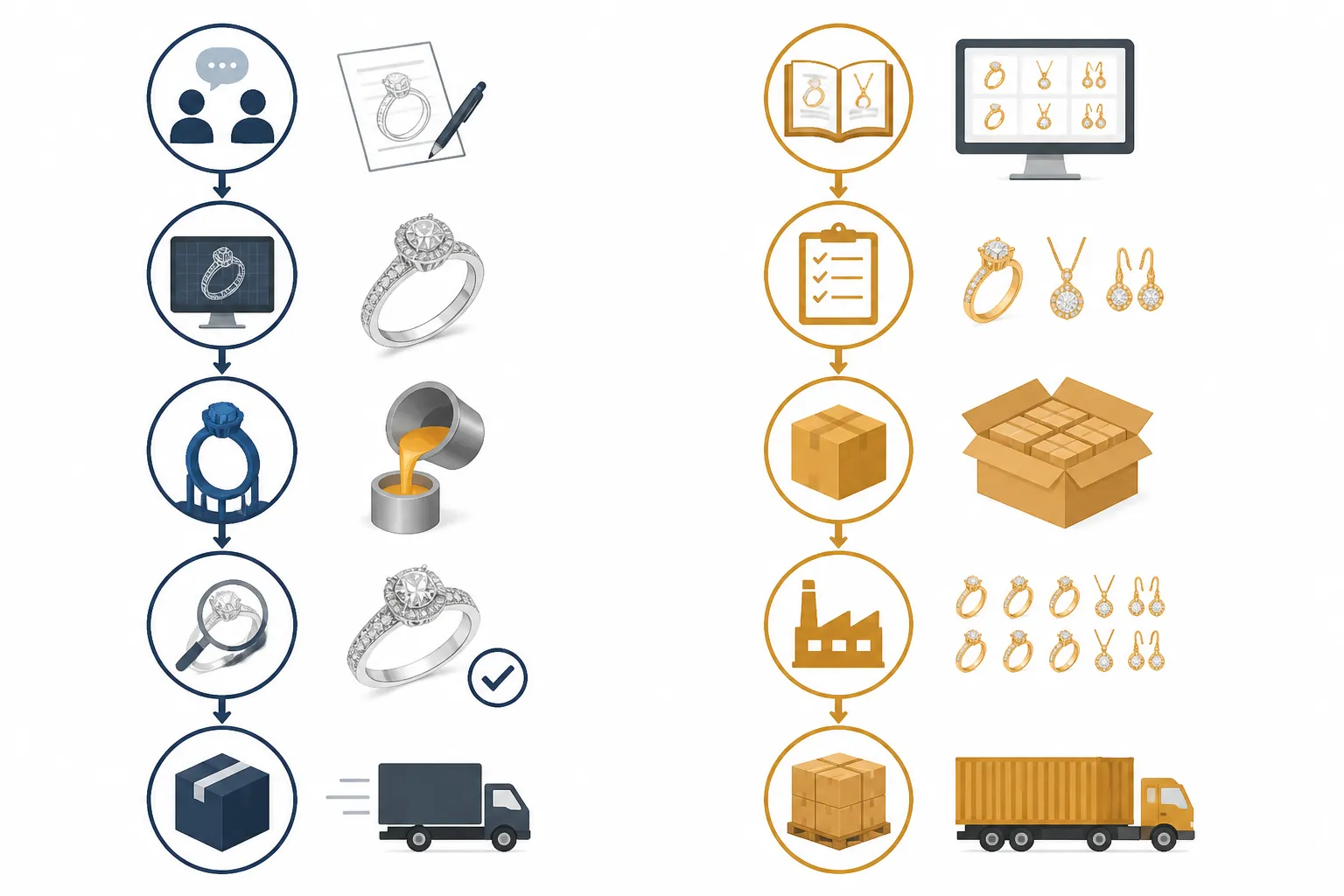
Traditional custom jewelry comes with a real cost: high minimum orders, extended production timelines, and per-piece pricing that erodes margins fast. If you're a buyer, importer, or DTC store owner who's hit those walls, the eight alternatives below cover the full range — from stock catalog OEM with low MOQ to consumer-facing personalization platforms to full bespoke ateliers.
Why Look for Alternatives to Custom Jewelry?
Custom jewelry sounds appealing at the quoting stage: a unique design, your exact specifications, your brand on the product. The reality tends to be messier. Minimum order quantities from most manufacturers start high — often hundreds of pieces per design — which leaves small buyers locked out entirely or sitting on slow-moving inventory they can't liquidate.
Lead time is the second problem. A genuinely custom piece, from approved brief to shipment, takes several months under normal conditions — and that assumes no revision cycles or sample rejections. For DTC operators running trend-driven product lines, that window is too wide. By the time inventory lands, the trend has moved on and you're discounting.
Quality consistency is the third. Custom orders often rely on small workshops that lack formal QC protocols. One batch looks great; the next has inconsistent plating or stone settings that fail after a few wears. Returns, complaints, and chargebacks follow. Buyers who went custom to differentiate end up paying a premium for problems they didn't anticipate.
What to Look for in a Custom Jewelry Alternative
Before shortlisting suppliers or platforms, align your evaluation on these dimensions:
- MOQ flexibility: Can you order per style, or are you locked into large bulk minimums? For test buys and seasonal drops, this matters more than unit price.
- Personalization depth: Do you need blank-canvas design, or would engraving, stone choice, and finish selection cover your actual needs?
- Lead time: Stock catalog ships faster than custom production. Know your delivery window before committing.
- Quality assurance: Does the supplier conduct in-house QC, or is inspection your responsibility and cost?
- Payment and trade terms: For cross-border orders, check whether the supplier accepts your preferred payment method (T/T, PayPal, L/C) and what trade terms apply (EXW, FOB, DDP).
- Multilingual support: If your procurement team spans markets, native-language supplier communication reduces the costly errors that inflate lead times.
- Compliance: For EU and UK markets, REACH compliance and nickel-content standards matter at customs clearance.
Top 8 Alternatives to Custom Jewelry
1. STRAND — Stock Catalog + OEM Custom Jewelry, Low MOQ
Best for: Importers, DTC store owners, and boutique buyers in the US, EU, UK, and MENA who need reliable jewelry product with low minimum orders and multilingual supplier support.
Pricing: Varies by style and quantity; request current OEM and stock pricing at strandjewelry.com.
Key strengths vs. custom jewelry:
- 114-style stock catalog with MOQ of just 12 pcs/style on 109 of those 114 styles — well below typical custom minimums; select styles available from 1 pc
- Full OEM custom capability in gold-plated and rhodium-plated copper, 925-style silver finishes, glass beads, natural stone, and faux pearls
- In-house QC inspection before every shipment — no outsourced third-party inspection variability
- Multilingual sales (EN, FR, AR, ES, DE, RU) with multiple payment methods: T/T, Western Union, PayPal, L/C, Xtransfer; shipping via air, sea, or express
Limitations / trade-offs:
- Primarily earrings, necklaces, and sets — buyers needing rings or bracelets as primary SKUs should confirm current catalog coverage before committing
- Hangzhou-based; international shipping adds lead time compared to domestic suppliers
- Custom OEM requires a sample confirmation stage before bulk production begins
How it compares to custom jewelry: Where traditional custom jewelry requires large upfront commitments and extended production timelines, STRAND bridges the gap with a live stock catalog on shorter shipping cycles, backed by full OEM capability when you do want bespoke designs. The 12 pcs/style MOQ lets you test a style before scaling — something no traditional custom house offers at that threshold. For multilingual procurement teams managing cross-border sourcing, native language support in six languages cuts the back-and-forth that normally inflates custom order lead times.
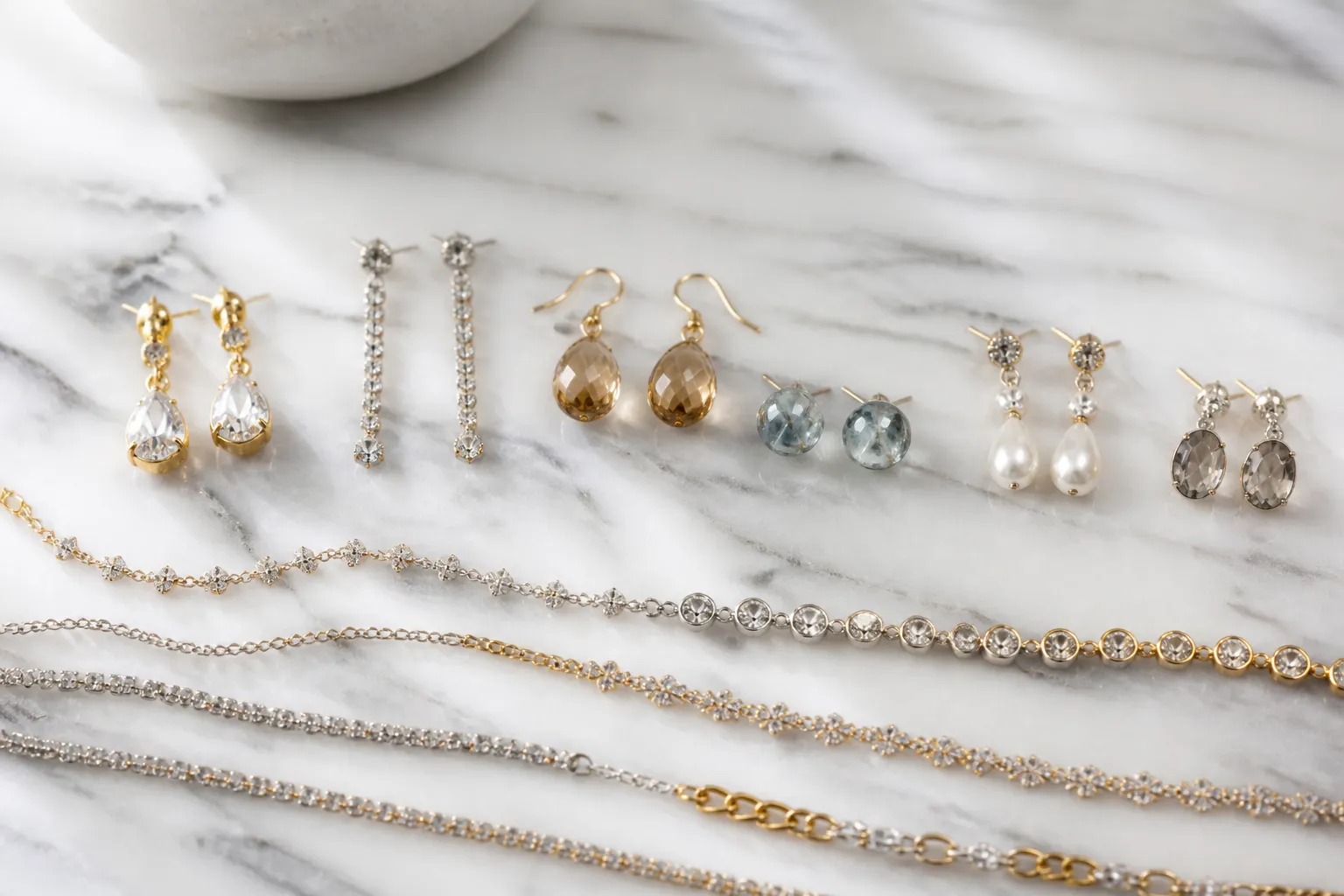
If you're sourcing rhinestone statement sets or gradient crystal drop earrings, the stock catalog gives you immediate options without waiting for a custom sampling cycle. The Two-Tone Rhinestone Fireworks Jewelry Set is a good example of the stock styles available, and the Vintage Green Crystal Geometric Jewelry Set shows the OEM finishing range across earrings, necklaces, and rings in a single coordinated set.
2. Jewlr — Personalized Jewelry for Consumer Brands and Gift Markets
Best for: DTC brands targeting the gifting, wedding, and family jewelry segments who need a mature personalization platform to benchmark against.
Pricing: Consumer-facing personalized jewelry starting at accessible price points, with free shipping included and a 99-day return policy. A one-year warranty comes standard.
Key strengths vs. custom jewelry:
- Extensive personalization matrix: stone shape (Round, Heart, Princess, Oval, Baguette, Pear, Marquise, Cushion), metal (Sterling Silver, White Gold, Gold Plated, Vermeil, Stainless Steel), and birthstone by month — from Garnet in January through to Diamond and Lab Diamond for April
- Consumer-facing configuration interface handles design complexity without a brief or back-and-forth with a jeweler
- Buy Now, Pay Later plans reduce checkout friction for end customers
- Covers rings, necklaces, bracelets, earrings, charms, anklets, and full sets under one roof — including wedding, engagement, promise, and family occasion categories
Limitations / trade-offs:
- Built for direct-to-consumer sales, not wholesale or OEM sourcing
- No white-label or private-label manufacturing option for trade buyers
- Personalization is templated — truly bespoke design work is not on offer
How it compares to custom jewelry: Jewlr replaces the custom jewelry experience at the consumer level by making personalization self-service. A shopper picks metal, stone shape, engraving text, and ship date — no jeweler consultation required. For a DTC brand studying how to offer a personalized jewelry line, Jewlr's UX is worth examining. But it's a retail platform, not a B2B supplier, which limits its usefulness for buyers who need trade terms or private-label capability.
3. Made by Mary — Artisan Personalized Jewelry for Gifting
Best for: Consumer brands and boutiques in the premium gifting market seeking an artisan aesthetic with engraving and name personalization.
Pricing: Mid-to-premium consumer price range; check current listings at madebymary.com for up-to-date figures.
Key strengths vs. custom jewelry:
- Strong brand narrative around handcrafted artisan production — resonates with customers who value origin story and perceived craft
- Engraving and name personalization available across a curated product line
- Clean lifestyle photography that transfers well to affiliate or co-branded marketing materials
- Established customer trust signals across social and review channels
Limitations / trade-offs:
- No wholesale or OEM program — brand is direct-to-consumer only
- Customization depth is limited to name, initial, and date engraving on existing silhouettes
- Premium retail pricing is not structured for buyers who need resale margin
How it compares to custom jewelry: Made by Mary offers a lighter-weight version of custom: pick a base design, add a name or date, receive a piece with a personal touch. Full custom jewelry allows blank-canvas design; Made by Mary works from a fixed silhouette catalog. For DTC operators who want to offer "personalized" without managing a custom production pipeline, this is lower friction — but it's a consumer brand, not a supplier.
4. Kay Jewelers — National Chain with Personalization Services
Best for: Consumers and small boutiques that want personalized jewelry with in-store service and the backing of an established retail brand.
Pricing: Varies widely by metal, stone, and personalization type; visit kay.com for current personalized jewelry pricing.
Key strengths vs. custom jewelry:
- Nationwide retail presence with in-store engraving and personalization services available on-demand
- Strong brand trust for high-occasion gift purchases (anniversaries, Mother's Day, weddings)
- Wide metal range including gold, white gold, and sterling silver
- Financing options available for higher-value pieces
Limitations / trade-offs:
- No B2B, wholesale, or OEM capability whatsoever
- Personalization is limited to engraving, birthstone settings, and nameplate designs — not true custom design
- Retail pricing includes substantial margin, making it unsuitable for sourcing or resale contexts
How it compares to custom jewelry: Kay represents the mainstream retail answer to custom jewelry demand: take an existing design, add initials or a birthstone, and call it personal. That works for a large consumer segment. For trade buyers sourcing product to resell or brand privately, it's the wrong channel entirely. Its practical value here is as a reference point for understanding what US consumers associate with "personalized jewelry" — not as a sourcing option.
5. Icebox — High-End Custom Jewelry for Luxury Clients
Best for: Retailers and buyers serving a luxury clientele who need fully bespoke, high-value custom pieces where price is secondary to design and materials.
Pricing: Bespoke; based on materials, design complexity, and stone selection. Contact Icebox directly for quotes.
Key strengths vs. custom jewelry:
- Specializes in high-value custom work including diamond setting, grillz, and one-of-a-kind statement pieces
- Strong positioning in the luxury and premium custom segments with recognized brand credibility
- In-house production emphasis on craftsmanship and surface finishing
- Portfolio-driven client relationships for repeat custom work
Limitations / trade-offs:
- High price floor — not viable for volume buyers or mid-market sourcing
- Extended lead times inherent to true custom production
- No catalog, no stock product; every order is a full custom engagement
How it compares to custom jewelry: Icebox sits at the premium end of the custom jewelry spectrum — more specialized and focused on flagship one-off pieces than on scalable product lines. If your client needs a statement custom chain or diamond-set hero piece for a campaign, Icebox delivers. If you're building a product catalog or managing SKU-level inventory, it's the wrong fit: the production model doesn't scale commercially.
6. Mystique Jewelers — Full Bespoke Custom Design
Best for: Buyers who need genuinely bespoke design work and a collaborative jeweler relationship for high-value fine jewelry pieces.
Pricing: Custom quotes vary by design complexity and materials; contact Mystique Jewelers directly.
Key strengths vs. custom jewelry:
- Full design collaboration from concept to finished piece, including CAD rendering approval before production
- Works across fine metal and gemstone combinations including engagement, bridal, and heirloom categories
- Sample visual approval at design stage reduces post-production disappointment
- Specialized in bridal and sentimental fine jewelry — a focused niche rather than a broad catalog
Limitations / trade-offs:
- Designed for one-off or small-quantity high-value orders — not scalable for commercial product lines
- Timelines are extended by nature; not suited for trend-driven buying cycles
- No OEM, private label, or wholesale capability
How it compares to custom jewelry: Mystique Jewelers represents the traditional custom jewelry experience in its most complete form: a jeweler who works through a detailed brief, produces a unique piece, and stands behind the result. That process has genuine value for fine jewelry and sentimental commissions. For commercial buyers who need units, margins, and repeatable production, the economics don't scale — this model works for a flagship SKU, not a product line.
7. Semi-Custom Stock Catalog Sourcing (OEM-Ready Wholesale)
Best for: Buyers who want brand differentiation without the cost and timeline exposure of full custom design.
Pricing: Depends on supplier and quantity; stock catalog items typically ship at lower per-unit cost than custom. MOQs vary widely by supplier.
Key strengths vs. custom jewelry:
- Faster turnaround: stock items ship on existing inventory cycles, not custom production timelines
- Lower MOQ thresholds — some suppliers offer single-piece minimums on catalog styles
- OEM finishing (packaging, tags, proprietary stamps) can be applied to stock designs for a private-label effect
- Easier quality benchmarking because you can handle physical samples before committing to volume
Limitations / trade-offs:
- Base silhouette designs are shared with other buyers — no exclusivity without full custom development
- Customization scope is limited to finish, colorway, packaging, and sometimes stone selection
- Requires a supplier with genuine OEM capability and established production capacity, not just a reseller
How it compares to custom jewelry: Semi-custom stock sourcing trades design exclusivity for speed, cost, and predictability. For most DTC buyers — especially those building product lines in trend-driven categories like crystal earrings or geometric sets — the difference between a custom design and a well-curated stock piece is not visible to the end customer. The operational advantages often outweigh the loss of design uniqueness. STRAND's catalog exemplifies this model: 114 styles across drop earrings, studs, and necklace-earring sets in vintage crystal, glass bead, and rhinestone finishes, with OEM capability layered on top when needed.
8. Open OEM Platforms (Alibaba and Equivalents)
Best for: High-volume buyers with internal QC capability who want maximum price competitiveness across a wide supplier base.
Pricing: Lowest per-unit cost at scale; varies significantly by supplier quality tier and order volume.
Key strengths vs. custom jewelry:
- Broadest supplier base — access to factories across all jewelry categories and price tiers
- Competitive per-unit pricing at volume
- Custom design capability available from many suppliers
- Wide material and finish range, from brass to sterling silver to stainless steel
Limitations / trade-offs:
- Quality consistency is entirely the buyer's responsibility — no guaranteed pre-shipment inspection
- Communication barriers and language gaps are common; multilingual account management is the exception
- Vetting reliable suppliers from low-quality ones requires experience, time, and test orders
How it compares to custom jewelry: Open OEM platforms give you the widest choice and the lowest price floor, but shift all risk and verification work to the buyer. Traditional custom jewelry involves a single supplier relationship with accountability; open platforms require ongoing vetting across multiple vendors. Buyers who need a vetted supplier with dedicated account support, pre-shipment QC, and multilingual service find a middle path that open platforms can't reliably replicate.
Side-by-Side Comparison Table
| Traditional Custom Jewelry | STRAND | Jewlr | Made by Mary | Icebox | Mystique Jewelers | |
|---|---|---|---|---|---|---|
| Best for | One-off bespoke pieces | B2B importers, DTC brands | Consumer gifting | Artisan gifting | Luxury custom | Fine bespoke |
| MOQ | High (typically 100s/design) | 12 pcs/style (stock); 1 pc on select styles | N/A — consumer retail | N/A — consumer retail | N/A — bespoke | N/A — bespoke |
| Lead time | Extended (custom production) | Faster via stock catalog; custom adds time | Consumer-speed delivery | Consumer-speed | Extended | Extended |
| Personalization depth | Full bespoke design | OEM custom + stock catalog | Templated (stone, metal, engraving) | Name/initial engraving | Full bespoke | Full bespoke |
| B2B / Wholesale | Varies by manufacturer | Yes (EXW/FOB; multiple payment options) | No | No | No | No |
| Pre-shipment QC | Varies by supplier | In-house QC on every order | N/A | N/A | In-house | In-house |
| Multilingual support | Rarely | EN, FR, AR, ES, DE, RU | English primary | English primary | English primary | English primary |
How to Pick the Right Alternative
The right choice tracks your buying scenario more than your personal preference for any single feature.
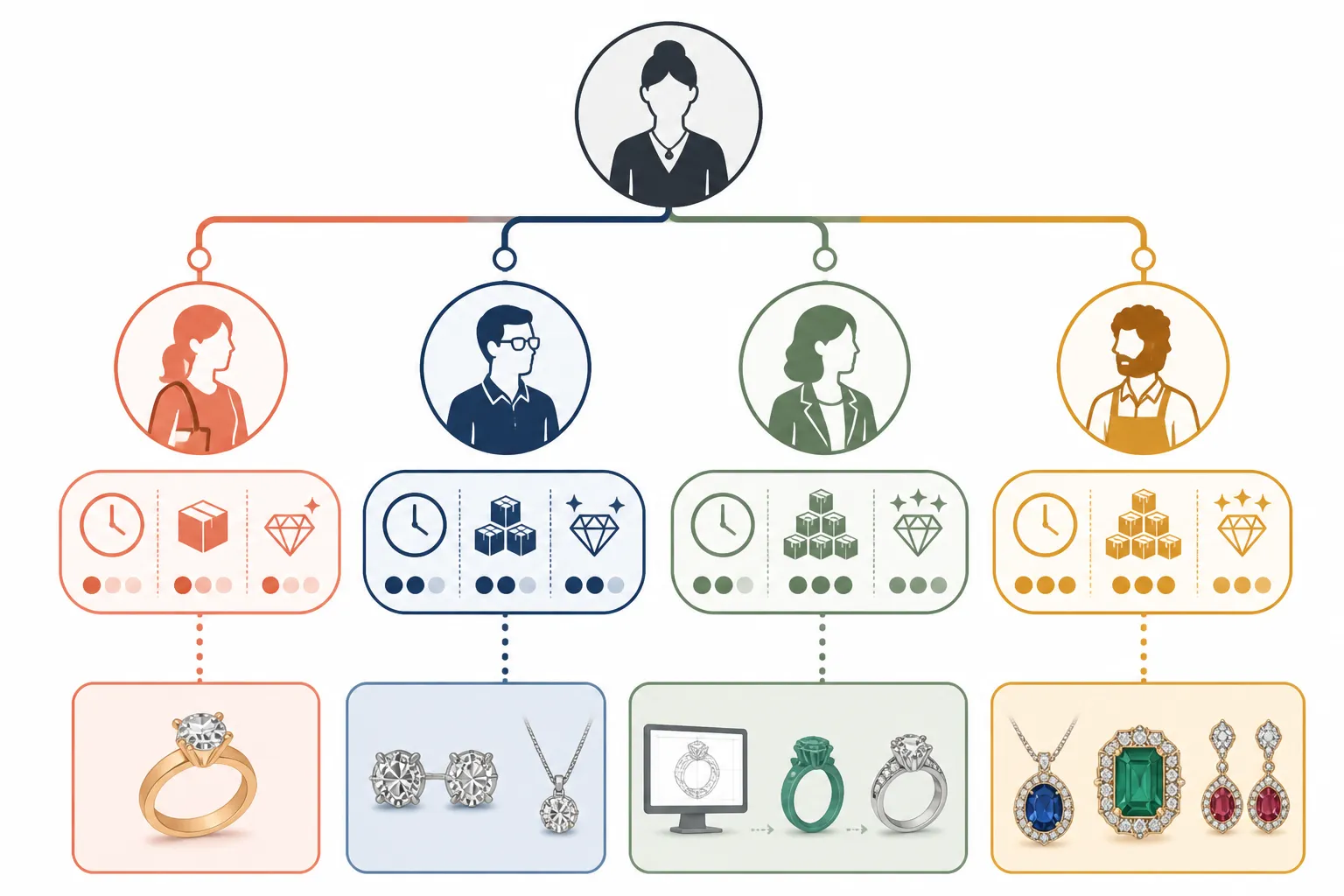
You're a DTC store owner building a trend-driven jewelry line: Full custom jewelry is too slow and too capital-intensive for trend cycles. A stock catalog OEM supplier with low MOQ — STRAND's 12 pcs/style threshold — lets you test styles before committing to depth. If consumer personalization is part of your proposition, Jewlr's UX is worth benchmarking for how personalized jewelry flows work — though it's a retail platform, not a supply source.
You're an importer filling an annual buy for a retail chain: Custom jewelry may be appropriate if your lead times are long enough and your volume justifies the commitment. If you're sourcing fashion jewelry in trend-relevant categories (gradient crystals, vintage rhinestones, two-tone glass beads), a vetted stock catalog supplier with pre-shipment QC removes the sample-rejection risk that custom sourcing carries as standard.
You serve a premium or luxury segment: Icebox or Mystique Jewelers are the right referrals for clients who need genuinely bespoke, high-value pieces — custom pendants, diamond-set statement work, heirloom commissions. Don't apply this model to commercial product lines; the economics break at volume.
You're a boutique buyer testing a new jewelry category: Starting from 1 piece (available on select STRAND catalog styles) or 12 pcs/style lets you prove demand before placing a real order. That is impossible with traditional custom jewelry minimums. Prove it small, then scale what sells.
Conclusion
Custom jewelry made sense when differentiation required it and timelines allowed it. For most commercial buyers today, the combination of low-MOQ stock catalog sourcing and OEM customization covers the majority of what full custom production promised — at faster cycles, lower minimum commitments, and more predictable quality outcomes.
For B2B buyers at the consideration stage: STRAND's 114-style catalog (MOQ 12 pcs/style on 109 of 114 styles, with select styles from 1 pc) is a practical starting point. The OEM layer adds design flexibility when you're ready to scale a signature style. Pre-shipment in-house QC, multilingual sales support across six languages, and payment flexibility via T/T, PayPal, L/C, and Xtransfer are built in — not add-ons.
For consumer-facing personalization, Jewlr offers one of the most complete templated personalization platforms available, with a 99-day return policy and free shipping — a strong reference for DTC brands designing a gifting experience.
For luxury or fine jewelry clients who genuinely need bespoke, Icebox and Mystique Jewelers handle that end of the market well.
Your next step: If you're sourcing fashion jewelry for the US, EU, UK, or MENA market — earrings, necklace sets, or custom OEM pieces — request a catalog and MOQ quote directly at strandjewelry.com. Multilingual reps cover EN, FR, AR, ES, DE, and RU, and can walk you through stock availability, OEM options, and trade terms in your language.