
8 Best Alternatives to Custom Jewelry for B2B Buyers in 2026
8 Best Alternatives to Custom Jewelry for B2B Buyers in 2026
Custom jewelry covers a wide spectrum — from personalized engraving platforms to full OEM production runs. The right alternative depends on whether you're buying a single gift or sourcing a catalog. This guide breaks down 8 alternatives across both ends, with concrete tradeoffs for each.
Why Look for Alternatives to Custom Jewelry?
Custom jewelry sounds straightforward until you're mid-order and hitting walls. Lead times stretch to 8–12 weeks. MOQs that make sense for a major retailer feel punishing for a DTC store testing a new earring style. Pricing tiers push you into over-ordering just to hit a unit cost that pencils out. These are the friction points importers and procurement teams cite most often.
For B2B buyers, the lock-in problem runs deeper. A supplier handling your OEM production may bundle quality control, packaging, and shipping into a single opaque quote. When something goes wrong — wrong plating, mismatched stone colors, late shipment — you have limited visibility and little recourse. Procurement teams are increasingly looking for alternatives with clear terms stated upfront, not discovered mid-production.
Retail-stage buyers face a different frustration. Many personalized jewelry platforms limit customization to name engraving or birthstone swaps. If you need a specific stone — amethyst, garnet, peridot — or a finish that isn't standard yellow gold or silver, the options narrow sharply. Knowing your alternatives to custom jewelry before you're locked in is worth the research time.
What to Look for in a Custom Jewelry Alternative
Run through these criteria before committing to any alternative:
- MOQ flexibility: Are minimums stated clearly, or buried in a sales conversation? Verified numbers matter more than vague promises.
- Material range: Does the catalog cover the metals and stones you need — gold-plated copper, rhodium-plated, 925 sterling, natural stone, glass bead?
- Lead time transparency: Is production time quoted upfront, or only after samples are approved?
- QC process: Is there an in-house inspection step before shipment, or do you rely on third-party audits?
- Trade terms and payment: EXW, FOB, T/T, PayPal, L/C — confirm what's supported before negotiating.
- Custom OEM capability: Can the supplier handle private label or branded packaging at production scale?
- After-sales support: Warranty, return policy, and language support matter once an order ships.
Top 8 Alternatives to Custom Jewelry
1. STRAND — Direct OEM Jewelry Supplier from Hangzhou
Best for: B2B importers, DTC store owners, and multilingual procurement teams sourcing chains, earrings, and custom OEM jewelry from China
Pricing: Factory-direct; request a quote at strandjewelry.com. MOQ starts at 12 pcs/style on 109 of 114 catalog styles, with select styles available from 1 pc
Key strengths vs custom jewelry:
- Vetted Chinese workshops with in-house QC inspection before every shipment — reduces the defect surprises common with arms-length sourcing
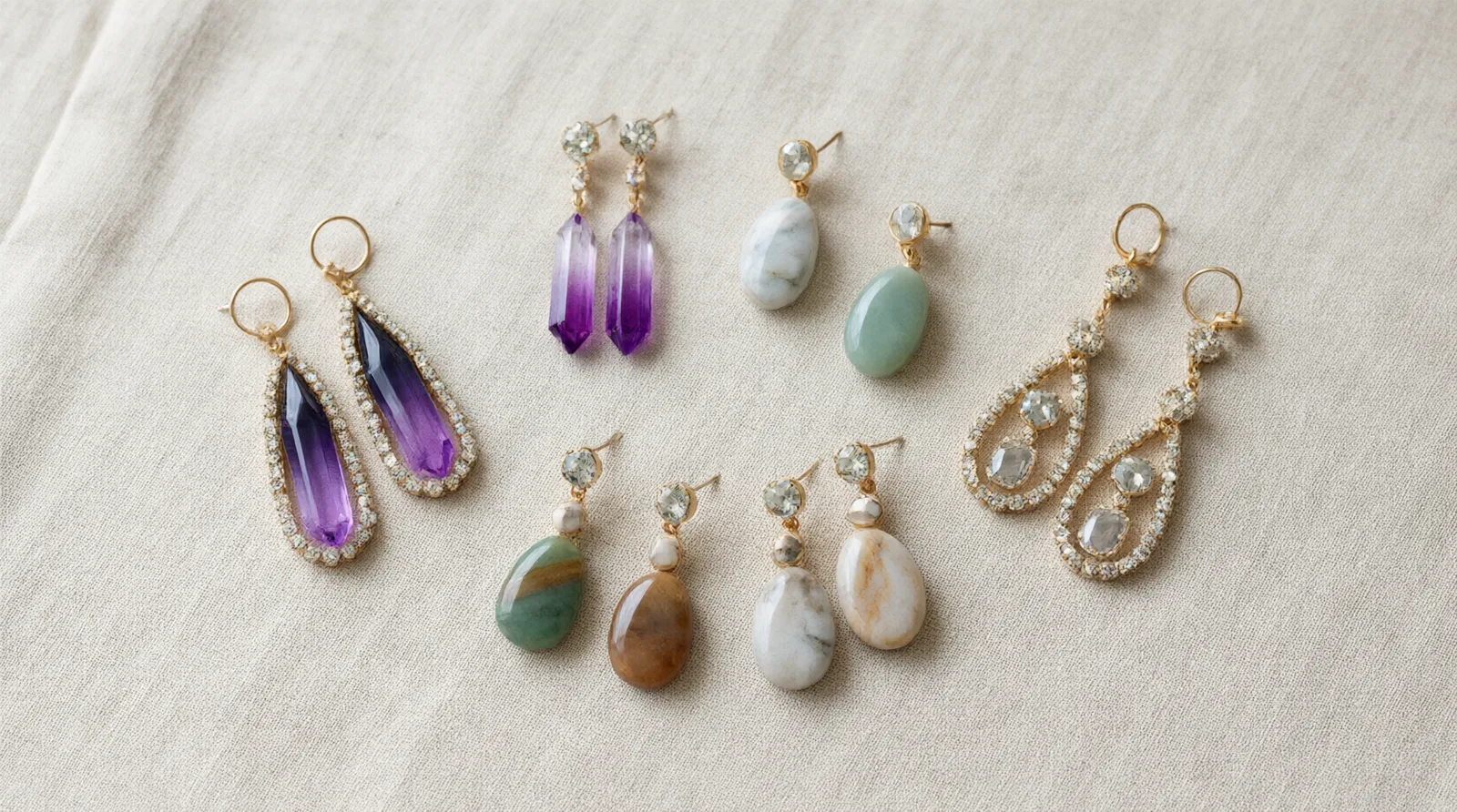
- 114-style stock catalog covering drop earrings, stud earrings, and necklace + earring sets in vintage, gradient crystal, two-tone glass bead, and rhinestone styles
- Multilingual sales team (EN, FR, AR, ES, DE, RU) — a genuine differentiator for EU and MENA procurement teams who hit language barriers with other suppliers
- Flexible payment options: T/T bank transfer, Western Union, PayPal, L/C, and Xtransfer; shipping by air, sea, or express
Limitations / trade-offs:
- Factory-direct model means production lead times apply — not a same-week fulfillment option
- Custom OEM has its own sampling timeline; confirm current lead time estimates before planning a product launch
- Primarily copper-based metals (gold-plated, rhodium-plated); buyers needing solid gold or platinum need a separate source
How it compares to custom jewelry: Where generic custom jewelry suppliers often bundle unclear fees with opaque minimums, STRAND publishes real MOQ numbers and supports direct procurement inquiries in six languages. For DTC brands scaling into the US, EU, UK, or MENA, that level of supply chain visibility is harder to find from a single partner. The custom OEM option covers gold-plated and rhodium-plated copper, 925-style silver finishes, glass beads, and natural stone — so you're not limited to catalog styles if your brand identity demands something specific. For a deeper supplier comparison, see Custom Jewelry: 6 Sources Buyers & DTC Brands Need in 2026.
2. Jewlr — Personalized Jewelry for End Consumers
Best for: DTC brands researching consumer-facing personalization benchmarks; end consumers buying personalized gift jewelry
Pricing: Mid-range retail; personalized pieces range widely by style and material (as listed at jewlr.com)
Key strengths vs custom jewelry:
- A broad catalog of personalized products (listed as 641 items as of early 2025) across rings, necklaces, bracelets, and earrings — wide selection for DTC brands researching what works at retail
- Materials include 18K Gold Plated Silver, 925 Sterling Silver, and Vermeil — covers standard retail expectations
- Consumer-friendly policies including a 99-day return window, one-year warranty, and free shipping offers (verify current policy at jewlr.com, as these terms are subject to change) reduce purchase hesitation for end buyers
- Buy now, pay later options lower cart abandonment — proven consumer conversion levers
Limitations / trade-offs:
- Built for D2C consumers, not wholesale or OEM buyers — no trade pricing or bulk terms
- Customization is mostly limited to engraving, birthstone selection (amethyst, garnet, peridot), and name tags — not true product-level design
- Not a sourcing option for importers; useful as a benchmark for retail price expectations
How it compares to custom jewelry: Jewlr operates in the consumer personalization lane — name engraving, birthstone swaps, heart and infinity motifs. That's a narrow product definition. If you're building a wholesale catalog rather than selling single units, Jewlr's model is instructive for understanding what consumers expect and what retail margins look like, not a procurement solution.
3. Kay Jewelers — Established US Retail Personalization
Best for: Buyers studying mainstream US market positioning; consumers wanting personalized jewelry from a recognized chain with physical stores
Pricing: Mid-range retail; personalized pieces vary by metal and stone; see kay.com/personalized for current listings
Key strengths vs custom jewelry:
- National brand recognition across the US — important for DTC brands benchmarking against established retail competition
- Personalized options include name necklaces, diamond-set initials, and engravable bracelets
- Physical store presence for in-person consultation, which pure online custom platforms can't offer
- Consumer financing options support higher-ticket purchases
Limitations / trade-offs:
- Retail pricing carries significant brand and overhead markup — not a sourcing model for wholesale buyers
- Limited true customization; designs are pre-set with a personalization layer (engraving, stone swaps)
- No B2B, OEM, or import-focused services
How it compares to custom jewelry: Kay represents the mid-market retail ceiling — accessible enough for everyday buyers, recognized enough to carry brand authority. Like Jared stores at the luxury end, Kay uses its physical footprint and financing to justify pricing that direct OEM sourcing can substantially undercut. For DTC operators, studying Kay's personalized product mix is useful market research, not a supply chain strategy.
4. Kendra Scott — Fashion-Forward Gemstone Jewelry
Best for: DTC brands targeting the US fashion market; buyers researching color-story and gemstone-forward design trends
Pricing: Mid-to-high retail; check Kendra Scott's current site for pricing
Key strengths vs custom jewelry:
- Strong color storytelling using turquoise, amethyst, and natural stones — a practical reference for DTC brands building seasonal collections
- High social proof and brand recognition in US women's fashion
- Broad retail presence across standalone stores and department store concessions
Limitations / trade-offs:
- No wholesale, OEM, or import services — strictly consumer retail
- Price premium reflects brand equity, not material cost; not relevant for volume buyers
- Proprietary aesthetic; you can't source "Kendra Scott style" without your own supplier relationship
How it compares to custom jewelry: Kendra Scott's value to an importer or DTC brand is its market signal, not its supply chain. The way it positions turquoise pendants, amethyst drops, and color-shifting stones tells you what US consumers are willing to pay. Pair that market insight with a direct OEM supplier and you can build a comparable aesthetic at import margins.
5. Made by Mary — Minimalist DTC Personalized Jewelry
Best for: DTC brands in the minimalist or demi-fine space; consumers buying everyday layering pieces
Pricing: Mid-range DTC retail; personalized pieces vary by style
Key strengths vs custom jewelry:
- Clear brand positioning around delicate, everyday-wear personalized jewelry — a proven DTC playbook worth studying
- High customer loyalty; useful case study for repeat purchase mechanics
- Natural and semi-precious stone options in earrings and necklaces
Limitations / trade-offs:
- No trade or OEM service — consumer-only brand
- Customization limited to existing catalog options (names, initials, birthstones)
- Retail premium priced into the brand, not just the materials
How it compares to custom jewelry: Made by Mary shows how a focused aesthetic combined with personalization builds high-LTV consumer brands. It's a direct-to-consumer success story — not a supply infrastructure model. Importers who want the product capability behind this kind of brand should look at OEM suppliers able to replicate the delicate finish at production scale.
6. Brook & York — Classic American Personalized Jewelry
Best for: Buyers benchmarking mid-market US personalized jewelry pricing and gift-occasion style
Pricing: Mid-range retail; bestselling pieces at brookandyork.com
Key strengths vs custom jewelry:
- Clean, classic aesthetic that performs across broad age demographics — useful positioning reference
- Personalization options include initial discs, name bars, and layered chain sets
- Strong gifting occasion positioning — a model for DTC brands targeting birthdays, anniversaries, and holidays
Limitations / trade-offs:
- No OEM, wholesale, or B2B tier
- Style range is narrower than a full OEM catalog
- Retail pricing doesn't translate to import cost modeling
How it compares to custom jewelry: Brook & York represents "accessible luxury" in American personalized jewelry — clean enough to gift, affordable enough to buy without a special occasion. For procurement teams, it's a useful comp for setting DTC retail price points, not a sourcing destination.
7. Everthine Jewelry — Fine Personalized Jewelry
Best for: Consumers shopping for higher-end personalized pieces; DTC operators researching the fine and demi-fine segment
Pricing: Varies by piece and metal; see everthinejewelry.com for current listings
Key strengths vs custom jewelry:
- Fine and demi-fine material focus — useful benchmark for buyers targeting the premium consumer segment
- Engraving and birthstone personalization with higher perceived material quality
- Positioned above fashion jewelry, below luxury fine jewelry — a segment with clear consumer demand
Limitations / trade-offs:
- Consumer retail only — no trade or OEM services
- Smaller catalog than major platforms
- Premium price point limits volume appeal for typical DTC testing
How it compares to custom jewelry: Everthine occupies a specific tier — consumers who want more than fashion jewelry but aren't buying fine. For DTC operators entering this space, understanding Everthine's product mix helps define what OEM production specs need to deliver: plating thickness, stone quality, packaging finish.
8. Jared — Luxury In-Store Custom Jewelry Experience
Best for: US consumers buying high-ticket personalized or custom pieces with in-store consultation; market research for the luxury custom segment
Pricing: High-end retail; varies significantly by metal, diamond weight, and design complexity
Key strengths vs custom jewelry:
- Among the most recognized luxury jewelry stores in the US — a clear ceiling benchmark for high-ticket custom work
- True custom design services with in-store consultants, covering diamond-set and fine metal options
- Strong positioning around wedding and anniversary custom pieces
Limitations / trade-offs:
- Retail luxury pricing — far above what's achievable through direct OEM sourcing
- No B2B, import, or wholesale tier
- Custom design lead times can stretch weeks
How it compares to custom jewelry: Jared represents the premium consumer ceiling for custom work. For DTC brands, Jared's price anchoring is actually useful: it establishes what consumers associate with "custom" at the top of the market, making well-sourced fashion jewelry look like strong value at a fraction of the retail price.
Side-by-Side Comparison Table
Note: The table below provides a partial comparison covering five of the eight alternatives discussed above (STRAND, Jewlr, Kay Jewelers, Kendra Scott, and Made by Mary). Brook & York, Everthine Jewelry, and Jared are excluded from this table because they operate exclusively as consumer retail brands without B2B, OEM, or import capabilities, making their operational metrics less directly comparable for procurement purposes.
| Dimension | STRAND | Jewlr | Kay Jewelers | Kendra Scott | Made by Mary |
|---|---|---|---|---|---|
| Target buyer | B2B importers, DTC stores | End consumers | End consumers | End consumers | End consumers |
| MOQ | 12 pcs/style (most styles) | Single unit | Single unit | Single unit | Single unit |
| Custom OEM | Yes | No | No | No | No |
| Pricing model | Wholesale / factory-direct | Mid-range retail | Mid-range retail | Mid-to-high retail | Mid-range retail |
| Payment terms | T/T, PayPal, L/C, WU, Xtransfer | Consumer methods | Consumer + financing | Consumer methods | Consumer methods |
| Multilingual support | EN, FR, AR, ES, DE, RU | English primary | English primary | English primary | English primary |
| Quality assurance | In-house QC before shipment | Extended returns and warranty (verify current policy at jewlr.com) | Store-level QC | Brand QC | Brand QC |
How to Pick the Right Alternative
You're an importer building a wholesale catalog: Skip the consumer retail platforms entirely. Your relevant alternatives are direct OEM suppliers with published MOQs, in-house QC, and trade terms that work across currencies. Ask specifically about sampling lead times for custom OEM work before planning a product launch. For a full sourcing breakdown, 6 Best Custom Jewelry Sources for Importers & DTC Stores in 2026 covers the supplier landscape in detail.
You're a DTC store owner testing a new style: MOQ is your primary constraint. A source with 12-piece minimums per style lets you test demand without over-committing to inventory. At that scale, you can run amethyst drops alongside turquoise pendants and let sell-through data drive your next reorder.
You're a buyer researching market pricing: Consumer platforms — Jewlr, Kay, Kendra Scott, Made by Mary, Brook & York — give you a clear picture of what retail looks like. Map that against factory pricing to understand your margin opportunity.
You're sourcing for EU, UK, or MENA markets: Language and payment flexibility matter more than they appear to on paper. A supplier with Arabic, French, or Spanish support saves significant back-and-forth during sampling and production. Confirm trade terms (EXW vs FOB) and available shipping modes (air vs sea vs express) before finalizing.
You need luxury-tier consumer positioning: Study Jared's custom design offerings for design language and pricing signals, then source a comparable aesthetic from an OEM supplier at a fraction of the retail input cost.
The Bottom Line
The right alternative to custom jewelry depends entirely on where you sit in the supply chain. Consumer platforms like Jewlr — with its broad catalog of personalized products (noted as 641 items as of early 2025) and consumer-friendly return and warranty policies (verify current terms at jewlr.com) — are built for end buyers, not procurement teams. Retail chains like Kay and Jared stores anchor the mid-market and luxury consumer segments; they're market benchmarks, not sourcing partners.
For importers, DTC store owners, and procurement teams who need a production-capable partner, the calculus is different. You need real MOQ numbers, verified QC, multilingual support, and trade terms that work across geographies.
STRAND is built for exactly that buyer profile: Hangzhou-based with direct workshop access, a 114-style stock catalog, 12-piece minimums on most designs, and sales support in six languages — covering buyers in the US, EU, UK, and MENA.
Ready to start sourcing? Request a quote or get MOQ and pricing at strandjewelry.com.