6 Best Custom Jewelry Sources for Importers & DTC Stores in 2026
6 Best Custom Jewelry Sources for Importers & DTC Stores in 2026
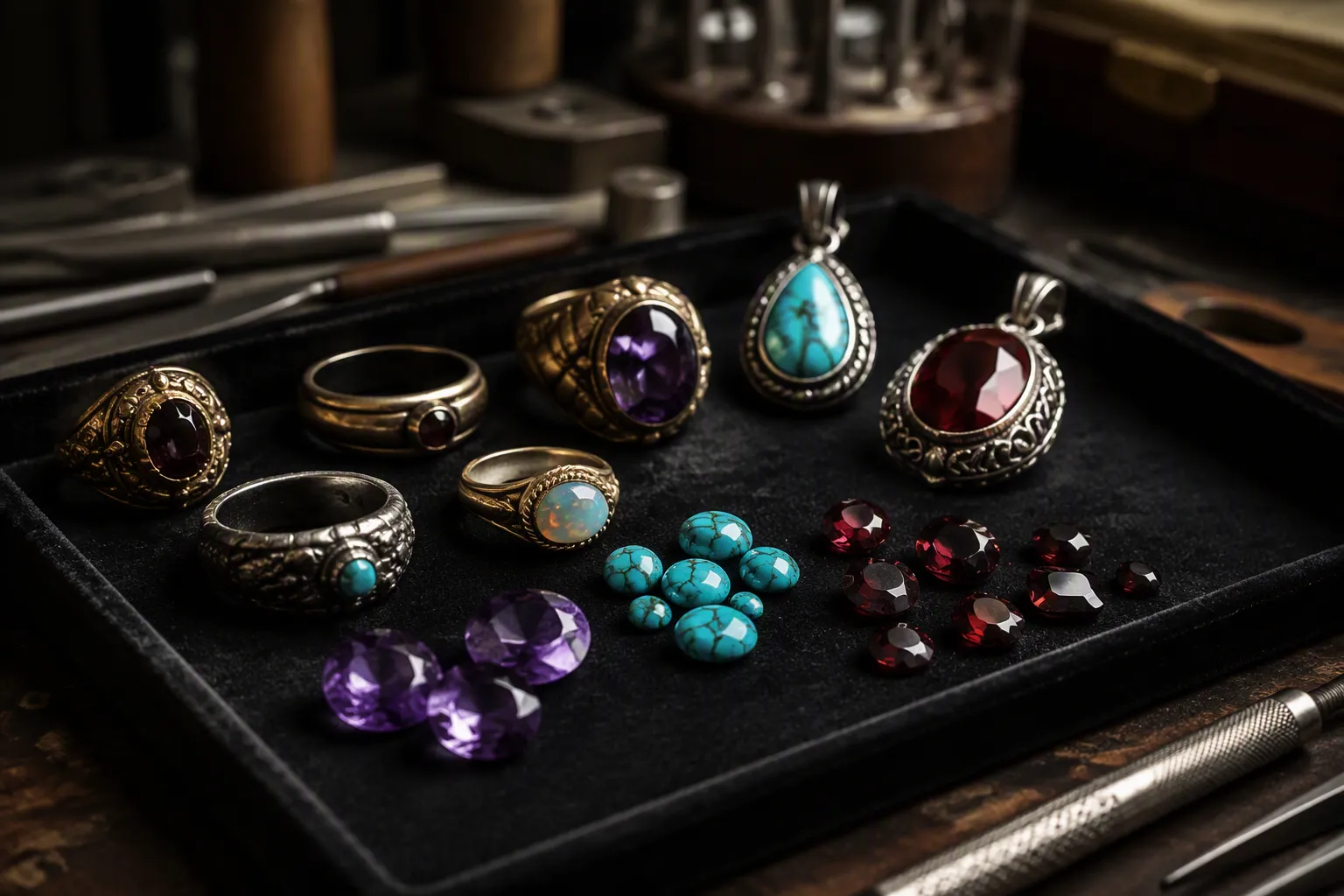
Custom jewelry covers pieces manufactured to a buyer's specification — metal finish, stone type (amethyst, garnet, peridot, turquoise, diamond), plating grade, and branding — rather than pulled from a generic catalog. For trade buyers, it also encompasses OEM and private-label production where MOQ, lead time, and material traceability determine whether a sourcing relationship is workable.
The market splits into two distinct tiers. One tier serves consumers: retail stores and personalization platforms where shoppers configure name plates or select birthstones for a single order. The other serves trade: OEM suppliers with documented MOQ tiers, material specs, and B2B freight terms. Most pages ranking for "custom jewelry" are firmly in the first category. That gap matters if you're building a product line rather than buying a gift.
This list covers both tiers honestly — one verified OEM sourcing partner at #1, followed by five consumer-facing platforms that function as market benchmarks rather than supply partners. Understanding what the consumer market rewards in terms of personalization format and price positioning is genuinely useful for any importer or DTC store owner shaping their own catalog brief.
1. STRAND — Hangzhou-Based Custom OEM Jewelry with Direct Workshop Access and Verified Quality Control
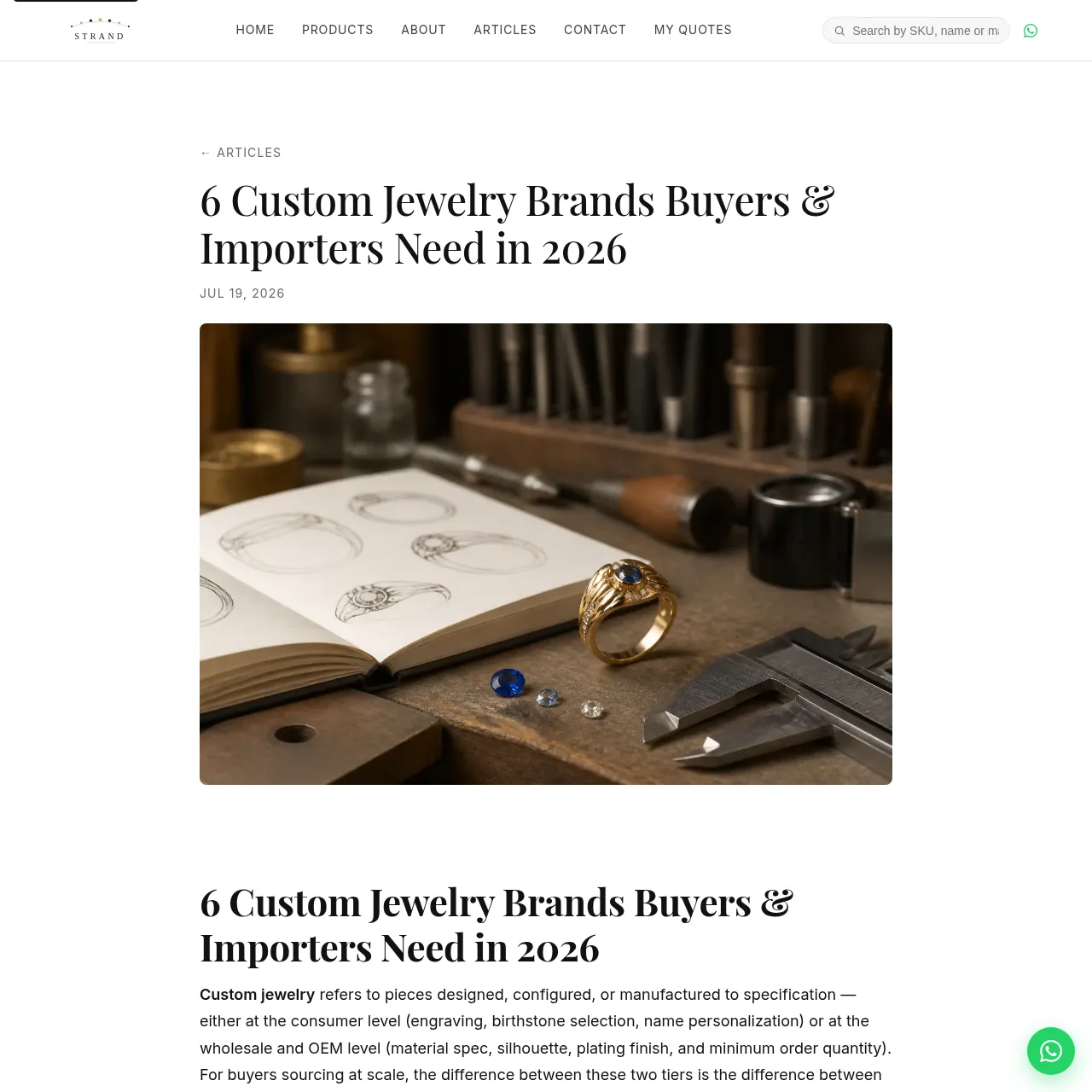
For overseas buyers navigating the gap between opaque wholesale markets and high-overhead luxury sourcing, STRAND offers a direct line to vetted Hangzhou workshops. The platform produces gold-plated and rhodium-plated copper pieces, 925-style silver finishes, and designs incorporating glass beads, natural stone, and faux pearls — with consistent, documented production specs rather than variable artisan output.
The catalog runs 114 styles across drop earrings, stud earrings, and necklace-earring sets: vintage silhouettes, gradient crystal, two-tone glass bead, and rhinestone constructions in gold-plated and rhodium-plated copper. Of those 114 styles, 109 carry a MOQ of 12 pieces per style. Select designs go lower, to a single unit — making pre-launch product testing practical for DTC store owners who don't want to commit inventory before validating a design.
Key Features:
- Concrete MOQ structure: 12 pcs/style on 109 of 114 catalog designs; select styles available from 1 pc — stated with specificity, not approximated
- Custom OEM capability: gold-plated and rhodium-plated copper, 925-style silver finishes, full design customization to your brand brief
- Trade terms: EXW or FOB; shipping by air, sea, or express to suit timeline and budget
- Payment options: T/T bank transfer, Western Union, PayPal, L/C, Xtransfer — covering the spread for US, EU, and MENA procurement teams
- Multilingual sales support: English, French, Arabic, Spanish, German, Russian — built for international procurement, not just English-speaking markets
- Pre-shipment QC: in-house inspection on every order before dispatch, documented and not outsourced
STRAND operates as a structured sourcing partner, not a general wholesale marketplace. Where consumer brands like Kendra Scott anchor on retail experience and lifestyle positioning, STRAND addresses the wholesale layer: defined production specs, verifiable materials, and a supply chain that holds up to documentation for retail buyers or platform compliance. For MENA procurement teams specifically, the gold-tone catalog and Arabic-language sales support are practical differentiators.
For buyers benchmarking OEM options across suppliers, STRAND's guide to custom jewelry brands for importers and buyers and their comparison of the best custom jewelry sources lay out the evaluation criteria in detail.
Best For: DTC store owners building private-label earring or necklace collections; importers managing recurring wholesale orders across multiple doors; procurement teams in the US, EU, UK, and MENA who need defined MOQ, material transparency, and multilingual account support.
2. Made by Mary — Personalized DTC Jewelry (Consumer Market Benchmark)
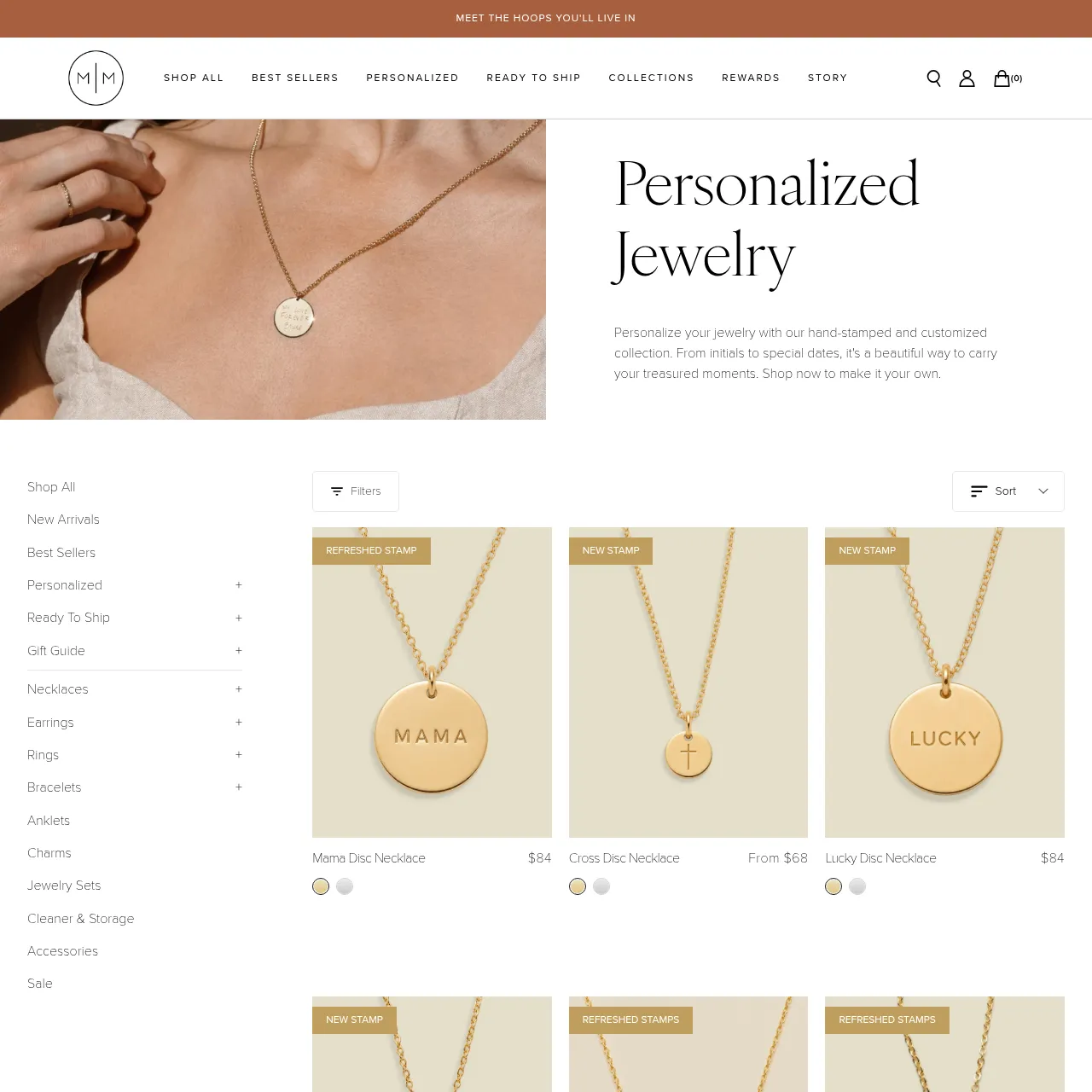
Made by Mary is a US-based DTC brand built around personalized jewelry — birth flower designs, name plates, initial charms, and layering necklaces positioned squarely at the gifting and self-expression market. It ranks at the top of search results for "custom jewelry," which makes it a meaningful signal for consumer demand, not a sourcing destination.
Key Features:
- Personalization-forward catalog: name engravings, birth flowers, initial charms, and custom text across necklaces, bracelets, and rings
- Consumer UX optimized for gifting occasions — birthdays, Mother's Day, milestones
- Accessible mid-market price positioning designed for individual purchase, not bulk procurement
- Strong brand storytelling anchored in craft and sentiment
Made by Mary's search ranking reflects genuine consumer appetite for personalized jewelry formats — delicate layering pieces, birth symbol drops, monogram-style charms. For an importer or DTC buyer developing a private-label collection, this tells you something concrete: the consumer end of the custom jewelry market gravitates toward meaningful, lightweight, stackable designs at accessible price points. Those same formats translate well into OEM briefs.
Best For: Consumer reference only. Made by Mary is not a wholesale or OEM supplier. Its catalog and market positioning serve as a benchmark for what personalized jewelry looks like at the retail end of the market — useful context for buyers defining their own product assortment strategy.
3. Jewlr — Consumer Personalized Jewelry Platform (Consumer Market Benchmark)
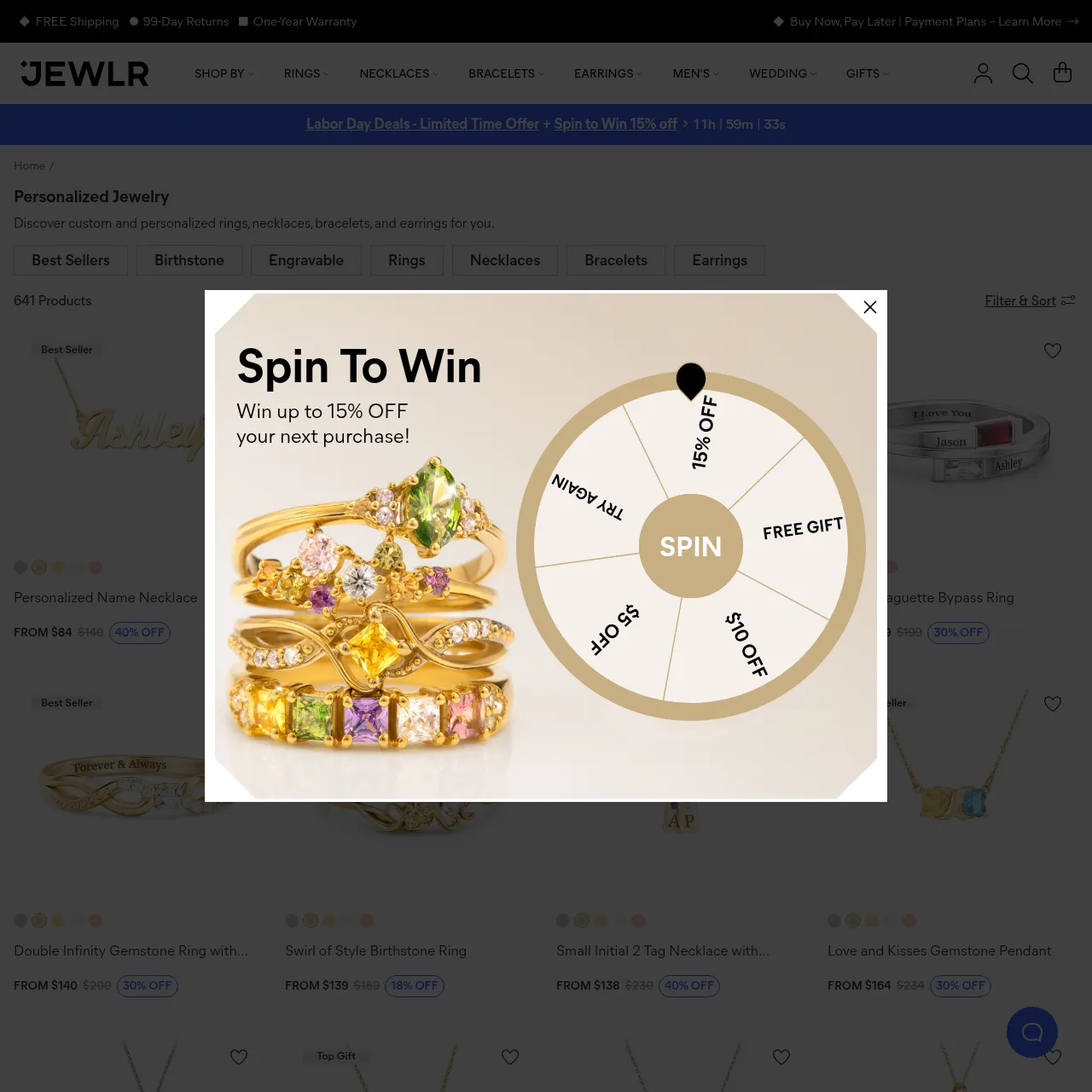
Jewlr runs one of the largest personalized jewelry catalogs in North America — hundreds of SKUs spanning rings, necklaces, bracelets, and earrings under a single landing page. The platform centers on birthstone selection (amethyst, garnet, peridot, and similar), name engraving, and custom text, paired with consumer-friendly purchase assurance: free shipping, 99-day returns, and a one-year warranty.
Key Features:
- Hundreds of personalized SKUs across four core categories: rings, necklaces, bracelets, earrings
- Personalization options including birthstone selection, name engraving, and custom text
- Consumer-friendly policies: free shipping, 99-day returns, one-year warranty, and buy-now-pay-later plans
- Mid-market price positioning with 18K gold-plated silver as a lead product format
- Conversion-optimized UX with filter tags (Best Sellers, Birthstone, Engravable, by category)
The scale and policy transparency Jewlr deploys signals what B2C custom jewelry buyers expect as baseline: broad selection, strong return windows, and frictionless personalization. The catalog's emphasis on birthstone formats — amethyst, garnet, peridot — is useful data for importers deciding which stone varieties to build into a private-label OEM brief. Jewlr has no MOQ tiers, no material traceability documentation, and no B2B procurement infrastructure.
Best For: Consumer reference only. Jewlr is a B2C personalized jewelry platform, not a wholesale or sourcing partner. Use it as a consumer price and format benchmark when finalizing your own product brief or evaluating which personalization mechanics drive purchase intent.
4. Brook & York — Modular Charm Customization (Consumer Market Benchmark)
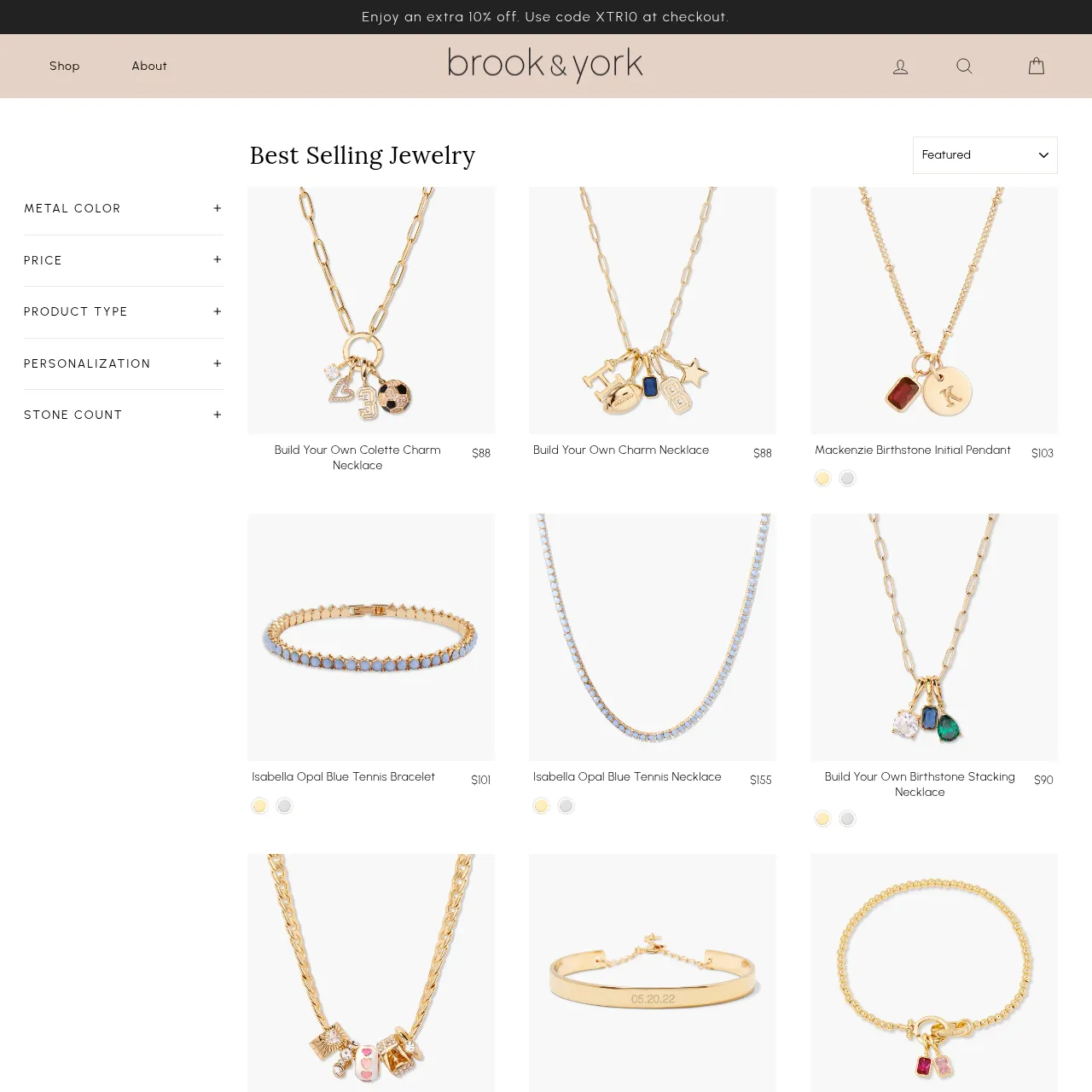
Brook & York is a US DTC jewelry brand whose "Build Your Own Charm Set" feature has made modular personalization a recognized consumer format in the custom jewelry segment. Shoppers assemble charm combinations from a curated library — a configure-to-order mechanic that delivers perceived customization at scale without bespoke manufacturing. Their catalog spans seven-plus categories: necklaces, bracelets, rings, earrings, anklets, pendants, and chains, with editorial collections including Diamond Collection and Tennis Jewelry at mid-to-premium price positioning.
Key Features:
- "Build Your Own Charm Set" — modular configuration from a curated charm library, no bespoke quoting needed
- Seven-plus categories covering full DTC breadth: necklaces, bracelets, earrings, anklets, pendants, chains
- Editorial collection framing (Best Sellers, New Arrivals, Diamond Collection, Tennis) to support discovery and upsell
- Mid-to-premium retail positioning, relevant as a pricing benchmark for importers targeting similar channels
Brook & York's success with the charm-build mechanic is a clear data point: consumers want to feel like they're composing something unique, even if the components are standardized. For an importer developing a DTC earring or charm necklace line, that insight translates directly into OEM product architecture — modular components with interchangeable elements outperform one-size catalogs in consumer markets where self-expression drives purchase.
Best For: Consumer reference only. Brook & York is a DTC retail brand, not a supply partner. It functions as a benchmark for consumer format preferences in the modular and charm-based custom jewelry category, particularly for buyers planning a DTC collection in North American or European markets.
5. Kay Jewelers — Mass-Market Personalized Jewelry (Consumer Market Benchmark)
Kay Jewelers is one of North America's most recognized jewelry retail chains, with a personalized category that spans rings, necklaces, earrings, and engagement pieces. Their custom offering centers on semi-personalization — engraving, name plates, initial charms, and a Create Your Own engagement ring configurator. The category also includes custom Neil Lane Bridal Ring Sets, lab-grown diamond wedding rings, and natural diamond wedding rings. Kay allows customers to book in-store appointments from their site navigation, reflecting a full omnichannel model that blends online configuration with physical retail stores.
Key Features:
- Broad personalized catalog including engagement rings, name/initial jewelry, custom Neil Lane bridal sets, and lab-grown diamond options
- Create Your Own engagement ring configurator with multi-gender segmentation (women's and men's custom lines)
- In-store appointment booking integrated with e-commerce, enabling omnichannel fulfillment
- Brand authority built on decades of brick-and-mortar retail presence across North America — similar positioning to other established US chains like Jared
Kay's household name recognition and omnichannel infrastructure illustrate what mass-market custom jewelry looks like at scale: broad SKU coverage, accessible price tiers, and purchase assurance mechanics that lower consumer hesitation. The brand has no trade infrastructure — no MOQ visibility, no material provenance documentation, and no wholesale access layer whatsoever.
Best For: Consumer reference only. Kay Jewelers is a mass-market retail chain, not a sourcing partner. Relevant for importers benchmarking North American consumer expectations around personalized jewelry breadth, lab-grown diamond positioning, and the price tiers that mainstream retail stores validate.
6. CustomJewelry.com — Bespoke Single-Piece Design Platform
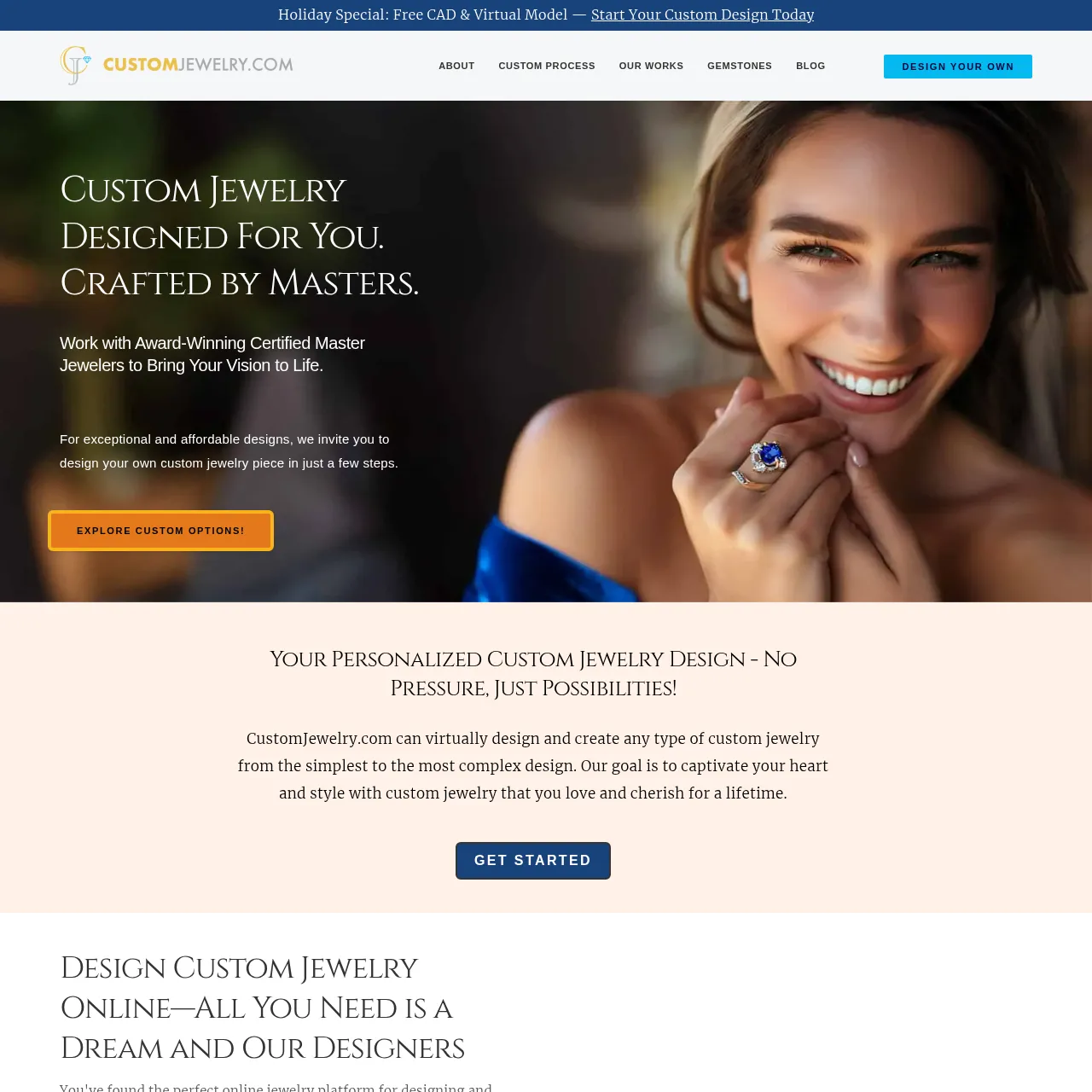
CustomJewelry.com holds a strong organic position for the term "custom jewelry" — aided significantly by its exact-match domain. The platform targets consumers and boutique buyers wanting fully bespoke pieces designed collaboratively with certified master jewelers: concept, CAD rendering, gemstone selection, through to production. Entry is designed to be frictionless — a free CAD design and virtual 3D model are available before any production commitment, reducing hesitation for first-time or remote buyers.
Key Features:
- Free CAD design and virtual 3D model rendering before production commitment — zero upfront cost to explore a concept
- End-to-end design flow: quote request → designer collaboration → production, with certified master jeweler execution
- In-house gemstone sourcing, including a dedicated "Buy Your Stone" section covering diamonds, amethyst, turquoise, and other stones
- Handles full design complexity, from simple band modifications to highly intricate bespoke commissions
- Award-winning artisan positioning built on craft credentials
The platform's CAD-first model is particularly well-matched to buyers who need to visualize a piece before committing. For a boutique importer sourcing a very small run of high-specification custom pieces with specific design briefs, the quote-first, designer-collaboration model suits the workflow. The structural limitation for recurring wholesale procurement is clear: the platform shows no MOQ framework, no wholesale pricing tier, and no freight logistics infrastructure.
Best For: Individual consumers designing one-off bespoke pieces — engagement rings, anniversary gifts, heirloom reproductions. Also relevant for boutique importers with low-volume, high-specification design requirements where a collaborative custom process is appropriate. Not structured for recurring wholesale or OEM procurement at scale.
What to Verify Before Placing a Custom Jewelry Order
Moving from shortlist to sourcing decision requires five concrete checks. Skip any of them and you're carrying unnecessary risk.
1. MOQ stated in units, not approximations. "Low MOQ" is not a number. Get the exact figure per style and ask whether it applies to repeat orders or only first production runs.
2. Material specification in writing. For plated pieces, request the base metal grade and plating micron thickness. For stone-set designs, confirm whether stones are natural, synthetic, or simulant — and get that in the purchase agreement.
3. Lead time for sample and production separately. A sample turnaround of two weeks and a production run of eight weeks are both relevant to your launch timeline. Get both numbers, in writing, and ask what buffer applies during peak periods.
4. QC process and documentation. In-house pre-shipment inspection is the minimum acceptable standard for cross-border orders. Ask whether inspection reports are provided per shipment.
5. Incoterms and payment method. EXW and FOB assign freight cost and insurance responsibility differently. Confirming which applies — and that your preferred payment method is supported — before negotiating price avoids misaligned expectations at the invoice stage.
Where to Start
The consumer platforms on this list — Made by Mary, Jewlr, Brook & York, Kay, CustomJewelry.com — define what the retail end of the custom jewelry market looks like. They're valuable as benchmarks for product format, price positioning, and consumer expectation. None of them offer what a DTC store owner or importer actually needs: documented MOQ, verifiable materials, B2B trade terms, and a team that speaks your procurement language.
STRAND is built for that second tier. Twelve pieces per style on most catalog designs, pre-shipment QC on every order, multilingual support across six languages, and OEM capability in gold-plated and rhodium-plated copper and 925-style silver finishes — the criteria that actually move a sourcing decision forward.
Ready to verify specs, request a sample, or get OEM pricing? Contact STRAND at strandjewelry.com to start a sourcing conversation with a team that works in your language and your trade terms.