
Custom Jewelry vs. Retail Alternatives: The Ultimate Sourcing Guide
Custom Jewelry vs. Retail Alternatives: The Ultimate Sourcing Guide
Custom jewelry sourced directly from OEM manufacturers offers B2B buyers unit-cost advantages and design exclusivity, while retail alternatives provide immediate availability and one-off personalization for individual consumers. For importers, DTC store owners, and procurement teams scaling a fashion jewelry line, cross-border custom manufacturing is the only viable path to margin control; retail alternatives serve local jewelers fulfilling single-client bridal or luxury requests.
TL;DR / Quick Verdict
If you are a buyer, importer, or DTC brand owner sourcing drop earrings, necklace sets, or stud earrings in volume, direct-to-manufacturer custom jewelry is your primary option. Retail alternatives—such as established jewelry stores or online personalized platforms—fit local businesses needing single-unit bespoke pieces like an engagement ring, not commercial inventory. Procurement teams managing multilingual supply chains across the US, EU, UK, or MENA should prioritize OEM suppliers offering low minimum order quantities (MOQs) and flexible trade terms over domestic retail customization services.
At-a-Glance Comparison Table
| Dimension | Custom Jewelry (Direct OEM) | Alternatives (Retail Stores / Online Platforms) |
|---|---|---|
| Pricing Model | Wholesale / EXW or FOB pricing | Retail markup (often categorized in tiers, e.g., collections under $2,750, under $5,000, or under $10,000) Source |
| Minimum Order Quantity | Low MOQs on most stock designs; select styles from 1 pc | Typically 1 piece per design |
| Target Audience | Importers, DTC brands, wholesale buyers | Individual consumers, local bridal clients |
| Materials & Styles | Gold-plated/rhodium-plated copper, glass beads, natural stone, faux pearls, vintage/gradient crystal | Fine metals, diamond, amethyst, garnet, peridot, turquoise |
| Lead Time & Shipping | Production lead time required; shipping by air, sea, or express | Next day shipping available on orders placed before 2pm ET; free shipping often offered on orders over $1,000 Source |
| Payment Terms | B2B payment methods tailored for international trade | Credit card, retail financing, standard consumer checkout |
| Support & Communication | Sales teams equipped for international B2B communication | Localized, typically English-only or region-specific |
| Quality Assurance | In-house QC inspection before every shipment | Store-level appraisal, consumer return policies |
Custom Jewelry Overview
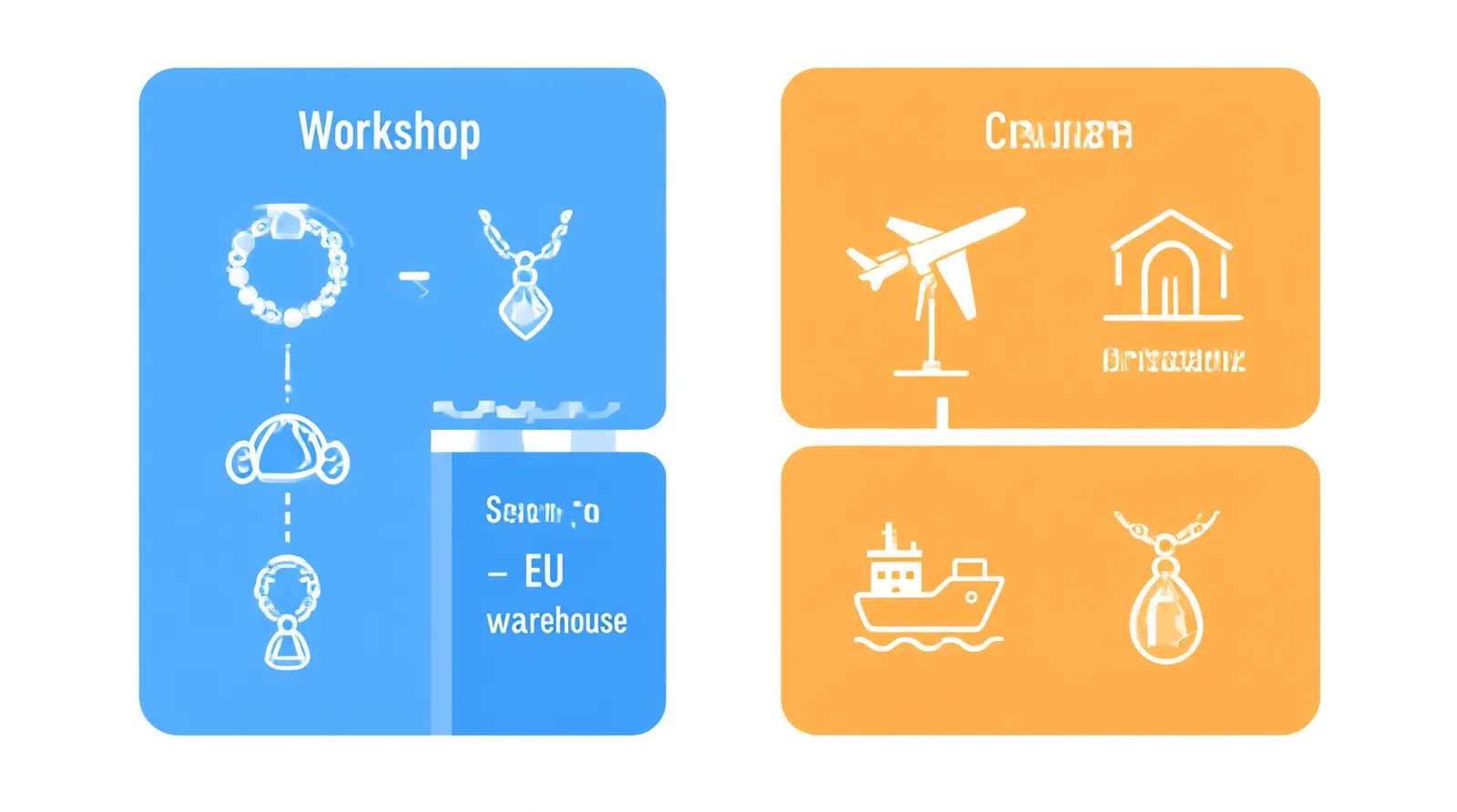
Custom jewelry in a B2B context refers to fashion and semi-fine pieces designed, manufactured, and shipped directly from vetted workshops to overseas buyers. STRAND operates as a Hangzhou-based brand linking these Chinese workshops directly to importers and DTC store owners in the US, EU, UK, and MENA regions. The focus is on scalable product lines: drop earrings, stud earrings, and necklace-and-earring sets featuring vintage, gradient crystal, two-tone glass bead, and rhinestone styles.
This model is built for commercial buyers who need inventory, not just a single sentimental item. Standout strengths include a stock catalog where the majority of styles carry low minimum order quantities, allowing smaller DTC brands to test markets without heavy capital risk. Custom OEM capabilities extend to gold-plated and rhodium-plated copper, 925-style silver finishes, glass beads, natural stones, and faux pearls. Because procurement teams are often distributed globally, STRAND provides sales support suited for international B2B communication. Trade terms are structured for international logistics, offering EXW or FOB options with shipping routed by air, sea, or express courier. Payment flexibility is also a core feature, accommodating standard B2B trade methods. Every shipment undergoes in-house QC inspection before dispatch.
For buyers evaluating how to structure their vendor list, our breakdown of Custom Jewelry: 6 Sources Buyers & DTC Brands Need in 2026 details how direct OEM suppliers fit into a broader procurement strategy.
Alternatives Overview
Alternatives to direct OEM custom jewelry encompass domestic retail jewelers, large-scale chain stores (like those operated by Jared or Kendra Scott), and online personalized jewelry platforms (such as Zales or Foundrae). These channels are built for the end consumer or the local boutique owner fulfilling one-off client requests. For a deeper look at how these channels stack up operationally, review this B2B buyer’s guide comparing retail and manufacturer models.
Retail alternatives excel in speed, localized service, and fine material access. A store like Brown & Company Jewelers offers dedicated custom jewelry design services in Atlanta, complete with "Build Your Engagement Ring" tools and scheduled bridal appointments Source. They handle high-value materials that fashion OEMs typically do not, including solid gold, diamond settings, and precious gemstones like amethyst, garnet, peridot, and turquoise. Logistics for these alternatives cater to the consumer: next-day shipping is available on orders placed before 2pm ET, and free shipping is frequently offered on all orders over $1,000 Source.
However, these alternatives are fundamentally misaligned with B2B volume sourcing. Pricing reflects retail margins rather than wholesale unit economics. Minimum orders are naturally set at one piece, which is ideal for a consumer but useless for a DTC brand needing 500 units of a specific rhinestone drop earring. Furthermore, communication is generally limited to the local language and standard business hours, lacking the multilingual, cross-time-zone infrastructure required for international import operations.
Feature-by-Feature Breakdown
Pricing and Unit Economics
Direct custom jewelry operates on wholesale pricing structures. Buyers negotiate based on material costs (e.g., copper base vs. 925-style silver finish), plating thickness, and order volume. Trade terms like EXW (Ex Works) or FOB (Free on Board) give importers control over their freight costs. This allows DTC brands to maintain healthy profit margins when retailing fashion jewelry.
Alternatives use fixed retail pricing. Stores often segment their offerings into luxury gift guide collections—for example, categorizing inventory under $2,750, under $5,000, and under $10,000 Source. While this transparency helps a consumer budget for a single purchase, it destroys the unit economics required for a commercial buyer attempting to restock a storefront or e-commerce site. Understanding these structural cost differences is critical when building out your B2B sourcing strategy.
Core Features and Product Range
OEM custom jewelry focuses on trend-driven fashion and semi-fine categories. STRAND’s catalog emphasizes specific aesthetics: vintage motifs, gradient crystals, two-tone glass beads, and rhinestones. The manufacturing process supports variations in gold-plated and rhodium-plated copper, alongside natural stone and faux pearl integration. Buyers can modify existing stock designs or commission entirely new molds.
Retail alternatives focus heavily on fine jewelry and bridal. Services like building an engagement ring or scheduling bridal appointments dominate their feature sets Source. If your target market demands certified diamonds or rare gemstone cuts, retail alternatives have the bench jewelers to execute them. If your market demands fast-fashion turnaround on trend-specific earring sets, they do not.
Minimum Order Quantities (MOQ) and Scalability
Scalability is the sharpest dividing line between the two options. Custom jewelry suppliers bridge the gap between mass production and boutique sourcing. STRAND maintains low MOQs on the vast majority of its catalog designs, with select styles available from just 1 piece. This allows buyers to test a new turquoise-inspired glass bead collection without committing to thousands of units upfront. Once a style proves profitable, scaling up to container-load volumes is a standard operational shift.
Alternatives inherently lack commercial scalability. You cannot order 500 identical custom-engraved pendants from a local Atlanta jeweler without facing prohibitive per-unit labor costs and extended timelines that disrupt retail planning.

Quality Assurance and Compliance
Cross-border custom jewelry requires stringent pre-shipment checks. STRAND conducts in-house QC inspections before every shipment leaves the facility. For B2B buyers, requesting documentation on plating micron thickness, nickel-free compliance (crucial for EU and UK markets), and material safety standards is a standard part of the RFQ (Request for Quote) process.
Retail alternatives rely on post-sale consumer protections. A local store might offer appraisals or warranties, but they do not provide the batch-level QC reports or compliance certificates that an importer needs to clear customs or satisfy marketplace requirements (like Amazon or regional e-commerce platforms).
Logistics and Payment Infrastructure
International custom jewelry sourcing demands flexible logistics. Suppliers ship via air, sea, or express depending on the buyer's urgency and budget. Payment infrastructure must accommodate corporate finance departments, hence the acceptance of standard B2B trade methods suitable for cross-border transactions.
Alternatives optimize for consumer convenience. Fast fulfillment, such as next-day shipping on orders placed before 2pm ET, and perks like free shipping on orders over $1,000, are standard retail expectations Source. Payment is restricted to credit cards or consumer financing platforms, which do not integrate into B2B accounting workflows.
Support and Communication
Multilingual procurement teams require vendors who speak their language. Direct OEM suppliers like STRAND offer sales support equipped for international B2B communication, removing friction for importers operating across the US, EU, UK, and MENA.
Retail alternatives provide localized, face-to-face service. This is highly valuable for a nervous bride choosing a setting, but irrelevant for a German DTC store owner trying to coordinate a sea freight shipment of stud earrings from China.
Pros and Cons
Custom Jewelry (Direct OEM)
Pros:
- Commercial pricing structures (EXW/FOB) protect profit margins.
- Low MOQs on most designs reduce inventory risk.
- International sales support streamlines global procurement.
- Flexible B2B payment methods.
- In-house QC inspections ensure batch consistency before export.
- Access to diverse fashion materials (gold/rhodium-plated copper, glass beads, faux pearls).
Cons:
- Requires longer lead times for production and international transit.
- Not suited for sourcing certified fine gemstones (e.g., high-carat diamond solitaires).
- Demands basic knowledge of import logistics, customs clearance, and trade terms.
Alternatives (Retail Stores / Online Platforms)
Pros:
- Immediate availability and rapid shipping (e.g., next-day dispatch before 2pm ET) Source.
- Face-to-face consultations for highly emotional purchases like bridal rings Source.
- Access to fine luxury materials and traditional bench-jeweler craftsmanship.
- No minimum order requirements; buy exactly one piece.
Cons:
- Retail markups destroy wholesale viability.
- Incapable of fulfilling bulk inventory orders for DTC brands.
- Limited to local languages and regional customer service hours.
- Consumer-focused payment gateways do not support corporate purchasing.
When to Choose Custom Jewelry
Opt for direct OEM custom jewelry if you are a DTC store owner launching a seasonal collection of gradient crystal earrings and need 50 units per colorway to test conversion rates before scaling. It is the correct choice for importers supplying multiple boutiques across the MENA or EU regions who require account managers experienced in handling international specifications. Choose this route if your business model relies on maintaining a specific margin threshold that retail markups would instantly erase. It is also the necessary path if you want to develop proprietary designs—such as a signature two-tone glass bead necklace set—that competitors cannot source from the same public retail shelves. For a deeper evaluation of vendor types, review our guide on 6 Custom Jewelry Sources Ranked: OEM Suppliers & Retail Benchmarks for 2026.
When to Choose Alternatives
Choose retail alternatives if you are a local jewer looking to outsource a single, highly complex bespoke request for a walk-in client, such as resetting a family heirloom diamond or mounting a rare peridot stone. Alternatives are appropriate for consumers buying a one-off luxury gift where the experience of visiting a store, utilizing a "Build Your Engagement Ring" interface, or scheduling a private bridal appointment adds perceived value to the purchase Source. If you need a single piece of fine jewelry delivered tomorrow because you missed an anniversary, the next-day shipping infrastructure of retail alternatives is the only logical solution Source.
Final Verdict
The decision between custom jewelry and retail alternatives is rarely a matter of preference; it is dictated entirely by your purchasing intent and business model. If you are buying for yourself or fulfilling a single client's bridal request, retail stores and online platforms offer the speed, fine materials, and localized service required. If you are buying to sell, retail alternatives will bankrupt your margins.
For importers, DTC brand owners, and wholesale buyers, direct-to-manufacturer custom jewelry is the operational baseline. The ability to secure low MOQs across the catalog, negotiate EXW or FOB trade terms, pay via B2B trade methods, and communicate with internationally focused sales teams transforms jewelry from a luxury expense into a scalable retail asset.
To evaluate current pricing, verify material compliance for your target market, or request samples from the catalog, submit a formal inquiry to the STRAND procurement team. Request your quote, sample, and current MOQ terms directly at https://strandjewelry.com.