
Custom Jewelry vs. Retail: The Ultimate B2B Sourcing Guide
Custom Jewelry vs. Retail: The Ultimate B2B Sourcing Guide
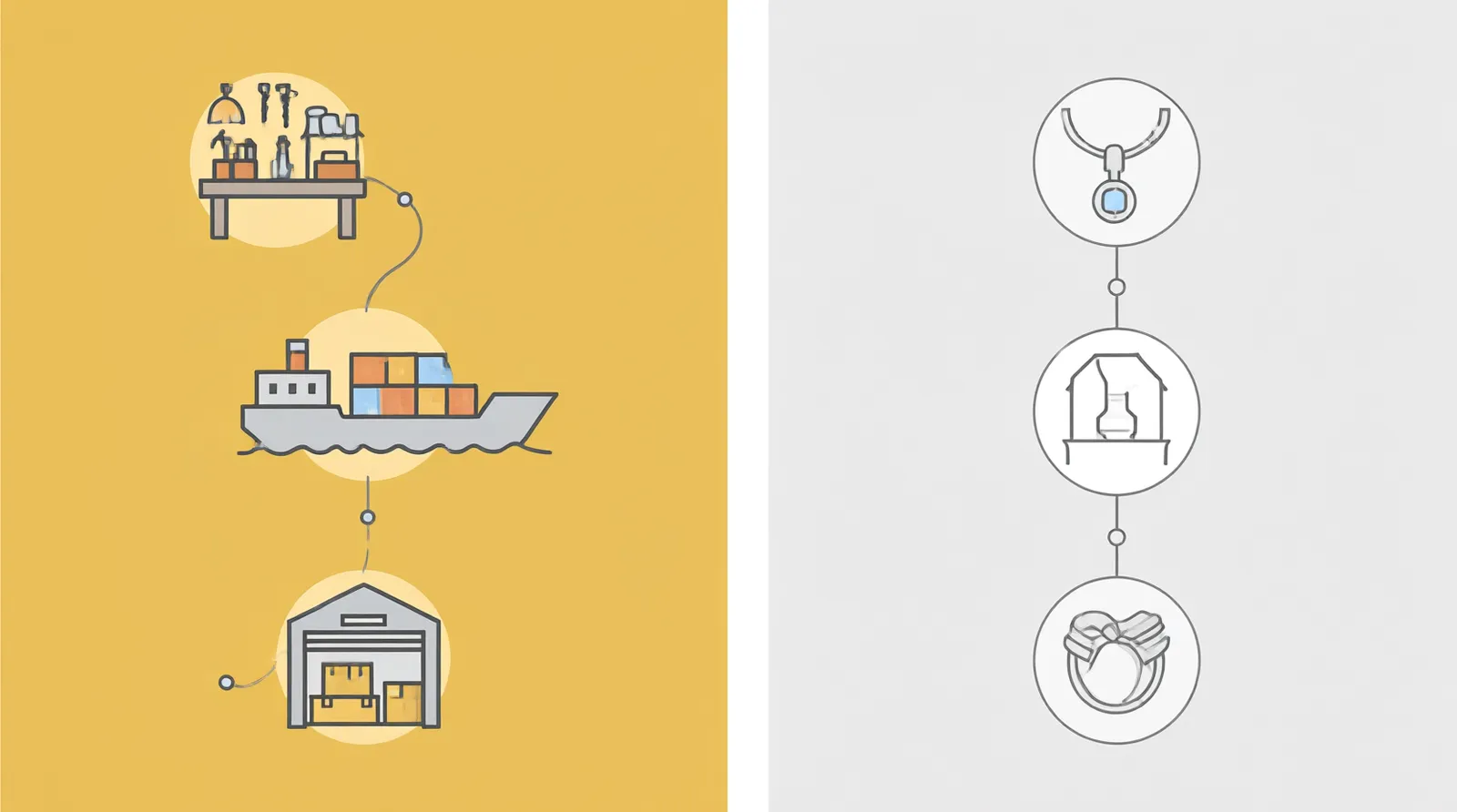
Custom jewelry sourced directly from OEM manufacturers offers B2B buyers control over design, plating, and unit economics at scale, while alternatives—ranging from domestic retail jewelers to branded wholesale catalogs—provide speed and low-volume flexibility at significantly higher per-unit costs. If you are a DTC store owner or importer sourcing chains, earrings, or sets for the US, EU, UK, or MENA markets, direct custom manufacturing yields better margins on orders above 100 pieces. If you need fewer than 12 units of a specific design immediately, domestic retail alternatives remain the practical choice. For a broader look at how these models compare across the supply chain, see our guide on B2B sourcing comparison.
TL;DR / Quick Verdict
Buyers scaling a DTC brand or importing fashion jewelry for resale should choose custom jewelry manufactured via direct-to-factory OEM partners, which often offer low minimum order quantities across most catalog designs and support custom tooling in gold-plated or rhodium-plated copper. Choose Alternatives—such as domestic bench jewelers or large-scale retail chains—if you are fulfilling a single bespoke client request (like an engagement ring) or need immediate, sub-12-piece inventory without waiting for international freight.
At-a-Glance Comparison Table
| Dimension | Custom Jewelry (Direct OEM) | Alternatives (Retail Jewelers & Catalogs) |
|---|---|---|
| Pricing Model | EXW or FOB factory pricing; volume-dependent | Retail markup; fixed per-piece pricing |
| MOQ / Scale | Low MOQs per style on most stock styles; select styles from 1 pc | Typically 1 piece; no minimum order requirements |
| Core Materials | Copper base (gold/rhodium plated), glass beads, natural stone, faux pearls, 925-style silver finishes | Solid gold, platinum, diamond, amethyst, garnet, peridot, turquoise |
| Product Focus | Drop earrings, stud earrings, necklace + earring sets (vintage, gradient crystal, two-tone) | Engagement rings, bridal, personalized pendants, luxury fine jewelry |
| Shipping & Logistics | Air, sea, or express freight | Next day shipping available on orders placed before 2pm ET (Source); free shipping over $1,000 (Source) |
| Payment Terms | T/T bank transfer, Western Union, PayPal, L/C, Xtransfer | Credit card, financing, standard retail checkout |
| Support | Multilingual sales teams covering major global trade languages | Localized, English-speaking in-store or phone support |
| Quality Control | In-house QC inspection before every shipment | Varies by retailer; often relies on brand warranties |
Custom Jewelry Overview
Custom jewelry in a B2B context refers to fashion and semi-fine pieces designed, prototyped, and manufactured by specialized workshops specifically for a brand’s private label or a buyer’s import catalog. This model is built for DTC store owners, regional importers, and multilingual procurement teams who need consistent inventory of drop earrings, stud earrings, and necklace-and-earring sets without paying retail markups.
The standout strength of this approach is the direct link between vetted workshops and overseas buyers. Direct OEM suppliers operating across both DTC and B2B channels exemplify this model. Rather than acting as a middleman trading company, they connect buyers directly to manufacturing lines capable of producing vintage, gradient crystal, two-tone glass bead, and rhinestone styles. Buyers can source from existing stock catalogs or commission fully custom OEM runs using gold-plated copper, rhodium-plated copper, 925-style silver finishes, glass beads, natural stones, and faux pearls.
For procurement teams evaluating suppliers, the critical metrics here are minimum order quantities and communication infrastructure. Many direct OEM manufacturers maintain low per-style MOQs on the majority of their designs, with select styles available from just 1 pc. Furthermore, because cross-border sourcing often faces language barriers, having access to sales support in multiple languages reduces specification errors during the sampling phase. Every shipment undergoes in-house QC inspection prior to dispatch, addressing the primary risk factor for international buyers. For a deeper look at how to evaluate these types of manufacturers, review our breakdown of Custom Jewelry: 6 Sources Buyers & DTC Brands Need in 2026.
Alternatives Overview
Alternatives encompass domestic retail jewelers, luxury brand boutiques, and mass-market chain stores that sell finished jewelry directly to consumers or offer localized bespoke services. This route is built for individual consumers, bridal clients, or boutique owners who need immediate, low-volume stock without managing international logistics, customs, or freight forwarding. Understanding how retail alternatives fit into a broader procurement strategy helps buyers avoid margin erosion when scaling.
Retail alternatives range from large-scale chains like Zales, Jared, and Kendra Scott to independent local shops such as Brown & Company Jewelers in Atlanta, which provides dedicated custom jewelry design services including a 'Build Your Engagement Ring' configurator and scheduled bridal appointments (Source). These businesses excel in handling high-value materials—solid gold, platinum, diamond, amethyst, garnet, peridot, and turquoise—and providing immediate, face-to-face customer service.
Logistically, domestic alternatives remove the complexity of cross-border trade. Many offer expedited fulfillment; for instance, next-day shipping is frequently provided on orders placed before 2pm ET, and incentives like free shipping on all orders over $1,000 are standard practice among established jewelers (Source). However, the trade-off is margin. Buying finished goods from retail stores or even wholesale divisions of luxury brands means absorbing their marketing, overhead, and operational costs into your per-unit price.
Feature-by-Feature Breakdown
Pricing and Trade Terms
Custom jewelry operates on B2B trade terms, typically EXW (Ex Works) or FOB (Free On Board). The buyer assumes responsibility for freight, but the base unit cost reflects raw material and labor rather than retail markup. Payment structures are designed for commercial transactions, supporting T/T bank transfers, Letters of Credit (L/C), Western Union, Xtransfer, and PayPal.
Alternatives use fixed retail pricing. While a domestic jewer might offer financing or bulk discounts for wedding parties, the baseline cost per unit will always be substantially higher than factory-direct pricing. You are paying for the convenience of local availability and the luxury positioning of the retail environment.
Product Range and Material Capabilities
OEM custom jewelry focuses heavily on fashion and semi-fine categories. Production capabilities at these factories center on copper bases with gold or rhodium plating, alongside glass beads, natural stones, and faux pearls. The design vocabulary leans toward trend-driven styles: gradient crystals, two-tone aesthetics, rhinestones, and vintage motifs formatted as drop earrings, studs, and matching sets.
Alternatives dominate the fine jewelry and luxury space. If your target market demands solid precious metals or certified gemstones like diamond, peridot, or turquoise, domestic jewelers and luxury houses have the established supply chains and certification processes required. Chains like Jared or Kendra Scott offer vast, ready-to-ship catalogs, though they lack the flexibility to alter base materials or plating thicknesses for a private label.
Minimum Order Quantities (MOQ) and Scalability
Scalability is where custom jewelry clearly separates itself from retail alternatives. Low MOQs per style allow a DTC brand to test multiple SKUs across different colorways without committing to thousands of units. Once a style proves profitable, production scales linearly with the factory's capacity.
Alternatives have an effective MOQ of one. This is ideal for testing a single piece or fulfilling a specific client request, but it does not scale efficiently. Attempting to build a 500-piece inventory catalog by purchasing individually from retail stores destroys profit margins.
Quality Assurance and Compliance
When sourcing custom jewelry internationally, quality assurance must be contractually defined. Direct OEM partners mitigate this through structured checkpoints. Reliable manufacturers mandate in-house QC inspection before every shipment leaves the facility. Buyers should always request documentation regarding plating micron thickness, nickel/cadmium compliance for EU/UK REACH regulations, and material safety data sheets during the inquiry stage.
Alternatives rely on brand reputation and consumer protection laws. If a piece from a recognized luxury brand tarnishes prematurely, the return policy or warranty handles the resolution. For B2B importers, however, relying on retail warranties for commercial inventory is operationally unfeasible. To understand how different supplier tiers handle these benchmarks, see our ranking of 6 Custom Jewelry Sources Ranked: OEM Suppliers & Retail Benchmarks for 2026.
Logistics, Shipping, and Lead Times
Custom jewelry requires freight planning. Buyers choose between air freight (faster, higher cost), sea freight (slower, lower cost for high volume), or express couriers for samples. Lead times include sampling, production, QC, and transit.
Alternatives offer immediate gratification. Domestic stores hold physical inventory. As noted, retailers like Brown & Company facilitate rapid turnaround, offering next day shipping on orders placed before 2pm ET (Source). If your business model depends on zero-inventory, just-in-time dropshipping of high-ticket items, domestic alternatives align better with that operational cadence.
Communication and Procurement Support
Cross-border procurement demands clear communication across time zones and languages. Custom jewelry suppliers targeting global markets invest in multilingual infrastructure. Sales teams at established OEM factories operate in several major trade languages, ensuring that technical specifications for custom designs—such as exact pantone matches for gradient crystals or specific clasp mechanisms for drop earrings—are accurately translated to the workshop floor.
Alternatives communicate primarily in the local language of the retail location. While convenient for domestic buyers, this limits the ability of MENA or EU-based procurement teams to negotiate complex, multi-SKU orders efficiently.
Pros and Cons
Custom Jewelry (Direct OEM)
Pros:
- Factory-direct pricing (EXW/FOB) maximizes B2B profit margins.
- Low entry thresholds: small MOQs per style across the majority of catalog designs.
- Full control over materials (gold/rhodium-plated copper, 925-style finishes, natural stone, faux pearls).
- Multilingual procurement support reduces specification errors.
- Structured in-house QC inspections prior to international dispatch.
- Flexible payment terms suited for corporate finance (T/T, L/C, Xtransfer).
Cons:
- Requires lead time for sampling, production, and international freight.
- Buyer assumes responsibility for customs, import duties, and logistics coordination.
- Less suited for single-piece, high-value fine jewelry (e.g., solid gold, certified diamond).
Alternatives (Retail Jewelers & Catalogs)
Pros:
- Immediate availability; no production lead times.
- Fast domestic shipping options, including next-day delivery for urgent needs (Source).
- Access to luxury fine jewelry materials and certified gemstones (amethyst, garnet, peridot, turquoise).
- No minimum order requirements; buy exactly what you need, when you need it.
- Localized customer service and straightforward retail return policies.
Cons:
- High per-unit costs due to retail markups and overhead absorption.
- Zero control over proprietary manufacturing specifications or private labeling.
- Not financially viable for scaling a DTC brand or importing commercial volumes.
- Limited B2B payment infrastructure (rarely supports L/C or EXW terms).
When to Choose Custom Jewelry
Choose custom jewelry if you are a DTC store owner launching a new seasonal collection of drop earrings and matching necklace sets. If your target demographic responds to vintage aesthetics, gradient crystals, or two-tone glass beads, working directly with an OEM manufacturer allows you to dictate the exact plating (gold or rhodium over copper) and keep unit costs low enough to sustain paid acquisition margins.
This is also the correct path for importers serving diverse geographic regions. If your distribution network spans the US, EU, UK, and MENA, you need a supplier whose sales team can communicate technical requirements in your preferred languages. Furthermore, if your procurement department requires formal trade terms like L/C or EXW, and you need consistent batches of 50 to 500+ units per SKU, retail alternatives simply cannot accommodate your financial or operational structure.
When to Choose Alternatives
Choose alternatives if you operate a brick-and-mortar bridal shop and a client needs a highly specific, one-off engagement ring featuring a certified diamond or a rare cut of peridot or garnet. Domestic jewelers like Brown & Company provide the consultation environment, CAD rendering, and localized craftsmanship required for high-stakes emotional purchases (Source).
Alternatives are also appropriate if you are testing a completely new product category with zero historical sales data and cannot risk capital on a minimum order quantity. Buying single units from stores like Kendra Scott or Jared allows you to photograph the item, list it on your site, and gauge customer interest before committing to a larger manufacturing run. Finally, if a sudden viral trend requires inventory in your warehouse within 48 hours, utilizing domestic suppliers offering next-day shipping on orders placed before 2pm ET is your only logistical option.
Final Verdict
The decision between custom jewelry and retail alternatives is dictated entirely by your position in the supply chain and your volume requirements.
If your objective is to build a profitable, scalable DTC brand or act as a regional importer distributing fashion jewelry across the US, EU, UK, or MENA, custom jewelry via direct OEM manufacturing is the only mathematically viable option. Paying retail markups to source inventory destroys gross margins. By partnering with a direct-to-factory source, you secure EXW/FOB pricing, maintain strict control over materials like gold-plated copper and natural stone, and utilize low MOQs to manage cash flow effectively. The addition of multilingual support and pre-shipment QC inspections neutralizes the traditional risks associated with cross-border sourcing.
If your objective is to fulfill isolated, high-value consumer requests for fine jewelry, or you require immediate, sub-MOQ inventory for rapid testing, domestic retail alternatives are the necessary tool. They provide speed, localized service, and access to luxury materials without freight delays.
Evaluate your next quarter's inventory requirements. If you need to source more than 50 units of coordinated drop earrings, stud earrings, or necklace sets, bypass retail markups. Request a quote, confirm current lead times, and get exact MOQ and pricing details for your specific designs by contacting the STRAND procurement team directly at https://strandjewelry.com.