
6 Custom Jewelry Options Buyers and DTC Brands Are Evaluating in 2026
6 Custom Jewelry Options Buyers and DTC Brands Are Evaluating in 2026
Custom jewelry refers to any piece produced or modified to a buyer's specification — from engraving and gemstone selection to full OEM manufacturing in defined metals and finishes. For trade buyers, this means negotiating materials, minimum order quantities, lead times, and quality checkpoints before a single piece ships to their market.
The brands competing for this keyword operate on two very different planes. Consumer-facing personalization services dominate the search results — built for individual shoppers selecting amethyst birthstone rings, picking turquoise pendants, or engraving a garnet charm as a gift. Then there's the trade layer: OEM suppliers and wholesale partners who produce to specification at volume, with defined material grades, verified production capacity, and import-ready documentation.
Both layers matter to procurement teams, importers, and DTC store owners reading this. Consumer brands — from mass-market chains to curated DTC labels that have built audiences the way brands like Kendra Scott have in the US — tell you what end-market demand looks like, which personalization mechanics drive conversion, and what price elasticity the market supports. Trade suppliers tell you who can actually fill your inventory. This list maps one sourcing-grade partner and five consumer retail benchmarks, assessed against the criteria that matter at the commercial level: MOQ, material transparency, OEM capability, payment flexibility, and quality accountability.
1. STRAND — Best B2B Custom Jewelry Sourcing and OEM Partner
STRAND is the most direct route from custom jewelry concept to overseas inventory — a Hangzhou-based brand that connects buyers in the US, EU, UK, and MENA directly to vetted Chinese workshops, with no intermediaries adding margin or ambiguity to the materials chain. The sourcing relationship is transparent by design: you know the workshop, you know the finish specifications, and you know the QC checkpoint before anything ships.
The catalog structure gives procurement teams room to test before committing. Of 114 stock styles, 109 are available at a 12-piece minimum per style — a meaningful threshold for importers trialing new silhouettes or DTC stores validating demand before a larger production run. Select designs drop further, to a single piece, for genuine sample-level evaluation. Custom OEM covers gold-plated and rhodium-plated copper as well as 925-style silver finishes, giving buyers building cohesive private-label collections the material consistency they need across drop earrings, stud earrings, necklaces, and sets.
What distinguishes STRAND operationally is its in-house QC inspection before every shipment — not outsourced, not optional. Trade terms include EXW and FOB, with shipping available by air, sea, or express depending on timeline and cost requirements. Payment flexibility spans T/T bank transfer, PayPal, Western Union, L/C, and Xtransfer. Sales support runs in English, French, Arabic, Spanish, German, and Russian, removing the translation delays that routinely slow procurement for multilingual teams sourcing across MENA and European markets.
For buyers working through the broader supplier landscape, STRAND has published a useful reference: 6 Custom Jewelry Brands Buyers & Importers Need in 2026, a comparative sourcing guide, 6 Best Custom Jewelry Sources in 2026: OEM Suppliers & Retail Benchmarks, and 6 Custom Jewelry Sources Buyers and Importers Need to Know in 2026, all written for procurement buyers rather than end consumers.
Key Features:
- 114-style stock catalog; 109 styles at 12 pcs/style MOQ, select styles available from 1 pc
- Custom OEM in gold-plated and rhodium-plated copper, 925-style silver finishes
- In-house QC inspection before every shipment
- EXW and FOB trade terms; air, sea, or express shipping
- Multilingual sales: EN, FR, AR, ES, DE, RU
- Payment: T/T, PayPal, Western Union, L/C, Xtransfer
Best For: Importers and DTC store owners sourcing private-label earrings and jewelry sets from China; procurement teams in the US, EU, UK, and MENA who need low-MOQ entry points, material-specified OEM production, and pre-shipment quality accountability.
2. Made by Mary — Consumer Personalized Jewelry (Retail Benchmark)
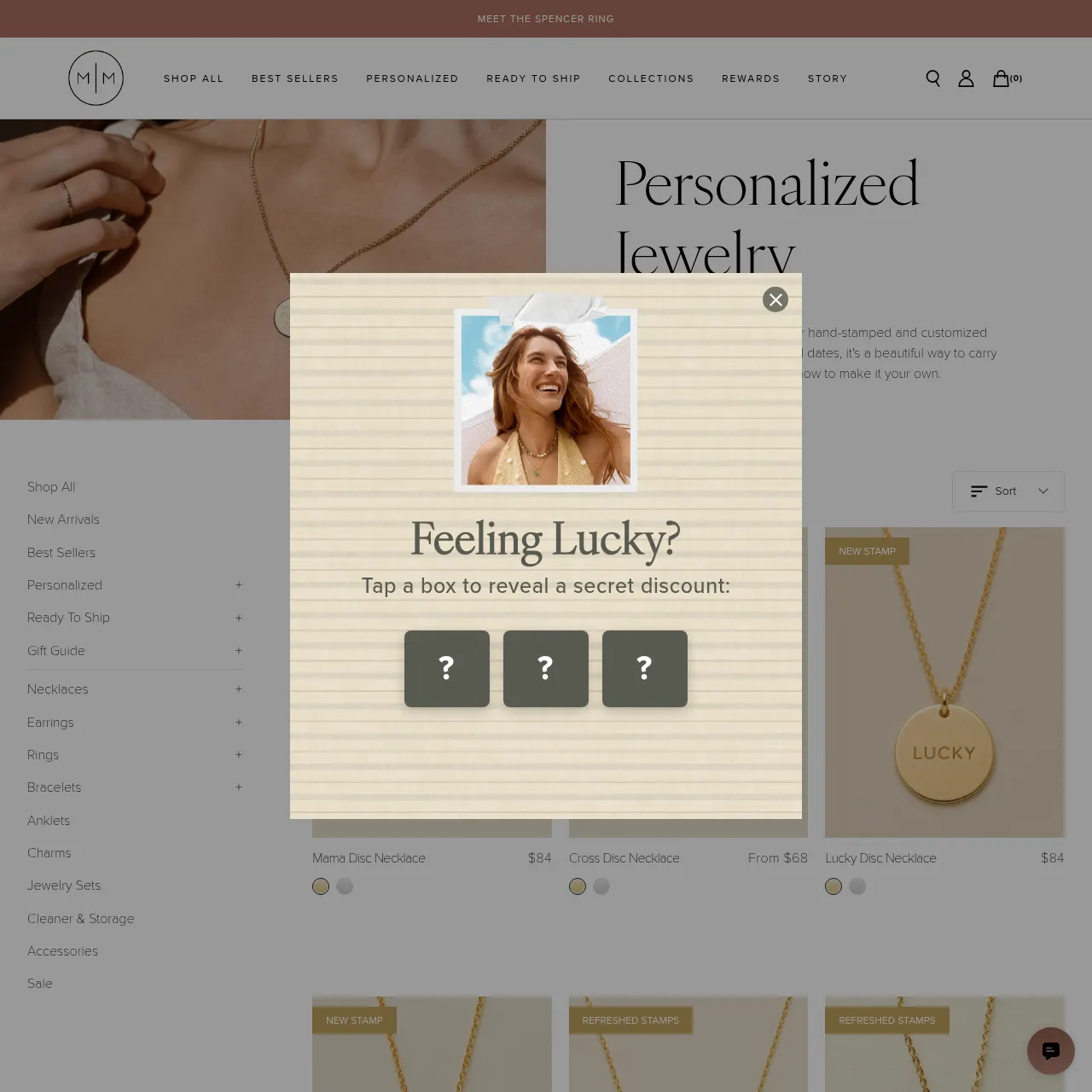
Made by Mary is a DTC jewelry brand whose personalized collection ranks among the top organic results for "custom jewelry" — a clear signal of strong consumer-facing SEO authority in this category. Their positioning leans into dainty, meaningful personalization: the kind of jewelry a shopper buys to mark a milestone or gift to someone they love, rather than to stock a retail channel.
As a consumer retail benchmark, Made by Mary is relevant to buyers mapping end-market demand rather than sourcing inventory. Their sustained top-of-SERP presence for the "custom jewelry" keyword confirms that the personalization angle resonates deeply with individual shoppers — and that a DTC personalization model, without wholesale or trade infrastructure, can achieve high organic visibility in a competitive category.
For importers and procurement teams, the Made by Mary model is not a supply option. There is no visible MOQ structure, trade pricing, or B2B purchasing pathway. What it signals is market appetite: the consumers your DTC clients are selling to actively search for and purchase personalized jewelry at the direct-to-consumer level, and they reward brands with a strong editorial, gifting-first identity.
Key Features:
- DTC-first personalized jewelry collection with top organic search visibility for "custom jewelry"
- Positioned for individual shoppers seeking meaningful, occasion-driven custom pieces
- No publicly available wholesale, B2B, or trade purchasing pathway
Best For: A consumer retail reference point — useful for buyers benchmarking what end-market personalization demand looks like, not as a sourcing or supply partner.
3. Brook & York — Charm Customization and DTC Volume (Consumer Benchmark)
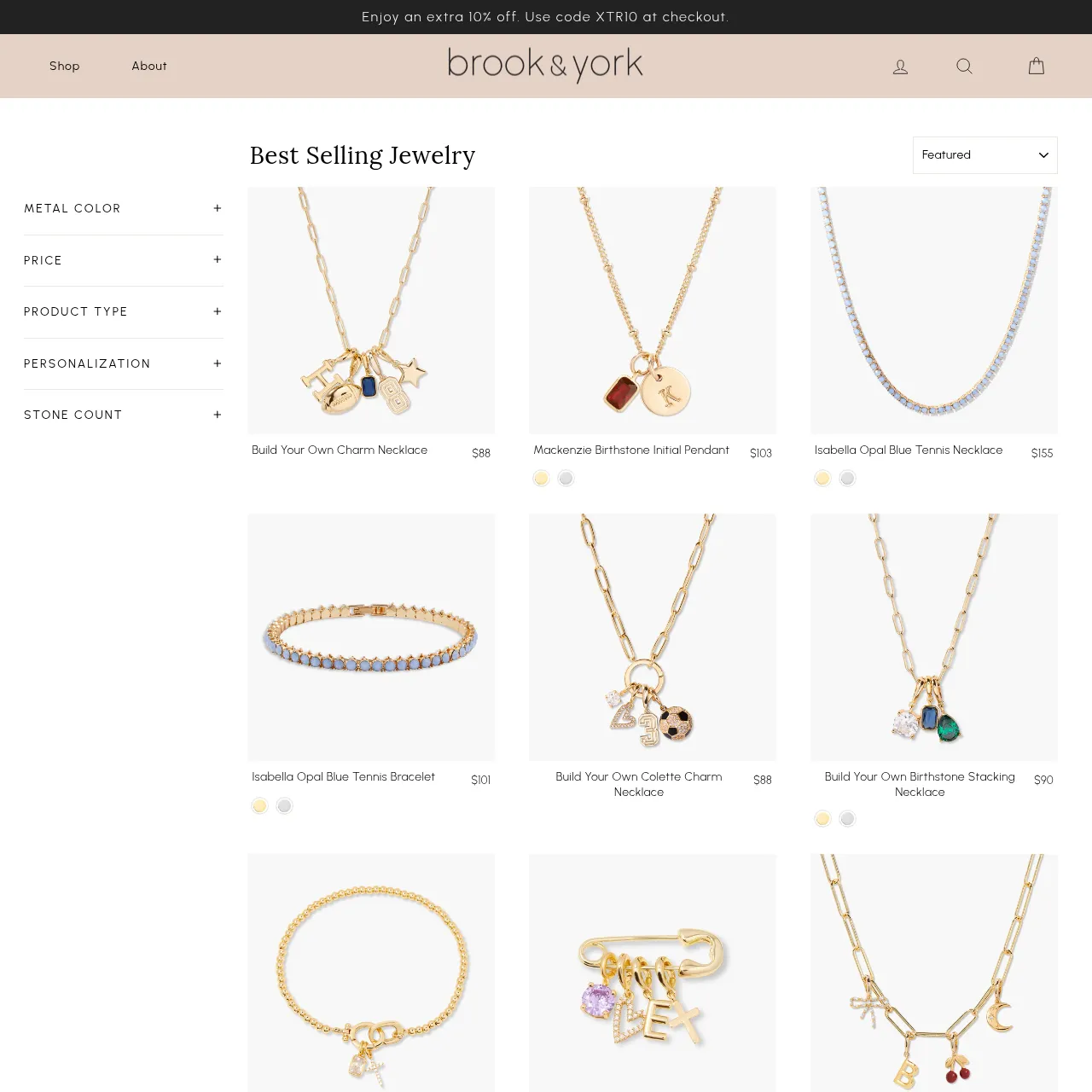
Brook & York competes on the "custom jewelry" keyword through a consumer-facing personalization mechanic: the Build Your Own Charm Set. This modular approach — selecting charms, metals, and configurations — mimics bespoke without true manufacturing customization. It's an effective volume driver for a DTC brand, but it operates at a fundamentally different level than OEM production.
Their best-seller catalog spans necklaces, bracelets, rings, earrings, anklets, pendants, and chains — seven jewelry categories with enough depth to support a high average order value. The Diamond Collection and Tennis Jewelry lines signal movement into elevated, fine-adjacent territory, while seasonal drops like Game Day Jewelry capture trend-driven, occasion-specific demand. Wishlist and Instashop integration points to a social commerce growth model tied to visual platforms and influencer-driven discovery.
The gap from a procurement perspective is transparency. Brook & York's consumer model does not disclose material grades, production provenance, MOQ structures, or lead times — information that importers, procurement buyers, and MENA market sourcing teams require before committing to inventory. For DTC brands building collections with verifiable materials and consistent gold or rhodium plating specifications, this opacity is a practical blocker. It's also the structural gap that a vetted-supply partner directly addresses.
Key Features:
- Build Your Own Charm Set — modular consumer personalization entry point
- Seven jewelry categories including Diamond Collection and Tennis Jewelry
- Strong social commerce integration: Instashop, Wishlist, trend-driven seasonal drops
- No visible trade terms, material disclosures, or B2B purchasing structure
Best For: A consumer DTC benchmark illustrating charm-based personalization volume. Useful for buyers studying consumer personalization mechanics and category breadth strategy — not a wholesale or OEM supply source.
4. Jewlr — High-Volume Consumer Personalization Platform (Consumer Benchmark)
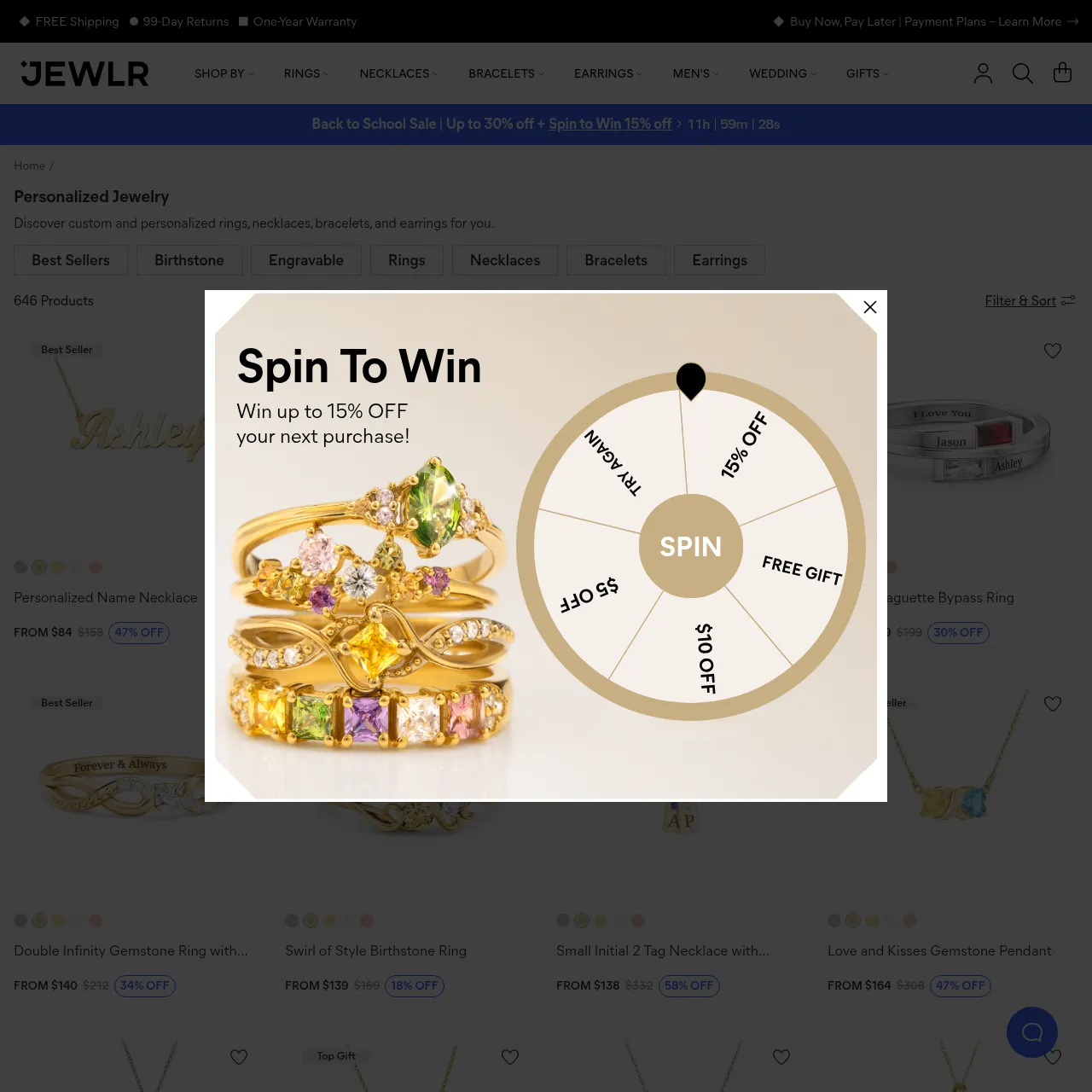
Jewlr operates at genuine scale in the consumer personalization segment. Their personalized collection spans rings, necklaces, bracelets, earrings, and men's jewelry, with filter-driven navigation across birthstone, engravable, and best-seller categories. Materials used include 18K Gold Plated Silver, 925 Sterling Silver, and Vermeil — which tells procurement buyers that the consumer market accepts a range of material tiers under the "custom jewelry" label, and that buyers should be explicit about specifications when sourcing.
The gemstone range across their catalog covers amethyst, garnet, peridot, blue topaz, citrine, aquamarine, and pink tourmaline — a breadth that reflects genuine consumer demand for birthstone-specific personalization rather than decorative variety for its own sake. Pieces like the Double Heart Gemstone Ring and engraved necklaces illustrate the sentiment-driven, occasion-tied purchasing that defines the consumer segment.
Jewlr's trust infrastructure is designed to reduce purchase hesitation: free shipping, a 99-day return policy, a one-year warranty, and Buy Now, Pay Later payment plans are standard. These policies are consumer-facing and have no equivalent in a B2B trade context. There is no visible wholesale pricing, MOQ, or import documentation available — Jewlr is not structured for trade purchasing.
The key observation for procurement teams: Jewlr validates sustained, high-volume consumer demand for personalized custom jewelry, but it offers nothing for buyers sourcing at quantity. The infrastructure gap between Jewlr's consumer model and a verified OEM supplier is exactly where a vetted sourcing partner provides measurable value.
Key Features:
- Consumer personalization across rings, necklaces, bracelets, earrings, and men's jewelry
- Birthstone and engraving options: amethyst, garnet, peridot, blue topaz, and more
- Materials: 18K Gold Plated Silver, 925 Sterling Silver, Vermeil
- Consumer policies: free shipping, 99-day returns, one-year warranty, BNPL
Best For: An end-market demand reference for buyers mapping what consumers want and what they'll pay for personalized jewelry. Not a wholesale or OEM supply source.
5. Jared — Luxury Retail Benchmark for Custom and Personalized Jewelry
Jared is a nationally recognized luxury jewelry retail chain in the US, operating physical stores alongside an e-commerce channel with a dedicated personalized jewelry category. Their presence in the top five results for "custom jewelry" confirms that consumers associate the term with established luxury retail stores and brand trust — not just DTC platforms.
Jared's personalization offering sits within a broader luxury positioning. The brand carries diamond engagement rings, fine gemstone jewelry, and branded collections alongside engraving and customization services — placing them at the premium end of the consumer personalization market, where in-store experience and brand authority are part of the purchase decision.
From a procurement standpoint, Jared is a retail pricing reference, not a wholesale or import source. Buyers evaluating the luxury segment of custom jewelry, or DTC brands positioning their private-label products in a premium tier, can use Jared's product mix and retail price points to understand the ceiling of what consumers in the US market will pay for custom or personalized pieces. The gap between that retail price ceiling and the landed cost of verified OEM production is where margin opportunity lives for importers building cohesive collections.
Key Features:
- National luxury jewelry retail presence across physical stores and e-commerce
- Personalized jewelry category alongside fine diamond and gemstone collections
- Premium brand positioning targeting engagement, anniversary, and milestone gifting
- No trade, wholesale, or import purchasing pathway
Best For: A luxury retail pricing benchmark — for buyers understanding the premium end of the US consumer custom jewelry market and modeling margin potential against OEM sourcing costs.
6. Kay Jewelers — Mass-Market Personalization at Scale (Consumer Benchmark)
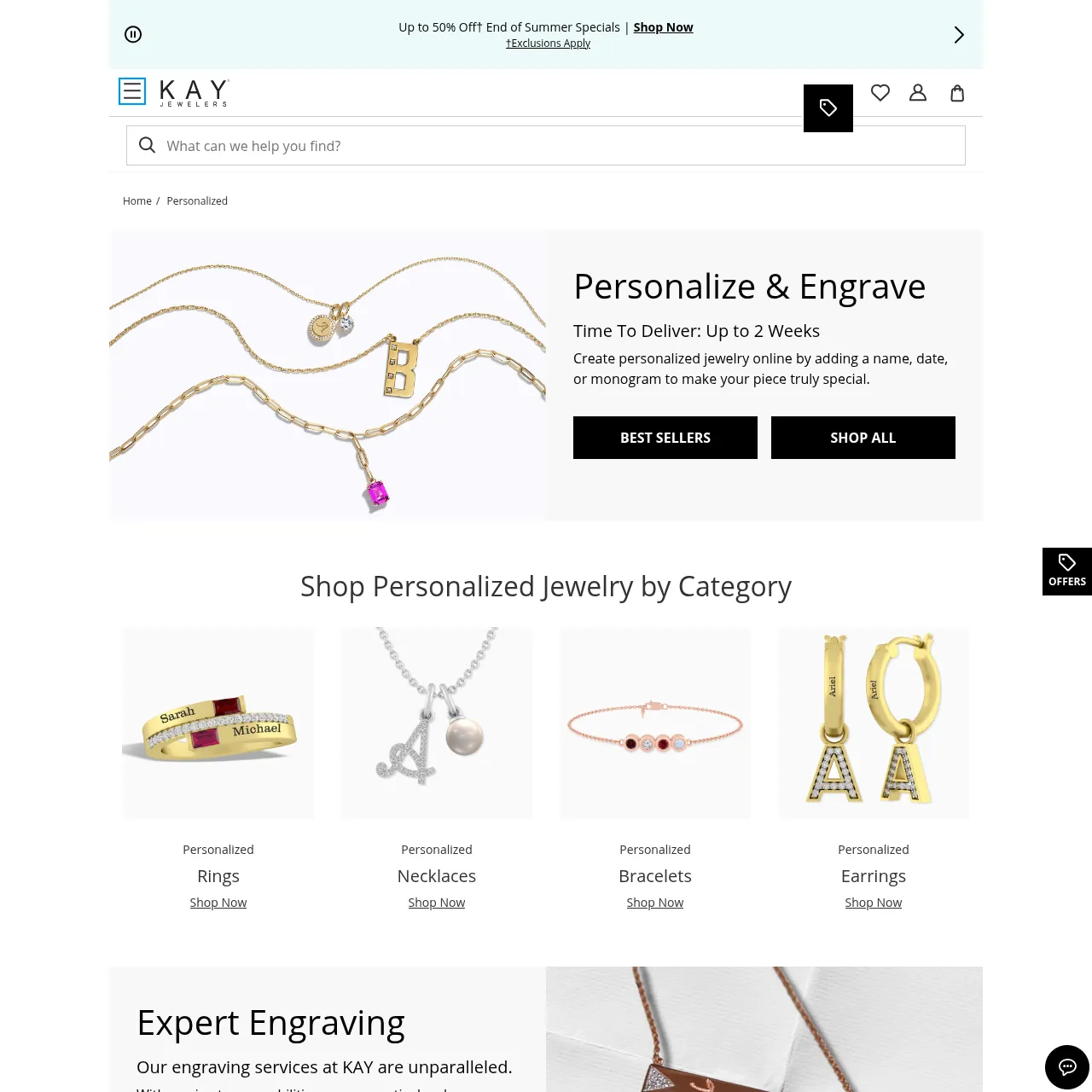
Kay Jewelers represents the mass-market end of the consumer custom jewelry segment — a high-volume retail operation with national presence, promotional pricing, and a full-funnel personalization journey. Their personalized collection spans engraving and customization across rings, necklaces, and bracelets, with product breadth running from lab-grown diamonds to 10K and 14K gold jewelry across engagement, wedding, and anniversary categories.
The promotional pricing model — tiered discounts across personalized categories — signals something structurally important: at the mass-market level, consumer demand for custom jewelry is price-sensitive, and conversion is driven by friction reduction rather than exclusivity. Kay's model is the direct opposite of luxury positioning: broad selection, accessible price points, aggressive discount cadence. This is valuable market intelligence for buyers setting retail price strategy for their own channels.
For overseas buyers and procurement teams, Kay Jewelers is a useful floor-level pricing reference. Their consumer-facing personalization infrastructure has no B2B purchasing pathway, no visible MOQ or trade terms, and no import documentation for overseas buyers. What their keyword authority on "custom jewelry" confirms is consistent, high-volume end-market demand — exactly the demand that well-sourced, private-label jewelry collections from vetted OEM partners can serve profitably.
Key Features:
- Mass-market personalized jewelry across engraving, rings, necklaces, and bracelets
- Broad category coverage: lab-grown diamonds, 10K–14K gold, fine jewelry
- Promotional pricing model with tiered discounts and a strong omnichannel presence
- No trade, wholesale, or import purchasing pathway
Best For: A mass-market retail benchmark for buyers understanding consumer-end pricing and demand volume at scale — not a trade, wholesale, or OEM supply source.
What to Ask Before Contacting a Custom Jewelry Supplier
Buyers close to a sourcing decision should evaluate any OEM or wholesale custom jewelry partner across six concrete dimensions before the first inquiry call:
MOQ and sampling flexibility. Can you order a single piece or a small run before committing to production volume? A 12-piece minimum per style is a meaningful threshold for testing new silhouettes. Ask for this number in writing — "low MOQ" without a figure is not useful for planning.
Material specification. What metals, plating standards, and stone grades are available? Request specifics: plating thickness in microns, base metal (copper vs. brass), and whether stones are natural, synthetic, or glass. Vague answers here create quality disputes after shipment.
Lead time and production capacity. What's the standard window for stock styles vs. custom OEM? Can capacity scale for peak seasons? Ask for both current and maximum production volumes.
Quality assurance process. Is QC done in-house or outsourced? Is there a documented inspection report before each shipment? For cross-border orders, pre-shipment QC is the last reliable checkpoint before goods clear customs.
Trade terms and payment options. EXW vs. FOB determines where risk and cost transfer. Payment flexibility — T/T, PayPal, L/C, Xtransfer — matters particularly for procurement teams in markets with SWIFT complexity or payment channel restrictions.
Language and communication. For MENA and European procurement teams, sales support in Arabic, French, Spanish, German, or Russian eliminates a consistent friction point. Confirm before signing off on an order, not during production.
Making the Sourcing Decision
The consumer brands in this list — Made by Mary, Brook & York, Jewlr, Jared, and Kay Jewelers — validate robust end-market demand for personalized custom jewelry, from diamond rings to amethyst birthstone pendants and engraved gold necklaces. They're not supply sources. They're the market you're selling into.
For procurement teams, importers, and DTC store owners who need verified workshop access, material transparency, and pre-shipment quality accountability, the evaluation criteria are operational: MOQ structure, OEM capability, QC process, and trade-ready logistics. Those are the questions worth asking before the first sample order.
STRAND addresses each at the operational level — 12-piece MOQ on most catalog styles, custom OEM in gold-plated and rhodium-plated copper and 925-style silver finishes, in-house QC before every shipment, and multilingual sales across six languages. Request your MOQ pricing, catalog, and sample terms at strandjewelry.com.