
Custom Jewelry vs. Alternatives: The B2B Buyer's Sourcing Decision Guide
Custom Jewelry vs. Alternatives: The B2B Buyer's Sourcing Decision Guide
TL;DR / Quick Verdict
Custom jewelry OEM from a vetted manufacturer gives importers and DTC brands full design control, private-label capability, and wholesale margins that retail alternatives simply can't match. Off-the-shelf options — personalization platforms, branded chain stores, domestic distributors — offer speed and zero production risk, but at retail pricing that eliminates resale viability. Build a product line with custom OEM; use retail alternatives only for single-unit needs or competitive benchmarking.
At-a-Glance Comparison Table
| Dimension | Custom Jewelry (OEM / Manufacturer) | Retail & DTC Alternatives |
|---|---|---|
| Pricing model | Factory quote + shipping; wholesale spreads | Fixed retail per-unit pricing |
| MOQ | 12 pcs/style (most catalog designs); select styles from 1 pc | 1 piece |
| Customization depth | Full OEM: metal, finish, stone, design, packaging | Template-level: engraving, birthstone, name selection |
| Private label / branding | Yes | No |
| Lead time | Production window + shipping | Days (pre-made inventory) |
| Margin potential | High (wholesale-to-retail spread) | None to negative for resellers |
| Gemstone / material options | Natural stone, glass bead, crystal, faux pearl | Amethyst, garnet, peridot, CZ, diamond accents |
| Payment flexibility | T/T, PayPal, L/C, Western Union, Xtransfer | Credit card, BNPL |
| Support languages | EN, FR, AR, ES, DE, RU | English-primary |
| Shipping options | Air, sea, express — EXW or FOB terms | Consumer standard/express |
| Quality assurance | In-house pre-shipment QC on every order | Consumer warranties; brand-level return policies |
| Best for | Importers, DTC brands, OEM buyers scaling a catalog | Gifting, retail sampling, single-unit testing |
Custom Jewelry Overview
Custom jewelry in a B2B context means working directly with a manufacturer to produce pieces built to your specification — metal substrate, plating finish (gold, rhodium, rose gold), stone type, design geometry, and packaging. That's a different category from the consumer "personalization" services that add a name or swap a birthstone on an existing template.
STRAND, a Hangzhou-based manufacturer connecting vetted Chinese workshops to overseas buyers, operates in this space. Their stock catalog runs 114 styles — drop earrings, stud earrings, and necklace-and-earring sets in gold-plated and rhodium-plated copper, with glass bead, natural stone, and faux pearl materials across vintage, gradient crystal, two-tone, and rhinestone aesthetics. The standard MOQ is 12 pieces per style on 109 of 114 catalog designs; select styles are available from 1 piece for sampling. Beyond catalog orders, full custom OEM is available: buyers supply design files or reference samples, and STRAND produces to spec with in-house QC before shipment.
The model is designed specifically for the importer, wholesale buyer, or DTC brand building a differentiated product at a competitive landed cost — not for someone buying one piece as a gift.
Alternatives Overview
"Alternatives" here covers three distinct categories, each solving a different problem.
Retail personalization platforms — brands like Jewlr carry a large catalog of personalized jewelry products, including engravable rings, birthstone necklaces, name pendants, and bracelets in metals like 18K gold-plated silver, 925 sterling silver, and vermeil. Gemstone options span amethyst, garnet, peridot, citrine, aquamarine, and multiple CZ grades. Consumer protections are solid — Jewlr offers a one-year warranty and a 99-day return policy. This is a consumer channel, not a trade one.
Branded chain stores — Jared, Kay, and the Kendra Scott tier carry personalized and luxury-adjacent jewelry in physical stores and online. Selection is curated to consumer demand, and pricing reflects retail margin. Kendra Scott stores, for example, carry signature colorblock designs with semi-precious stones. None of these channels offer wholesale terms or trade pricing to B2B buyers.
Domestic wholesale distributors — US or EU-based distributors buy from manufacturers and resell to retailers at lower MOQs than factory-direct, but with their own margin layered in. They also carry no custom production capability.
Each alternative solves a different problem than custom OEM. The sourcing path depends entirely on which problem you actually have.
Feature-by-Feature Breakdown
Pricing & Margin Structure
Factory-direct custom OEM pricing from a manufacturer like STRAND operates on a quote basis — unit cost depends on design complexity, metal finish, plating specification, and order volume. The wholesale-to-retail spread is substantial. A DTC brand sourcing at factory cost and selling at retail sets its own margin; that's the structural advantage of the direct-manufacturing relationship.
Retail alternatives are priced for the end consumer. Jewlr's personalized jewelry catalog carries pieces at consumer retail price points — name necklaces, engravable pendants, and multi-element designs — with retail margin already baked in and prices that fluctuate with seasonal promotions. A reseller buying from a platform like this operates at thin or inverted margins. It's not a wholesale channel.
For B2B buyers, this is the decisive difference: factory sourcing creates margin; retail sourcing consumes it.
Customization Depth
Custom OEM delivers full specification control: plating color, substrate metal, stone type and setting style, design elements, and packaging. Buyers targeting specific aesthetics — gradient crystal earring sets, vintage two-tone beaded drops, rhinestone pave studs — can specify from STRAND's catalog or co-develop original designs. Material options include glass beads, natural stone, and faux pearls alongside crystal and rhinestone finishes.
Retail personalization platforms are intentionally constrained. Jewlr's "custom" options mean selecting a birthstone, choosing an engraving text, and picking from available metal finishes. Kendra Scott operates similarly in its stores. There is no design freedom beyond those variables — the system is optimized for consumer ease, not trade specification.
A DTC brand trying to build product identity from a retail personalization platform gets zero differentiation. Every buyer on that platform has the same template access.
Minimum Order Quantities & Flexibility
STRAND's standard MOQ is 12 pieces per style — low by manufacturing standards, deliberately structured for importers and DTC brands testing new SKUs. That means a buyer testing five new designs orders under 60 units total. Select designs are available from 1 piece for pre-production sampling before committing to a full run.
Retail alternatives technically have an MOQ of 1, which sounds more flexible until you consider that they carry no trade pricing and no wholesale terms. Domestic distributors may work at 6–24 piece minimums per SKU, but their prices reflect the extra margin tier. For a buyer sourcing 500–5,000 pieces per season, the relevant question isn't minimum order size — it's what the per-unit cost looks like at each volume tier. That conversation happens with manufacturers, not retail platforms.
Quality Assurance & Compliance
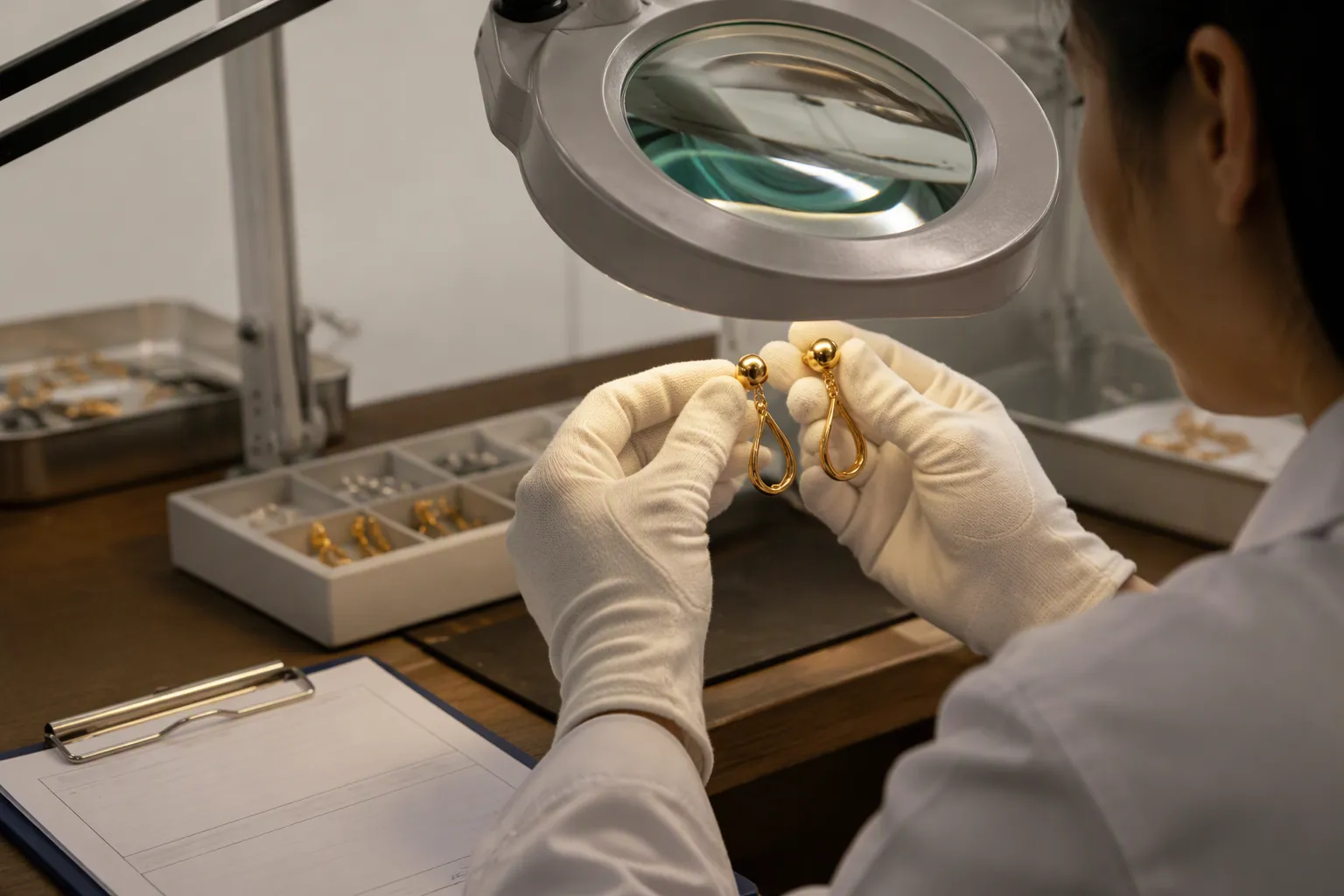
STRAND conducts in-house QC inspection before every shipment — a critical step for cross-border B2B orders where a quality problem discovered post-delivery means returns, reorders, and customer service costs. Buyers evaluating any manufacturer should ask for their inspection protocol, defect rate benchmarks, and whether pre-shipment third-party audit access is available.
Retail alternatives offer consumer-facing protections: a one-year warranty at Jewlr, along with their 99-day return policy. These are consumer protections, not trade guarantees. They don't address batch consistency, plating thickness uniformity, or the test documentation importers need for customs compliance in the EU (REACH, nickel directive) or US (CPSC requirements). For compliance-sensitive markets, only a manufacturer can provide the necessary certifications and documentation.
Lead Time & Supply Chain Scalability
Custom OEM carries production lead time. Catalog-style orders with standard finishes move faster than full-custom design work; shipping options (air, sea, express) let buyers balance cost against delivery speed, with EXW or FOB terms to support both lean air freight runs and bulk sea shipments in established reorder cycles.
Retail and domestic alternatives ship in days to two weeks — because the product is already made. That speed has a hard ceiling: when a design performs well and you need 800 more units in a specific colorway, retail alternatives can't scale with you. Custom OEM can. The lead time trade-off is real, but it's a planning problem, not a structural limitation.
Payment & Trade Terms
STRAND supports T/T bank transfer, Western Union, PayPal, L/C, and Xtransfer — the full range of cross-border B2B payment instruments, including tools suited to multilingual procurement teams in MENA, EU, and the US. L/C terms are particularly relevant for higher-volume importers managing risk on large production runs.
Retail platforms run on consumer payment rails: credit card, debit, and BNPL. No L/C, no wire terms, no trade credit. That's appropriate for their market — and entirely mismatched for a procurement operation managing a sourcing budget.
Multilingual Support & Market Coverage
STRAND's sales team operates in English, French, Arabic, Spanish, German, and Russian. For procurement teams managing budgets in MENA, Francophone markets, or non-English EU regions, this directly reduces friction. Specification errors introduced by language gaps in a production brief are costly and hard to catch before shipment.
Jared stores, Kendra Scott, and most US-based distributors offer English-only support. Jewlr and similar DTC personalization platforms are English-primary. For a multilingual sourcing operation, the supplier's language capability is an operational criterion, not a nice-to-have.
Pros and Cons
Custom Jewelry (OEM Manufacturer Route)
Pros
- Full product specification control: metal, finish, stone type (natural stone, glass bead, crystal, faux pearl), design elements, and packaging
- Wholesale pricing with genuine resale margin
- Private label and brand packaging options available
- MOQ of 12 pcs/style on most STRAND catalog designs; select styles from 1 piece
- In-house pre-shipment QC on every order
- Multi-currency, multilingual procurement support (EN, FR, AR, ES, DE, RU)
- Scalable: same supplier handles test order and 10x reorder
Cons
- Longer lead time than pulling from domestic stock
- Requires production planning: design briefs, sample approval, production scheduling
- Per-style minimums mean committing to at least 12 units per SKU on most designs
- Cross-border logistics demand customs documentation and import compliance work
Alternatives (Retail, DTC Personalization, Domestic Wholesale)
Pros
- Immediate availability — days from order to delivery
- No MOQ for single-unit purchases
- Established product quality; no production risk
- Consumer protections: warranties, easy returns
- Physical store access (Jared, Kendra Scott) for hands-on evaluation before speccing competitive designs
Cons
- Retail pricing eliminates resale margin
- Customization limited to template-level options (names, engravings, birthstone swaps)
- No private label or brand differentiation
- Predominantly English-only support
- Not scalable for volume buying
- Consumer payment terms only — no L/C, wire terms, or trade credit
When to Choose Custom Jewelry
You're building a product line. A cohesive DTC collection — say, a gradient crystal earring range in four colorways with matching necklace sets and branded packaging — requires custom OEM. Off-the-shelf retail options deliver no differentiation.
You're importing for wholesale distribution. Distributors reselling to boutiques or retailers in the US, EU, or MENA need wholesale pricing, trade documentation, and suppliers with real QC infrastructure. A retail platform isn't an option.
You need MOQ flexibility without sacrificing customization. Testing five new designs at 12 pieces each means committing to 60 units — a manageable test budget before scaling a winner. The 1-piece sampling option on select styles lets you verify the physical product before production.
Your procurement team is multilingual. Sourcing conversations happening in Arabic, French, or Spanish move faster and with fewer errors when the supplier matches your working language.
For a structured look at how custom OEM compares across six sourcing channels, Custom Jewelry: 6 Sources Buyers & DTC Brands Need in 2026 covers the full landscape.
When to Choose Alternatives
You need one piece, immediately. A personalized amethyst pendant or diamond-accented name necklace for a specific gifting occasion is exactly what retail personalization platforms handle well. The 99-day return policy and consumer warranty make single-unit purchases low-risk.
You're benchmarking the market before finalizing your SKU list. Studying what Kendra Scott stores carry, what peridot or citrine designs are trending on Jewlr, or what price points luxury-adjacent chains like Jared use is competitive intelligence worth gathering. Retail alternatives are useful as reference points, not sourcing channels.
You need to test consumer demand before committing to an OEM run. Some DTC operators buy small retail lots to validate demand before going to a manufacturer with a production brief. That's a legitimate sequencing step — but retail is a temporary signal-gathering stage, not a scalable sourcing model.
For a broader comparison of how OEM manufacturing benchmarks against retail and wholesale tiers across key procurement dimensions, 6 Custom Jewelry Sources Ranked: OEM Suppliers & Retail Benchmarks for 2026 covers the full decision matrix.
Final Verdict
The comparison between custom jewelry OEM and retail alternatives isn't genuinely close for the buyer this article targets. Importers, DTC brands, and wholesale distributors building scalable product lines need factory pricing, trade terms, QC documentation, and a supplier who can grow with their volume. Retail personalization platforms serve the end consumer well — they aren't a substitute for a manufacturing relationship and weren't designed to be.
The real sourcing decision isn't custom vs. retail. It's which manufacturer offers the right combination of MOQ flexibility, design capability, QC rigor, and procurement support for your specific market and volume tier.
The next step is direct contact: request current MOQ and unit pricing for the specific styles and finishes you need, ask for a sample against your specifications, and confirm trade terms and lead times before committing to a production run.
Request a quote or sample from STRAND → MOQ, pricing, and production lead times are available on request.