
Custom Jewelry Buying Guide: How to Vet Suppliers & Protect Your Margins
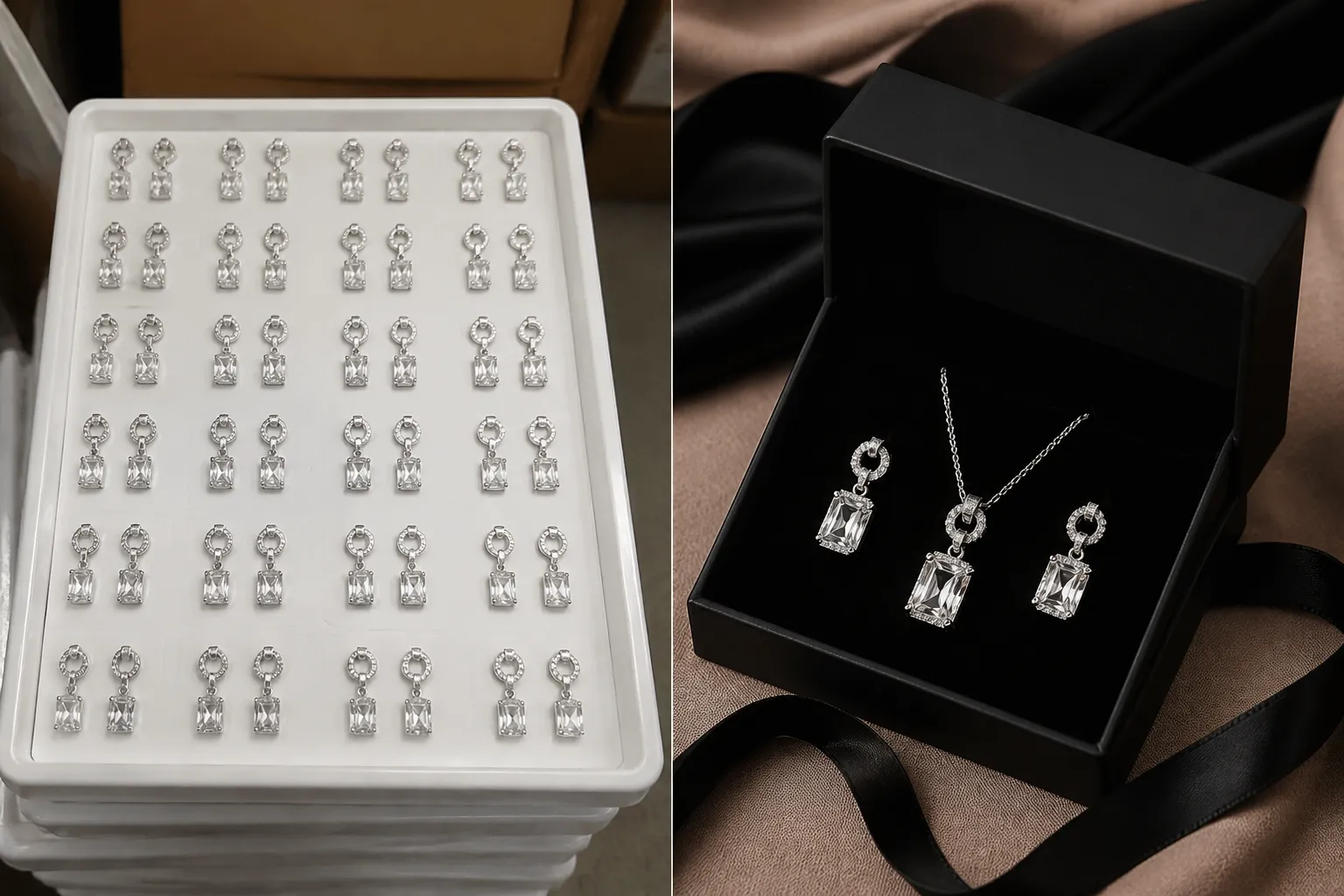
Custom Jewelry Buying Guide: How to Vet Suppliers & Protect Your Margins
Custom jewelry solves a specific problem: off-the-shelf designs don't fit your brief, your brand, or your customer's expectations. Whether you're a DTC store owner sourcing a private-label earring line, an importer filling seasonal gaps, or a procurement manager building a catalog from scratch, the decisions you make before placing an order define your margins, your timeline, and your risk exposure.
Who This Guide Is For
This guide is written for buyers, importers, and DTC store owners who are past the browsing stage and actively evaluating suppliers. You might be sourcing drop earrings and necklace sets for a US boutique, replenishing a seasonal catalog for an EU marketplace, or building a branded private-label collection for a MENA retailer. Your trigger is concrete: you need custom jewelry produced to a spec, delivered on time, and priced to protect your margin — and you need to vet the supplier doing it.
If you're a retail consumer shopping for a personalized gift, the Budget Tiers and Vendor Questions sections still apply. But the core of this guide is written for professional buyers managing real MOQs, quality audits, and multi-SKU orders.
What Custom Jewelry Actually Does for Your Business
Custom jewelry — whether OEM production to your design or personalization of existing catalog styles — gives you product differentiation that generic stock can't match. You control the finish (gold-plated versus rhodium-plated), the stone (amethyst, garnet, peridot, turquoise, or diamond simulant), the SKU depth, and the branding. That control comes at a cost: longer lead times, minimum order requirements, and upfront sampling investment.
For buyers sourcing from China, the calculus is straightforward. Lower unit costs, access to a full production ecosystem (casting, plating, stone-setting, QC), and the ability to run styles that luxury retail stores — the Jareds and Kendra Scotts of the world — won't stock in their standard assortment.
Key Decision Factors
1. Metal Base and Plating Specification
The metal base determines durability, weight, and downstream certifications. Copper is the most common base in fashion jewelry — it plates cleanly and holds dimensional tolerance well. 925 sterling silver is standard for pieces positioned as semi-fine. Plating thickness matters: thin gold plate under 0.5 microns tarnishes quickly in humid markets.
What good looks like: a supplier who quotes plating thickness in microns, specifies the base metal clearly, and provides test reports on request. Ask explicitly about gold-plated and rhodium-plated options, and whether both finishes can be accommodated within a single order.
2. MOQ Structure and Flexibility
Minimum order quantity is often the first filter. Many suppliers quote per-style MOQs that make sense at scale but price out smaller operators testing new categories. The right MOQ depends on your business model.
STRAND, for example, publishes MOQs of 12 pieces per style on 109 of its 114 catalog designs, with select styles available from 1 piece — figures that matter when you're testing new SKUs without committing to deep inventory. For custom OEM work, MOQ requirements differ and should be confirmed directly. Request current MOQ and pricing terms before building any sourcing plan around a supplier's numbers.
3. Stone Options and Sourcing Transparency
Stones are where personalization lives — and where quality variance is highest. For commercial fashion jewelry, the main categories are: synthetic stones (cubic zirconia, glass beads, rhinestones), natural semi-precious stones (garnet, amethyst, peridot, turquoise), and simulants or lab-grown alternatives.
Jewlr's personalized jewelry configurator illustrates how stone options cascade for retail buyers: stone count (from none to 6 or more per piece), shape (round, heart, princess, oval, baguette, pear, marquise, cushion), and birthstone by month — garnet for January, amethyst for February, diamond for April. For B2B buyers, the question isn't just which stones are available. It's whether the supplier can source consistent batches with color matching across multiple production runs.
4. Lead Times and Production Capacity
Lead time has two separate components: sample lead time (prototype production before you approve) and bulk production lead time (approved sample to shipped goods). Both should be confirmed in writing.
What good looks like: sample lead time of 7–15 business days, bulk production 20–35 days depending on complexity. Ask whether the supplier runs in-house production or subcontracts to workshops — subcontracting adds a layer of risk and timeline uncertainty that rarely shows up in the initial pitch.
5. Quality Control Process
QC is the most under-specified part of most supplier conversations. Surface-level answers like "we check everything before shipping" don't tell you what's being inspected or at what defect tolerance.
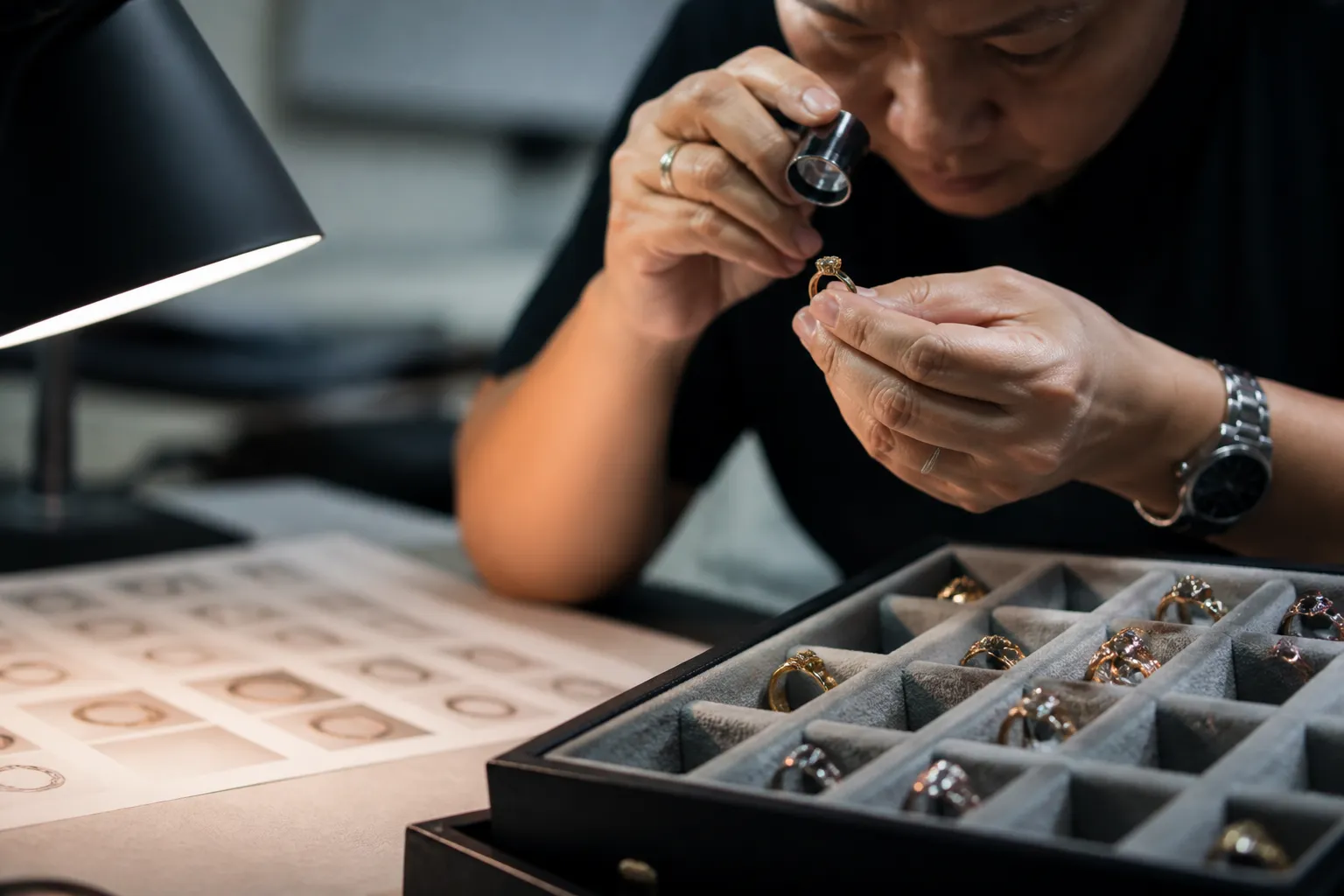
Suppliers worth working with run documented in-house QC before every shipment — checking plating uniformity, stone security, clasp function, and dimensional tolerance against spec. Ask for a sample QC report or defect rate data from a recent production run. Third-party inspection via SGS, Bureau Veritas, or Intertek is the gold standard for high-volume orders.
6. Trade Terms, Payment, and Logistics
EXW (Ex Works) and FOB (Free on Board) are the two most common terms for factory-direct sourcing from China. EXW puts freight responsibility on you from the factory gate; FOB transfers risk at the port of export. Know which you're agreeing to before you calculate landed cost.
Payment terms shape your cash flow risk. Acceptable methods from verified B2B suppliers include T/T bank transfer, L/C for large orders, PayPal for samples, and newer cross-border platforms like Xtransfer. Wire-only suppliers who won't accept L/C or verified platforms for large orders are a risk signal. Get landed cost estimates — inclusive of freight, duties, and insurance — not just factory-gate pricing.
7. Customization Scope and OEM Capability
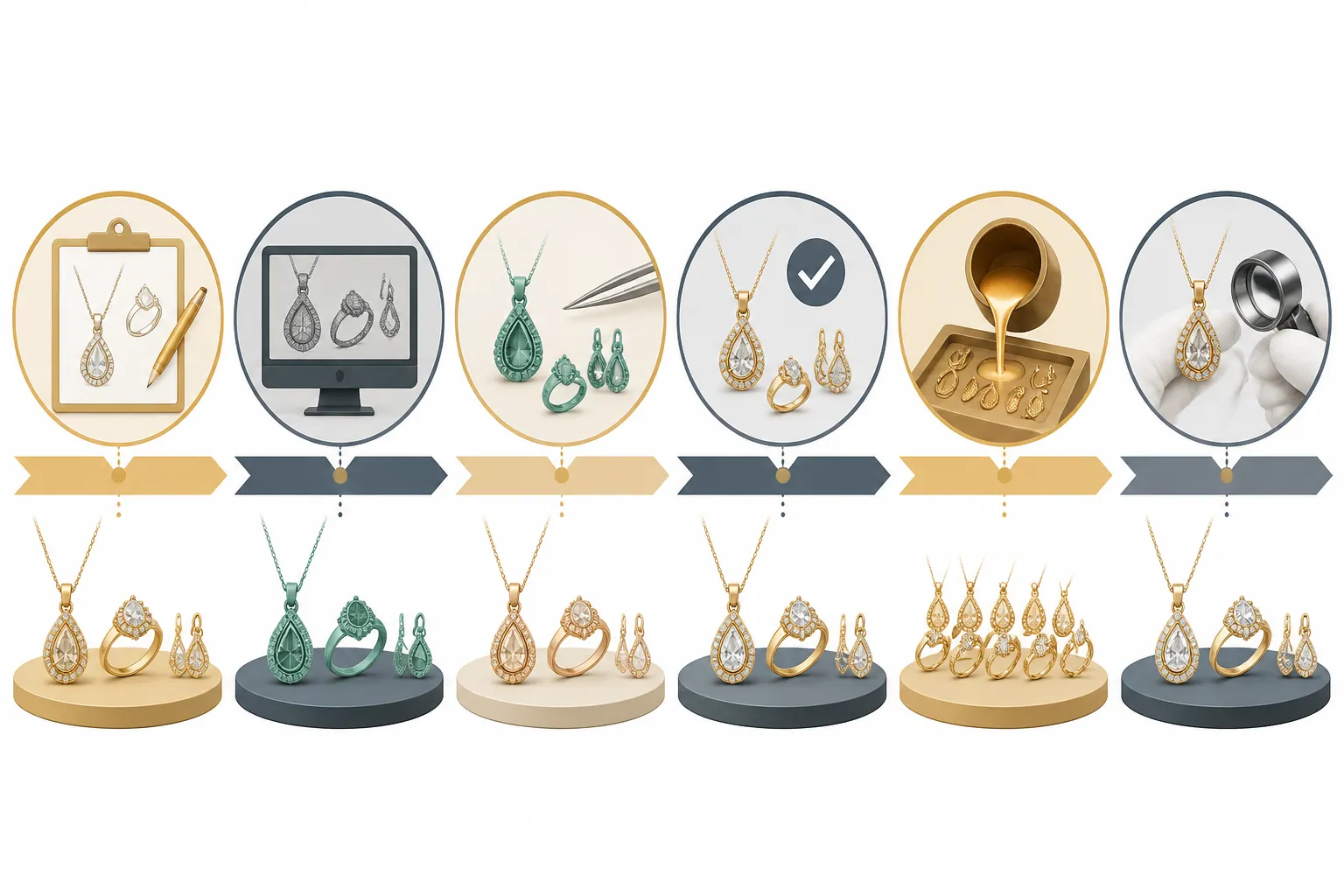
Not all "custom jewelry" suppliers offer the same depth of customization. The spectrum runs from selecting styles from an existing catalog → modifying a stock design (stone swap, finish change) → full OEM production from your technical drawing. Know where your project sits before approaching suppliers.
For OEM, confirm what the supplier needs to start: CAD files, physical reference samples, or a sketch plus spec sheet. Ask how many revision rounds are included before bulk production sign-off, and who owns the tooling after the run. For reference points on how OEM sourcing compares across supplier types, this breakdown of custom jewelry sources is worth reviewing before you shortlist.
8. Communication and Multilingual Support
For cross-border procurement, communication quality is an operational variable, not a soft factor. Miscommunication on stone color, plating finish, or clasp type costs you a production run. Suppliers with native-language support in your market language reduce that risk in a way that translated emails cannot.
STRAND operates with multilingual sales teams across English, French, Arabic, Spanish, German, and Russian — a practical advantage for procurement teams in the US, EU, UK, and MENA markets where buyer and supplier regularly work across a language gap.
Budget Tiers
This table reflects realistic ranges for custom and personalized jewelry across buyer types. For OEM production pricing, always request a formal quote — unit costs vary by complexity, material, and volume.
| Tier | Unit Price Range | What You Get |
|---|---|---|
| Entry | $10–$50 | Stock catalog styles, basic personalization (engraving, birthstone swap), gold-plated or rhodium-plated copper base, fashion-grade stones, MOQ typically 12+ per style |
| Mid-Market | $50–$200 | Semi-custom OEM, multiple finish options, natural semi-precious stones (garnet, turquoise, amethyst), tighter QC tolerances, branded packaging options |
| Premium | $200–$500 | Full OEM from your design, 925 sterling or gold-filled base, higher-grade stones including diamond simulants or lab-grown, structured sample approval process, third-party inspection available |
| Luxury / Fine | $500+ | Solid gold or platinum, certified natural gemstones (peridot, diamond), hallmarking, full compliance documentation, fully bespoke production |
For retail benchmarking context: Jewlr's personalized jewelry range shows consumer price points for personalized pieces — with popular styles like name necklaces and gemstone rings in the $84–$189 range at time of publication — useful as a DTC margin reference when setting your cost targets.
Red Flags to Avoid
- No written MOQ or pricing available. Any supplier who won't quote specifics in writing before you transfer funds is a risk signal. Legitimate operations share MOQs on request.
- Vague plating specs. "High-quality gold plating" without micron thickness is not a specification. Push for numbers.
- No sample process. A supplier who discourages sampling to speed you toward bulk is protecting their margin at your expense. Skipping samples is how buyers get stuck with defective production runs.
- Wire-only payment for large orders. Reputable cross-border suppliers accept T/T alongside L/C or verified platforms for high-value transactions. Wire-only for five- or six-figure purchases leaves you with no recourse.
- Inconsistent material descriptions. If the same SKU is described as "amethyst" in one message and "purple crystal" in another, that's a sourcing transparency issue — and a compliance risk in markets with material disclosure requirements.
- No in-house QC documentation. "We check everything" is not a process. Ask for a sample inspection checklist or defect rate from a recent production run.
- Supplier can't confirm the production location. Undisclosed subcontracting to unlisted workshops means your audit is meaningless. Know exactly where your product is made.
Buying Process Checklist
- Define your requirements. Confirm product type (earrings, necklace sets, bracelets), target finish, stone preferences, quantity per SKU, target unit cost, and any certifications your market requires (REACH for EU, CPSC/Prop 65 for the US).
- Shortlist 3–5 suppliers. Use verified sourcing directories, trade show contacts, or established platforms. Confirm production capability — not just catalog depth.
- Send a standardized RFQ. Cover: style reference, quantity, finish, stone spec, packaging requirement, and delivery destination. Compare landed cost, not factory-gate price alone.
- Order samples for every style you plan to produce in bulk. Evaluate plating quality, stone security, weight, dimensions, and packaging. Confirm how many revision rounds are included before production sign-off.
- Run a pilot bulk order with a new supplier before committing full volume — even if the quantity is higher than ideal. Validate production consistency first.
- Check references from buyers in your market or product category. A supplier with a track record shipping to EU buyers has proven compliance experience that a domestically-focused operation may not.
- Negotiate contract terms. Confirm payment schedule, inspection rights, defect tolerance and remedy, delivery timelines, and IP ownership for any OEM tooling.
- Confirm QC before production starts — whether in-house, supplier-run, or third-party. Never discuss inspection after goods are already packed for shipment.
Questions to Ask Vendors
- What is your MOQ per style, and does it differ between stock catalog designs and full custom OEM production?
- What base metals do you work with, and what plating thickness (in microns) do you apply for gold-plated and rhodium-plated finishes?
- Can you produce in 925 sterling silver or gold-filled, and what's the price differential versus a copper base?
- For natural semi-precious stones — amethyst, garnet, peridot, turquoise — how do you ensure color consistency across production batches?
- What is your sample lead time, and how many revision rounds are included before bulk production begins?
- What is your bulk production lead time for an order of [your target quantity]?
- What does your in-house QC process cover, and can you share a sample inspection report or defect rate from a recent order?
- What trade terms do you offer (EXW or FOB), and what shipping options are available to [your destination market]?
- What payment methods do you accept for samples and for bulk orders?
- Have you shipped to buyers in [your market — US, EU, UK, MENA]? Can you provide references?
- For OEM: what file format do you need (CAD, sketch + spec sheet, physical reference piece), and who owns the tooling after production?
- Can you provide compliance documentation for my target market — REACH for EU, CPSC/Prop 65 for the US?
Recommended Next Steps
The most common failure mode in custom jewelry procurement is moving to bulk before validating the supplier, the sample, and the terms in writing. The checklist above exists to prevent that — run it in sequence, don't compress it.
If you're sourcing drop earrings, necklace sets, or crystal and rhinestone-style fashion jewelry for a US, EU, UK, or MENA market, STRAND operates as a Hangzhou-based B2B supplier with a 114-style stock catalog, MOQ from 12 pieces per style on most designs, full OEM capability in gold-plated and rhodium-plated copper, and multilingual sales support across six languages.
The next step is a conversation, not a commitment. Request a quote or get current MOQ and pricing at strandjewelry.com — bring your style references, target quantity, and destination market, and get specifics back from a sales team that works in your language.