
Custom Jewelry vs. Alternatives: The B2B Buyer’s Guide
Custom Jewelry vs. Alternatives: The B2B Buyer’s Guide
Custom jewelry sourced through cross-border OEM manufacturers delivers the lowest per-unit cost and highest design control for DTC brands, importers, and retail buyers ordering in volume. Alternatives—ranging from domestic bench jewelers to established wholesale distributors—offer faster turnaround on single pieces or branded inventory but carry significantly higher price points and limited scalability. If your procurement strategy requires low-piece minimums across multiple styles with international shipping terms, custom jewelry is the direct path; if you need a single bespoke engagement ring built around a customer's own diamond by tomorrow, a local jeweler is the practical choice.
TL;DR / Quick Verdict
Buyers, importers, and DTC store owners scaling a fashion jewelry line should choose custom jewelry via an overseas OEM supplier when they need low MOQs, specific plating finishes, and cross-border trade terms. Choose alternatives—such as domestic retail jewelers or large-scale brand wholesalers—when fulfilling one-off bespoke requests for walk-in customers or when you require immediate, localized stock without managing international logistics.
At-a-Glance Comparison Table
| Dimension | Custom Jewelry (OEM) | Alternatives (Domestic Jewelers / Wholesale Brands) |
|---|---|---|
| Pricing Model | Factory-direct EXW or FOB pricing | Retail markup or fixed wholesale tiers |
| Minimum Order Quantity | Low piece counts per style on most designs; select styles available from 1 pc | 1 piece (bespoke) or high case-pack minimums (wholesale) |
| Core Materials | Gold-plated/rhodium-plated copper, glass beads, natural stone, faux pearls, 925-style silver finishes | Fine metals (gold, tungsten, cobalt), genuine gemstones, diamonds |
| Lead Time | Production + transit time (air, sea, or express shipping) | Immediate (in-stock) or weeks/months for local bench work |
| Trade & Payment Terms | T/T bank transfer, Western Union, PayPal, L/C | Credit card, financing, local invoice |
| Support & Language | Multilingual sales teams | Local language only |
| Quality Assurance | In-house QC inspection before every shipment | Visual inspection at point of sale or local appraisal |
| Target Buyer | DTC brands, importers, multi-region retail chains | Individual consumers, small local boutiques |
Custom Jewelry Overview
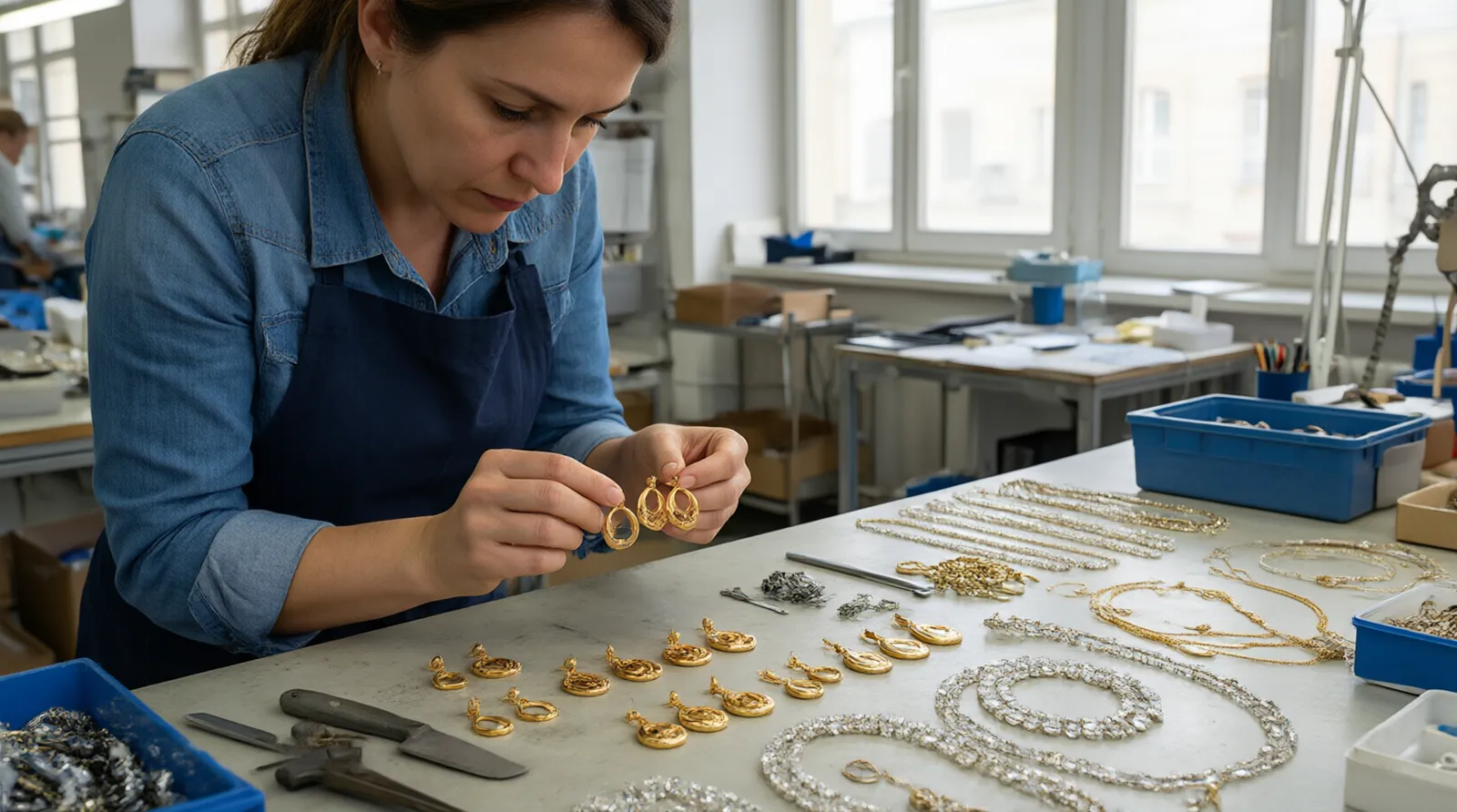
Custom jewelry in a B2B context refers to fashion and semi-fine pieces manufactured to a buyer’s specifications—or selected from a supplier’s proprietary catalog and branded for resale—via overseas workshops. This model is built for importers, DTC store owners, and multilingual procurement teams operating across the US, EU, UK, and MENA regions who source chains, earrings, and matching sets directly from China. For a deeper look at how these channels compare operationally, see our B2B sourcing comparison guide.
Overseas OEM suppliers link vetted Chinese workshops directly to these overseas buyers. The standout strength here is the balance between customization and accessible volume thresholds. Rather than requiring thousands of units to trigger a production run, these manufacturers maintain extensive stock catalogs featuring vintage, gradient crystal, two-tone glass bead, and rhinestone designs. Buyers can execute custom OEM orders using materials like gold-plated and rhodium-plated copper, glass beads, natural stone, and faux pearls. Because the supply chain bypasses regional middlemen, buyers gain access to manufacturing-level pricing while retaining control over design specifics, from stud earring dimensions to necklace clasp types.
For procurement teams evaluating this route, the primary criteria revolve around verifying supplier reliability, understanding exact lead times for sampling versus bulk production, and confirming compliance certifications for target markets (e.g., REACH in the EU). Requesting current terms directly from the manufacturer remains the standard protocol to lock in these variables.
Alternatives Overview
Alternatives to cross-border custom jewelry encompass domestic bench jewelers, regional chain stores (like Jared or Kendra Scott locations), luxury fine jewelry houses, and local wholesale distributors. These channels are built primarily for individual consumers seeking bespoke fine jewelry, or for small brick-and-mortar stores needing immediate, localized inventory without navigating customs.
Take a domestic operation like Bulow Jewelers, located at the 16th St. Mall in downtown Denver, CO. They offer highly personalized services, allowing customers to build custom engagement rings by selecting the color, clarity, cut, carat weight, and cost, and can even craft custom rings using a customer's own diamonds (Source). Their capabilities extend to custom wedding bands made from metals including gold, tungsten, and cobalt, alongside custom engraving on rings, earrings, necklaces, bracelets, and watches (Source).
The strength of these alternatives lies in tactile, face-to-face service and immediate fulfillment for fine jewelry. However, for a B2B buyer trying to stock a DTC storefront with 50 variations of amethyst or peridot drop earrings, relying on domestic bespoke jewelers or buying pre-priced wholesale from major brands introduces margin-crushing costs and zero flexibility in material engineering.
Feature-by-Feature Breakdown
Pricing and Trade Terms
Custom jewelry suppliers operate on international trade terms, typically offering EXW (Ex Works) or FOB (Free on Board) pricing. This shifts the logistics control—and cost optimization—to the buyer, who then selects air, sea, or express shipping based on urgency and budget. Payment infrastructure is built for cross-border commerce, accommodating T/T bank transfers, Western Union, PayPal, and L/C (Letters of Credit).
Alternatives function on localized retail or standard wholesale pricing. A domestic jeweler charges for labor, overhead, and fine materials on a per-piece basis. While a retailer like Bulow Jewelers provides transparent local purchasing (reachable at their physical address at 910 16th Street, Suite 1223, Denver, Colorado 80202, or via phone at (303) 872-2500), this model does not scale economically for a buyer attempting to import hundreds of fashion jewelry SKUs for online resale (Source).
Product Range and Material Flexibility
OEM custom jewelry focuses heavily on fashion and semi-fine categories. Production centers on drop earrings, stud earrings, and necklace + earring sets. Material flexibility is high within this scope: buyers can specify gold-plated or rhodium-plated copper bases, integrate glass beads, natural stones, faux pearls, or request 925-style silver finishes. Styles span vintage aesthetics, gradient crystals, two-tone glass beads, and rhinestone arrangements.
Alternatives dominate the fine jewelry space. Domestic jewelers and luxury stores focus on precious metals and genuine stones—diamond, turquoise, garnet, and solid gold or platinum. If a DTC brand wants to sell affordable, trend-driven fashion jewelry, sourcing solid amethyst or peridot from a local fine jeweler will price them out of their target market. Conversely, if a consumer needs a certified diamond solitaire, an OEM fashion jewelry workshop is the wrong venue.
Minimum Order Quantities (MOQ)
MOQ dictates cash flow for importers and store owners. Custom jewelry via overseas OEM suppliers offers defined thresholds: low piece counts per style on most stock designs, with select styles available from just 1 pc. Catalog sizes and exact MOQ availability fluctuate over time, so buyers should confirm current inventory levels directly with the supplier. This structure allows a buyer to test multiple earring designs without committing to massive warehouse space.
Alternatives vary wildly. Bespoke domestic jewelers have an MOQ of one, but at a premium unit cost. Large-scale wholesale distributors or brand programs (like those supplying traditional retail stores) often mandate high case-pack minimums, forcing buyers into deep inventory commitments on fewer styles. For a comprehensive look at how different suppliers stack up on these thresholds, review our breakdown of 6 Custom Jewelry Sources Ranked: OEM Suppliers & Retail Benchmarks for 2026.
Quality Assurance and Compliance
Cross-border custom jewelry relies on structured, pre-shipment protocols. Reputable OEM suppliers conduct in-house QC inspections before every shipment leaves the facility. For buyers importing into the EU or US, requesting documentation regarding nickel-free testing, lead compliance, and material safety data sheets during the inquiry phase is standard practice to ensure goods clear customs without delay.
Alternatives handle quality through local appraisals, gemological certificates (e.g., GIA for diamonds), and in-store visual inspections. While highly reliable for fine jewelry, this decentralized approach doesn't translate to batch-testing 5,000 pairs of rhinestone stud earrings efficiently.
Support and Communication
Procurement teams spanning multiple regions require vendors who speak their language—literally. Many overseas OEM suppliers provide multilingual sales support to eliminate translation friction for buyers in the MENA region or Europe coordinating with Chinese workshops. Understanding how these B2B sourcing channels differ in communication infrastructure is critical for avoiding costly delays.
Domestic alternatives provide localized support. You can walk into a store, sit across a desk, and discuss a custom piece. This is ideal for consumer-facing bespoke work but lacks the infrastructure to manage complex, multi-time-zone B2B supply chains.
Scalability and Lead Times
Scalability favors custom jewelry. Once a mold or design file is approved, an OEM workshop can replicate it across thousands of units. The trade-off is lead time; buyers must account for sampling, production, and transit (air, sea, or express). Planning cycles are longer, but unit economics improve drastically at scale.
Alternatives offer speed for single units. If a customer needs a custom engraved bracelet for a weekend event, a local bench jeweler can often accommodate it. But scaling that same order to 500 units for a national retail rollout would overwhelm a local shop's capacity and timeline. To understand how buyers balance these timelines, see our guide on Custom Jewelry: 6 Sources Buyers & DTC Brands Need in 2026.
Pros and Cons
Custom Jewelry (OEM)
Pros:
- Highly favorable unit economics for volume buyers and DTC brands.
- Low entry barriers with modest MOQs on the majority of catalog styles.
- Complete material control (plating types, base metals, stone alternatives).
- Multilingual support streamlines cross-border communication.
- Flexible international payment methods (T/T, L/C, etc.).
- Standardized pre-shipment QC inspections.
Cons:
- Requires planning for production and international transit lead times.
- Buyers must manage import logistics, customs clearance, and duties.
- Not suitable for one-off fine jewelry pieces (e.g., high-carat diamond rings).
- Physical inspection of goods prior to purchase requires sample ordering.
Alternatives (Domestic Jewelers / Wholesale Brands)
Pros:
- Immediate access to inventory or rapid turnaround for single bespoke items.
- Face-to-face consultation and tactile evaluation of materials.
- Specialized expertise in fine jewelry, precious metals, and certified gemstones.
- No international shipping, customs, or freight forwarding required.
- Easy returns or adjustments handled locally.
Cons:
- Prohibitive per-unit costs for scaling a fashion jewelry business.
- Limited ability to customize base materials or mass-produce trend-driven designs.
- Lack of infrastructure to support multilingual, cross-border B2B procurement.
- High wholesale minimums if buying pre-made branded inventory.
When to Choose Custom Jewelry
Choose custom jewelry through an overseas OEM partner if you are a DTC store owner launching a new seasonal collection of gradient crystal drop earrings and need to test market response without tying up capital in massive inventory. It is the correct path if you are an importer serving the MENA or EU markets requiring vendor communication in languages other than English, or if your business model depends on maintaining healthy margins on fashion jewelry made from gold-plated copper, glass beads, and faux pearls. Custom jewelry is also the operational standard when you need to dictate specific trade terms (FOB/EXW) and pay via L/C or T/T to align with your company's accounting practices.
When to Choose Alternatives
Choose alternatives if you are a consumer or a boutique jeweler tasked with creating a one-of-a-kind engagement ring utilizing a family heirloom diamond. Domestic jewelers—like those found searching Yelp for custom shops in Phoenix, New York, or Houston—are necessary when the project involves fine metals like tungsten or cobalt, requires precise finger-sizing on-site, or demands immediate completion. Alternatives are also appropriate if you are a small gift shop looking to buy five pre-packaged, branded necklaces off a shelf today without dealing with freight forwarders or customs declarations.
Final Verdict
The decision between custom jewelry and its alternatives is not about which is objectively better; it is about matching the procurement channel to your commercial intent. If your objective is to build, scale, or stock a fashion jewelry brand across international markets with controlled margins, cross-border custom jewelry via an OEM supplier is the only mathematically viable option. The low MOQs, diverse material engineering, and multilingual B2B infrastructure solve the exact problems importers and DTC owners face. If your objective is localized, fine-jewelry craftsmanship for individual end-consumers, domestic retail jewelers hold the advantage in speed and tactile service.
For buyers ready to evaluate production capabilities, request current lead times, or verify compliance documentation for your target market, initiate a direct inquiry. Contact us to request a quote, get current MOQ and pricing details, or arrange a sample order at https://strandjewelry.com.