
8 Best Alternatives to Custom Jewelry for Buyers & DTC Brands
8 Best Alternatives to Custom Jewelry for Buyers & DTC Brands
Buyers, importers, and DTC store owners actively shopping for alternatives to custom jewelry typically hit three walls: high minimum order quantities that tie up cash flow, long production lead times that delay seasonal launches, and retail platforms built for single consumers rather than B2B procurement. Replacing a traditional custom jewelry workflow means finding suppliers or platforms that balance design flexibility with commercial terms—like low MOQs, trade-friendly shipping (EXW/FOB), and multilingual support for cross-border teams.
Whether you are replacing an expensive domestic jeweler or pivoting away from rigid overseas factories, the market now offers distinct tiers of alternatives. These range from direct-to-manufacturer OEM partnerships in Hangzhou to large-scale personalization engines like Jewlr, which currently lists 637 personalized jewelry products across categories like birthstone rings, engravable necklaces, and bracelets. The right replacement depends entirely on whether you are buying one piece for a client or sourcing 500 units of gold-plated copper drop earrings for your own storefront.
Why Look for Alternatives to Custom Jewelry?
Traditional custom jewelry services often lock buyers into pricing structures designed for luxury bridal clients rather than commercial resale. If you run a DTC brand or manage procurement for a chain of stores, paying per-piece artisan rates destroys your margins. Many bespoke jewelers also require high upfront deposits and lack the infrastructure to handle recurring bulk orders, forcing you to restart negotiations every time you need to replenish best-selling styles like gradient crystal studs or two-tone glass bead necklaces.
Scale limitations present another major friction point. A local bench jeweler might craft a stunning amethyst or garnet pendant, but they cannot reliably produce 1,000 identical units within a four-week window. For importers in the US, EU, UK, and MENA regions, this lack of production capacity means missed retail seasons. Furthermore, communication barriers frequently stall projects; if your procurement team operates in French, Arabic, Spanish, German, or Russian, relying on a monolingual workshop leads to costly spec errors and delayed shipments.
Finally, platform lock-in restricts your supply chain agility. Retail-focused custom jewelers dictate their own return policies, shipping methods, and payment gateways. They rarely offer EXW or FOB trade terms, nor do they accommodate B2B payment methods like T/T bank transfers, L/C, or Xtransfer. Buyers looking to maintain control over their logistics and cash flow need alternatives that treat them as commercial partners, not just end consumers.
What to Look for in a Custom Jewelry Alternative
When evaluating replacements for your current custom jewelry supplier, measure each option against these specific procurement criteria:
- Minimum Order Quantity (MOQ): Can you test a style without committing to hundreds of units? Look for suppliers offering MOQs as low as 12 pcs/style on stock designs, or even 1 pc for select items.
- Material & Finish Flexibility: Does the alternative support your required base metals and plating? Verify availability of gold-plated and rhodium-plated copper, 925-style silver finishes, glass beads, natural stones, and faux pearls.
- Trade Terms & Logistics: Ensure the supplier supports EXW or FOB terms and can ship via air, sea, or express couriers to match your inventory timelines.
- Payment Infrastructure: Commercial buyers need options beyond credit cards. Confirm support for T/T bank transfer, Western Union, PayPal, L/C, and Xtransfer.
- Quality Assurance: Ask about in-house QC inspection protocols before shipment. You cannot afford to receive a container of defective turquoise or peridot settings.
- Multilingual Support: Cross-border teams require sales support in their native languages (EN, FR, AR, ES, DE, RU) to avoid miscommunications on CAD files or stone specifications.
- Catalog Depth: A strong alternative should offer a baseline catalog (e.g., 100+ styles) that you can sell immediately while waiting on bespoke OEM runs.
For a deeper breakdown of how to evaluate manufacturers against retail benchmarks, review our guide on Custom Jewelry: 6 Sources Buyers & DTC Brands Need in 2026.
Top Alternatives to Custom Jewelry
1. STRAND (Direct OEM & Stock Catalog Sourcing)
Best for: DTC store owners, importers, and multilingual procurement teams needing scalable fashion jewelry with low MOQs.
Pricing: B2B wholesale/OEM pricing (Request a Quote based on material and volume).
Key strengths vs custom jewelry:
- Operates out of Hangzhou, linking vetted Chinese workshops directly to overseas buyers, cutting out middleman markups.
- Offers a 114-style stock catalog where 109 styles carry an MOQ of just 12 pcs/style, with select styles available from 1 pc.
- Provides full custom OEM capabilities in gold-plated/rhodium-plated copper, 925-style silver finishes, natural stone, and faux pearls.
- Supports global procurement teams with multilingual sales staff fluent in EN, FR, AR, ES, DE, and RU.
Limitations / trade-offs:
- Focused on fashion and semi-fine jewelry; not the right fit if you are sourcing solid 18k gold or natural diamond fine jewelry.
- Requires B2B communication and setup (trade terms, wire transfers) rather than a simple "add to cart" retail checkout.
How it compares to custom jewelry: Traditional custom jewelry relies on a single artisan making one piece at a time. STRAND replaces this bottleneck by giving buyers access to factory-level production with boutique-level flexibility. Instead of paying retail premiums for a bespoke peridot necklace, you can commission an OEM run of vintage-style drop earrings or rhinestone sets tailored to your brand's exact specs, backed by in-house QC inspection before every shipment. Payment terms like T/T, Western Union, PayPal, L/C, and Xtransfer make it viable for serious commercial operations.
2. Jewlr (Personalized E-Commerce Platform)
Best for: Dropshippers or retailers who want to resell personalized pieces without holding physical inventory.
Pricing: Retail-tier pricing. Jewlr runs seasonal promotions and discounts on personalized items like name necklaces and gemstone rings, though final costs range widely based on materials selected.
Key strengths vs custom jewelry:
- Massive catalog depth, featuring 637 personalized jewelry products spanning rings, necklaces, bracelets, and earrings.
- Highly structured customization engine allowing end-users to select specific birthstones like amethyst, garnet, peridot, turquoise, and cubic zirconia.
- Consumer-friendly policies including a 99-day return window and a one-year warranty.
Limitations / trade-offs:
- Pricing is built for retail consumers, leaving very thin margins for B2B buyers trying to resell.
- No OEM manufacturing capabilities; you are limited to their existing templates and personalization fields.
How it compares to custom jewelry: Jewlr automates the personalization aspect of custom jewelry through software, whereas true custom jewelry involves manual design work. For a buyer wanting to offer customers engraved stacking hearts or initial tag necklaces with birthstones, Jewlr removes the need for a bench jeweler. However, if you are a DTC brand wanting to create a proprietary line of two-tone glass bead earrings, Jewlr cannot help you. It is a retail fulfillment tool, not a manufacturing partner.
3. GLDN (Handcrafted Personalized Brand)
Best for: Boutique retailers looking for a specific minimalist, hand-stamped aesthetic to complement their product mix.
Pricing: Mid-tier retail pricing for personalized everyday wear.
Key strengths vs custom jewelry:
- Strong brand identity focused on delicate, personalized pieces that appeal to modern DTC consumers.
- Handcrafted feel without the multi-month wait times associated with traditional bespoke jewelers.
- Curated collections make it easy for boutique owners to understand the visual merchandising angle.
Limitations / trade-offs:
- Limited to their specific design language; you cannot request heavy vintage styles or complex rhinestone arrangements.
- Strictly B2C focused, meaning no wholesale portals, EXW/FOB terms, or bulk OEM production.
How it compares to custom jewelry: GLDN occupies the space between mass-market mall jewelry and fully bespoke custom jewelry. While a traditional custom jeweler builds from scratch, GLDN offers a fixed menu of personalization (names, dates, initials) applied to pre-designed templates. For buyers who love the aesthetic but need commercial scale, GLDN falls short because they do not manufacture for third-party brands.
4. Made By Mary (Curated Layering & Personalization)
Best for: Fashion-forward boutiques targeting trend-conscious demographics looking for layered necklace and earring sets.
Pricing: Accessible luxury retail pricing.
Key strengths vs custom jewelry:
- Focuses heavily on styling and layering, offering pre-built sets that reduce decision fatigue for the end consumer.
- Incorporates personalized elements (initials, charms) into highly trendy silhouettes.
- Faster turnaround than traditional custom jewelry due to standardized base components.
Limitations / trade-offs:
- Like GLDN, it is a closed retail ecosystem. You cannot hire them to produce your own brand's designs.
- Material options are restricted to their standard offerings; no custom requests for specific natural stones or unique plating thicknesses.
How it compares to custom jewelry: Made By Mary solves the "design paralysis" problem inherent in custom jewelry. Instead of asking a client what they want from scratch, they provide curated frameworks. But for an importer or DTC owner, this model is a dead end. You cannot source their products at wholesale to build your own catalog. If you need that level of branded control, you must pivot to an OEM supplier like STRAND.
5. Jared (Retail Chain Personalization)
Best for: Consumers seeking the trust and physical footprint of established brick-and-mortar stores for milestone gifts.
Pricing: Premium retail, often aligned with traditional mall jeweler markups.
Key strengths vs custom jewelry:
- Extensive network of physical stores allows customers to see and touch metal samples and stone qualities in person.
- Backed by the corporate infrastructure of a major retailer, providing standardized warranties and financing options.
- Offers personalization on a wide variety of fine jewelry, including diamond-accented pieces.
Limitations / trade-offs:
- High overhead costs are baked into the pricing, making it unviable for commercial resale.
- Customization is limited to engraving or selecting from preset modular options, not true ground-up custom design.
How it compares to custom jewelry: Jared represents the corporatization of custom jewelry. Where an independent custom jeweler offers deep collaboration, stores like Jared offer streamlined, templated personalization at scale. For a B2B buyer, Jared is irrelevant as a sourcing partner. Their model is strictly consumer-facing, and attempting to buy personalized inventory here for resale will destroy your unit economics.
6. Kendra Scott (Fashion Jewelry & Color Bar)
Best for: Volume retail buyers and franchise operators looking for recognizable fashion jewelry with a personalization hook.
Pricing: Mid-range fashion jewelry pricing.
Key strengths vs custom jewelry:
- The "Color Bar" concept allows rapid customization using interchangeable stones and settings, mimicking custom jewelry at retail speed.
- Massive brand recognition in the US market drives immediate foot traffic and online conversions.
- Broad assortment covering everything from statement drop earrings to delicate stud earrings.
Limitations / trade-offs:
- Proprietary designs only; you cannot use their infrastructure to manufacture your own brand's IP.
- Geared toward North American retail; less optimized for cross-border EU, UK, or MENA importers compared to direct OEM sources.
How it compares to custom jewelry: Kendra Scott bridges the gap between off-the-shelf fashion jewelry and custom jewelry through modularity. Customers pick a setting and a stone (like turquoise or amethyst) and get a "custom" piece instantly. However, for a DTC store owner trying to launch their own brand, this is a competitor's product, not a sourcing solution. To replicate this speed-to-market with your own branding, you need an OEM manufacturer capable of producing diverse stock catalogs with rapid customization.
7. The Custom Jeweler (Independent Bench Service)
Best for: High-net-worth clients or specialized buyers needing one-off heirloom restorations or highly complex, unique commissions.
Pricing: High-end bespoke pricing based on labor hours and raw material costs.
Key strengths vs custom jewelry:
- True ground-up design capability, handling complex CAD work, wax carving, and stone setting that automated platforms cannot touch.
- Direct access to master jewelers who can work with high-value materials, including solid gold and diamond settings.
- Unmatched attention to detail for singular, highly emotional projects.
Limitations / trade-offs:
- Zero scalability; a single artisan or small bench cannot fulfill a 500-unit purchase order for a DTC brand.
- Lead times are measured in months, not days or weeks.
How it compares to custom jewelry: This is traditional custom jewelry in its purest form. While the quality is exceptional, it fails the commercial test for importers and store owners. If you need to stock a catalog of rhinestone and faux pearl necklace + earring sets for a seasonal launch, an independent bench jeweler is the wrong tool. You need factory-level output with artisan-level oversight—which is exactly why B2B buyers transition to dedicated OEM sourcing.
8. Local Wholesale Districts (e.g., LA Jewelry District, Hatton Garden)
Best for: Brick-and-mortar store owners who prefer inspecting physical inventory before purchasing and negotiating face-to-face.
Pricing: Wholesale tier, varying wildly by vendor and negotiation skills.
Key strengths vs custom jewelry:
- Immediate possession of goods; no waiting for international freight or customs clearance.
- Ability to physically inspect plating quality, clasp mechanisms, and stone settings before committing capital.
- Wide variety of vendors in one geographic location allows for rapid comparison shopping.
Limitations / trade-offs:
- Inventory is often generic and widely available to competitors in your same market.
- Lacks the structured OEM capabilities, multilingual support, and digital catalogs provided by modern cross-border manufacturers.
How it compares to custom jewelry: Wholesale districts offer a middle ground between retail custom jewelry and overseas manufacturing. You get better pricing than a bespoke jeweler, but you sacrifice the ability to truly customize designs for your brand. You are largely buying what already exists. For brands that want exclusive designs—like specific gradient crystal patterns or vintage-inspired drop earrings—direct OEM sourcing remains superior.
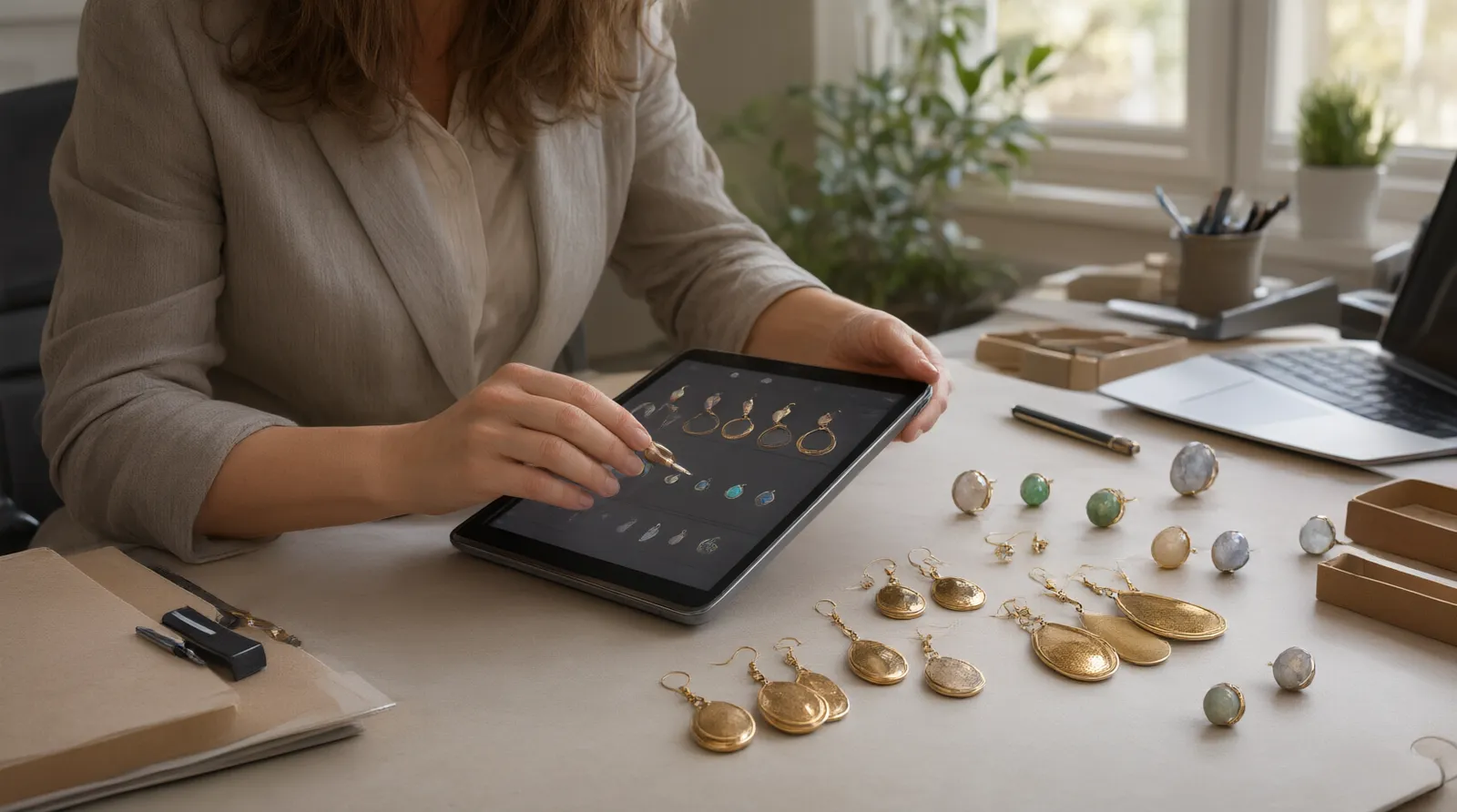
Side-by-Side Comparison Table
| Feature | Traditional Custom Jewelry | STRAND (OEM/Stock) | Jewlr | GLDN | Made By Mary | Jared | Kendra Scott | The Custom Jeweler | Local Wholesale Districts |
|---|---|---|---|---|---|---|---|---|---|
| Primary Audience | Individual Consumers | B2B Buyers, DTC, Importers | Consumers / Dropshippers | Boutique Retailers / Consumers | Fashion Boutiques / Consumers | Retail Consumers | Retail Consumers | Individual Consumers | Brick-and-Mortar Store Owners |
| MOQ | 1 piece | 12 pcs/style (109 of 114 styles); 1 pc select | 1 piece | 1 piece | 1 piece | 1 piece | 1 piece | 1 piece | Varies by vendor (often low bulk) |
| True OEM Capabilities | Yes (Manual) | Yes (Factory scaled) | No (Templates only) | No (Proprietary) | No (Proprietary) | No (Modular only) | No (Proprietary) | Yes (Manual) | Rarely (mostly stock resale) |
| Trade Terms (EXW/FOB) | Rarely | Yes | No | No | No | No | No | No | Varies (usually local pickup/delivery) |
| B2B Payment Methods | Credit Card / Cash | T/T, WU, PayPal, L/C, Xtransfer | Credit Card / BNPL | Credit Card | Credit Card | Credit Card / Financing | Credit Card | Credit Card / Wire | Cash / Wire / Check |
| Multilingual Support | Usually English only | EN, FR, AR, ES, DE, RU | English | English | English | English | English | English | Varies by vendor |
| Production Scale | Very Low | High | Medium | Low-Medium | Low-Medium | High (Retail) | High (Retail) | Very Low | Medium (Aggregated) |
Note: For a detailed ranking of how these models perform against each other commercially, read our analysis of 6 Custom Jewelry Sources Ranked: OEM Suppliers & Retail Benchmarks for 2026.
How to Pick the Right Alternative
Your choice depends entirely on your position in the supply chain and your immediate commercial goals. When evaluating custom jewelry alternatives, consider your operational constraints first.
If you are a DTC Store Owner or Importer: Stop looking at retail platforms like Jared, Kendra Scott, or GLDN. Their business models compete with yours. You need an alternative that functions as a backend manufacturing partner. Prioritize suppliers that offer EXW or FOB trade terms, accept T/T or L/C payments, and provide an existing catalog (like a 114-style lineup) that you can sell immediately while your custom OEM designs are in production. Verify that the supplier conducts in-house QC inspections before shipping so you aren't stuck with defective inventory overseas.
If you are managing a Multilingual Procurement Team: Communication delays kill margins. If your buyers operate in the MENA region, Europe, or Latin America, you need an alternative with native-level sales support. Sourcing from a factory that provides documentation and communication in Arabic, French, Spanish, German, or Russian prevents catastrophic errors in CAD approvals or stone selections (e.g., confusing peridot specifications with citrine).
If you are a Boutique Owner testing new styles: You need flexibility without massive capital risk. Look for alternatives offering low MOQs—specifically around 12 pieces per style. This allows you to test whether vintage styles, rhinestone drops, or two-tone glass bead sets resonate with your local market before committing to a 500-piece production run. Avoid traditional custom jewelers whose minimum project fees price out small-batch retail testing.
Conclusion
Replacing traditional custom jewelry isn't about finding a cheaper version of the same service; it is about aligning your sourcing model with your actual business mechanics. Retail platforms like Jewlr—with their 637 personalized jewelry products and 99-day returns—solve problems for individual gift shoppers. Brick-and-mortar chains solve problems for consumers who want to try things on in person. Neither solves the structural problems faced by commercial buyers trying to scale a brand across borders.
For importers, DTC founders, and procurement teams operating in the US, EU, UK, and MENA markets, the most viable alternative is direct OEM sourcing. You need a partner capable of delivering gold-plated and rhodium-plated copper, 925-style silver finishes, natural stones, and faux pearls at commercial volumes, backed by real trade terms and multilingual infrastructure.
Review your current catalog gaps and production bottlenecks today. If you need to source drop earrings, stud earrings, or necklace and earring sets with commercial-grade flexibility, visit STRAND to Request a Quote, Get MOQ & Pricing, or Request a Sample for your next collection.