
8 Best Alternatives to Custom Jewelry for DTC Brands in 2026
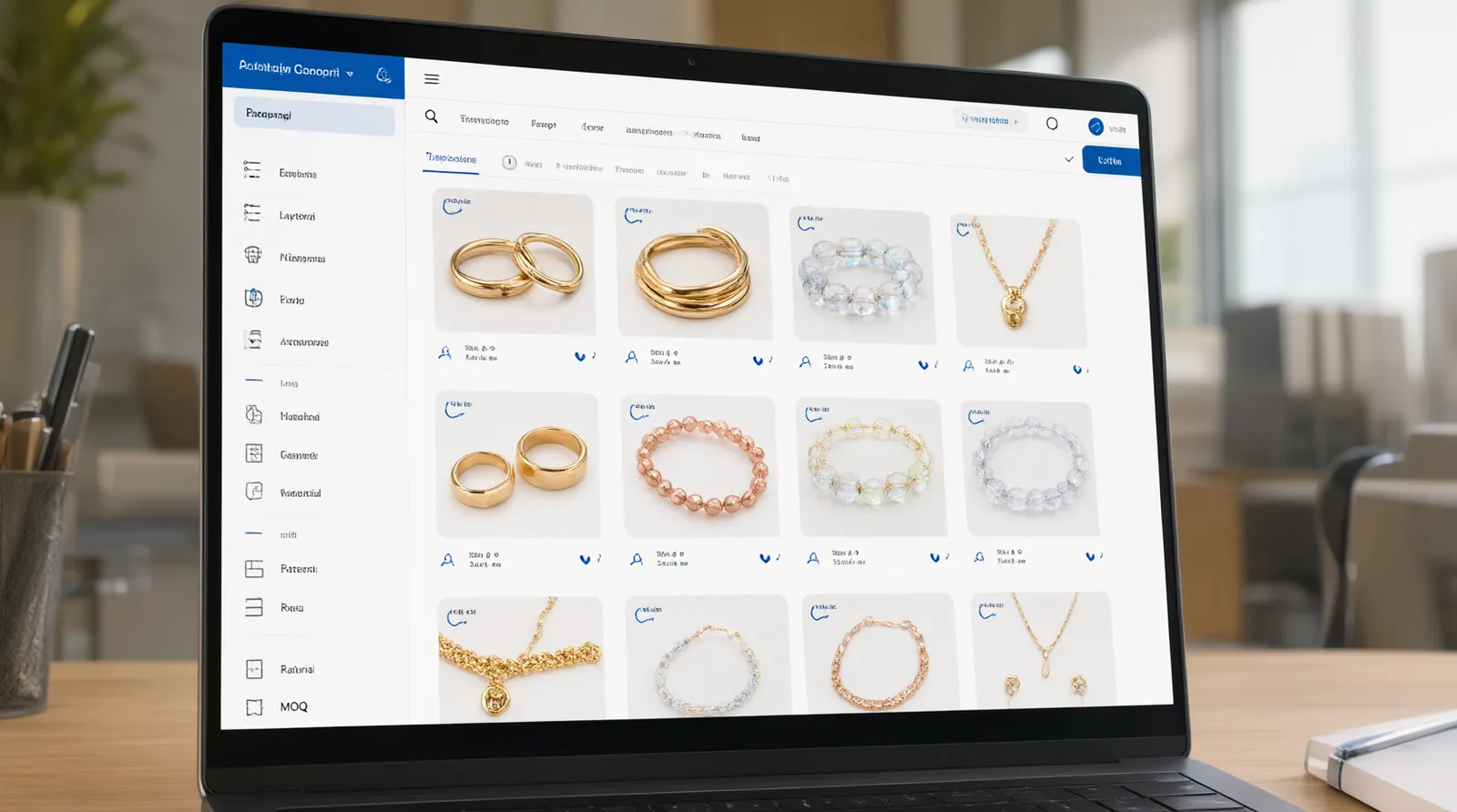
8 Best Alternatives to Custom Jewelry for DTC Brands in 2026
Buyers and DTC store owners actively shopping for replacements to traditional custom jewelry typically pivot toward direct-to-factory OEM programs, curated stock catalogs with low minimum order quantities (MOQs), or specialized wholesale platforms. The most common alternatives to custom jewelry solve three specific bottlenecks found in standard bespoke manufacturing: high per-unit costs at low volumes, unpredictable production timelines, and limited material flexibility across markets like the US, EU, UK, and MENA.
Why Look for Alternatives to Custom Jewelry?
Sourcing fully bespoke pieces often means committing to MOQs of 50 to 100 units per design before a factory will even open a mold. For independent DTC brands or regional importers testing new styles—like gradient crystal drop earrings or two-tone glass bead necklaces—tying up capital in unproven inventory is a massive risk. Many procurement teams find that traditional workshops demand large upfront deposits just to begin sampling, leaving buyers locked into designs that may not resonate with their local market.
Pricing opacity is another friction point. When you work through middlemen or domestic bench jewelers to create custom jewelry, the final unit cost frequently inflates by 40% to 60% compared to direct factory pricing. This margin compression makes it difficult to compete on retail price while maintaining a luxury aesthetic. Furthermore, communication delays caused by time zones and language barriers can stretch a four-week production cycle into eight weeks, causing missed seasonal launches.
Finally, there is the issue of scale limits and quality consistency. A workshop might produce a flawless sample of rhodium-plated copper studs, but struggle to replicate that finish uniformly across a 500-piece run. Buyers need sourcing models that offer either the flexibility of low-volume testing or the rigorous quality assurance required for larger commercial orders, without sacrificing design variety.
What to Look for in a Custom Jewelry Alternative
Before replacing your current supplier, evaluate potential alternatives against these procurement criteria:
- Minimum Order Quantity (MOQ): Can you test designs at 12 pcs/style or lower, rather than committing to 100+ units?
- Material & Finish Range: Does the supplier offer gold-plated copper, rhodium plating, 925-style silver finishes, natural stone, and faux pearls?
- Trade Terms & Logistics: Are EXW or FOB terms available, with clear options for air, sea, or express shipping?
- Payment Flexibility: Do they accept T/T bank transfer, Western Union, PayPal, L/C, or Xtransfer?
- Quality Assurance: Is there an in-house QC inspection protocol executed before every shipment leaves the factory?
- Multilingual Support: Can your procurement team communicate in EN, FR, AR, ES, DE, or RU without relying on third-party translators?
- Catalog Depth: Is there an existing library of proven sellers (e.g., vintage or rhinestone styles) you can draw from immediately?
Top Alternatives to Custom Jewelry
1. STRAND (Direct Factory OEM + Stock Catalog)
Best for: Cross-border fashion jewelry buyers, importers, and DTC store owners needing low-MOQ stock or tailored OEM manufacturing directly from vetted Chinese workshops.
Pricing: Factory-direct (EXW/FOB); request quote based on volume and materials.
Key strengths vs custom jewelry:
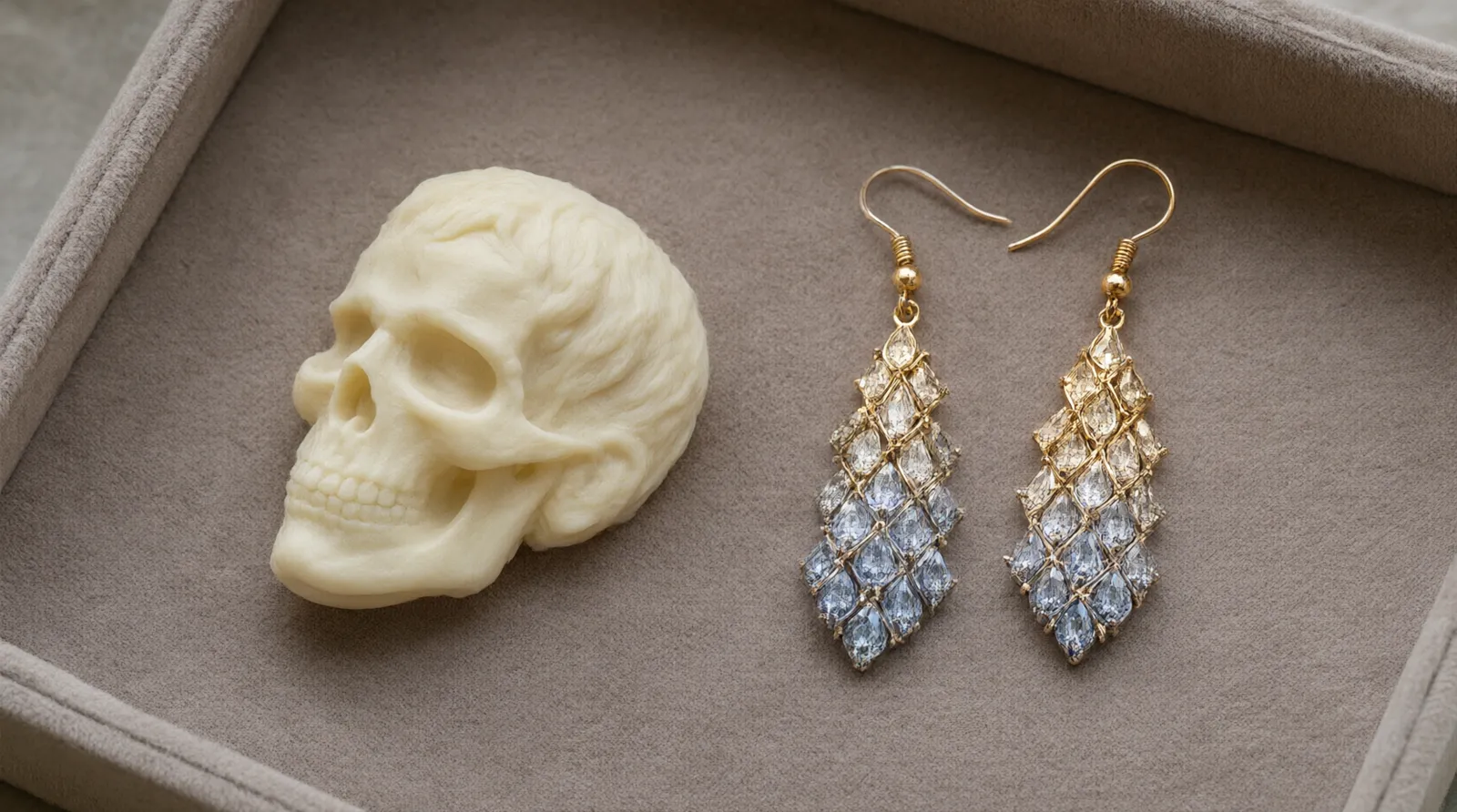
- Access to a 114-style stock catalog featuring drop earrings, stud earrings, and necklace + earring sets in vintage, gradient crystal, two-tone glass bead, and rhinestone styles.
- MOQ of 12 pcs/style on 109 of the 114 catalog designs, with select styles available from 1 pc, drastically lowering the barrier to entry compared to traditional bespoke runs.
- Multilingual sales support in English, French, Arabic, Spanish, German, and Russian, eliminating communication bottlenecks for global procurement teams.
- In-house QC inspection before every shipment ensures uniform plating (gold-plated/rhodium-plated copper, 925-style silver finishes) and stone setting (natural stone, faux pearls).
Limitations / trade-offs:
- As a Hangzhou-based brand linking directly to overseas buyers, shipping times depend heavily on whether you choose air, sea, or express freight.
- Focuses specifically on fashion and semi-fine jewelry; not the right fit if you are sourcing solid 24k gold investment pieces.
How it compares to custom jewelry: Traditional custom jewelry routes force buyers to pay premium tooling fees for small batches. STRAND bypasses this by offering an immediate catalog of proven designs at 12 pcs/style, while still providing full custom OEM capabilities for buyers who want to modify those base designs. If you are evaluating different sourcing tiers, our guide on Custom Jewelry: 6 Sources Buyers & DTC Brands Need in 2026 breaks down how direct-OEM models stack up against traditional brokers.
2. Gold Point NYC (Wholesale Vintage & Estate)
Best for: Brick-and-mortar stores and online resellers looking for one-of-a-kind vintage and estate pieces without waiting for production.
Pricing: Wholesale tier pricing; varies per unique item.
Key strengths vs custom jewelry:
- Immediate availability of finished goods, including pieces featuring amethyst, garnet, peridot, turquoise, and diamond accents.
- Zero production lead time; inventory is ready to ship upon purchase.
- Each piece carries inherent uniqueness, appealing to customers seeking a luxury feel without paying for modern bespoke manufacturing.
Limitations / trade-offs:
- Inventory is finite. You cannot reorder 50 identical vintage rings once they sell out.
- Limited ability to alter designs, metal types, or sizing prior to purchase.
How it compares to custom jewelry: When buyers seek custom jewelry for its exclusivity, vintage wholesale offers that same rarity without the 6-to-8 week wait time. However, you sacrifice control over the exact design specifications. You cannot request a specific gradient crystal layout; you buy what has already been crafted.
3. Local Bench Jewelers (Yelp-Sourced Artisans)
Best for: Independent retailers in cities like Phoenix, New York, or Houston needing hyper-local, face-to-face collaboration for small-batch repairs or highly personalized bespoke pieces.
Pricing: High hourly labor rates plus material costs; generally the most expensive per-unit option.
Key strengths vs custom jewelry:
- Direct, in-person oversight of the wax carving, casting, and setting process.
- Ability to iterate on a single prototype rapidly without international shipping delays.
- Ideal for servicing end-consumer bespoke requests (e.g., resetting a family diamond into a new mounting).
Limitations / trade-offs:
- Production capacity is severely limited; scaling a design to 100 units is often impossible for a single artisan.
- Labor costs make retail margins incredibly thin for DTC brands trying to compete online.
How it compares to custom jewelry: Searching "custom jewelry" on platforms like Yelp yields local artisans perfect for one-off consumer projects. But for B2B importers or DTC store owners, local bench jewelers lack the economies of scale. A local jeweler might charge $150 to cast and finish a single pair of brass earrings, whereas factory-direct OEM programs reduce that unit cost to a fraction of the price at 12+ piece volumes.
4. Kendra Scott (Retail Benchmark & Inspiration)
Best for: DTC brand owners studying successful color-bar retail models and trend forecasting for semi-fine fashion jewelry.
Pricing: Retail pricing ($50–$150+ per piece).
Key strengths vs custom jewelry:
- Proven track record of popularizing customizable color combinations (e.g., swapping stones in a signature silhouette).
- Demonstrates high consumer demand for personalized aesthetics without true bespoke manufacturing.
- Excellent benchmark for understanding how to market semi-fine materials to a broad audience.
Limitations / trade-offs:
- Not a B2B sourcing partner; you cannot wholesale their products for your own store.
- Designs are mass-produced under a proprietary model, limiting true customization.
How it compares to custom jewelry: Many DTC founders look at Kendra Scott's retail success and assume they need expensive custom jewelry tooling to replicate it. In reality, you can achieve a similar "personalized" effect by sourcing modular designs—like interchangeable glass bead drops—from OEM suppliers, allowing your customers to mix and match without you bearing the cost of bespoke manufacturing.
5. Jared / Signet Jewelers (Mass-Market Custom Programs)
Best for: Understanding the upper bounds of mass-market personalization and fine jewelry retail operations.
Pricing: Premium retail pricing targeting the fine jewelry consumer.
Key strengths vs custom jewelry:
- Established infrastructure for handling diamond and precious metal customization at scale across hundreds of stores.
- Strong brand trust with consumers looking for engagement or milestone pieces.
- Standardized design templates that streamline the customer ordering process.
Limitations / trade-offs:
- Strictly B2C; no wholesale or white-label options for independent importers.
- Design parameters are rigidly confined to their approved corporate catalogs.
How it compares to custom jewelry: Jared represents the corporate approach to custom jewelry—standardized, high-ticket, and entirely closed off to independent B2B buyers. If you are an importer trying to build a brand that competes in the accessible luxury space, replicating their model requires sourcing from agile OEM manufacturers who allow you to dictate the designs, rather than buying off a corporate shelf.
6. Alibaba / Global B2B Marketplaces
Best for: Price-sensitive buyers willing to vet dozens of factories independently to find the lowest possible unit cost.
Pricing: Varies wildly; often advertised at rock-bottom rates that exclude tooling, shipping, and QC fees.
Key strengths vs custom jewelry:
- Massive directory of thousands of manufacturers capable of producing almost any material combination.
- Trade Assurance programs offer basic financial protection for cross-border transactions.
- Easy to send out mass RFQs (Requests for Quotation) to multiple vendors simultaneously.
Limitations / trade-offs:
- Quality inconsistency is rampant; samples rarely match bulk production without strict oversight.
- Communication barriers and hidden fees (mold charges, plating surcharges) inflate the final landed cost.
- No centralized in-house QC; the buyer assumes all risk for defective shipments.
How it compares to custom jewelry: While marketplaces provide access to custom jewelry manufacturers, the burden of vetting falls entirely on the buyer. Unlike dedicated cross-border brands that link vetted workshops directly to overseas buyers and handle QC internally, marketplace sourcing requires hiring third-party inspectors and managing fragmented logistics.
7. Faire / Wholesale Marketplaces
Best for: Boutique owners looking to buy finished, branded fashion jewelry from other indie designers at wholesale rates.
Pricing: Wholesale (typically 50% of MSRP), often with net-60 payment terms.
Key strengths vs custom jewelry:
- Curated, aesthetically cohesive brands ready for immediate retail sale.
- Low opening order requirements and favorable return policies for first-time buyers.
- No product development or manufacturing management required.
Limitations / trade-offs:
- You are selling someone else's brand identity, making it hard to build your own DTC moat.
- No ability to customize materials, plating, or packaging with your own branding.
How it compares to custom jewelry: Buying wholesale on Faire is the opposite of commissioning custom jewelry. It trades creative control and brand ownership for convenience. If your goal is to build a distinct label with proprietary designs—like specific rhodium-plated copper silhouettes—you must move away from wholesale aggregators and toward OEM manufacturing.
8. Private Label Catalog Programs (White-Label)
Best for: Importers who want to apply their own branding to pre-manufactured, unbranded stock jewelry.
Pricing: Tiered based on volume; generally higher than raw OEM but lower than bespoke.
Key strengths vs custom jewelry:
- Faster time-to-market than ground-up custom jewelry design.
- Proven silhouettes that have already been tested in the market.
- Allows for custom packaging and branding tags without altering the core product.
Limitations / trade-offs:
- Competitors may be buying the exact same base designs from the same catalog.
- Limited ability to change structural elements (e.g., swapping a faux pearl for a natural stone in a fixed setting).
How it compares to custom jewelry: Private label sits between off-the-shelf retail and full custom jewelry. It solves the speed problem but introduces a differentiation problem. To truly stand out, buyers often start with a private label catalog and use an OEM partner to tweak specific elements—like changing a standard gold plate to a two-tone gradient finish. For a deeper breakdown of how these tiers rank against each other, review our analysis of 6 Custom Jewelry Sources Ranked: OEM Suppliers & Retail Benchmarks for 2026.
Side-by-Side Comparison Table
| Feature | Traditional Custom Jewelry | STRAND (OEM + Stock) | Gold Point NYC (Vintage) | Local Bench Jewelers | Alibaba Marketplaces | Faire (Wholesale) |
|---|---|---|---|---|---|---|
| Primary Model | Bespoke Manufacturing | Direct Factory OEM + 114-Style Catalog | Wholesale Vintage/Estate | Artisan Craftsmanship | B2B Directory Aggregator | Branded Wholesale |
| Typical MOQ | 50–100+ pcs/style | 12 pcs/style (109/114 styles); select from 1 pc | 1 pc (unique items) | 1 pc | Varies (often 50+) | Varies by brand |
| Lead Time | 6–10 weeks | Stock: Days; OEM: Weeks | Immediate | 2–6 weeks | 4–8 weeks | Immediate |
| Material Control | High | High (Copper, 925-style, glass, stone) | None (pre-made) | Very High | Variable | None (pre-made) |
| In-House QC | Varies by jeweler | Yes, before every shipment | Condition graded | Artisan self-checked | Buyer's responsibility | Brand dependent |
| Multilingual Support | Usually local only | EN, FR, AR, ES, DE, RU | English | English | Platform translation | English |
| Trade Terms | Retail/Deposit | EXW, FOB | Wholesale Net | Retail/Deposit | Varies | Net-60 available |
How to Pick the Right Alternative
Your ideal alternative depends entirely on your position in the supply chain and your immediate business constraints. Finding the right custom jewelry alternative for buyers means aligning your sourcing model with your actual operational needs rather than defaulting to legacy methods.
If you are a DTC Store Owner testing a new collection: Avoid traditional custom jewelry with its heavy upfront tooling costs. Instead, utilize a stock catalog program with a 12-piece MOQ. This allows you to list vintage, rhinestone, or natural stone styles on your site, validate consumer demand, and only commit to larger OEM production runs once a specific silhouette proves profitable.
If you are a Regional Importer (US, EU, UK, MENA): Your primary bottleneck is likely logistics and communication. Prioritize suppliers offering EXW or FOB terms with established air, sea, and express shipping routes. Multilingual support is non-negotiable here; a procurement team operating in Arabic or French needs a sales counterpart who speaks the language natively to prevent costly specification errors regarding plating thickness or stone grading.
If you are a Brick-and-Mortar Boutique Owner: If your customers demand one-of-a-kind stories, vintage wholesale alternatives provide instant inventory with built-in history. However, if you want to build a proprietary brand that customers can only get from your store, you must transition toward OEM manufacturing where you control the design IP.
If you are scaling past 500 units per style: Local bench jewelers and handmade marketplaces will break under the pressure. You require a factory-direct partner with documented in-house QC inspection protocols. At this volume, a 5% defect rate ruins margins; pre-shipment inspections are mandatory.
Conclusion
Replacing traditional custom jewelry sourcing isn't about abandoning personalization; it is about finding a manufacturing model that aligns with your actual order volume, budget, and timeline. For buyers and DTC brands tired of inflated MOQs, opaque pricing, and communication delays, direct-to-factory OEM programs paired with flexible stock catalogs offer the most viable path forward. They deliver the material variety—from gold-plated copper to faux pearls—with the commercial terms required to protect your margins.
Review your current inventory turnover and identify which designs are stagnating due to high minimum commitments. Once you know your target volume, reach out to a manufacturer that supports your scale. Request a sample, verify the QC process, and confirm trade terms before locking in your next seasonal buy. To explore a 114-style catalog with 12-piece MOQs, multilingual procurement support, and direct OEM capabilities, Request a Quote and Get MOQ & Pricing from STRAND.