
Stainless Rings Buyer's Guide: How to Source SKUs That Actually Sell
Stainless Rings Buyer's Guide: How to Source SKUs That Actually Sell
A stainless ring is a finger ring crafted from stainless steel alloy — typically 316L or 304 grade — prized for its corrosion resistance, hypoallergenic surface, and structural durability that outlasts most base metals. For jewelry buyers sourcing at scale, it represents one of the most reliable SKUs in any catalog: low return rates, broad market appeal, and a price-to-perceived-value ratio that protects margins.
This guide covers everything procurement teams, DTC store owners, and importers need to evaluate before placing an order: material grades, design considerations, quality benchmarks, lead times, and the questions worth asking any supplier before committing to a run.
What Exactly Is a Stainless Ring?
A stainless ring is not just "a ring that doesn't rust." The term describes a specific category of jewelry constructed from steel alloyed with chromium (minimum 10.5% by mass), which forms a passive oxide layer on the surface that resists staining, tarnish, and corrosion. That self-healing layer is what makes it a practical choice for daily-wear jewelry.
The two grades most relevant to jewelry are:
- 316L (Marine Grade): Contains molybdenum, which significantly boosts resistance to chloride corrosion. This is the standard in quality jewelry manufacturing. The "L" denotes low carbon content, which improves weld integrity and reduces risk of intergranular corrosion.
- 304 Grade: More common in entry-level and fashion jewelry. Adequate for most dry-wear contexts but slightly more vulnerable to salt and sweat over extended periods.
For buyers targeting consumers who wear jewelry daily — including markets where rings are worn continuously rather than removed — 316L is the specification worth insisting on.
Why Stainless Rings Have Become a Core Catalog Item
The appeal isn't accidental. Retailers who carry stainless rings consistently report lower return and complaint rates compared to brass or zinc alloy alternatives, for reasons that are straightforward once you understand the material.
Durability under real-world conditions. A 316L stainless ring maintains its finish through handwashing, exercise, and humid climates. For buyers selling into markets where jewelry is worn throughout the day — including MENA regions where summers are extreme and rings are often culturally significant — this matters enormously. A ring that tarnishes after six weeks generates returns and erodes brand trust.
Hypoallergenic profile. Stainless steel is nickel-safe in the 316L alloy configuration at quantities well within the EU's REACH regulation thresholds. Consumers with sensitive skin who have given up on brass or copper-core jewelry often find stainless the first metal that works for them. This is a genuine selling point, not marketing copy.
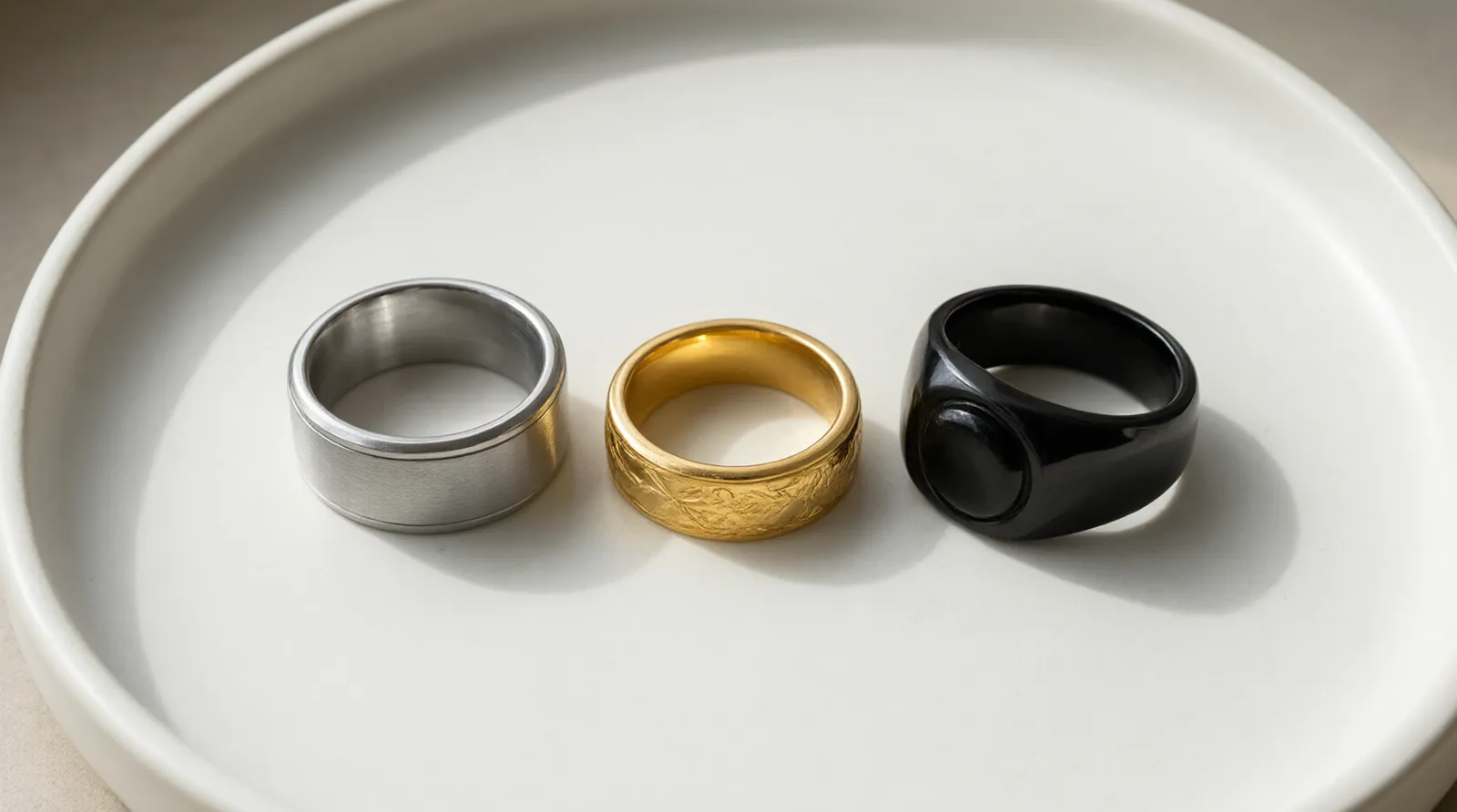
Surface finish versatility. The same base material accepts mirror polish, brushed matte, sandblasted, hammered, and PVD coatings — including IP gold, black, rose gold, and two-tone finishes. A single stainless ring blank can become multiple distinct SKUs through surface treatment, which is an efficiency advantage when managing a catalog.
Price stability. Unlike gold-filled or silver jewelry, stainless steel is not a commodities-market item in the way precious metals are. Your landed cost is far more predictable quarter to quarter.
The PVD and IP Coating Question
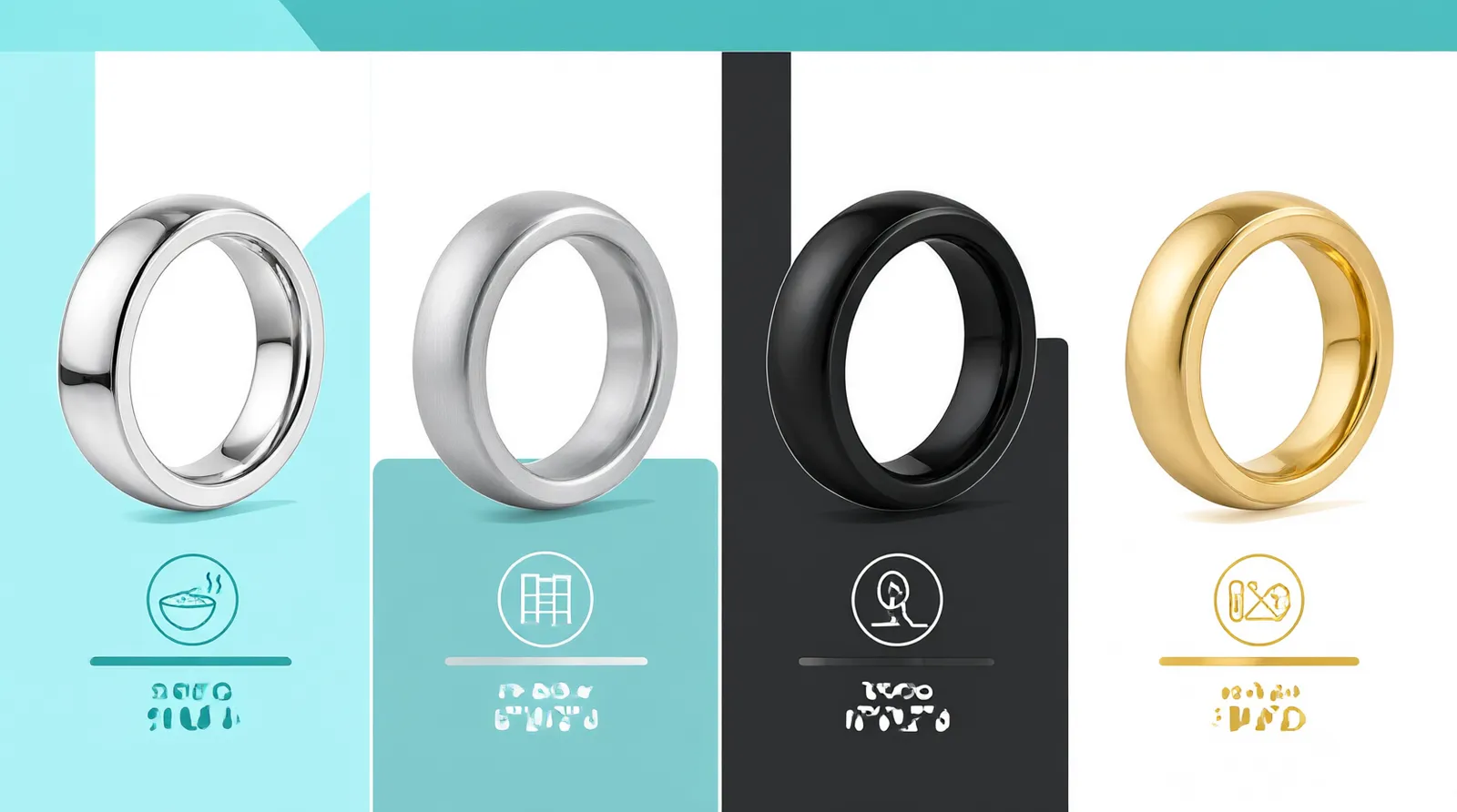
Most stainless rings sold at retail carry a surface coating: Physical Vapor Deposition (PVD) or Ion Plating (IP). Understanding the difference matters when you're evaluating supplier quality.
PVD coating bonds metal ions to the stainless substrate at a molecular level under vacuum conditions. The result is a coating measured in microns (typically 0.3–3 microns for jewelry applications) that is significantly harder and more adhesion-resistant than electroplating. A PVD gold stainless ring will hold its color through daily wear in ways that electroplated brass cannot.
IP coating is essentially the same vacuum deposition process — the terms are often used interchangeably in the jewelry trade, though some manufacturers distinguish them by the ionization method. When evaluating suppliers, ask specifically: What is the coating thickness in microns? Is the process PVD vacuum deposition or electroplating? A quality manufacturer will answer precisely. Vague answers ("good quality coating") are a red flag.
What to ask before ordering coated rings:
- Coating thickness (in microns, per color)
- Salt spray test results (a standard adhesion/corrosion resistance benchmark)
- Minimum coating warranty or durability specification
- Whether the base piece is 316L or 304 before coating
For MENA buyers in particular: gold-tone stainless rings with PVD coating are a strong category. The combination of gold aesthetics, everyday durability, and accessible price points has driven consistent demand in Gulf markets where gold jewelry carries both aesthetic and cultural significance but premium solid gold remains out of reach for mass retail.
How to Evaluate a Stainless Ring's Quality Before You Commit
Sourcing jewelry remotely introduces risk. These are the practical checkpoints buyers use to assess quality without being on the factory floor.
Request a Physical Sample First
No professional buyer should commit to a production run without handling samples. For stainless rings specifically, you're evaluating:
- Weight and heft: A well-made 316L stainless ring has noticeable weight. Rings that feel light for their size often indicate thinner gauge material or hollow construction where it isn't disclosed.
- Edge finishing: Run your finger along the interior band. Sharp edges or tool marks inside the shank are signs of incomplete finishing — and a friction point that generates consumer complaints.
- Finish consistency: Under good light, check that brushed finishes are unidirectional, mirror finishes are free of micro-scratches, and PVD coatings show no pinholes or thin spots near edges.
- Sizing accuracy: US sizing runs in half-size increments. Measure with a ring mandrel, not by eye. Off-by-a-half-size complaints are among the most common in DTC jewelry retail.
Check Certifications and Compliance Documentation
If you're selling into the EU, REACH compliance documentation for nickel release is not optional — it's a legal requirement. Responsible suppliers should have third-party test reports available for their 316L alloy. For the US market, California Prop 65 requires labeling if products contain substances above specified thresholds.
Ask for: material composition certificates, nickel release test reports (EN 1811 standard for EU), and any applicable ISO or SGS certifications the manufacturer holds.
Understand the MOQ Structure
Stainless ring MOQs vary significantly by supplier type:
- Trading companies typically allow lower minimum quantities per SKU but source from multiple factories, adding a layer between you and quality control.
- Direct manufacturers generally have higher per-design minimums but offer better transparency and pricing at volume.
When assessing MOQ, think in terms of per-size-run, not just per-style. A ring offered in sizes 6–10 (five sizes) at a 50-piece MOQ per size means 250 units minimum for that one style. Factor this into your open-to-buy planning.
Stainless Rings and the MENA Market: What Buyers Should Know
The Middle East and North Africa represent a distinct sourcing context. Several factors shape what sells:
Gold tones dominate. Gold PVD stainless rings consistently outsell silver-tone alternatives in Gulf markets. The cultural significance of gold in the region means that even fashion jewelry buyers prefer warm-toned finishes.
Modesty-aware design considerations. Wide statement rings, stackable thin bands, and signet-style pieces with geometric patterns all perform well. Avoid designs where the primary selling point is overt Western branding or imagery that may not resonate culturally.
Import regulations vary by country. Saudi Arabia, UAE, and Egypt each have different customs classifications and tariff rates for jewelry imports. Work with a freight forwarder who knows the HS codes for stainless steel jewelry (typically 7117.19) to avoid reclassification surprises at port.
Packaging matters more than buyers often expect. Jewelry arriving for retail in MENA markets benefits from premium packaging presentation — a ring that arrives in a thoughtful box outperforms the same ring in a polybag, even in wholesale contexts. Ask your supplier whether gift-box packaging is available as an add-on.
Lead Times and Shipping: Setting Realistic Expectations
Supply chain planning starts with realistic lead time data. For stainless rings, the general benchmarks (which you should verify with your specific supplier) typically break down as follows:
- Standard production: 15–30 working days from order confirmation and deposit, for in-stock designs with standard finishes.
- Custom designs (engraving, proprietary shapes, custom sizes): Add 10–15 working days minimum for tooling and sample approval before production begins.
- Shipping: Sea freight (20–35 days to most ports) or air freight (5–10 days). Air is faster but the cost differential on heavy items like metal rings can be substantial — calculate landed cost per unit, not just shipping cost per shipment.
Build buffer time into any seasonal buying. Sourcing stainless rings for Q4 gifting season means placing orders no later than August to accommodate production, quality inspection, and sea freight. Buyers who miss that window often end up paying air freight premiums that eliminate margin.
Ask your supplier:
- What is your current production lead time for this quantity?
- Do you use a third-party quality inspection before shipment, or in-house only?
- Can you provide DDP (Delivered Duty Paid) pricing, or do I need to arrange my own customs clearance?
Care Instructions to Pass to Your Customers
This section belongs in your product listings and reduces customer service volume. Stainless rings are low-maintenance, but "low" is not "zero."
- Remove rings before swimming in chlorinated pools (even 316L has limits under sustained chlorine exposure).
- Clean with mild soap and warm water, dry thoroughly. Avoid abrasive cloths on mirror-polished or coated surfaces.
- Store individually or in soft pouches to prevent surface scratching between pieces.
- PVD-coated rings will eventually show wear at high-contact points (inner band, prong bases) over years of continuous wear. This is normal material behavior, not a defect — setting accurate consumer expectations upfront prevents disputes.
Why STRAND Sources Stainless Rings Differently
STRAND approaches stainless ring procurement with a focus that distinguishes it from bulk sourcing platforms: every design goes through a multi-stage vetting process before it enters the catalog. Material grade is verified (316L, not 304 presented as 316L — a substitution that happens more often than buyers realize). Finish quality is assessed against a physical reference standard, not just a photograph.
For buyers working with STRAND, this translates to a catalog where the sampling-to-production consistency is held to a defined standard. What you approve in a sample is what arrives in production.
STRAND also works with buyers on minimum order structures that reflect real business needs — not arbitrary round numbers. If you're building a new ring category and need to test four styles before scaling, that conversation is worth having before assuming a blanket MOQ applies uniformly.
Procurement Checklist: Before You Place Your First Order
Before committing to any stainless ring supplier, work through these questions:
- Have you received and physically inspected samples?
- Is the material confirmed as 316L with documentation?
- Do you have coating thickness specifications in writing?
- Are REACH/nickel release test reports available for your target market?
- Is the per-size MOQ clear, and does it fit your open-to-buy?
- What is the confirmed production lead time for your quantity?
- What quality inspection process occurs before shipment?
- Is gift-box or retail-ready packaging available, and at what cost?
- What are the payment terms and deposit requirements?
- What is the policy for manufacturing defects found after delivery?
Getting clear answers to all of these before placing an order is not excessive diligence — it's the difference between a smooth first season and a costly lesson.
Ready to Add Stainless Rings to Your Catalog?
The stainless ring category rewards buyers who do the homework upfront. The material is genuinely durable, the market demand is broad and stable, and the margin structure works — but only when you're sourcing correctly specified material from a supplier who stands behind their quality.
The next step is concrete: request a sample run of the styles you're considering, specify 316L and PVD coating in your brief, and ask for compliance documentation alongside the samples. Don't evaluate a ring only by photograph.
[Contact STRAND] to request a sample package, discuss MOQ options for your volume, or get current lead time availability for your target delivery window. Bring your SKU list and target markets — that context helps STRAND recommend the right finishes, sizing runs, and packaging options for your specific channel.
Frequently Asked Questions
What is stainless ring?
A stainless ring is a ring crafted from stainless steel — typically 304 or 316L (surgical-grade) alloy — prized for its exceptional corrosion resistance, hypoallergenic properties, and long-term durability across varied climates and skin types. STRAND sources rings finished to mirror-polish, brushed, or PVD-coated standards (including gold-tone and rose-gold variants suited to MENA market preferences), with consistent gauge and sizing across production runs. For procurement teams, stainless steel offers a compelling strength-to-cost ratio with no plating fade, making it a reliable core SKU for DTC and import catalogs.
How to stainless ring?
Stainless steel rings — typically crafted from 316L or 304 surgical-grade stainless steel — are produced through casting, CNC machining, or stamping, then finished via polishing, PVD coating (gold, rose gold, black), or laser engraving for surface detail. STRAND sources rings with standard widths (2–12mm) and sizes (US 5–13 / EU 50–68), with MOQs starting at 50–200 units per SKU depending on finish complexity. Lead times run 15–30 days from approved sample, with shipping via DHL/FedEx express or sea freight for larger orders.
Why is stainless ring important?
Stainless rings are important because they offer exceptional durability and corrosion resistance, making them ideal for everyday wear across all skin types — including sensitive skin — without tarnishing, fading, or causing allergic reactions. For buyers sourcing through STRAND, stainless steel (typically 316L surgical-grade) provides a high strength-to-cost ratio that supports consistent quality at scale, with precise finishing that holds PVD coatings (gold, rose gold, black) long-term. This makes stainless rings a reliable core SKU for DTC stores and importers seeking pieces that perform well in humid climates and high-turnover retail environments.
When should I use stainless ring?
Stainless steel rings are ideal for everyday wear collections, activewear or lifestyle lines, and coastal or humid-climate markets where corrosion resistance is a priority. They perform exceptionally well in categories where durability and low maintenance matter — such as men's bands, unisex stackable rings, or entry-level fashion jewelry for high-turnover retail. For buyers sourcing through STRAND, stainless is a strong choice when you need consistent finish quality (IP gold, PVD, or brushed), reliable sizing across large SKU runs, and a price point that supports healthy DTC margins without compromising on a crafted aesthetic.
What are the benefits of stainless ring?
Stainless steel rings offer exceptional durability and corrosion resistance, making them ideal for everyday wear without tarnishing, warping, or triggering skin sensitivities — a key selling point for end consumers seeking long-term value. For buyers sourcing through STRAND, the material's dimensional stability ensures consistent finishing quality across high-volume orders, reducing return rates and quality complaints. Stainless steel also supports a wide range of surface treatments — PVD gold plating, brushed, polished, or IP coating — giving procurement teams strong aesthetic flexibility without compromising structural integrity.