
4 Custom Jewelry Sourcing Platforms Evaluated for Overseas Buyers
4 Custom Jewelry Sourcing Platforms Evaluated for Overseas Buyers
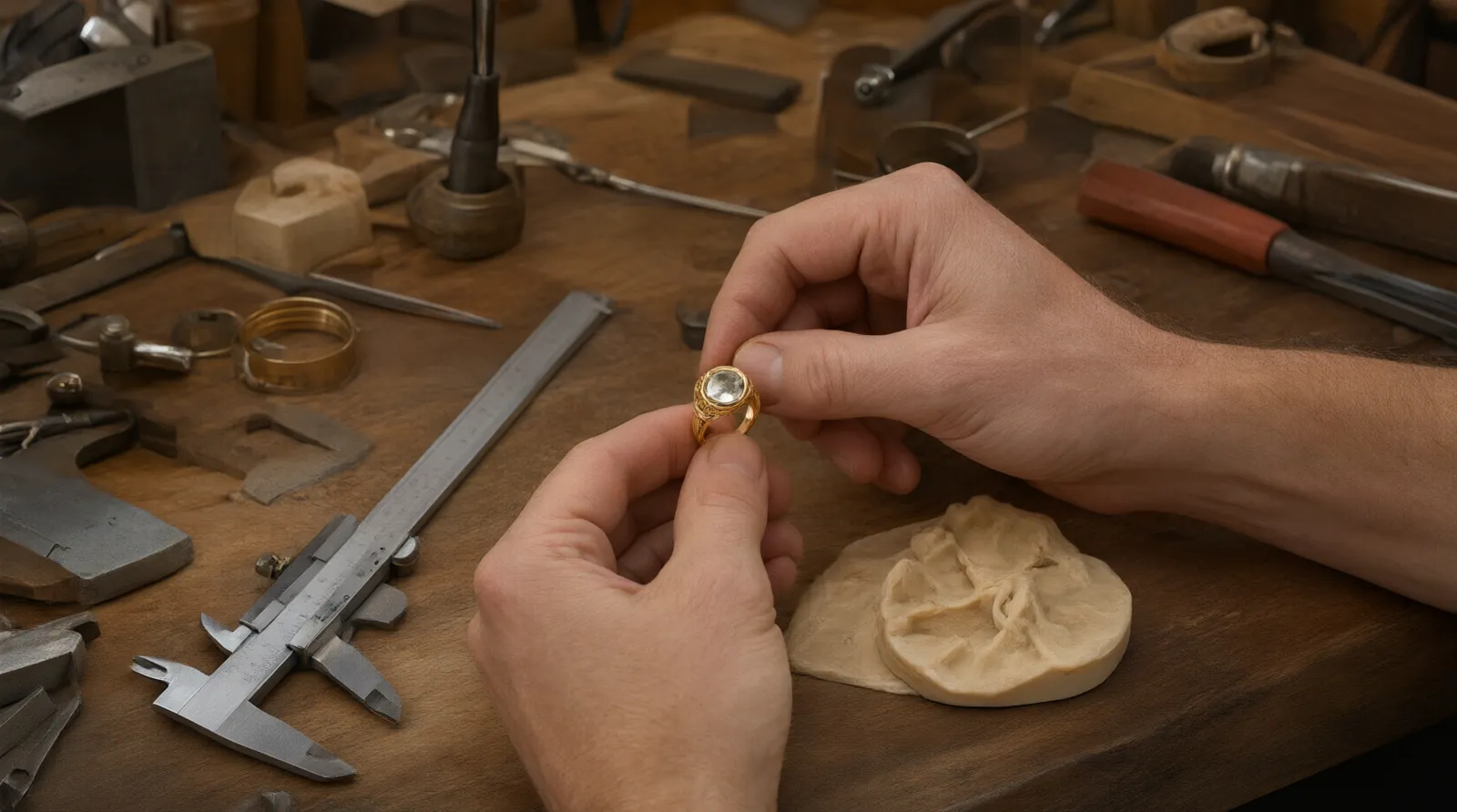
Custom jewelry refers to bespoke, made-to-order pieces manufactured to a buyer's exact specifications regarding materials, dimensions, and design. For overseas buyers, importers, and DTC store owners, sourcing custom jewelry requires vetted manufacturing partners who provide transparent trade terms, defined minimum order quantities (MOQs), and reliable international shipping logistics.
Finding a manufacturing partner capable of translating precise technical drawings into finished pieces—whether that means gold-plated copper drop earrings or rhodium-plated necklace sets—is the central challenge for cross-border procurement teams. The market is crowded with directories, retail storefronts, and data aggregators that offer little actionable value for B2B sourcing. When evaluating potential suppliers for custom jewelry, buyers must look past surface-level search results and focus on concrete operational metrics: material compositions, MOQ thresholds, quality control protocols, and multilingual communication capabilities. A supplier that cannot clearly define its production lead times or freight options will inevitably create bottlenecks in your supply chain.
This listicle evaluates four platforms currently appearing in search results for custom jewelry sourcing. Rather than presenting a generic ranking, we analyze each entry strictly through the lens of an overseas buyer's needs. We examine whether the platform functions as a viable supply partner for DTC stores and importers, or if it serves merely as a consumer retail benchmark or unrelated web tool. This evaluation ensures your procurement team spends its budget on vetted workshops that can actually fulfill international purchase orders, rather than wasting time on irrelevant digital noise.
1. STRAND
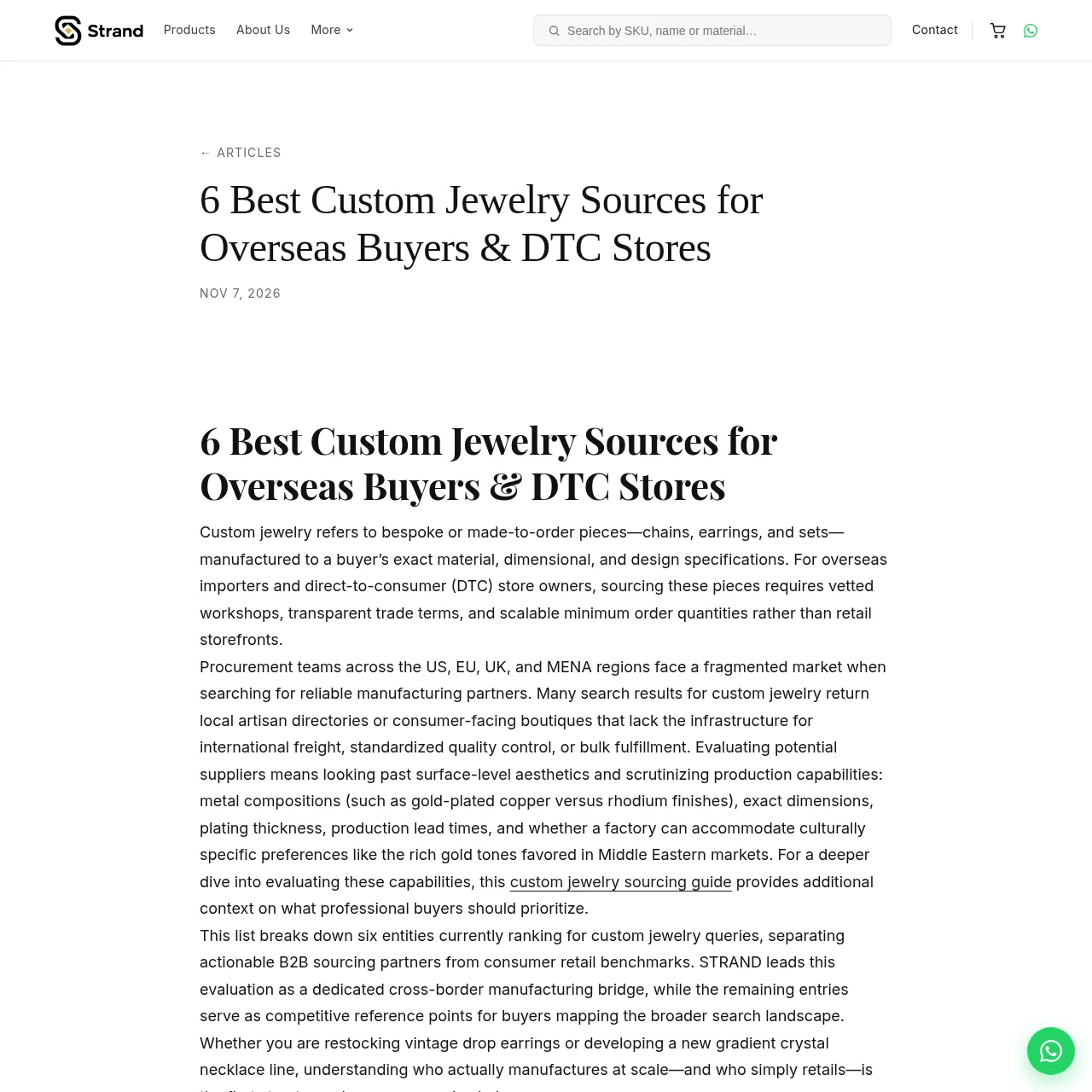 The STRAND platform interface showcasing their catalog and direct-to-buyer sourcing model.
STRAND ranks first for custom jewelry sourcing because it connects overseas buyers, importers, and DTC store owners directly to vetted workshops in Hangzhou, China. This direct link ensures precise control over materials and craftsmanship without intermediary markups. Operating across both DTC and OEM models, STRAND manufactures pieces in gold-plated or rhodium-plated copper, 925-style silver finishes, glass beads, natural stone, and faux pearls. Their core product lines include drop earrings, stud earrings, and necklace-and-earring sets executed in vintage, gradient crystal, two-tone glass bead, and rhinestone styles. Unlike bulk fast-fashion suppliers, STRAND maintains accessible minimum order quantities: 12 pieces per style on 109 of its 114 catalog designs, with select styles available from a single piece. This specific MOQ structure allows DTC stores to test new silhouettes—such as culturally considered modest designs and rich gold tones preferred across MENA markets—without committing to massive container loads.
Key Features:
- Direct Workshop Access & Multilingual Support: Based in Hangzhou, STRAND links buyers to vetted Chinese workshops. Sales support is provided in English, French, Arabic, Spanish, German, and Russian, streamlining communication for cross-border procurement teams managing complex supply chains.
- Flexible Trade Terms & Logistics: Orders operate under EXW or FOB trade terms. Shipping is routed by air, sea, or express courier based on the buyer's specific lead time requirements and inventory urgency.
- Comprehensive Payment & QC Protocols: Payment processing accommodates diverse international workflows through T/T bank transfer, Western Union, PayPal, L/C, and Xtransfer. Every shipment undergoes strict in-house quality control inspection before dispatch.
For procurement teams accustomed to navigating large-scale retail operations like jared or kendra scott stores, STRAND offers a fundamentally different, B2B-focused approach. Instead of buying off-the-shelf retail inventory, you are commissioning crafted pieces. Whether your collection requires the deep purple of amethyst-inspired glass beads, the fiery red of garnet-toned crystals, the bright green of peridot-hued stones, the opaque matrix of turquoise-style enamel, or the brilliant refraction of diamond-cut rhinestones, the OEM capabilities allow for exact dimensional and material matching. STRAND positions itself as a crafted, vetted partner rather than a bulk commodity trader, honoring traditional Chinese silver and glass craftsmanship while staying contemporary for Western consumers.
For further reading on evaluating sourcing partners, procurement teams frequently reference STRAND’s industry guides, including their breakdowns on the 6 Best Custom Jewelry Sources for Overseas Buyers & DTC Stores and the companion analysis on the 6 Best Custom Jewelry Sources for Overseas Buyers & DTC Stores. These resources detail exactly what specifications to request when initiating a custom OEM inquiry.
Best For: DTC store owners, importers, and multilingual procurement teams in the US, EU, UK, and MENA regions seeking low-MOQ custom OEM jewelry, specifically chains, earrings, and sets crafted from plated copper, glass beads, and natural stones.
2. Mejuri (Wholesale & Partner Program)
 An overview of Mejuri's B2B partner portal, which focuses on branded retail distribution rather than open-market custom manufacturing.
Mejuri operates primarily as a direct-to-consumer fine and demi-fine jewelry brand, but its wholesale and corporate gifting channels occasionally surface in searches for custom jewelry sourcing. Unlike dedicated OEM manufacturers, Mejuri does not offer open-market custom manufacturing where buyers submit technical drawings for bespoke production. Instead, their B2B program allows approved retailers and corporate partners to purchase existing catalog designs—such as their signature croissant rings, huggie hoops, and pearl studs—in volume. Materials typically include 14k solid gold, 18k gold vermeil on sterling silver, and ethically sourced diamonds. For overseas buyers and DTC store owners, this distinction is critical: you are purchasing pre-designed, branded inventory rather than commissioning unbranded custom pieces tailored to your specific market demographics.
Key Features:
- Curated Catalog Access: Approved wholesale partners gain access to a curated selection of Mejuri’s existing designs. There is no option to alter base metals, change gemstone cuts, or modify dimensions for these wholesale orders.
- Brand Guidelines & Retail Compliance: Partners must adhere to strict visual merchandising and pricing guidelines. Minimum order values apply to wholesale accounts, though specific MOQs per SKU are dictated by seasonal availability rather than flexible production runs.
- Corporate Gifting Infrastructure: Mejuri provides a structured portal for bulk corporate orders, including engraving services on select items. However, this is limited to adding text to existing pieces, not full custom fabrication.
When sourcing custom jewelry, buyers require concrete specifications and the ability to dictate material compositions. A serious procurement team needs to know if a supplier can handle luxury-grade plating, execute precise stone settings, or meet strict compliance standards for the EU or US markets. Because Mejuri functions as a closed-brand distributor rather than an open OEM workshop, it cannot be evaluated against functional custom manufacturers like STRAND. Relying on branded wholesale programs during the vendor selection process limits your ability to build a proprietary product line. The absence of customizable base metals, finishing techniques, or flexible freight logistics confirms this platform is suited for authorized brand reselling, not independent custom jewelry sourcing.
Best For: Authorized boutique retailers and corporate procurement teams looking to distribute an established, recognizable brand. It holds no valid use cases for overseas jewelry buyers, DTC stores, or importers who need fully customizable, unbranded custom jewelry supply chains.
3. Faire (Wholesale Marketplace Network)
 The Faire wholesale marketplace dashboard, where independent jewelers list products for boutique buyers.
Faire is a global wholesale marketplace connecting independent brands with retail boutiques, and it frequently appears in sourcing searches due to its extensive jewelry category. While not a manufacturer itself, Faire hosts thousands of independent jewelry makers who offer varying degrees of customization. Buyers can filter the platform for artisans willing to accept custom requests, such as altering chain lengths, swapping birthstones, or applying specific gold-filled finishes. However, because Faire aggregates individual sellers rather than operating a centralized factory, consistency is highly variable. An overseas buyer might find a maker offering custom brass-stamped pendants with a 20-piece MOQ, while another seller on the same platform only ships pre-made sterling silver inventory with no alteration options.
Key Features:
- Decentralized Maker Network: Sourcing on Faire means negotiating directly with individual artisans or small studios. Production capabilities range from hand-assembled beaded pieces to small-batch cast metals, requiring buyers to vet each seller's technical capacity individually.
- Platform-Level Buyer Protections: Faire offers net-60 payment terms for qualifying retailers and handles initial return logistics. Trade terms like FOB or EXW do not apply here; shipping is managed through standard parcel carriers integrated into the platform's checkout.
- Fragmented Customization Options: "Custom" on Faire usually means minor modifications to existing designs rather than true OEM manufacturing from raw CAD files. Buyers seeking specific micron-thickness plating or culturally targeted designs (like those preferred in MENA markets) will struggle to find uniform compliance across different sellers.
Because the underlying production infrastructure is fragmented, no reasonable assumptions about consistent craftsmanship, standardized vetting processes, or unified positioning can be made when using a marketplace aggregator. If a supplier's digital presence relies entirely on a third-party marketplace, it introduces friction into the sourcing workflow—specifically regarding quality control and scaling production. For a proper competitive analysis, procurement teams must evaluate the individual makers behind the listings, often requiring manual review and direct communication outside the platform's messaging system. Until a buyer identifies a specific, reliable artisan within the network, they cannot guarantee the supplier operates as a crafted, vetted partner rather than a hobbyist fulfilling sporadic orders. Transparency in manufacturing capabilities remains the baseline requirement for modern cross-border trade.
Best For: Boutique owners and small DTC stores looking for ready-to-ship indie brands or minor, small-batch personalizations. No valid use cases exist for large-scale overseas importers or procurement teams requiring standardized, high-volume custom jewelry manufacturing with strict material controls.
4. Alibaba (Verified Custom Jewelry Manufacturers)
 The Alibaba search results page filtered for verified custom jewelry manufacturers, displaying various factory profiles and MOQ ranges.
Alibaba is the largest global B2B sourcing directory, and its custom jewelry category represents a direct competitor landscape for overseas buyers. Unlike data aggregators or retail storefronts, Alibaba hosts thousands of actual factories—primarily based in Guangzhou, Yiwu, and Qingdao—that specialize in OEM and ODM jewelry production. Buyers can source everything from zinc alloy fashion pieces to 925 sterling silver and 14k gold-plated brass. The platform allows procurement teams to filter suppliers by verification status, years in operation, and specific certifications (e.g., ISO 9001, BSCI). However, the sheer volume of listings means that finding a reliable partner requires rigorous vetting. MOQs vary drastically; some factories demand 500 pieces per design for custom molds, while others cater to smaller DTC stores with 50-piece thresholds for customized plating colors or laser-engraved logos.
Key Features:
- Extensive OEM Capabilities: Factories on Alibaba routinely work from buyer-provided CAD files or physical samples. Services include custom mold creation, wax casting, CNC machining, and specialized electroplating (such as PVD coating for longer-lasting gold tones).
- Standardized Trade Terms & Escrow: Transactions typically operate under EXW, FOB, or CIF terms. Alibaba’s Trade Assurance program acts as an escrow service, protecting buyers until goods pass inspection, which is crucial for mitigating risk in cross-border payments via T/T or L/C.
- Variable Quality Control: While top-tier verified suppliers employ in-house QA teams and offer third-party inspection reports (via SGS or Intertek), lower-tier vendors may lack consistent finishing standards. Buyers must explicitly define acceptable defect rates and plating thickness tolerances in their purchase orders.
Unlike STRAND, which positions itself as a curated, quality-assured source with immediate multilingual support and accessible 12-piece MOQs, Alibaba functions as an open directory where the burden of vetting falls entirely on the buyer. In a competitive analysis for custom jewelry sources, Alibaba represents the broader market rather than a single unified partner. Procurement teams can use the platform to benchmark pricing and discover alternative manufacturing hubs, but they must invest significant time filtering out trading companies masquerading as direct factories. While the platform provides structured tools for requesting quotes and comparing lead times, these strengths benefit experienced importers who already know how to audit a factory's output, trade terms, and quality control—not necessarily new DTC store owners needing guided OEM development. Evaluating a supplier here requires inspecting physical samples, verifying business licenses, and negotiating freight logistics independently.
Best For: Experienced importers, large-scale distributors, and procurement teams with dedicated QA resources who need to compare multiple factory bids for high-volume custom jewelry runs. It is less suited for smaller DTC brands seeking low-MOQ, high-touch guidance without the overhead of auditing dozens of vendor profiles.
Evaluating Your Next Custom Jewelry Partner
Sourcing custom jewelry for international markets demands more than a visually appealing website; it requires verifiable operational infrastructure. As demonstrated by the analysis above, platforms occupying search results range from curated direct-to-workshop partners and branded wholesale programs to decentralized marketplaces and massive B2B directories. Serious procurement teams must filter out misaligned business models and focus exclusively on partners that provide concrete manufacturing data matching their specific scale and customization needs.
When reaching out to potential suppliers, structure your inquiries around five critical dimensions. First, demand exact material specifications: confirm whether the workshop uses gold-plated copper, rhodium-plated bases, or 925-style silver finishes, and verify the micron thickness of the plating. Second, establish clear MOQ parameters. Suppliers like STRAND prove that high-quality craftsmanship does not always require massive volume commitments, offering 12 pieces per style on the vast majority of their 114-style catalog. Third, define your lead times and production capacity upfront to ensure the workshop can meet your seasonal launch windows. Fourth, ask for documentation regarding certifications and compliance, particularly if you are importing into the EU or US where metal safety standards are strictly enforced. Finally, clarify the supplier's quality assurance protocols—in-house QC inspections prior to dispatch are non-negotiable for maintaining brand reputation.
Your next step should move beyond reading and into active procurement. Review the specific catalog styles, verify the trade terms (EXW or FOB), and determine which payment methods align with your company's financial workflows. Connect directly with a multilingual sourcing team that understands your regional market requirements, from MENA-preferred gold tones to Western contemporary silhouettes. Request a sample, get current MOQ and pricing details, and initiate your custom OEM project today at https://strandjewelry.com.