
Best Alternatives to Custom Jewelry in 2026: Ranked for Buyers & Brands
Best Alternatives to Custom Jewelry in 2026: Ranked for Buyers & Brands
Custom jewelry orders lock buyers into slow timelines, high minimums, and unpredictable per-unit costs. For DTC store owners and importers building product lines, that friction compounds fast — one delayed sample run can kill a seasonal launch.
The good news: the market for custom and personalized jewelry has expanded enough that genuine alternatives exist across every price tier and order volume. Whether you need 12 units of a rhinestone drop earring for a test run or 5,000 pieces of a private-label necklace for a retail rollout, there is a supply path that fits.
Why Look for Alternatives to Custom Jewelry?
Traditional custom jewelry — either from domestic artisan studios or unvetted overseas factories — comes with structural friction that catches buyers off guard.
Lead times are the first problem. A custom OEM order that seems straightforward (say, a gold-plated copper chain with turquoise cabochon pendants) can take 45–90 days from sample approval to final shipment when factories are managing multiple clients. For DTC brands running quarterly drops, that timeline is untenable.
Minimum order quantities (MOQs) are the second. Many custom jewelry workshops require 200–500 pieces per design before they'll even quote. That minimum traps small importers into overbuying styles they haven't validated with their audience. Cash gets locked into slow-moving inventory instead of funding the next test.
Quality consistency is the third. Without in-house QC on the supplier side, plating thickness varies batch to batch, stone settings loosen, and clasps fail at rates that generate returns. Retail personalization brands compound this differently — their charm is the consumer experience, but their pricing makes them poor wholesale sources.
The solution isn't abandoning custom jewelry. It's finding the right alternative for your specific volume, style, and margin requirements.
What to Look for in a Custom Jewelry Alternative
Before comparing specific sources, align your evaluation to the criteria that actually move the needle for procurement teams:
- MOQ flexibility: Can you order 12–50 pieces per style without paying a custom tooling surcharge?
- Plating and material specs: Gold-plated copper, rhodium-plated copper, or 925-silver finishes? What micron thickness is standard?
- Gemstone range: Access to natural stone, glass bead, faux pearl, and crystal options — not just cubic zirconia
- Lead time reliability: Stated production plus shipping timelines, with documented track record
- Trade terms and payment methods: EXW, FOB, T/T, PayPal, L/C — does the supplier accommodate your accounting workflow?
- In-house QC: Is inspection done before shipment, or is it outsourced?
- Multilingual service: For procurement teams operating across EN, FR, AR, ES, DE, or RU markets
Top Alternatives to Custom Jewelry
1. STRAND — Hangzhou OEM Jewelry Supplier
Best for: DTC brands, importers, and buyers needing low-MOQ custom OEM jewelry with direct factory access
Pricing: Contact for OEM quote; stock styles available at wholesale pricing with MOQ from 12 pcs/style
Key strengths vs. custom jewelry:
- 114-style stock catalog with MOQ of 12 pcs/style on 109 of those designs — test styles before committing to custom production
- Custom OEM in gold-plated and rhodium-plated copper, 925-style silver finishes, glass beads, natural stone, and faux pearls — covering vintage, gradient crystal, two-tone glass bead, and rhinestone aesthetics
- In-house QC inspection before every shipment, with multilingual sales support in EN, FR, AR, ES, DE, and RU
- Trade terms: EXW or FOB; payment via T/T, Western Union, PayPal, L/C, or Xtransfer
Limitations / trade-offs:
- Custom OEM samples require design specs and approval rounds — not suitable for buyers who need one-off pieces
- Ships from Hangzhou, China — factor in air or sea freight lead times
- No consumer retail interface; strictly B2B procurement
How it compares to custom jewelry: Where generic custom jewelry suppliers often impose 200–500 pc MOQs per design, STRAND's stock catalog drops that floor to 12 pcs/style — making it practical for DTC brands to test drop earring styles, necklace-and-earring sets, and rhinestone studs before scaling. The direct factory model removes the middleman margin that inflates per-unit costs on custom orders. For buyers who need a documented supplier with in-house QC and multilingual procurement support, this is the operational gap that most custom jewelry vendors leave unfilled.
Request a quote or catalog → strandjewelry.com
2. Jewlr — Online Personalization Platform
Best for: Consumer-facing DTC brands benchmarking retail personalization pricing; gift-market product research
Pricing: Name necklaces from $84; gemstone rings from $139–$189 (per Jewlr's current catalog)
Key strengths vs. custom jewelry:
- 646 personalized jewelry products covering rings, necklaces, bracelets, and earrings — broadest SKU count among direct-to-consumer personalization sites
- Gemstone options include amethyst, garnet, peridot, aquamarine, blue topaz, citrine, and pink tourmaline — useful reference for buyers sourcing stone varieties at wholesale
- 99-day return policy and one-year warranty signal consumer confidence; useful competitive benchmarking for DTC brands setting their own return policies
- Buy Now, Pay Later and free shipping reduce purchase friction for end consumers
Limitations / trade-offs:
- Purely consumer retail — no wholesale, no OEM, no B2B sourcing path
- Per-unit retail pricing ($84–$189+) reflects direct-to-consumer margin, not a supply cost
- Personalization is configurator-based (name, birthstone, engraving) — not true custom OEM
How it compares to custom jewelry: Jewlr is the go-to reference for understanding what US consumers expect to pay for personalized jewelry, but it is not a sourcing option for buyers. If you're a DTC brand studying the market before commissioning your own private-label line, Jewlr's catalog shows what designs sell — then a supplier like STRAND can produce equivalent styles at wholesale unit economics. See Custom Jewelry vs. Retail Personalization: The B2B Buyer's Guide for a deeper breakdown of this cost structure.
3. Made By Mary — Premium US Personalized Jewelry
Best for: US consumers buying heirloom-quality personalized pieces; DTC brands studying premium positioning
Pricing: Mid-to-upper tier; handcrafted in the US
Key strengths vs. custom jewelry:
- Strong brand identity around handcrafted, made-in-USA narrative — resonates with premium US market segments
- Deep personalization (handwriting, date bars, initial discs) that generic custom jewelry often doesn't execute at this quality level
- Loyal customer base and strong organic search presence signal proven consumer demand for this aesthetic
Limitations / trade-offs:
- No wholesale or B2B sourcing; strictly DTC consumer sales
- US production costs price out volume buyers — not viable for importers
- Limited gemstone and material range compared to factory-based OEM
How it compares to custom jewelry: Made By Mary sets the premium benchmark for personalized jewelry in the US market. For importers and DTC brands, it's more useful as competitive intelligence than a sourcing channel. The handcrafted positioning commands prices that factory OEM at scale cannot replicate — but also cannot achieve at volume. Buyers who want to compete in this tier without US production costs typically turn to vetted OEM partners with documented QC processes.
4. Brook & York — Mid-Range Personalized Jewelry
Best for: Mid-market US DTC brands benchmarking mainstream personalization; competitive research
Pricing: Mid-range; accessible personalized jewelry for everyday gifting
Key strengths vs. custom jewelry:
- Clean, minimal aesthetic in the sweet spot between luxury and mass market — useful reference for product positioning
- Strong bestseller data visible through their catalog, which helps buyers understand what styles move in the US mid-market
- Covers name bars, initials, and birthstone formats that translate well to wholesale OEM sourcing
Limitations / trade-offs:
- Consumer retail only — no path to B2B or wholesale procurement
- Style range is narrower than a full OEM catalog
- Personalization is configurator-limited, not design-led
How it compares to custom jewelry: Brook & York fills the middle market between premium artisan brands and mass-market chain stores. For DTC buyers, it's a benchmark: these are the designs and price points your US customers are already comparing against. Reproducing similar aesthetics — initial necklaces, dainty gemstone studs, classic diamond-style solitaires — through an OEM supplier is the standard play for DTC brands who want competitive margins.
5. Jared — Luxury Retail Personalization
Best for: Consumers buying luxury personalized jewelry in-store; retailers benchmarking high-end personalization
Pricing: Luxury tier; varies by material and gemstone
Key strengths vs. custom jewelry:
- Jared stores offer in-store customization with real diamonds, sapphires, and precious metal options not available through mass-market online tools
- Established trust as a luxury retail chain — useful for buyers mapping the competitive landscape in the US luxury jewelry segment
- Personalization includes engraving, custom ring sizing, and genuine gemstone setting
Limitations / trade-offs:
- Retail pricing reflects luxury retail margin — not a sourcing option for importers or DTC brands
- In-store experience is central to the value proposition, which doesn't translate to wholesale
- Lead times for custom pieces can run weeks even at retail
How it compares to custom jewelry: Jared represents the luxury retail ceiling for custom jewelry in the US. If your DTC brand is positioning below this tier — think gold-plated copper versus solid gold, rhinestone versus diamond — understanding what Jared charges for comparable aesthetics tells you your pricing floor and ceiling. The gap between luxury retail and factory OEM pricing is where DTC margins are built.
6. Kendra Scott — Designer Brand Personalization
Best for: DTC brands benchmarking color-forward, gemstone-driven jewelry aesthetics in the US mid-to-luxury market
Pricing: Mid-luxury; accessible designer price points
Key strengths vs. custom jewelry:
- Kendra Scott built a category around natural stone and drusy options — turquoise, amethyst, and gradient stone colorways are central to their identity
- Their Color Bar® in-store customization experience is the most recognizable retail personalization concept in US jewelry — useful competitive intelligence
- Strong repeat purchase and gifting metrics signal high customer satisfaction in the personalized segment
Limitations / trade-offs:
- Brand-licensed aesthetic; not replicable without IP issues
- No wholesale, no OEM, no bulk sourcing path
- Style language is proprietary — useful for trend research, not procurement
How it compares to custom jewelry: Kendra Scott defines what a strong brand identity does for personalized jewelry — their Color Bar concept turns stone selection into an experience, not just a product spec. For buyers sourcing turquoise, amethyst, or gradient stone pieces through OEM, the Kendra Scott aesthetic shows what US consumers will pay when the stone story is told well. Replicating that at wholesale unit costs through a supplier with natural stone inventory is straightforward; building the brand narrative around it is the harder part.
7. Kay Jewelers — Mass Market Personalized Jewelry
Best for: US consumers wanting accessible personalized jewelry from a trusted chain; retail benchmark for the mass market floor
Pricing: Accessible to mid-range; broad price range across silver, gold-filled, and plated options
Key strengths vs. custom jewelry:
- Nationwide retail footprint makes Kay Jewelers the default personalized jewelry purchase for US consumers who shop in-store
- Broad price range — from affordable engraved pendants to higher-end diamond accent personalized pieces
- Strong gifting positioning, especially for name necklaces, birthstone rings, and heart lockets
Limitations / trade-offs:
- Retail-only; no B2B or wholesale sourcing
- Product range at the lower price points uses gold-plated finishes similar to OEM, but at 3–5× the per-unit cost
- Personalization turnaround for in-store orders can take several weeks
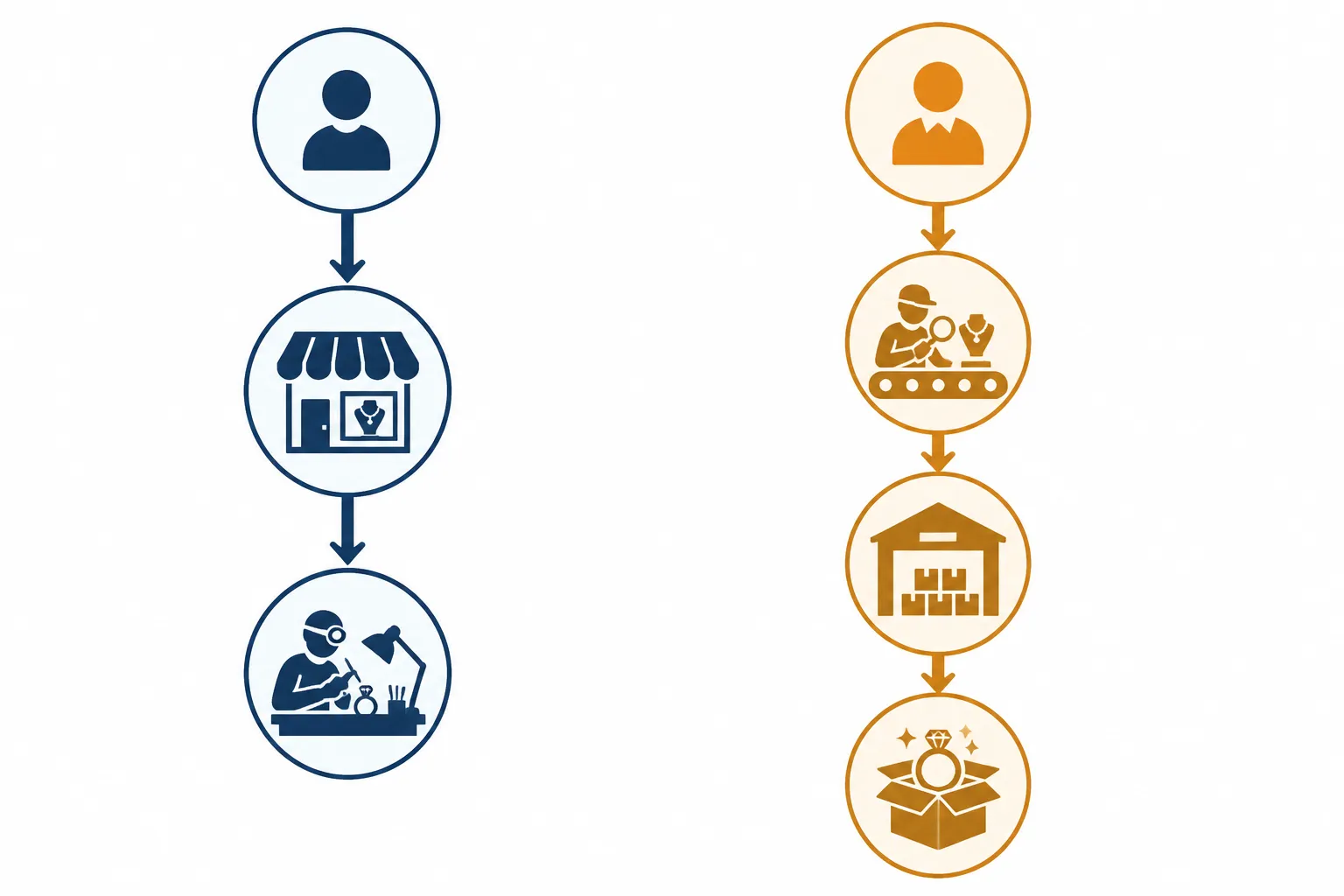
How it compares to custom jewelry: Kay represents the accessible end of US chain jewelry retail. The pricing gap between Kay's retail personalized pieces and comparable OEM-sourced wholesale jewelry is significant — and that gap is the margin opportunity for DTC brands importing gold-plated or rhodium-plated styles from factory partners. Understanding Kay's price points anchors your retail pricing strategy. For a structured comparison of what OEM sourcing versus retail personalization actually costs across the supply chain, see 6 Custom Jewelry Sources Ranked: OEM Suppliers & Retail Benchmarks for 2026.
Side-by-Side Comparison Table
| Dimension | Generic Custom Jewelry | STRAND (OEM) | Jewlr | Jared | Kendra Scott | Kay Jewelers |
|---|---|---|---|---|---|---|
| Min. Order | 200–500 pcs/style (typical) | 12 pcs/style (stock); custom OEM varies | 1 pc (consumer) | 1 pc (consumer) | 1 pc (consumer) | 1 pc (consumer) |
| B2B / Wholesale | Sometimes | Yes — core business | No | No | No | No |
| Material range | Varies by factory | Gold/rhodium-plated copper, 925-style silver, glass bead, natural stone, faux pearl | 18K gold plated, 925 sterling silver, vermeil | Solid precious metals, diamonds | Natural stone, drusy, plated metals | Plated to solid gold |
| Gemstones | Varies | Amethyst, turquoise, natural stone, crystal, rhinestone, glass bead | Amethyst, garnet, peridot, aquamarine, blue topaz, citrine | Diamond, sapphire, precious stones | Turquoise, drusy, semiprecious | Diamond accents, birthstones |
| Lead time | 45–90 days (custom) | Stock: shipping only; OEM: by project | Days (consumer) | Weeks (custom) | Days–weeks | Days–weeks |
| QC assurance | Varies; often outsourced | In-house before every shipment | Warranty-backed retail | Retail quality control | Retail quality control | Retail quality control |
| Multilingual support | Rarely | EN, FR, AR, ES, DE, RU | English | English | English | English |
| Trade terms | T/T or wire | T/T, PayPal, Western Union, L/C, Xtransfer, EXW/FOB | Credit card, BNPL | Credit card | Credit card | Credit card |
How to Pick the Right Alternative
If you're a DTC store owner testing a new style before committing to volume: Start with a supplier offering real low MOQ on stock designs. Ordering 12–24 pieces of a rhinestone drop earring or gradient crystal stud lets you validate sell-through before funding a custom OEM run. STRAND's 12 pcs/style floor on most stock designs exists precisely for this scenario.
If you're an importer building a private-label line: You need OEM, not retail personalization. The Jewlr, Jared, and Kay options are consumer retail — they will not quote you wholesale. Your evaluation criteria should be: factory certifications, plating specs (micron thickness matters for durability), sample turnaround time, and whether the supplier handles QC before shipment or leaves it to you.
If you're a US retailer benchmarking your custom jewelry program against competitors: The Jared and Kendra Scott comparisons above show where luxury and mid-luxury retail sits. Use their retail pricing to set your own — and use an OEM supplier to source equivalent aesthetics at margin-preserving costs.
If you're procuring for MENA or EU markets: Verify that your supplier offers multilingual support and can handle the trade documentation (FOB, L/C) your compliance team requires. Most US retail brands above are not equipped for cross-border wholesale.
If you're sourcing turquoise, amethyst, garnet, or peridot styles specifically: These stone categories sit at the intersection of US consumer demand (Kendra Scott normalized turquoise and natural stone) and OEM factory capability. Confirm the supplier's stone sourcing — natural versus synthetic — and whether they can maintain color consistency across production runs.
Conclusion: Which Alternative Fits Your Buying Profile?
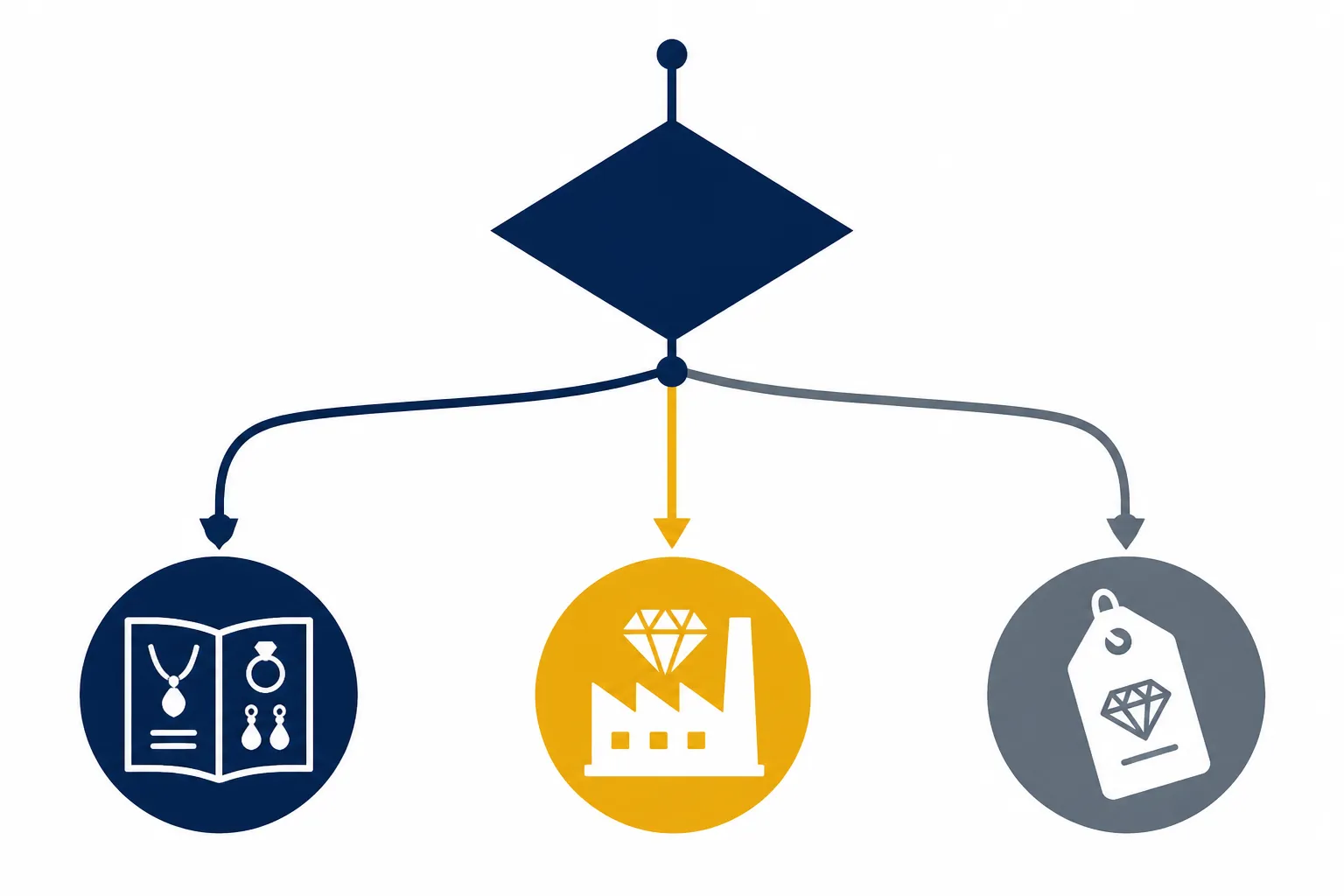
For buyers and importers who are genuinely at the procurement stage, the split is clear. Retail personalization brands — Jewlr, Made By Mary, Jared, Kendra Scott, Kay — are the competitive landscape you're selling into, not the supply chain you're buying from. Their value is as pricing and positioning benchmarks.
The sourcing decision comes down to two questions: what volume can you commit to per style, and do you need true custom OEM or will a vetted stock catalog serve your launch needs?
If you're sourcing drop earrings, stud earrings, necklace-and-earring sets, or crystal and natural stone styles in the 12–500 piece range — with in-house QC, multilingual sales support, and flexible trade terms — contact STRAND directly at strandjewelry.com to request current MOQ tiers, a catalog PDF, and a sample quote. The procurement conversation starts with your target styles and quantities; everything else follows from there.