
Wholesale Jewelry Craft Supplies: A Pro Buyer's Complete Guide
Wholesale Jewelry Craft Supplies: A Pro Buyer's Complete Guide
Wholesale jewelry craft supplies are materials, components, and tools purchased in bulk at trade prices — including findings, chain, beads, wire, clasps, and precious metals — sold to professional jewelers, retailers, and DTC brands at per-unit costs that are substantially lower than retail. For overseas buyers and importers building a consistent product line, accessing the right wholesale network is a foundational business decision.
Sourcing at the wholesale level is not simply about spending less per piece. It determines your production reliability, the consistency of your finishes across seasons, and ultimately the quality signal your end customers receive. Whether you run a DTC jewelry store, manage procurement for a regional retailer, or import for a curated boutique chain, the criteria you apply before placing a wholesale order will define your margins and your reputation.
This guide covers the full picture: what wholesale jewelry craft supplies include, when to move to wholesale, how to vet suppliers, what material categories matter, and what to ask before committing to an order.
What Are Wholesale Jewelry Craft Supplies?
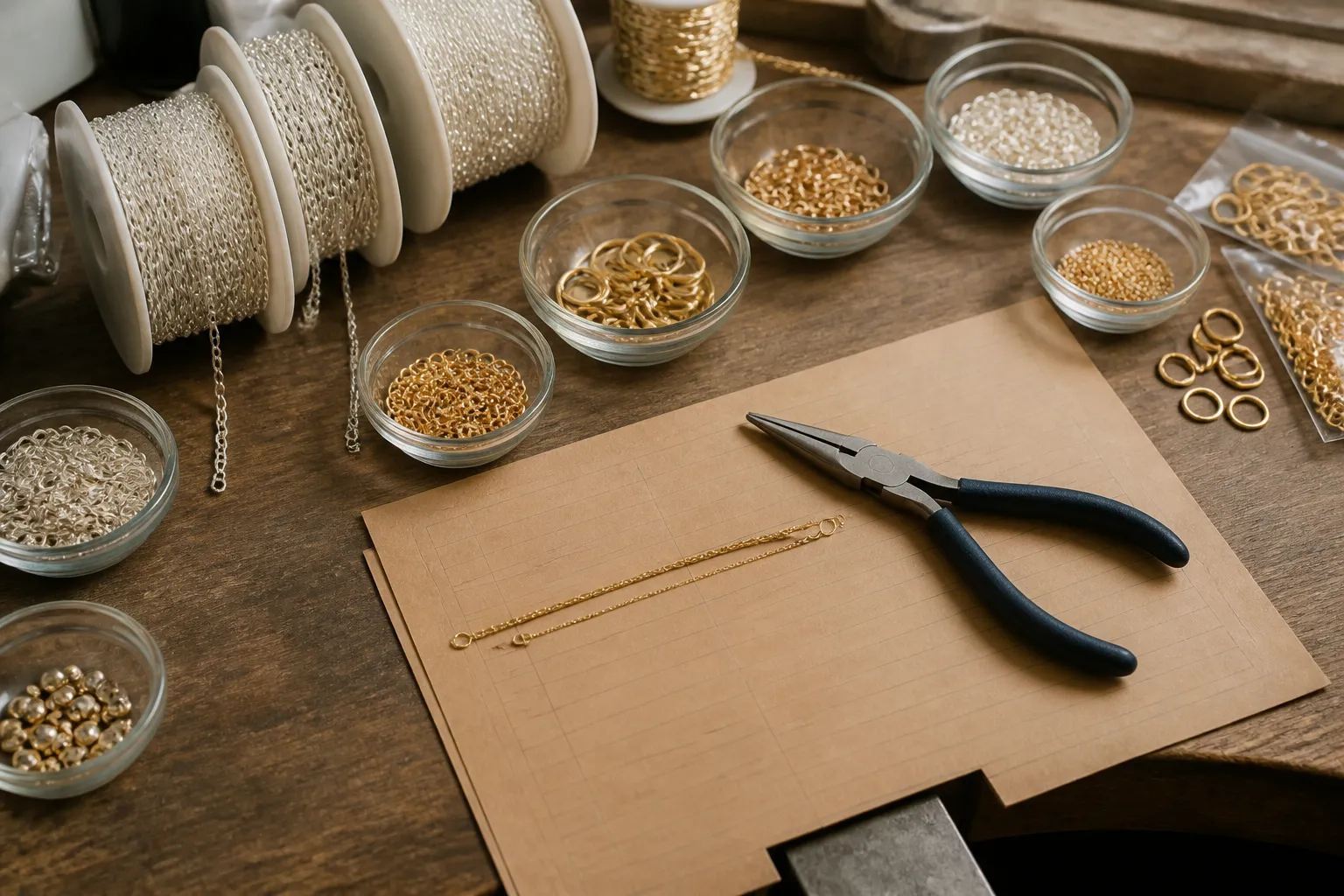
Wholesale jewelry craft supplies span every component a maker or manufacturer needs between raw metal and finished piece. The category is broad, but it falls into a few clear buckets:
- Findings — the functional hardware of jewelry: clasps, jump rings, ear wires, leverbacks, posts, clutches, headpins, crimps, bails, and settings. These are the parts that hold a piece together or allow it to be worn.
- Chain — sold by the foot or in bulk spools, in materials ranging from sterling silver and gold-filled to brass, stainless steel, and oxidized finishes.
- Beads and stringing supplies — including seed beads, semi-precious stones, and components like Soft Flex beading wire and Stretch Magic cord.
- Metals and sheet — raw material inputs: fine silver (.999), sterling (.925), gold-filled, 14-karat gold, copper, brass, and rose gold-filled.
- Tools and consumables — bench tools, solder, metal clay, and finishing supplies.
The scale and specificity of a well-stocked wholesale catalog is considerable. Established suppliers in the industry carry hundreds of SKUs within individual subcategories — one major US supplier lists nearly 370 chain products and more than 340 distinct findings in its catalog alone. For a buyer placing a seasonal assortment order, that depth means you can source a coordinated range without splitting across multiple vendors.
Why Wholesale Sourcing Changes Your Bottom Line
Retail pricing on jewelry components is workable for hobby makers producing small quantities. For any business running production volumes — even modest ones — it creates a margin problem that compounds with every piece you sell.
The math is straightforward. Precious metal spot prices move daily: as of early August 2026, sterling silver trades around $63–64 per troy ounce and gold around $4,344–4,348 per troy ounce. Suppliers who pass that market price through transparently — without adding a surcharge on top of the metal market rate — give buyers a real cost advantage over retail sources that embed margin at every tier. The difference between paying a marked-up retail price and a straight market-indexed wholesale price, across a full season's component orders, is significant.
Beyond price, wholesale sourcing gives you material consistency. If you're producing a line of sterling silver drop earrings with oxidized jump rings across 200 units, you need every jump ring to come from the same finish batch. Retail quantities rarely guarantee that. Wholesale minimums, while real constraints to plan around, exist precisely because they enable the supplier to maintain consistent inventory and batch quality.
For DTC stores and importers in particular, the procurement question is never just "what does it cost?" It is "what can I reliably reorder, and in what time frame?" That reliability question is where a wholesale relationship earns its value.
When Should You Switch to Wholesale?
The right moment to move from retail to wholesale sourcing is earlier than most buyers expect. Three conditions typically signal readiness:
You're reordering the same components repeatedly. If you've purchased the same ear wire style three or four times from a retail source, you're already absorbing retail margin on what should be a commodity input. That's the simplest case for opening a wholesale account.
You're quoting or producing in defined runs. A production run of 50, 100, or 200 units of a single design requires guaranteed component availability. Retail stock is not designed for that kind of reliability. Wholesale accounts give you access to pre-order options and back-order notifications that retail channels don't.
You're selling to other businesses. If you're supplying boutiques, gift shops, or curated retailers, your cost structure has to support both your margin and theirs. That's only viable if your component costs are at wholesale.
One practical note: most legitimate wholesale suppliers require proof of business credentials before granting trade pricing. A state-issued business license or tax ID is the standard requirement. This is a feature, not a hurdle — it means the pricing tiers are protected and the catalog is maintained for trade buyers, not general consumers.

How to Source Wholesale Jewelry Craft Supplies
Sourcing wholesale craft supplies for jewelry production follows a clear sequence. Shortcutting any step tends to create problems downstream — inconsistent quality, unexpected lead times, or components that don't match your existing range.
Step 1: Define your material requirements precisely. Before contacting any supplier, document the exact specifications you need: metal type (sterling, gold-filled, brass), finish (polished, oxidized, matte), gauge (for wire and jump rings), and any dimensional requirements (clasp size in mm, chain link size). Vague requests get vague quotes.
Step 2: Identify suppliers who specialize in your category. A supplier with deep inventory in sterling silver findings will serve a fine jewelry maker differently than one focused on fashion metals or beading supplies. Match the supplier's core competency to your primary material.
Step 3: Apply for a wholesale account and review the terms. Understand the minimum order quantities (MOQ) per SKU, the minimum order value, and any tier-based pricing structures. Also clarify whether metal-market pricing is passed through at cost or marked up — this matters significantly for precious metal components.
Step 4: Request samples before committing to a full order. For findings and chain in particular, physical samples let you verify gauge consistency, clasp action, finish durability, and how the component works with your other materials.
Step 5: Evaluate shipping, lead time, and returns policy. For overseas buyers especially, understanding incoterms, estimated transit times by shipping method, and the supplier's policy on damaged or misrepresented goods is essential before placing an order of meaningful size.
For a broader look at how to evaluate a wholesale jewelry supplier across all these dimensions, The Complete Buyer's Guide to Jewellery Accessories Wholesale covers the vetting framework in depth.
Key Material Categories and What to Evaluate
Not all wholesale jewelry craft supplies carry the same procurement complexity. Here's how the major categories break down and what to assess in each.
Sterling Silver (.925)
Sterling silver is the workhorse of professional jewelry making. It's workable, solderable, widely stocked, and priced at a predictable market rate. When sourcing wholesale, check:
- Purity marking: components should be stamped or certified as .925
- Finish consistency: polished, brushed, and oxidized finishes should be uniform within a batch
- Gauge accuracy: critical for wire and jump rings — a mislabeled gauge affects solder flow and clasp function
Gold-Filled
Gold-filled components offer the appearance and durability of gold at a fraction of the cost of solid gold. They're a practical choice for mid-market DTC brands and are especially relevant for buyers serving MENA markets where gold tone is a strong purchasing signal. Gold-filled is not gold-plated — it has a mechanically bonded gold layer, typically 14-karat, that is significantly more durable. Confirm the micron thickness or the gold layer fraction (standard is 1/20 by weight) with your supplier.
Oxidized and Antique Finishes
Oxidized components — particularly sterling silver and brass — add dimension to bohemian, artisan, and vintage-styled ranges. When sourcing oxidized jump rings or beads at wholesale, consistency across batches is the key variable: oxidation depth and color can vary between production runs if the supplier doesn't control the process tightly.
Findings in Depth
Findings are where catalog depth matters most. A single clasp category can include push-gate clasps in multiple sizes (10mm, 12mm, 14mm are common), lobster clasps in various configurations, toggle clasps, magnetic clasps, and box clasps — each in multiple materials. A well-stocked wholesale supplier gives you the option to build a coordinated system across your full line without sourcing from multiple vendors.
Tools and Consumables
If you're producing in-house, wholesale access to bench tools, solder, and metal clay at trade prices reduces your overhead meaningfully. These are lower-frequency purchases but benefit from the same bulk pricing logic as components.
What to Evaluate Before Placing a Wholesale Order
Price and Market Transparency
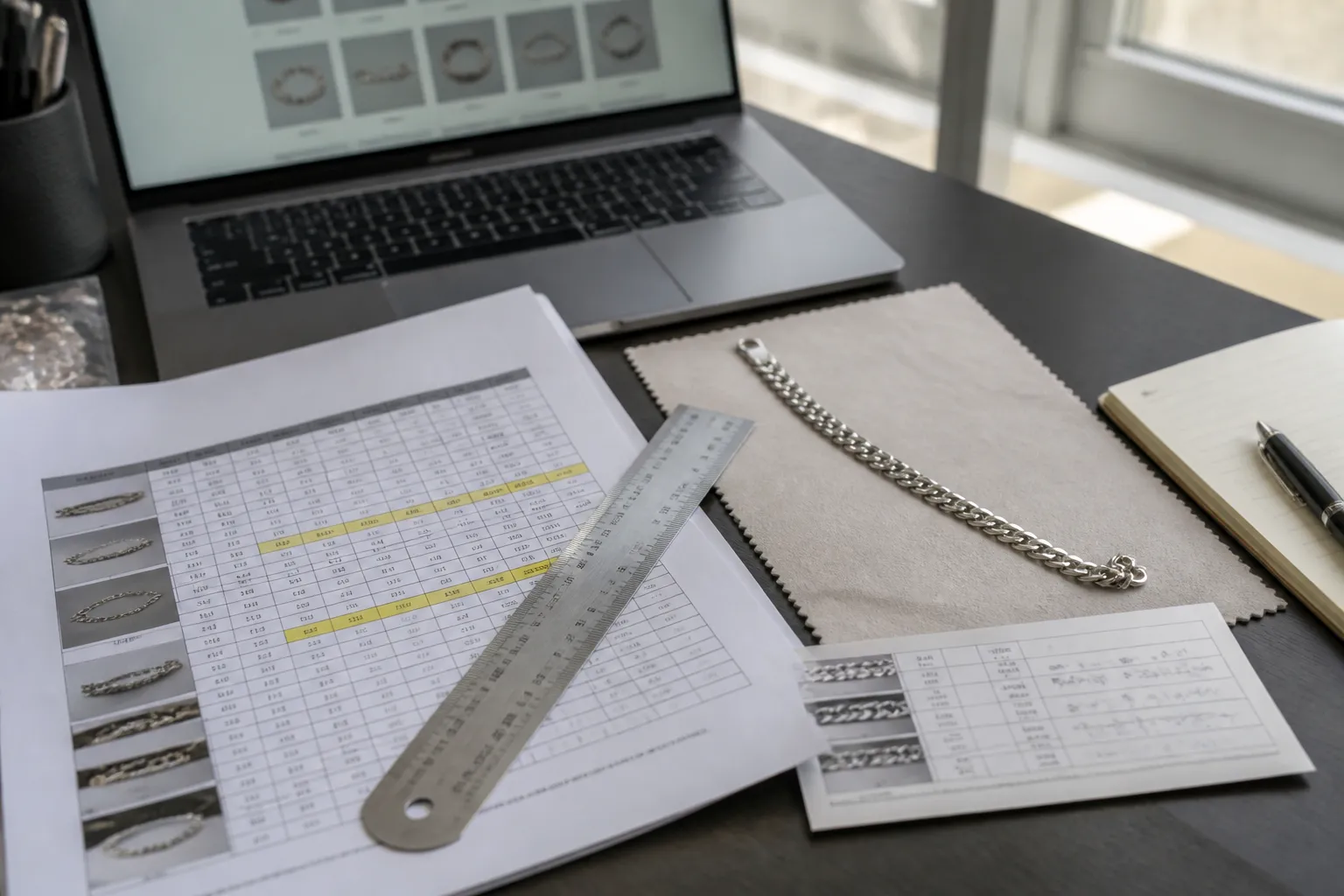
Understand whether the supplier's precious metal pricing is tied to the live spot market or whether it's set at intervals. Suppliers who update pricing daily and pass the market rate through without adding a surcharge give you the most predictable cost structure. Ask specifically: "Do you add a surcharge to the metal market price?"
Minimum Order Quantities
MOQs vary widely by supplier and by product category. A chain supplier may set MOQ by linear footage; a findings supplier may set it by piece count or dollar value. For overseas buyers, consolidating your order above the MOQ threshold for a single shipment — rather than placing several small orders — typically reduces per-unit freight cost substantially.
Lead Time and Shipping Options
For importers, lead time is a planning variable, not an afterthought. Confirm:
- Processing time from order placement to dispatch
- Available shipping methods (air freight, sea freight, courier services) and estimated transit times to your destination
- Whether the supplier has experience shipping to your region and handles customs documentation
Quality Assurance and Returns
A reputable wholesale supplier will have a defined policy for components that arrive damaged, misrepresented, or defective. Before your first large order, ask for this policy in writing. Understand whether returns require pre-authorization, what the timeframe is, and whether replacement or credit is the standard resolution.
Relationship and Communication
Wholesale procurement is a relationship, not a one-time transaction. Suppliers who provide consistent account management — whether by phone, email, or an online portal — are easier to work with as your volume grows. Note the supplier's available communication hours and languages if you're operating across time zones.
Country of Origin and Quality Verification
Country of origin matters for three reasons: import duty rates, compliance standards, and quality consistency expectations in your target market.
Components manufactured in the United States or the European Union are typically produced to consistent purity standards and are easier to certify for markets with strict labeling requirements (like the EU's nickel directive for skin-contact jewelry). Components manufactured in Asia — particularly in established jewelry production hubs — can meet equivalent quality standards, but require supplier verification: request purity testing certificates, batch reports, or third-party quality audits.
For buyers in MENA markets, gold purity is closely scrutinized by end consumers. If you're sourcing gold-filled or gold-plated components, verify the karat of the base gold layer and the plating process with your supplier before making quality claims in your own product listings.
One practical approach: request a first-order sample set covering the components you plan to source most heavily. Test clasps through realistic open-close cycles, check that jump ring gauges match specifications, and assess whether finish consistency holds across units in the same lot. Document your findings before approving the supplier for ongoing orders.
Building a Wholesale Supply Chain That Scales
Most buyers who start sourcing wholesale craft supplies for jewelry begin with one or two core material categories and expand as their volume justifies it. That's the right approach. Spreading your initial wholesale orders across too many suppliers simultaneously makes quality management harder and reduces your leverage with any single vendor.
A more effective pattern: identify your highest-frequency component (usually findings or chain), establish a wholesale account with a supplier who excels in that category, and build a track record. Once you understand that supplier's reliability, lead times, and pricing behavior across seasons, you're in a position to either deepen that relationship or add a second supplier for categories they don't cover well.
For overseas buyers, it's worth building redundancy into your supply chain before you need it. Shipping disruptions, raw material shortages, and seasonal demand spikes can affect even established suppliers. Knowing a secondary source for your most critical components — even if you don't use them regularly — protects your production schedule.
Ready to Source Wholesale Jewelry Craft Supplies?
Building a reliable wholesale supply chain for jewelry craft components takes time and deliberate vetting. The payoff is a cost structure and material consistency that retail sourcing simply cannot offer at scale.
STRAND works with DTC stores, importers, and procurement teams across international markets to supply vetted, crafted jewelry components — not commodity bulk. If you're evaluating suppliers for your next season or looking to consolidate your component sourcing under a single trusted partner, the next step is direct: [contact STRAND] to discuss your material requirements, preferred finishes, and order volumes.
For a comprehensive framework on evaluating any wholesale jewelry accessories supplier, read The Complete Buyer's Guide to Jewellery Accessories Wholesale — it covers sourcing criteria, supplier red flags, and how to structure your first wholesale order from end to end.
The market prices referenced in this article (sterling silver ~$63–64/oz, gold ~$4,344–4,348/oz) reflect publicly available spot rates as of early August 2026 and will fluctuate with live market conditions.
Frequently Asked Questions
What is wholesale jewelry craft supplies?
Wholesale jewelry craft supplies are materials and components — such as gemstone beads, metal findings, wire, chains, clasps, and stringing materials — purchased in bulk quantities at reduced per-unit costs, intended for jewelry designers, independent retailers, and importers who produce or resell finished pieces. For overseas buyers, sourcing wholesale allows consistent access to vetted, repeatable materials across production runs, with MOQs typically starting from 50–500 units per SKU depending on material and supplier. STRAND sources and curates these components with attention to material integrity and finish quality, making them suitable for both DTC brands and procurement teams building reliable supplier relationships.
How to wholesale jewelry craft supplies?
To wholesale jewelry craft supplies through STRAND, buyers typically start by submitting a trade inquiry specifying materials (e.g., 925 sterling silver findings, semi-precious stone beads, brass components), target quantities, and intended use — MOQs generally begin at 100–500 units per SKU depending on material and finish. Orders are fulfilled with standard lead times of 15–30 days for stocked components or 45–60 days for custom-sourced materials, with shipping available via DHL, FedEx, or sea freight for larger consignments. Procurement teams and importers are encouraged to request a curated sample set first to verify quality, dimensions, and finish consistency before committing to bulk orders.
Why is wholesale jewelry craft supplies important?
Wholesale jewelry craft supplies are essential for DTC stores, importers, and procurement teams because they provide consistent access to vetted materials — beads, findings, chains, wire, and semi-precious components — at volume pricing that preserves healthy margins without sacrificing quality. For overseas buyers, sourcing through a trusted wholesale partner like STRAND reduces lead times, simplifies logistics, and ensures material traceability across SKUs. This reliability is especially critical when fulfilling large or repeat orders where consistency in metal tone, stone grade, and finish directly impacts end-customer satisfaction and brand reputation.
When should I use wholesale jewelry craft supplies?
Wholesale jewelry craft supplies are the right choice when you're sourcing at volume for consistent production runs — whether you're a DTC store building a seasonal collection, an importer fulfilling recurring retail orders, or a procurement team managing multi-SKU inventory across markets. STRAND recommends committing to wholesale when your order cadence justifies MOQ thresholds (typically starting at 50–200 units per SKU depending on material: brass findings, sterling components, semi-precious strands, or enamel charms), as this is where per-unit cost and lead time advantages become material. It's also the strategic tier when you need supply chain reliability — consistent specifications on dimensions, plating depth, and finish — rather than one-off samples.
What are the benefits of wholesale jewelry craft supplies?
Purchasing wholesale jewelry craft supplies through STRAND allows DTC stores, importers, and procurement teams to secure consistent, vetted materials — such as sterling components, brass findings, and semi-precious beads — at volume pricing that meaningfully improves per-unit margins without compromising on quality. Wholesale access also ensures supply chain reliability, with predictable lead times and scalable MOQs that support both small-batch artisan runs and larger seasonal orders. Additionally, sourcing from a curated wholesale partner reduces the risk of material inconsistencies, giving buyers confidence in finish, gauge, and provenance across repeat orders.