
Wholesale Jewellery Making Supplies: The Complete Buyer's Guide
Wholesale Jewellery Making Supplies: The Complete Buyer's Guide
Sourcing quality wholesale jewellery making supplies is the single decision that determines whether your production margins hold or collapse. Whether you run a DTC jewellery brand, import finished components, or manage procurement for a retail chain, buying at wholesale prices — with the right supplier — cuts your material costs substantially while giving you access to professional-grade metals, findings, and components that retail craft stores simply do not stock.
This guide covers everything you need: what wholesale jewellery making supplies actually include, how to evaluate suppliers, when the wholesale model makes sense for your operation, and the procurement criteria most buyers overlook until their first order goes wrong.
Quick definition (for buyers researching options): Wholesale jewellery making supplies are professional-grade metals, findings, chain, beads, and tools sold in bulk quantities to businesses and trade buyers at below-retail pricing — typically sourced direct from distributors rather than through retail intermediaries, with access gated by business credentials.
What Are Wholesale Jewellery Making Supplies?
Wholesale jewellery making supplies are the raw materials, structural components, and professional tools that jewellery makers and businesses buy in volume at trade pricing. The category is broader than most new buyers expect.
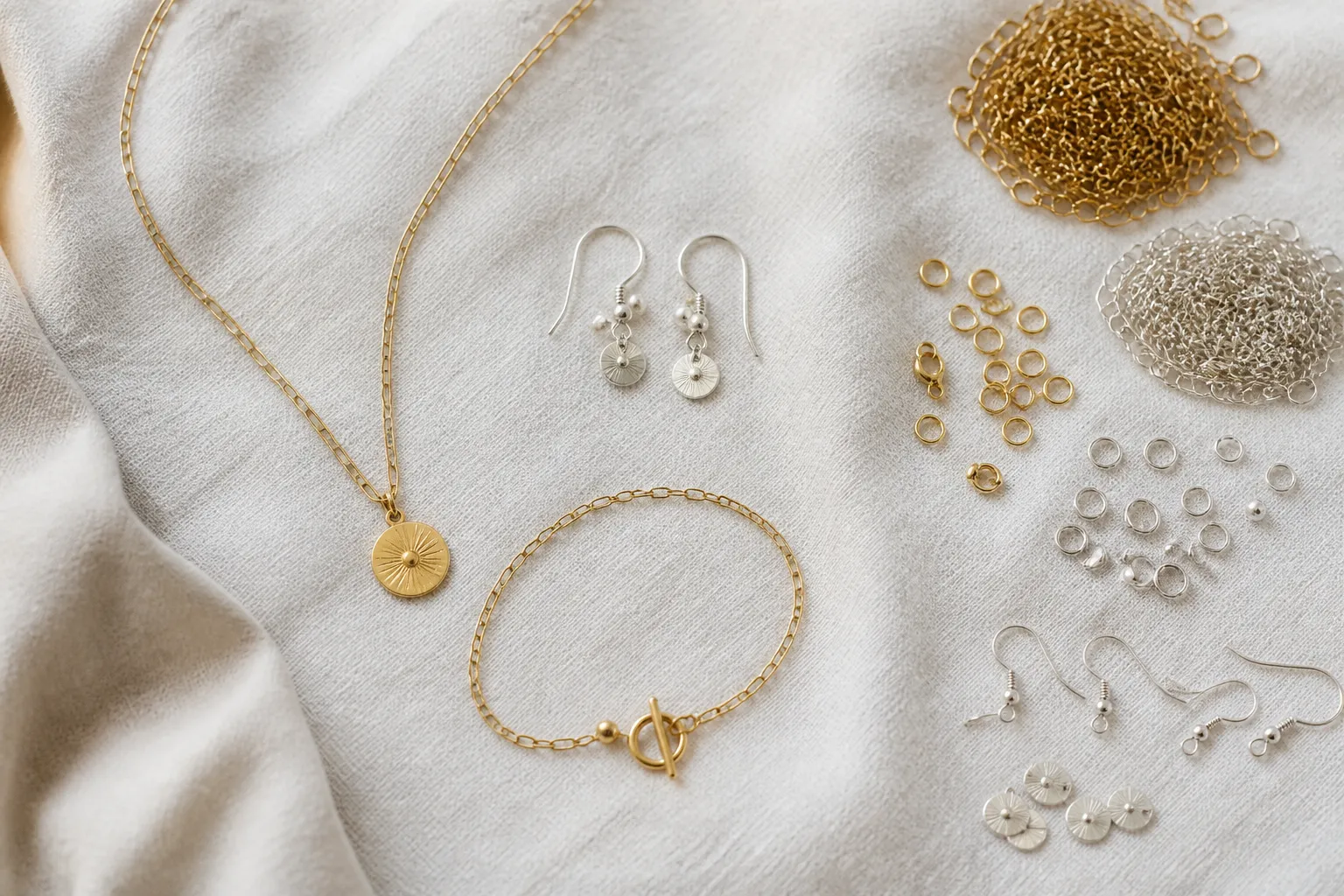
At its core, it divides into six pillars:
- Metals and wire — sterling silver, gold-filled (yellow and rose), 14 karat gold, copper, brass, stainless steel, and fine 999 silver, available in sheet, wire, and rod form
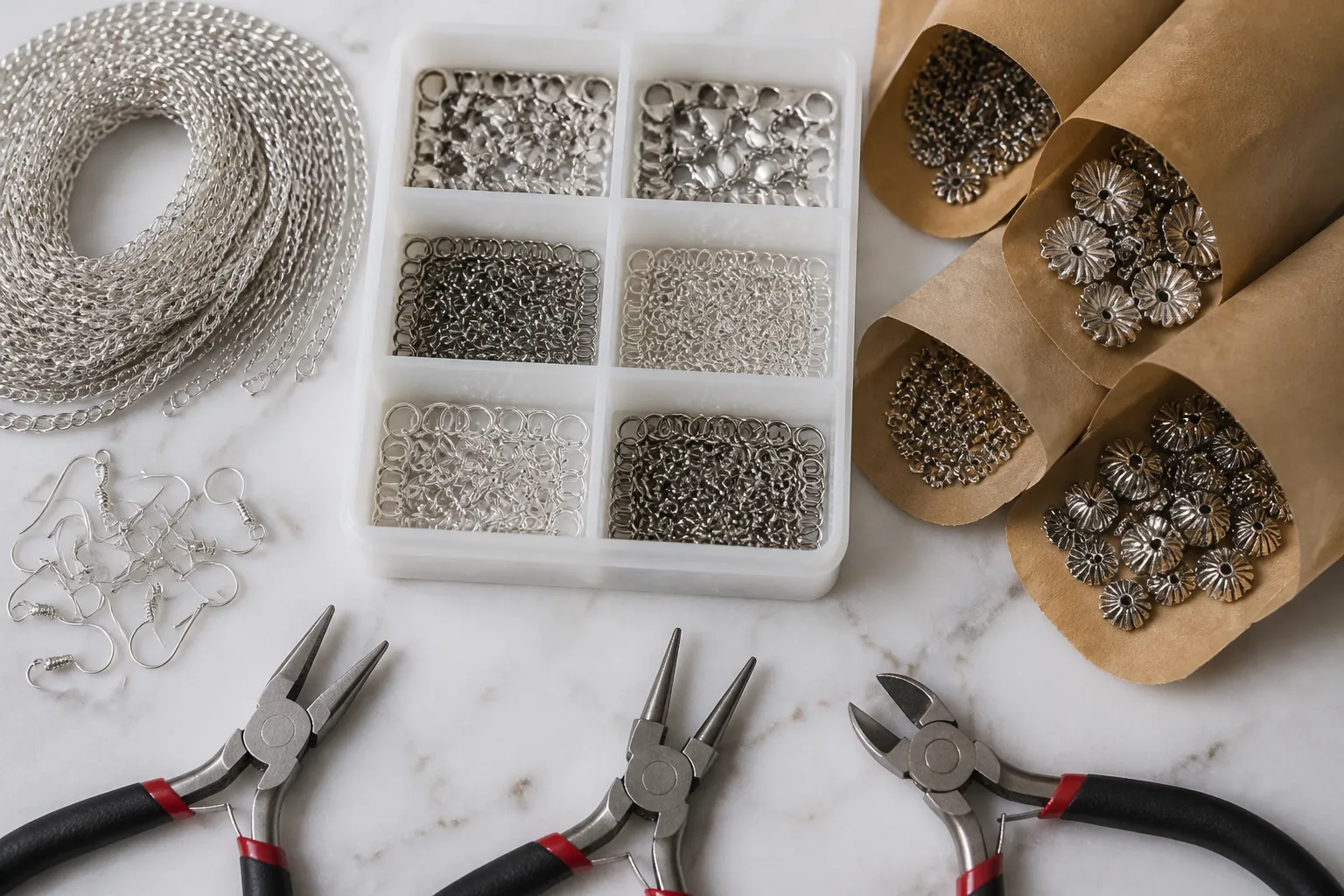
- Findings — clasps, jump rings, ear wires, lobster claws, toggle sets, crimp beads, and pin backs; the functional hardware that holds every piece together
- Chain — cable, curb, rolo, figaro, box, satellite, and specialty styles, sold by the foot or in spooled footage
- Beads, caps, and accent pieces — metal spacers, bead caps, and decorative components that complement hand-fabricated elements
- Charms and pendants — cast or stamped decorative components sourced as blanks or finished shapes
- Tools and specialty supplies — pliers, mandrels, burnishers, beading wire, stretch cord, and permanent jewellery equipment
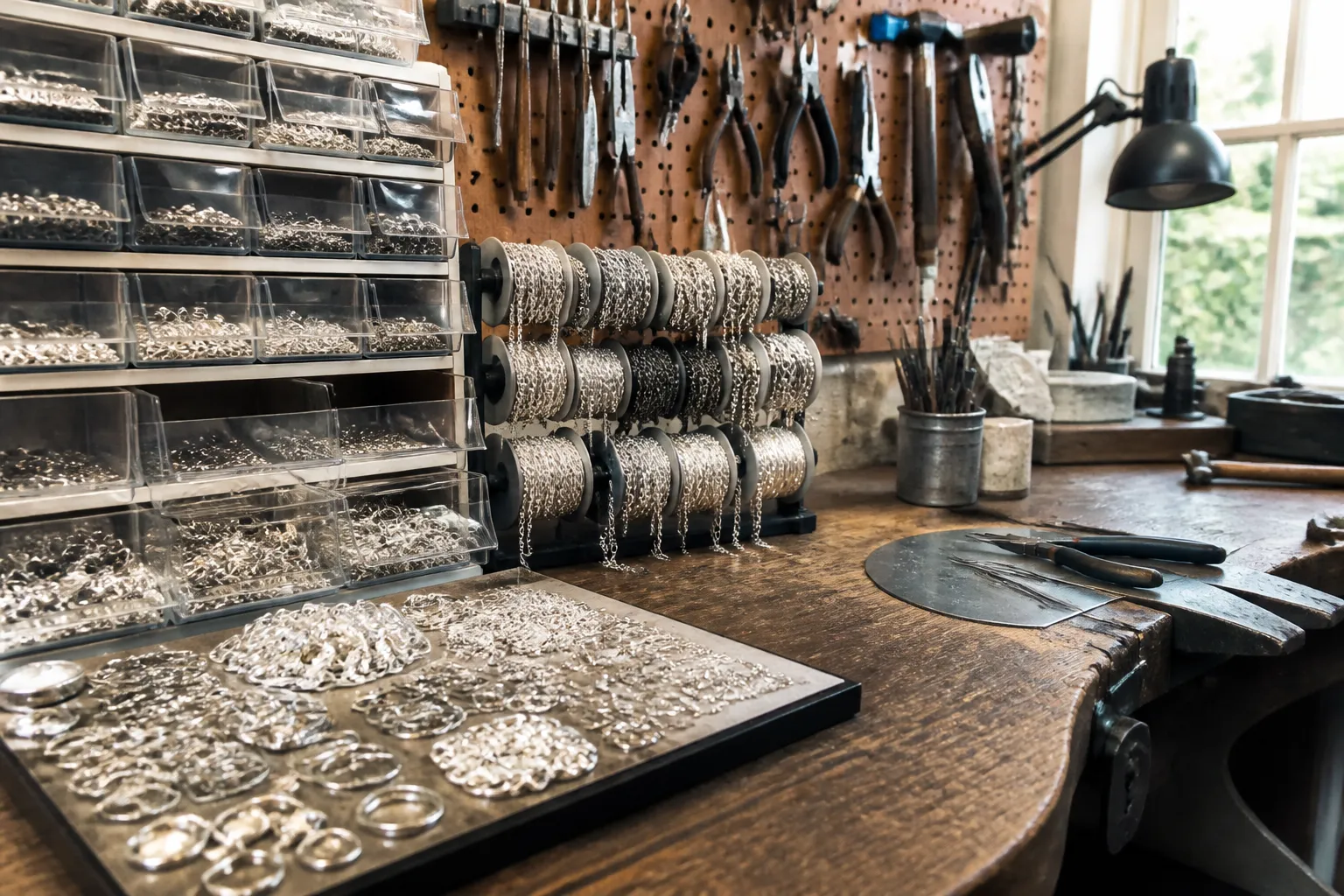
Established wholesale distributors with over 50 years in the trade carry product ranges spanning all these categories simultaneously — in some cases running to 800+ SKUs in sterling silver alone across chains, findings, earring components, rings, and bracelets. That depth matters when building a consistent collection: sourcing chain, findings, and clasps from a single vetted distributor reduces inconsistencies in metal tone, alloy finish, and gauge specification across a production run.
The Core Categories: What You Can Source at Wholesale
Understanding the full scope of available categories helps you consolidate sourcing and negotiate better terms. Here is how experienced buyers think about each pillar.
Precious and Base Metal Components
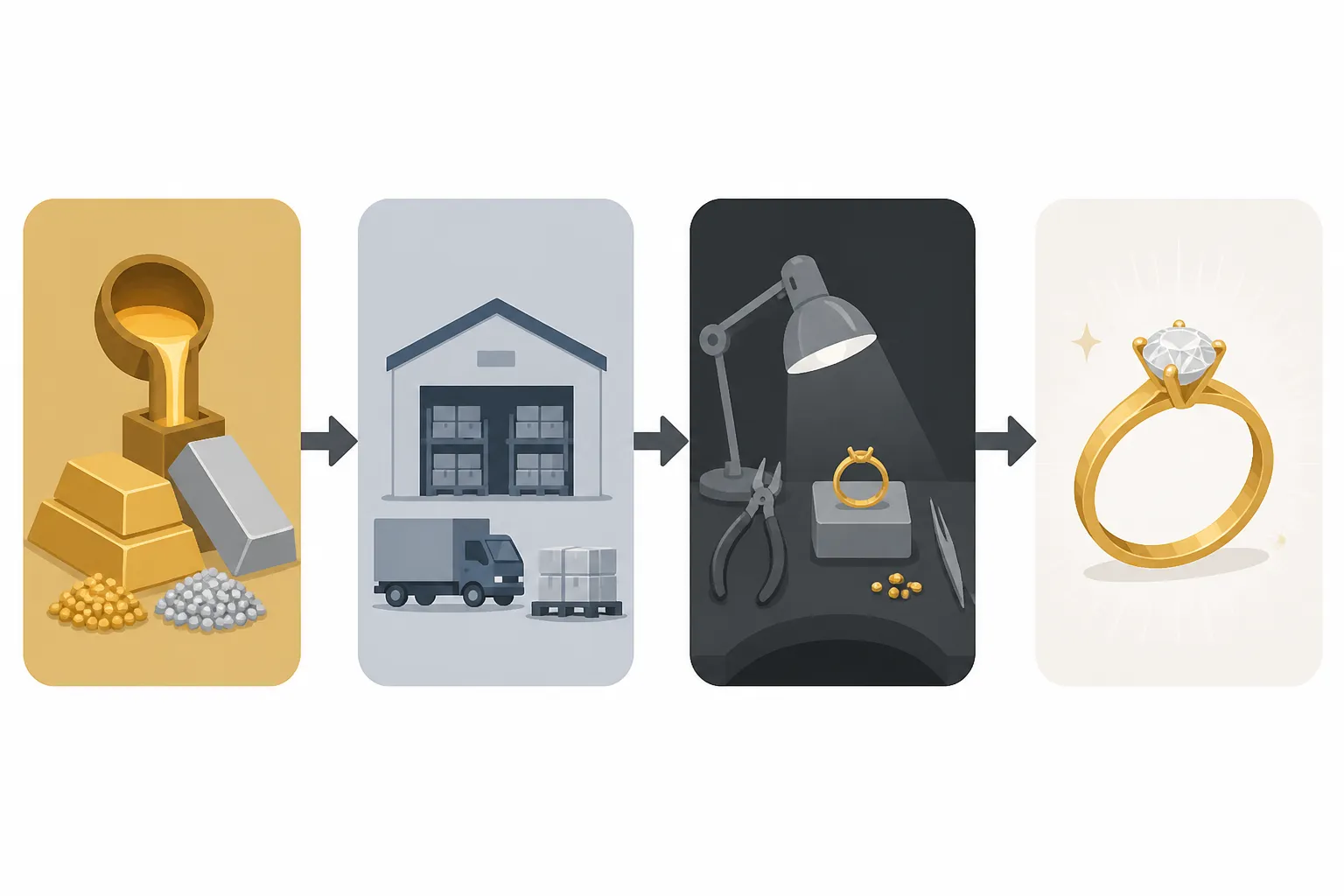
This is where alloy specification matters most. Sterling silver (92.5% silver / 7.5% copper alloy) and gold-filled (a mechanical bond of gold over base metal — categorically different from electroplating) are the workhorses of professional jewellery production. Precious metal components are priced against live commodity markets: in early August 2026, silver was trading in the $63 per troy ounce range and gold above $4,300 per troy ounce. Your supplier's pricing transparency is therefore critical — distributors who pass through the raw market rate without a surcharge give you a cleaner landed cost model.
Materials commonly available at wholesale include: sterling silver, gold-filled (yellow and rose), 14 karat gold, copper, brass, stainless steel, oxidized finishes, and specialty options like fine 999 silver, metal clay, and 24 karat gold.
Findings
Findings are the functional backbone of any piece. A low-grade lobster clasp or an inconsistent ear wire undermines the finest handmade component above it. Wholesale findings suppliers stock hundreds of SKUs across every closure type, gauge, and finish. A critical detail many buyers miss: verify that your findings alloy matches your other components. Mixing incompatible metals — for example, sterling silver findings with gold-plated chain — creates galvanic corrosion risk over the product's lifetime.
Chain
Chain is sold by the foot or by the spool, and the variety available through a professional wholesale distributor far exceeds anything found in retail. Cable, curb, rolo, figaro, box, satellite, twisted, satellite bead — each in multiple gauges and multiple metals. Sourcing chain wholesale means you're not constrained to pre-cut lengths, giving you full control over finished necklace and bracelet dimensions and the ability to cut custom lengths for each design.
Beads, Charms, and Decorative Components
For collections that incorporate mixed-element design, wholesale beads, charms, and accent pieces complete your material sourcing. Metal bead caps in matched finishes, round spacers, decorative pendants, and cast charms can typically be sourced alongside your findings from the same distributor — reducing the number of vendor relationships you need to manage and ensuring finish consistency across your components.
Specialty and Permanent Jewellery Supplies
Permanent jewellery — laser-welded or micro-welded bracelets and chains — has become a significant service offering for independent studios. Specialist wholesale distributors stock the dedicated micro-welding equipment, compatible footage chain, and connecting components required. Professional beading wire and stretch cord supplies round out the specialty category for bead-and-wire construction styles.
How to Source Wholesale Jewellery Making Supplies the Right Way
Sourcing wholesale jewellery making supplies is a procurement process, not a shopping trip. Done correctly, it delivers cost certainty, supply continuity, and material consistency. Done poorly, it produces off-spec components and delayed production cycles.
Step 1: Qualify as a Wholesale Buyer
Most legitimate wholesale distributors gate trade pricing behind business credential verification. This means a state-issued business licence, a resale certificate, a VAT registration (for international buyers), or a registered trade name. Some US-based distributors explicitly provide wholesale pricing only to customers who supply verified business credentials. Prepare this documentation before approaching suppliers — it signals that you are a commercial buyer, not a hobbyist, and expedites account approval.
Step 2: Evaluate Supplier Depth and Specification Consistency
A supplier who carries 800+ sterling silver products and 500+ gold-filled items across chains, findings, earrings, and charms can fulfill a complex collection without forcing you to split sourcing across multiple vendors. Single-source procurement reduces quality variance between components and simplifies reordering. When evaluating a new supplier, request their full product catalogue and confirm that the materials they carry match the alloy specifications your designs require.
Step 3: Understand How Metal Market Pricing Works
Precious metal components are priced against daily commodity benchmarks. When evaluating suppliers, ask specifically whether they apply a surcharge on top of the spot market price — suppliers who pass through the market rate directly, without added margin, give you more accurate cost models and better protect you from opaque markups. Some distributors publish their daily metal market price openly so buyers can verify against commodity benchmarks in real time.
For a comprehensive breakdown of how to assess different supplier types, evaluate wholesale terms, and build a reliable purchasing relationship, The Complete Buyer's Guide to Jewellery Accessories Wholesale covers the full qualification process in detail.
Step 4: Place Sample Orders Before Volume Commitments
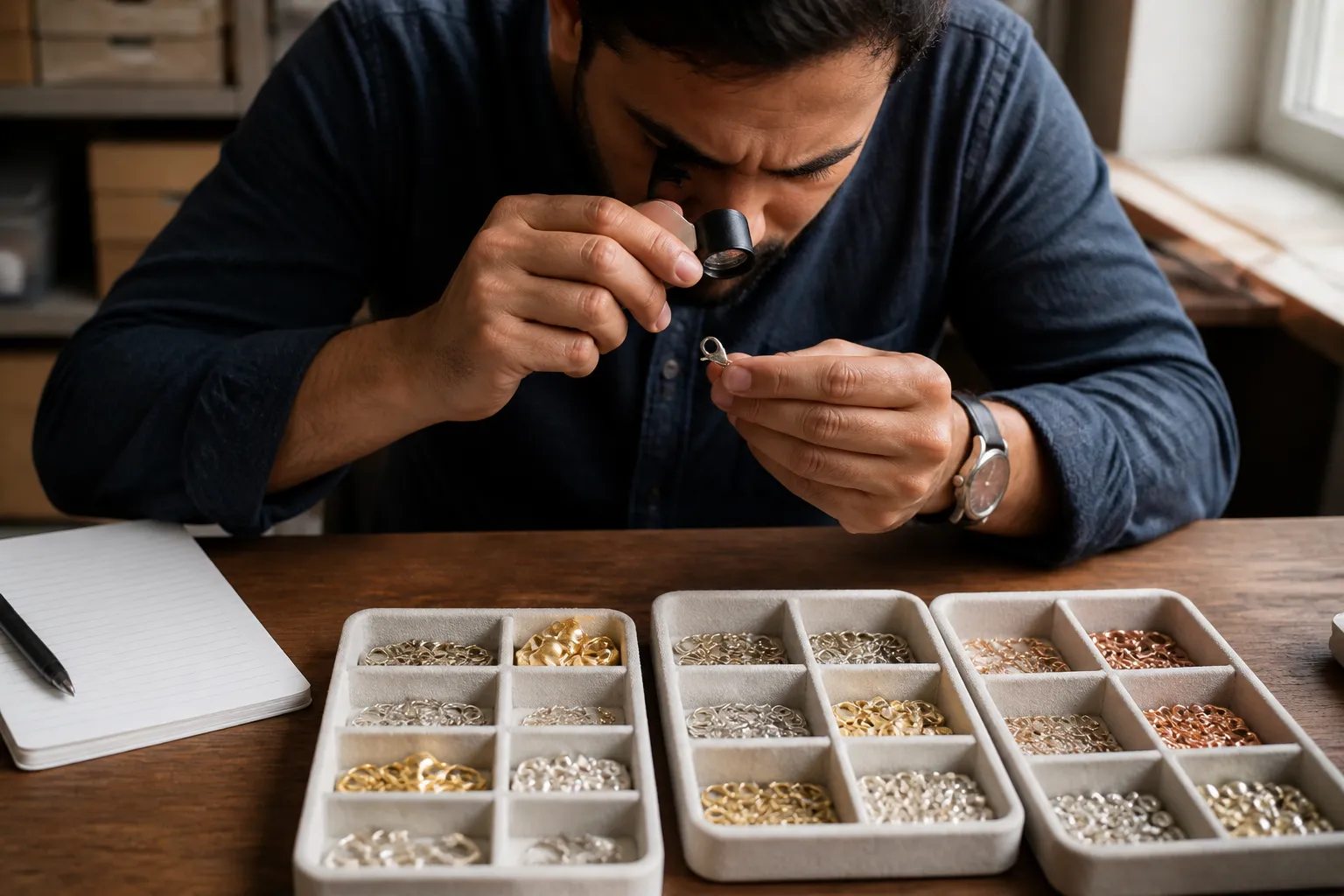
Before committing to bulk quantities, order samples of your critical components — particularly findings and chain. Check gauge consistency across a batch of jump rings. Test clasp strength and spring tension on lobster claws. Examine chain link spacing under a loupe. None of these failure points appear in a product listing. All of them surface in a sample, and discovering them before a volume order saves significant cost and delay.
Why Wholesale Jewellery Making Supplies Matter for Your Business
The margin case for wholesale is direct. Retail craft store pricing for sterling silver findings can run three to five times the cost of the same component sourced at trade from a professional distributor. That gap compounds across every piece in your collection and every production run.
The benefits of wholesale jewellery making supplies extend beyond unit price, though:
Consistency at scale. Retail purchases often vary between batches — different finish lots, slightly inconsistent gauges, variable plating thickness. Wholesale distributors who serve professional jewellers maintain tighter specifications across bulk shipments. That consistency matters when you're producing 50 or 500 units of the same design and expect uniform appearance across the collection.
Access to professional material grades. The sterling silver chain available from a wholesale jewellery supply distributor is not the same product sold in craft retail chains. Professional-grade sterling carries consistent hallmarking, tighter gauge tolerances, and documented alloy composition — documentation you can share with buyers and stockists who ask about material traceability.
Supply security and reorder reliability. A retail shelf can go out of stock and not reorder for weeks. Wholesale distributors who have served the professional jewellery trade for decades maintain deep inventory in their core SKUs precisely because their professional customers cannot tolerate supply gaps mid-production.
Business credibility. Buyers, stockists, and procurement teams who inspect your production quality will ask about your material sources. Sourcing from established wholesale jewellery supply distributors gives you credible, specific answers about alloy composition and material standards — a meaningful differentiator when pitching to quality-conscious retailers.
When Does Wholesale Make Sense?
The timing question is practical: wholesale is the right model when your production volume justifies it and your planning horizon can absorb minimum order quantities without tying up disproportionate working capital in inventory.
You're producing consistent collections, not one-off experiments. If your output is fewer than 10–15 pieces per month across a range of different designs, retail sourcing may remain more efficient when you account for capital tied up in bulk inventory. Once you're producing consistent small-batch runs — even 20–50 pieces of key designs — wholesale economics start to work.
You've validated your designs at sample scale. Commit to wholesale volumes only for components you have already tested in finished pieces. A finding that looks right in a product photo can fail in assembly or wear. Validate first, then order volume.
You have proper storage capacity. Bulk wire, footage chain, and findings require organized, climate-appropriate storage — ideally temperature-stable and humidity-controlled to prevent tarnishing of sterling silver. Be realistic about what you can store properly; degraded material through poor storage eliminates the cost advantage of wholesale pricing.
You're approaching a defined production deadline. Lead times matter more in wholesale than retail. Build in a realistic buffer for order processing, shipping transit, and customs clearance. For international wholesale orders from North American or European distributors, buyers in the MENA region and Asia should typically factor two to four weeks minimum — longer for peak season or high-demand periods.
Your hero SKUs are established. Wholesale makes the most sense for the components that appear across your bestselling pieces — the chain your customers reorder, the clasp style that defines your brand. One-off or experimental components can still be sourced retail or on demand; reserve wholesale commitments for what you know you'll use.
What to Evaluate Before Placing Your First Wholesale Order
These are the procurement dimensions that experienced buyers work through before committing to a new supplier. Run through each one before you reach out or place a first order.
Price and Availability
Wholesale pricing should reflect a meaningful discount over retail — the exact discount varies by category and volume tier, so ask for a tiered pricing sheet upfront. For precious metal components, confirm whether your supplier updates pricing against the daily commodity market and whether they can offer price-lock options for large forward orders. Equally important: confirm that your specific required SKUs are in stock in the quantities you need. A competitive price on a perennially out-of-stock component is not a procurement solution.
Shipping and Lead Time
Confirm origin location, available carriers, international tracking capability, and standard processing time from order to dispatch. For international buyers, add customs clearance time — typically 3–10 business days depending on destination country and commodity classification. Ask whether your supplier issues commercial invoices with accurate HS commodity codes and declared values for jewellery components. This matters directly for import duty calculation and customs clearance speed.
Alloy Specification and Quality Documentation
Request a spec sheet or certificate of composition for your key materials before ordering volume. Sterling silver should be documented as 925 alloy. Gold-filled should specify the karat of the gold layer and the bonding method. Plated components should declare the plating thickness in microns and the base metal. If a supplier cannot or will not provide this documentation, that is a significant red flag — legitimate professional wholesale distributors provide it as standard.
Returns and Defect Policy
Establish the supplier's defect and returns policy before your first order. Professional wholesale suppliers in the jewellery trade typically accept returns on demonstrably defective items within a defined window after receipt. Get the terms in writing. Understand whether defect claims require return of the full batch or can be handled per-unit. A clear policy protects your margins when (not if) a component batch arrives below specification.
Minimum Order Quantities
MOQs vary significantly. Some distributors set a minimum by total order value (for example, a dollar-value threshold per order); others set minimums per SKU by quantity. Know your supplier's MOQ structure upfront — ordering below minimum often triggers retail pricing, which eliminates the wholesale advantage entirely. Ask whether first-order sample minimums differ from standard replenishment minimums.
How STRAND Approaches Wholesale Jewellery Making Supplies
STRAND's procurement model is built around the criteria above. Every material and component in the STRAND range is sourced from vetted wholesale suppliers with documented alloy specifications, consistent finish standards, and established lead time reliability. That foundation translates directly into consistent quality for overseas buyers — DTC stores, importers, and procurement teams — who need dependable reorder performance across production cycles.
STRAND carries findings, chain, and component-level supplies appropriate for professional jewellery making, spanning sterling silver, gold-filled, and select base metals. For buyers sourcing for the MENA market, STRAND stocks gold-tone components suited to both traditional and contemporary jewellery aesthetics — pieces that align with regional preferences for warm gold tones and understated elegance without compromising on material integrity.
If you are evaluating STRAND as a wholesale source for your next production run, [Contact the supplier] to discuss your specific component requirements, MOQ thresholds, lead time expectations, and current material availability. The team can provide confirmed pricing and availability against your exact specification list.
What Serious Buyers Do Next
Wholesale jewellery making supplies are not a shortcut to profitability — they are a professional infrastructure decision that pays off when approached systematically. The buyers who extract the most value from wholesale sourcing share a few common habits: they qualify their supplier relationships before committing to volume, they test components in finished pieces before scaling, and they evaluate every supplier against the same core criteria — price transparency, alloy documentation, lead time reliability, and a clear defect policy.
Start with your highest-volume components. Identify the chain, findings, or wire that appears across your entire current collection. Qualify as a business buyer with your target supplier, request samples of those specific components, evaluate them against your quality standard, then place your first wholesale order with defined reorder triggers built in.
To deepen your understanding of the broader wholesale jewellery sourcing landscape — including how to evaluate suppliers for finished accessories alongside raw components — read The Complete Buyer's Guide to Jewellery Accessories Wholesale.
Ready to take the next step? [Contact the supplier] with your component list and target quantities — and let STRAND confirm what's available, what lead times look like, and what trade pricing applies to your order.
Frequently Asked Questions
What is wholesale jewellery making supplies?
Wholesale jewellery making supplies are bulk quantities of raw materials and components — such as semi-precious stone beads, sterling silver or gold-filled findings, chains, clasps, wire, and stringing materials — sourced at trade pricing for use in jewellery production. Buyers include independent designers, DTC brands, importers, and procurement teams who require consistent quality and reliable supply across repeated orders. STRAND sources and vets these components with attention to material integrity, finish quality, and supplier traceability, so buyers can build production runs with confidence rather than gambling on inconsistent bulk stock.
How to wholesale jewellery making supplies?
To wholesale jewellery making supplies, connect directly with vetted manufacturers or distributors who offer transparent MOQs (typically starting at 50–500 units per SKU), clear lead times (commonly 2–6 weeks), and reliable international shipping options such as DHL, sea freight, or FOB terms. Prioritize suppliers who provide detailed material specifications — 925 sterling silver, 14K gold-fill, surgical steel, brass with e-coating — so you can confidently communicate quality to your end buyers. STRAND simplifies this process by curating craft-grade components across findings, chains, beads, and semi-precious stones, with consolidated ordering designed for importers and procurement teams sourcing at scale.
Why is wholesale jewellery making supplies important?
Wholesale jewellery making supplies are essential for DTC stores, importers, and procurement teams because they enable consistent access to vetted materials — beads, findings, chains, wire, and clasps — at volume pricing that supports healthy margins without compromising on craftsmanship. For buyers building a reliable product line, sourcing from a trusted wholesale partner like STRAND ensures dimensional consistency, predictable lead times, and MOQ structures that align with seasonal purchasing cycles. This supply stability is especially critical when serving discerning markets that expect quality-forward, repeatable designs rather than inconsistent one-off components.
When should I use wholesale jewellery making supplies?
You should use wholesale jewellery making supplies when producing at consistent volume — whether fulfilling recurring retail orders, building seasonal collections, or stocking a DTC store — as buying in bulk significantly reduces per-unit material costs and ensures batch-to-batch consistency in components like findings, chains, and stones. Wholesale sourcing is also the right move when you need to standardize specifications (gauge, plating thickness, stone grade) across a product line, which is essential for importers and procurement teams managing quality control at scale. STRAND recommends engaging wholesale supply channels once your order cadence justifies MOQ thresholds, typically when you're placing repeat orders and need reliable lead times to protect your inventory pipeline.
What are the benefits of wholesale jewellery making supplies?
Purchasing wholesale jewellery making supplies allows DTC stores and importers to significantly reduce per-unit material costs, improving margins without compromising on quality — particularly when sourcing vetted components such as sterling silver findings, brass stampings, semi-precious beads, or gold-filled wire in volume. Wholesale access also ensures supply consistency across production runs, which is critical for procurement teams managing repeat orders with predictable MOQs and lead times. For STRAND partners, this means reliable access to curated, craft-grade materials that support both small-batch artisan work and larger catalog commitments.
Three links inserted:
- Link #1 (92%) —
professional-grade metals, findings, and componentsin the opening paragraph, linking to the Wholesale Jewelry Craft Supplies guide. - Link #2 (86.6%) —
The Complete Buyer's Guide to Jewellery Accessories Wholesalein Step 3, converting the existing plain-text reference into a hyperlink. - Link #3 (80.1%) —
earring componentsin the "What Are Wholesale Jewellery Making Supplies?" body paragraph, linking to the hoop earrings sourcing guide.