
White Gold Hoop Earrings: The Cross-Border Buyer's Sourcing Guide
White Gold Hoop Earrings: The Cross-Border Buyer's Sourcing Guide
White gold hoop earrings occupy a unique and commercially powerful position in the global fashion jewelry market. They straddle the line between accessible everyday wear and occasion-worthy elegance — which is precisely why buyers, importers, and DTC store owners in the US, EU, UK, and MENA regions return to them season after season. But sourcing white gold hoop earrings across borders, at scale, with consistent quality, is a different discipline entirely from browsing a retail catalog. This guide is written for procurement professionals and DTC operators who need to understand the product deeply before they place an order.
The Cross-Border Fashion Jewelry (DTC + OEM) Reality
The cross-border fashion jewelry supply chain is built on a deceptively simple premise: source from manufacturing clusters in China (primarily Yiwu, Guangzhou, and Hangzhou), then fulfill into Western and Gulf markets where consumers are willing to pay a meaningful margin above cost. In practice, the execution involves navigating currency fluctuations, lead time compression, customs classifications, retailer compliance requirements, and the ever-shifting demands of social-media-driven trend cycles. White gold hoop earrings — whether rhodium-plated brass, white-gold-filled, or vermeil — sit at the intersection of all these pressures.
For DTC operators running Shopify or WooCommerce storefronts targeting US and EU consumers, white gold hoops function as anchor SKUs: high search volume, strong conversion intent (buyers searching specifically for "white gold hoop earrings" are close to purchase), and natural upsell pairing with necklaces and stud sets. For importers supplying boutiques, department stores, or regional distributors across the MENA and UK markets, the same product must meet different compliance thresholds, packaging standards, and quality expectations. A single SKU might need to move through five different regulatory contexts before it reaches the end consumer.
OEM and private-label buyers add another layer of complexity. When a buyer in Dubai or London wants white gold hoop earrings under their own brand, they need not just a product but a supplier capable of executing on finish specifications, hallmarking preferences, custom packaging, and low minimum order quantities without sacrificing unit economics. The gap between what generic wholesale platforms advertise and what a serious cross-border jewelry operation actually requires is where most sourcing challenges originate.
Why Generic Solutions Fall Short for Cross-Border Fashion Jewelry
Off-the-shelf wholesale sourcing — browsing Alibaba listings, placing a test order, repeating at volume — fails the cross-border jewelry operator in predictable ways. The core issue is that white gold hoop earrings are a finish-sensitive product. The difference between a rhodium plating that holds its white gold appearance through six months of daily wear and one that yellows within three weeks is invisible in a product photo and undetectable in a spec sheet. It shows up only in returns, chargebacks, and Trustpilot reviews.
Generic platforms also cannot serve the multilingual, multi-market reality of serious cross-border buyers. A procurement team sourcing for a UK importer, a UAE boutique chain, and a US DTC brand simultaneously needs a supplier who can handle English compliance documentation, Arabic product labeling requirements, and Spanish-language catalog sheets — not one who routes every non-English inquiry into a chatbot queue. The operational friction of managing these translations and regulatory adaptations through a middleman adds cost and delay that erodes margin.
Finally, trend responsiveness is non-negotiable. White gold hoop earrings cycle through micro-trend variations — chunky tube hoops, open-front hoops, huggie-style hoops, twisted wire hoops — faster than most factory-facing catalogs update. A buyer who locks into a generic supplier's existing inventory is always one season behind. The DTC operator specifically needs a manufacturing partner capable of moving from a Pinterest reference image to a production-ready sample inside a commercially viable timeline.
Core Use Cases: White Gold Hoop Earrings in Practice
1. DTC Brand Building: Anchor SKU Strategy
The problem: A DTC jewelry brand launching or scaling its US storefront needs a high-intent, search-driven product that converts browsers into buyers and anchors a broader earring collection. White gold hoop earrings consistently rank among the highest-volume jewelry search terms in the US and EU, making them a logical cornerstone — but only if the product quality matches the premium positioning the brand needs to sustain its AOV.
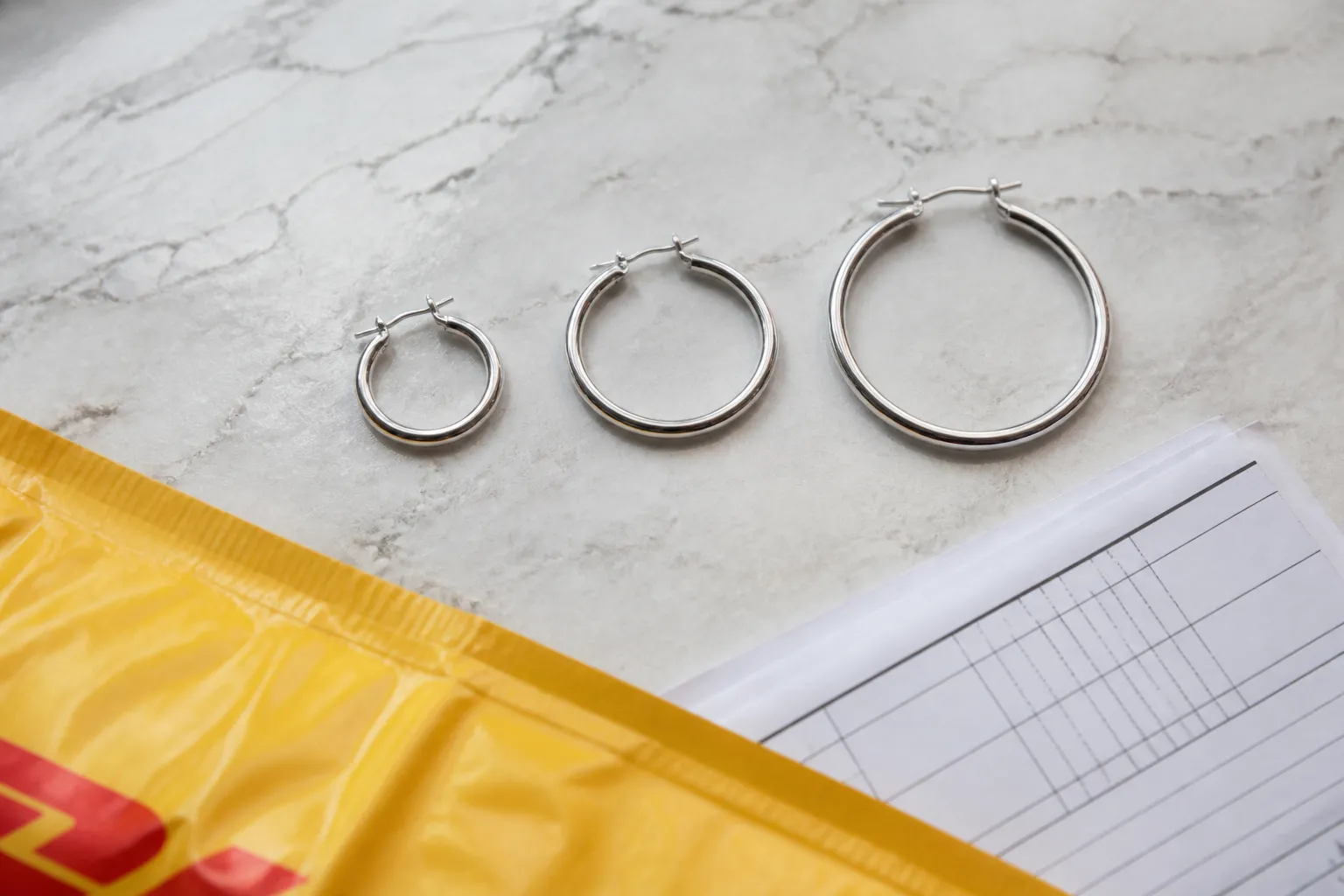
How white gold hoop earrings address it: A well-sourced white gold hoop in rhodium-plated 925 sterling or high-grade brass delivers the look of fine jewelry at fashion jewelry price points. Offered in a size run (15mm huggie / 30mm medium / 50mm statement), a single hoop earring line becomes a collection that drives multiple add-to-cart behaviors per session.
What success looks like: Return visitor rate above 30%, earring category contributing 40%+ of total revenue, average review rating above 4.5 stars with specific callouts of "looks expensive," "hasn't tarnished," and "exactly as pictured."
Vignette: A San Francisco-based DTC brand sourced a three-size white gold hoop run through an OEM partner and launched the collection as a hero product. Within 90 days, the hoop earring SKUs accounted for 38% of total revenue and drove a 22% lift in multi-item orders.
2. OEM Private Label: Custom Finish and Branding
The problem: A regional jewelry importer supplying boutiques in the UAE and Saudi Arabia needs white gold hoop earrings with a specific finish — heavier gauge, matte interior, high-polish exterior — that matches their house aesthetic. Off-catalog products won't differentiate their brand; they need OEM production with their own logo stamped on the finding and their packaging design on the outer box.
How white gold hoop earrings address it: OEM production allows the buyer to specify wire gauge, inner diameter, closure type (click-in, hinged, lever-back), plating thickness, and surface treatment. With the right manufacturing partner, private-label white gold hoops can be produced with custom stamping, branded polybags, and compliance labels in Arabic — meeting ESMA and Gulf Standardization Organization (GSO) requirements for jewelry sold in the Gulf Cooperation Council (GCC) market.
What success looks like: Production samples approved within two rounds, no customs holds on UAE import documentation, boutique partners reordering within the first season, brand recognition building on consistent product quality across SKUs.
Vignette: A Hangzhou-based OEM partner produced a 200-unit run of branded white gold tube hoops for a Dubai importer, complete with Arabic hallmarking documentation and custom gift boxes — the importer placed a follow-up order at 3x volume before the initial shipment sold through.
3. Multi-Market Importing: Compliance Routing by Destination
The problem: An importer managing supply for retail accounts in the UK, Germany, and the US simultaneously cannot afford to run separate sourcing programs for each market. But white gold hoop earrings sold in the EU must meet REACH regulation nickel release limits; products entering the UK post-Brexit carry separate UKCA marking considerations; US imports require CBP-compliant country-of-origin labeling. A single product run needs to satisfy all three.
How white gold hoop earrings address it: A vetted manufacturing partner with in-house QC and documentation capability can produce a single compliant base product and adapt the paperwork, labeling, and packaging for each destination market. Nickel-free plating processes satisfy EU REACH Article 67 (Annex XVII, Entry 27) restrictions on nickel release. Material safety documentation, SGS test reports, and country-of-origin certificates are prepared per-market, not as an afterthought.
What success looks like: Zero customs holds across all three markets, full audit trail for each shipment's compliance documentation, buyer accounts renewing contracts due to zero quality complaints at point of sale.
Vignette: A London-based importer sourced a unified white gold hoop program from a Hangzhou supplier and routed the same base product to UK, German, and Texan retail partners — with destination-specific labeling produced in a single factory run.
4. Seasonal Trend Capsules: Speed-to-Market OEM
The problem: Fashion jewelry trend cycles, especially those amplified by TikTok and Instagram, compress the window between "trending" and "oversaturated" to six to ten weeks. A DTC operator or boutique buyer who identifies a white gold hoop micro-trend — say, open-front sculptural hoops or interlinked chain hoops — needs to go from reference image to in-stock product before the trend peaks.
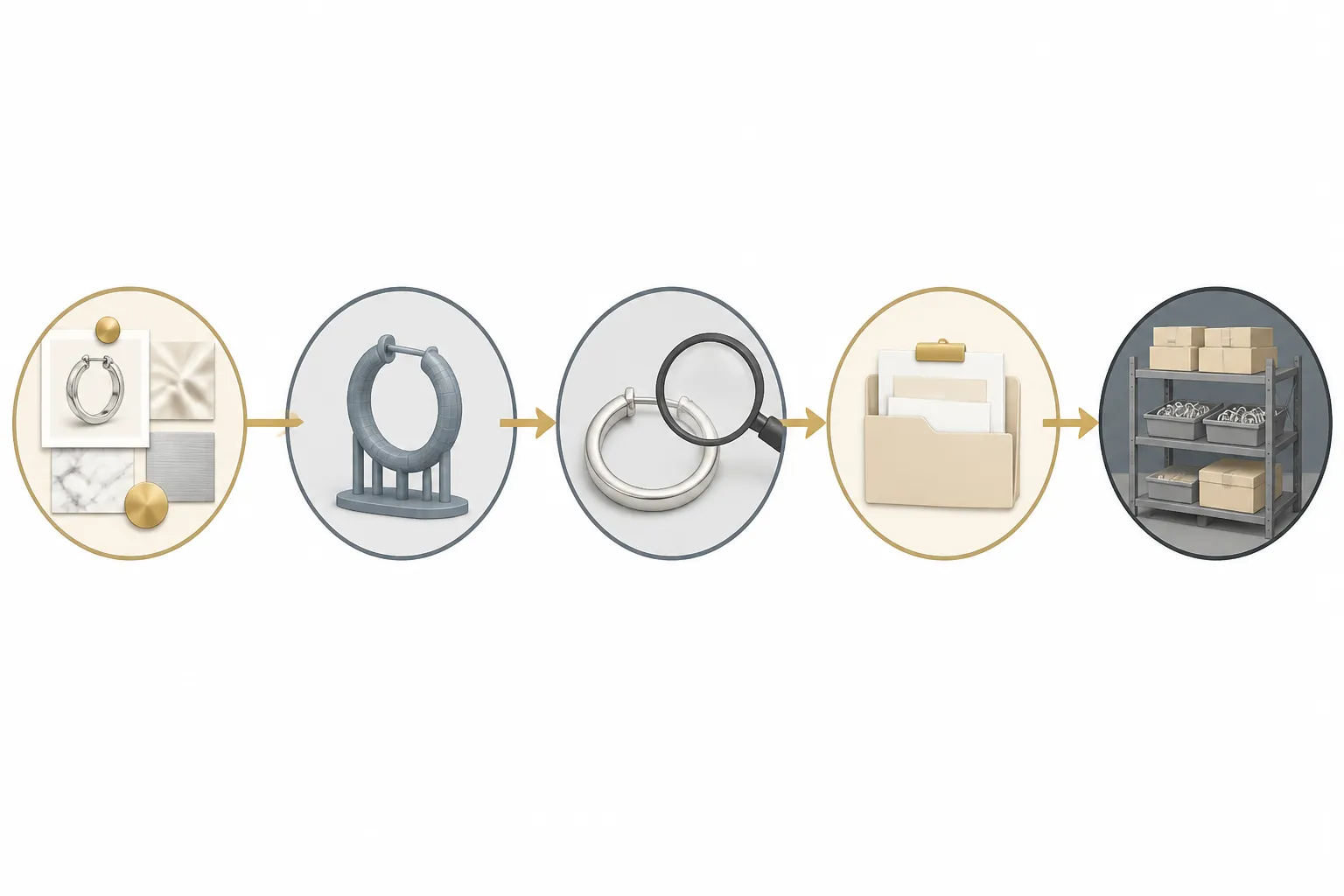
How white gold hoop earrings address it: An OEM supplier with rapid prototyping capability and low MOQ thresholds makes trend-responsive sourcing viable for operators who cannot commit to 1,000-unit minimums on an unproven style. A fast-turnaround development process — concept to wax model to production sample — allows buyers to test trend styles at small quantities before committing to a larger production run.
What success looks like: Sample delivery within [lead time per supplier], production run launched within [production lead time], trend SKU live on storefront before peak search volume, sell-through rate above 80% before markdown is required.
Vignette: A UK DTC operator used a low-MOQ OEM partner to launch a limited run of sculptural open-front white gold hoops timed to a viral styling moment — the 150-unit run sold out in 11 days without a single unit going to clearance.
5. Wholesale Catalog Expansion: Earring Set Bundling
The problem: A US-based wholesale distributor supplying independent boutiques needs to expand its earring offering beyond studs without overhauling its catalog infrastructure. Adding a white gold hoop category that pairs naturally with existing necklace and stud inventory creates bundle opportunities, increases average wholesale order value, and gives boutique buyers a reason to consolidate their purchasing.
How white gold hoop earrings address it: White gold hoop earrings are natural set-builders. A supplier offering coordinated necklace + earring sets in matching white gold finishes — vintage crystal drops, rhinestone-accented hoops, two-tone glass bead combinations — allows distributors to offer curated groupings rather than individual SKUs. This simplifies the boutique buyer's merchandising decisions and supports higher sell-through at retail.
What success looks like: Wholesale AOV increase of 15-25% after set introduction, boutique reorder rate improving due to easier merchandising, end-consumer sell-through above 75% per season.
Vignette: A Dallas-based jewelry distributor added a white gold hoop and necklace set program from an OEM partner and saw boutique buyers increase their per-order value by an average of $340 in the first quarter.
6. MENA Market Entry: Localized Sourcing and Service
The problem: A buyer expanding into Saudi Arabia, the UAE, or Egypt faces not just regulatory complexity but language and relationship barriers. Jewelry procurement in the Gulf is relationship-driven; buyers expect Arabic-language communication, culturally appropriate product curation (modest-wear alignment, formal occasion focus), and payment and shipping terms that reflect regional logistics realities.
How white gold hoop earrings address it: White gold is a dominant preference in Gulf jewelry markets, where yellow gold is traditional and white gold reads as modern and international. A supplier who offers Arabic-language service, catalog materials in Arabic, and experience with Gulf customs documentation — including GCC Certificate of Conformity requirements — removes the friction that blocks most China-based suppliers from effectively serving MENA buyers.
What success looks like: Successful first shipment cleared through UAE or Saudi customs without holds, Arabic-language product descriptions ready for local e-commerce platforms, buyer relationship established with a named account manager who communicates in Arabic.
Vignette: A Riyadh-based jewelry importer sourced white gold hoop earrings through a Hangzhou supplier with Arabic-language service capability — the first container cleared customs in Dubai within standard processing time, with full GCC documentation prepared in advance.
Considerations Specific to Cross-Border Fashion Jewelry (DTC & OEM)
Regulatory and Compliance
White gold hoop earrings sold in the EU must comply with REACH Regulation (EC) No 1907/2006, specifically Annex XVII Entry 27 restricting nickel release to less than 0.2 μg/cm²/week for post assemblies that come into direct and prolonged contact with the skin. Request SGS or Intertek nickel release test reports for any EU-bound stock.
In the United States, CBP requires accurate country-of-origin marking under 19 CFR Part 134. Jewelry must be legibly marked "Made in China" or equivalent. The FTC's Guides for the Jewelry Industry (16 CFR Part 23) govern use of terms like "gold-filled," "gold-plated," and "white gold" — verify your supplier understands the distinction and documents accordingly.
UK buyers post-Brexit should confirm UKCA marking applicability (for regulated products) and check whether their customs broker is current on commodity codes for jewelry (HS 7113).
For GCC/MENA markets, the Emirates Authority for Standardization and Metrology (ESMA) and Gulf Standardization Organization (GSO) publish jewelry-specific standards. Arabic-language labeling and halal-compliant process documentation may be required by specific retail accounts.
Integration with Industry-Standard Tools
Cross-border jewelry operations typically run procurement workflows across a combination of tools: Alibaba for initial supplier discovery, Tradeling or Faire for regional wholesale, Shopify or WooCommerce for DTC, and ShipBob, Flexport, or direct freight forwarders for logistics. A supplier who can generate documentation in formats compatible with these platforms — commercial invoices, packing lists, and certificates of origin that match Flexport's upload templates — reduces operational friction meaningfully.
For DTC operators, supplier-provided product photography and multi-angle image sets that meet Amazon, Shopify, and regional marketplace specifications (white background, minimum resolution, multiple angles) save a material amount of post-production cost.
Data Sensitivity and IP Protection
OEM buyers commissioning custom white gold hoop earring designs carry legitimate IP risk when sharing proprietary design files, mold specifications, or brand assets with manufacturing partners. Before sharing design documentation, confirm your supplier operates under a non-disclosure and non-compete framework appropriate for your market. Request a countersigned NDA with jurisdiction clause appropriate to your operating territory. In China, registered design patents (外观设计专利) provide enforceable protection for custom jewelry forms and are worth considering for high-value proprietary designs.
Scale and Seasonality
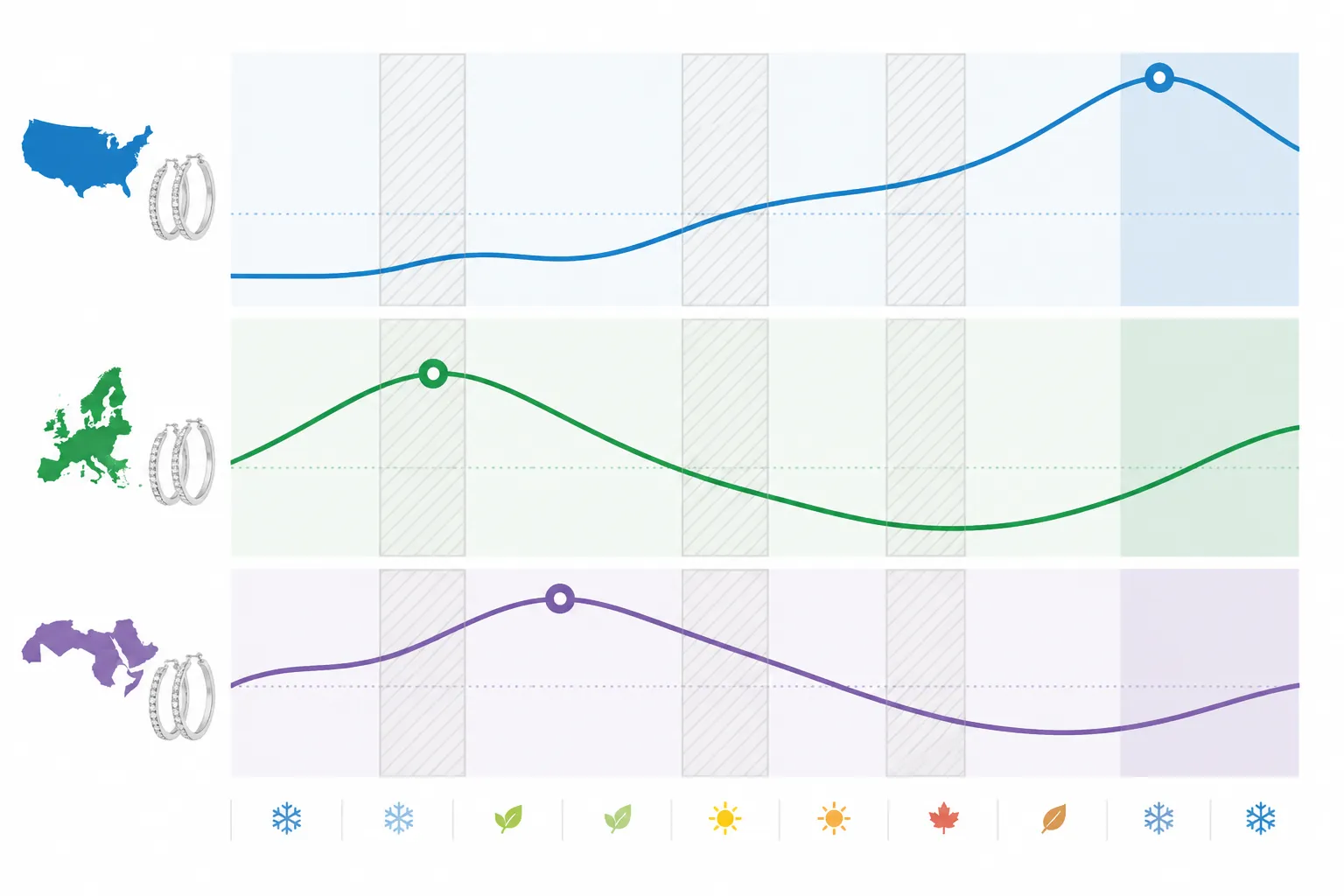
White gold hoop earrings follow dual seasonality peaks: Q4 holiday gifting (October through December) and Q1/Q2 spring/summer wear (February through May). Cross-border buyers sourcing from China must account for Chinese New Year production shutdowns (typically two to four weeks in January/February) when planning Q1 inventory. Book production capacity for Q4 no later than August; Q1 spring orders should be confirmed by November.
Implementation Roadmap for Cross-Border Fashion Jewelry Teams
Phase 1 — Pilot (Weeks 1–6)
- Define target markets and identify which regulatory frameworks apply (EU REACH, US FTC, GCC, UK).
- Shortlist 2–3 Hangzhou or Guangzhou-based OEM suppliers with documented nickel-free plating capability and SGS testing experience.
- Request samples of white gold hoop earrings in your priority size and finish specification. Evaluate against plating durability, closure function, weight, and finish consistency.
- Confirm documentation capability: can the supplier produce SGS reports, country-of-origin certificates, and destination-specific labeling for your target markets?
- Place a pilot order at 12 pcs to test end-to-end logistics, customs clearance, and product quality under real shipping conditions.
Phase 2 — Pilot Orders & Range Expansion (Months 2–4)
- Establish a preferred supplier relationship with signed NDA, agreed lead times, and named QC contacts.
- Expand the white gold hoop program to a size run and introduce coordinated set SKUs (hoops + studs, hoops + necklace).
- Build compliance documentation templates for each target market with your customs broker.
- Integrate supplier into your procurement workflow — PLM system, freight forwarder connections, and invoice formats.
- Launch DTC product listings with supplier-provided imagery and localized product descriptions.
Phase 3 — Multi-Market Scale (Months 5–12)
- Negotiate capacity allocation for seasonal peak production (Q4 holiday, Q1 spring).
- Develop OEM private-label program: branded packaging, custom stamping, multi-language catalog.
- Activate MENA market entry with Arabic-language service and GCC compliance documentation.
- Establish reorder triggers based on sell-through data, with 8–10 week lead time buffer built into inventory planning.
- Conduct annual supplier audit (QC process review, plating equipment inspection, documentation compliance check).
ROI and Business Outcomes for Cross-Border Fashion Jewelry (DTC + OEM)
The financial case for a well-structured white gold hoop earring sourcing program is measurable across several dimensions that matter in this vertical:
Gross margin: Fashion jewelry sourced from vetted Chinese OEM partners at competitive FOB pricing and sold at DTC retail or wholesale margins routinely achieves 60–75% gross margin on core SKUs. White gold hoops, as high-demand basics with strong repeat purchase potential, anchor this margin profile.
Inventory turn: A buyer who correctly times seasonal production and maintains a tight SKU count (three to five hoop styles rather than twenty) achieves faster inventory turn, reducing carrying cost and markdown risk. Sell-through rates above 80% before end-of-season clearance are achievable with disciplined OEM planning.
Returns and chargebacks: Plating durability is the primary driver of returns in fashion jewelry. Buyers who specify plating thickness (minimum 0.5 microns rhodium for white gold finish) and require SGS durability testing as a production gate reduce return rates materially versus buyers who source on price alone.
Customer lifetime value: White gold hoop earrings function as entry-point purchases that lead to higher-value repeat orders — sets, statement pieces, gifting SKUs. DTC operators who use hoops as an acquisition product and build loyalty through consistent quality see LTV multiples of 2.5–4x versus single-purchase conversion.
Supplier consolidation savings: Multi-market buyers who consolidate white gold hoop production with a single OEM partner (rather than managing separate supplier relationships for US, EU, and MENA inventory) reduce procurement overhead, simplify QC, and negotiate better per-unit pricing through volume aggregation.
Conclusion: What Cross-Border Fashion Jewelry Decision-Makers Should Do Next
White gold hoop earrings are not a commodity purchase for the serious cross-border buyer. They are a category investment — one that requires supplier vetting, compliance documentation, OEM capability assessment, and a procurement partner who understands the operational realities of moving fashion jewelry across multiple regulatory environments.
The buyers who outperform in this category share three characteristics: they source from vetted manufacturing partners rather than anonymous catalog listings; they invest in compliance documentation before they need it rather than after a customs hold; and they treat their OEM supplier as a long-term partner capable of responding to trend shifts, not a transactional price quotation.
STRAND operates from Hangzhou, China, connecting overseas buyers directly to quality-vetted workshops producing drop earrings, stud earrings, necklace and earring sets, and custom OEM jewelry in vintage, gradient crystal, two-tone glass bead, and rhinestone styles. White gold hoop earrings are available in OEM and catalog configurations, with multilingual service in English, Arabic, and Spanish. In-house QC inspection precedes every shipment.
For buyers evaluating a sourcing relationship, the right questions to bring to a first conversation include: What is your MOQ for OEM white gold hoop production? What plating thickness do you guarantee, and what SGS or Intertek testing documentation do you provide? What is your standard lead time from confirmed order to FOB departure? Can you provide Arabic-language documentation for GCC market imports?
Ready to evaluate STRAND as your white gold hoop earrings sourcing partner?
Request a Quote → strandjewelry.com
Submit your specification requirements, target market, and volume range to receive MOQ pricing, lead time estimates, and a sample arrangement proposal from STRAND's multilingual procurement team.
This article is intended for professional buyers, importers, and DTC operators evaluating white gold hoop earring sourcing options. All regulatory references are current as of publication date and should be verified against the latest guidance from the relevant authority before import decisions are made.