
Sterling Silver Necklace Wholesale: The Buyer's Complete Guide
Sterling Silver Necklace Wholesale: The Buyer's Complete Guide
Quick definition (featured-snippet ready): Sterling silver necklace wholesale means purchasing .925 silver necklaces in bulk — directly from manufacturers or distributors — at below-retail unit pricing. Buyers include DTC stores, importers, and procurement teams who need authenticated material, consistent batches, and pricing that supports real margin. MOQ, purity certification, and lead time are the core evaluation criteria.
Wholesale sourcing for sterling silver necklaces is a supply chain decision first, a purchasing decision second. Get the sequence right — verify materials, establish MOQ terms, confirm lead times — and the economics work. Get it backwards, and you absorb the cost months later in returns, reorders, and margin compression.
This guide covers everything a serious buyer needs to know: what you're actually buying, how to evaluate suppliers, what questions to ask before an order, and when wholesale sourcing makes commercial sense for your business.
What Is Sterling Silver Necklace Wholesale?
Sterling silver is defined by its alloy composition: 92.5% pure silver combined with 7.5% other metals, typically copper. That ratio — stamped .925 or "sterling" on the finished piece — is the recognized international standard for silver jewelry quality. When you buy wholesale, you're sourcing these authenticated pieces in volume, directly from a supplier or manufacturer, at pricing that reflects bulk rather than retail markup.
The distinction from retail matters commercially because retail pricing absorbs multiple layers of overhead: distributor margins, storefront costs, and marketing spend. Wholesale strips those layers away. The result is a lower cost basis per unit — which translates directly into either margin or competitive pricing at the point of sale.
The case for silver over gold at the wholesale level is also straightforward on numbers. Silver trades at a small fraction of gold's spot price — the gap between the two metals is substantial, often exceeding 60:1 by weight — a ratio that makes .925 silver the default choice for volume buyers who need real metal without the capital exposure of gold sourcing.
Understanding What You're Actually Buying: Silver Categories Explained
Not all "silver" necklaces are the same material. This is the first lesson in wholesale sourcing, and skipping it is expensive.
.925 Sterling Silver
The industry standard. Stamped .925 or "sterling," it's durable enough for daily wear, takes a high polish, and is recognized in every major market. In MENA markets particularly, material authenticity is part of the purchase decision — buyers and end consumers expect real silver, and they know how to verify it. A .925 stamp with documentation is the baseline, not a premium feature.
Silver-Plated
A base metal (usually brass or copper) coated in a thin silver layer. The unit price is lower, but the longevity is not comparable. Plating wears through with regular wear. For buyers targeting quality-conscious consumers or building a brand with repeat purchase intent, silver-plated stock is a short-term cost saving with medium-term margin risk.
Fine Silver (.999)
Pure silver — too soft for necklace chains. It bends and scratches easily. Rarely encountered in wholesale chain catalogs for exactly this reason.
For any professional wholesale purchase, the purity stamp should be non-negotiable. Established B2B suppliers are explicit about this: Sonara Jewelry, for instance, specifies that it sells .925 sterling silver Italian chains — that transparency is a reliable signal when you're vetting a new supplier relationship.
The Chain Styles That Matter in Wholesale Necklace Sourcing
Chain style is not purely aesthetic. It determines durability, drape, price per inch, repairability, and which customer segments the piece appeals to. Buyers building an assortment need to understand the commercial differences.
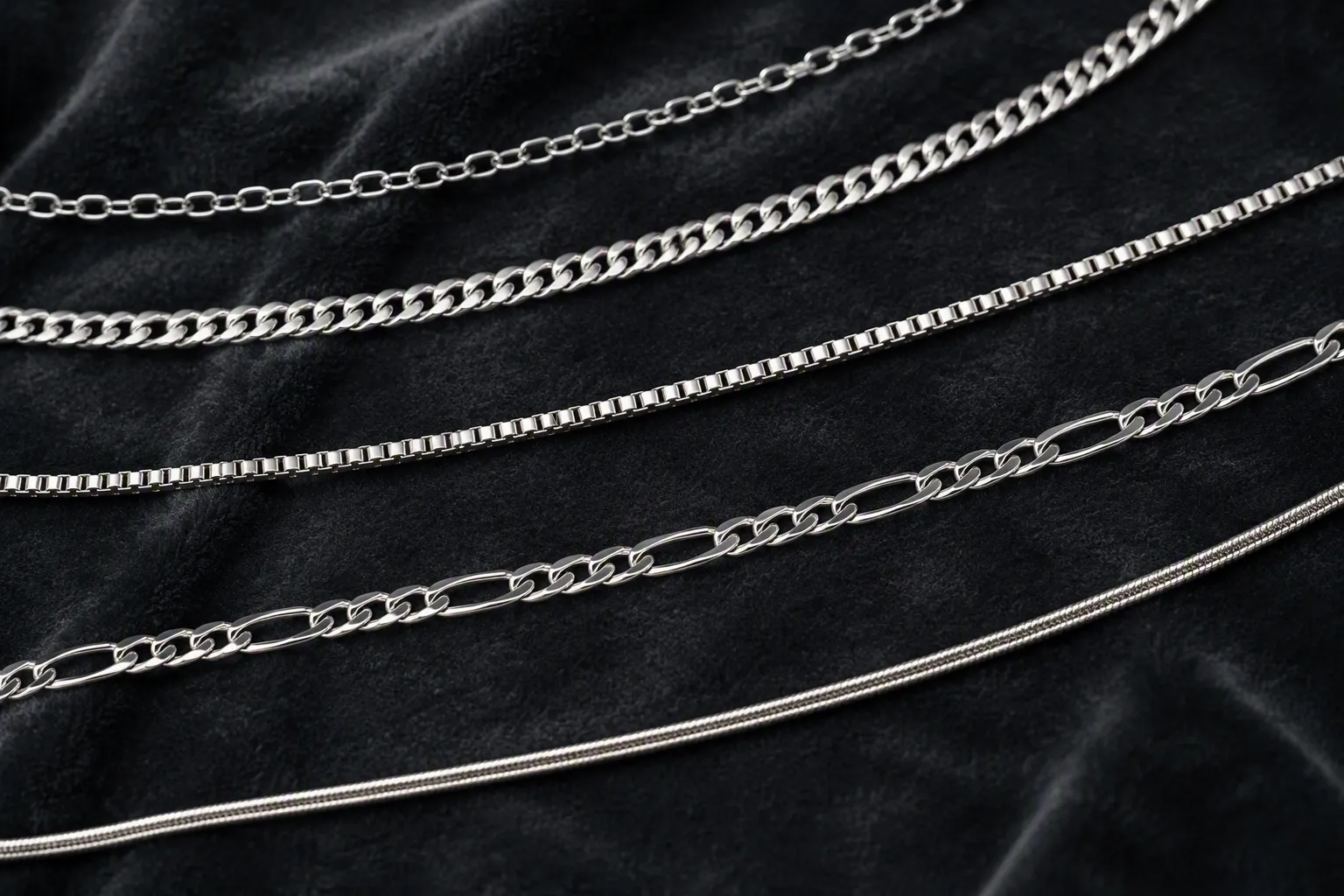
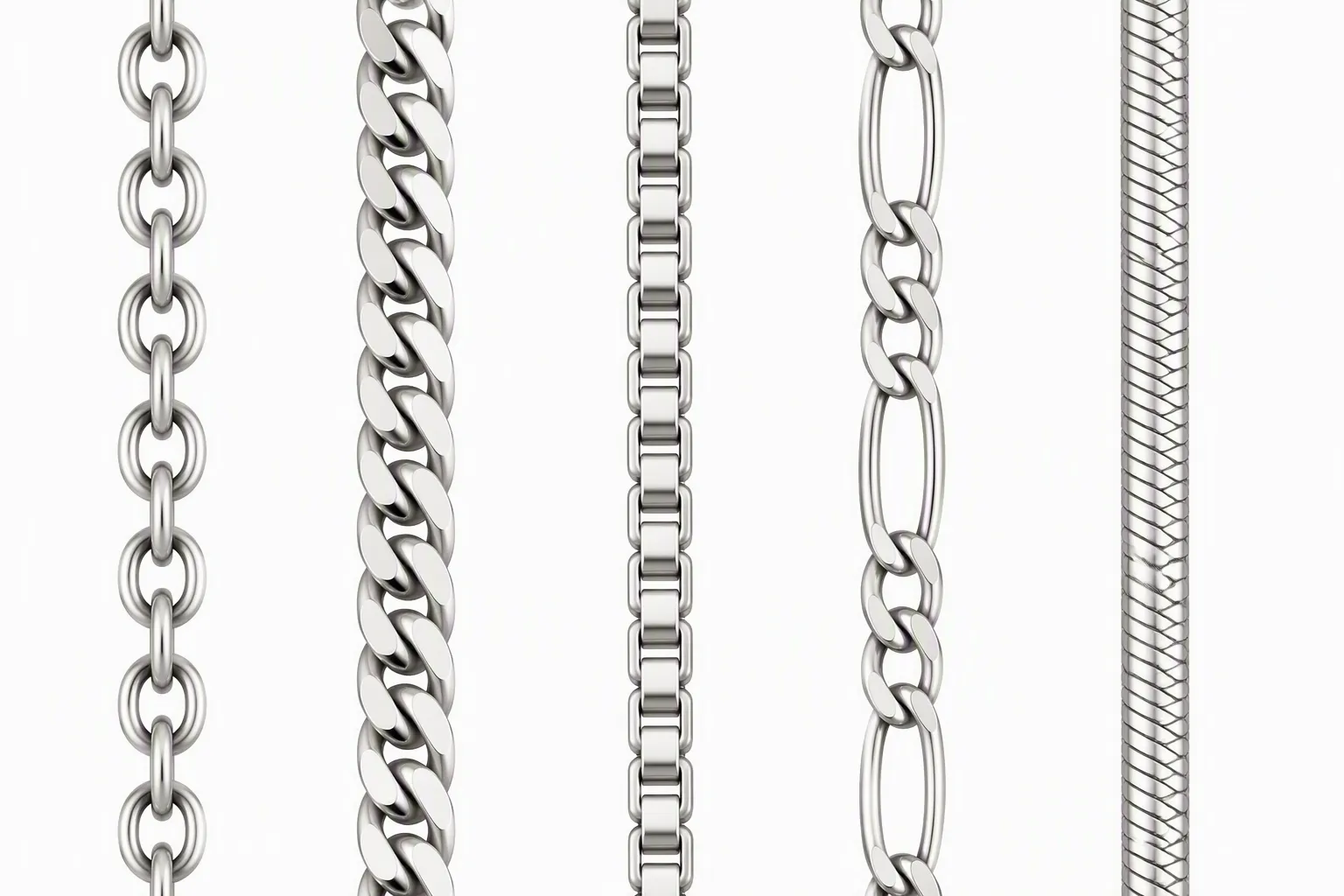
Cable Chain
The most widely stocked wholesale style. Uniform oval links, clean silhouette, consistent drape against the neckline. Works as a pendant chain or as a standalone statement. High baseline demand across DTC and retail categories.
Curb Chain
Flat, interlocking links that lie flush. Popular in men's collections and in MENA markets where heavier, substantive chains carry perceived value. Available in a wide range of widths — from fine to substantial.
Box Chain
Square links in a geometric pattern. Slightly stiffer construction than cable, with a structured look. Handles heavier pendants better because the link load is distributed differently.
Figaro Chain
Two or three short links followed by one elongated link. Classic Italian origin — relevant for buyers sourcing Italian-manufactured sterling silver, which carries a documented quality reputation in international markets.
Snake / Omega Chain
Smooth, tube-like construction with a distinctive drape. Stylistically differentiated, but worth noting that these chains are more difficult to repair if broken. An important factor if your target market has high after-sale service expectations.
The breadth of what's available at the wholesale level is significant. Halstead carries an extensive range of sterling silver chain products — covering standard and fashion styles for necklaces, bracelets, and anklets — that gives buyers real room for seasonal assortment building and category differentiation.
How to Evaluate a Wholesale Supplier Before You Commit
A low unit price means nothing if the supplier ships inconsistent quality, misses lead times, or can't provide certification documentation. Evaluation happens before the purchase order, not after.
Material Certification
Ask for the .925 purity stamp documentation and confirm what third-party testing, if any, supports it. Reputable wholesale suppliers build documentation requirements into their onboarding. Sonara Jewelry operates as a wholesale B2B-only supplier and requires a business license to purchase — that requirement is actually a quality filter. It signals a commercial-grade supply chain, not a gray-market operation.
Minimum Order Quantities
MOQ varies meaningfully across the market. Sonara Jewelry sets a $100 minimum order — an accessible entry point for buyers testing a new supplier or style. Other suppliers, like Halstead, sell chain by the inch with the best pricing on 100-foot spools. That model suits buyers who want to finish necklaces in-house and need precise length control.
Wholesale Pricing Access
Most professional wholesale suppliers require proof of business before unlocking wholesale pricing. Halstead, for example, requires a valid state tax ID. If you're sourcing internationally, clarify what documentation equivalent is accepted — this is a standard pre-purchase conversation, not a bureaucratic obstacle.
Finished vs. Unfinished Chain
Finished necklaces arrive complete with clasps, ready to package and sell. Halstead's finished necklace range runs from chokers to opera-length pieces, all finished with quality clasps. Unfinished footage chain requires your team to add jump rings, soldered links, or tab/tube closures before the piece is retail-ready. Both approaches have a role: finished stock saves labor, unfinished footage gives you control over length, hardware, and production timing.
One practical detail worth knowing: spooled chain is often factory-segmented, meaning continuous uninterrupted lengths are not guaranteed. If a design requires a specific continuous run, confirm this with the supplier explicitly before placing the order.
What to Ask Before Placing a Wholesale Order
These are the procurement criteria that distinguish buyers who build sustainable supply chains from those who absorb avoidable costs.
Material & Quality
- Is the chain stamped .925? Is batch documentation available?
- What metal makes up the 7.5% alloy — copper, zinc, or a mix?
- Has the batch been tested for heavy metal content compliance (relevant for EU and some MENA import requirements)?
Dimensions & Specifications
- What is the chain gauge (wire diameter)?
- What finished lengths are available — choker (14–16"), princess (17–19"), matinee (20–24"), opera (28–36")?
- What clasp hardware is included, and what's the gauge compatibility with common pendant bails?
Pricing & MOQ
- What is the current wholesale price per inch or per unit at your target volume?
- What volume qualifies for the best pricing tier?
- Are there spool-based discounts for unfinished footage?
Lead Time & Logistics
- What is the lead time for in-stock pieces versus made-to-order?
- What shipping carriers and Incoterms does the supplier offer?
- What are the import duty and VAT implications for your destination market?
Quality Assurance & Returns
- What is the policy for defective or mislabeled pieces?
- Is pre-production sampling available before full order commitment?
Running through this checklist before a purchase order is raised is where margin is protected. The questions aren't difficult — but skipping them is where sourcing relationships go wrong.
The Commercial Case for Wholesale Sterling Silver Necklaces
The economics are real, but the nuances matter for building a margin model that holds.
Per-Unit Cost at Volume
Retail pricing embeds multiple cost layers. Wholesale removes distributor margin and retail overhead from the unit cost, giving you a lower cost basis per piece. That gap — between what retail charges and what wholesale costs — is where your margin lives.
Batch Consistency
One-off retail purchases often come from mixed inventory runs. Wholesale relationships give you access to consistent production batches: same gauge, same clasp hardware, same finish across every piece in a reorder. For DTC brands building a product line with recognizable style coherence, this consistency is the point, not just a nice-to-have.
Catalog Depth
Wholesale catalogs are substantially broader than retail assortments. Access to an extensive catalog of sterling silver chain SKUs means room for seasonal differentiation, category expansion, and private-label development — none of which is practical at retail scale.
Positioning and Quality Sourcing
There is a real and commercially significant difference between sourcing crafted, certified sterling silver at wholesale and buying commodity plated pieces in bulk. STRAND's approach to wholesale sourcing is built on that distinction: material authentication, vetted supplier relationships, and quality benchmarks that hold up when your customers inspect the product. For buyers serving markets where material provenance is part of the purchasing decision — including quality-conscious DTC audiences and MENA importers — this sourcing discipline protects both brand integrity and repeat purchase rates.
When Wholesale Sourcing Is the Right Decision
Wholesale is not the right channel at every stage of a jewelry business. The economics only work once certain conditions are in place.
Wholesale makes sense when:
- You're reordering the same SKU consistently and the accumulated retail premium has become a meaningful cost
- You need batch consistency for brand integrity and are seeing quality variation in retail-sourced stock
- Your order volume qualifies for supplier wholesale pricing tiers
- You're building a category — a sterling silver necklace line — rather than stocking individual pieces opportunistically
- You're sourcing for a market where material authenticity documentation is expected at the point of import or sale
The decision to move to wholesale is also a documentation decision. You need proof of business, potentially a tax ID, and the administrative readiness to manage purchase orders and supplier communication. For buyers who aren't yet at that stage, low-MOQ platforms with accessible minimums (like Sonara Jewelry's $100 minimum) offer a practical bridge.
For importers sourcing into MENA markets specifically, wholesale relationships provide the supply chain transparency that retail cannot: batch certification, hallmarking documentation, and the supplier accountability that buyers in those markets increasingly require.
How STRAND Approaches Sterling Silver Necklace Wholesale
STRAND sources vetted .925 sterling silver necklaces for overseas buyers — DTC stores, importers, and procurement teams who need authenticated materials, reliable lead times, and sourcing criteria that hold under scrutiny.
The process is direct:
- Specify requirements — chain style, length, gauge, clasp type, target volume, and any market-specific compliance needs
- Request samples — evaluate finish, weight, hallmarking, and clasp quality before committing to a full order
- Confirm MOQ and lead time — STRAND is clear about what's in stock versus what's made-to-order, and provides that information before purchase
- Place the order — with QA benchmarks, shipping terms, and documentation requirements confirmed in writing upfront
STRAND does not source on price alone. The value is procurement certainty: materials you can verify, lead times you can plan around, and supplier relationships that don't introduce quality surprises after the shipment lands.
Making the Right Wholesale Decision
Sourcing sterling silver necklaces wholesale is a structured process, not a one-click purchase. It starts with knowing exactly what you're buying — .925 stamped, batch-certified, consistent gauge and hardware — and builds through supplier vetting, documentation, and sample evaluation before any volume commitment.
The market has real depth and accessible entry points. From Halstead's extensive footage chain catalog to Sonara Jewelry's B2B-only Italian sterling silver program, the supply exists. The work is matching the right supplier to your specific business requirements: volume, category, destination market, and quality standard.
Start with a sample order. Verify the hallmark. Confirm lead time in writing. Build the supplier relationship before committing to volume. That sequence, executed consistently, is what separates wholesale programs that scale from those that create recurring procurement problems.
Ready to source? [Contact STRAND] to discuss your sterling silver necklace requirements, check current availability, and request a wholesale quote tailored to your volume and market.
Material specifications and pricing referenced in this article are sourced from publicly available supplier documentation. Current wholesale pricing and availability should be confirmed directly with suppliers before placing an order.
Frequently Asked Questions
What is sterling silver necklace wholesale?
Sterling silver necklace wholesale refers to the bulk procurement of necklaces crafted from 925 sterling silver — an alloy of 92.5% pure silver and 7.5% copper — sourced directly from manufacturers or vetted suppliers at trade pricing below retail. For DTC stores, importers, and procurement teams, this model enables margin control while offering consistent quality across styles such as chains, pendants, and chokers in standardized lengths (typically 16"–24") and finishes (rhodium-plated, oxidized, or polished). STRAND sources wholesale sterling silver necklaces with transparent MOQ structures, reliable lead times, and certified materials — giving buyers the confidence to build scalable, quality-driven product lines.
How to sterling silver necklace wholesale?
To wholesale sterling silver necklaces, source from a vetted supplier like STRAND that offers verified .925 sterling silver with clear MOQ thresholds (typically starting at 20–50 pieces per style), transparent lead times (14–30 days for standard orders), and documented quality certifications. Submit a trade inquiry with your target SKUs, desired chain lengths (common range: 16"–24"), clasp types, and packaging requirements to receive a tiered pricing sheet based on volume. Confirm shipping terms (FOB, DDP, or air freight options) and request samples before committing to bulk orders to validate craftsmanship and finish consistency.
Why is sterling silver necklace wholesale important?
Sterling silver necklace wholesale is important because it allows DTC stores, importers, and procurement teams to source high-quality 925 sterling silver pieces at volume-competitive pricing, protecting margins while maintaining product integrity for discerning end customers. For buyers working with STRAND, wholesale access means consistent supply of vetted, crafted pieces — with predictable lead times and reliable hallmarking — rather than chasing inconsistent spot buys. This supply chain reliability is especially critical for building cohesive seasonal collections or meeting steady retail replenishment cycles across multiple markets.
When should I use sterling silver necklace wholesale?
Sterling silver necklace wholesale is the right approach when you're stocking a DTC store, fulfilling a seasonal collection, or sourcing inventory for retail distribution and need consistent quality across multiple SKUs at scale. It's especially valuable when your procurement cycle requires predictable lead times, verified .925 silver content, and MOQ flexibility — typically starting at 20–50 units per style — to manage cash flow without sacrificing craftsmanship. STRAND's wholesale program suits importers and buyers who prioritize vetted materials and reliable repeat supply over one-off spot purchasing.
What are the benefits of sterling silver necklace wholesale?
Purchasing sterling silver necklaces wholesale through STRAND gives buyers access to consistently graded 925 sterling silver at unit economics that support healthy retail margins — typically with MOQs starting at 20–50 pieces per style and lead times of 15–25 business days. Wholesale sourcing also enables catalog depth, allowing DTC stores and importers to stock multiple chain styles (box, rope, figaro) and lengths (16"–24") without fragmenting their supplier relationships. Beyond cost efficiency, working with a vetted wholesale partner ensures hallmarking compliance, consistent weight tolerances, and quality documentation that satisfies customs requirements across key import markets.