
Pearl Drop Earrings: Cross-Border Sourcing Guide for Fashion Buyers
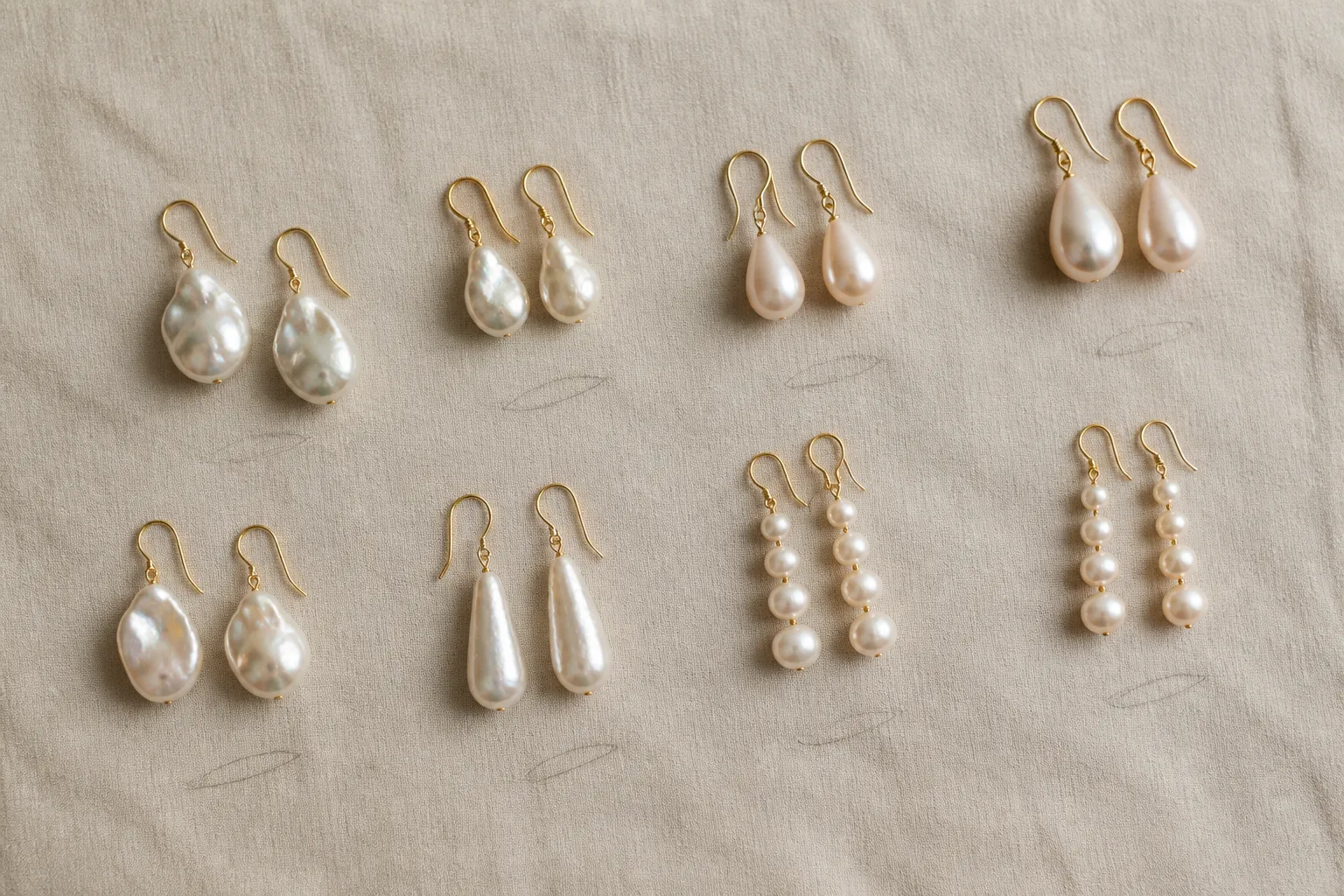
Pearl Drop Earrings: Cross-Border Sourcing Guide for Fashion Buyers
The Cross-Border Fashion Jewelry (DTC + OEM) Reality
The global fashion jewelry market is not a monolith — it is a fragmented, seasonally volatile, margin-sensitive supply chain that separates sophisticated operators from struggling ones at every handoff. Nowhere is this truer than with pearl drop earrings, a category that spans the broadest possible spectrum of buyer expectations: from a Shopify DTC store owner in Dallas building a $45 AOV gifting catalog to a French retailer placing a 5,000-unit OEM order for a branded jewelry line. The product may look simple on a lifestyle photograph, but the procurement path behind it is dense with variables that determine whether a business is profitable or not.
For cross-border buyers sourcing from Chinese workshops — the dominant manufacturing hub for fashion-grade pearl earrings — the reality involves navigating currency exposure, customs classification (HS codes differ meaningfully between imitation pearl earrings and freshwater pearl earrings), packaging compliance requirements for the EU and UK markets, lead time management across time zones, and the perpetual challenge of translating aesthetic intent into a factory specification that a production line in Zhejiang or Guangdong can execute consistently at scale. The gap between a Pinterest reference image and a delivered production sample is where most sourcing failures begin.
OEM buyers add another layer: they need a supplier partner who understands brand positioning, can accommodate private-label requests, and won't reproduce their designs for a competing buyer six months later. DTC operators have a different but equally pressing concern — they need consistent, photogenic product that arrives on time, matches the approved sample, and can be reordered quickly when a SKU goes viral on TikTok or Instagram Reels. Both profiles are sourcing pearl drop earrings in high volume, and both need a supply-chain partner who can meet them where they are — with transparent trade terms, multilingual communication, and verifiable quality control before a container ships.
Why Generic Sourcing Solutions Fall Short for Cross-Border Fashion Jewelry
Marketplace-first platforms — think Alibaba's open catalog or a generic trade directory — were designed for commodity procurement, not for the nuanced, design-forward, brand-critical decisions that define fashion jewelry sourcing. When a DTC buyer uploads a reference image of a baroque pearl drop earring with an oxidized brass hook and asks for a quote, they need more than a price per unit. They need material transparency (is this freshwater pearl, shell pearl, or ABS imitation?), plating durability data (how many microns of gold on the ear wire?), packaging options compatible with their unboxing experience strategy, and a supplier who can communicate back in English, Spanish, or Arabic depending on which team member is handling procurement that week.
Generic solutions also miss the seasonal compression that defines fashion jewelry buying cycles. A pearl drop earring designed for the holiday gifting window must be sampled in August, approved in September, and shipped ex-factory by late October. Miss any of those milestones and the product arrives after peak sell-through. Platforms that treat all product categories with the same 30–60-day lead time estimates as baseline fail fashion jewelry buyers structurally. The category demands a sourcing partner with dedicated capacity planning, pre-staged materials, and a production calendar that is honest about constraints — not one optimized for generating inquiry volume.
Finally, quality variance in fashion-grade pearl earrings is wide and often invisible until product is in-hand. Pearl luster grade, nacre coating uniformity, drill-hole positioning, hook gauge, and closure security are all specification variables that photo verification cannot adequately confirm. OEM buyers building branded lines cannot afford a QC failure at the consumer level — returns, social media complaints, and brand equity damage are the downstream costs. Cross-border buyers need a supply chain that includes in-house QC inspection before shipment, not a third-party report ordered after the fact when a dispute has already begun.
Core Use Cases: How Pearl Drop Earrings Drive Value Across the Supply Chain
1. DTC Store Inventory Planning: Building a Drop Earring Catalog That Converts
The problem: DTC fashion jewelry operators frequently over-invest in breadth at the expense of depth. They source 40 SKUs when their conversion data shows that 8 styles drive 80% of revenue. Pearl drop earrings, because of their versatility and perennial demand, are a catalog anchor — but only when sourced in the right silhouette mix, at the right price point, with reliable reorder windows.
How pearl drop earrings address it: A curated assortment of pearl drop styles — graduated drop lengths, two-tone settings, vintage-inspired baroque shapes, minimalist single-pearl drops on delicate chains — lets a DTC operator build "look families" that cross-sell naturally. A customer who converts on a dainty freshwater pearl drop stud is a strong candidate for a matching pearl drop and necklace set in the same colorway. The earring functions as both a hero SKU and a gateway product to higher-AOV set purchases.
What success looks like: Repeat purchase rate on pearl drop SKUs exceeding 18% within 90 days of first purchase; SKU rationalization reducing catalog complexity by 30% while maintaining or growing gross merchandise volume; reorder lead times short enough to prevent stockouts during peak gifting seasons (Valentine's Day, Mother's Day, holiday Q4).
Example scenario: A UK-based DTC jewelry brand identifies that their teardrop pearl earring in gold vermeil finish accounts for 22% of all earring revenue despite being one of six drop styles in the catalog. They consolidate inventory investment behind this SKU and two complementary variants, negotiate a preferred-supplier arrangement for priority restocking, and see a 15% improvement in inventory turn within two quarters.
2. OEM Private-Label Production: Translating Brand Aesthetic into Manufacturable Specification
The problem: Brands entering the jewelry category — fashion labels extending into accessories, lifestyle DTC operators launching jewelry sub-brands, retail chains building private-label programs — frequently struggle to bridge the gap between their visual brand language and a factory's technical specification sheet. A moodboard of "romantic, vintage-inspired pearl drops with warm gold tones" means something very different to a creative director than it does to a production manager.
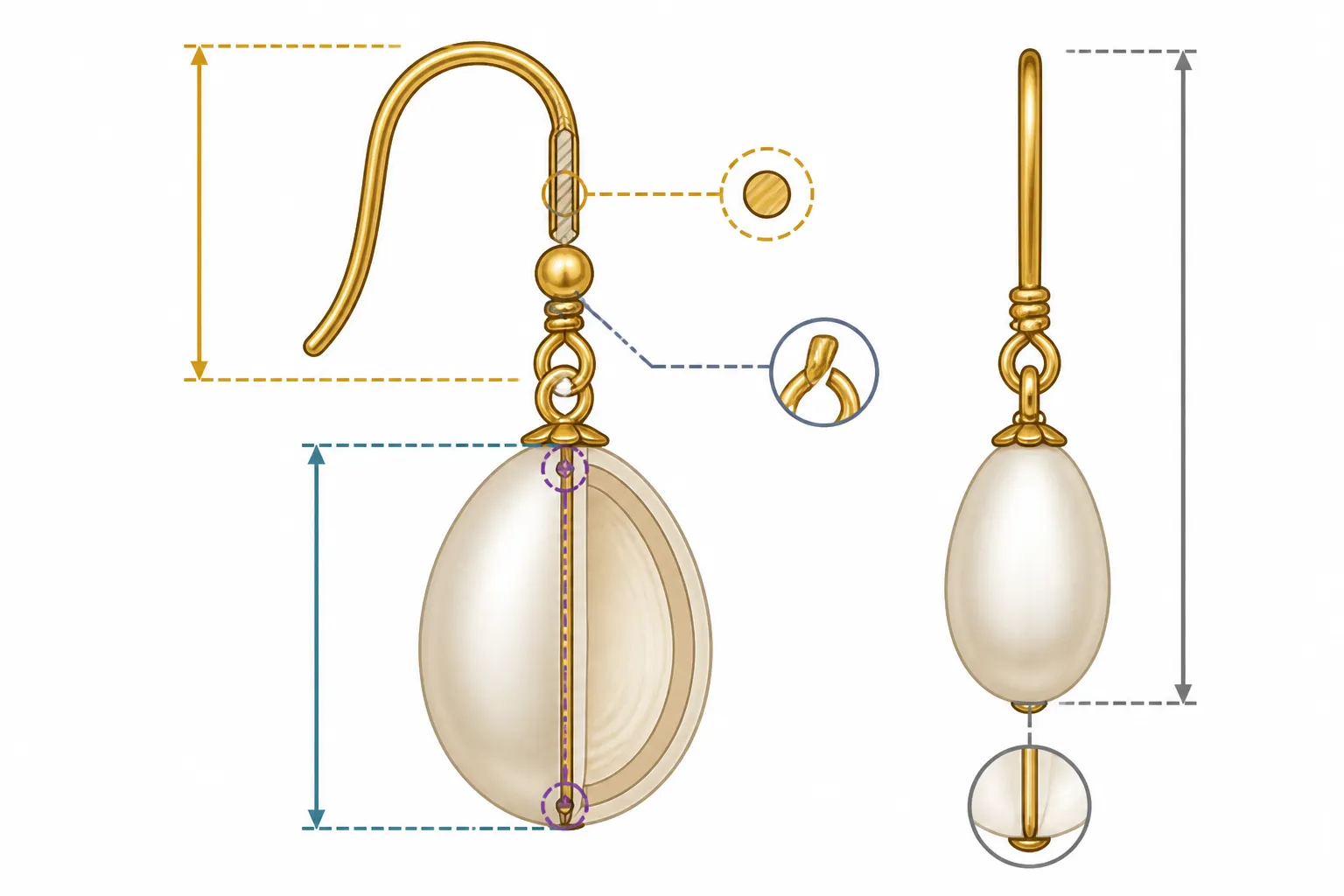
How pearl drop earrings address it: Pearl drop earrings are among the most specification-intensive SKUs in the fashion jewelry category. Every element is a decision: pearl type (shell pearl, freshwater, imitation ABS), pearl diameter (typically 6mm to 12mm for drop styles), shape (round, teardrop, button, baroque), surface luster grade, setting style (bezel, prong, wire-wrapped), metal base (brass, zinc alloy, 304 stainless), plating type and thickness (14K gold fill, 18K gold flash, rhodium), ear wire gauge and closure type. OEM suppliers with strong design-to-production workflows — like STRAND's vetted workshop network in Hangzhou — can translate a brand brief into a structured specification document, produce a pre-production sample for approval, and maintain version control through revision rounds before bulk production begins.
What success looks like: Pre-production sample approval achieved within [standard sample lead time]; fewer than two revision rounds to achieve brand-approved specification; bulk production color and dimension variance within ±5% of approved sample; zero plating adhesion failures within a 6-month sell-through window.
Example scenario: A MENA-based fashion retailer launching a pearl jewelry private label engages STRAND's Arabic-speaking procurement team to manage specification translation and workshop coordination. The retailer approves a first sample within the agreed timeline and proceeds to bulk production with confidence in specification fidelity — without needing an in-person factory visit.
3. Seasonal Trend Response: Sourcing Pearl Earring Styles Aligned to Runway and Social Cycles
The problem: Fashion jewelry trend cycles have compressed dramatically. A pearl earring silhouette that trends on TikTok or appears on a red carpet can generate significant search and purchase intent within 72 hours. Buyers who are not already in conversation with a supplier capable of fast-turn production — or who don't have pre-staged inventory in the right base materials — miss the window entirely.
How pearl drop earrings address it: Pearl as a material direction has demonstrated unusual resilience across multiple trend cycles — from the "quiet luxury" aesthetic of 2022–2023 to the Y2K revival's oversized baroque pearl moments, to the current broader movement toward investment-piece jewelry aesthetics. This resilience means buyers can maintain a standing relationship with a pearl earring supplier rather than scrambling for new vendor relationships each season. The key is a supplier with flexible production capacity and pre-staged pearl components (shell pearl blanks, freshwater pearl inventory, wire and findings) that can move quickly from concept to sample when a trend signal emerges.
What success looks like: Sample-to-bulk production timeline compressed to competitive market windows; ability to introduce a new pearl drop silhouette within a single buying season; trend-responsive SKU additions that don't require renegotiating base supplier terms.
Example scenario: An EU multi-brand online retailer spots a significant search volume spike for "oversized baroque pearl drop earrings" following a major fashion week. Because they have an active supplier relationship with pre-staged baroque pearl components, they commission a new sample and receive it within the expedited sample window — moving from inquiry to production decision before competitors can respond.
4. Quality Control at Source: Preventing Landed-Cost Disasters Before They Happen
The problem: Fashion jewelry buyers who rely on factory self-inspection or post-shipment third-party audits frequently discover quality issues after the damage is done — product is in a warehouse, customs duties have been paid, and the supplier relationship is in dispute. For pearl drop earrings specifically, the most common QC failure points are: inconsistent pearl luster between units in the same batch, plating adhesion failures on ear wires (a point of skin contact that accelerates oxidation), misaligned drill holes causing the pearl to hang off-center, and hook gauge inconsistency affecting closure security.
How pearl drop earrings address it: Sourcing through a supplier with in-house QC inspection capability — built into the production workflow, not added as an afterthought — transforms quality from a reactive problem to a preventive system. STRAND's in-house QC team inspects production batches before shipment, catching dimensional variance, surface defects, and plating issues at the source. This eliminates the cost and complexity of landed-cost disputes and protects buyers in the US, EU, UK, and MENA from the downstream brand and margin damage that consumer-facing quality failures create.
What success looks like: Consumer return rates on pearl earring SKUs below category benchmark; zero shipment rejections at customs due to material misrepresentation; supplier-side QC documentation available for retail compliance requirements; consistent product photography match between sample and bulk delivery.
Example scenario: A US importer supplying a regional jewelry chain with pearl drop earrings for a 200-unit opening order receives STRAND's pre-shipment QC report with dimensional measurements and luster-grade photographs for each batch. The chain's quality team approves the shipment remotely — eliminating the need for a third-party inspection agency and reducing total landed cost.
5. Multilingual Procurement Coordination: Managing Cross-Border Sourcing Across Language Barriers
The problem: Cross-border fashion jewelry sourcing is inherently multilingual. A buying team in Dubai may have procurement staff communicating in Arabic, a logistics partner documenting in English, and a production contact in Hangzhou responding in Mandarin. Specification errors, delivery discrepancies, and commercial disputes frequently originate not in bad faith but in translation failures — a measurement misread, a material substitution misunderstood, a shipping instruction ambiguously conveyed.
How pearl drop earrings address it: For buyers sourcing pearl drop earrings at volume, a supplier with genuine multilingual capability — not machine-translated auto-responses, but dedicated account management in English, Arabic, and Spanish — removes a structural risk from the procurement process. STRAND's multilingual service model is designed specifically for the US, EU, UK, and MENA buyer profiles it serves, where procurement teams frequently operate across language contexts and need a supplier who can receive a specification brief in Arabic and confirm production details in English without accuracy loss.
What success looks like: Zero specification errors attributable to translation; buying team NPS scores reflecting communication quality as a supplier differentiator; ability to onboard new procurement staff in any of the supported languages without retraining supplier relationships.
Example scenario: A Spanish-language DTC jewelry brand scaling into the US market uses STRAND's Spanish-speaking account manager to coordinate their first OEM pearl drop earring order — receiving samples, revisions, and commercial documentation entirely in Spanish before transitioning to English for US customs documentation.
6. Low-MOQ Entry Orders: Testing Pearl Drop Earring Styles Before Scaling
The problem: Emerging DTC brands and market-testing importers cannot commit to the minimum order quantities that traditional wholesale fashion jewelry suppliers require. A 1,000-unit MOQ for an unproven pearl drop earring style represents significant inventory risk for a brand with a monthly revenue run rate below $50K. Yet lower-volume buyers are frequently excluded from OEM customization options, forced into generic catalog styles that don't differentiate their brand.
How pearl drop earrings address it: Suppliers offering low-MOQ OEM production — with custom packaging, private labeling, and style customization available at accessible entry quantities — allow emerging brands to test a pearl drop earring style against their audience before committing to bulk inventory investment. STRAND's low-MOQ model is explicitly designed for this buyer profile: brands that need the customization depth of an OEM relationship without the cash-flow commitment of a traditional wholesale minimum.
What success looks like: Entry order inventory sold through before reorder minimum is required; validated sell-through rate data informing a scaled follow-on order; OEM customization (packaging, style adjustment) available at entry quantities without cost-per-unit penalties that eliminate margin.
Example scenario: A new US DTC jewelry brand tests two pearl drop earring colorways — a classic white freshwater drop and a champagne shell pearl teardrop — at low entry quantities. White freshwater outsells the champagne variant 3:1 in the first eight weeks, and the brand scales to a larger reorder on the validated SKU with confidence.

Cross-Border Fashion Jewelry (DTC + OEM) — Specific Considerations
Regulatory and Compliance Requirements
Fashion jewelry sold in the US, EU, UK, and MENA markets is subject to distinct regulatory regimes that affect pearl drop earrings at the material and labeling level.
- EU REACH Regulation: Limits nickel release from articles in direct and prolonged skin contact (including ear wires). Pearl drop earrings with base metal components must comply with EN 12472 nickel-release testing. Buyers sourcing for EU distribution should request material compliance documentation — specifically, confirmation that the ear wire and any metal setting components meet REACH nickel limits.
- UK PRAS (Post-Brexit): The UK now operates its own chemical regulation regime, largely mirroring REACH but with diverging updates. Buyers supplying UK retail need current material compliance certificates, not legacy EU documentation.
- US CPSC / State Regulations: California Prop 65 applies to jewelry sold in California and requires disclosure for certain heavy metals. Buyers supplying US retail chains should request supplier declarations on cadmium and lead content in metal components.
- MENA Market Requirements: Gulf Cooperation Council (GCC) countries have varying import documentation requirements for fashion jewelry. Buyers should confirm whether a Certificate of Origin, material composition declaration, or specific labeling in Arabic is required for their target market.
- HS Code Classification: The distinction between "imitation pearl" earrings (HS 7117) and "natural or cultured pearl" earrings (HS 7101) has meaningful duty implications in most markets. Buyers should ensure accurate classification to avoid customs delays or reclassification penalties.
Integration with Industry-Standard Sourcing Tools
Cross-border fashion jewelry buyers typically operate across multiple procurement and inventory management platforms:
- ERP/Inventory Platforms (e.g., NetSuite, Brightpearl, Cin7): Pearl drop earring SKU data — including supplier reference codes, material specifications, and reorder points — should be structured for import into these systems from the initial order stage.
- Product Information Management (PIM): DTC brands managing multilingual storefronts need supplier-provided product data (dimensions, materials, care instructions) in formats compatible with PIM tools like Akeneo or Plytix.
- Trade Finance Tools: For larger OEM orders, buyers using trade finance platforms or letter-of-credit workflows need supplier banking details and pro-forma invoicing in standard international trade formats.
Data Sensitivity
Fashion jewelry OEM specifications — including design files, material formulations, and brand packaging artwork — are commercially sensitive. Buyers should confirm that OEM suppliers operate under non-disclosure agreements (NDAs) and that design files are not shared across the supplier's broader production network. STRAND's vetted workshop model includes supplier confidentiality as a procurement standard.
Scale and Seasonality
Pearl drop earrings follow predictable seasonal demand patterns: Q4 holiday gifting (October–December), Valentine's Day (January–February production window), Mother's Day (February–March production window), and bridal/occasion season (spring). Cross-border buyers should plan OEM orders to arrive at their distribution point 6–8 weeks before peak sell-through begins, accounting for production, QC, shipping, and customs clearance lead times.
Implementation Roadmap for Cross-Border Fashion Jewelry Teams
Phase 1 — Pilot (Weeks 1–6)
- Define your pearl drop earring sourcing objective: catalog inventory, OEM private label, or trend-response open stock.
- Submit a sample request to STRAND at strandjewelry.com with your reference images, target price point, and quantity range.
- Receive pre-production samples; evaluate against your specification criteria (pearl type, luster, plating, drop length, closure).
- Confirm material compliance documentation requirements for your target market (EU REACH, US Prop 65, UK PRAS, GCC).
Phase 2 — Pilot Orders & Range Expansion (Weeks 7–16)
- Negotiate commercial terms: MOQ, pricing tiers, payment terms (T/T, LC, Escrow options), and lead time commitments per order volume.
- Confirm packaging and labeling requirements; submit brand artwork files for OEM private label production if applicable.
- Place entry order; receive pre-shipment QC report before approving shipment.
- Clear customs with correct HS classification; confirm delivery to your distribution point.
- Evaluate landed cost, sell-through velocity, and return rate against pilot KPIs.
Phase 3 — Scaled Sourcing (Months 4–12)
- Build a preferred-supplier framework with STRAND for pearl drop earring category; negotiate annual volume commitments for priority production capacity.
- Integrate supplier SKU data into your ERP/PIM systems for automated reorder triggers.
- Expand into complementary SKUs (pearl necklace + earring sets, stud variants, two-tone colorways) using the established supplier relationship and QC workflow.
- Review compliance documentation annually as regulatory requirements in your target markets update.
ROI and Business Outcomes for Cross-Border Fashion Jewelry
The return on a well-structured pearl drop earring sourcing strategy is measurable across several dimensions that matter specifically to cross-border fashion jewelry operators:
- Gross Margin Improvement: Direct sourcing from vetted Chinese workshops — bypassing intermediary agents — typically delivers 20–35% cost-of-goods improvement versus buying through distributor catalogs, depending on volume and specification complexity.
- Inventory Turn: Low-MOQ entry orders and reliable reorder windows reduce overstock risk and improve inventory turn ratios. Brands that validate SKU performance before scaling inventory investment see measurable improvement in working capital efficiency.
- Return Rate Reduction: Pre-shipment QC inspection reduces consumer-facing quality failures. A 1–2% reduction in return rate on a jewelry SKU with a $35–55 retail price point delivers meaningful margin recovery at scale.
- Supplier Consolidation: Centralizing pearl drop earring sourcing with a single vetted supplier reduces procurement overhead — fewer RFQs, fewer onboarding processes, fewer compliance documentation requests — freeing buying team bandwidth for higher-value activities.
- Speed-to-Market: Suppliers with pre-staged materials and responsive account management compress the sample-to-production timeline, enabling trend-responsive buying decisions that are not available through catalog-only procurement channels.
- Brand Equity Protection: Consistent quality across reorders protects the brand equity that DTC operators build through content, photography, and customer experience — an asset that a single quality failure can damage disproportionately to its unit economics.
Conclusion: Your Next Steps as a Cross-Border Jewelry Decision-Maker
Pearl drop earrings are a deceptively complex sourcing category — visually simple, commercially nuanced, and heavily dependent on the quality and reliability of the supply chain behind them. For cross-border buyers in the US, EU, UK, and MENA sourcing fashion-grade pearl earrings for DTC sale or OEM private label, the difference between a profitable category and a margin-eroding one often comes down to three factors: specification clarity, pre-shipment quality assurance, and a supplier relationship that can communicate and execute across language and time-zone barriers without friction.
STRAND is a Hangzhou-based jewelry sourcing brand that connects overseas buyers directly to vetted Chinese production workshops, with in-house QC, multilingual account management (English, Arabic, Spanish), and transparent trade terms designed for the cross-border fashion jewelry buyer. Whether you are placing your first low-MOQ entry order for a DTC catalog or scaling an OEM private-label production program, STRAND's sourcing model is built around the procurement realities of your market.
Before you reach out, prepare:
- Reference images or design files for your target pearl drop earring styles
- Your target market(s) and any known compliance requirements (EU REACH, Prop 65, etc.)
- Estimated order quantity range so your account manager can confirm MOQ and pricing tiers
- Your target in-hands date, so lead time feasibility can be confirmed upfront
Request a Quote or Sample at strandjewelry.com →
Talk to a procurement specialist, get MOQ and pricing for your volume tier, and receive a sample specification proposal — in English, Arabic, or Spanish, depending on your team's working language.
STRAND — Hangzhou-based. Globally sourced. Quality-verified before it ships.