
How the Orion mPulse Permanent Jewelry Welder Actually Works
How the Orion mPulse Permanent Jewelry Welder Actually Works
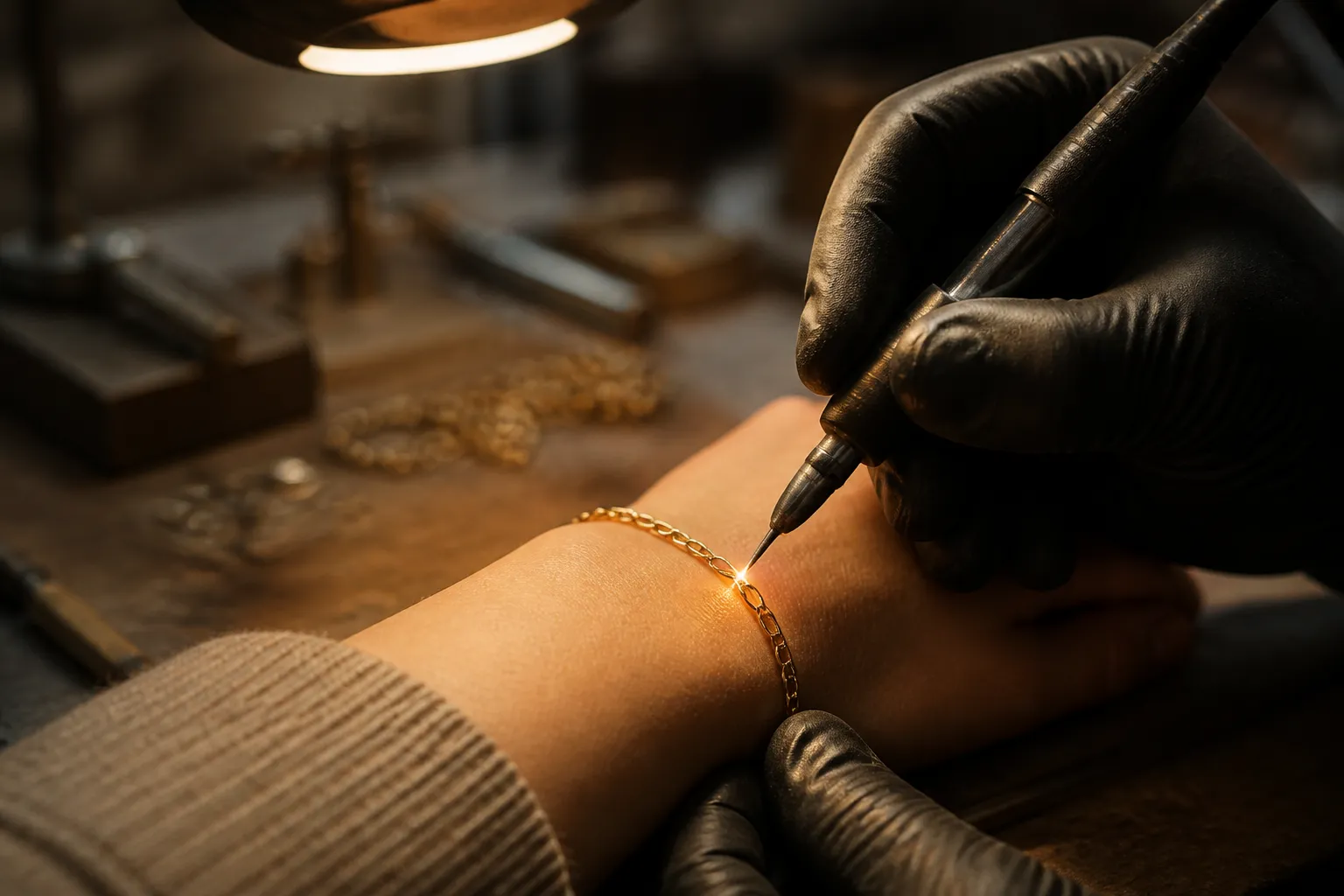
The Orion mPulse permanent jewelry welder is a pulse arc welding device designed to fuse fine jewelry chain links directly on the customer's body — creating clasp-free, "forever" bracelets, anklets, and necklaces with a single, precise electrical discharge. It has become the tool of choice for jewelers, boutiques, and pop-up studios building out permanent jewelry services.
Permanent jewelry — also called forever jewelry or clasp-free jewelry — has grown into a mainstream service offering. Customers choose a chain, sit for 30 seconds while a link is welded shut around their wrist, and walk away wearing a piece they never take off. The Orion mPulse is the piece of equipment that makes that moment possible safely and repeatedly. If you are evaluating tools for launching or scaling a permanent jewelry service, understanding exactly what this welder does — and what it does not — is the foundation of a sound procurement decision.
What Is the Orion mPulse Permanent Jewelry Welder?
The Orion mPulse is a bench-top pulse arc welder manufactured by Sunstone Engineering under their Orion product line. Unlike torch soldering — which requires open flame, flux, and cool-down time — pulse arc welding delivers a controlled burst of electrical energy between two electrodes in milliseconds. That burst melts a tiny zone of metal and fuses it without heat spreading to surrounding areas or to the customer's skin.
The "mPulse" designation refers to the micro-pulse technology that governs how energy is delivered. The system allows the operator to dial in energy output across a wide range, which matters when you are working with chains of varying gauge, metal purity, and karat. A 14k gold chain, a sterling silver anklet, and a rose gold bracelet all require different settings; the mPulse provides that granularity.
Three things distinguish this machine from general-purpose jewelers' welders:
- On-body weld capability. The electrode geometry and low-energy output are suited to working millimeters from skin without burning the customer.
- Speed. Each weld takes a fraction of a second. High-traffic event days — bridal parties, pop-up markets — are viable because throughput is genuinely fast.
- Minimal training curve. Compared to laser welders, which require safety enclosures, goggles, and significant calibration knowledge, the mPulse is accessible to technicians who are skilled jewelers but not laser-welding specialists.
How Pulse Arc Welding Actually Fuses a Chain Link
Understanding the mechanism helps you evaluate the tool honestly before buying.
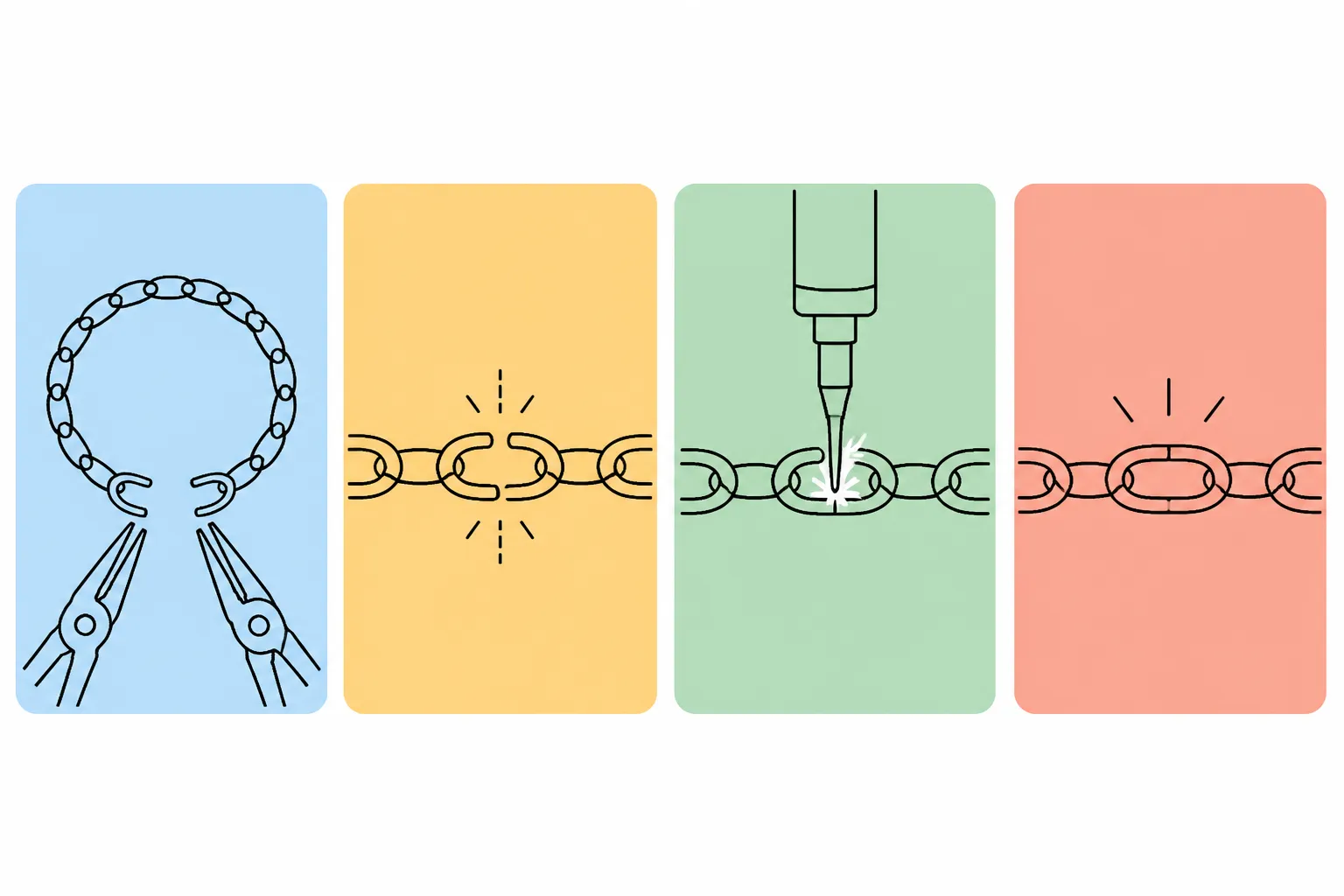
When the operator places the electrode tip against a jump ring or chain link and triggers the welder, a stored electrical charge discharges in a pulse. The metal at the contact point reaches its melting temperature locally, flows slightly, and solidifies as the pulse ends. The surrounding metal — including the customer's skin a centimeter away — barely registers a temperature change. No solder is used. No flux residue remains. The weld point is part of the metal itself.
This is fundamentally different from torch soldering, where a third material (solder) joins two surfaces, and from laser welding, which uses a focused light beam to achieve the same localized melt. Pulse arc welding sits between those two in terms of equipment cost and technical complexity: more precise than a torch, more affordable and portable than a fiber laser.
The operator controls four key variables:
- Energy level — adjusted by pulse intensity setting
- Electrode pressure — how firmly the tip contacts the metal
- Electrode condition — tungsten tips wear and must be ground regularly
- Metal preparation — chain ends must be cut cleanly and aligned before welding
All four affect weld quality. A messy cut or an overused electrode produces a rough join that may not hold long-term. Experienced operators learn to read the weld visually within the first few pieces; the learning curve is shallow but real.
Key Features of the Orion mPulse Worth Evaluating
Before committing to any welding equipment, procurement teams and studio owners should assess the mPulse against the specific demands of a permanent jewelry operation.
Adjustable Energy Output
The mPulse's adjustable energy range is not a minor spec — it is the central reason the machine suits a range of jewelry chains. Fine-gauge sterling silver chains require lower energy than thicker 14k gold links. A welder with too few settings either burns thin chains or fails to fuse heavier ones. Ask the supplier for the energy range in joules or watt-seconds relevant to the chain gauges you plan to stock.
Foot Pedal and Stylus Operation
The mPulse ships with a stylus-style electrode handpiece and a foot pedal trigger. This leaves both hands free to stabilize the chain and position the jump ring — which is critical when you are working close to a customer's skin. Single-hand trigger designs exist on the market, but two-handed stabilization consistently produces cleaner welds on fine chain.
Electrode Tip Consumables
Tungsten electrode tips are the primary consumable. They wear with use and must be ground back to a clean point periodically. Factor ongoing electrode costs into your operating budget, and confirm availability of replacement tips from your supplier. Downtime from a worn electrode mid-event is preventable with a small inventory of spares.
Compact Footprint
The mPulse bench unit is compact enough to operate from a small table or cart. This matters for mobile setups — bridal events, retail pop-ups, and traveling service bookings. Many operators who run both a fixed studio and mobile events cite portability as a decisive factor.
When to Choose the Orion mPulse Over a Laser Welder
The permanent jewelry market has two primary tool tiers: pulse arc welders (including the Orion mPulse) and fiber laser welders. Each suits a different operator profile.
Choose the Orion mPulse when:
- You are launching a permanent jewelry service and want to minimize initial capital outlay
- Your team includes skilled jewelers but no laser-welding-certified technicians
- You run mobile or pop-up events where portability is non-negotiable
- Your chain selection is primarily fine-gauge gold-filled, sterling silver, or solid gold in lighter weights
A fiber laser welder makes more sense when:
- You are doing high-volume studio production, not just on-body weld services
- You need to weld heavier gauges, mixed metals, or unusual alloys
- You already have a dedicated laser-safe workspace and certified staff
- Budget is not the primary constraint
For most boutique jewelry studios and DTC stores adding a permanent jewelry service to their offering, the mPulse hits a practical sweet spot. It is capable enough for professional results, accessible enough to train staff quickly, and priced below the threshold that requires a formal capital expenditure approval at many small businesses.
Metal Compatibility and Chain Selection
The Orion mPulse welds a range of metals commonly used in permanent jewelry, but compatibility depends on metal composition, chain gauge, and jump ring geometry. Here is what to know before building your chain inventory.
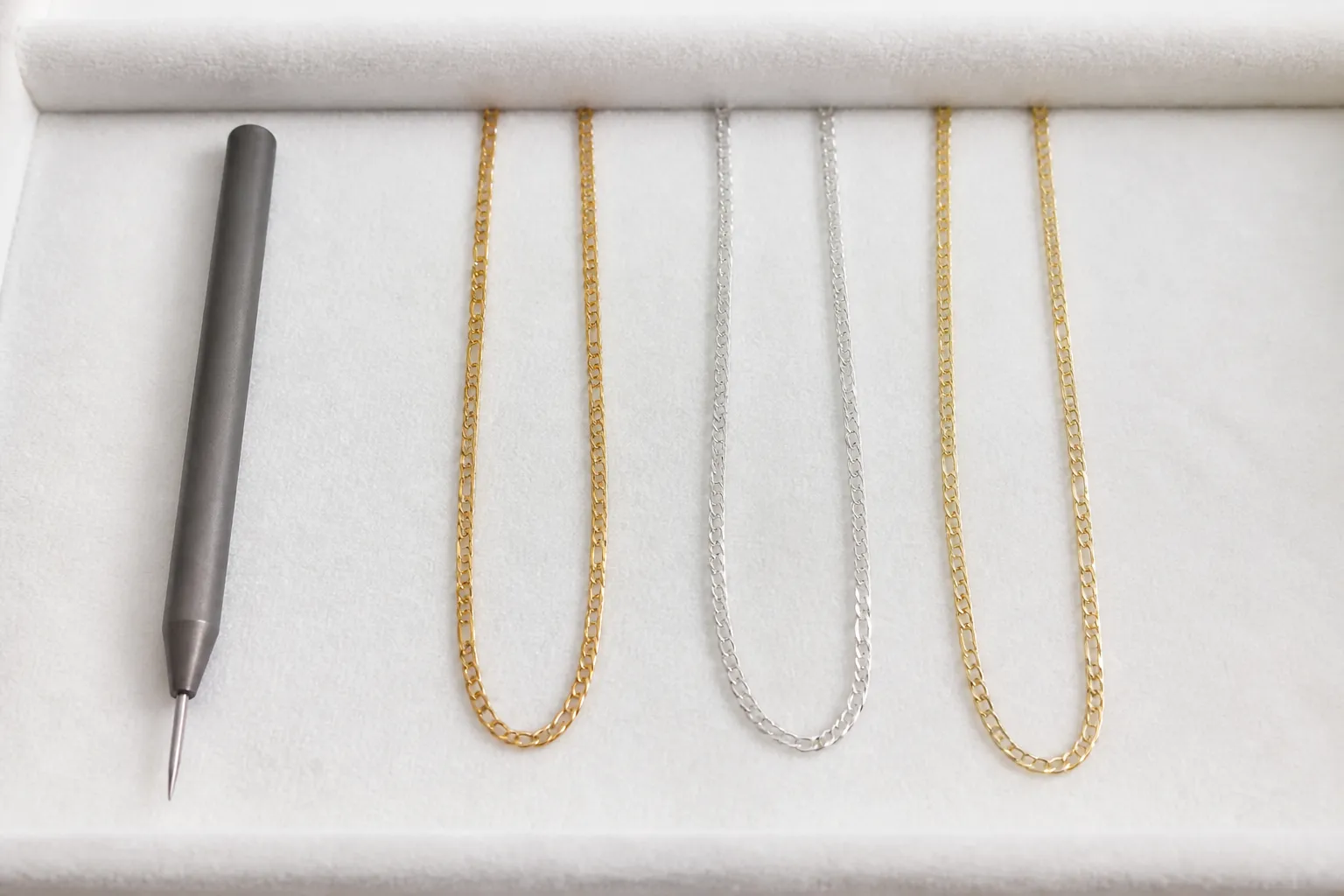
Gold-Filled Chain
Gold-filled chain is the most common stock in permanent jewelry studios. It carries a layer of solid gold bonded to a base metal core, typically brass. The mPulse welds gold-filled chain reliably at appropriate energy settings. The weld zone should fall on the jump ring rather than on the chain body itself.
Solid Gold (10k, 14k, 18k)
Solid gold is premium inventory. It welds cleanly on the mPulse, and the higher gold content often means customers will wear the piece for years or permanently. 14k is the most common request — it balances durability with visible gold color. 18k is softer and more prone to deformation under heavy electrode pressure, so energy calibration is critical.
Sterling Silver
Sterling silver welds well on the mPulse and is popular for price-sensitive markets. Be aware that sterling oxidizes over time on the skin, which some customers interpret as a quality issue. Offering fine silver (99.9%) or rhodium-plated sterling addresses this but comes with different weld behavior.
Gold-Filled vs. Vermeil vs. Gold-Plated
Gold-plated and vermeil chains are sometimes proposed as cost-reduction alternatives. Gold-plated chain has a very thin gold layer over base metal; the weld burns through to bare metal and the result is visually inconsistent. Vermeil is better — sterling base with substantial gold plating — but weld behavior still differs from gold-filled. Most experienced operators recommend against stocking gold-plated chain for permanent jewelry services regardless of price advantage.
If you are curating jewelry inventory alongside your welding service, pieces that complement permanent chain work — like statement earrings or layering necklaces your customer can pair with their new welded bracelet — round out the service experience. STRAND's Two-Tone Rhinestone Fireworks Jewelry Set (Earrings & Necklace) and delicate stud options like the Minimalist Metal Bar Pearl Drop Stud Earrings in Gold pair naturally with the understated permanence of a welded chain.
Setting Up a Permanent Jewelry Service: Operational Basics
Buying the Orion mPulse is step one. Running a profitable permanent jewelry service requires a few adjacent decisions.
Chain and Jump Ring Sourcing
The mPulse welds jump rings — small circular links — shut after the chain is sized. The jump ring gauge must match the chain. Most chain suppliers sell matched jump rings; buying mismatched gauges is a common beginner error. A jump ring that is too thin will burn through at low energy settings; too thick and it will not fuse cleanly without scorching the chain.
Workspace Setup
You need a grounded work surface, good lighting, and a stable chair for both operator and customer. Anti-static mats help protect sensitive components. Keep a jar of fine steel wool or electrode conditioning equipment nearby — tip maintenance is a per-session task, not an occasional one.
Safety Basics
Pulse arc welding does not produce significant UV radiation or toxic fumes when working with gold and silver. Standard precautions include:
- Never weld on or near piercings, rings, or metal accessories
- Keep the weld point at least several millimeters from skin
- Confirm the customer has no pacemaker or implanted electronic device (electrical discharge, though micro-scale, is a precautionary concern)
- Have a first aid kit accessible — the risk is very low, but burns from electrode contact are possible on high energy settings
Pricing Your Service
Permanent jewelry is priced by chain length, metal type, and market positioning. A typical offering covers the cost of the chain by the inch, a flat "weld fee," and optional charm add-ons. Because the mPulse enables fast throughput, event-based pricing — flat rate per customer for group bookings — is a profitable model for studios with mobile capability.
Buyer's Evaluation Checklist Before Purchasing
For procurement teams assessing the Orion mPulse, these are the questions to resolve before placing an order:
| Evaluation Dimension | What to Ask |
|---|---|
| Price & availability | Current unit price, lead time from distributor, regional stock location |
| Warranty | Warranty period, what is covered, where warranty claims are processed |
| Training & support | Does the supplier offer onboarding materials, video tutorials, or direct technical support? |
| Consumables supply | Are electrode tips available locally or only from the manufacturer? |
| Shipping | For international buyers: customs classification, declared value, shipping carrier options |
| Returns | What is the return window, and are restocking fees charged if equipment is defective? |
Do not purchase welding equipment based on social media demonstration videos alone. Request a specification sheet, confirm the energy output range meets your chain gauge requirements, and ask the supplier for a list of metal types the warranty covers for use.
For MENA-market buyers: gold tone and high-karat compatibility are especially relevant, as gold jewelry remains culturally central across Gulf and Levant markets. Confirm the mPulse settings documentation includes guidance for 18k and 21k gold chain, which appear more frequently in those markets than in Western inventories.
The Business Case: Why Permanent Jewelry Services Work
A permanent jewelry service has a fundamentally different economics model than standard retail. The sale is experiential — customers pay not just for the piece but for the ritual of having it welded on. That experience commands a premium over equivalent chain sold from a display case.
Studios that add permanent jewelry to an existing retail or boutique operation report that the service drives foot traffic, encourages upselling (earrings, charms, layering pieces), and generates social media content naturally — customers photograph their own wrists as part of the experience. The Orion mPulse's speed is directly tied to the revenue ceiling: faster welds mean more customers served per hour during high-demand events.
For DTC brands and importers considering adding permanent jewelry as a service category, the entry cost is relatively contained. The welding unit, chain inventory in a curated selection of metals and gauges, and a basic training investment are the core requirements. Unlike adding a new product SKU, the service creates recurring engagement — customers return to add bracelets to the same wrist, bring friends, or commission the service for events.
Making Your Purchase Decision
The Orion mPulse permanent jewelry welder is a purpose-built tool for a specific service. It is not a general bench welder repurposed for a trend — Sunstone Engineering developed the mPulse category with the on-body jewelry application in mind, which is reflected in the electrode design, energy range, and stylus handling.
If you are ready to launch or expand a permanent jewelry service, the evaluation path is straightforward: confirm the energy specifications match your metal inventory, secure a reliable supply of replacement electrode tips, and verify warranty coverage in your region before committing.
Ready to source? Contact the supplier directly to confirm current pricing, lead time, and availability in your market. For international orders, ask specifically about customs documentation, declared value options, and whether a regional distributor carries stock — shipping a welding unit internationally from the US carries lead time and import duty implications worth clarifying upfront.
For pieces that complement a welded chain service — earrings, pendants, and sets that your customers will want to wear alongside their new forever bracelet — explore the STRAND collection of curated jewelry sets built for international retail and DTC buyers.
The Orion mPulse is the right tool for studios serious about permanent jewelry. Match it to the right chain inventory, train your team on electrode maintenance, and the service pays for the equipment quickly. Start by requesting a full specification sheet and current pricing from your supplier — that conversation is where the decision gets concrete.
Frequently Asked Questions About the Orion mPulse
What metals can the Orion mPulse weld? The mPulse is rated for gold alloys (10k, 14k, 18k), gold-filled, sterling silver, fine silver, and platinum. Copper and brass can technically be welded but are rarely used in permanent jewelry applications because they oxidize against skin. Always cross-reference your specific chain alloy against the manufacturer's compatibility list — alloy composition within a karat can affect weld behavior.
Does the weld hold permanently? A properly executed pulse arc weld on a quality jump ring is as strong as the rest of the chain. The weakest point after welding is the chain link itself, not the weld. That said, "permanent" in the permanent jewelry context is a service positioning term — the piece can be cut off with scissors and the chain can fray over time like any fine jewelry worn continuously. Weld integrity is not the limiting factor for most customers.
How long does it take to learn to use the mPulse? Most jewelers with basic metalworking experience produce clean welds within a single training session of a few hours. The first dozen welds on scrap chain establish muscle memory for electrode pressure and positioning. Budget a half-day of practice before welding on paying customers.
Can you use the Orion mPulse for repair work beyond permanent jewelry? Yes. The mPulse is a capable repair welder for small jump rings, prong tips, and chain links. Its energy range suits fine jewelry repair tasks that fall below what a torch soldering setup handles cleanly. Many studios use it as their primary fine-chain repair tool alongside the permanent jewelry service.
What is the maintenance schedule? Electrode tips are the primary maintenance item. Ground the tip back to a clean, sharp point every 20–40 welds depending on metal type and energy setting — you will see weld quality degrade before the tip is completely spent. The machine body requires no scheduled internal maintenance under normal use, but keep it free of metal filings and dust, which can affect the discharge circuit.
Troubleshooting Common Weld Issues
Even experienced operators encounter inconsistent results. Here are the most common problems and their causes.
Weld doesn't fuse / jump ring stays open This almost always means insufficient energy, a poorly conditioned electrode tip, or a gap between the two metal surfaces being joined. Check the tip first — grind it fresh — then verify the jump ring ends are butted cleanly with no visible gap before triggering the pulse.
Chain link or jump ring discolors or burns Energy is set too high for the gauge and alloy. Drop the energy one step and test on scrap. Discoloration on gold-filled chain is also a sign that the weld is landing on the chain body rather than only on the jump ring — adjust position before the next weld.
Weld looks rough or lumpy The electrode tip is worn or the contact pressure was inconsistent. Ground the tip and practice the trigger motion on scrap to find a steady hand pressure. Rough welds can be cleaned with a polishing cloth but prevention is faster than repair.
Customer feels heat during weld The weld point is too close to skin, or the energy setting is higher than the gauge requires. Reposition the jump ring location and reduce energy. If the service setup requires the weld point within a few millimeters of skin, lower-energy settings are not just a preference — they are a safety requirement.
Sourcing the Orion mPulse: International Buyer Considerations
For buyers outside North America, purchasing the Orion mPulse involves logistics questions that domestic buyers do not face. These are the practical points to resolve with the supplier or an authorized distributor before placing an order.
Voltage compatibility. The mPulse is designed for the North American power standard (110V/60Hz). International buyers in 220V/50Hz markets — which includes most of Europe, the Middle East, and much of Asia — need a step-down transformer or a regionally distributed variant if one exists. Confirm this with the supplier before shipping; running the unit on incompatible voltage without conversion will damage it and voids the warranty.
Import duties and customs classification. Pulse arc welders are typically classified under electrical welding apparatus in most customs tariff schedules. Duty rates vary by country. Request the HS code from the supplier for accurate duty estimation; some distributors will provide a proforma invoice with the correct classification to simplify customs clearance.
Warranty service location. If the unit develops a fault, where is warranty service performed? For buyers in MENA or Asia-Pacific markets purchasing directly from a US-based supplier, returning the unit for service is logistically complex. Ask whether warranty claims can be handled via a local distributor or whether the supplier ships replacement parts for field repair.
Lead time for international orders. Depending on the distributor's stock position, international orders can carry lead times of several weeks when combined with freight and customs processing. If you are building toward a specific launch date — a retail opening, a seasonal event window — build that buffer into your procurement timeline.
Final Word
The Orion mPulse permanent jewelry welder occupies a specific, well-defined role: it is the accessible, professional-grade tool for studios building a permanent jewelry service without the capital and infrastructure overhead of laser welding. Its energy adjustability, on-body weld safety profile, and portable form factor make it the default recommendation for boutiques, DTC brands, and event-based jewelers entering this service category.
What it requires in return is correct metal sourcing, consistent electrode maintenance, and operator practice before customer-facing use. None of those requirements are onerous — they are simply the professional standard for any service that involves a small electrical discharge near a customer's skin.
Your next step: contact the supplier or an authorized regional distributor to request a current specification sheet, confirm voltage compatibility for your market, and get a firm quote with lead time. Bring your chain gauge requirements to that conversation — the spec sheet will confirm whether the mPulse's energy range covers everything in your planned inventory before you commit.