
How to Choose a Jewelry Wholesale Vendor That Actually Delivers
How to Choose a Jewelry Wholesale Vendor That Actually Delivers
A jewelry wholesale vendor is a B2B supplier that sells finished or semi-finished jewelry pieces at bulk pricing to retailers, importers, and DTC brands. Wholesale pricing activates at defined minimum order quantities (MOQs), giving buyers the margin structure required to run a profitable jewelry business — but only if you choose the right vendor from the start.
Choosing the wrong vendor costs more than money. It costs sell-through windows, customer trust, and sometimes entire seasonal assortments. This guide walks through what wholesale vendors are, how to evaluate them, what to ask before placing your first order, and when wholesale sourcing makes more sense than custom production.
What Is a Jewelry Wholesale Vendor?
A jewelry wholesale vendor sits between the manufacturer (or craftsperson) and the end consumer. They supply retailers, boutiques, online stores, and importers with ready-to-sell or customizable pieces at pre-negotiated wholesale prices — typically a fraction of the MSRP.
Three things separate a wholesale vendor from a retail supplier:
- Gated pricing: Wholesale rates are accessible only to registered business buyers. Halstead — a supplier of wholesale silver and gold-filled jewelry with 50 years of industry experience — shows retail pricing by default; logged-in wholesale clients see their account-specific rates exclusively.
- MOQ requirements: Minimum order quantities per SKU or per order total are the standard mechanism for unlocking bulk pricing.
- Catalog depth: Established vendors carry significant SKU ranges. Halstead's catalog lists 77 earring SKUs, 52 charm SKUs, 40 ring styles, and 25 hoop earring styles, spanning Sterling Silver (155 products), Gold-Filled (47 products), and Gold-Plated Sterling options.
For buyers considering private-label or made-to-order inventory alongside off-the-shelf wholesale, Custom Jewelry: 6 Sources Buyers & DTC Brands Need in 2026 covers the adjacent sourcing landscape — the evaluation criteria overlap, but the vendor type and lead-time structure differ considerably.
Why the Right Jewelry Wholesale Vendor Matters
The vendor you choose sets three things that are nearly impossible to fix mid-season: your cost of goods, your inventory reliability, and your product quality floor. Get one wrong and the other two suffer.
Cost of goods defines your margin ceiling. A vendor with opaque pricing or inconsistently enforced MOQs makes gross margin forecasting impossible. Before committing to any vendor relationship, you need the per-unit wholesale price, the MOQ at that price, and whether tiered pricing exists at higher volumes.
Reliability protects your sell-through rate. In-stock wholesale styles ship immediately — that matters when you're building seasonal collections or responding to a trend spike. Vendors who frequently backlog popular SKUs put your sell-through windows at risk.
Quality sets your brand floor. For retailers and DTC brands competing on product integrity — not just price point — material specification matters. Sterling silver (92.5% silver content), gold-filled (a mechanically bonded solid gold layer over a base metal core), and gold-plated (a thin electroplated layer) are not interchangeable claims. Buyers serving MENA markets often face heightened end-customer expectations around gold content and hallmarking. A vendor who can supply material certificates and purity documentation is not a nice-to-have in those channels — it's a requirement.
Types of Jewelry Wholesale Vendors
Understanding vendor categories helps you match the right source to your business model.
Finished Goods Wholesalers
These vendors sell ready-to-retail pieces — in some cases tagged, packaged, and display-ready. Halstead describes its wholesale collection as "easy upsell items for retailers" that ship from in-stock inventory, with theme collections spanning Nature, Beach, Western, Christian, and Pets — specialty niches with strong retail margins in gift stores and boutiques.
Best for: gift shops, boutiques, online stores, and marketplaces that need immediate inventory without design involvement.
Components and Findings Wholesalers
These vendors supply raw materials — chains, clasps, charms, blanks — to jewelry studios and makers who assemble finished pieces themselves. Halstead's catalog bridges both categories, offering 18 chain SKUs and 52 charm SKUs alongside finished jewelry.
Best for: independent designers, jewelry studios, and makers building proprietary designs at scale.
Custom and OEM Vendors
These vendors manufacture to your specification — your design, your materials, your branding. MOQs tend to be higher and lead times longer, but the output is a product no competitor can source from the same catalog. STRAND operates in this category, supplying vetted custom jewelry to DTC stores and importers with transparent material documentation. For a structured breakdown of this sourcing type, see Custom Jewelry: 6 Sources Buyers & DTC Brands Need in 2026.
Best for: brands competing on exclusive product design, private-label buyers, and importers building proprietary collections.
Marketplace-Based Vendors
Platforms like Alibaba and Faire aggregate multiple vendors under one interface. Pricing can be competitive, but quality control is entirely the buyer's responsibility. Vendor vetting requires considerably more due diligence than working with an established direct wholesale account.
Best for: experienced buyers with strong QA processes who need price discovery across many suppliers.
How to Evaluate a Jewelry Wholesale Vendor
Vendor evaluation is not a single conversation — it's a structured process across six dimensions.
1. Materials and Specifications
Request precise material documentation before sampling. Gold-filled pieces use a legally regulated minimum gold layer thickness; gold-plated pieces do not. For markets where hallmarking is legally or culturally expected — including the UK, UAE, Saudi Arabia, and wider GCC — vendor documentation must match those requirements.
Ask: What is the metal purity (925 sterling, 14K gold-filled)? Are third-party material certificates available? What plating thickness in microns is standard on gold-plated styles?
2. Pricing Structure and MOQ
Request a full pricing schedule, not just a per-unit figure. Confirm whether pricing tiers exist at different volume levels, whether MOQ applies per SKU or per order total, and whether wholesale pricing requires account approval. Many established vendors gate wholesale rates behind a registered account — that's normal practice.
3. Lead Time and Stock Availability
In-stock programs can ship fast. Custom or made-to-order programs carry production lead times that vary significantly by vendor and order complexity. Know which program applies to each SKU. Ask: What is the typical lead time for in-stock versus made-to-order? Is there a same-day shipping cut-off?
4. Shipping, Duties, and Landed Cost
For overseas buyers, the catalog price is never the total cost. Clarify: Does the vendor ship internationally? What are the Incoterms (FOB, CIF, DDP)? Who handles customs duties and import taxes? Can the vendor provide commercial invoices formatted for your country's customs requirements?
For MENA-based buyers specifically: ask whether the vendor has experience shipping into GCC markets and whether DDP options are available. Customs documentation requirements in the region can be precise and product-specific.
5. Quality Assurance and Returns
A vendor's return policy reflects their confidence in their own output. Look for a stated defect standard, a clear return window, and an RMA process for defective items. A sample program before bulk commitment is the minimum baseline for any credible vendor.
6. Communication and Account Support
Before onboarding a new vendor, send a detailed inquiry and measure response time and specificity of answers. A vendor who asks clarifying questions back — who wants to understand your business — is more valuable than one who sends a price list and waits.
When Should You Use a Jewelry Wholesale Vendor?
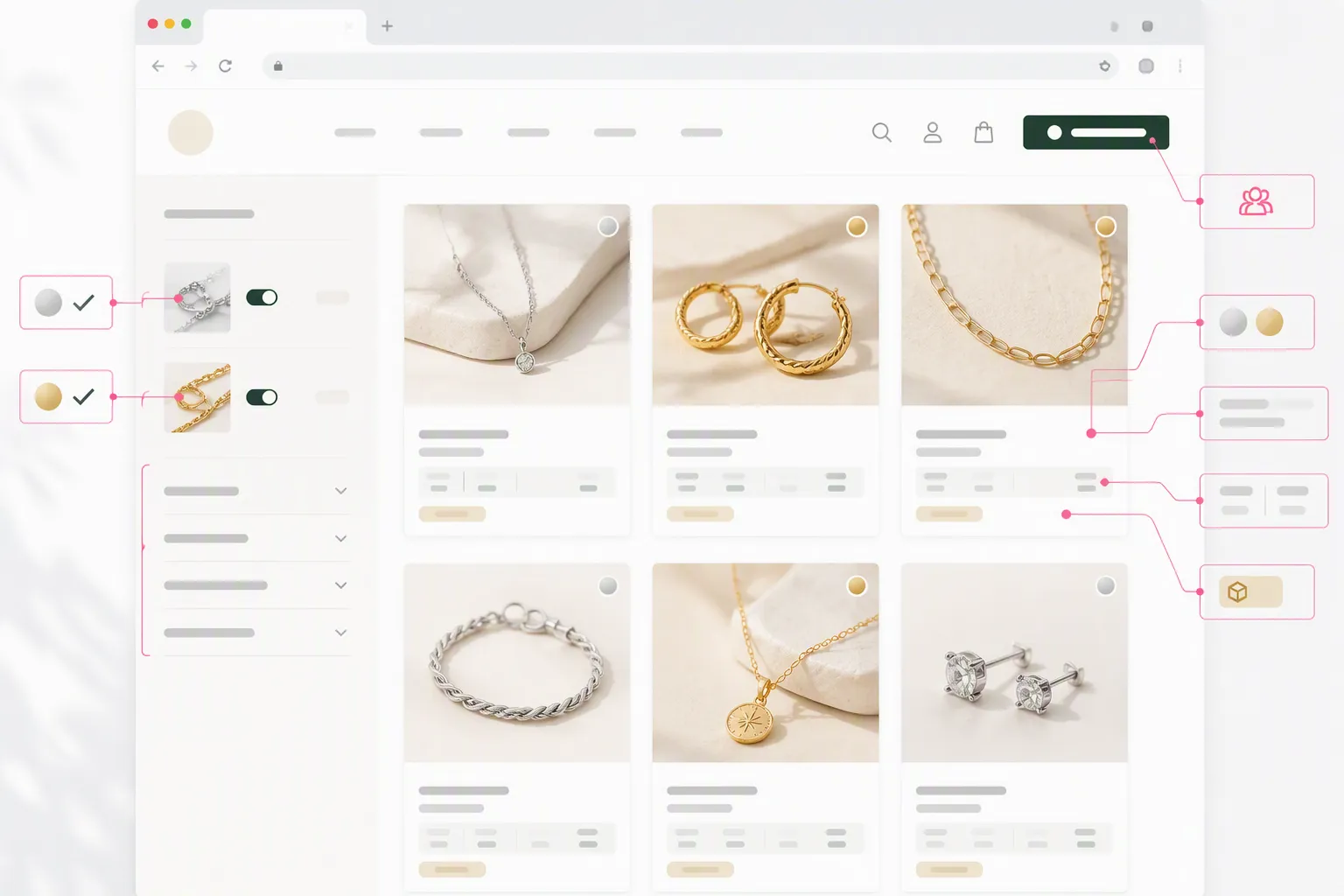
Wholesale sourcing fits a specific point in a business lifecycle — not every stage.
Wholesale sourcing makes sense when:
- You have validated demand for a category and need repeatable, fast-replenishment inventory
- Your order volume justifies MOQ requirements without locking up excessive working capital
- You are building a retail assortment and need range across styles and price points
- You are entering a new market and need in-stock inventory before committing to a custom production cycle
Consider custom or OEM sourcing instead when:
- You need exclusive designs that competitors cannot source from the same catalog
- Your brand positioning depends on proprietary materials, hallmarking, or construction
- You are building a hero product line where differentiation at the product level is non-negotiable
The two approaches are not mutually exclusive. Many DTC brands and importers run a blended model: wholesale for fast-moving core staples, custom production for flagship or collection-defining pieces.
What to Ask Before You Place Your First Order
A structured due diligence checklist for first-time vendor engagement:
| Question | Why It Matters |
|---|---|
| What materials do you use, and can you provide certificates? | Protects against mislabeled or sub-specification product |
| What is your MOQ per SKU and per order? | Determines whether the vendor fits your buying cycle |
| What are current lead times for in-stock vs. made-to-order? | Aligns inventory planning with your go-to-market timeline |
| What Incoterms do you offer, and do you ship to my market? | Clarifies landed cost and customs responsibility |
| What is your defect standard and return window? | Quantifies the quality guarantee and recourse |
| Can I order samples before committing to bulk? | Verifies quality before significant capital outlay |
| At what volume do I qualify for wholesale pricing? | Confirms you meet the threshold before budgeting |
Red Flags When Vetting a Jewelry Wholesale Vendor
These signals warrant caution or disqualification:
No material documentation available. A vendor who cannot or will not provide metal purity, plating specifications, or material certificates is selling you an unknown product. That is a supply chain risk, not just a quality issue.
No clear MOQ structure. If pricing and minimum quantities shift conversation to conversation, the relationship will be unpredictable at scale.
No sample program. Any vendor confident in their product quality will offer samples. Resistance to sampling is a red flag, not a standard negotiating position.
Pricing far below precious metal market rates. Gold and silver spot prices fluctuate every trading session — Halstead publishes a daily market update reflecting current rates. Wholesale jewelry pricing on genuine precious metal pieces cannot exist far below those material floors. Prices that seem dramatically too good typically indicate mislabeled or sub-specification metal.
Slow pre-sale communication. If responses take a week before you have placed a single order, expect the same when you have a shipment problem.
The Benefits of Working with a Vetted Wholesale Jewelry Vendor
Concrete advantages over ad hoc or marketplace sourcing:
Consistent quality at scale. Established wholesale vendors operate with documented product standards. That consistency allows you to build a brand with predictable product quality rather than a one-off assortment.
Margin predictability. Clear wholesale pricing tiers and MOQs make gross margin modeling possible before an order is placed — not after the invoice lands.
Faster go-to-market. In-stock wholesale programs let you replenish best-sellers quickly, test new categories without production cycles, and respond to market signals in near-real time.
Assortment depth from a single relationship. A vendor with wide catalog coverage — spanning themes, materials, and SKU types — reduces the overhead of managing multiple vendor relationships while keeping your buying consolidated.
End-customer credibility. Accurate material labeling, hallmarks where markets require them, and consistent finish quality build repeat purchase behavior. That chain starts at the vendor level.
Your Next Step: How to Start a Wholesale Inquiry
Before reaching out to any jewelry wholesale vendor, prepare these five pieces of information:
- Business type and resale channel — boutique, online store, importer, DTC brand
- Product categories — earrings, rings, bracelets, necklaces, charms
- Preferred materials — Sterling Silver, Gold-Filled, Gold-Plated, specific karat requirements
- Approximate volume — monthly or seasonal unit count per category
- Target markets and documentation requirements — hallmarking for UK or GCC markets, customs invoice formats, labeling regulations
A vendor worth working with will ask most of these questions themselves. One that quotes price immediately without understanding your business is typically optimized for one-time transactions, not ongoing supply relationships.
STRAND works with DTC stores, importers, and procurement teams to provide vetted wholesale and custom jewelry sourcing with transparent material specifications. [Contact STRAND to discuss your sourcing requirements] — bring your SKU list and target volumes, and the conversation starts from specifics, not generalities.
Exploring custom or private-label options alongside wholesale? Our guide Custom Jewelry: 6 Sources Buyers & DTC Brands Need in 2026 maps the full landscape for DTC brands and importers building proprietary collections.
Frequently Asked Questions
What is jewelry wholesale vendor?
A jewelry wholesale vendor is a business or manufacturer that supplies jewelry in bulk quantities to retailers, importers, and DTC store owners at trade pricing — below retail cost — enabling buyers to stock inventory and resell at a margin. They typically offer structured MOQs (minimum order quantities), material specifications (e.g., 925 sterling silver, 18K gold vermeil, stainless steel), and defined lead times for production or fulfillment. Unlike retail sellers, wholesale vendors like STRAND focus on consistent quality, verified sourcing, and scalable supply to support professional procurement needs.
How to jewelry wholesale vendor?
To source from a jewelry wholesale vendor like STRAND, start by requesting a product catalog with material specs (925 sterling silver, 18K gold vermeil, brass with plating details), MOQs (typically 20–50 units per SKU), and lead times (usually 15–30 days for production runs). Vet vendors by asking for material certifications, sample orders, and references from existing retail accounts to confirm quality consistency. Once aligned on terms, establish a formal purchase agreement covering packaging standards, shipping options (DDP or FOB), and reorder flexibility to support your store's growth.
Why is jewelry wholesale vendor important?
A jewelry wholesale vendor is the backbone of any retail or import operation, providing consistent access to vetted, production-ready pieces at volume pricing that protects your margins — without the unpredictability of sourcing one-off suppliers. For DTC stores and procurement teams, a reliable vendor relationship also means predictable MOQs, lead times, and quality standards you can build your catalog around. STRAND connects overseas buyers with crafted, rigorously vetted jewelry collections, giving you the supplier consistency needed to scale confidently across markets.
When should I use jewelry wholesale vendor?
Use a jewelry wholesale vendor when you're sourcing inventory at scale — whether you're stocking a DTC store, fulfilling an import order, or building a curated product line — and need consistent quality, reliable lead times, and vetted materials like 925 sterling silver, 18K gold vermeil, or brass with PVD coating. It's the right move when your order volume justifies MOQ thresholds (typically 50–200 units per SKU) and you want to negotiate per-unit pricing that protects your margins. STRAND is built for buyers who prioritize craftsmanship and traceability over commodity volume, making wholesale partnerships most valuable when product integrity and brand alignment matter as much as price.
What are the benefits of jewelry wholesale vendor?
Working with a jewelry wholesale vendor gives DTC stores and importers access to vetted, consistent product at lower per-unit cost — enabling healthier margins without sacrificing quality or craftsmanship. A reliable vendor relationship also means predictable lead times, flexible MOQ structures, and consolidated shipping options that simplify procurement logistics across international markets. For buyers sourcing through STRAND, this translates to curated collections with transparent material specifications and quality assurance built into the supply chain from the start.