
Earrings for Women: 6 Best Sources & Platforms for Buyers in 2026
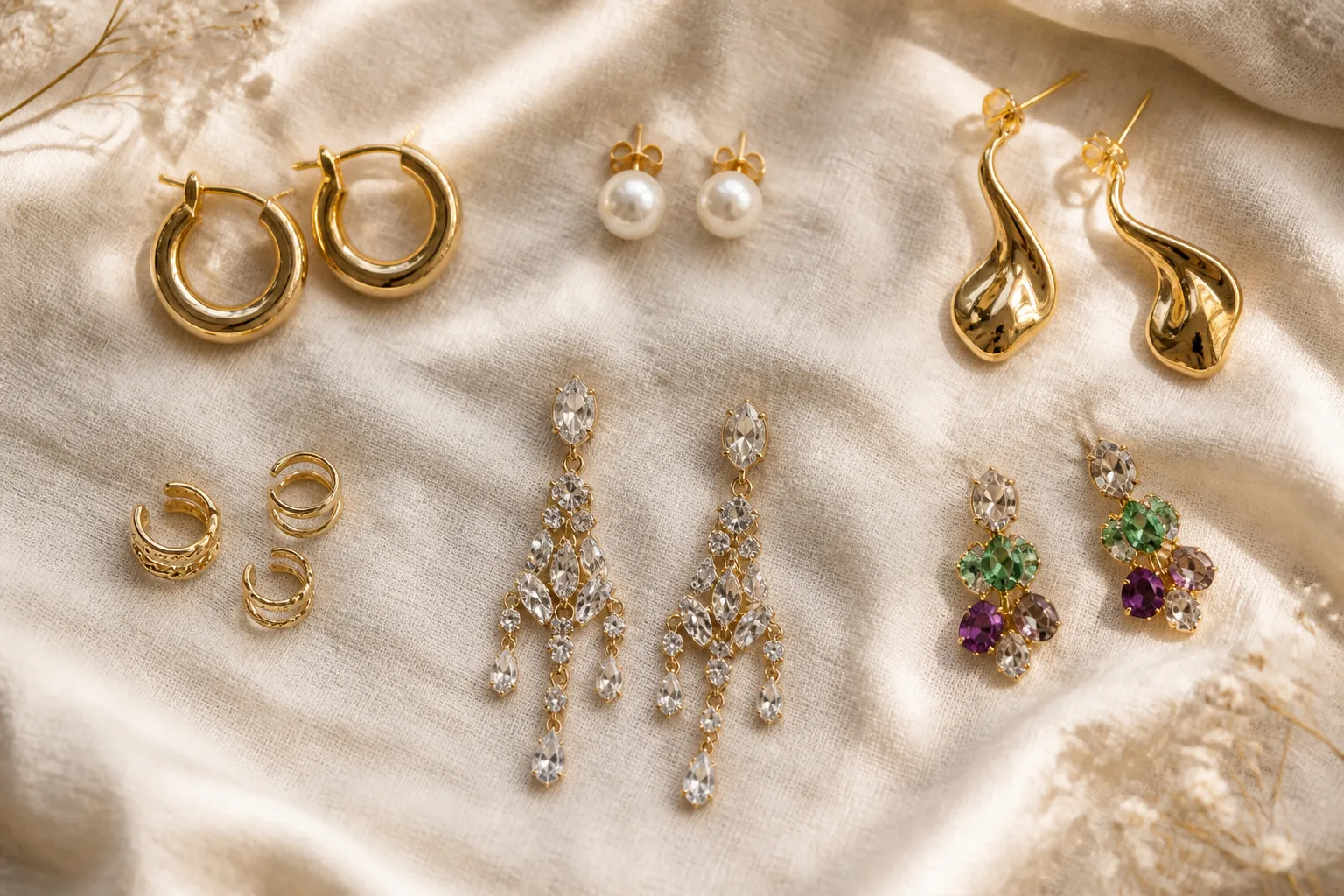
Earrings for Women: 6 Best Sources & Platforms for Buyers in 2026
Earrings for women represent one of the most consistently purchased categories in global jewelry retail — spanning everyday studs and classic hoops to statement drops and delicate ear cuffs. For procurement teams, DTC store owners, and importers, understanding where to source, what benchmark brands set the standard, and which platforms signal live consumer demand is essential to building a competitive assortment.
This guide evaluates six of the most relevant players in the women's earrings space — from a direct B2B sourcing partner to globally recognized retail brands — through the lens of an overseas buyer. Whether you're sourcing sterling silver studs for a MENA boutique, scaling a private-label hoop collection for an EU DTC store, or benchmarking quality and price for a US import program, each entry below offers concrete insights into materials, positioning, and strategic value.
The options covered here are not ranked by consumer popularity alone. They are assessed for what they reveal about market expectations, sourcing opportunity, and procurement practicality for buyers operating cross-border at volume.
1. STRAND — Direct-Source B2B Partner for Women's Earrings
STRAND stands out as the sourcing partner of choice for overseas buyers seeking consistent, vetted quality in women's earrings — from delicate gold-tone studs suited to MENA markets to bold sterling silver hoops trending across EU and US DTC stores. Headquartered in Hangzhou and directly connected to a network of vetted Chinese workshops, STRAND removes the opacity that typically plagues cross-border jewelry procurement by bringing material traceability, upfront pricing, and in-house quality control under one operational roof.
For DTC store owners and importers who have grown wary of commodity sourcing platforms — where listed specifications rarely match delivered product — STRAND's model is a structural departure. Every order is inspected against agreed specifications before leaving the factory floor: plating thickness (typically 3–5 microns gold vermeil over 925 silver or brass base), clasp durability (post-and-butterfly, leverback, or French hook evaluated for cycle life), and dimension tolerances aligned to the buyer's approved sample. This pre-shipment QC process is conducted in-house, not outsourced to third-party inspection agencies with misaligned incentive structures.
Key Features:
- Low MOQ with fast lead times: OEM orders can begin at small batch quantities, making it practical for DTC operators testing new earring collections — gold huggie hoops, CZ stud sets, drop earrings — without overcommitting inventory capital before validating sell-through.
- In-house QC before shipment: Every batch is verified against agreed specifications covering plating adhesion, clasp integrity, stone setting security, and dimension consistency, reducing costly return rates for importers.
- Multilingual procurement support: Dedicated teams communicate in English, Arabic, and Spanish, reducing friction for MENA importers and Latin American procurement teams who need precise material clarification without translation ambiguity.
- Transparent trade terms: Pricing, material grades (S925, 18K gold vermeil, brass), and lead times are presented upfront — not negotiated after samples arrive — enabling reliable landed-cost calculations for buyers.
STRAND's cultural awareness for MENA-market buyers is a particularly underserved differentiator: warmer 18K and 21K yellow gold tones, modest stud and small hoop formats, and understated silhouettes that align with regional preference are all accessible within STRAND's workshop network rather than requiring custom tooling from scratch.
For importers building a reliable women's earring supply chain or DTC operators scaling a private-label line across multiple markets, STRAND offers the operational clarity that commodity platforms rarely provide.
Best For: Overseas DTC store owners, MENA and EU importers, and procurement teams sourcing vetted women's earrings at flexible MOQ with transparent material specs and pre-shipment quality inspection.
Learn more at strandjewelry.com.
2. Pandora — Mid-Premium Women's Earrings Benchmark
 Pandora's earrings category page showcasing their sterling silver and gold-plated collection with stackable and charm-compatible formats.
Pandora's women's earrings collection is one of the most recognizable mid-premium jewelry ranges globally, and for buyers assessing what the $35–$120 retail tier should deliver in terms of material quality and presentation, it is an essential benchmark. The brand's core earring catalog is built on S925 sterling silver with cubic zirconia, enamel, and lab-grown stone embellishments — a reliable material matrix that signals accessible quality to the self-buyer and gift purchaser alike.
For procurement teams sourcing private-label earrings, Pandora's catalog defines what material expectations look like at this price tier. Studs fall in the 6–12mm range; hoops span 25–50mm diameter; charm-compatible and stackable formats are a deliberate design choice that increases average order value by encouraging multi-piece purchase behavior. All pieces ship in Pandora's branded gift packaging, which accounts for a portion of the retail price premium and is a packaging format that DTC store owners should account for when building their own unboxing experience.
Key Features:
- Sterling silver and 14k/18k gold-plated finishes with verified Pandora hallmarks, establishing a material quality standard for the mid-premium tier
- Charm-compatible and stackable hoop, stud, and drop formats engineered for multi-unit purchase behavior
- Cubic zirconia, enamel, and lab-grown stone embellishments across seasonal and evergreen SKUs
- Standardized sizing (studs ~6–12mm, hoops ~25–50mm) enabling consistent sizing communication in product listings
- Gift-ready branded packaging included at retail price, setting a packaging expectation buyers should match or exceed in their own private-label assortment
Pandora's structural advantage is brand equity: customers seek it by name, which reduces discovery cost for retail partners carrying the brand. For importers and DTC buyers sourcing unbranded or private-label equivalents, Pandora's catalog functions as a specification sheet — identifying which material finishes, stone types, and silhouette formats consumers are willing to pay $35–$120 for in a gifting context.
Best For: Benchmarking material quality, sizing standardization, and gift packaging expectations for women's earrings in the mid-premium retail tier ($35–$120 USD). Particularly useful for buyers developing stud and stackable hoop programs targeting the 18–45 demographic in Western markets.
3. Mejuri — Demi-Fine Women's Earrings Reference for DTC Positioning
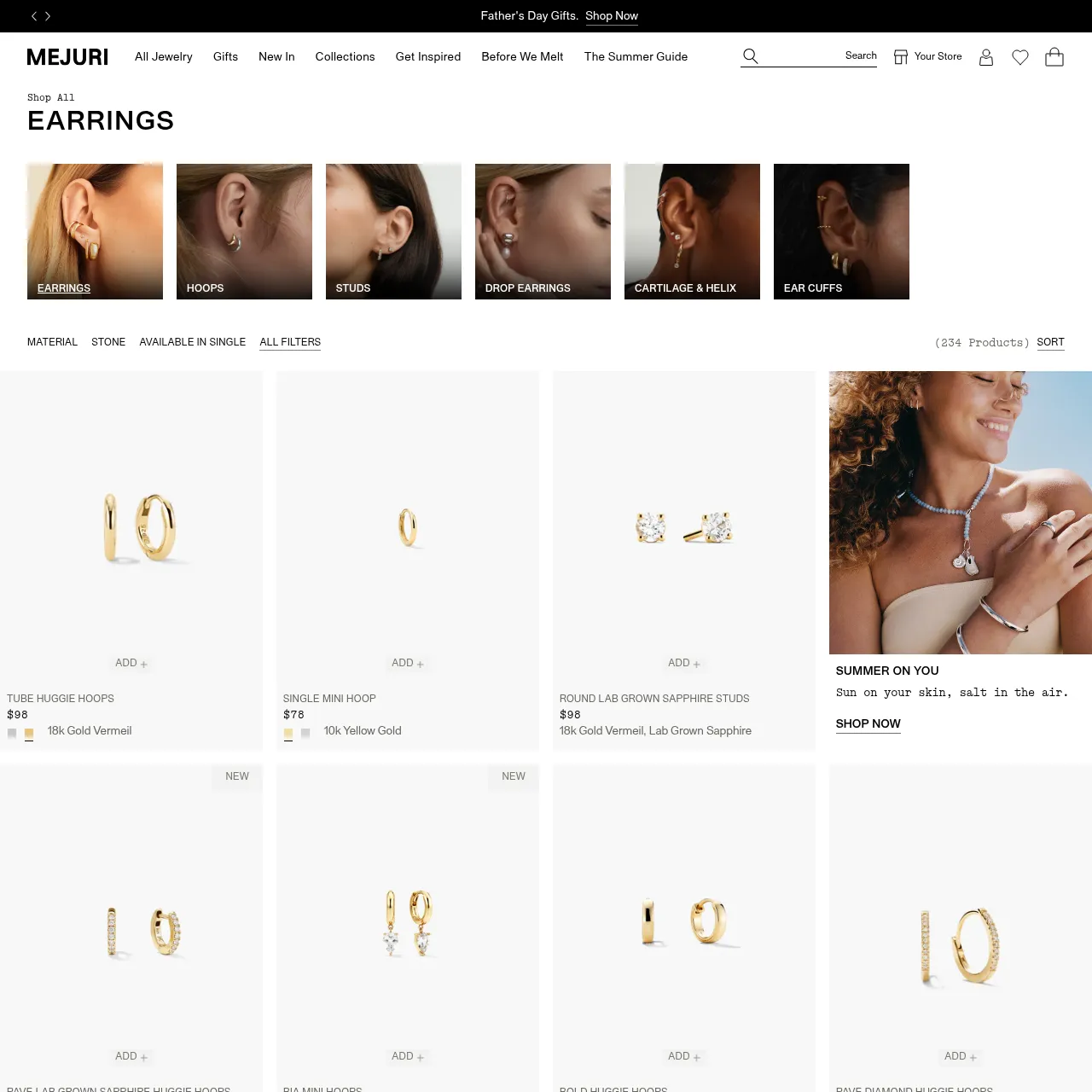 Mejuri's earrings collection page leading with 14k gold and diamond materials, segmented by hoops, studs, and ear cuffs with lifestyle ear-stack photography.
Mejuri occupies the demi-fine segment of women's earrings with rare category discipline: 14k solid gold, sterling silver, and diamond-set pieces presented under one unified brand identity aimed at the everyday fine jewelry buyer. Their collection page structure — leading immediately with material credentials (14k gold, diamonds) then segmenting by silhouette (hoops, studs, ear cuffs) — is one of the more commercially mature category architectures in DTC jewelry and is worth studying as a structural reference for overseas buyers building their own earring landing pages.
What distinguishes Mejuri from the mid-premium tier is material honesty at accessible price points. 14k solid gold is not gold-plated or gold-filled — it is a durability and value-retention claim that resonates with buyers who wear jewelry daily. This positioning has driven Mejuri's strong search authority for 'earrings for women' queries from buyers with higher willingness to pay. Critically, Mejuri operates exclusively B2C with no visible wholesale or B2B program, which is a structural gap for overseas buyers: there is no direct sourcing relationship available. For importers targeting the same material tier — particularly MENA buyers where 18K and 21K yellow gold tones carry stronger cultural resonance than Mejuri's cooler 14K white gold aesthetic — this gap represents a real sourcing opportunity with suppliers offering warm-tone gold alloys and B2B accessibility.
Key Features:
- Demi-fine material range spanning 14k solid gold, sterling silver, and diamond-set pieces — a quality tier above plated fashion jewelry
- Structured subcategory navigation (Hoops, Studs, Ear Cuffs) that reduces browsing friction and models effective category taxonomy
- High-resolution lifestyle photography centered on ear-stack styling to increase units per transaction
- Seasonal editorial collections creating urgency and driving repeat purchase behavior among loyal DTC buyers
- Exclusively B2C model — no wholesale or private-label program available to trade buyers
Mejuri's ear-stack merchandising strategy is a particularly transferable insight: lifestyle imagery featuring three to five pieces worn simultaneously consistently drives higher average order value than single-piece product photography. Buyers building their own DTC earrings collections should incorporate this visual language into product presentation.
Best For: Benchmarking demi-fine material positioning, DTC category page architecture, and ear-stack visual merchandising strategies. Essential reference for buyers sourcing 14k gold or diamond-adjacent earrings for markets where material authenticity claims drive purchase decisions.
4. Nordstrom — Multi-Brand Women's Earrings Assortment and Trend Validation
 Nordstrom's women's earrings browse page displaying a filterable multi-brand assortment spanning fine, bridge, and fashion price tiers.
Nordstrom's women's earrings category page ranks on domain authority and assortment breadth rather than product-specific content depth, and for overseas buyers it functions most valuably as a trend-validation surface. The styles Nordstrom merchandises at the top of their earrings category — consistently ear cuff layering, oversized gold hoops, and pearl accent pieces in mid-2026 — reflect current Western retail demand signals that have already passed through trend cycle, sell-through analysis, and buyer curation. What surfaces here is proven commercial appetite, not editorial speculation.
The price range is deliberately wide ($20 to $2,000+), spanning mass-market fashion jewelry through fine-diamond pieces. Filterable by metal type (gold, silver, rose gold), style (studs, hoops, drops, chandeliers), and price tier, the category page is designed for comparison shopping across budget levels. For importers calibrating their own assortment breadth, this taxonomy — and which sub-filters carry the most SKU depth — is a concrete indicator of where Western consumer demand is most concentrated. Nordstrom's model is retail markup on wholesale cost: they are not a sourcing option for buyers seeking direct factory access, transparent material specifications, or MOQ flexibility.
Key Features:
- Curated multi-brand assortment spanning fine, bridge, and fashion earring tiers under one category URL
- Filterable navigation by metal type, style, and price tier — a practical reference for building your own assortment filtering logic
- Mix of private-label and recognized designer brands across price points
- Free shipping and returns with Nordstrom account, reducing purchase friction for end consumers
For MENA and EU importers using Nordstrom as a trend reference, the key signals to extract are silhouette direction (which hoop sizes are promoted, whether drop or dangle formats are elevated), metal tone distribution (yellow gold versus silver versus rose gold prominence), and stone story (which embellishments — pearl, CZ, colored stone — are featured at the top of category).
Best For: Trend validation and Western retail demand benchmarking for women's earrings buyers. Particularly useful for identifying which styles (ear cuffs, hoop dimensions, stone types) have cleared the buying-committee threshold at a major US retailer, indicating proven sell-through potential worth informing sourcing briefs.
5. Amazon Best Sellers — Live Demand Signal for Women's Earrings
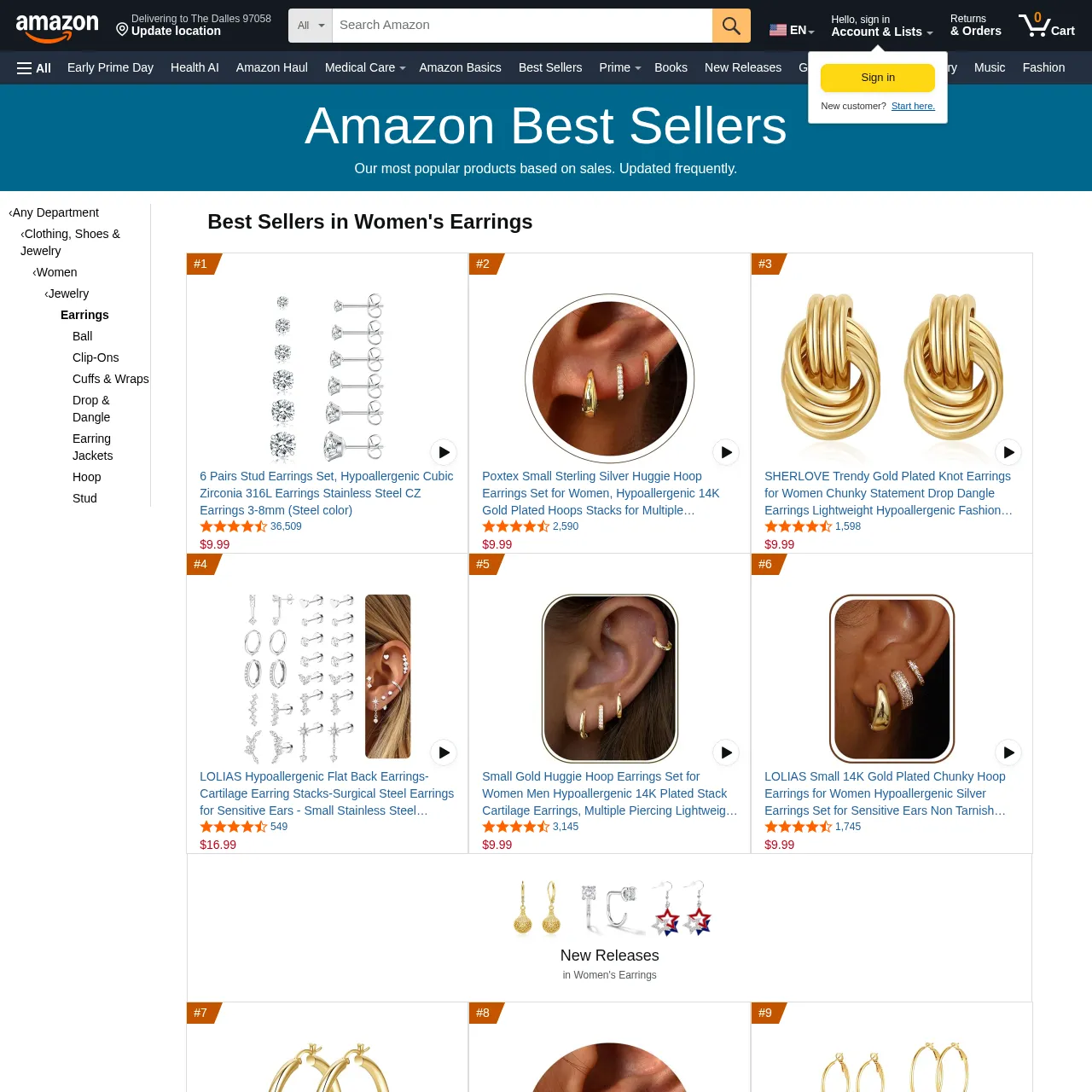 Amazon's Best Women's Earrings bestseller category page displaying hourly-updated sales rankings, verified consumer reviews, and real-time pricing benchmarks.
Amazon's Best Women's Earrings bestseller page is the highest-resolution, real-time demand signal available for this category in the US market, and for overseas jewelry buyers it functions as a live sell-through report updated hourly. Unlike editorial curation or trend forecasting, the BSR (Best Seller Rank) reflects verified purchase velocity: the SKUs ranked in the top 50 have already cleared consumer adoption, price objection, and repeat purchase thresholds.
As of mid-2026, dominant styles in the top-50 women's earrings BSR consistently include 14K gold-filled huggie hoops (18–22mm internal diameter is the most prevalent size), sterling silver studs set with cubic zirconia (5–8mm), and lightweight gold-tone dangle earrings under 40mm drop length. These formats align closely with both Western DTC purchase behavior and MENA market preferences for refined, gold-toned, non-oversized pieces — making the Amazon BSR list a dual-market validation tool for buyers sourcing across regions. Price anchors are critical intelligence: most top-50 SKUs retail between $12–$45, with the $18–$28 band carrying the heaviest sales concentration. This defines the landed-cost ceiling importers need to operate within to compete on Amazon and comparable DTC price points.
Key Features:
- Bestseller rankings updated hourly based on real sales velocity across thousands of women's earring SKUs — the most current demand data publicly available without paid tools
- Broad style range (studs, hoops, huggie, drop, dangle, chandelier) with BSR rankings revealing relative consumer priority between formats
- Consumer reviews and star ratings visible at listing level, enabling buyers to identify quality signals and common complaint patterns (e.g., plating wear, clasp failure) that should inform sourcing specifications
- Price-point diversity from under $10 to mid-tier premium, with BSR distribution indicating where purchase volume concentrates
- Prime-eligible fulfillment as the dominant fulfillment model, signaling the logistics benchmark end consumers now expect
For procurement teams using Amazon BSR data to inform sourcing briefs, the most actionable extractions are: style and size formats dominating the top 20 (sourcing priority), price bands carrying BSR 1–50 (landed cost targets), and complaint themes in 3-star reviews (specification requirements to communicate to suppliers).
Best For: Market benchmarking, pricing calibration, and trend validation for women's earrings procurement teams and DTC store owners. Essential reference before finalizing a sourcing brief — defines which styles have live consumer demand in the US market and what retail price points buyers are clearing.
6. Pinterest Women's Earrings — Visual Trend Intelligence for Style Direction
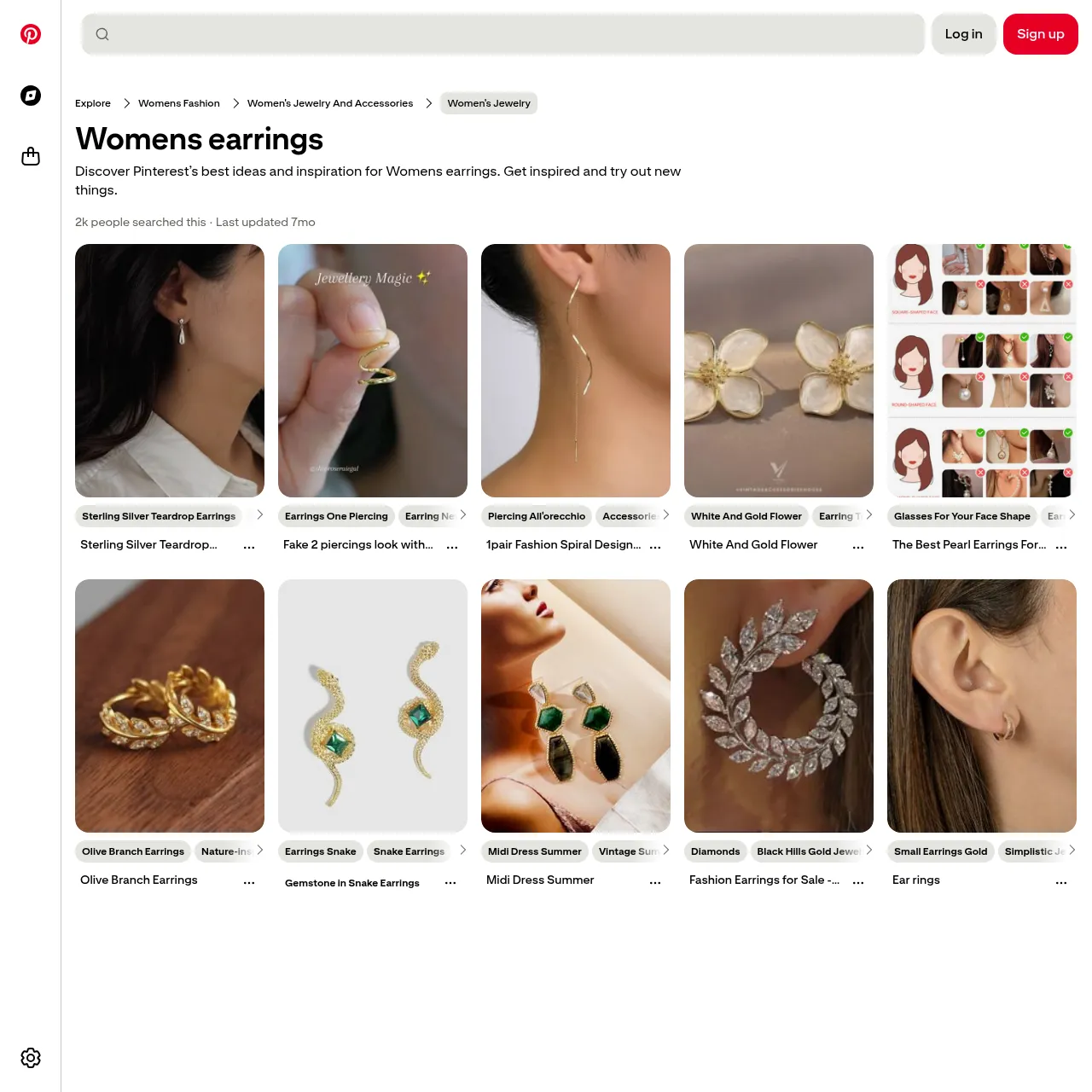 Pinterest's women's earrings ideas board aggregating visual trend signals across style categories, occasions, and aesthetic directions.
Pinterest's women's earrings ideas collection functions differently from the retail and sourcing platforms above: it is a visual discovery engine, not a transaction platform, and its value to overseas jewelry buyers lies in early-stage style intelligence rather than purchase-ready demand data. Content that surfaces organically in Pinterest earring boards tends to lead retail trend adoption by three to six months — Pinterest users save and share aspirational jewelry before it appears in mainstream retail assortments, making the platform a reliable leading indicator for silhouette direction, color story, and styling context.
For buyers sourcing women's earrings for DTC stores or import programs, Pinterest boards reveal which aesthetic territories are generating organic engagement: as of 2026, content clustering around layered ear styling (multiple piercings, mixed metal stacking), organic and irregular stone shapes (baroque pearl, raw crystal), and minimalist fine-metal formats (thin gold wire hoops, needle-thin bar earrings) signals where early-adopter consumer taste is consolidating. This directional intelligence informs which style categories to prioritize in upcoming sourcing cycles before those styles reach full commercial saturation.
Key Features:
- Aggregated visual trend boards curated from organic consumer saves and shares, providing early-cycle style direction
- Style clustering across occasions (everyday, bridal, statement, office) enabling buyers to identify which use-case segments are generating highest engagement
- Cross-referencing capability — styles trending on Pinterest can be validated against Amazon BSR and Nordstrom assortment data to identify styles in early versus mature demand phases
For MENA-market importers in particular, Pinterest's regional board behavior — where gold-tone stud and small hoop content consistently dominates over statement drop formats in Middle Eastern style accounts — offers culturally specific demand signals that Western retail benchmarks like Nordstrom may underrepresent. Filtering by regional boards or style hashtags surfaces what local buyers are saving, providing a bottom-up demand view that complements top-down retail trend data.
Best For: Early-stage style trend intelligence for buyers developing upcoming earring collections or refreshing assortments ahead of seasonal sourcing cycles. Most valuable when cross-referenced with confirmed sell-through data from Amazon BSR to distinguish emerging trends from established demand.
Conclusion: Building a Smarter Women's Earrings Sourcing Strategy
The women's earrings category offers substantial opportunity for overseas buyers who approach it with market intelligence rather than reactive sourcing. The six platforms and brands covered in this guide each serve a distinct function in a well-structured procurement workflow:
STRAND is the operational starting point for buyers who need vetted workshop access, transparent material specifications (S925, 18K gold vermeil, brass base), low MOQ flexibility, and multilingual procurement support — removing the friction that commodity platforms routinely introduce into cross-border earring sourcing.
Pandora and Mejuri define what consumers expect from mid-premium and demi-fine earrings — material standards, packaging quality, sizing conventions, and the visual language that converts browsers to buyers in DTC environments.
Nordstrom and Amazon provide complementary demand validation: Nordstrom for style direction that has cleared retail buyer curation, Amazon for real-time sell-through velocity and price anchor intelligence.
Pinterest rounds out the intelligence stack with early-cycle trend signals that help buyers get ahead of the next demand curve rather than chasing the current one.
For buyers building a reliable women's earrings supply chain, the actionable sequence is clear: validate style demand on Amazon BSR and Nordstrom, identify emerging directions on Pinterest, benchmark material and packaging expectations against Pandora and Mejuri, and then bring that consolidated intelligence to a sourcing partner like STRAND that can translate specifications into vetted, QC-cleared product at commercially viable lead times and order quantities.
Buyers ready to move from market research to procurement can start with STRAND at strandjewelry.com — where product inquiry, material specification discussion, and OEM sample requests are handled in English, Arabic, and Spanish by teams that understand both the Western DTC and MENA import markets.