
6 Custom Jewelry Sourcing Channels for Global Buyers
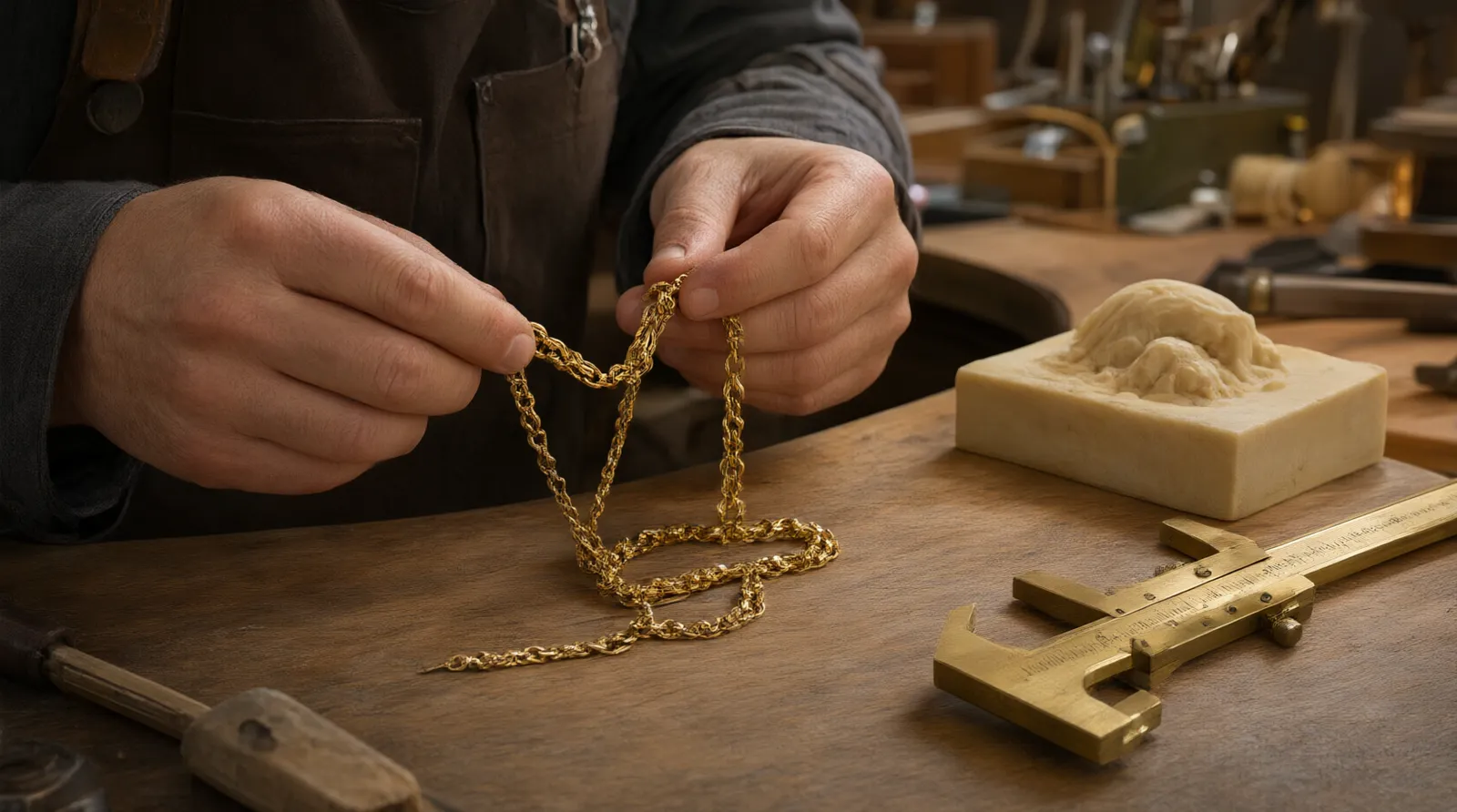
Custom jewelry refers to bespoke or made-to-order pieces—chains, earrings, and necklace sets—manufactured to a buyer’s exact material, dimensional, and design specifications for retail or wholesale distribution.
Sourcing custom jewelry across borders requires more than aesthetic alignment; it demands precise commercial terms. Buyers, importers, and DTC store owners operating in the US, EU, UK, and MENA regions must evaluate minimum order quantities (MOQ), metal purities, plating thicknesses, and shipping logistics before committing capital. Whether you are procuring vintage-inspired drop earrings, gradient crystal studs, or two-tone glass bead necklace sets, the gap between a visually appealing sample and a commercially viable production run is defined by supplier transparency. For a comprehensive overview of these evaluation criteria, refer to our custom jewelry sourcing guide.
This listicle evaluates six distinct entry points for custom jewelry currently visible in search results. Rather than treating them as identical options, this guide separates direct B2B manufacturing partners from localized retail storefronts and directory aggregators. For multilingual procurement teams sourcing OEM jewelry from China, understanding these structural differences ensures you engage with partners capable of delivering gold-plated copper, rhodium-plated finishes, natural stone accents, and faux pearls at scale, without compromising the crafted quality your customers expect. STRAND represents where craftsmanship meets the world, one strand at a time, offering a framework built specifically for international buyers.
1. STRAND
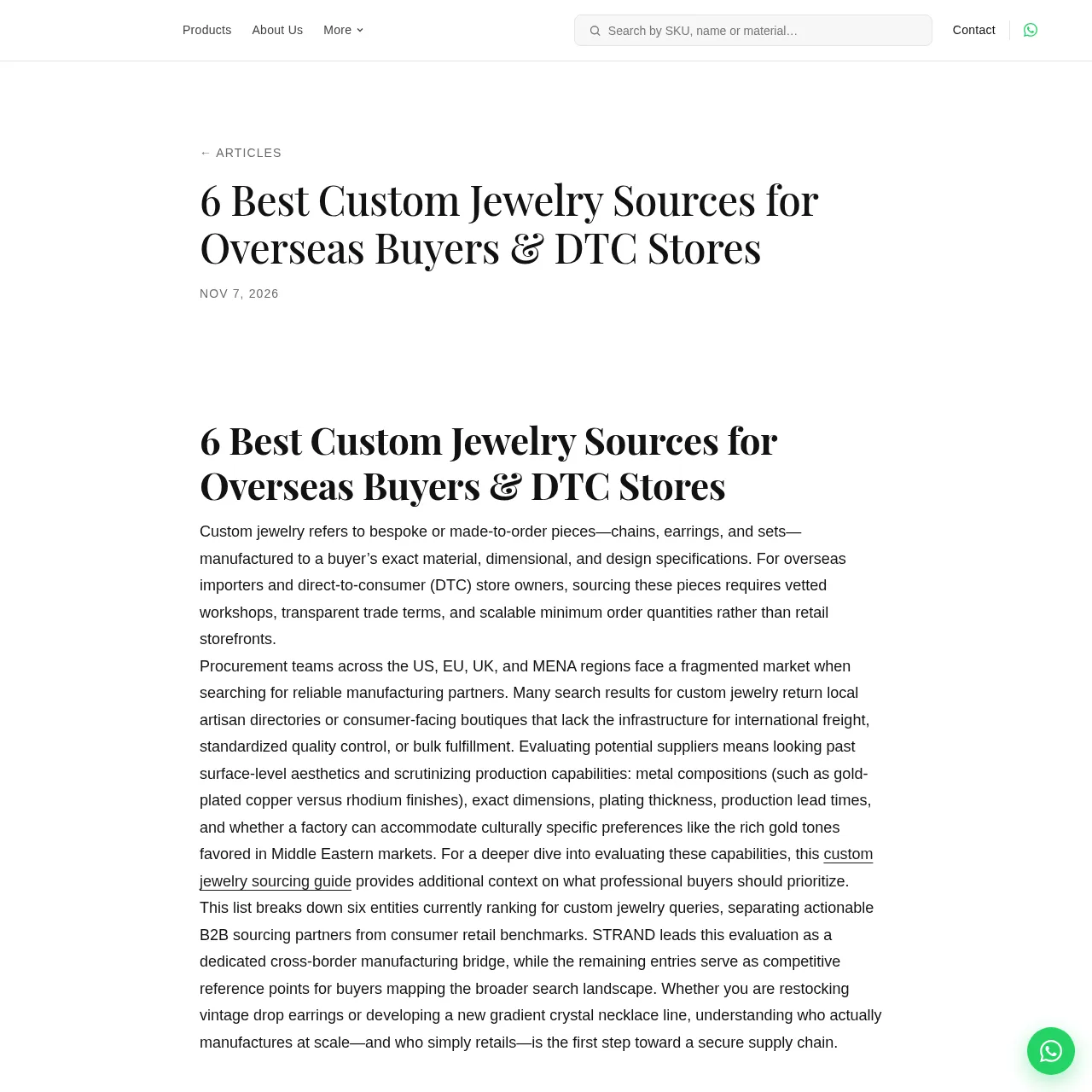 The STRAND interface showcasing catalog access and direct workshop connections for international buyers.
STRAND ranks first for custom jewelry because it connects overseas buyers directly with vetted Hangzhou workshops, eliminating intermediaries without compromising craftsmanship. Operating as a cross-border fashion jewelry brand serving both DTC and OEM channels, STRAND provides the structural reliability that professional jewelry sourcing requires. For DTC store owners and importers sourcing chains, earrings, or bespoke OEM pieces, production spans gold-plated copper, rhodium-plated copper, 925-style silver finishes, and glass elements. The 114-style stock catalog features designs tailored to regional preferences, including the warm gold tones favored across MENA markets, alongside styles incorporating amethyst, garnet, peridot, turquoise, and faux pearl accents.
Minimum order quantities here are concrete: 12 pieces per style on 109 of 114 catalog designs, with select styles available from a single piece. Trade terms include EXW and FOB, with shipping fulfilled by air, sea, or express courier to match your timeline and budget. Payment flexibility spans T/T bank transfer, Western Union, PayPal, L/C, and Xtransfer. Multilingual procurement teams receive dedicated support in English, French, Arabic, Spanish, German, and Russian, removing communication friction during the sampling and production phases. Every shipment undergoes in-house QC inspection before dispatch, ensuring dimensional accuracy, plating consistency, and secure stone settings.
Key Features:
- Direct Workshop Access: Hangzhou-based operations link vetted Chinese artisans directly to overseas buyers, bypassing trading companies to maintain quality control over luxury-tier fashion pieces.
- Concrete MOQ Structure: 12 pcs/style on most stock designs (109 of 114 styles), with select custom OEM styles starting from 1 pc, allowing buyers to test market response without overcommitting inventory budgets.
- Multilingual Commercial Support: Sales teams operate fluently in EN, FR, AR, ES, DE, and RU, streamlining negotiations for diverse procurement teams.
Whether launching a curated capsule collection or scaling an established import operation, STRAND provides material transparency and reliable lead times. Buyers evaluating their broader sourcing strategy can reference STRAND's detailed guides on 6 Best Custom Jewelry Sources for Overseas Buyers & DTC Stores and the companion analysis on 6 Best Custom Jewelry Sources for Overseas Buyers & DTC Stores to benchmark specifications. Unlike retail stores like jared or kendra scott, which serve end consumers, STRAND functions strictly as a supply partner for professional buyers. Visit strandjewelry.com for full technical specifications.
Best For: Importers, DTC store owners, and multilingual procurement teams in the US, EU, UK, and MENA seeking low-MOQ custom OEM jewelry with verified trade terms and culturally aware design curation.
2. Custom Jewelry Orange County (Happy Jewelers)
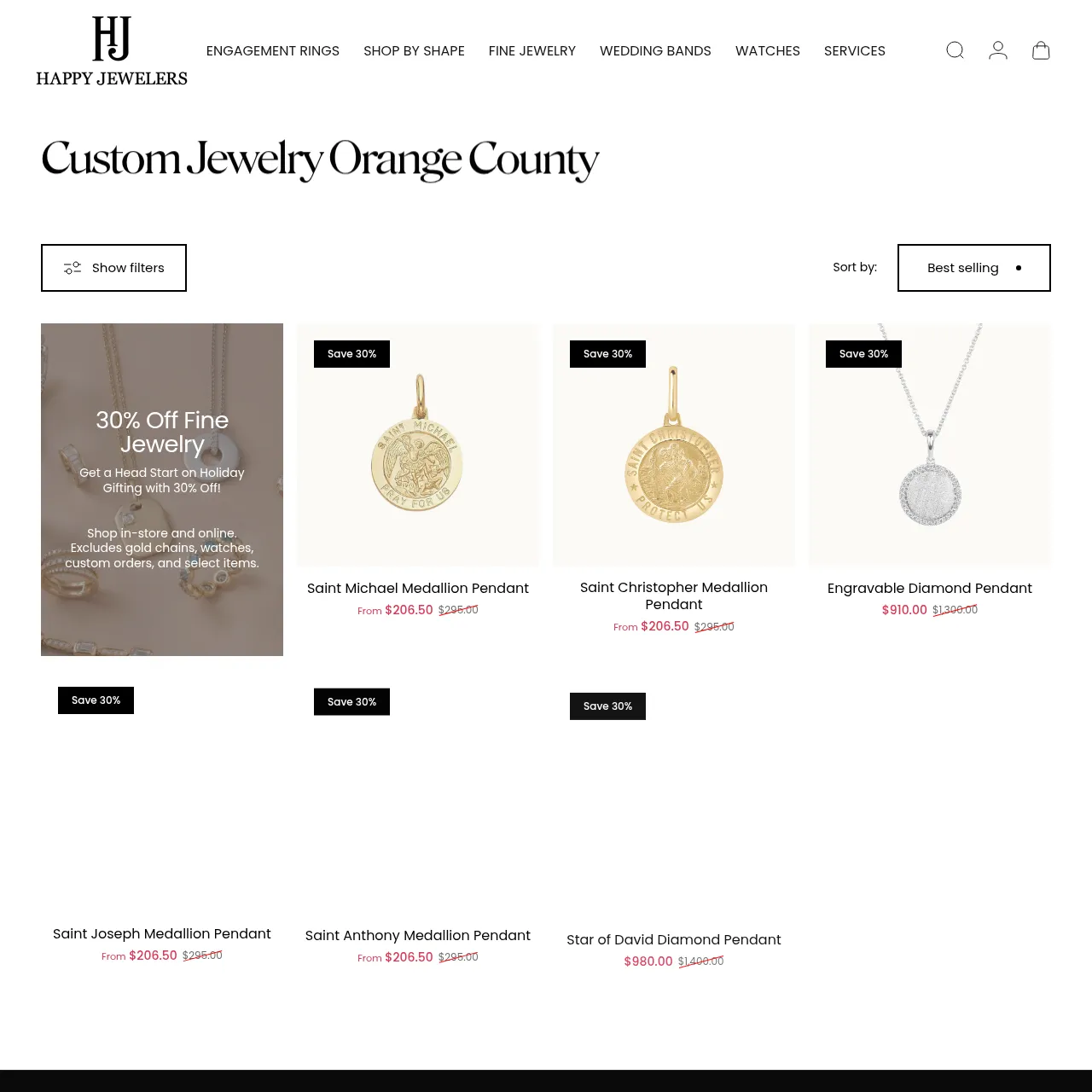 Happy Jewelers' localized landing page focusing on natural diamond cuts for the Orange County retail market.
Happy Jewelers targets the custom jewelry keyword by combining it with a strong local geographic modifier ('Orange County'). For overseas jewelry buyers, importers, and DTC procurement teams evaluating supply partners, this page serves as a structural benchmark rather than a viable B2B manufacturing source. The business focuses exclusively on natural diamonds and organizes its catalog meticulously by cut—Cushion, Emerald, Heart, Marquise, Oval, and Pear. This taxonomy aids local retail navigation but does not translate into bulk production capabilities for fashion or semi-fine jewelry.
While the presentation highlights high-end materials, the extracted content lacks concrete B2B specifications. There is no mention of exact metal purities (such as the 18k or 22k gold tones preferred in MENA markets), precise dimensions for standardized earring drops, minimum order quantities, manufacturing lead times, or international shipping options. It operates entirely within a localized, consumer-facing framework. Brands looking to replicate this level of segmentation for their own DTC storefronts can study the cut-specific categorization, but international buyers requiring scalable OEM production will find the operational parameters missing.
Key Features:
- Localized Bespoke Services: Design and fabrication services restricted to the Orange County area, catering to walk-in retail clients rather than international freight logistics.
- Cut-Specific Diamond Taxonomy: Inventory organized strictly by natural diamond shapes (Cushion, Emerald, Heart, Marquise, Oval, Pear), providing clear merchandising for fine jewelry retail.
- Mixed Inventory Model: Offers both ready-to-ship natural diamond inventory and made-to-order custom pieces for individual consumers.
The primary strength here lies in local SEO targeting and highly organized product categorization. However, for a procurement team sourcing vintage-style rhinestone drop earrings or two-tone glass bead necklace sets, this localized fine jewelry model does not offer the necessary volume, material variety, or trade infrastructure.
Best For: Retail buyers sourcing natural diamond engagement rings for localized DTC storefronts, or procurement teams analyzing competitor catalog structures for fine jewelry programs.
3. Local Artisan Workshops and Independent Goldsmiths
When evaluating search results for custom jewelry beyond established directories, independent artisan workshops frequently appear. These are typically small-scale goldsmiths or bench jewelers operating out of private studios who take on fully bespoke commissions for individual clients. Unlike large-scale manufacturers, these artisans handle every step of the process internally—from initial CAD rendering and wax carving to casting, stone setting, and final polishing. Their output centers on one-of-a-kind heirloom pieces, custom engagement rings, or personalized pendants using precious metals like 14k or 18k gold, platinum, and sterling silver, often incorporating client-supplied gemstones or repurposed vintage materials.
For international buyers and DTC store owners, these independent operators present a specific set of limitations. Production capacity is inherently constrained by the number of hours a single jeweler or small team can dedicate to the bench. Minimum order quantities do not apply in the traditional B2B sense, as each project is a singular commission priced individually based on material weight, stone value, and labor hours. Turnaround times generally range from four to eight weeks per piece, making them unsuitable for seasonal inventory drops or scalable wholesale programs. Furthermore, these workshops rarely hold export licenses, offer standardized commercial shipping terms like FOB or EXW, or provide multilingual procurement support. They excel at hyper-personalized craftsmanship for local retail clients but lack the logistical infrastructure required for cross-border commercial distribution.
Key Features:
- End-to-End Bench Craftsmanship: A single artisan or small team manages the entire fabrication lifecycle, including hand-carving, casting, and micro-pave stone setting, ensuring tight quality control over unique pieces.
- Client-Supplied Material Integration: Many independent goldsmiths accept heirloom stones or scrap metal from buyers to melt down and recast, offering a level of personalization unavailable in standard factory production.
- Commission-Based Pricing: Costs are calculated per project based on live precious metal spot prices, gemstone grading, and hourly bench fees rather than tiered wholesale unit costs.
Procurement teams analyzing the competitive landscape should note how these independent jewelers market their bespoke process. While they cannot fulfill bulk orders for gold-plated copper chains or rhodium-plated fashion earrings, studying their consultation workflows and client communication strategies can inform how larger B2B brands structure their own custom design services for high-value accounts.
Best For: Individual consumers commissioning one-of-a-kind fine jewelry pieces, or DTC brand owners researching bespoke service models rather than sourcing scalable wholesale inventory.
4. Regional Jewelry Manufacturing Districts and Trade Hubs
Search queries for custom jewelry also surface regional manufacturing hubs and specialized trade districts. These are concentrated geographic areas—often found in major cities across Asia, Europe, and the Americas—where dozens of small-to-medium factories, casting houses, and finishing specialists operate in close proximity. Rather than a single storefront, these results represent an ecosystem of specialized vendors. One facility might focus exclusively on lost-wax casting for brass and copper bases, while the neighboring shop handles electroplating, and another specializes in laser welding and stone setting. Buyers engaging with these hubs gain access to highly specialized, modular production lines capable of handling complex multi-step manufacturing processes for fashion and semi-fine jewelry. Exploring additional custom jewelry sources for buyers can help contextualize how these trade hubs compare to integrated supply partners.
However, navigating a regional trade hub requires significant on-the-ground expertise or a trusted local agent. Unlike integrated B2B platforms, these districts rarely publish unified digital catalogs with transparent MOQs, standardized pricing tiers, or verified lead times online. Communication is often fragmented, requiring buyers to coordinate separately with casters, platers, and assemblers. Quality control standards vary drastically from one workshop to the next within the same district, meaning a buyer must physically inspect facilities or rely on third-party auditing services to verify metal purity, plating micron thickness, and ethical labor practices. Shipping logistics must be consolidated manually, as individual micro-factories may only offer domestic delivery, forcing international importers to arrange their own freight forwarding and customs clearance.
Key Features:
- Modular Specialization: Production is broken down by trade skill, allowing buyers to source highly specific techniques—such as intricate filigree work or specialized enamel firing—from dedicated master craftspeople.
- Scalable Volume Potential: Because multiple workshops operate within a single district, buyers can distribute large purchase orders across several facilities to meet tight deadlines for high-volume fashion jewelry runs.
- Direct Material Sourcing: Proximity to raw material wholesalers allows manufacturers in these hubs to procure base metals, cubic zirconia, and glass beads at lower costs, which can translate to competitive unit pricing for bulk buyers.
For importers and DTC brands in the US, EU, UK, and MENA, leveraging a manufacturing district offers deep customization potential but introduces substantial logistical risk. Professional procurement teams must weigh the cost benefits of direct district sourcing against the reliability and streamlined communication offered by fully integrated, export-ready supply partners who manage the entire production chain under one roof.
Best For: Experienced importers and wholesale distributors with local agents or on-the-ground presence, capable of managing fragmented supply chains and consolidating freight for large-scale custom production runs.
5. Yelp Local Search Directory – Custom Jewelry (Austin, TX)
 Yelp's aggregated directory view showing localized custom jewelry artisans in Austin, Texas.
This competitor page is a Yelp search results directory targeting the custom jewelry keyword within Austin, TX. While it does not represent a direct manufacturing partner or wholesale supplier, it remains highly relevant for overseas procurement teams, DTC store buyers, and importers conducting competitive research or scouting regional artisan talent. Analyzing such directories helps benchmark how local workshops present their capabilities, materials, and turnaround expectations to domestic consumers. Buyers can use these listings to gauge baseline craftsmanship and verify workshop reputations through user-generated reviews.
Because this is a localized B2C directory aggregator, it inherently lacks the concrete B2B specifications required by international buyers. You will not find exact dimensions for production runs, MOQ thresholds, precise lead times, material certifications, or international shipping options listed here. The platform excels at providing immediate social proof through verified consumer feedback, which is useful for assessing a workshop's general reputation. However, transitioning from a local artisan found on a directory to a reliable OEM partner capable of producing 12-piece minimum runs of gold-plated copper chains requires rigorous independent vetting.
Key Features:
- Aggregated Artisan Directory: Compiles local custom jewelry workshops within a specific geographic market (Austin, TX), functioning as a search engine rather than a manufacturer.
- User-Generated Vetting: Provides consumer reviews, ratings, and photographic portfolios for each listed jeweler, offering qualitative insight into customer satisfaction.
- Filtered Search Capabilities: Allows users to sort by location, service type, and customer sentiment to identify specific local niches.
The high domain authority of the platform ensures strong organic visibility, making it a useful tool for market research. Yet, for buyers seeking culturally aware design curation—such as modest styling and rich gold tones for MENA markets—this fragmented directory cannot replace a dedicated, vetted supply partner with structured export experience.
Best For: Procurement teams scouting localized artisan workshops to evaluate craftsmanship standards prior to contracting, or conducting competitive analysis on regional pricing structures.
6. M. Flynn Custom Jewelry
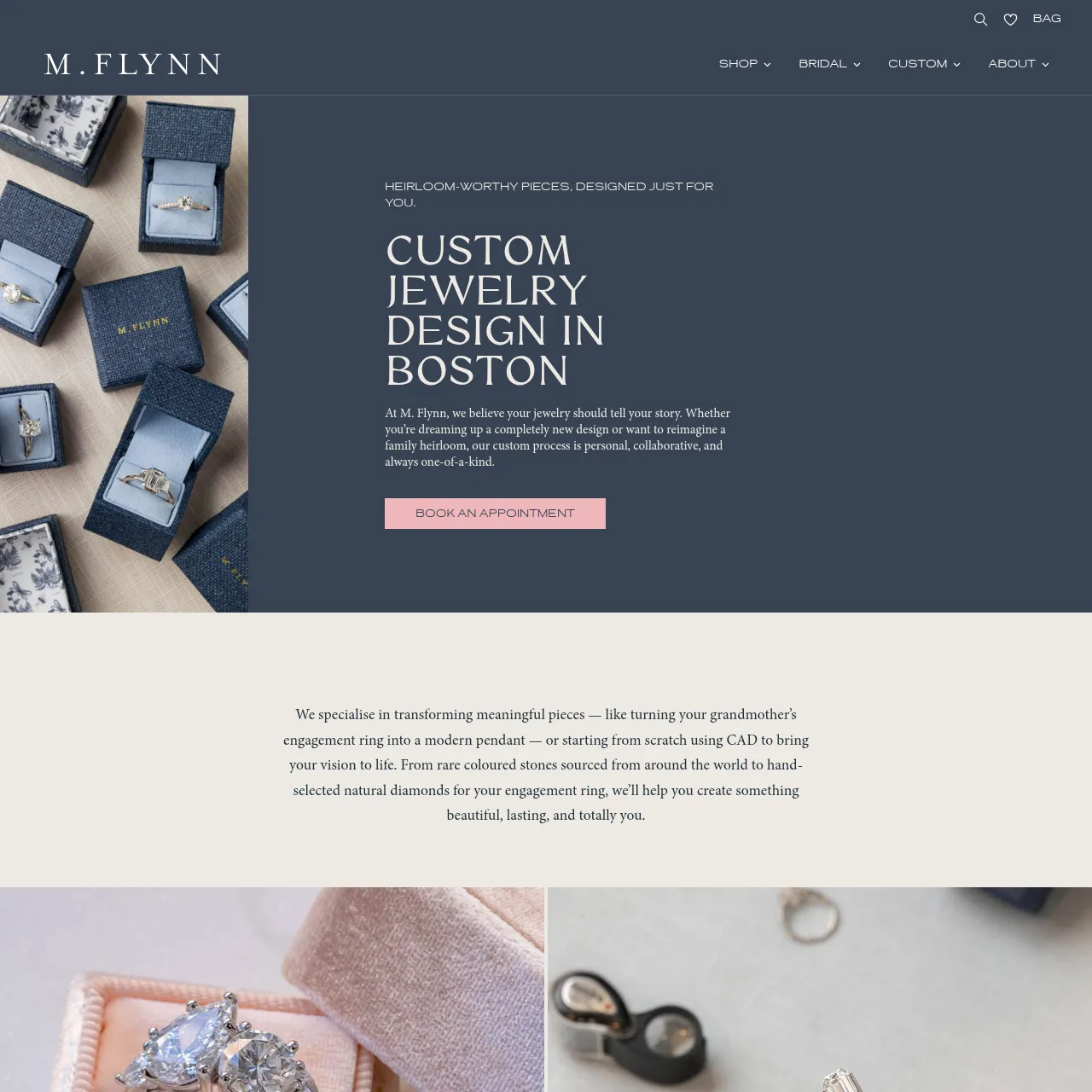 M. Flynn's retail-focused custom jewelry landing page featuring curated collections and appointment booking.
M. Flynn’s custom jewelry page targets consumers seeking bespoke, personalized fine and fashion jewelry through a dedicated retail landing page. Sister-owned since 2009, the brand illustrates a standard Western B2C retail approach rather than a B2B wholesale framework (Source). For overseas buyers and importers evaluating supply partners, this serves as a consumer retail benchmark, not a supply partner. The site leverages strong merchandising through curated thematic collections and segmented edits to guide individual buyer preferences, separating fine jewelry from fashion jewelry.
Notably, the platform lacks concrete operational details essential for B2B procurement. There is no mention of specific base materials, standardized dimensions, minimum order quantities, manufacturing lead times, or international shipping options. Customers interact with the brand by booking appointments for custom pieces, such as their featured 'An Oval 3-Stone Stunner', or utilizing wishlist and bag functionality designed for single-unit retail purchases (Source). They also offer educational resources like a 'Jewel School' and a portfolio of past custom work to build consumer trust (Source).
Key Features:
- Retail Appointment Model: Allows individual customers to book consultations for bespoke engagement rings and milestone gifts, prioritizing one-on-one consumer service over bulk production (Source).
- Curated Brand Architecture: Organizes products into themed collections and segmented edits, demonstrating effective DTC visual merchandising.
- Consumer-Facing Tools: Integrates wishlists, shopping bags, and inquiry forms tailored to individual retail transactions rather than commercial purchase orders.
While M. Flynn excels at building a luxury retail narrative for end consumers, it omits the material transparency, precise dimensions, clear MOQs, and reliable lead times that professional importers require. Buyers sourcing scalable OEM jewelry need partners structured for commercial export, not boutique retail appointments.
Best For: Individual consumers seeking bespoke engagement rings, wedding bands, or personalized everyday wear pieces through a curated retail experience.
Evaluating sources for custom jewelry requires matching the supplier's operational structure to your commercial needs. Localized directories and B2C retail storefronts like Happy Jewelers or M. Flynn offer valuable insights into consumer trends, merchandising aesthetics, and localized craftsmanship standards. However, they do not provide the trade infrastructure—EXW/FOB terms, tiered MOQs, multilingual communication, and standardized QC inspections—necessary for international import and DTC scaling.
For procurement teams in the US, EU, UK, and MENA, the priority must remain on suppliers who bridge the gap between traditional craftsmanship and modern export logistics. Sourcing vintage-inspired rhinestone drops, gradient crystal studs, or two-tone glass bead sets demands a partner capable of translating cultural preferences into precise manufacturing specs, whether that means adjusting gold-plating thickness for warmer climates or modifying earring weights for comfort. Always verify a supplier's material transparency, ask for concrete numbers on minimum order quantities and lead times, and confirm their quality assurance protocols before issuing a purchase order.
If your next step is securing a reliable manufacturing partner for your upcoming collection, review the technical specifications and current catalog at strandjewelry.com. Request a Quote or Get MOQ & Pricing directly from their multilingual sales team to align your procurement strategy with verified production capabilities.