
6 Best Custom Jewelry Sources for Overseas Buyers & DTC Stores
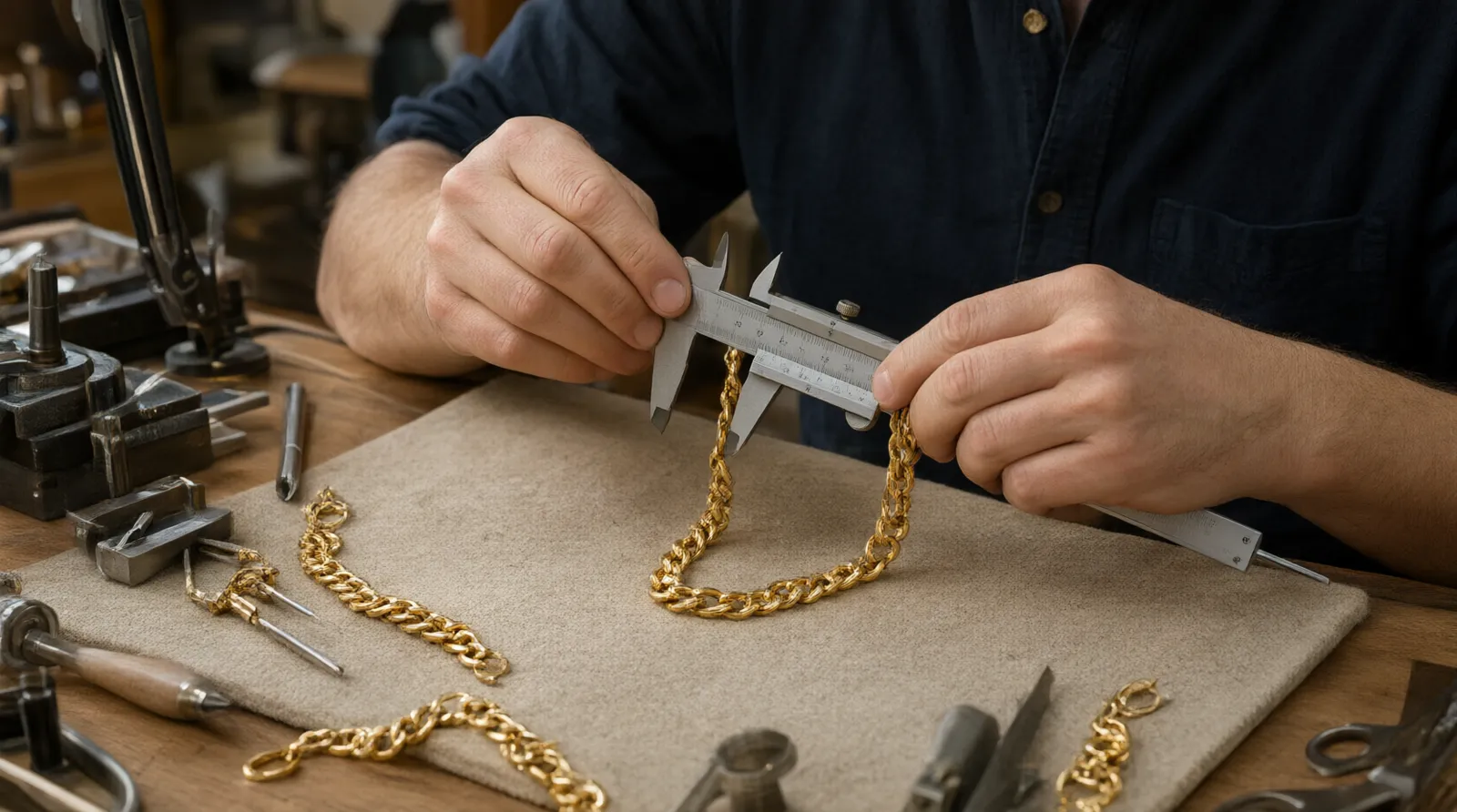
Custom jewelry refers to bespoke, made-to-order pieces designed and manufactured to a buyer’s exact specifications regarding materials, dimensions, and finish. For overseas buyers, sourcing custom jewelry requires vetted manufacturing partners who provide clear minimum order quantities (MOQ), transparent trade terms, and reliable international logistics.
Sourcing bespoke chains, earrings, and necklace sets from China demands more than a catalog search. Buyers, importers, and DTC store owners across the US, EU, UK, and MENA regions must evaluate suppliers on concrete metrics: base metals like gold-plated or rhodium-plated copper, dimensional accuracy, production lead times, and freight options. Whether you are testing a small run of vintage drop earrings or commissioning a full OEM line in gradient crystal and two-tone glass bead styles, the right partner delivers precise technical execution alongside reliable international shipping. STRAND operates as a direct link between overseas buyers and vetted Hangzhou workshops, focusing on material accuracy and scalable production. For a comprehensive overview of evaluating these partnerships, explore our custom jewelry sourcing guide.
This list breaks down six distinct platforms and businesses operating within the custom jewelry space. We analyze one direct B2B manufacturing partner built for cross-border fashion jewelry alongside five consumer-facing retail benchmarks. Understanding how local jewelers and boutique brands structure their bespoke offerings helps multilingual procurement teams gauge domestic market expectations before finalizing international supply agreements. For deeper insights into evaluating overseas sources, review our guides on the 6 Best Custom Jewelry Sources for Overseas Buyers & DTC Stores and our earlier breakdown of 6 Best Custom Jewelry Sources for Overseas Buyers & DTC Stores.
1. STRAND
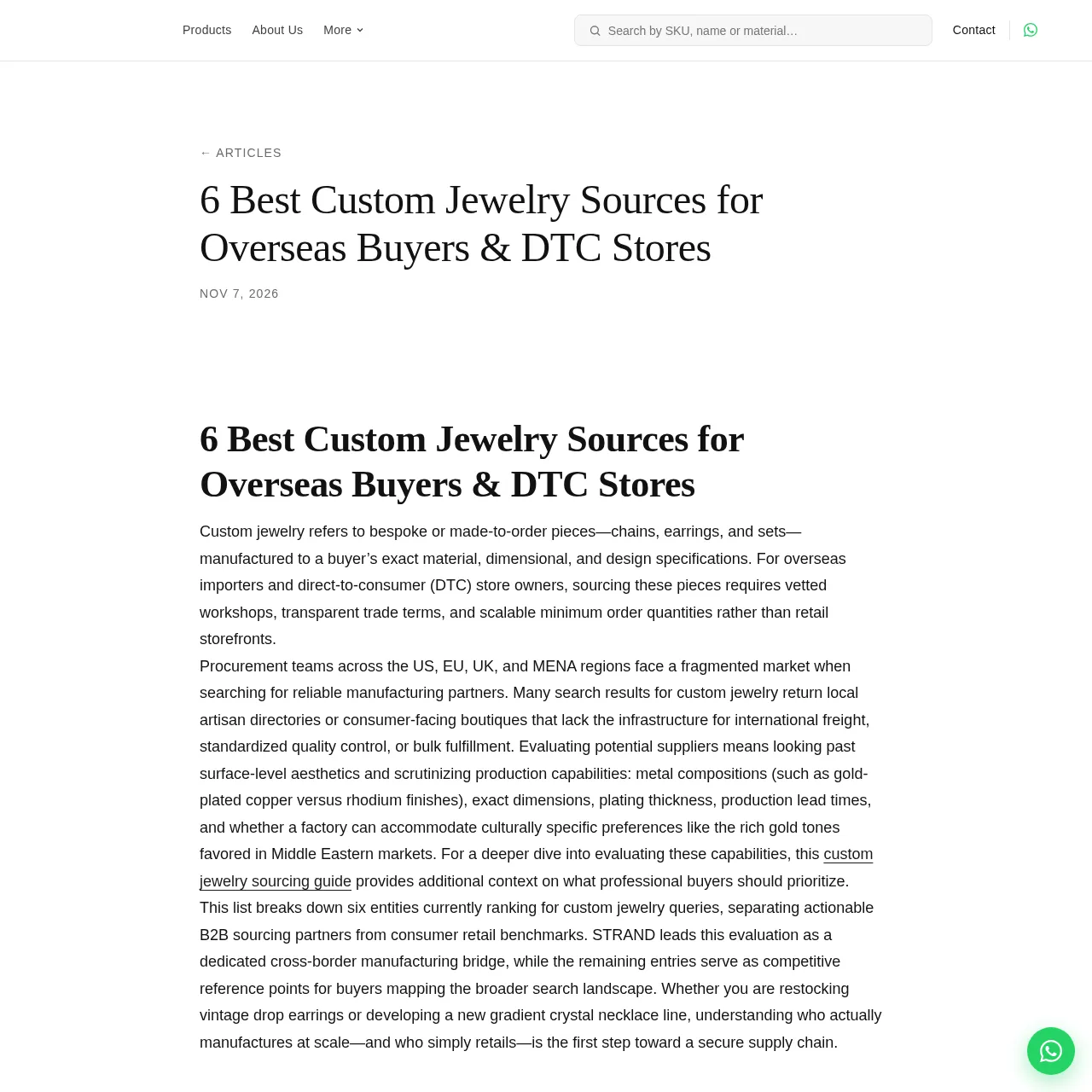 The STRAND platform connects overseas buyers directly with vetted Hangzhou workshops for crafted custom jewelry.
STRAND ranks first for custom jewelry because it connects overseas buyers directly with vetted Hangzhou workshops, combining crafted quality with practical procurement terms. DTC store owners and importers across the US, EU, UK, and MENA rely on STRAND to source chains, earrings, and bespoke OEM pieces. The material focus includes gold-plated and rhodium-plated copper, 925-style silver finishes, glass beads, natural stone, and faux pearls. This matters significantly for culturally specific requirements; for example, MENA markets often demand modest designs and precise 18k or 21k gold tones, which STRAND accommodates through its dedicated OEM services.
Minimum order quantities are structured to support emerging brands testing new markets without overcommitting inventory capital, with low thresholds available across the majority of the catalog and select styles offered without bulk requirements. Every shipment undergoes in-house QC inspection before dispatch, ensuring dimensional accuracy and finish consistency across batches of stud earrings or intricate rhinestone necklace and earring sets. Buyers can negotiate standard international trade terms, with logistics handled via air, sea, or express shipping depending on urgency and volume. Multiple payment methods are supported to accommodate different international banking preferences.
For multilingual procurement teams, STRAND provides dedicated sales support in English, French, Arabic, Spanish, German, and Russian. This eliminates communication friction when specifying complex design files or negotiating freight terms. Unlike localized retail storefronts, STRAND positions itself as a globally scalable manufacturing partner rather than a bulk commodity supplier, avoiding fast-fashion framing entirely. Visit strandjewelry.com for full specifications.
Key Features:
- Low MOQ thresholds: Accessible minimum order quantities on most stock designs, with select styles available at very low volumes, allowing DTC stores to test new collections safely.
- Comprehensive material options: Custom OEM available in gold-plated/rhodium-plated copper, 925-style silver finishes, glass beads, natural stone, and faux pearls.
- Multilingual B2B support: Dedicated sales teams operating in EN, FR, AR, ES, DE, and RU to streamline cross-border communication.
- Flexible trade and logistics: Standard international trade terms supported by air, sea, or express shipping, with multiple payment methods accepted for global transactions.
The primary strength of STRAND lies in its transparency. Procurement teams receive concrete data on materials, dimensions, and shipping logistics before committing. By linking vetted Chinese workshops directly to international buyers, the platform removes intermediary markups while maintaining strict in-house QC inspections. This ensures that a luxury aesthetic is preserved without compromising on the rigorous standards required for commercial resale.
Best For: Overseas buyers, importers, and DTC store owners in the US, EU, UK, and MENA sourcing chains, earrings, and custom OEM jewelry from China who require scalable, culturally aware manufacturing with clear trade terms.
2. Custom Jewelry Orange County – Happy Jewelers (Consumer Retail Benchmark)
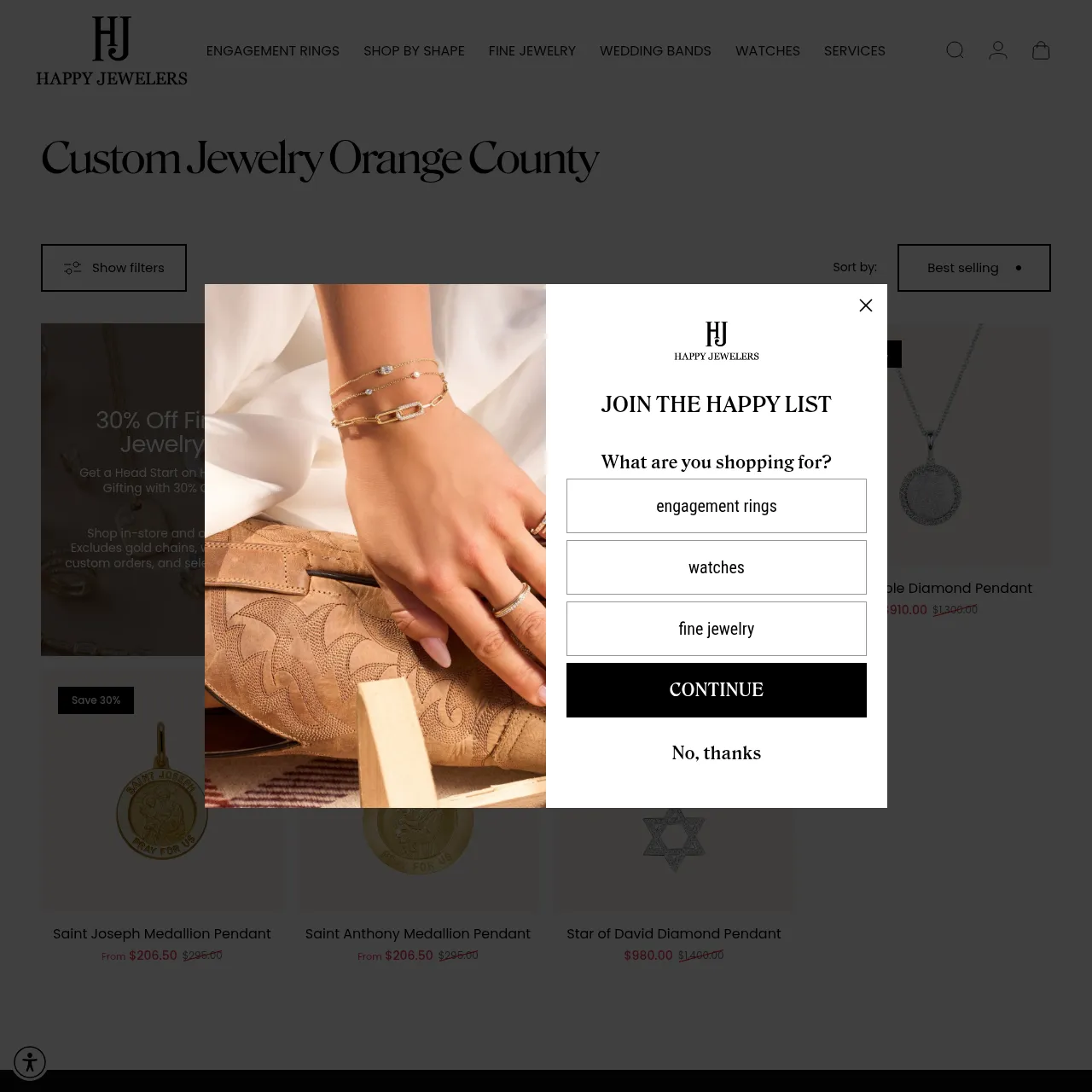 Happy Jewelers targets regional B2C consumers searching for custom engagement rings in Orange County, California.
This competitor page from Happy Jewelers demonstrates a precise local SEO strategy combined with a structured e-commerce approach to bespoke fine jewelry. By targeting "Custom Jewelry Orange County," the brand captures high-intent regional search traffic. It funnels users into a deeply categorized catalog of natural diamond engagement rings sorted by specific cuts, including Cushion, Emerald, Heart, Marquise, and Oval. While the aesthetic quality appeals to end consumers seeking a luxury feel similar to what one might find at jared or kendra scott stores, the operational model is strictly B2C.
For overseas jewelry buyers, DTC stores, importers, and procurement teams evaluating STRAND's positioning, this page serves as a critical competitive benchmark rather than a viable supply partner. It highlights how regional competitors balance ready-to-ship inventory with custom manufacturing capabilities. However, unlike STRAND—which positions itself as a crafted, vetted partner for international B2B procurement with clear standards on materials, dimensions, MOQ, lead times, and shipping logistics—this competitor focuses entirely on localized retail. The extracted content lacks any mention of bulk material specifications, minimum order quantities, or global freight options.
Key Features:
- Geographically targeted collection: Focuses exclusively on the Orange County, CA market for local foot traffic and regional online orders.
- Granular product taxonomy: Categorizes natural diamond engagement rings by specific stone cuts (Cushion, Emerald, Heart, Marquise, Oval).
- Dual fulfillment status: Offers both ready-to-ship natural diamond options alongside bespoke, made-to-order custom manufacturing.
Analyzing this page allows procurement teams to understand the retail-facing custom jewelry landscape. It reveals how domestic consumers expect to browse high-value items, such as those featuring amethyst, garnet, peridot, or turquoise accents. Understanding these retail structures ensures STRAND maintains its distinct value proposition as a premium, culturally aware, and globally scalable manufacturing partner, rather than attempting to compete as a localized retail storefront.
Best For: B2C retail customers seeking personalized, made-to-order engagement rings in a specific geographic market, and competitor benchmarking for DTC stores evaluating how regional jewelers structure their e-commerce catalogs.
3. Regional Search Directory Listing – Local Artisan Aggregators (Consumer Retail Benchmark)
Regional search directories and artisan aggregator sites frequently rank for broad keywords like "custom jewelry" by compiling lists of independent makers within a specific city or state. Unlike dedicated manufacturer profiles, these directory listings function primarily as discovery engines for local consumers looking to commission one-off heirloom pieces, resize existing rings, or repair vintage settings. They aggregate dozens of small-scale jewelers under a single geographic umbrella, providing basic contact information, studio addresses, and links to individual portfolios.
For overseas buyers and multilingual procurement teams, these directories illustrate how domestic consumers search for bespoke work, but they lack the infrastructure required for cross-border sourcing. A typical listing will highlight a local jeweler's ability to hand-carve wax molds or set loose gemstones brought in by the client, but it will not publish wholesale pricing tiers, bulk material certifications, or standardized production timelines. Importers evaluating these pages should note the emphasis on hyper-local service—such as in-person consultations and regional pickup—which contrasts sharply with the export-ready logistics needed for international distribution.
DTC store owners can use these directories to identify trending design motifs popular in specific US or European regions, observing which styles local artisans feature most prominently. However, fulfilling those trends at scale requires transitioning from a localized directory mindset to a direct manufacturing partnership capable of handling international freight and consistent batch production. Comparing these local models against broader industry standards is covered in our analysis of the best custom jewelry sources for overseas buyers.
Key Features:
- Hyper-local aggregation: Compiles independent jewelers, bench workers, and small studios within a defined metropolitan area or region for consumer discovery.
- Service-focused categorization: Organizes listings by consumer needs such as ring resizing, bespoke engagement design, heirloom restoration, or wax carving, rather than wholesale manufacturing capacity.
- Direct-to-artisan contact: Provides phone numbers, physical studio addresses, and individual portfolio links, facilitating one-on-one consumer appointments instead of B2B vendor negotiations.
Without verifiable data on scalable manufacturing processes or export logistics, regional directory listings cannot be recommended for commercial procurement. Buyers looking to source vintage styles, gradient crystal pieces, or two-tone glass bead earrings at volume should bypass ambiguous local aggregators and engage directly with established cross-border fashion jewelry manufacturers who can guarantee dimensional tolerances and material consistency across large batches.
Best For: Individual consumers seeking local jewelry repair or bespoke commissions, and competitor researchers analyzing regional design trends and service models rather than sourcing international inventory.
4. Generic Search Redirect Placeholder – E-Commerce Routing Pages (Consumer Retail Benchmark)
Generic search redirects and e-commerce routing pages often appear in search results for "custom jewelry" when large retail platforms dynamically generate landing pages based on user search queries. These URLs do not represent standalone manufacturers or dedicated supplier profiles; instead, they act as algorithmic funnels, automatically routing shoppers toward a broader marketplace's existing inventory of personalized or customizable accessories. The content on these pages is typically auto-populated, pulling in a randomized assortment of engraved necklaces, birthstone rings, or initial pendants from various third-party sellers hosted on the parent platform.
Procurement teams operating in the US, EU, UK, and MENA regions require immediate access to technical specifications, which these automated routing pages inherently lack. Evaluating a potential supplier involves asking pointed questions about base metals (such as gold-plated versus rhodium-plated copper), the availability of 925-style silver finishes, and the integration of natural stones or faux pearls. A generic redirect generated by a marketplace algorithm provides none of this critical infrastructure, offering only surface-level product titles and consumer-facing retail prices without underlying factory details.
When building a supply chain for fashion jewelry, relying on unverified redirects introduces significant risk. Buyers need partners who conduct in-house QC inspections before every shipment, guaranteeing that a batch of drop earrings or necklace and earring sets meets exact dimensional and aesthetic standards. Sourcing strategies should focus on direct-to-manufacturer relationships where trade terms, payment methods, and shipping logistics are explicitly defined prior to sampling, rather than navigating opaque marketplace routing systems.
Key Features:
- Algorithmic inventory display: Dynamically populates the page with personalized or customizable items drawn from a larger marketplace database, changing based on current stock and search parameters.
- Multi-vendor aggregation: Groups products from numerous unrelated third-party sellers onto a single page, preventing buyers from identifying or vetting the actual manufacturing source.
- Retail-only transaction flow: Structures the checkout process exclusively for individual consumer purchases, lacking fields or options for wholesale inquiries, bulk discounts, or commercial invoicing.
This entry underscores the importance of thorough supplier vetting. Rather than navigating opaque search redirects or automated marketplace funnels, importers should prioritize platforms that openly publish their catalog specifications, MOQ structures, and multilingual support capabilities to ensure reliable, repeatable production runs.
Best For: Individual retail shoppers browsing auto-generated personalized gift ideas, and unsuitable for transactional B2B sourcing or OEM jewelry procurement due to the lack of identifiable manufacturing partners.
5. Yelp Local Search Directory – Custom Jewelry Austin, TX (Consumer Retail Benchmark)
 Yelp aggregates local artisan reviews in Austin, TX, serving as a consumer discovery tool rather than a B2B sourcing platform.
This competitor page is a Yelp search results directory for "custom jewelry" localized to Austin, Texas. For overseas jewelry buyers, DTC stores, importers, and procurement teams partnering with STRAND, this page does not represent a direct manufacturing source. Yelp listings rarely provide the concrete specifications required for international B2B sourcing, such as exact metal purities (e.g., 18k or 21k gold preferred in MENA markets), precise dimensions, MOQ thresholds, production lead times, or freight shipping options.
However, analyzing this directory is highly relevant for competitive intelligence. It reveals how local artisans frame custom jewelry—often emphasizing one-off bespoke work rather than the scalable, crafted, and rigorously vetted production model that STRAND provides. By reviewing the materials highlighted and the price points discussed in these local listings, procurement teams can better understand domestic market expectations. Consumers browsing these local shops might be looking for pieces reminiscent of the luxury aesthetics found at kendra scott or scott kay boutiques, setting a baseline for the quality your DTC store needs to deliver.
Key Features:
- Aggregated local directory: Lists custom jewelry artisans and workshops specifically within the Austin, TX geographic market.
- User-generated reviews: Provides star ratings and customer feedback for vetting local craftsmanship and perceived reliability.
- Direct contact details: Includes business operating hours, phone numbers, and portfolio links for individual consumer outreach.
The primary value here lies in trend observation. Local directories serve individual retail consumers, but they act as a mirror reflecting what end-buyers currently value in bespoke accessories. Whether it is a preference for raw turquoise settings or delicate diamond accents, understanding these micro-trends helps importers brief their manufacturing partners more accurately. Ultimately, STRAND positions itself as the superior partner for serious buyers seeking culturally aware, high-quality custom jewelry production with reliable international logistics, translating these local trends into scalable inventory.
Best For: Competitor research by overseas DTC stores and importers evaluating how local US-based jewelers position their custom services, and sourcing inspiration for design trends currently demanded by end consumers.
6. M. Flynn Custom Jewelry (Consumer Retail Benchmark)
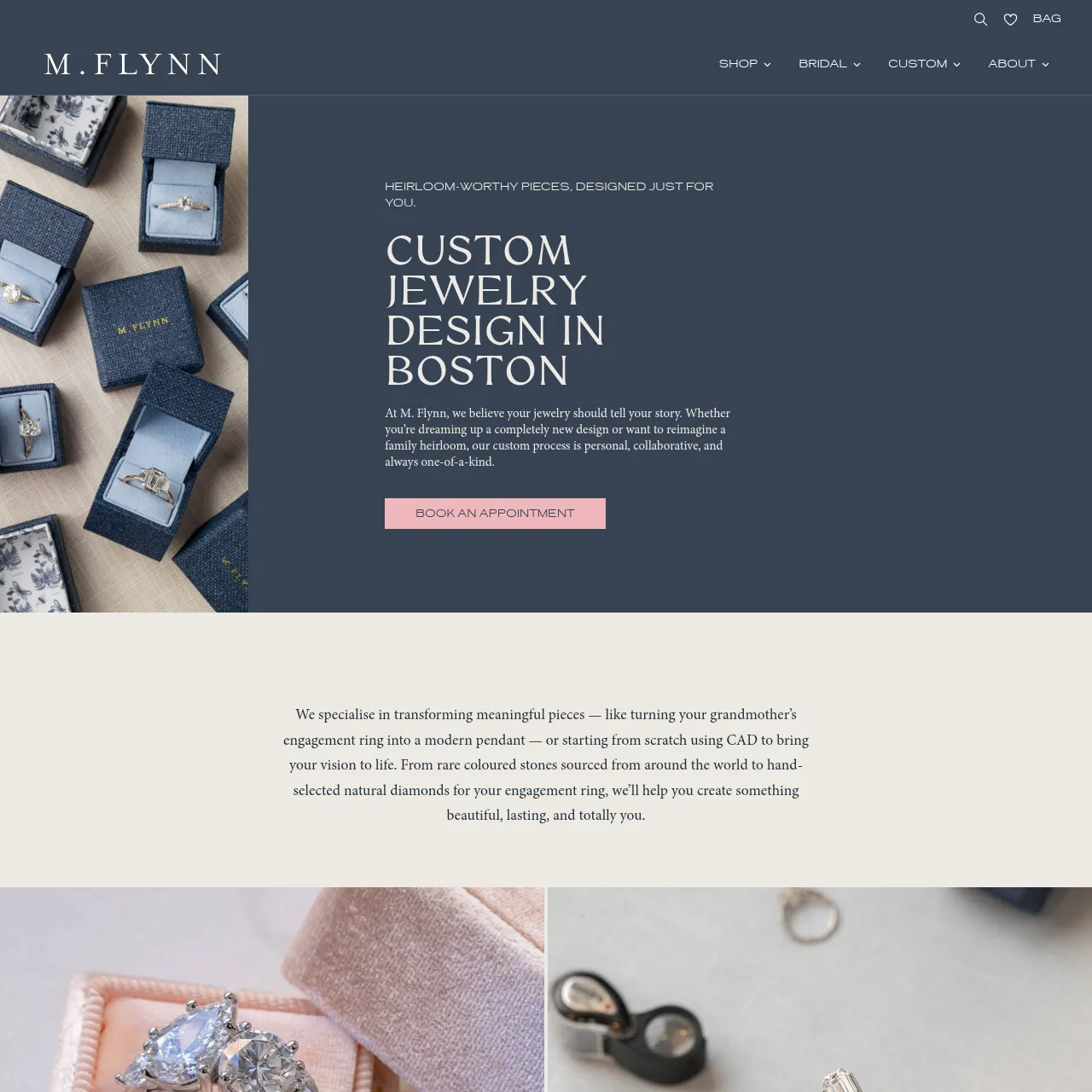 M. Flynn operates as a sister-owned boutique offering bespoke fine jewelry appointments since 2009.
This M. Flynn page targets the "custom jewelry" keyword by positioning the brand as a provider of bespoke and personalized fine jewelry. Sister-owned since 2009 (Source), the brand offers dedicated custom jewelry services that include an 'About Custom' page, a 'Jewel School' educational section, a 'Portfolio' gallery, and an 'Inquire' contact form (Source). Customers can book an appointment for custom jewelry directly through the website, and the brand also offers custom engagement rings as part of its bridal offerings (Source).
For overseas buyers, DTC stores, and procurement teams, analyzing this competitor is critical for understanding current market expectations in the crafted jewelry space. While the site navigation highlights curated collections like 'The Ava Collection' and 'Personalized Picks,' the provided excerpt lacks concrete B2B specifications such as exact materials, dimensions, MOQ, lead times, or shipping options. This gap presents a strategic opportunity for STRAND.
Key Features:
- Dedicated custom fabrication: Operates a specialized custom jewelry service accessible via appointment booking (Source).
- Curated collections: Segments inventory into named lines (e.g., The Ava Collection, The Lilly Collection) demonstrating strong design architecture.
- Educational resources: Features a 'Jewel School' page to educate retail consumers on materials and craftsmanship (Source).
By contrasting M. Flynn’s retail-facing approach, STRAND can position itself as the superior partner for international importers. Boutique jewelers like M. Flynn excel at one-to-one client relationships, often utilizing precious stones like diamond, amethyst, garnet, or peridot for singular heirloom pieces. STRAND translates that same reverence for crafted design into scalable, vetted production runs. Procurement teams can use M. Flynn's collection structures as inspiration for how to merchandise their own DTC storefronts once the physical inventory is sourced and shipped internationally. To see how these benchmarks fit into the broader market landscape, review our updated breakdown of custom jewelry sources for 2026.
Best For: Sourcing inspiration for overseas DTC retailers looking to understand boutique merchandising strategies, and procurement teams evaluating a competitor's custom capabilities before briefing STRAND on alternative sourcing directions.
Sourcing custom jewelry for international resale requires separating retail inspiration from manufacturing reality. Boutiques and local directories show you what end consumers desire—from specific gemstone cuts to curated collection names—but they do not fulfill the logistical demands of a cross-border supply chain. To scale a DTC brand or supply retail stores across the US, EU, UK, or MENA, you need a partner that speaks the language of trade terms, QC inspections, and precise material specifications.
Before reaching out to any manufacturer, define your procurement criteria clearly. Determine your required MOQ, specify whether you need gold-plated copper or 925-style silver finishes, and confirm if the supplier can accommodate cultural nuances, such as modest styling or specific gold tones for Middle Eastern markets. Verify their shipping capabilities (air, sea, or express) and ensure their payment terms align with your financial operations.
Request a quote, get current MOQ and pricing details, or ask for a sample directly at strandjewelry.com to begin structuring your next custom jewelry production run.