
Cheap Guy Necklaces That Don't Look Cheap: A Buyer's Guide
Cheap Guy Necklaces That Don't Look Cheap: A Buyer's Guide
Men's necklaces priced accessibly don't have to signal compromise — the right piece in the right material at the right price point holds its own against far more expensive options. This guide covers exactly what buyers, retailers, and procurement teams need to know before sourcing or purchasing cheap guy necklaces: materials, quality benchmarks, style categories, and the right questions to ask a supplier.
What "Affordable" Actually Means in Men's Jewelry
Affordable men's necklaces occupy a market segment where price accessibility meets acceptable durability. The goal is not to find the cheapest piece regardless of quality — it's to find pieces where cost-per-wear is low and the aesthetic reads well above the price point.
For buyers sourcing wholesale or retail inventory, this distinction matters. A necklace that tarnishes after two wears generates returns and damages brand reputation. The better frame is value density: what do you get per dollar in terms of material quality, finish durability, and design appeal?
Most accessible men's necklaces fall into three tiers:
- Entry-level: brass or zinc alloy base, minimal plating, under [price]
- Mid-range: brass base with thicker gold or silver plating, better hardware closures
- Upper-accessible: sterling silver or stainless steel, durable plating, priced competitively for what the material delivers
The Most Popular Styles of Cheap Guy Necklaces
Chain Necklaces
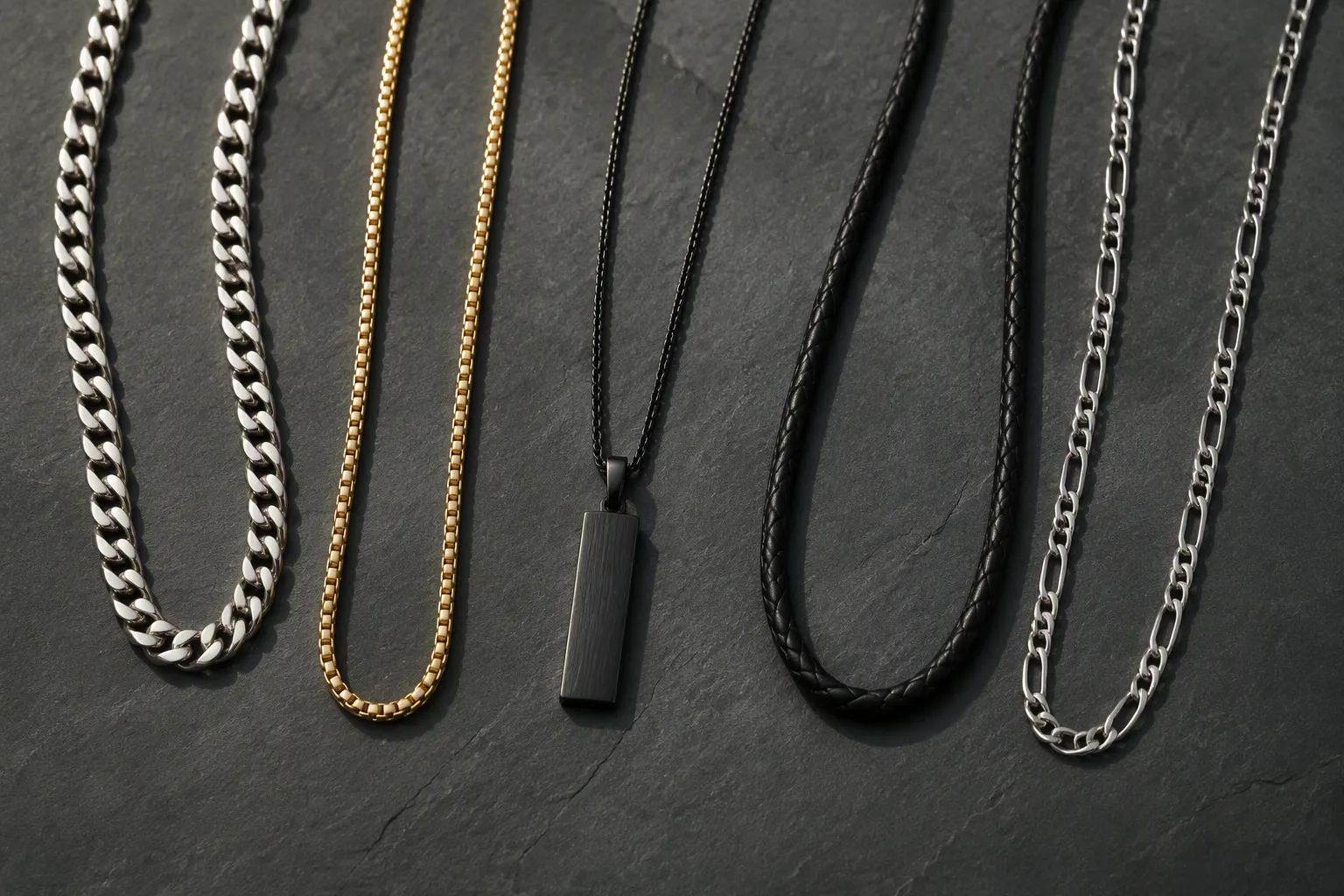
Chain necklaces dominate the men's accessible jewelry category. Cuban links, figaro chains, box chains, and rope chains each carry a distinct visual weight and wrist-to-neck proportion signal. Cuban links read streetwear-adjacent; box chains trend more minimal and versatile.
For buyers targeting younger demographics (18–35), Cuban links and rope chains in gold tone are consistently strong performers. Buyers targeting minimalist or business-casual consumers typically find more traction with slim box or figaro chains in silver tone.
Pendant Necklaces
Pendant styles — cross, geometric, dog tag, tribal motif — allow more expressive individual style. Pendant necklaces also offer better margin flexibility, since the chain and pendant can be sold as a set or separately.
STRAND's Two-Tone Sunburst Teardrop Earrings & Necklace Set-Gold demonstrates how a thoughtfully designed pendant can anchor a full set offering — pairing earrings with a coordinating necklace raises the average order value while keeping the per-piece cost accessible.
Cord and Leather Necklaces
Waxed cord and leather necklaces remain a popular entry-level option. They work especially well in bohemian, beach, or festival-adjacent markets. The limitation is durability — cord and leather require more care guidance for the end consumer, and lower-quality leather substitutes fade quickly.
Layered and Multi-Strand Necklaces
Layered necklaces — one look, multiple chains of varying length — have grown in the men's market. They're typically sold as a single pre-assembled piece, which simplifies the purchasing decision and reduces consumer styling friction.
Materials That Determine Durability (and Price)
Brass
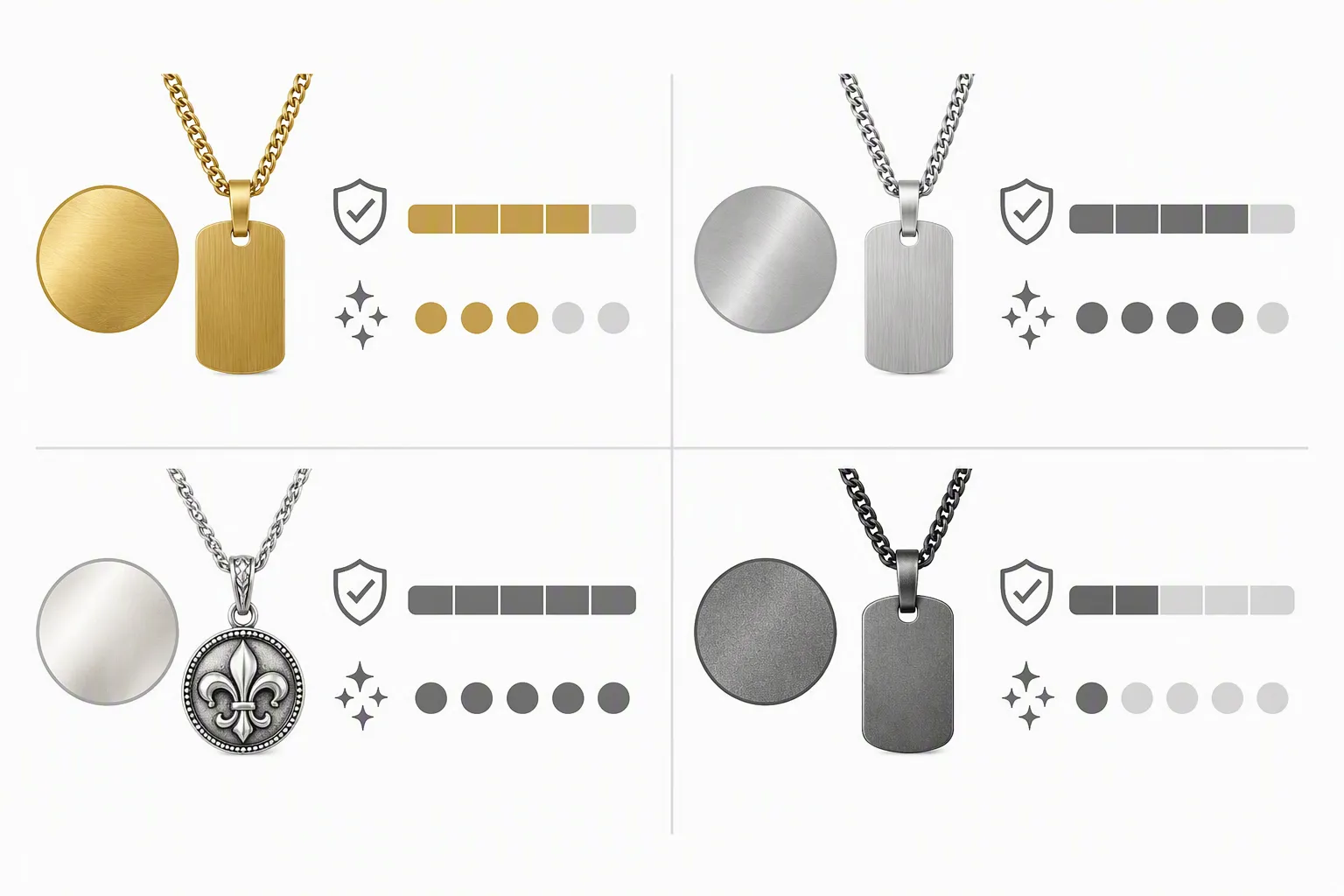
Brass is the workhorse of affordable jewelry manufacturing. It machines and casts well, accepts plating cleanly, and holds its form. The trade-off is that brass oxidizes — without adequate plating thickness or a lacquer topcoat, it tarnishes.
When evaluating brass pieces, ask for plating thickness in microns. Thicker plating extends the finish life significantly.
Stainless Steel
Stainless steel is corrosion-resistant by nature. It doesn't require plating to maintain its finish, though IP (ion plating) gold-tone finishes are common. For coastal or high-humidity markets, stainless steel outperforms brass in longevity.
Stainless steel pieces tend to cost slightly more per unit but generate fewer returns from tarnishing — a procurement consideration worth factoring in.
Zinc Alloy
Zinc alloy appears frequently in the lowest price tier. It's lightweight and castable into complex shapes, but less durable than brass or steel and more prone to surface wear. For fashion-forward, trend-driven pieces with a short product lifecycle, zinc alloy can be appropriate. For catalog staples expected to perform over multiple seasons, it's a higher risk.
Sterling Silver (925)
Sterling silver sits at the top of the accessible-men's-necklace category. The ".925" stamp guarantees 92.5% silver content. Sterling pieces genuinely hold resale value and require less qualification with end buyers skeptical of "cheap" jewelry. For buyers building a quality-positioned DTC catalog, a few sterling options anchor the range credibly.
How to Evaluate Quality Before You Buy
Most quality failures in affordable necklaces trace back to three points: clasp mechanism, plating adhesion, and solder joins at pendant bails.
Clasp mechanism — lobster claw clasps are the standard and the safest bet. Spring rings are cheaper to produce but fail faster under regular use. Box clasps feel premium but require more precise alignment.
Plating adhesion — ask for cross-section or QC report showing plating thickness. A minimum of 0.5 micron gold plating is the floor; 1–2 microns provides meaningfully better wear.
Pendant bail join — on pendant necklaces, the small loop connecting pendant to chain (the "bail") is a stress point. Soldered bails are stronger than slip-fit wire-form bails.
For buyers building a quality-vetted catalog, requesting sample pieces before placing a volume order is standard practice. Evaluate the sample under close inspection: flex the chain, work the clasp 20–30 times, check for sharp edges on the pendant, and look for even plating coverage at bend points.
Why Men's Necklaces Are a Smart Category for Buyers and Retailers
Men's jewelry has expanded steadily as a retail category. The traditional barrier — men not wearing necklaces — has eroded across most demographic segments. What was once a niche is now a mainstream gifting and self-purchase category.
For DTC stores, men's necklaces offer:
- Strong gifting conversion: they're popular as gifts for partners, fathers, grads
- High repeat purchase potential: consumers who buy one necklace often layer styles
- Lower SKU complexity than women's jewelry: fewer size variants, simpler merchandising
For importers and procurement teams, men's necklaces have favorable landed cost profiles — they're compact and lightweight, which keeps per-unit shipping costs low relative to retail price.
What to Ask a Supplier Before Placing an Order
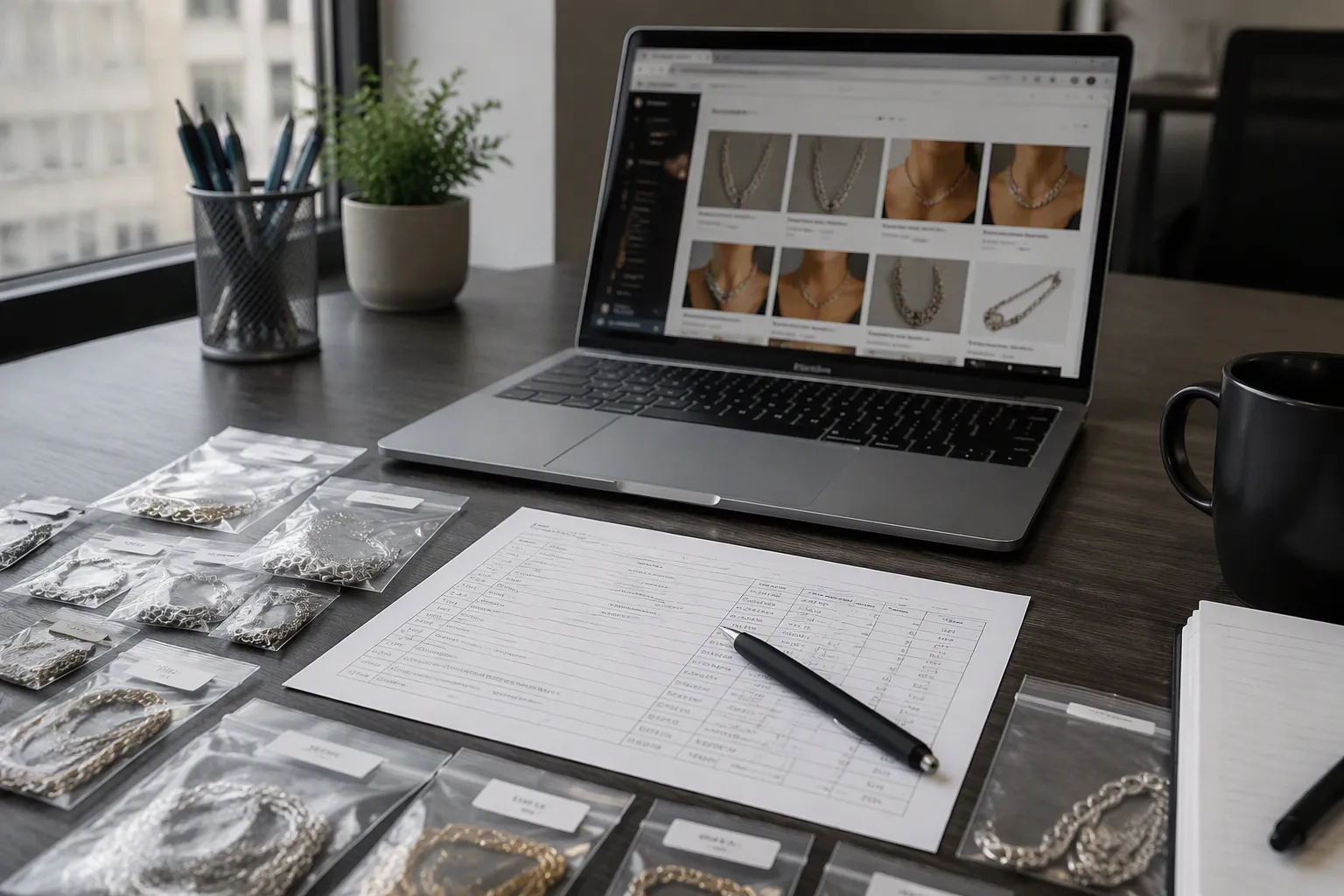
Before committing to any volume order of men's necklaces, run through these evaluation criteria with your supplier:
Pricing and MOQ
Ask for tiered pricing across quantity breaks. Many suppliers operate with minimum order quantities per style — confirm whether MOQ applies per SKU or across the full order. If the supplier's MOQ is higher than your sell-through confidence, negotiate a sample or trial order first.
Lead Time and Production Schedule
Get a written lead time from order confirmation to readiness for shipment. Seasonal peaks (Q4, Valentine's, Father's Day) can compress production windows significantly — factor this into your planning.
Plating Specifications
Request documentation on base material and plating thickness. For gold-tone pieces, confirm whether the gold plating is standard electroplating or vacuum plating (IP). For anti-tarnish claims, ask what the protection mechanism is (lacquer topcoat, e-coating, etc.).
Quality Control Process
Ask whether the supplier conducts QC inspection before shipment. Responsible suppliers will describe their QC process without prompting. Third-party inspection (SGS, Bureau Veritas) is available for larger orders and worth the cost for new supplier relationships.
Returns and Warranty Policy
Understand the supplier's policy on defective units. Plating defects, broken clasps, and solder failures are the most common failure modes. A supplier who stands behind their product with a clear defect warranty is a lower-risk partner than one offering price alone.
For pieces sourced through STRAND, the catalog is positioned as a curated, quality-vetted range — not volume-driven fast-fashion inventory. When comparing suppliers, asking for STRAND's specific terms on MOQ, lead time, and quality warranty gives you a concrete benchmark.
Styling Men's Necklaces: What Buyers Should Know for Marketing
If you're building product pages or marketing content for men's necklaces, understanding how end consumers think about styling increases conversion. Men who buy necklaces fall roughly into three behavioral segments:
The minimalist — one chain, worn daily, preferably versatile across casual and smart-casual settings. Slim chains in silver or gold, lengths between 18–22 inches. This buyer cares about durability because they never take it off.
The expressive wearer — layers, mixes metals, uses jewelry as a signature element of personal style. Open to bolder pendants, thicker chains, mixed materials.
The occasional gifter — buying for someone else, often under time pressure. Needs a clear size/length recommendation, a gift-suitable presentation, and a returns policy they can explain to the recipient.
Product pages that address all three segments — with length guidance, styling notes, and clear material descriptions — convert better than pages that list specs alone.
Procurement Checklist: Before You Commit
Use this as a final filter before placing an order on men's necklaces:
- Base material confirmed (brass, stainless, zinc, sterling)
- Plating thickness documented (in microns)
- Clasp type confirmed (lobster claw preferred)
- MOQ understood and aligns with your sell-through estimate
- Lead time in writing with seasonal buffer factored
- Sample reviewed physically — clasp worked, finish checked, joins inspected
- QC process understood
- Defect/return terms documented
Making the Right Choice for Your Store or Catalog
The best affordable men's necklace for your catalog is the one that matches your customer's durability expectations, aesthetic, and price sensitivity — with a supplier who documents quality rather than just claims it. Getting this right means thinking through your range architecture before you place a single order.
Anchor your range with one or two proven materials. If your customer base trends younger and trend-driven, a brass-base gold-tone Cuban link and a slim stainless steel box chain cover most of the demand spectrum without over-complicating inventory. If you're building a quality-positioned DTC brand, anchoring with a sterling silver option — even one or two SKUs — signals credibility to buyers who are skeptical of accessible price points.
Match the style mix to your three buyer types. The minimalist needs a durable daily-wear chain at a length they can wear under a shirt or over it (18–20 inches). The expressive wearer needs at least one layering option or a bold pendant. The gifter needs a clear, gift-ready presentation and a simple length recommendation in the product description. A range that addresses all three can do so with as few as four to six SKUs — you don't need depth, you need coverage.
Sequence your sourcing decisions deliberately. Start with samples before committing to volume. Use the sample evaluation (clasp cycling, plating inspection at bend points, bail solder check) as a supplier qualification step, not just a quality check. A supplier who ships good samples but poor production runs is a common failure mode — request that your first production order include a small QC holdback before full release.
Know your acceptable defect threshold before returns become a brand problem. Plating failures are the most visible defect type in this category. If your return rate on a specific style climbs, the root cause is almost always insufficient plating thickness or a base material mismatch — both are addressable at the sourcing stage with better documentation requirements. Setting a clear defect threshold in your supplier agreement (typically expressed as a percentage of units per batch) gives you recourse without renegotiating terms after a problem shipment.
Price is a tiebreaker, not the primary decision criterion. Two suppliers offering identical per-unit pricing at different plating specs are not equivalent offers — the lower-plating option carries a hidden cost in returns and customer service that only appears after the inventory is already in your warehouse.
To expand your range with a coordinated set option, take a look at the Two-Tone Sunburst Teardrop Earrings & Necklace Set-Gold from STRAND — it illustrates how a matched necklace-and-earring set can anchor a product range without significant price escalation.
Ready to source? [Contact the supplier] for current MOQ tiers, plating specifications, and lead time availability on men's necklace styles.
STRAND — curated jewelry for buyers who source with intent.
Frequently Asked Questions
What is cheap guy necklaces?
Affordable Men's Necklaces — A Buyer's Perspective
"Cheap guy necklaces" in the trade context refers to budget-friendly men's necklaces — typically priced for accessible retail — made from materials such as stainless steel, brass with plating (gold or silver tone), or zinc alloy, often featuring chain styles like curb, box, or figaro links in lengths of 18"–24". For procurement teams, STRAND sources vetted men's necklace styles that balance competitive unit cost with consistent finish quality, suitable for DTC margins without sacrificing perceived value. Key sourcing metrics to evaluate include plating thickness (e.g., 18K gold, 1–3 microns), tarnish resistance, MOQ (typically 50–200 units per SKU), and lead times of 15–30 days depending on customization.
How to cheap guy necklaces?
Sourcing Affordable Men's Necklaces for Retail
For DTC stores and importers looking to source cost-effective men's necklaces, focus on stainless steel, brass, or zinc alloy pieces with PVD or gold-ion plating — these deliver durable, market-ready finishes at accessible price points without sacrificing presentation.
STRAND offers vetted men's necklace collections (rope chains, box chains, pendant styles) with typical MOQs starting at 50–100 units per SKU, FOB lead times of 15–25 business days, and shipping options including DHL Express and sea freight consolidation for larger orders.
For MENA-market procurement, STRAND recommends prioritizing 18K gold-tone finishes on stainless steel bases, as these align with regional aesthetic preferences while keeping landed costs competitive for mid-tier retail positioning.
Why is cheap guy necklaces important?
Affordable men's necklaces fill a critical gap in the accessories market by making everyday wearable jewelry accessible to a broader male demographic, driving consistent repeat purchases for DTC stores and importers. For procurement teams, this price tier typically offers strong margin potential — especially when sourced from vetted suppliers offering stainless steel, brass, or zinc alloy constructions with reliable plating (gold-tone, silver, or gunmetal) that hold up under normal wear. STRAND's entry-level men's necklace range addresses this demand while maintaining material transparency and quality control, giving buyers a credible, scalable product line without sacrificing brand integrity.
When should I use cheap guy necklaces?
Budget-accessible men's necklaces are ideal for high-turnover retail environments — think seasonal promotions, gift sets, or entry-level price points where customers want style without a significant commitment. They also work well for bulk procurement in DTC stores testing new men's accessory categories, allowing buyers to gauge demand before investing in premium SKUs.
For STRAND sourcing specifically, these pieces suit buyers looking for accessible price-point anchors (typically stainless steel or brass-base with IP plating, MOQ from 100–500 units) that complement a tiered catalog — pairing well alongside mid-range and statement pieces to broaden customer reach.
What are the benefits of cheap guy necklaces?
Affordable men's necklaces offer buyers strong margin potential while keeping retail price points accessible — a key advantage for DTC stores targeting style-conscious consumers who want to refresh their look frequently. STRAND sources entry-level men's necklaces in stainless steel, brass, and zinc alloy with quality-vetted finishes (IP gold, matte silver, oxidized black), so "accessible price" never means compromised durability or aesthetics. Low unit costs also lower the barrier for importers and procurement teams to test new styles with minimal inventory risk before committing to larger volumes.