
How to Buy the Bulk of Jewelry: The Ultimate Wholesale Guide
How to Buy the Bulk of Jewelry: The Ultimate Wholesale Guide
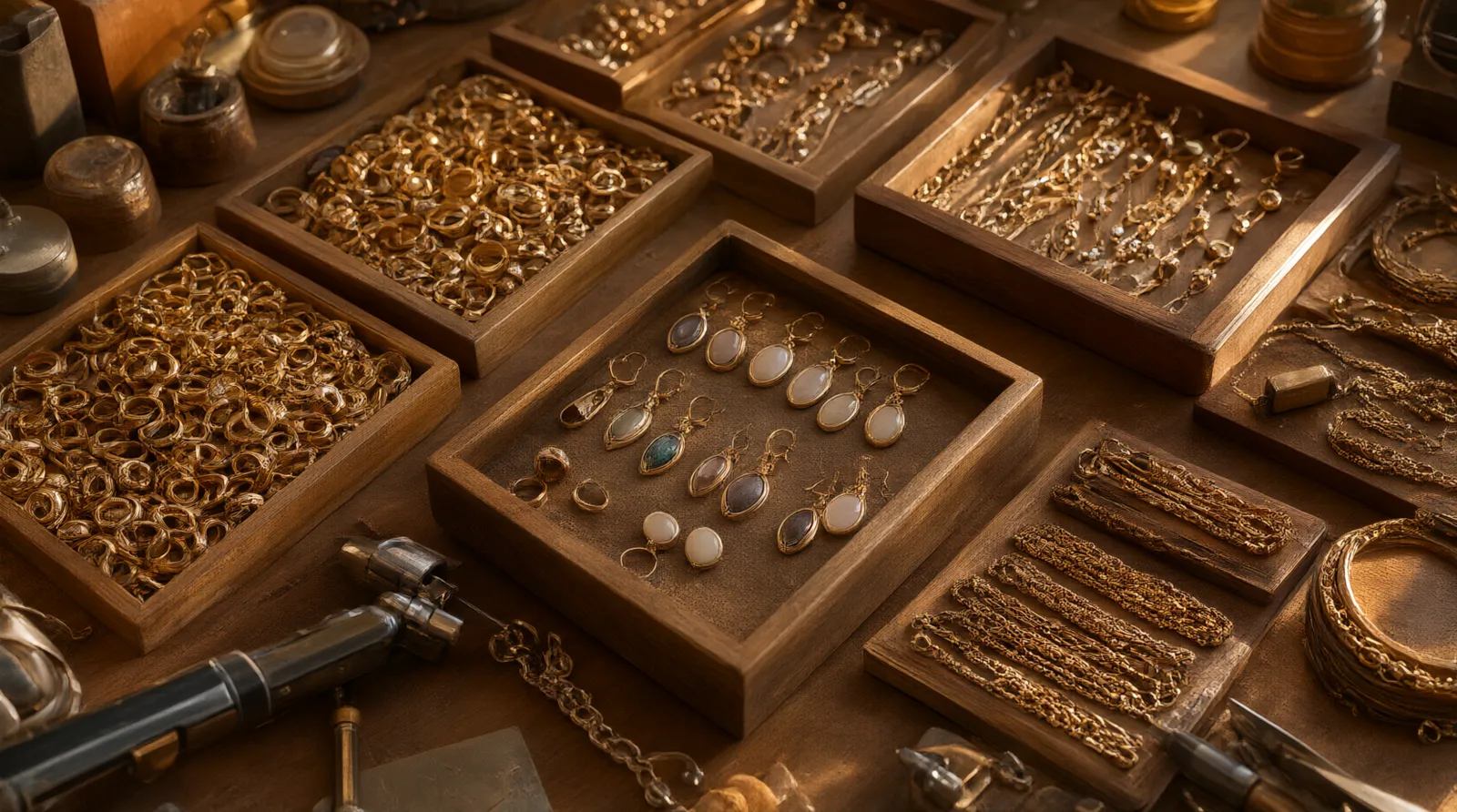
Buying jewelry in bulk refers to purchasing finished pieces—such as rings, earrings, bracelets, and necklaces—in large wholesale quantities directly from a manufacturer or vetted supplier. Buyers order in bulk to secure lower per-unit costs, ensure consistent inventory for retail storefronts, and maintain uniform quality across product lines.
For overseas procurement teams, DTC store owners, and importers, understanding how to source bulk jewelry correctly separates profitable businesses from those struggling with inconsistent supply chains. Ordering large quantities is not simply about filling a warehouse; it requires precise coordination around materials, dimensions, minimum order quantities (MOQ), lead times, and shipping logistics.
Whether you are stocking a boutique in Dubai that favors modest designs and rich gold tones, or supplying a multi-channel e-commerce brand in North America, the mechanics of bulk purchasing remain rooted in careful evaluation. STRAND approaches this process by prioritizing crafted, thoroughly vetted collections over mass-produced fast fashion. This guide breaks down exactly what you need to know before placing your next large-scale order.
What Exactly Is Bulk Jewelry?
When industry professionals discuss buying jewelry in bulk, they are referring to the wholesale acquisition of finished pieces in high volume. This differs significantly from buying raw supplies. While platforms like Artbeads offer premium bulk jewelry supplies such as seed beads and findings—sometimes featuring promotional tiers like $5 & $10 finds—procuring finished jewelry means you are buying ready-to-sell products. These include completed earrings, fully assembled bracelets, sized rings, and clasped necklaces. For buyers who also need to source components alongside finished goods, exploring wholesale jewelry craft supplies can help streamline your entire procurement strategy.
For an importer or a DTC store, bulk jewelry represents the core inventory that drives revenue. A typical wholesale order might consist of 500 units of a single SKU (Stock Keeping Unit) or a mixed container of 2,000 assorted pieces. The defining characteristic is the volume discount applied to the per-unit price, which allows retailers to maintain healthy profit margins when selling at market value.
Understanding this distinction is critical for MENA markets, where buyers often seek specific material compositions. Purchasing finished jewelry in bulk ensures that every piece meets the exact karat weight or plating thickness required by local consumer protection standards, rather than leaving the final assembly—and potential quality variations—to third-party workshops.
Why Sourcing Jewelry in Bulk Matters for Your Business
Purchasing jewelry in bulk is fundamentally an exercise in margin control and supply chain stability. When a procurement team secures a large order, the per-unit manufacturing cost drops because the factory can optimize its production run without stopping to recalibrate machinery for different designs.
Securing Consistent Quality Across Batches
A common challenge for growing DTC brands is batch inconsistency. If you order 50 rings one month and 50 the next, slight variations in stone setting or metal polishing can occur. By ordering bulk jewelry in a single production run, you guarantee that every piece shares the exact same finish, dimensions, and material composition. STRAND enforces strict vetting protocols during these runs to ensure each piece reflects genuine craftsmanship rather than rushed output.
Meeting Regional Cultural Expectations
For importers targeting the Middle East and North Africa, cultural alignment is non-negotiable. Consumers in these regions frequently prefer modest styling—longer necklace drops, higher necklines on pendants, and substantial bracelet widths that do not appear overly delicate. Furthermore, warm gold tones (often 18k or 21k visual finishes) dominate the market. Buying in bulk allows you to commission custom plating baths or solid alloy mixes tailored specifically to these aesthetic preferences, ensuring your entire inventory resonates with local tastes.
Inventory Availability and Sales Velocity
Running out of a best-selling SKU during peak seasons (such as Ramadan or Eid gifting periods) results in immediate lost revenue. Maintaining a deep stock through bulk purchasing prevents stockouts. Retailers who hold sufficient inventory can fulfill orders immediately, reducing customer wait times and increasing repeat purchase rates.
How to Buy Jewelry in Bulk: A Step-by-Step Procurement Guide
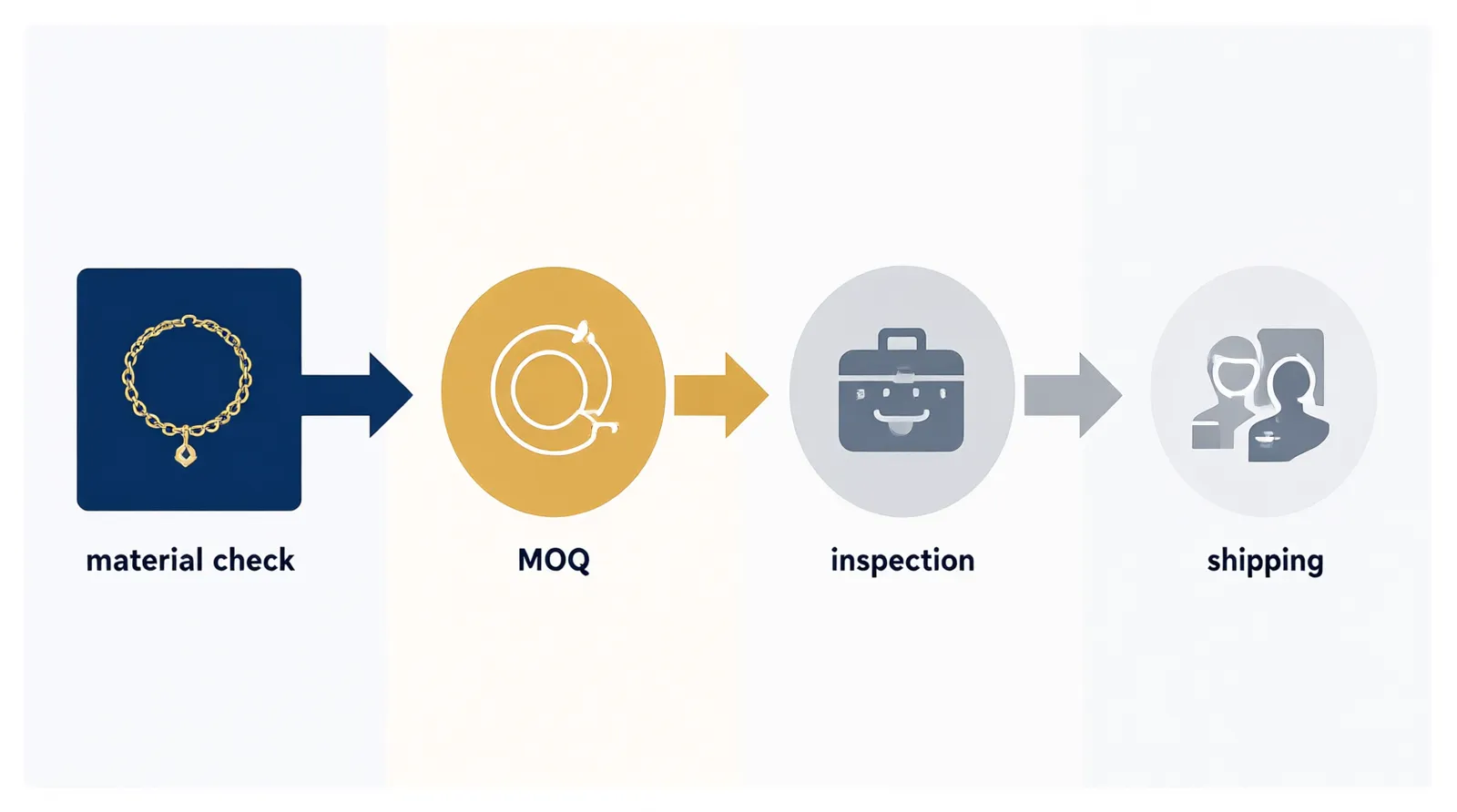
Executing a bulk purchase requires moving beyond simple online checkouts. It involves direct communication with manufacturers, detailed specification sheets, and structured timelines. Here is how procurement teams successfully navigate the process. For a broader overview of navigating this landscape, review our complete guide on how to buy wholesale on jewelry.
Step 1: Define Material and Dimension Specifications
Before requesting quotes, document the exact physical properties of the jewelry you need.
- Materials: Specify the base metal (e.g., 925 sterling silver, brass) and the finishing layer. For gold-toned pieces popular in MENA markets, define whether you require flash plating, vermeil (a thick layer of gold over sterling silver, typically 2.5 microns or more), or solid gold.
- Dimensions: Provide exact measurements in millimeters. For example, specify that hoop earrings must have an inner diameter of 20mm and a wire thickness of 2.5mm. Ring bands should have defined widths (e.g., 4mm) and precise sizing scales (US sizes 5-10 or corresponding international equivalents).
Step 2: Negotiate Minimum Order Quantities (MOQ)
Suppliers set MOQs to justify the setup costs of manufacturing. A standard MOQ for custom-designed bulk jewelry might range from 100 to 500 pieces per style, though this varies heavily based on complexity. Discuss tiered pricing structures with your supplier. Often, committing to a slightly higher MOQ yields a disproportionately larger discount per unit. Always request current terms directly from the manufacturer, as MOQs fluctuate based on their existing production schedules.
Step 3: Request and Evaluate Samples
Never place a bulk order without first approving a physical sample. The sample phase verifies that the factory can execute your design files accurately. Check the sample for weight, clasp tension, stone security, and plating adhesion. STRAND treats sampling as a mandatory quality gate, ensuring the final bulk run mirrors the approved prototype perfectly.
Step 4: Establish Production Lead Times
Lead time is the duration between order confirmation and shipment readiness. For bulk jewelry, production lead times generally span several weeks, depending on the intricacy of the designs and the total volume. Factor in additional time for raw material sourcing if you require specific gemstones or specialized alloys. Always build a buffer into your timeline to account for customs clearance delays at the destination port.
Key Evaluation Criteria Before Placing a Bulk Order
Overseas buyers must evaluate suppliers across four distinct dimensions to mitigate risk. Treating these criteria as a checklist prevents costly errors.
Price and Availability
Request itemized quotes that separate the unit cost, tooling fees (if applicable), and packaging costs. Verify that the supplier has the raw materials available to meet your requested delivery date. A low price is irrelevant if the factory cannot source the required brass or silver to fulfill the order.
Shipping Options and Logistics
Bulk shipments rarely travel via standard courier services due to weight and cost. Evaluate freight options:
- Air Freight: Faster transit times, suitable for high-value, lower-weight items like fine gold jewelry. More expensive but reduces capital tied up in transit.
- Sea Freight: Cost-effective for heavy, high-volume orders (e.g., thousands of brass-based fashion pieces). Requires longer lead times and careful planning around port schedules. Clarify Incoterms (such as FOB or EXW) so both parties understand exactly where liability transfers during transit.
Quality Assurance and Warranty
Ask the supplier about their defect tolerance rate. Industry-standard acceptable quality limits (AQL) dictate how many flawed pieces can exist in a batch before the entire shipment is rejected. Ensure the manufacturer conducts pre-shipment inspections. For plated jewelry, inquire about tarnish-resistance testing and warranty coverage against premature fading.
Return Policies and Dispute Resolution
International returns are logistically complex and expensive. Establish clear protocols before signing a contract. If a percentage of the bulk order arrives damaged or fails to match the approved sample, determine whether the supplier will issue credit notes, replace the goods in the next production run, or refund the difference.
Finding the Perfect Pieces: Rings, Earrings, Bracelets, and More
Not all jewelry categories behave the same way in a bulk purchasing scenario. Different product types require specific attention to sizing, hardware, and structural integrity.
Rings
Rings present the unique challenge of size distribution. When ordering bulk rings, you must provide a size curve. A standard US distribution might allocate 10% to size 5, 25% to size 6, 30% to size 7, 20% to size 8, and 15% to size 9. Failing to provide a precise size breakdown results in excess dead stock in uncommon sizes. Additionally, verify the shank thickness; rings meant for daily wear require thicker bands (e.g., 1.5mm to 2mm minimum) to prevent bending.
Earrings
Earring backs and posts are frequent failure points in mass production. For bulk orders, specify hypoallergenic materials for posts, such as surgical steel or pure titanium, especially for markets with strict consumer safety regulations. If designing for MENA consumers, consider styles that align with modest aesthetics—elegant drop earrings or chandelier styles featuring intricate metalwork and warm gold finishes often perform better than ultra-minimalist studs.
Bracelets
Bracelet length and clasp durability dictate customer satisfaction. Standard women's lengths hover around 17cm to 18cm, but offering adjustable extension chains (typically 3cm to 5cm) accommodates a wider demographic without requiring multiple distinct SKUs. Test lobster clasps and spring rings on your samples repeatedly to ensure they do not fail under tension.
Necklaces and Pendants
Chain strength is paramount. Specify the wire gauge of the chain links. A delicate 0.5mm chain may look beautiful but will snap easily in a retail environment if handled roughly. For bulk imports, opt for slightly heavier chains (e.g., 0.8mm to 1.2mm) to reduce return rates. Pendant bails must also be sized correctly to slide freely along the chosen chain width.
The Benefits of Partnering with Vetted Suppliers for Bulk Orders
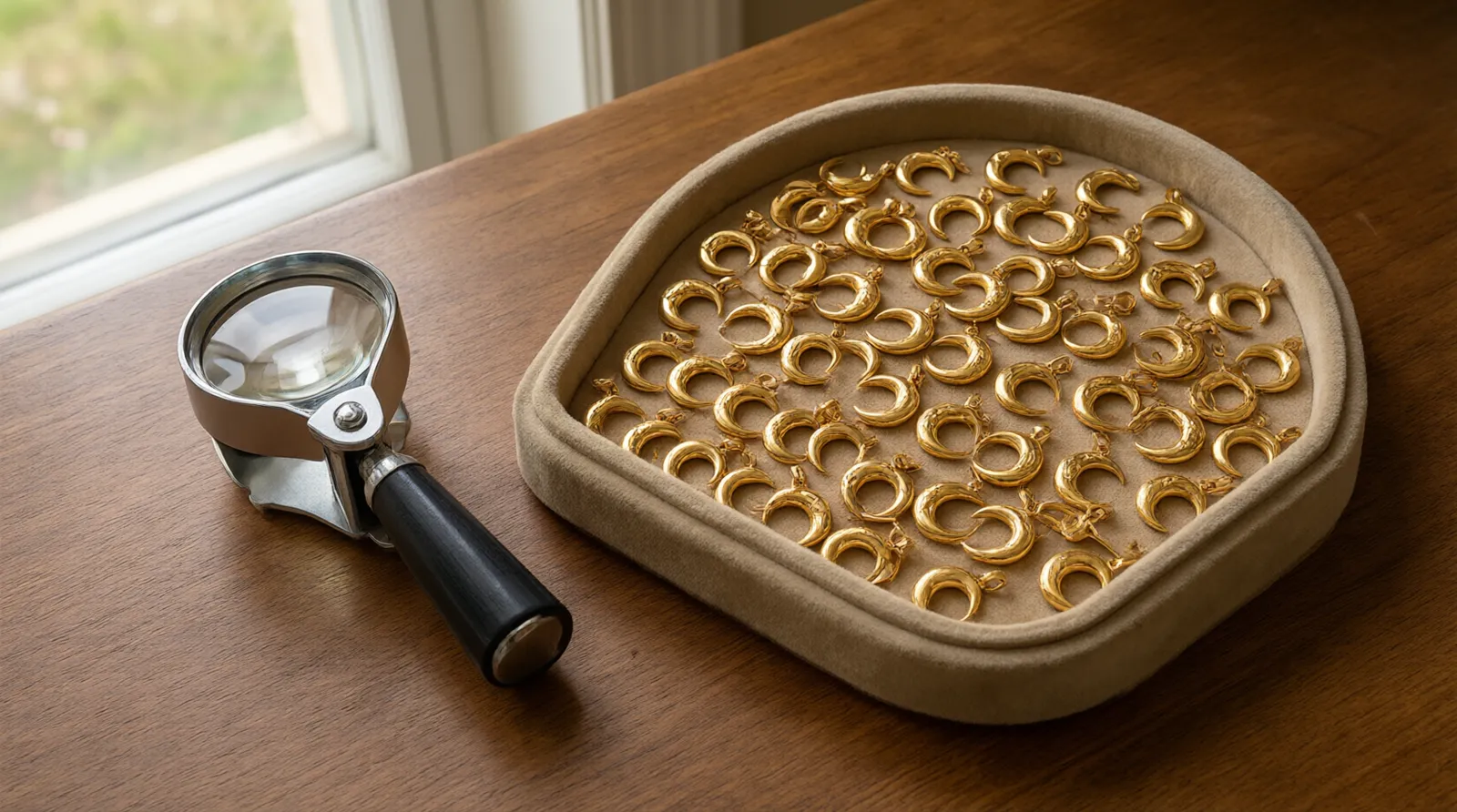
Choosing where to buy bulk jewelry is just as important as knowing what to buy. Partnering with a supplier that prioritizes craftsmanship over sheer volume protects your brand's reputation.
Craftsmanship Over Fast Fashion
Many overseas buyers make the mistake of chasing the lowest possible price, ending up with poorly cast metals and thin plating that tarnishes within days. STRAND operates on the principle that bulk does not mean compromised. Vetted suppliers use precision casting methods, hand-polishing techniques, and controlled electroplating environments to ensure that even an order of 5,000 units maintains artisan-level quality.
Streamlined Customs and Compliance
Experienced bulk suppliers understand export documentation. They provide accurate commercial invoices, packing lists, and certificates of origin. For buyers importing into regions with strict hallmarking laws (like the UAE or Saudi Arabia), working with a supplier who understands these compliance requirements prevents shipments from being held at customs.
Long-Term Scalability
A reliable bulk partner grows with your business. As your DTC store expands or your import volumes increase, established suppliers can reserve production capacity for you. This relationship dynamic means shorter lead times and priority access to new material innovations, keeping your catalog competitive.
When Should You Use Bulk Purchasing Strategies?
Timing your bulk purchases strategically maximizes cash flow efficiency. There are specific scenarios where ordering jewelry in bulk is the most logical business decision.
- Pre-Launch Inventory Building: If you are launching a new DTC brand, you need sufficient stock to fulfill initial marketing-driven demand. Placing a bulk order prior to launch ensures you do not sell out during your opening week.
- Seasonal Preparation: Retail peaks require months of advance preparation. To stock up for holiday seasons or regional gifting festivals, bulk orders must be placed well ahead of time to account for manufacturing and ocean freight transit.
- Core Collection Restocking: Every jewelry brand has "evergreen" pieces—simple gold hoops, classic chain necklaces, or staple rings that sell year-round. These items are ideal candidates for bulk purchasing because the risk of them going out of style before you sell through the inventory is minimal.
- Material Price Locking: Precious metal markets fluctuate. If gold or silver prices are currently favorable, locking in a bulk order secures those material costs for your future inventory, protecting your margins against sudden market spikes.
Actionable Next Steps for Overseas Buyers
Ordering jewelry in bulk transforms your procurement strategy from reactive restocking to proactive business scaling. By focusing on precise material specifications, culturally aligned designs, and rigorous supplier evaluation, you protect your margins and your brand identity. Remember that true value lies in partnering with manufacturers who view bulk production as an exercise in consistent craftsmanship, not a race to the bottom.
Your next step is to audit your current inventory velocity. Identify the top three SKUs driving your revenue—whether they are gold-tone drop earrings for the MENA market or heavy-gauge chain bracelets for Western demographics. Compile your exact dimension requirements, target MOQs, and preferred shipping terms into a single specification sheet.
Once your parameters are defined, reach out to a trusted partner to review your needs and confirm current production availability.
[Get a Quote] or [Contact the supplier] directly to discuss your specification sheet. Request physical samples of your top three SKUs before committing to a full production run. Verify plating thickness, clasp tension, and alloy composition against your documented requirements during this sample phase. Confirm current lead times for your specific volume, as factory capacity fluctuates throughout the year. Ask for a detailed breakdown of shipping options—air freight versus sea freight—and clarify Incoterms so you know exactly where liability transfers during transit. Securing these details upfront ensures your bulk order arrives on schedule, meets your quality standards, and supports your retail margins without unexpected logistical delays.
Frequently Asked Questions
What is bulk of jewelry?
For overseas buyers, "bulk of jewelry" refers to procurement at scale—typically MOQs starting at 100–500 units per SKU—with STRAND offering vetted, crafted pieces in 925 sterling silver, 18k gold vermeil, and solid brass. Standard dimensions follow precise millimeter specs, with production lead times of 4–6 weeks and shipping via DHL Express or consolidated sea freight. For MENA markets, STRAND prioritizes modest silhouettes and rich gold tones to align with regional preferences while maintaining artisanal quality standards.
How to bulk of jewelry?
STRAND supplies vetted, crafted jewelry in bulk for DTC stores and importers, offering 18k gold-plated brass and sterling silver pieces with standard dimensions of 16–20" chains and MOQs starting at 50 units per SKU. Production lead times are 4–6 weeks, with MENA-friendly modest designs available in rich gold tones, shipped via DHL Express or sea freight depending on order volume.
Why is bulk of jewelry important?
For overseas buyers and procurement teams, purchasing jewelry in volume through STRAND ensures consistent access to vetted, crafted pieces—such as 18k gold-tone brass or 925 sterling silver—with reliable MOQs starting at 300 units per style. This approach secures predictable 4–6 week production lead times and streamlined shipping options (air freight for urgent restocks or sea freight for larger consignments), which is essential for DTC stores and importers planning seasonal drops. It also allows STRAND to maintain strict quality control across specific dimensions and finishes, including modest, culturally considered designs preferred by MENA markets.
When should I use bulk of jewelry?
STRAND volume orders are ideal for DTC stores, importers, and procurement teams needing consistent inventory of crafted, vetted pieces—such as 18k gold-plated brass or 925 sterling silver—in standard dimensions with MOQs starting at 100 units per SKU. Please allow a 4–6 week lead time for production, with shipping available via air freight or sea freight depending on your destination. For MENA markets, STRAND prioritizes modest silhouettes and rich gold tones to align with regional preferences.
What are the benefits of bulk of jewelry?
Ordering jewelry in volume through STRAND secures consistent access to vetted, crafted pieces—such as 18k gold-tone brass or 925 sterling silver—while optimizing per-unit landed costs for DTC stores and importers. STRAND supports MOQs starting at 300 units with a 4–6 week production lead time, offering air freight or sea shipping options tailored to your procurement schedule. For MENA markets, bulk programs can be curated to feature modest, culturally resonant designs in preferred gold tones, ensuring every shipment meets exact specifications.