
How to Order Bulk Custom Keychains for Your Brand in 2026
How to Order Bulk Custom Keychains for Your Brand in 2026
Bulk custom keychains are one of the most practical branded accessories a DTC store, importer, or procurement team can add to their catalog — provided the sourcing is handled with the same rigor applied to core product lines. Get the spec wrong, miscalculate MOQ tiers, or choose the wrong material for your end market, and you're sitting on inventory that neither sells nor represents the brand well.
This guide covers every stage of the procurement process: what bulk custom keychains actually are, which materials and finishes suit different use cases, how to evaluate a supplier before committing, and when the economics genuinely make sense for your brand.
Quick definition: Bulk custom keychains are branded key accessories produced in quantity — typically starting from 50 to 500+ units — with a logo, message, or design applied through die-casting, laser engraving, epoxy printing, or enamel fill. They serve promotional, retail, and gifting purposes across brand categories from lifestyle to jewelry.
What Are Bulk Custom Keychains, and How Do They Differ from Personalized Orders?
A custom keychain is a functional accessory — typically metal, acrylic, leather, or PVC — that carries a brand mark, shape, or message. When ordered in bulk, per-unit cost drops significantly compared to single-unit custom production, making them a staple for:
- Promotional merchandise programs — trade shows, brand activations, loyalty gifts
- Retail product line extensions — sold alongside apparel, accessories, or lifestyle goods
- Corporate gifting — employee kits, client gifts, conference swag
- DTC brand add-ons — low-cost branded accessories bundled with a higher-value hero product
The terms "custom" and "personalized" are often conflated, but they describe fundamentally different production models. Custom keychains carry a single design applied uniformly across the entire batch — same logo, same finish, same shape on every unit. Personalized keychains have variable data on each unit: a name, a date, a unique code. Personalized production costs more per unit because it requires individual processing. Most bulk orders are custom (one design, many units), and that distinction matters for both pricing and lead time conversations with suppliers.
Why Bulk Custom Keychains Belong in a Brand's Product Mix
Keychains occupy a rare position in branded merchandise: they're genuinely useful, universally kept, and compact enough to ship economically alongside other inventory. A branded tote or apparel piece might sit in a drawer; a keychain goes on someone's keys the day they receive it and stays visible every time they unlock a door or reach into a bag.
For jewelry brands and accessory importers specifically, custom keychains offer a natural brand extension. They can share material DNA with a core jewelry line — brass, gold tone, sterling silver plate — without carrying the same unit economics as fine jewelry pieces. They also consolidate well in bundled shipments, which matters when you're shipping to retail accounts, 3PL fulfillment centers, or international distributors managing mixed SKU orders.
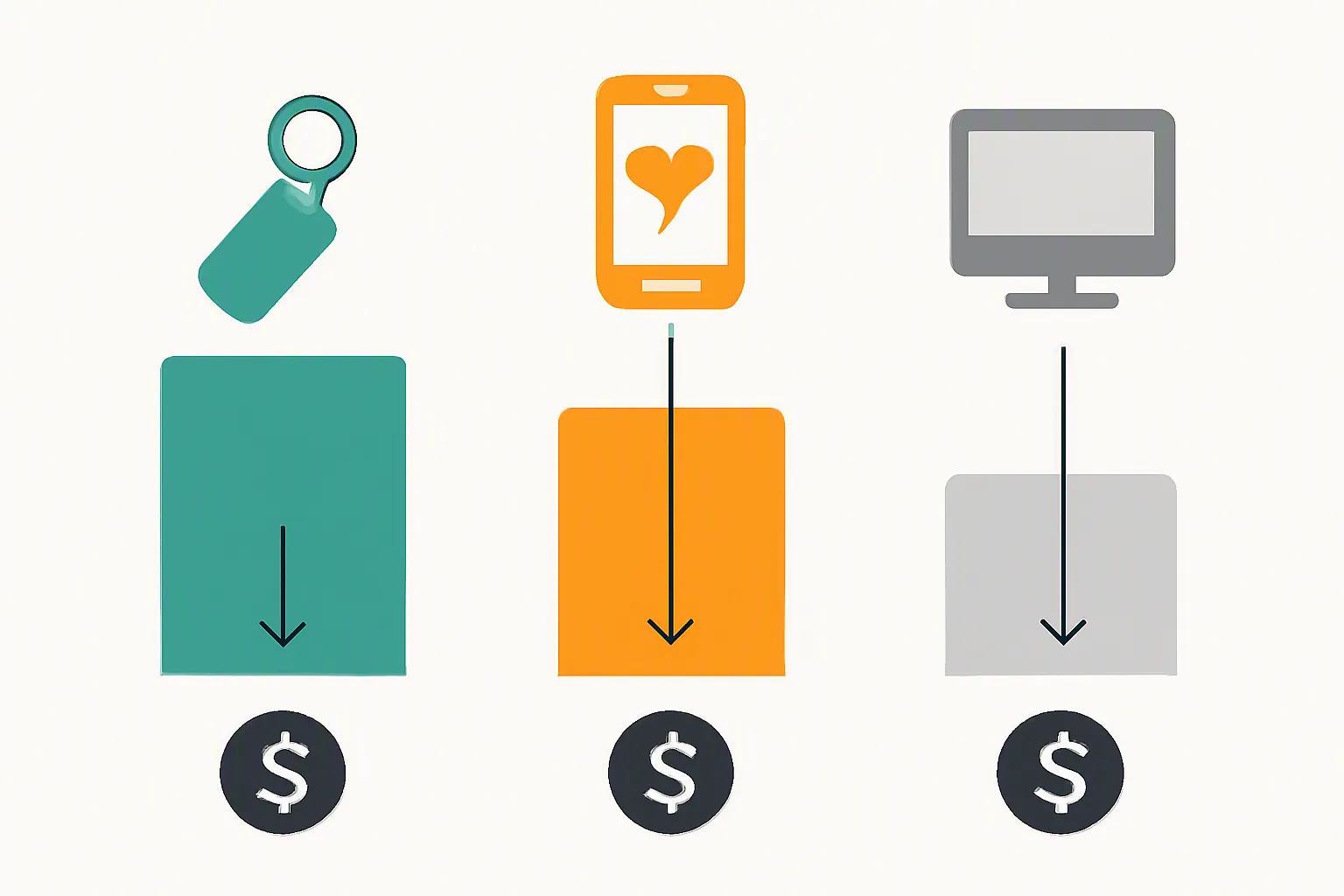
From a margin standpoint, the economics are straightforward. Production costs compress at scale, so buyers who reach higher MOQ tiers typically see per-unit costs drop to a level that supports healthy retail markup even on mid-tier materials. The exact break point varies by supplier and material, but the pattern is consistent: the jump from a small first run to a consolidated order often unlocks the most meaningful price improvement.
Brand Visibility That Compounds Over Time
Every unit placed in an end user's hands generates passive impressions for months or years. Unlike a digital ad that disappears after a single view, a keychain on a daily-use key ring can generate hundreds of visual exposures per week at zero additional cost to the brand. For DTC brands building organic awareness on a disciplined budget, that kind of compounding visibility is hard to replicate through paid channels at an equivalent cost-per-impression.
If your catalog already includes branded jewelry or fine accessories, the same supplier infrastructure — relationship management, spec sheet workflows, quality review processes — transfers directly to keychain procurement. For a broader view of how to structure that sourcing network, our guide on Custom Jewelry: 6 Sources Buyers & DTC Brands Need in 2026 covers the key channels worth building relationships with.
Materials, Finishes, and Design Formats: A Buyer's Reference
The material you select determines three things simultaneously: the final look and feel, the manufacturing method required, and the cost tier. Understanding how these interact prevents costly surprises after you've submitted artwork and approved a proof.
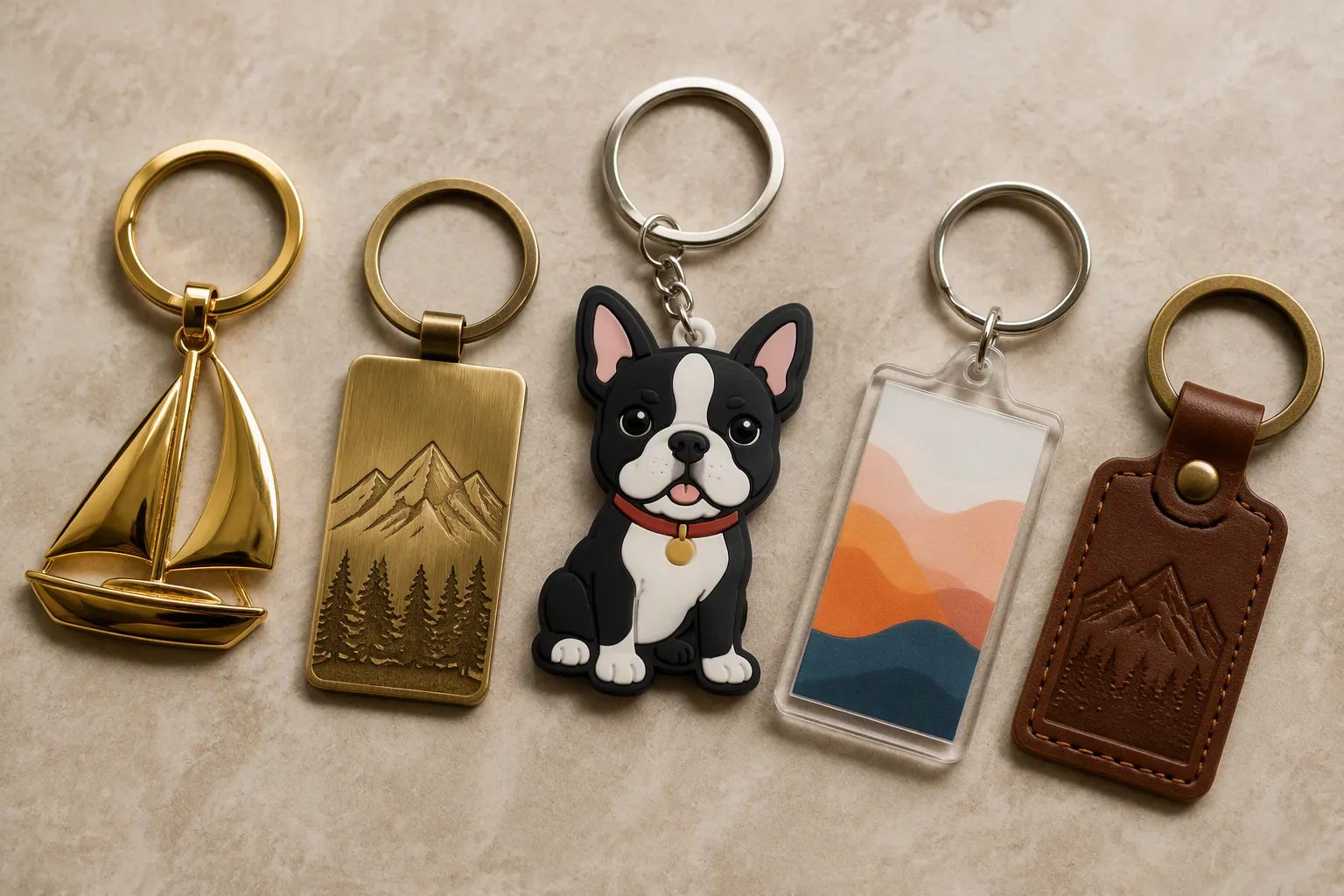
Metal Keychains: Zinc Alloy, Brass, and Stainless Steel
Zinc alloy (also called zamak) is the most widely used material for die-cast custom keychains. It molds into complex shapes at relatively low cost, accepts plating consistently (gold, silver, antique brass, black nickel, rose gold), and carries enough weight to feel substantial in hand. MOQs for zinc alloy tend to start lower than for brass or stainless steel, which makes it a practical choice for first orders or limited-run activations.
Brass produces a heavier, more premium product and is often chosen for keychains positioned alongside mid-range jewelry. It takes high-polish plating more consistently than zinc alloy and shows less micro-surface variation across large batches — relevant for buyers with strict finish specifications. Stainless steel is the choice when corrosion resistance is the priority: outdoor brands, humidity-prone markets, or accessories expected to hold up to daily handling over several years.
For brands targeting MENA markets, gold-tone finishes on brass or zinc alloy are worth prioritizing. Warm metal tones align with regional aesthetic preferences and communicate quality without requiring premium material costs.
Acrylic and PVC
Acrylic keychains are laser-cut or die-cut from sheets and work well for illustrated designs, character shapes, or brand marks with high color fidelity. They're lightweight, economical, and available in clear, frosted, or opaque formats — useful when the design concept calls for depth or visual layering. Soft PVC (rubber) keychains are 3D-molded and suited for character shapes or designs with significant dimensional variation that flat materials can't replicate.
Leather
Genuine leather keychains carry a tactile quality that suits luxury-adjacent brands. Standard branding methods include debossed logos (pressed into the leather) and foil stamping (metallic finishes applied with heat). Vegan leather (PU) offers comparable aesthetics at lower cost and with fewer supply-chain complications for brands managing sustainability credentials.
Branding Methods at a Glance
| Method | Best Substrate | What to Watch |
|---|---|---|
| Laser engraving | Metal, wood, acrylic | No color; marks are recessed |
| Enamel fill | Die-cast metal | Limited to solid fills; not suitable for gradients |
| Epoxy dome | Flat metal or printed insert | Color-accurate; surface can scratch with heavy use |
| Screen print | Flat acrylic, PVC, leather | Works cleanly for logos with defined lines |
| Full-color UV print | Acrylic, flat metal | Photo-quality output; durability varies by surface contact |
Buyers familiar with jewelry spec sheets will recognize the logic: every branding method has a substrate it performs on and a failure mode to plan around.
How the Ordering Process Works, Step by Step
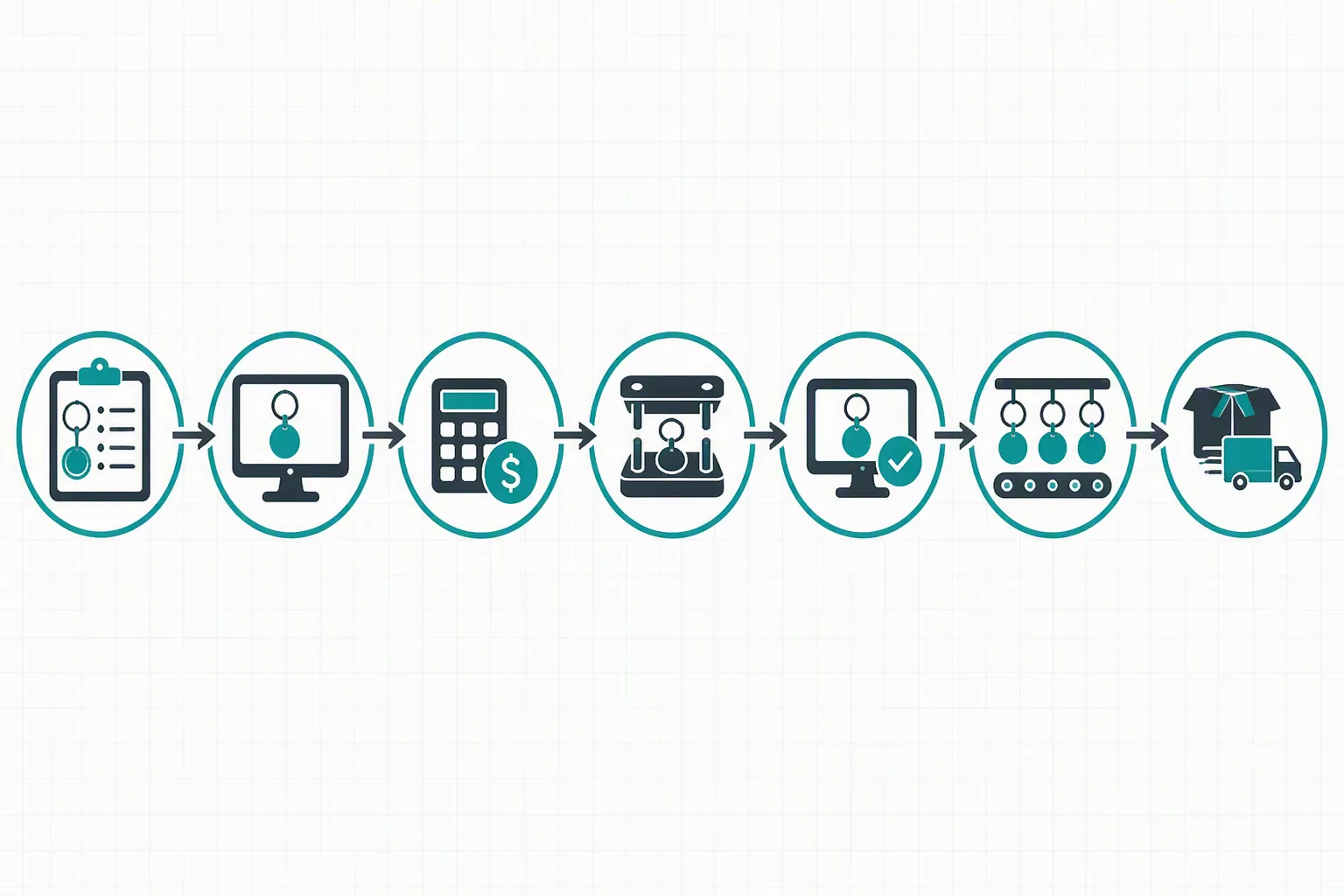
Understanding the production pipeline lets you set realistic timelines and catch friction points before they become costly delays.
Step 1 — Define the brief. Lock in shape, material, finish, branding method, and target quantity before contacting any supplier. A vague brief produces quotes that don't survive the revision process.
Step 2 — Request a design proof. Most reputable suppliers provide a digital proof before production begins — GS-JJ, for instance, advertises a free proof policy as part of their standard process. For orders above a certain value threshold or when working with an unfamiliar material, request a physical pre-production sample (often called a "PP sample" or "proto") before approving mass production. Budget one to two weeks for a physical sample to travel from manufacturer to your location.
Step 3 — Confirm MOQ and pricing tiers. Minimum order quantities vary by material, design complexity, and supplier. Simple flat designs may start at 50–100 units; complex die-cast shapes can require 200–500+ units to justify tooling costs. Always request pricing at multiple quantity break points — the difference between the 250-unit and 500-unit per-unit price is often where the economics shift most sharply.
Step 4 — Review tooling costs. Custom die-cast keychains require a mold, which is a one-time tooling fee. Subsequent reorders use the same mold, so the cost structure for reorders improves. Ask whether tooling fees are waived at certain volume thresholds or offset against the first order value.
Step 5 — Approve artwork and sign off on production. Most suppliers require vector files (AI, EPS, or PDF) for metalwork and screen printing. Raster images may be accepted for epoxy or UV print applications, but at a minimum of 300 dpi — confirm this before sending artwork to avoid delays at the approval stage.
Step 6 — Production and quality review. Standard production timelines for bulk custom keychains run 10–20 business days after artwork approval, depending on material complexity and factory scheduling. Totally Promotional offers 24-hour rush production on select products — a useful option for time-sensitive activations or early launch programs when inventory is still being finalized. Confirm whether your supplier performs a QC inspection step before shipment, and what documentation accompanies it.
Step 7 — Shipping and final inspection. Keychains are dense and small, which makes them economical to ship by air freight at low volumes and straightforward to consolidate with other product lines in sea freight containers. Confirm whether the supplier ships DDP (Delivered Duty Paid) or DAP/FOB, as this directly affects your landed cost. Some suppliers run free shipping promotions on qualifying orders — GS-JJ, for example, ships to the US, Canada, UK, and Australia and has offered free shipping on certain orders (confirm current terms when requesting your quote) — so this is worth clarifying upfront.
Key Procurement Criteria: What to Evaluate Before You Commit
Buyers evaluating a supplier for bulk custom keychains should run through the same checklist they apply to any branded merchandise source — price, lead time, quality standards, and recourse if something goes wrong.
Price and MOQ Transparency
The per-unit price at your target quantity is only part of the calculation. Factor in tooling fees, artwork setup fees, and shipping to get to a true landed cost before comparing quotes. A supplier with a low per-unit price but a high tooling fee may cost more than one with a slightly higher per-unit rate and no tooling charge.
If you're sourcing across international markets — MENA, Europe, North America — confirm what currencies the supplier accepts. Some suppliers support a wide range including USD, EUR, GBP, CAD, AUD, and others, which simplifies accounting for multi-region buying teams.
Lead Time Reliability
A keychain order that arrives three weeks after your product launch is more costly than a slightly higher per-unit price from a supplier who delivers on schedule. Ask directly for standard production timelines, any current lead time extensions due to factory load, and what the remediation process looks like if production is delayed. For orders tied to an event, retail floor date, or launch window, build contingency time into your planning — not into a rushed reorder.
Quality and Durability Standards
For metal keychains with plating, ask about plating thickness in microns. Thin plating tarnishes quickly under normal use — a problem for any brand that positions its accessories as lasting. For enamel-filled designs, ask about infill consistency and color matching across the batch.
Buyers already working with jewelry suppliers will have existing benchmarks: metal grade, plating specifications, finish consistency tolerances. Apply those same standards to keychain procurement. The product category may be lower priced, but the quality standards your brand depends on aren't.
Defect Policy and Recourse
Understand your recourse if a shipment arrives with defects beyond an acceptable threshold. A supplier's replacement policy — the defect percentage that triggers action, the turnaround on replacements, the documentation required — tells you more about their operational reliability than any marketing copy does.
When Should You Order Bulk Custom Keychains?
The economics of a bulk custom order work best under specific conditions. Not every situation justifies committing to a production run, and knowing when to act — and when to wait — protects both cash flow and brand positioning.
Order when you have a confirmed distribution channel. Retail floor dates, confirmed event dates, or an established DTC subscriber base give you a demand floor that justifies the quantity commitment.
Order ahead of a product launch or brand activation. Keychains ship easily, arrive before heavier inventory, and give a brand a physical presence during the early launch window while larger product lines are still in transit or clearing customs.
Order to build a bundled product offering. A keychain added to an existing product bundle — a jewelry set, an accessories kit, a seasonal gift box — increases perceived value without significantly raising the cost of goods per bundle.
Order to test a new supplier. Starting with a keychain order before placing higher-value inventory is a low-risk way to evaluate a supplier's production quality, communication habits, and timeline reliability before trusting them with more complex or expensive products.
Conversely, a bulk custom keychain order doesn't make sense if your design is likely to change before you've sold through the inventory, if you're ordering well ahead of any confirmed channel, or if you're treating it as an afterthought rather than a deliberate extension of your brand.
What to Ask Every Supplier Before Placing an Order
Before committing to a bulk custom keychain order, confirm these specifics in writing:
- What is your MOQ for this material and branding method? (MOQ varies significantly by product type — never assume.)
- Is there a tooling or mold fee, and does it apply to reorders?
- Do you provide a free design proof before production begins?
- What is your standard production lead time, and do you offer rush options?
- What are your shipping terms — DDP, DAP, or FOB — and what regions do you ship to?
- What is your defect threshold and replacement policy?
- What file formats are required for artwork approval?
- What currencies do you accept for international orders?
A supplier who answers these questions clearly and without deflection is more likely to be a reliable long-term partner than one who becomes vague when specifics are requested.
The Right Keychain Order Starts with the Right Supplier Conversation
Bulk custom keychains are a high-visibility, economical addition to any brand's merchandise strategy — but the difference between a successful order and a costly mistake usually comes down to preparation: a clear brief, a tested supplier relationship, and a realistic lead time that doesn't leave you waiting for inventory after your launch window has passed.
For buyers already sourcing jewelry or branded accessories, the same sourcing discipline applies here. Spec clearly, sample before committing to mass production, and evaluate suppliers on transparency rather than the lowest headline price. To expand your sourcing strategy across branded accessories more broadly, our guide on Custom Jewelry: 6 Sources Buyers & DTC Brands Need in 2026 maps out the supplier landscape in detail.
Ready to move forward? [Contact STRAND] to discuss your bulk custom keychain requirements — materials, MOQ tiers, lead times, and finishes suited to your market and brand positioning.
Frequently Asked Questions
What is bulk custom keychains?
Bulk custom keychains are personalized accessories ordered in large quantities — typically with a minimum order quantity (MOQ) starting from 50–500 units — featuring custom shapes, logos, text, or finishes tailored to a brand or campaign. They are commonly produced in materials such as zinc alloy, stainless steel, brass, or acrylic, with options for enamel fill, engraving, or plating in gold, silver, or rose gold tones. For procurement teams and DTC brands, bulk ordering reduces per-unit cost and ensures consistency across promotional, retail, or gifting applications.
How to bulk custom keychains?
To bulk custom keychains, start by selecting your material (brass, zinc alloy, stainless steel, or acrylic), then submit your artwork or logo to a vetted manufacturer like STRAND with your specifications — including dimensions, finish (gold-plated, brushed silver, enamel fill), and quantity. Most reliable suppliers require a minimum order quantity (MOQ) of 100–500 units and offer 15–30 day production lead times, with samples available before full-run approval. Confirm packaging, QC standards, and freight options (sea or air) upfront to ensure your order arrives inspection-ready for resale or gifting programs.
Why is bulk custom keychains important?
Bulk custom keychains are important because they offer businesses, brands, and event organizers a cost-effective way to produce consistent, branded merchandise at scale — reducing per-unit costs significantly while maintaining design uniformity across large quantities. For DTC stores and procurement teams, ordering in volume (typically 100–500+ units MOQ) ensures reliable inventory for promotional campaigns, corporate gifting, or retail distribution without repeated sourcing delays. They also serve as a high-visibility, everyday-use marketing tool, keeping a brand in a customer's hands — and top of mind — long after the initial interaction.
When should I use bulk custom keychains?
Bulk custom keychains are ideal when you need consistent branded merchandise for events, corporate gifting, retail packaging inserts, or promotional campaigns — situations where quantity, uniformity, and cost-per-unit matter. They work well for trade shows, product launches, loyalty programs, or as add-on accessories bundled with a primary product line. Most suppliers set MOQs starting at 100–500 units, so bulk orders make sense once your distribution channel or event scale justifies that volume.
What are the benefits of bulk custom keychains?
Bulk custom keychains offer significant cost efficiency through lower per-unit pricing at higher quantities (typically MOQs starting at 100–500 units), making them practical for DTC stores and procurement teams managing promotional or retail inventory. They serve as high-visibility brand touchpoints — customizable in materials (zinc alloy, brass, stainless steel), finishes (gold-tone, enamel, laser-engraved), and dimensions to align with brand identity or product gifting programs. For importers, consolidating a single bulk order also reduces per-shipment logistics costs and simplifies supply chain management.
Two links inserted: link #1 ("our guide on Custom Jewelry: 6 Sources Buyers & DTC Brands Need in 2026") placed in the "Brand Visibility That Compounds Over Time" section where the guide is referenced by name, and link #2 ("natural brand extension") placed in the "Why Bulk Custom Keychains Belong in a Brand's Product Mix" section where keychains are positioned as a logical extension for jewelry and accessory brands — the closest contextual fit for the alternatives-to-custom-jewelry topic.