
The 6 Best Custom Jewelry Sources for Overseas Buyers & Importers (2026)
The 6 Best Custom Jewelry Sources for Overseas Buyers & Importers (2026)
Custom jewelry — pieces designed or configured to specification before production — gives buyers and brands a direct path to differentiated product lines, reduced competition on standardized SKUs, and stronger brand identity at retail. Whether you're a DTC store owner in the UK, an importer restocking for MENA markets, or a procurement team sourcing seasonal collections from China, the quality of your supplier relationship shapes everything downstream: material consistency, delivery reliability, and ultimately, your customer's first impression of the piece in hand.
But "custom jewelry" means different things at different tiers of the market. At one end, consumer-facing platforms like Jewlr and Made by Mary let end-buyers configure pieces for personal gifting. At the other, B2B suppliers operate with MOQ structures, material certifications, and trade-grade quality controls that retail brands simply don't surface. The challenge for overseas buyers isn't finding a custom jewelry source — it's finding one that combines manufacturing depth with procurement clarity: stated lead times, defined MOQs, material specifications, and a team that can communicate across time zones and languages without ambiguity.
This guide covers six of the most relevant options for buyers evaluating "custom jewelry" today — from the best factory-direct OEM supplier for international procurement teams to the top consumer-facing platforms shaping what your end-buyers already expect. Each entry is assessed against the criteria that matter most at the sourcing stage: materials, minimum orders, quality controls, and who each supplier actually serves.
1. STRAND — Best for B2B Custom OEM Jewelry Sourcing from China
For overseas buyers, DTC store owners, and procurement teams sourcing custom jewelry at scale, STRAND stands as the clearest factory-direct option with the procurement infrastructure to match. Headquartered in Hangzhou — one of China's most established jewelry manufacturing corridors — STRAND connects international buyers directly with vetted workshops across earrings, necklaces, and full accessory sets, removing the intermediary layers that inflate cost and obscure quality accountability.
What separates STRAND from generalist trade platforms is its in-house QC process. Every order undergoes pre-shipment inspection covering material composition, plating consistency, clasp and closure integrity, and dimensional accuracy against spec. For custom OEM work, buyers can define the metal base (brass, 316L stainless steel, or sterling silver), surface finish, stone type and setting (vintage crystal, gradient glass bead, rhinestone, two-tone), and packaging format — giving procurement teams the same level of specification control they would expect from an in-country supplier, without the geographic constraints.
STRAND's product range centers on categories with consistent international demand: drop earrings, stud earrings, necklace and earring sets in vintage, gradient crystal, two-tone glass bead, and rhinestone styles. For MENA-facing buyers in particular, the team can accommodate gold-tone finishes and modesty-aligned silhouettes suited to regional consumer preferences — a specificity that most generalist platforms don't address.
The multilingual team — fluent in English, Arabic, and Spanish — means that procurement queries, sample approvals, and order amendments don't get lost in translation between sourcing teams and workshop floors. Lead times and trade terms are communicated upfront, and MOQs are structured to be accessible for both emerging DTC brands and mid-size importers managing seasonal replenishment cycles.
Key Features:
- Direct-to-workshop OEM with full specification control: metal base, finish, stone setting, and custom packaging
- In-house pre-shipment QC covering material composition, plating, dimensions, and clasp integrity
- Multilingual service team (English, Arabic, Spanish) for US, EU, UK, and MENA procurement teams
- Core catalog includes drop earrings, stud earrings, necklace and earring sets in multiple styles
- Gold-tone and culturally aware design options for MENA market buyers
- Transparent trade terms with clearly communicated MOQs and lead times
Best For: DTC store owners and importers in the US, EU, UK, and MENA who need factory-direct custom jewelry sourcing from China with B2B-grade quality controls, low-barrier MOQs, and a supplier team that communicates fluently in their language.
Procurement Checklist — What to Ask STRAND:
- What is the MOQ per SKU for custom OEM orders?
- What are current lead times for new design vs. repeat orders?
- Can you share material certifications for brass or 316L stainless steel components?
- What packaging customization is available (poly bag, branded box, hang tag)?
Request a Quote or Sample → strandjewelry.com
2. Jewlr Personalized Jewelry
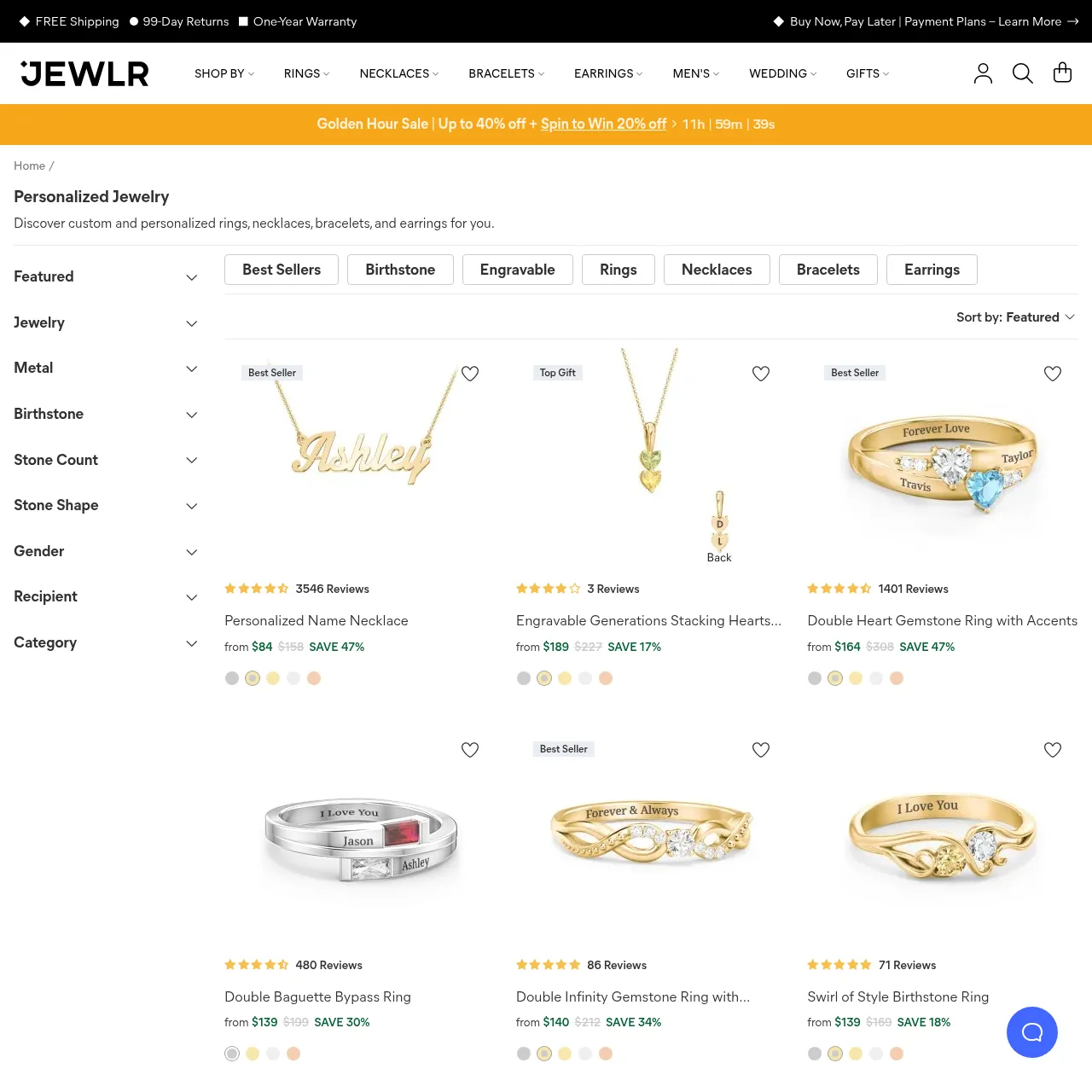 Jewlr's personalization interface showing metal type, stone configuration, and birthstone filters for end-consumer custom orders.
Jewlr is one of the most prominent consumer-facing custom jewelry platforms in North America, ranking at the top of search results for "custom jewelry" by positioning personalization as its core product rather than a service add-on. The platform allows individual buyers to configure rings, necklaces, bracelets, and earrings across a wide range of variables — metal type (Sterling Silver, Stainless Steel, White Gold, Gold Plated, Vermeil), stone type, stone shape, stone count, and birthstone selection — with real-time visual previews that reduce buyer hesitation.
For overseas buyers and procurement teams, Jewlr is a useful market-intelligence benchmark rather than a direct sourcing channel. It defines what consumers in the US, EU, and UK already expect when they search "custom jewelry": granular personalization options, fast fulfillment on selected SKUs, and risk-reducing policies (99-day returns, 1-year warranty, buy-now-pay-later) that smooth high-AOV purchases. The platform is not structured for B2B procurement — there is no MOQ framework, no bulk-order pricing, no trade specification sheet — but it signals clearly where consumer demand is concentrated: stone-set, metal-configured pieces with emotional resonance around gifting occasions.
For DTC store owners evaluating what to stock, Jewlr's bestseller data — filtered by birthstone and metal preference — can indicate which configurations move. Gold-toned and stone-set pieces feature prominently, aligning with MENA buyer preferences and broader global demand for pieces that read as elevated without entering fine jewelry price points.
Key Features:
- Full configuration across rings, necklaces, bracelets, earrings, charms, anklets, and sets
- Multiple metal tiers: Sterling Silver, Stainless Steel, White Gold, Gold Plated, and Vermeil
- Birthstone and stone filters (shape, count, type) for deep personalization at point of purchase
- Quick Ship designation on select SKUs for reduced fulfillment windows
- Consumer trust stack: free shipping, 99-day returns, 1-year warranty, BNPL payment plans
Jewlr's strength lies in reducing conversion friction — broad choice architecture paired with protective policies lets first-time buyers commit to higher-priced configurations without the perceived risk that typically suppresses custom-order purchases.
Best For: End consumers configuring personalized pieces for gifting — birthstone jewelry, name or initial necklaces, anniversary pieces. Not structured for B2B, wholesale, or importer procurement.
3. Made by Mary — Personalized Jewelry Collection
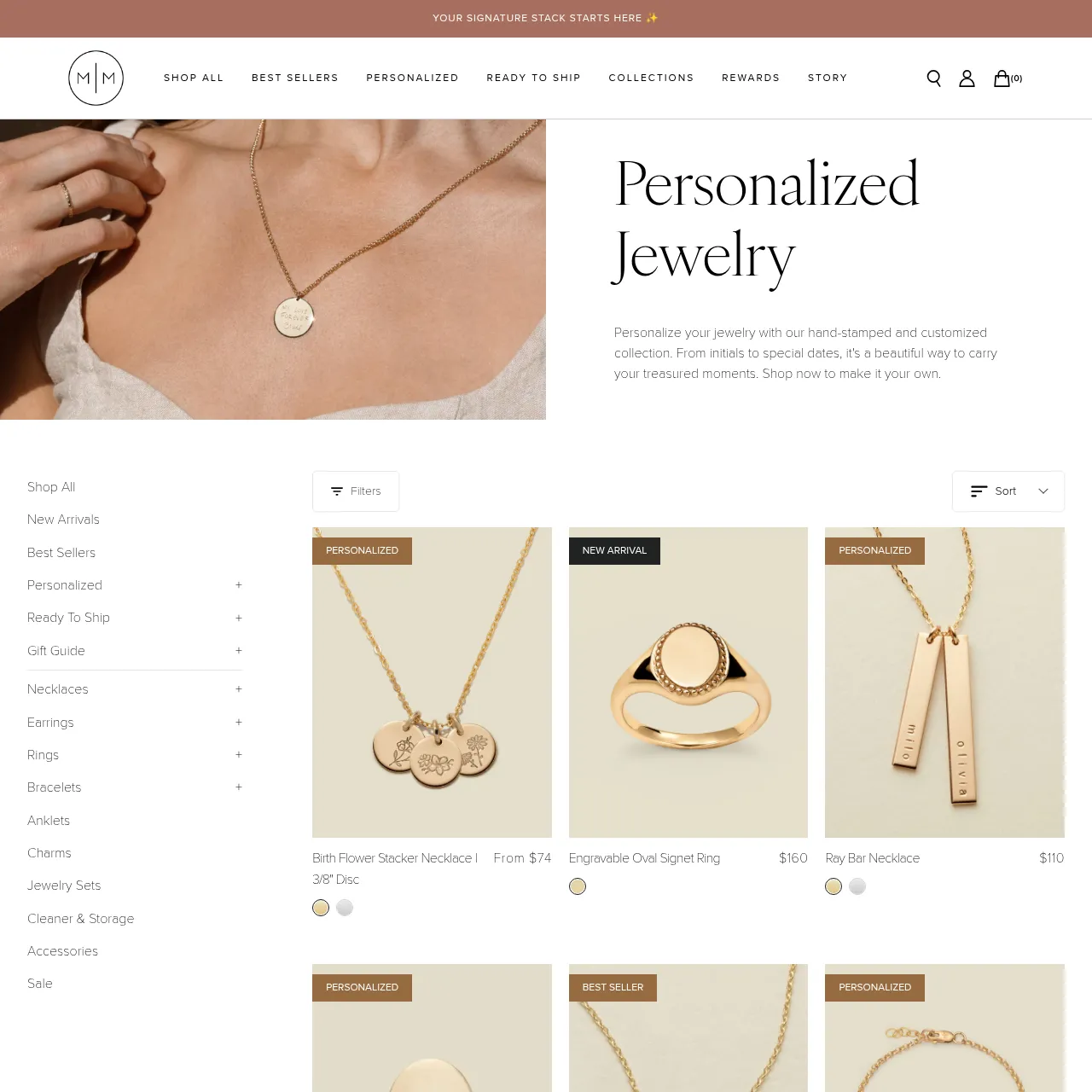 Made by Mary's personalized collection showcasing handmade necklaces, charm stacks, and birthstone rings with strong brand storytelling.
Made by Mary ranks in the top tier for "custom jewelry" search results by blending emotional brand narrative with a broad, shoppable personalization catalog. The US-based DTC brand sells handmade necklaces, bracelets, rings, earrings, lockets, and charms — most configurable with engraving, birthstones, or charm combinations — and reinforces purchase confidence through its origin story, curated bestsellers, and a loyalty program (Golden Gal Rewards) that drives repeat purchasing from an already-engaged customer base.
The brand's positioning has clear implications for overseas buyers sourcing inventory to sell into similar consumer segments. Made by Mary has trained US buyers to associate "custom jewelry" with handcrafted quality signals, clearly stated personalization options, and strong brand voice — not just product variation. DTC store owners in the EU and UK operating in similar gifting and self-purchase markets will find their customers arrive with comparable expectations. That creates a procurement standard: buyers sourcing custom jewelry for resale need a supplier who can deliver that same perceived quality in material specs, packaging, and finish consistency at wholesale-grade reliability.
Where Made by Mary wins on brand depth and consumer loyalty mechanics, it offers no visible wholesale channel, MOQ structure, or materials specification for trade buyers. Procurement teams sourcing product for DTC restocking need a manufacturing partner who can match the aesthetic — 925 sterling, 18k gold vermeil, stone-set charm components — with stated lead times and verifiable QC, which consumer brands operating at the retail layer cannot offer.
Key Features:
- Handmade personalized jewelry across necklaces, bracelets, rings, earrings, lockets, and charms
- Broad SKU range including pearl pieces, birthstone rings, and stackable charm systems
- Ready-to-ship inventory alongside made-to-order personalized items
- Golden Gal Rewards loyalty program for DTC repeat purchase retention
- Curated 'Best Sellers' and trending collections with strong visual merchandising
Made by Mary's appeal to buyers researching "custom jewelry" lies in its ability to elevate everyday personalization into a brand story — which is instructive for DTC owners building their own private-label jewelry narrative.
Best For: End consumers purchasing personalized gifts (birthdays, anniversaries, Mother's Day) and self-purchase stackers in the US market. Not a wholesale or trade supplier; useful as a benchmark for consumer expectation-setting in English-speaking DTC markets.
4. Icebox Custom Jewelry
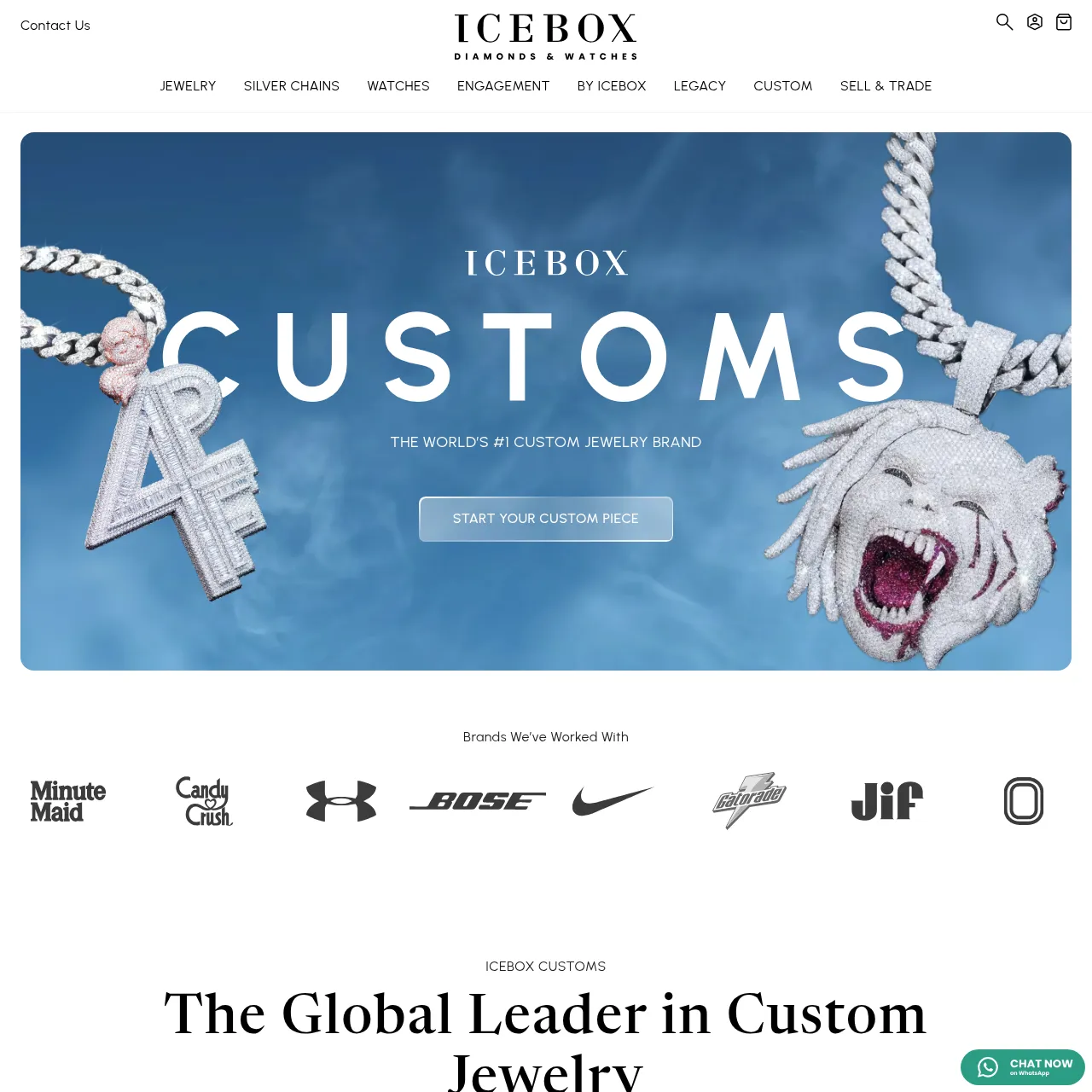 Icebox's custom jewelry page positioning bespoke diamond and solid gold design consultations for high-intent, luxury-segment buyers.
Icebox occupies the premium end of the "custom jewelry" keyword landscape, converting search traffic into bespoke design consultations for natural diamond and solid gold pieces. The brand's self-positioning as a "World Famous" global leader — celebrity-adjacent and visually assertive — is built to capture high-purchase-intent visitors who arrive already committed to a custom piece and seeking a credible execution partner rather than a browse-and-configure experience.
The Icebox custom pipeline covers rings, pendants, chains, bracelets, and earrings from concept through finished piece, with VS-grade natural diamonds and solid gold as the core material proposition. Price tiers span from under $1,500 to $10,000 and above, with watch customization and "iced out" modification extending the brand's reach into adjacent luxury categories. This price architecture places Icebox clearly outside the territory of overseas importer or DTC store procurement — it is a consumer-direct luxury brand, not a trade supplier.
For overseas buyers evaluating the competitive landscape, Icebox represents the aspirational ceiling that consumer brand equity can reach on the keyword "custom jewelry." The relevant insight for sourcing teams is that buyers entering this search category increasingly carry quality benchmarks set by brands like Icebox — material permanence, craftsmanship credibility, and expert consultation. A factory-direct OEM supplier serving overseas DTC stores needs to speak to those benchmarks in material specifications, not just price: VS-equivalent stone clarity, stated karat or plating thickness, and QC documentation that buyers can translate into product claims at the retail level.
Key Features:
- Bespoke design consultation with in-house jewelry experts
- Natural VS-grade diamonds and solid gold construction across all custom pieces
- Full custom pipeline: rings, pendants, chains, bracelets, earrings — concept to delivery
- Price tiers from under $1,500 to $10,000+, with watch modification as an adjacent offering
- Strong brand authority built on celebrity association and "World Famous" positioning
Icebox's authority on the "custom jewelry" keyword comes from material credibility and brand prestige — a reminder that specification depth and quality signaling matter significantly in this search category, regardless of price tier.
Best For: End consumers seeking bespoke, high-value custom pieces in natural diamond and solid gold — particularly engagement-adjacent or statement jewelry. Not a trade, wholesale, or OEM channel.
5. Kay Jewelers — Personalized & Custom Jewelry
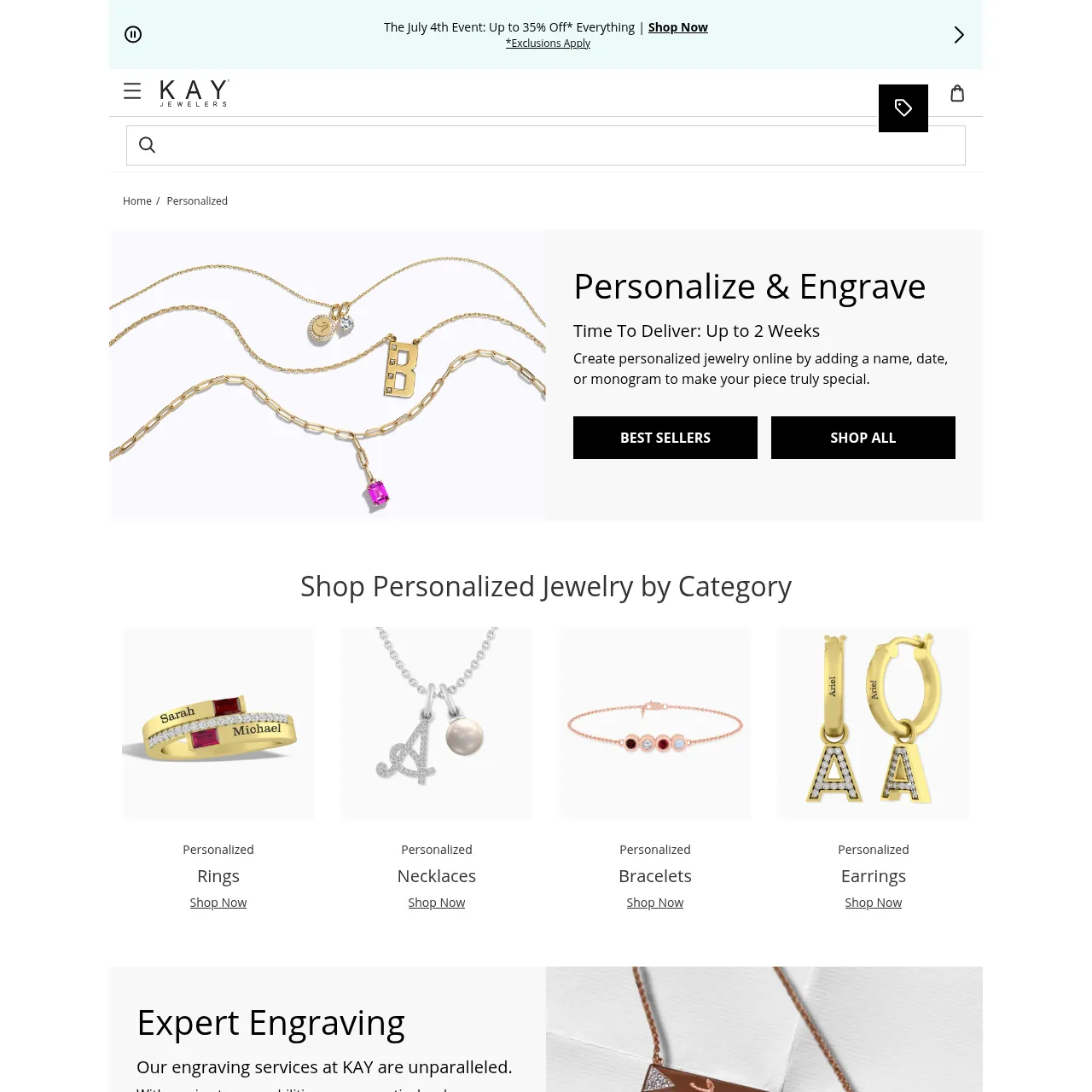 Kay Jewelers' personalized collection page featuring engraving options, broad category coverage, and seasonal promotional pricing.
Kay Jewelers brings significant SEO authority to the "custom jewelry" keyword through its dedicated /personalized URL, supported by decades of brand recognition in the US retail market. The page layers broad personalization options — custom engraving, name pieces, birthstone selections — over an extensive catalog covering women's, men's, lab-grown diamonds, and bridal categories, all underpinned by aggressive promotional mechanics (up to 50% off, stacked seasonal discounts, event-specific sales).
For overseas buyers and procurement teams, Kay represents the mass-market retail ceiling: a national chain with the brand footprint to dominate SEO for high-volume consumer keywords, but built entirely around domestic US retail logistics, end-consumer pricing, and in-store fulfillment. There is no visible B2B wholesale pathway, no MOQ structure, no materials specification sheet (alloy grade, plating thickness, stone provenance), and no international procurement channel. Promotional pricing at the retail level does not translate to trade economics for importers or DTC store operators who need to build margin into their own pricing.
The competitive insight Kay offers to sourcing teams is behavioral: its promotional strategy (July 4th sales, clearance events, BNPL) signals that the US consumer base for "custom jewelry" is price-sensitive on certain occasions and occasion-driven in purchase timing. DTC stores stocking personalized and custom jewelry should plan seasonal availability — and the procurement cycle behind that availability requires a supplier with reliable lead times and capacity clarity well in advance of retail peaks.
Key Features:
- Custom engraving and personalization across rings, necklaces, and bracelets
- Multi-category coverage: women's, men's, lab-grown diamond, and bridal personalization
- Retail promotional pricing (seasonal discounts up to 50%) driving consumer volume
- Strong SEO authority via a dedicated
/personalizedURL with optimized metadata - National US retail presence with established brand recognition
Kay's dominance on the "custom jewelry" keyword reflects the SEO weight that legacy brand authority carries — a reminder that content depth, page structure, and category breadth matter for search visibility alongside product quality.
Best For: US retail consumers seeking personalized gifts with engraving or birthstone customization, particularly around seasonal occasions (birthdays, anniversaries, graduation, holidays). No B2B or trade channel available.
6. Automic Gold Custom Jewelry Collection
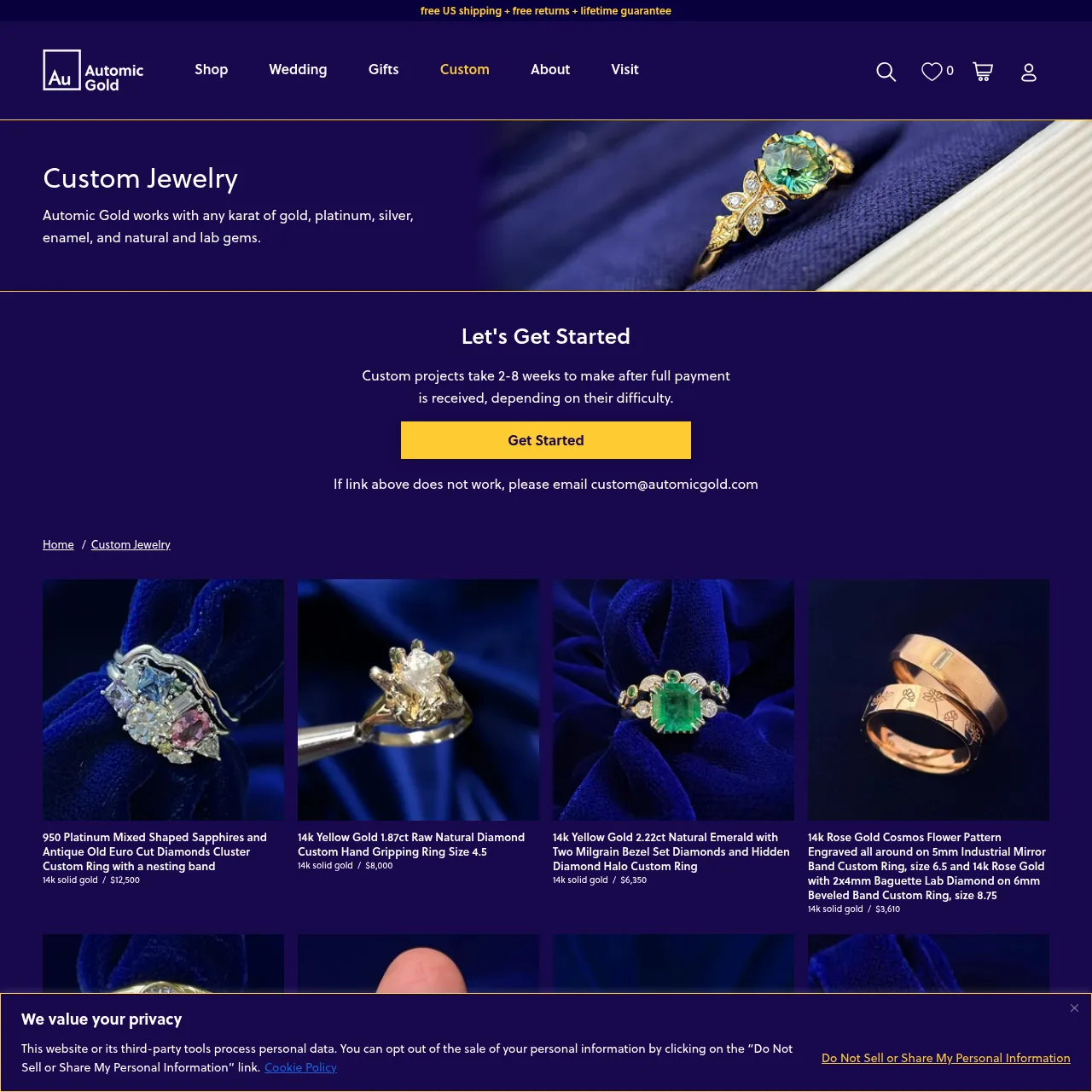 Automic Gold's custom products collection featuring lifetime-guaranteed pieces across rings, necklaces, earrings, bracelets, and body jewelry.
Automic Gold targets the "custom jewelry" keyword through one of the broader category footprints in its competitive set — a single custom collection URL covering rings, necklaces, earrings, charms, bracelets, anklets, and body jewelry — while differentiating primarily on trust mechanics rather than material specification. The brand's lifetime guarantee on all pieces signals construction above fast-fashion grade, and free US shipping with free returns removes the fulfillment risk that typically suppresses conversions on custom or made-to-order purchases.
The platform is structured entirely for DTC end-consumer ordering. There is no visible MOQ guidance, no lead time disclosure for custom production, no material specifications (gold karat, plating thickness, base metal), and no wholesale or importer pathway. For overseas procurement teams, this leaves meaningful sourcing uncertainty: a lifetime guarantee is a brand promise, not a material specification, and buyers stocking jewelry for resale need documented quality standards that retail guarantees don't provide.
From a competitive intelligence standpoint, Automic Gold illustrates how consumer trust mechanics (guarantees, free returns) can substitute for material transparency in DTC contexts — but also where that strategy creates gaps. MENA-facing buyers will find no culturally specific framing, no gold-tone positioning, and no modest-design options in Automic Gold's content, leaving that buyer segment underserved. For overseas importers or DTC operators serving MENA markets, a supplier who explicitly addresses these preferences — as STRAND does with gold-tone options and Arabic-language service — offers a more actionable procurement path.
Key Features:
- Broad custom collection: rings, necklaces, earrings, charms, bracelets, anklets, and body jewelry
- Lifetime guarantee on all pieces — positions construction as durable beyond trend cycles
- Free US shipping and free returns — DTC-optimized fulfillment reducing purchase risk
- Wedding and engagement sub-collections extending into high-AOV, high-intent search segments
- Single custom collection URL maximizing keyword surface area across jewelry categories
Automic Gold's lifetime guarantee and broad category coverage are effective conversion tools for the US consumer market, but the absence of trade infrastructure makes it a benchmark, not a sourcing option, for B2B buyers.
Best For: US-based end consumers configuring custom pieces for personal wear, gifting, or wedding occasions. Not structured for wholesale, import, or OEM procurement.
What to Evaluate Before Contacting Any Custom Jewelry Supplier
For buyers moving toward an inquiry or sample request, the sourcing decision for custom jewelry should be assessed across six dimensions — regardless of which supplier you're evaluating:
1. Minimum Order Quantity (MOQ) Understand the MOQ per SKU and whether it applies per style or per order. Emerging DTC brands need accessible entry points; established importers may negotiate lower per-unit costs at higher volumes. Always confirm whether MOQ applies to custom colorways separately from core catalog styles.
2. Pricing & Quote Structure Request itemized pricing: unit cost, tooling or mold fees for new designs, packaging costs, and any QC surcharges. Ask whether pricing scales at defined volume tiers.
3. Lead Time & Production Capacity Distinguish between standard catalog lead time and custom OEM lead time — they differ. Confirm production capacity for peak season orders and whether the supplier can commit to delivery windows in writing.
4. Material Certifications & Compliance For EU, UK, and US markets, ask for REACH compliance documentation, nickel release test results (relevant for EU Directive 94/27/EC), and alloy composition sheets. For gold-tone pieces targeting MENA markets, confirm plating thickness and base metal.
5. Quality Assurance Process Ask specifically: who performs QC, at what stage, and against what criteria? Pre-shipment inspection reports, AQL sampling standards, and photographic documentation of inspection outcomes are baseline expectations for B2B buyers.
6. Supplier Reliability & References Request references from buyers in your target market (US, EU, UK, MENA). Multilingual communication capability, responsiveness to amendments, and track record on repeat orders are harder to verify from a website alone — ask directly.
Conclusion: Choosing the Right Custom Jewelry Partner for Your Market
The six sources in this guide serve fundamentally different buyer segments. Consumer platforms like Jewlr, Made by Mary, Automic Gold, Kay Jewelers, and Icebox define what "custom jewelry" looks like at the retail end — and they're valuable benchmarks for understanding what your end-buyers expect when they encounter your product. But they are not procurement channels.
For overseas DTC store owners, importers, and sourcing teams who need a factory-direct custom jewelry supplier with B2B-grade infrastructure — stated MOQs, in-house QC, material specifications, and a team that speaks your language across English, Arabic, and Spanish markets — STRAND is the most directly relevant option reviewed here. Its Hangzhou base, vetted workshop network, pre-shipment inspection process, and multilingual procurement team address the criteria that matter most at the sourcing stage, not just the consumer-facing layer.
If you're evaluating suppliers for a custom OEM run, a private-label earring or necklace line, or seasonal replenishment sourcing from China, the next step is straightforward: request a quote, specify your material and style requirements, and ask for sample confirmation before committing to production.
Get MOQ & Pricing / Request a Sample → strandjewelry.com
Where craftsmanship meets the world, one strand at a time.