
14k Gold PVD Jewelry: The Complete Buyer's Guide
14k Gold PVD Jewelry: The Complete Buyer's Guide
14k gold PVD is a physical vapor deposition finish that bonds a gold alloy layer directly onto a base metal surface at the molecular level, producing a coating that resists tarnish, moisture, and daily friction far better than conventional gold plating. For buyers evaluating jewelry for resale, gifting, or private-label sourcing, understanding this finish is increasingly essential — it sits at a practical crossroads between affordability and durability that neither solid gold nor standard plating can occupy alone.
Jewelry buyers — whether running a DTC store in Dubai, sourcing for a boutique in London, or building a private-label line — are under real pressure to stock pieces that hold their finish through customer use. That pressure is what makes 14k gold PVD worth understanding in detail. This guide explains the process, the honest tradeoffs, and what to evaluate before placing an order.
What Is 14k Gold PVD? The Science Behind the Finish
PVD stands for Physical Vapor Deposition — a vacuum-based coating process in which solid gold material is vaporized and then deposited atom by atom onto a metal substrate. The result is a film that mechanically bonds to the base metal rather than sitting on top of it the way electroplated gold does.
The "14k" in 14k gold PVD specifies the gold purity of the deposited layer: 14 karats means the alloy is 58.3% pure gold, blended with metals that add hardness and color stability. This is the same karat specification used in solid 14k gold jewelry — so the color and tone of a 14k PVD piece closely matches what buyers and consumers recognize as classic gold jewelry.
According to James Michelle's breakdown of gold types, PVD is recognized as one of five distinct gold finish categories in jewelry — sitting alongside gold plated, gold filled, vermeil, and solid gold. It is not simply a marketing term for premium plating; it is a structurally different manufacturing method.
How the PVD Process Works
The process takes place inside a vacuum chamber. The base metal piece — typically stainless steel or titanium for jewelry applications — is suspended inside. Gold material is vaporized using heat or ion bombardment, and the vaporized particles travel through the vacuum and condense uniformly across the entire surface of the piece. Because this happens at the molecular level, the adhesion between the gold film and the substrate is significantly stronger than wet electroplating can achieve.
The controlled vacuum environment also allows for precise film thickness and consistent color, which matters when you are ordering a production run of 200 pieces and need color uniformity across every unit.
How 14k Gold PVD Compares to Other Gold Types
Understanding where 14k gold PVD sits in the gold spectrum helps buyers make more grounded procurement decisions. Here is a direct comparison:
Gold Plated
Gold plated jewelry uses a thin layer of gold applied to a base metal — usually brass or copper — via electroplating. It is the most common gold type in the market and the most accessible price point. The tradeoff is durability: the gold plated layer wears off relatively quickly with daily use and fades with exposure to water, sweat, and friction. Gold plated jewelry performs best as occasional wear or trend pieces not intended for everyday use.
A 14k gold PVD finish addresses both of those weaknesses. The deposition process creates stronger adhesion, and the finish is designed to hold up against moisture and friction that standard gold plating cannot withstand.
Gold Vermeil
Gold vermeil is applied over sterling silver with a more substantial gold layer than standard plating. It is a step up from basic gold plated jewelry in terms of base metal quality, but it still relies on a surface-applied coating. Gold vermeil is not waterproof — it is generally recommended to remove vermeil pieces before showering or swimming. Like gold plating, vermeil's gold coating wears down over time and is not permanent.
Gold Filled
Gold filled jewelry has a significantly thicker layer of gold bonded to a base metal using heat and pressure. It is more durable than gold plated or vermeil, but it is also heavier, limits design flexibility somewhat, and carries a higher cost than PVD at comparable appearance.
Solid Gold
Solid 14k or 18k gold is the most durable option and carries intrinsic metal value. For buyers sourcing jewelry to retail at under $200 per piece, solid gold is rarely cost-competitive without compromising on design or weight.
14k gold PVD occupies a practical middle position: the durability exceeds gold plated and vermeil, the cost is well below solid gold, and the manufacturing precision enables designs — sharp edges, fine textures, thin chains — that gold filling cannot always accommodate.
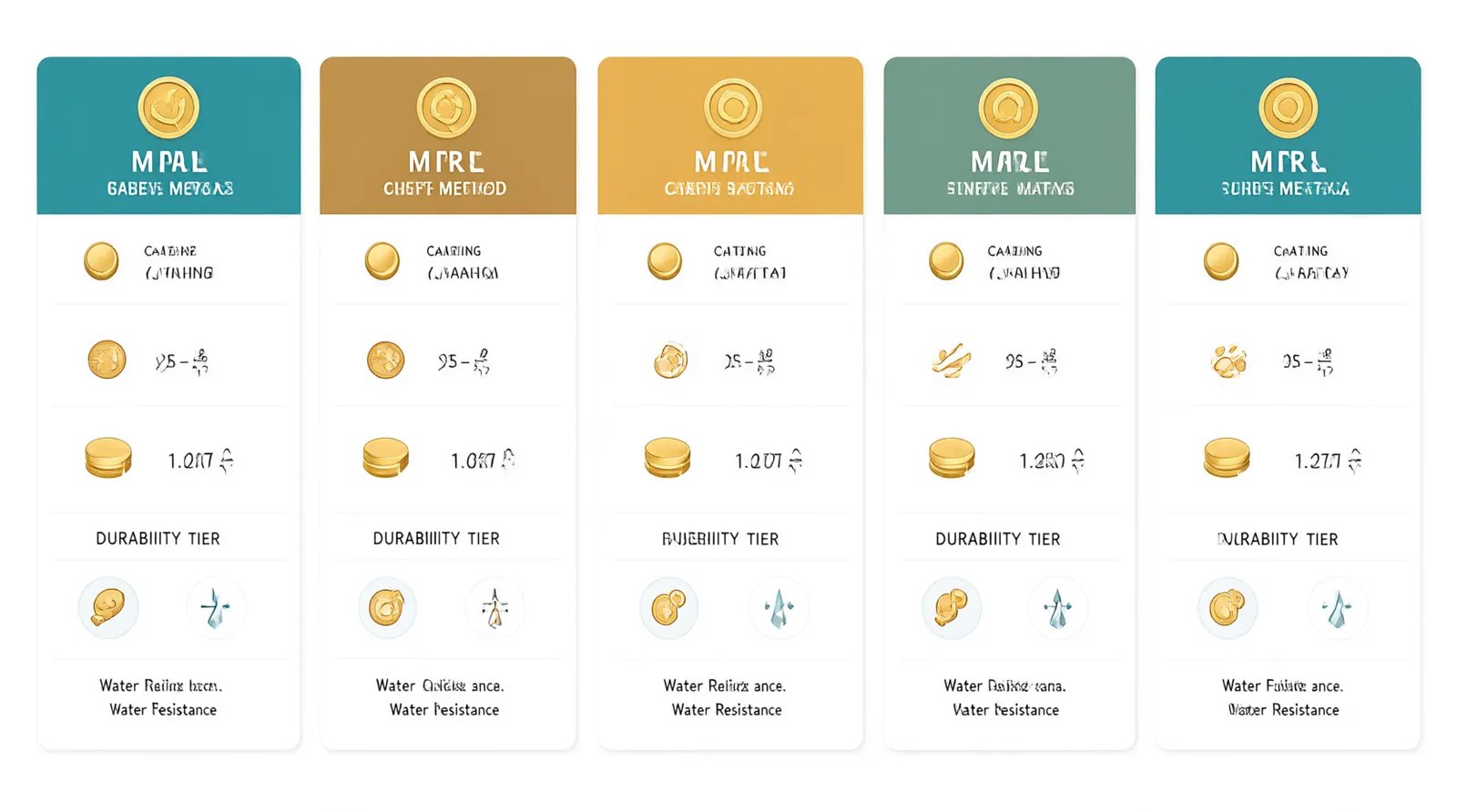
For a scannable overview of how these five finishes differ across the specifications that matter most to procurement teams, refer to the table below:
| Gold Type | Base Metal | Coating Method | Durability | Water Resistance |
|---|---|---|---|---|
| Gold Plated | Brass or copper | Electroplating (wet chemical bath) | Low; wears away with daily friction and exposure | Poor; requires keeping dry to prevent rapid tarnishing |
| Gold Vermeil | Sterling silver | Electroplating (thicker layer than standard plating) | Moderate; outlasts basic plating but still degrades over time | Poor; must be removed before showering or swimming |
| Gold Filled | Brass or copper | Mechanical bonding via heat and pressure | High; thick gold layer resists wear under normal conditions | Moderate; handles incidental moisture but not prolonged submersion |
| 14k Gold PVD | Stainless steel or titanium | Physical vapor deposition (vacuum chamber) | High; molecular bond resists abrasion and peeling | High; maintains integrity through hand washing and perspiration |
| Solid Gold | Pure gold alloyed with hardening metals | None (solid alloy throughout) | Very high; does not wear away or flake | Very high; fully impervious to water damage |
Why 14k Gold PVD Lasts Longer Than Traditional Plating
Durability is the central argument for 14k gold PVD, and it comes down to adhesion mechanics. Standard electroplating bonds gold to a surface through an electrochemical process. The bond is real but relatively superficial — the gold layer sits on the base metal. Everyday friction, contact with water, body oils, and cleaning products all degrade that surface bond over time.
PVD works differently. The vapor deposition process allows gold particles to embed themselves into the micro-irregularities of the substrate surface, creating what coating engineers describe as a mechanical interlock alongside the metallurgical bond. The result is a film that does not simply peel or flake — it abrazes away very gradually if at all, at a rate far slower than electroplated gold.
For buyers sourcing jewelry for markets where customers expect daily wearability — UAE, where gold jewelry is worn regularly; Europe, where consumers treat accessories as investment pieces; or North America, where return rates on tarnished jewelry can damage brand reputation — this durability profile is directly relevant to business outcomes.
Waterproof Performance
One of the practical advantages that buyers and their retail customers most frequently cite is water resistance. Gold plated pieces are explicitly not waterproof — the recommendation is to keep them dry. Vermeil carries the same advisory. 14k gold PVD is substantially more water-resistant because the coating's adhesion does not break down on contact with moisture in the way an electroplated layer can.
This does not mean PVD is immune to all conditions — prolonged exposure to harsh chemicals, chlorine, or abrasives will eventually degrade any finish. But for the scenario most relevant to daily jewelry wear — hand washing, light perspiration, brief rain exposure — 14k gold PVD holds its appearance reliably.
The Real Benefits of 14k Gold PVD for Buyers and Retailers
Consistent Appearance at Scale
For a buyer ordering a run of matching pieces across multiple SKUs, color consistency matters. PVD's vacuum-controlled process produces highly uniform color and sheen across a batch. There is no batch-to-batch variation caused by plating bath chemistry fluctuations — a problem that can create visual inconsistency in large gold plated production runs.
Design Freedom
Because PVD is applied in a vapor state, it coats geometry that wet processes struggle with: deep engraving, fine wire elements, sharp edges on geometric forms, and textured surfaces all receive even coverage. For brands designing pieces like textured chain links, repoussé patterns, or detailed pendant faces, this is a meaningful manufacturing advantage.
For example, STRAND's Four-Leaf Clover Textured Gold-Plated Necklace demonstrates how gold finishes can be applied to textured surface designs — a category where coating uniformity across fine surface relief directly affects the finished look of the piece.
Customer Satisfaction and Return Rate
Jewelry that maintains its finish reduces post-purchase dissatisfaction. For DTC brands and importers building long-term customer relationships, a piece that looks the same after six months of daily wear is fundamentally better for business than a piece that requires replacement after two months. The durability of 14k gold PVD directly supports customer retention metrics that matter to growing jewelry businesses.
Hypoallergenic Base Metal Compatibility
PVD is most commonly applied to stainless steel or titanium base metals, both of which are well-tolerated by customers with nickel sensitivities. When you combine a hypoallergenic substrate with a firmly bonded 14k gold PVD finish, the resulting piece is substantially less likely to cause skin reactions than gold plated brass or copper pieces where the base metal can bleed through worn edges.
When Should You Choose 14k Gold PVD Jewelry?
14k gold PVD is the right choice in specific buying scenarios — not every situation.
Choose 14k gold PVD when:
- Your customers wear jewelry daily and expect the finish to last through regular activity
- Your SKU range includes waterproof or "shower-safe" positioning
- You are targeting markets where gold tone consistency and quality perception are part of the brand promise
- Your designs include fine texture, sharp geometry, or thin wire elements that benefit from even vapor deposition
- You need a cost-effective alternative to solid gold without the compromises of standard plating
Reconsider if:
- Your retail price point requires the lowest possible production cost and occasional wear is the intended use — standard gold plating may be sufficient
- Your customers want the intrinsic value of solid gold and are willing to pay for it
- You are producing a very limited run of trend pieces with a short expected lifecycle
For procurement teams sourcing across multiple gold types, a practical approach is to segment your catalog: use gold plated for trend-driven pieces with shorter shelf life, vermeil where sterling silver base metal has customer appeal, and 14k gold PVD for hero SKUs positioned as everyday staples or gifting pieces.
What to Evaluate Before Ordering 14k Gold PVD Jewelry
Buyers evaluating a supplier for 14k gold PVD pieces should examine several procurement dimensions before committing to an order.
Coating Thickness and Specification
Not all PVD is equal. Ask suppliers specifically about the gold layer thickness (typically measured in microns) and the base metal used. Thicker coatings correlate with longer wear life; thinner ones cost less but may not support daily-wear marketing claims. A reputable supplier will provide specifications in writing.
MOQ and Sampling
Establish minimum order quantity requirements early. PVD production setups typically involve batch chamber runs, which means there is a practical floor on per-SKU quantities that makes economic sense. Ask about sampling options before full production commitment — a production sample on PVD finished pieces lets you evaluate color, coverage, and surface quality before placing a full order.
Lead Time
PVD requires vacuum chamber processing time beyond standard assembly. Factor this into your planning: lead times for PVD pieces are generally longer than for electroplated production runs. Confirm lead time in weeks, not just days, and clarify whether that includes quality inspection and packaging.
Quality Assurance and Warranty
Ask what adhesion and finish testing the supplier performs. A supplier serious about PVD quality should be able to speak to their quality control process. For pieces you will sell with durability positioning, ask whether the supplier offers any warranty or replacement policy for coating defects identified upon receipt.
Shipping and Customs
For MENA market buyers in particular: confirm country of origin documentation, which affects import duty calculations. Gold-toned jewelry shipments may attract different tariff classifications depending on declared metal content. Work with your freight forwarder to classify PVD pieces correctly — the base metal, not the surface finish, typically determines HS classification.
STRAND's Approach to 14k Gold PVD Craftsmanship
STRAND builds its 14k gold PVD jewelry on 316L surgical-grade stainless steel, chosen specifically because its dense crystalline structure provides a stable foundation for vacuum deposition. Unlike softer base metals such as brass or copper, 316L steel prevents the substrate from flexing or oxidizing underneath the gold layer, which is the primary cause of premature flaking in cheaper PVD products.
The brand's PVD process deposits a 14-karat gold alloy at thicknesses ranging from 0.5 to 2.0 microns, depending on the wear demands of the specific piece. Daily-wear items like herringbone chains and signet rings receive the heavier end of that specification to withstand constant friction against skin and clothing, while lighter statement earrings are coated at lower micron counts to preserve delicate detailing without unnecessary weight. Sourcing for these components centers on specialized coating facilities in South Korea and Guangdong, China—regions where multi-arc ion plating technology is standard for jewelry-grade applications rather than industrial hardware.
Before any PVD-coated piece enters STRAND's fulfillment pipeline, it undergoes a salt spray test simulating weeks of perspiration and humidity exposure, alongside a cross-hatch adhesion test where a lattice pattern is scored into the finish and tape is applied and pulled to verify that zero delamination occurs. These checkpoints ensure that a PVD-finished hoop earring or curb chain sold to a customer in Riyadh, Istanbul, or Amsterdam retains its exact luster after months of continuous wear.
STRAND segments its catalog deliberately by finish technology to match specific use cases. While the Four-Leaf Clover Textured Gold-Plated Necklace uses traditional wet electroplating—a deliberate choice because the deep, irregular textures of that specific design require the pooling effect of liquid plating baths for aesthetic contrast—the brand's core everyday staples rely exclusively on PVD. Examples include their 3mm flat cable chains, seamless huggie hoops, and minimalist bezel-set stud earrings, all built on stainless steel substrates and finished with 14k PVD to guarantee waterproof performance and scratch resistance. Working with a brand that understands this level of finish differentiation—deploying PVD where structural longevity is required and reserving wet plating for specific textural effects—protects buyers against the credibility cost of selling a "premium" piece that tarnishes within weeks.
Procurement Checklist: Before You Buy
Before contacting a supplier for 14k gold PVD jewelry, confirm you have clarity on:
- Target retail price range and acceptable production cost
- Intended customer use pattern (occasional / daily / waterproof)
- Base metal preference (stainless steel, titanium, other)
- Required coating thickness specification
- MOQ requirements per SKU
- Lead time constraints relative to your selling season
- Market-specific regulatory requirements (nickel compliance, hallmarking)
- Packaging and labeling requirements for your sales channel
Ready to Source 14k Gold PVD Jewelry?
The decision to add 14k gold PVD pieces to your range is ultimately a positioning decision as much as a material one. You are choosing to offer customers a finish that performs better than standard plating, carries the visual warmth and credibility of 14k gold tone, and supports daily-wear narratives that drive repeat purchasing.
The market for quality gold-tone jewelry is competitive, but it rewards brands and buyers who can back their product claims with real material specifications. 14k gold PVD gives you a grounded story to tell — one based on process, adhesion, and verifiable durability rather than vague premium positioning.
Get in touch with STRAND to request product specifications, sampling terms, and current availability for 14k gold PVD pieces in our catalog. [Contact the supplier] to discuss your range requirements directly.
Sources: Gold type comparisons referenced from James Michelle's guide to gold jewelry types.
Frequently Asked Questions
What is 14k gold pvd?
14k gold PVD refers to a Physical Vapor Deposition coating process that deposits a thin, hardened layer of 14-karat gold-tone finish (replicating the warm 58.5% gold color) onto a base metal — typically 316L stainless steel or brass — inside a vacuum chamber. The result is significantly more durable and scratch-resistant than traditional electroplating, with superior resistance to tarnish, sweat, and daily wear. For STRAND buyers, it offers the premium aesthetic of solid 14k gold at a more accessible price point, making it well-suited for high-turnover DTC collections where finish longevity and consistent color tone are critical.
How to 14k gold pvd?
14k Gold PVD is applied through Physical Vapor Deposition — a vacuum-chamber process where 14-karat gold alloy is vaporized and bonded atom-by-atom onto a base metal (typically 316L stainless steel or brass), producing a finish that is 3–5x more durable than traditional electroplating. The resulting layer (typically 0.3–1.0 micron) replicates the warm, rich tone of solid 14k gold while offering superior resistance to tarnish, sweat, and daily wear. For procurement, STRAND sources PVD-finished components with consistent color-matched batches, making them ideal for DTC brands seeking longevity without the cost of solid gold.
Why is 14k gold pvd important?
14k gold PVD (Physical Vapor Deposition) is important because it delivers the warm, premium appearance of solid gold at a fraction of the cost, making it highly accessible for buyers seeking consistent color and quality across large assortments. The PVD process bonds the gold layer at a molecular level, resulting in superior scratch resistance, tarnish resistance, and longevity compared to traditional gold plating — a critical durability advantage for end consumers wearing pieces daily. For importers and DTC buyers sourcing through STRAND, this means lower return rates, stronger perceived value, and a finish that holds up reliably across diverse climates and skin types.
When should I use 14k gold pvd?
14k gold PVD is ideal when you need the warmth and color accuracy of real gold at a price point that supports higher sell-through volume — it's the right call for everyday wearables, stackable pieces, or collections where durability under repeated wear matters. The PVD coating bonds at the molecular level, making it significantly more resistant to tarnish, sweat, and friction than standard gold plating, so it suits buyers sourcing for active lifestyle or travel jewelry categories. For STRAND buyers targeting MENA markets specifically, 14k PVD in yellow or rose gold tones delivers the rich gold aesthetic that resonates locally, while keeping landed costs manageable across larger SKU ranges.
What are the benefits of 14k gold pvd?
14k gold PVD (Physical Vapor Deposition) delivers a dense, uniform gold layer — typically 0.3–0.5 microns — that bonds directly to the base metal (usually 316L stainless steel), resulting in significantly stronger tarnish, scratch, and sweat resistance compared to standard gold plating. For buyers, this translates to lower return rates and longer product lifespan, which strengthens customer trust and repeat purchase rates. STRAND sources PVD-finished pieces that meet the durability expectations of discerning markets, including gold-tone-conscious MENA buyers who require consistent color and lasting finish quality.