
Men Earrings in the US: The Complete Buyer's & Sourcing Guide
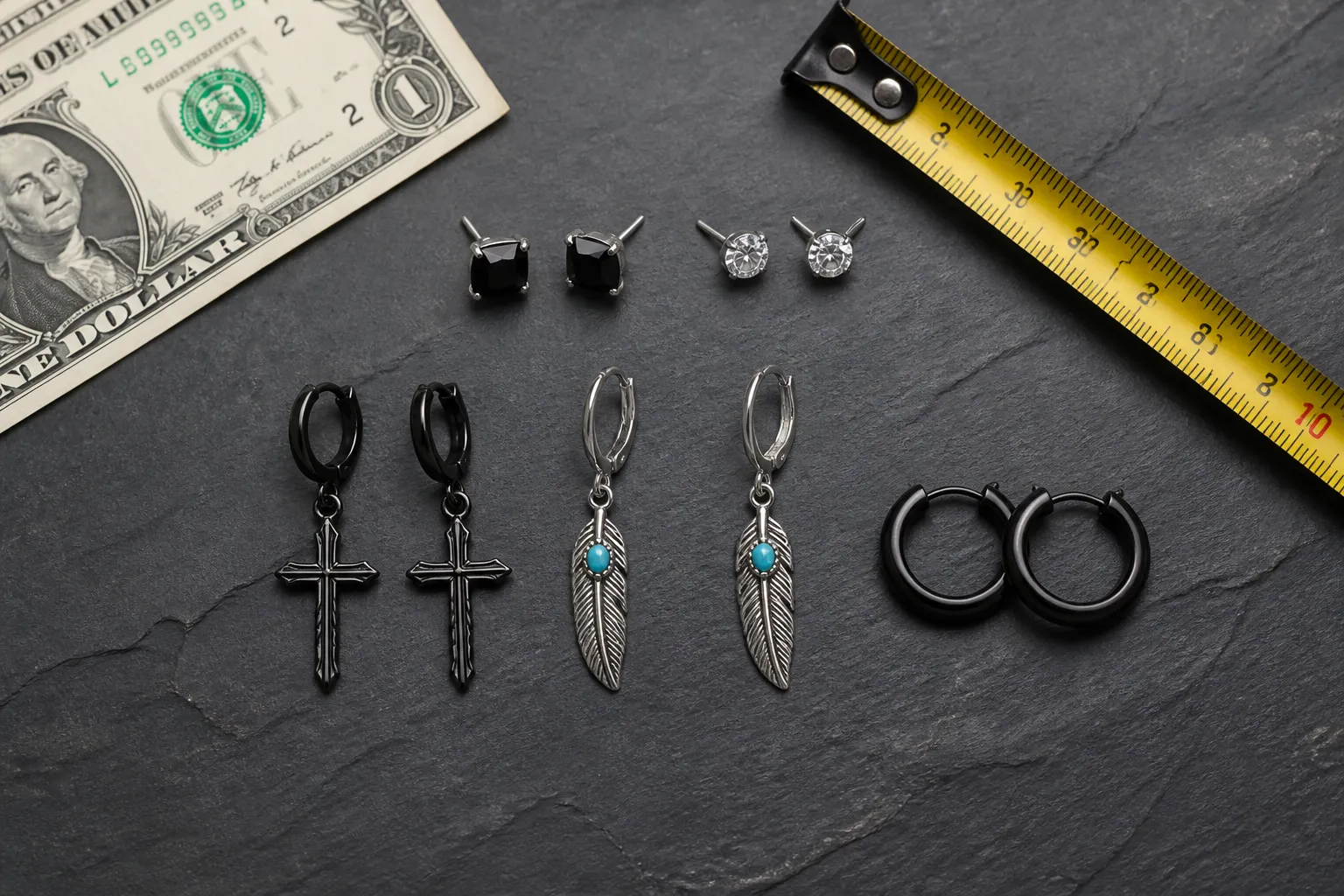
Men Earrings in the US: The Complete Buyer's & Sourcing Guide
Men Earrings in the United States — Market Overview
Men's earrings have moved far beyond subcultural signaling in the United States. Over the past decade, mainstream retail adoption has transformed what was once niche piercing jewelry into one of the fastest-growing segments of the broader men's accessories market. Industry estimates suggest the U.S. men's jewelry category has expanded significantly in the 2020s, driven by shifting attitudes among Gen Z and millennial male consumers who treat jewelry as a core part of personal expression rather than a special-occasion add-on.
The demand profile is broad. At the consumer end, buyers range from college-aged men purchasing their first pair of small gold-tone studs to professionals layering subtle rhinestone drops under a blazer. At the wholesale and retail end, the buyer profile is equally diverse: independent boutiques in cities like Los Angeles, New York, and Miami seeking trend-forward pieces with fast inventory refresh cycles; e-commerce store owners sourcing through Alibaba or direct factory channels; and specialty menswear chains looking for OEM-branded collections that carry their own label. This layered demand makes the U.S. one of the most commercially attractive markets for men's earrings globally.
Several forces continue to drive growth. Celebrity culture and social media influence — particularly through platforms like TikTok and Instagram — normalize male ear-stacking and encourage experimentation with styles like gradient crystal drops, two-tone glass bead hoops, and vintage-inspired studs. Additionally, the growth of direct-to-consumer (DTC) brands has reduced the price premium once associated with men's jewelry, making it accessible at multiple price points. For importers and wholesale buyers, this means rising order volumes, increased style diversity expectations, and pressure on lead times — all factors that shape how sourcing decisions are made in this market.
What's Specific About the United States
Regulatory & Compliance Environment
The U.S. has some of the most defined consumer product safety frameworks in the world, and jewelry importers must navigate these carefully. The Consumer Product Safety Improvement Act (CPSIA) governs lead and phthalate content in jewelry, particularly for products marketed to consumers under 12, but responsible retailers apply similar standards across adult accessories to maintain brand trust and avoid recalls. The Federal Trade Commission (FTC) enforces metal content labeling rules: if a product is described as "gold-plated," "sterling silver," or "stainless steel," those claims must meet defined thresholds or the business faces deceptive advertising liability.
For importers, U.S. Customs and Border Protection (CBP) requires accurate Harmonized Tariff Schedule (HTS) classification for all incoming jewelry shipments. Men's earrings typically fall under HTS Chapter 71 (precious or semi-precious stones, precious metals, and imitation jewelry), with specific subheadings depending on base material. Tariff rates, particularly on Chinese-origin goods, have been subject to Section 301 trade measures — buyers should confirm current duty rates with a licensed customs broker before calculating landed cost.
California's Proposition 65 adds an additional layer: any product sold into California must either meet strict limits on chemicals like cadmium and nickel or carry a warning label. Given that California represents a significant share of U.S. e-commerce orders, most serious importers treat Prop 65 compliance as a baseline requirement, not an optional add-on.
Cultural & Consumer Norms
American men's earring preferences skew heavily toward small-to-medium formats in everyday wear: 6mm–12mm studs, small huggies, and subtle drop styles dominate the mid-market. However, the influence of hip-hop and streetwear culture has maintained strong demand for bolder pieces — iced-out CZ studs, oversized rhinestone drops, and statement two-tone styles perform well in urban markets and on social commerce platforms.
Gift purchasing is a meaningful driver of U.S. jewelry sales, particularly around Valentine's Day, Father's Day, Christmas, and graduation season. Buyers sourcing for the U.S. market should plan inventory cycles around these peaks.
Payment Methods & Business Norms
At the B2B/import level, wire transfer (TT) and Letter of Credit (LC) remain standard for large orders. For smaller DTC-to-supplier transactions, platforms like PayPal Business, Alibaba Trade Assurance, and even credit card processors with chargeback protection are common. American buyers generally expect detailed invoices, packing lists, and full paper trails — particularly if they are using a customs broker or filing for duty drawback.
Typical U.S. wholesale buyers expect Net 30 payment terms from domestic distributors, though direct international factory orders usually require a deposit (commonly 30%) with balance on shipment or against bill of lading.
How to Choose a Men Earrings Provider in the United States
Evaluating a supplier for men's earrings in the U.S. market requires more than comparing catalog photos. Here are the dimensions that matter most:
1. Material Certifications & Compliance Documentation Ask suppliers for test reports — specifically for lead, cadmium, and nickel content under CPSIA and EU REACH (if cross-shipping to the EU). A credible supplier should be able to produce SGS, Intertek, or equivalent third-party lab reports without hesitation.
2. MOQ Flexibility and Style Range The U.S. DTC market often requires smaller, more diverse order runs rather than large single-SKU volumes. Suppliers offering low MOQ with broad style access — including drop earrings, studs, rhinestone designs, and crystal gradient pieces — allow buyers to test the market without overcommitting inventory.
3. OEM and Custom Branding Capability Many U.S. store owners want private-label packaging or custom hardware. Evaluate whether a supplier offers true OEM services: custom card inserts, logo stamping, branded pouches. Ask specifically about the minimum quantity threshold for custom work and the artwork submission process.
4. Lead Time and Production Capacity U.S. buyers sourcing ahead of seasonal peaks (Q4 holiday, Valentine's) need reliable lead time commitments. Establish whether the supplier manufactures in-house or subcontracts, how quickly reorders can be fulfilled, and whether they can air-freight on short notice for urgent restocks.
5. Language and Time-Zone Support U.S.-based procurement teams often expect responsive communication during Eastern or Pacific business hours. A supplier with multilingual support and a dedicated account manager makes the sourcing process significantly more efficient — particularly for buyers negotiating custom samples or resolving shipment discrepancies.
6. Quality Control Process Ask whether QC is performed in-house before shipping or relies entirely on the buyer's own inspection. Suppliers with on-site QC teams who inspect for plating consistency, clasp functionality, and dimensional accuracy reduce the rate of returns and buyer complaints.
STRAND, a Hangzhou-based fashion jewelry brand, is built specifically for this sourcing relationship. Connecting vetted Chinese workshops directly to U.S. importers and DTC store owners, STRAND offers drop earrings, stud earrings, necklace and earring sets in vintage, gradient crystal, two-tone glass bead, and rhinestone styles — with in-house QC before every shipment and multilingual support in English, Arabic, and Spanish.
Pricing in the United States
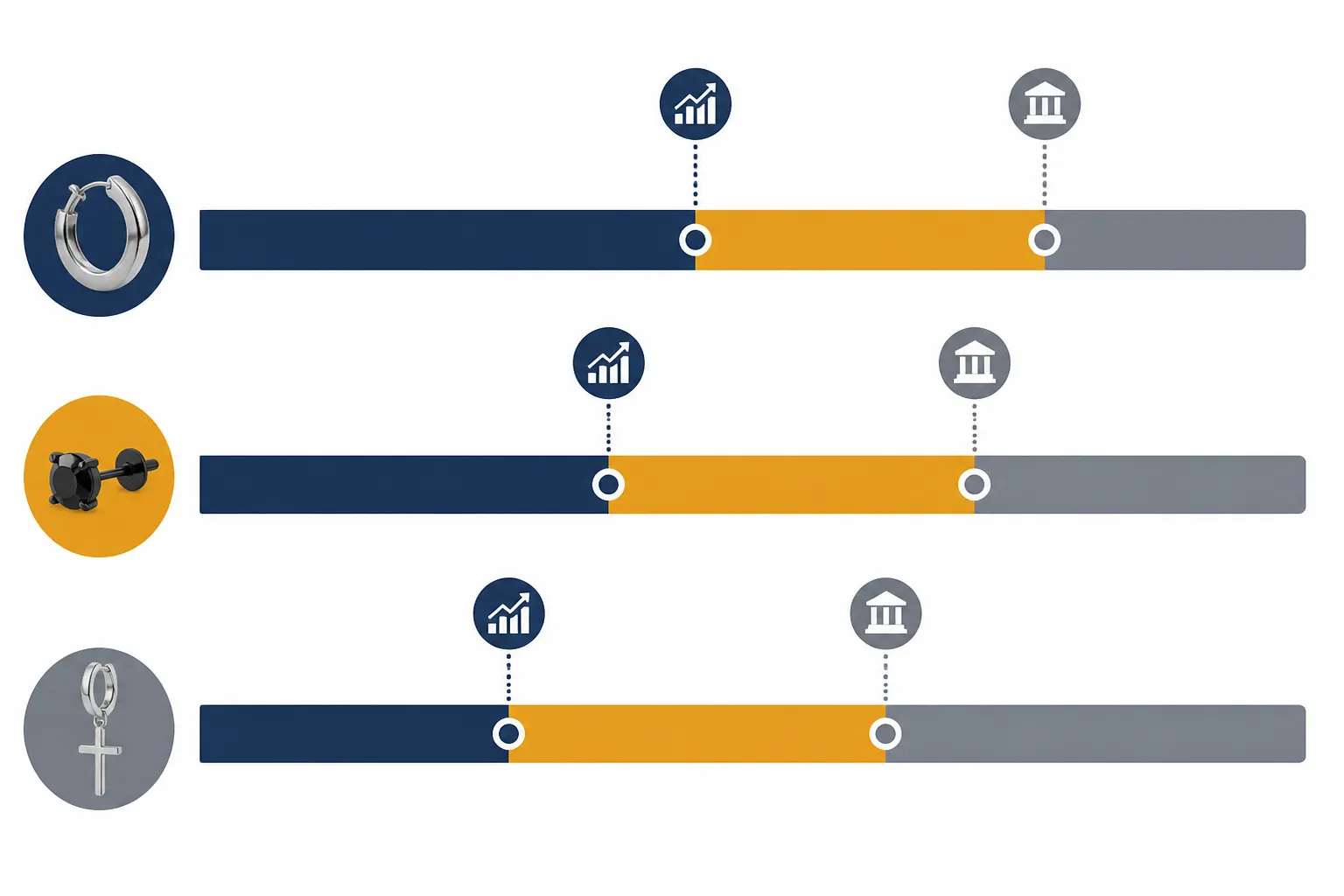
Men's earrings in the U.S. span an exceptionally wide price range, and understanding where your product fits is essential for margin planning.
Retail Price Tiers (USD)
| Segment | Retail Price Range | Typical Buyer |
|---|---|---|
| Fashion / Fast Jewelry | $8 – $35 | Mass market, TikTok Shop, Amazon |
| Mid-Market | $35 – $120 | Boutiques, DTC brands |
| Premium / Designer | $120 – $500+ | Specialty menswear, branded collections |
| Fine Jewelry | $500+ | Gold/diamond, fine material content |
For importers sourcing fashion and mid-market men's earrings directly from Chinese manufacturers, FOB (Free On Board) factory prices are typically a fraction of U.S. retail — the landed cost including freight, duties, and domestic warehousing determines your true cost basis. Duty rates on Chinese-origin imitation jewelry under current Section 301 tariffs have ranged up to 25% on top of the base HTS rate; confirm the current applicable rate with your customs broker before modeling margins.
What Drives Price Variation
- Material: Base metal (zinc alloy, brass, stainless steel) vs. sterling silver dramatically affects unit cost.
- Plating: Gold-tone, rose gold, rhodium, and black plating have different durability profiles and cost implications.
- Stone Type: Rhinestone and CZ (cubic zirconia) grades vary widely; higher-grade stones command higher prices.
- Customization: OEM work (logo, packaging, custom shapes) adds per-unit cost but increases retail margin potential.
- Order Volume: Unit cost decreases substantially as MOQ increases — buyers should request tiered pricing at multiple volume thresholds.
For accurate landed cost planning, always request a proforma invoice from your supplier that breaks out unit price, packaging, and freight separately, then model duties and last-mile delivery on top.
Common Challenges for Buyers in the United States
Logistics & Import Complexity
Navigating U.S. customs for jewelry imports is not trivial. Beyond tariff classification, buyers must address country of origin labeling, import security filing (ISF) deadlines for ocean shipments, and, for air freight, the threshold rules around formal vs. informal entry. Working with an experienced customs broker who handles jewelry shipments regularly is strongly recommended.
Domestic last-mile logistics — particularly for small B2B buyers fulfilling from their own warehouse — can also be a pain point. Building a relationship with a 3PL (third-party logistics) provider that handles jewelry SKUs can streamline receiving, repackaging, and order fulfillment.
Regulatory Non-Compliance Risk
The most common compliance failure U.S. buyers face is purchasing jewelry without verifying chemical safety. A shipment flagged by a retailer's internal QC team or an CPSC audit for excessive lead content can result in product recalls, retailer chargebacks, and reputational damage. Require third-party lab test reports for every new SKU, not just every new supplier.
Supplier Reliability & Communication Gaps
Time-zone differences, language barriers, and inconsistent communication are frequently cited pain points when sourcing men's earrings directly from overseas manufacturers. Buyers should establish clear communication protocols upfront — including a dedicated point of contact, preferred messaging channel, and response-time expectations — and treat a supplier's responsiveness during the sample phase as a predictor of production-phase reliability.
Style Trend Misjudgment
The U.S. men's earring market moves quickly, particularly at the fashion price point. Buyers who commit to large volumes of a single style risk being caught with slow-moving inventory if a trend peaks and declines. Sourcing from a supplier with a broad and regularly updated style catalog — and low enough MOQ to test multiple designs simultaneously — mitigates this risk considerably.
Payment & Trade Term Disputes
For new supplier relationships, buyers should understand the terms of any deposit paid before production begins. Use trade assurance platforms where available, request pre-shipment inspection, and ensure that all agreed specifications (dimensions, materials, finishes, packaging) are documented in writing before a deposit is transferred.
Frequently Asked Questions (United States-Specific)
Q: Do I need to register or license my business to import men's earrings into the United States? A: Importers must have a valid Employer Identification Number (EIN) and may need to register with U.S. Customs and Border Protection as an importer of record. There is no specific federal license for jewelry imports, but state-level sales tax registration is required in states where you have nexus. Working with a customs broker simplifies the import compliance process significantly.
Q: Are there nickel restrictions for jewelry sold in the United States? A: Unlike the EU, the U.S. does not have a federal nickel restriction equivalent to the EU Nickel Directive. However, high nickel content can trigger issues under California Proposition 65 and may cause consumer complaints or returns due to skin reactions. Best practice is to source nickel-free or hypoallergenic earring findings and request confirmation from your supplier.
Q: What's a realistic minimum order quantity (MOQ) for private-label men's earrings sourced from China? A: MOQ varies significantly by supplier and product complexity. For standard fashion earrings without customization, some suppliers accept orders as low as 12 pcs. For OEM/custom work with branded packaging, MOQs are generally higher. STRAND offers OEM with low MOQ designed for DTC brands and smaller importers — contact them directly for current thresholds.
Q: How long does it take to receive a shipment of men's earrings from a Chinese manufacturer to a U.S. warehouse? A: Sea freight from major Chinese ports (Ningbo, Shanghai) to U.S. West Coast ports (Los Angeles/Long Beach) typically takes 14–20 days, plus customs clearance. Air freight reduces transit to 5–10 days but at significantly higher per-unit cost. Total lead time from order confirmation to U.S. warehouse receipt — including production — should be confirmed with your supplier at time of order.
Q: Can I sell men's earrings on Amazon as an imported product? A: Yes, and Amazon is one of the primary channels for men's earrings in the U.S. However, Amazon requires compliance documentation for jewelry listings, and products subject to safety concerns can be suspended. Maintaining CPSIA-compliant test reports and accurate material descriptions in your listings protects your account health.
Q: What earring styles sell best for men in the U.S. market right now? A: Based on current retail and social commerce trends, small gold-tone and silver-tone studs remain the highest-volume staple. CZ and rhinestone styles perform strongly in the streetwear-adjacent segment. Drop earrings in gradient crystal or two-tone glass bead styles are gaining traction among style-forward buyers. Vintage-inspired designs with aged brass or oxidized finishes appeal to the mid-market boutique buyer.
Q: How do I verify that a Chinese jewelry supplier is legitimate before placing a large order? A: Request business registration documents, ask for references from other U.S. buyers, and — if possible — use a third-party sourcing agent or inspection service for your first order. Platforms like Alibaba Trade Assurance provide a degree of transaction protection. STRAND, as an example of a transparent trade-terms supplier, makes its workshop vetting process and in-house QC available as part of the buyer onboarding relationship.
Get Started in the United States
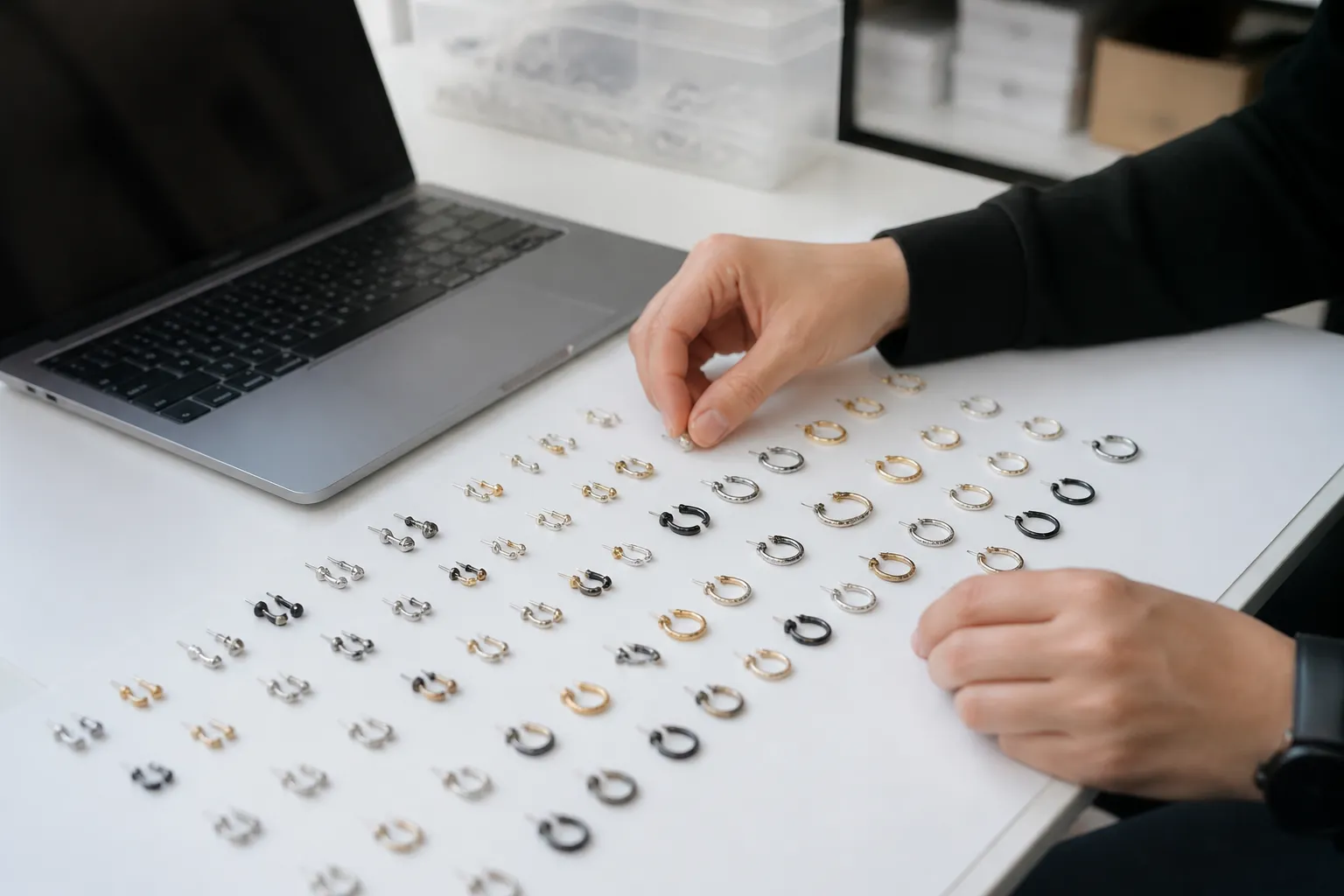
If you are a U.S.-based buyer, importer, or DTC store owner ready to source men's earrings, here are your concrete next steps:
Define your style brief. Identify 3–5 target styles — stud, drop, hoop, or sets — and your target retail price range. This determines what you can afford to pay at the landed cost level.
Calculate your landed cost. Factor in FOB unit price, freight (sea vs. air), current import duty rate for your HTS classification, customs brokerage fees, and domestic warehousing. This math needs to happen before you evaluate supplier pricing.
Request samples before committing to production. Any credible supplier should be able to provide physical samples. Evaluate plating durability, earring back quality, stone security, and packaging presentation against your retail standard.
Verify compliance documentation. Ask for SGS or equivalent third-party test reports covering lead, cadmium, and nickel content. Do not skip this step, especially for products entering California.
Clarify OEM terms if branding is needed. If you want private-label packaging or custom hardware, confirm the MOQ for custom work, artwork requirements, and any tooling fees.
Establish a reorder cadence. U.S. seasonal peaks (Q4, Valentine's Day) require inventory planning 60–90 days in advance for sea freight. Build a reorder schedule into your relationship from the start.
Ready to Source Men's Earrings?
STRAND is a Hangzhou-based fashion jewelry brand purpose-built for U.S., EU, UK, and MENA buyers sourcing directly from vetted Chinese workshops. The catalog covers drop earrings, stud earrings, necklace and earring sets in vintage, gradient crystal, two-tone glass bead, and rhinestone styles — with transparent trade terms, in-house QC before shipment, and multilingual support in English, Arabic, and Spanish. OEM is available with low MOQ and fast lead time for DTC brands that need a branded product.
Request a Quote — Get MOQ & Pricing for Men's Earrings
Submit your style brief, target volume, and delivery timeline to receive a proforma quote tailored to the U.S. market.
STRAND | Hangzhou-based. U.S.-market ready. Multilingual procurement support.