
Gold Earrings for Women: The Complete Sourcing & Style Guide for Buyers and DTC Retailers
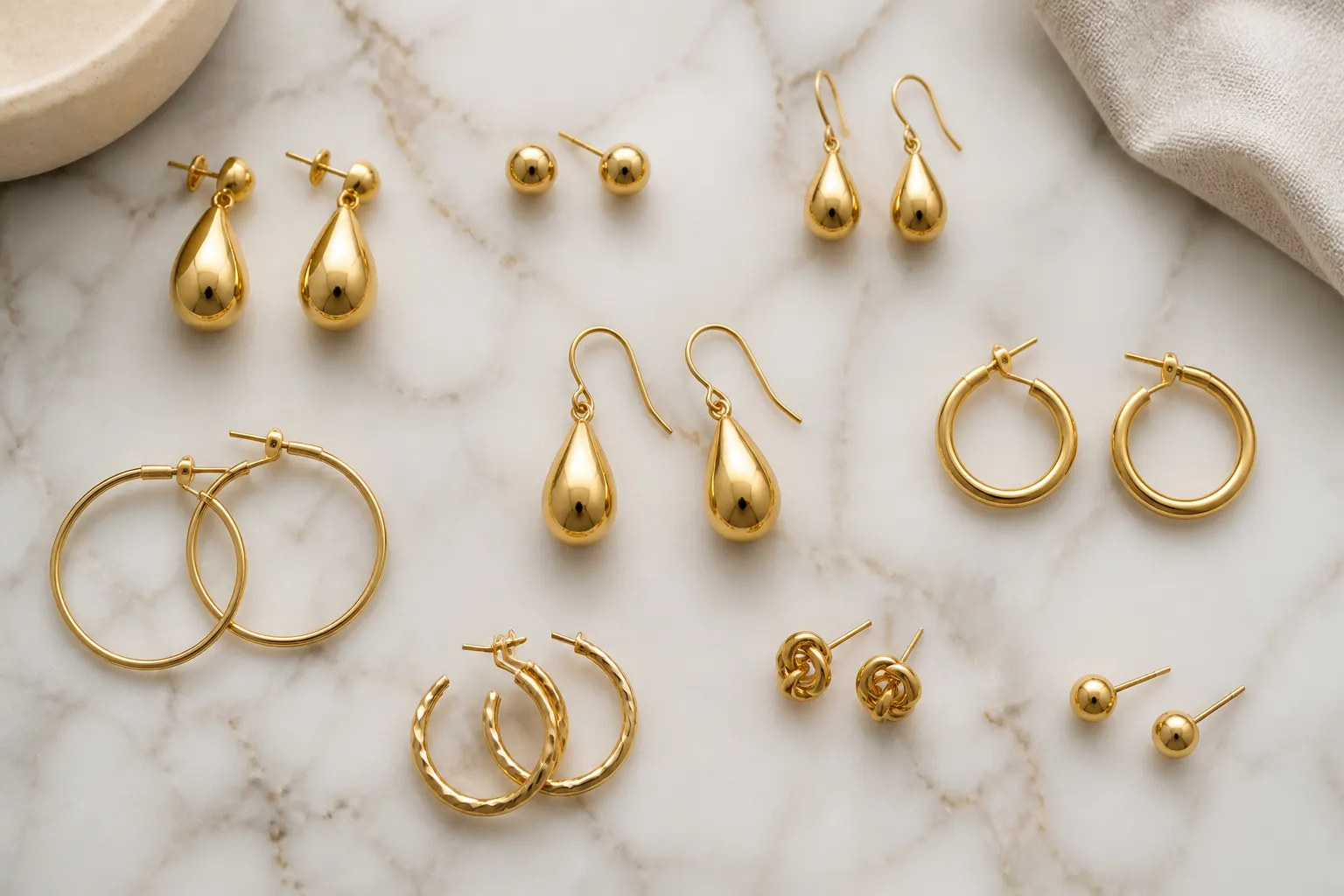
Gold Earrings for Women: The Complete Sourcing & Style Guide for Buyers and DTC Retailers
By STRAND Jewelry | Hangzhou-based cross-border fashion jewelry, OEM & wholesale
The Women's Jewelry Market Reality
Gold earrings for women have never occupied a more complex commercial landscape than they do today. The global women's jewelry market — valued at over $300 billion and still climbing — is being reshaped by three converging forces: the democratization of fine-adjacent fashion jewelry, the explosive growth of DTC e-commerce brands targeting millennial and Gen Z women, and the increasing power of cross-border sourcing chains that connect Western consumers directly to Asian manufacturing excellence. For buyers, importers, and boutique store owners in the US, EU, UK, and MENA regions, gold earrings for women are simultaneously a high-velocity SKU category and a minefield of sourcing decisions.
The challenge isn't finding gold earrings — it's finding the right gold earrings at the right margin, with the right quality consistency, delivered on a timeline that respects seasonal buying cycles. Women shoppers in 2025 expect jewelry that looks editorial, feels luxurious, and is priced accessibly. That trifecta is nearly impossible to achieve sourcing from domestic wholesalers or mass-market platforms. The gap between what the end consumer expects and what traditional supply chains deliver is precisely where modern cross-border sourcing partnerships — like those STRAND facilitates between vetted Chinese workshops and international buyers — create genuine commercial advantage.
Procurement teams sourcing earrings for women's retail also operate under real business constraints: tight Open-to-Buy budgets, SKU complexity across multiple style families, multi-market compliance requirements, and the operational burden of managing vendor relationships across time zones and languages. For multilingual procurement teams and solo DTC founders alike, the sourcing process for gold earrings can consume disproportionate bandwidth. This guide maps the real use cases, workflows, and decision criteria that drive successful sourcing outcomes in the women's jewelry vertical.
Why Generic Jewelry Sourcing Falls Short for Women's Fashion Retailers
Generic sourcing platforms and traditional wholesale directories are built for volume buyers who already know exactly what they want. They don't account for the nuanced aesthetic and sizing decisions that define women's earring categories — the difference between a 14mm drop earring and an 18mm one, or whether a two-tone gold bead cluster reads as "elevated everyday" versus "costume jewelry" at point of sale. These distinctions matter enormously to a buyer at a boutique fashion retailer or a DTC brand competing on Instagram and TikTok aesthetics.
What the women's jewelry vertical demands from a sourcing partner goes well beyond catalog access. It requires:
- Style intelligence: Understanding which gold earring silhouettes are trending in the EU versus the MENA region, and how to advise OEM buyers accordingly
- Material nuance: Distinguishing between 18k gold-plated brass, 14k gold-filled, and gold vermeil — and communicating material specifications clearly in English, Arabic, and Spanish to multilingual procurement teams
- Sampling agility: The ability to prototype a custom gradient crystal drop earring or rhinestone stud before a buyer commits to a production run
- Compliance readiness: Ensuring that gold earring components (especially post/back hardware) meet EU REACH regulations and US CPSC standards for nickel content and material safety
Off-the-shelf platforms that list ten thousand SKUs without providing material certificates, production capacity data, or direct QC transparency force buyers into expensive trial-and-error cycles. For women's fashion buyers with seasonal deadlines, that's not a process — it's a liability.
Core Use Cases: Gold Earrings for Women Across the Buying Journey
1. The DTC Brand Founder: Building a Hero SKU Line from Scratch
The Problem
A DTC jewelry brand founder in the UK has validated customer demand for demi-fine women's earrings through a Shopify store but is currently sourcing inconsistently from multiple Etsy-adjacent suppliers. Quality varies batch to batch. Hallmarking documentation is incomplete. She needs a single vetted manufacturing partner who can produce a cohesive gold earring line — studs, drops, and a necklace + earring set — under her own label.
How Gold Earring OEM Sourcing Addresses It
OEM (Original Equipment Manufacturer) partnerships with Hangzhou-based workshops give DTC founders exactly this consolidation. A sourcing partner like STRAND connects the founder to workshops specializing in vintage-style gold earrings, gradient crystal drops, and rhinestone studs, producing finished goods with custom packaging and branding. Low MOQ thresholds (typically 12 pcs units per style) allow founders to launch a cohesive 6-to-10 SKU earring range without the capital exposure of traditional wholesale minimums.
What Success Looks Like
- Single-source supply for 80%+ of earring SKUs
- Consistent plating thickness and color match across production runs
- CE / REACH documentation available for EU customs
- Unboxing-ready packaging with brand-consistent materials
Vignette: A London-based DTC founder consolidates her three-supplier earring chaos into a single STRAND OEM program, launching a 8-SKU "Golden Hour" drop earring line in time for Q4, with matching necklace + earring sets produced in the same production run.
2. The US Boutique Importer: Seasonal Buying Under Open-to-Buy Pressure
The Problem
A regional women's fashion boutique chain buyer in the US operates on Open-to-Buy (OTB) budgets that are locked quarterly. She needs to commit to gold earring inventory for the holiday selling season by late August — but lead time uncertainty from previous suppliers has resulted in late arrivals that missed peak weeks.
How Reliable Lead Times and Fast Production Resolve It
Fast lead time and transparent production scheduling are non-negotiables for OTB-constrained retail buyers. When a sourcing partner provides confirmed production start dates, milestone tracking, and pre-shipment QC sign-off, buyers can accurately plan receipt dates and floor set schedules. Gold earring styles with proven sell-through — vintage-look two-tone glass bead drops, rhinestone holiday studs — sourced through a partner with in-house QC reduce the risk of late-arriving inventory with quality issues that require chargebacks.
What Success Looks Like
- 95%+ on-time delivery against confirmed ship dates
- Pre-shipment inspection report available before goods leave China
- Zero customs delays attributable to missing documentation
- Sell-through rate improvement from accurate seasonal timing
Vignette: A boutique buyer in Nashville commits to a 500-unit holiday gold earring assortment in August, receives an inspection-cleared shipment in late October, and achieves a 78% sell-through by Black Friday — up from 52% the prior year when goods arrived in mid-November.
3. The MENA Distributor: Multilingual Procurement for Regional Fashion Retail
The Problem
A Dubai-based fashion accessories distributor supplies women's gold earrings to a network of regional boutiques across the UAE, Saudi Arabia, and Kuwait. Her procurement team works in Arabic and English, and prior supplier communication breakdowns — mistranslated specifications, incorrect karat claims, wrong closure types — have created costly return and replacement cycles.
How Multilingual Service Solves the Communication Gap
This is where suppliers with genuine multilingual capabilities (not just Google Translate disclaimers) differentiate themselves. A sourcing partner offering native Arabic-language support across product specification, contract terms, and QC reporting eliminates the ambiguity that causes expensive errors. For gold earring orders, this means closure type (post, French wire, huggies), plating specification (18k gold-plated, gold-filled), and stone setting details (prong-set rhinestone vs. glued crystal) are confirmed in the buyer's working language with no interpretation layer.
What Success Looks Like
- Zero specification errors attributable to language gaps
- Arabic-language product documentation available for import customs
- Faster approval cycles because procurement team can review specs natively
- Supplier reliability score maintained across seasonal reorders
Vignette: A Dubai distributor specifies a gradient crystal chandelier earring style in Arabic with her STRAND account manager, receives a bilingual product spec sheet and inspection report, and clears UAE customs without delay on a 1,200-unit shipment.
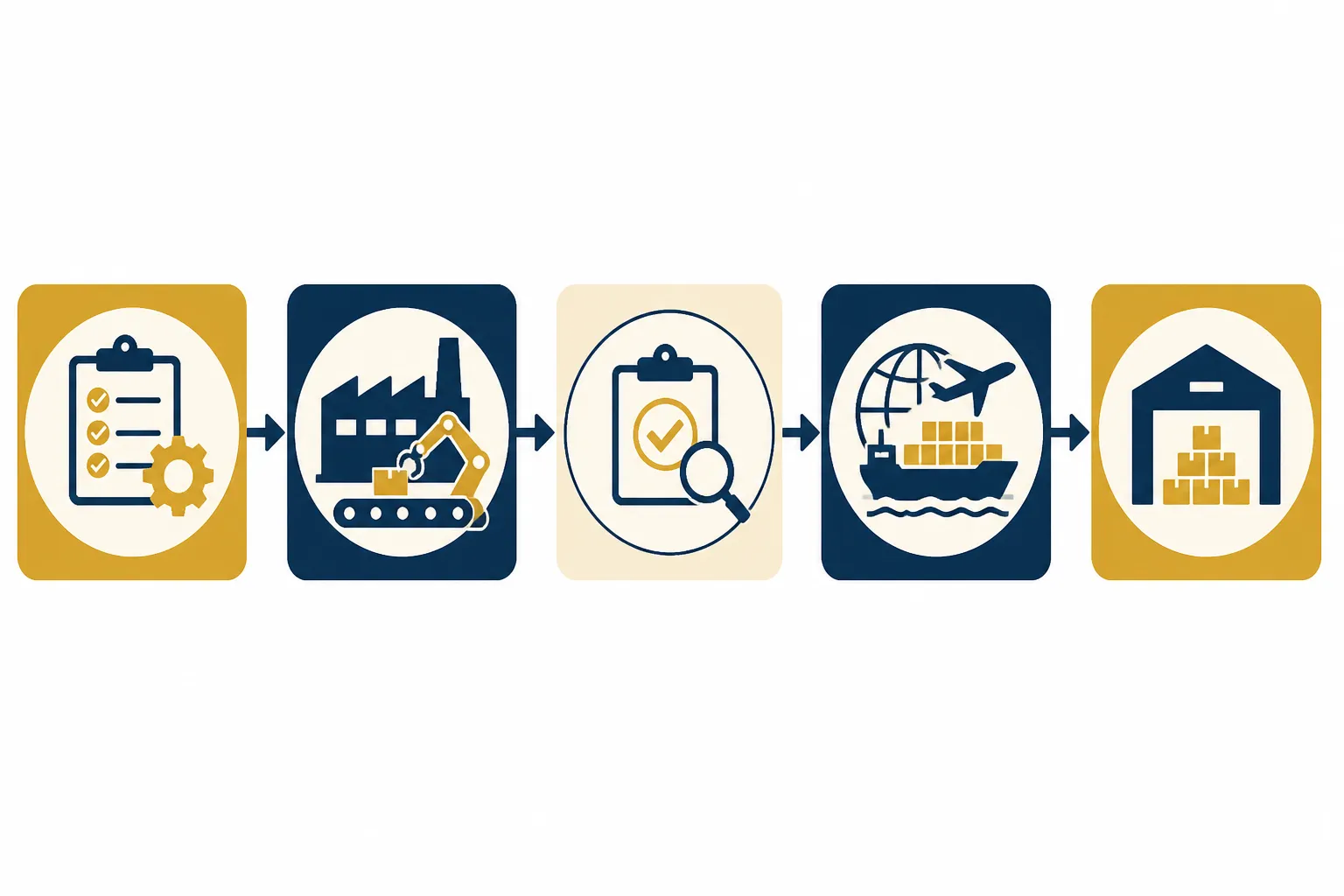
4. The EU Compliance-First Buyer: Navigating REACH and Nickel Regulations
The Problem
A German fashion accessories importer selling women's gold earrings through a national retail chain faces strict EU REACH compliance requirements, specifically Regulation (EC) No 1907/2006 restrictions on nickel release in jewelry items that come into prolonged contact with skin. Her previous supplier's earring posts tested above the allowable nickel release threshold, triggering a product recall and significant reputational damage with her retail partner.
How QC-Vetted Sourcing with Documentation Addresses Compliance Risk
EU buyers sourcing gold earrings for women must require suppliers to provide third-party test reports confirming nickel release rates below the EN 1811 standard threshold (0.5 μg/cm²/week for post components). A sourcing partner with in-house QC staff who routinely coordinate this documentation — and who understand EU REACH as a standard deliverable, not an exceptional request — removes the compliance burden from the buyer's team.
What Success Looks Like
- EN 1811 / REACH test reports provided as standard with each new style
- Material Safety Data Sheets (MSDS) available for plating materials
- Batch consistency verification ensuring production matches approved samples
- Zero product recalls attributable to materials non-compliance
Vignette: A Frankfurt-based buyer specifies REACH-compliant gold earring posts for a 2,000-unit women's collection, receives full test documentation with shipment, and passes retailer compliance audit without revision.
5. The OEM Custom Style Developer: Creating Proprietary Earring Designs
The Problem
A mid-size US women's accessories brand wants to develop a proprietary earring line — gradient crystal drop earrings with a custom two-tone gold and silver finish — that cannot be replicated by competitors buying the same stock SKUs from catalog suppliers. The design team has concept sketches but no manufacturing expertise, and previous attempts to develop custom jewelry have stalled due to high sampling minimums and slow response times.
How OEM with Low MOQ and Fast Sampling Enables Innovation
OEM partnerships that accept low minimum quantities per style and turn around product samples quickly are the engine of proprietary product development for women's jewelry brands. The development cycle — design brief to production sample — should move in weeks, not months. For gold earring OEM, this means the supplier's workshop team can translate a CAD file or hand sketch into a physical sample with the correct plating, stone setting, and closure hardware, enabling rapid design iteration before committing to full production.
What Success Looks Like
- First physical sample received within [lead time] days of design brief approval
- Maximum 2 revision rounds from sample to production-approved prototype
- Production MOQ accessible for new style launches (12 pcs units)
- Exclusive design registration or NDA available to protect proprietary styles
Vignette: A Seattle-based women's accessories brand develops a signature gradient crystal drop earring with a custom two-tone finish, going from sketch to production-ready sample in four weeks, launching as an exclusive collection on their DTC site for Valentine's Day.
6. The Multi-SKU Wholesale Buyer: Managing Style Depth Across a Jewelry Assortment
The Problem
A US wholesale jewelry distributor managing accounts for 150+ independent women's boutiques needs to maintain a breadth assortment of gold earrings — studs, drops, hoops, ear crawlers — across multiple price points, while controlling the SKU complexity that strains warehouse and catalog operations. Sourcing from five different suppliers per category is operationally unsustainable.
How a Consolidated Category Supplier Simplifies Operations
A supplier offering comprehensive coverage across gold earring styles — vintage drop, rhinestone stud, two-tone glass bead, necklace + earring sets — within a single vendor relationship dramatically reduces purchase order management, vendor compliance overhead, and quality coordination burden. Consistent plating standards across styles mean that different SKUs photograph consistently in catalog shoots, reducing retouching costs.
What Success Looks Like
- 4+ gold earring style families available from single vendor
- Consistent 18k gold plating specification across all SKUs
- Consolidated invoicing and shipping reducing logistics overhead
- Reorder cycle time reduced by consolidating to fewer vendor touchpoints
Vignette: A Dallas wholesale distributor consolidates three earring suppliers into a single STRAND partnership, reducing vendor management overhead by 40% while expanding her active gold earring SKU count from 28 to 45 styles.
Women's Jewelry Industry-Specific Considerations
Regulatory and Compliance
Gold earrings for women are subject to jewelry-specific regulations that vary significantly by market:
- EU REACH / EN 1811: Nickel release standards for skin-contact items are mandatory for EU market access. Buyers must require third-party test reports from accredited laboratories.
- US CPSC / California Prop 65: Lead and cadmium restrictions apply to fashion jewelry. Prop 65 Certificates of Compliance are frequently required by US retail chain buyers.
- UK Post-Brexit Standards: UK REACH mirrors EU REACH but operates under UKCA marking requirements. Importers must confirm supplier familiarity with UKCA vs. CE marking distinctions.
- MENA Halal/Material Standards: While not regulated identically across GCC markets, material transparency (especially regarding animal-derived adhesives in stone settings) is an increasing buyer requirement.
Buyers should require documentation packages — not verbal assurances — as standard deliverables in supplier agreements.
Integration with Industry-Standard Procurement Tools
Boutique buyers and DTC brands typically manage earring assortments through platforms including Faire, NuOrder, Shopify (with wholesale channels), and ERP systems like NetSuite or Brightpearl. Supplier integration capabilities — EDI compatibility, CSV catalog exports, API-ready product data — reduce manual data entry when onboarding new earring styles. When evaluating a new gold earring supplier, confirm that product data can be exported in formats compatible with your buying tools.
Data Sensitivity and IP Protection
For OEM buyers developing proprietary gold earring designs, intellectual property protection is a legitimate concern. Buyers should require signed NDAs before sharing original design files, and confirm that the supplier's workshop practices include exclusivity commitments for custom designs. Documented OEM agreements with clear IP clauses are standard practice in professional cross-border manufacturing relationships.
Scale and Seasonality
Women's gold earring demand follows predictable seasonal peaks: Q4 holiday (October–December), Valentine's Day (January–February), Mother's Day (April–May), and summer gifting. Buyers should build production lead times backward from these retail windows, accounting for ocean freight transit (typically 25–35 days for sea shipment from China to US/EU ports), customs clearance, and warehouse receiving. Production booking 12–14 weeks ahead of intended in-store or in-warehouse dates is a practical planning baseline.
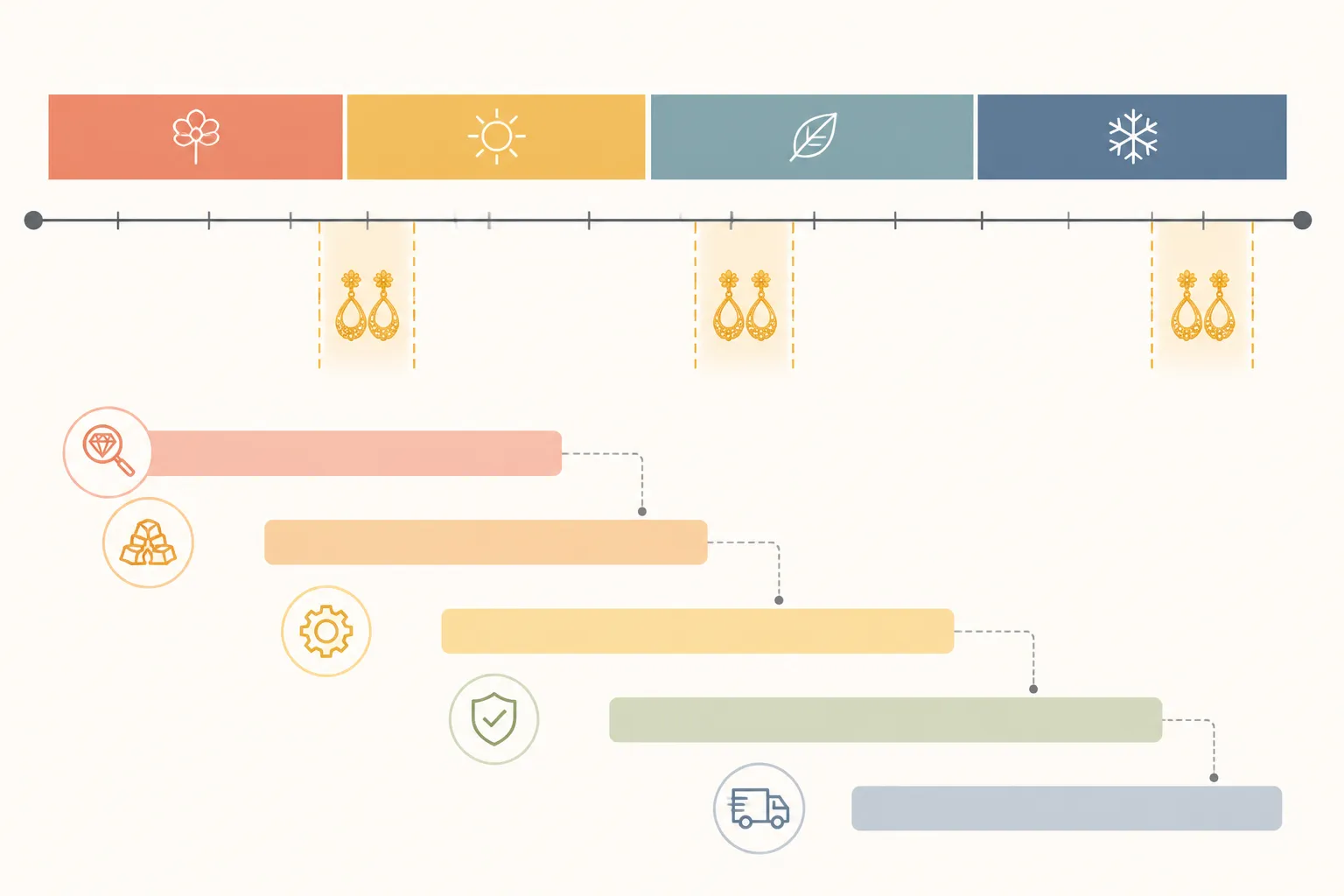
Implementation Roadmap for Women's Jewelry Buying Teams
Moving from a fragmented earring sourcing approach to a consolidated, OEM-capable supplier relationship follows a predictable maturation path:
Phase 1 — Pilot (Weeks 1–6)
- Identify 2–3 gold earring styles from the supplier's existing catalog to test with a small initial order
- Request material specification sheets and available compliance documentation for selected styles
- Place a pilot order at standard MOQ to evaluate product quality, packaging, and lead time accuracy
- Assess communication responsiveness and multilingual capability across the order cycle
- Document QC findings upon receipt against provided specifications
Phase 2 — Pilot Orders & Range Expansion (Weeks 7–16)
- Expand earring assortment to 8–12 SKUs across multiple style families (studs, drops, sets)
- Initiate first OEM custom development project if proprietary styles are a priority
- Negotiate vendor agreement including quality standards, lead times, and documentation requirements
- Integrate supplier's product data into buying/ERP system
- Establish reorder triggers and seasonal booking calendar aligned with selling windows
Phase 3 — Organization-Wide Consolidation (Months 5–12)
- Transition earring category spend to primary supplier, retiring underperforming legacy vendors
- Implement regular vendor review cadence (quarterly QC audits, style performance reviews)
- Develop seasonal exclusive collections through OEM program to differentiate assortment
- Leverage multilingual account management for multi-market expansion (US + EU + MENA parallel sourcing)
- Negotiate volume pricing tiers as consolidated spend grows
ROI and Business Outcomes for Women's Jewelry Retailers
Buyers who make the transition from fragmented, catalog-first sourcing to a consolidated cross-border sourcing partnership typically see measurable improvement across several KPIs that matter in the women's jewelry vertical:
| Metric | Before Consolidation | After Consolidated Sourcing |
|---|---|---|
| Vendor management overhead | 8–12 active earring suppliers | 1–2 primary suppliers |
| On-time delivery rate | 60–70% | 90%+ |
| Compliance documentation gap | Frequent | Systematic |
| OEM development cycle | 6–12 months | 6–10 weeks |
| Gross margin on earring category | Compressed by sourcing inefficiency | Improved through direct factory pricing |
| SKU depth per vendor | 5–15 styles | 30–50+ styles |
| Return/replacement rate | Elevated by inconsistent QC | Reduced through pre-shipment inspection |
The most significant ROI driver is not unit cost reduction alone — it's the combination of consistent quality, reliable lead times, and reduced operational overhead that together unlock the category's full margin potential. For DTC brands in particular, the ability to launch proprietary OEM gold earring collections with low MOQs transforms earring from a commodity category into a brand-building opportunity.
Conclusion: Next Steps for Women's Jewelry Decision-Makers
Gold earrings for women represent one of the highest-velocity, highest-margin categories available to women's fashion retailers and DTC brands — but extracting that value requires a sourcing approach built on transparency, quality consistency, and genuine category expertise. The sourcing decisions you make today — which supplier, which material standards, which OEM capability — will shape your earring assortment's competitive position for the next 12–24 months.
If you're evaluating suppliers for gold earrings for women, the questions that separate professional sourcing partners from catalog-only vendors are specific:
- What are your standard MOQ and lead time parameters for stock styles?
- Can you provide EN 1811 / REACH test reports for earring post components as a standard deliverable?
- What does your OEM development process look like from design brief to production sample?
- How do you handle multilingual communication for MENA and Spanish-speaking procurement teams?
- What pre-shipment QC process is standard, and can I receive inspection reports before goods ship?
STRAND exists to answer these questions with specifics — not generalities. As a Hangzhou-based cross-border fashion jewelry brand linking vetted Chinese workshops directly to overseas buyers, STRAND serves importers, DTC founders, and wholesale buyers in the US, EU, UK, and MENA with transparent trade terms, multilingual service, in-house QC, and OEM capability starting at accessible minimums.
Ready to source gold earrings for women that are quality-vetted, compliance-ready, and competitively priced?
Request a Quote or Get MOQ & Pricing →
Send your earring brief — style references, target price point, market, and timeline — and a STRAND sourcing specialist will respond in your preferred language with a tailored proposal.
STRAND Jewelry | Hangzhou, China | Cross-border DTC + OEM | English · Arabic · Spanish Serving buyers in the US, EU, UK, and MENA | strandjewelry.com