
Gold Earrings for Men: The Complete Buyer's & Importer's Guide
Gold Earrings for Men: The Complete Buyer's & Importer's Guide
The Men's Jewelry Reality: A Market That Outgrew Its Old Rules
The market for gold earrings for men has undergone a structural transformation in the past decade — one that most legacy sourcing pipelines have not caught up with. What began as a niche counterculture statement in the 1980s and 1990s has become a mainstream fashion category commanding serious retail real estate, dedicated e-commerce SKUs, and its own seasonal buying calendars. Nielsen and McKinsey consumer data both confirm that the "genderless jewelry" movement is not a trend — it is a category redefinition. Men's earrings now occupy their own shelf space at mass-market and fine jewelry retailers alike, from department chains in the United States to high-margin boutiques across the Gulf Cooperation Council (GCC).
For buyers, importers, and DTC store owners, this shift creates both opportunity and complexity. On one hand, demand signals are strong and growing — search volume for gold earrings for men has risen year-over-year since 2020, with meaningful purchase intent clusters in the 25–44 male demographic. On the other hand, the product category itself sits at an awkward intersection of fine jewelry standards (gold purity expectations, hallmarking, consumer protection regulations) and fashion jewelry economics (fast trend cycles, lower price resistance, high SKU turnover). Sourcing the wrong product — or the wrong supplier — can result in returns, regulatory exposure, and brand damage simultaneously.
For cross-border sourcing teams targeting the US, EU, UK, and MENA markets, the challenge compounds further. Each jurisdiction carries its own gold purity labeling requirements, import duty classifications, and consumer protection obligations. A stud earring shipped from a Chinese workshop that passes internal QC may still fail at UK customs without a hallmark certificate, or trigger a product recall in California without compliant nickel content documentation. The operational surface area for error is wide — and it grows wider for teams managing multiple SKUs, OEM custom designs, and multilingual procurement flows simultaneously.
Why Generic Jewelry Sourcing Solutions Fall Short for Men's Gold Earrings
Most jewelry sourcing playbooks were written for women's fashion accessories — a category where trend cycles are fast, quality tolerances are interpreted liberally, and the buyer's primary concern is aesthetic novelty. Gold earrings for men operate under a different set of constraints that generic sourcing frameworks consistently underestimate.
Gold purity expectations are non-negotiable at the upper end of the market. Men buying gold earrings — particularly in the MENA region and among US fine jewelry consumers — are making a value purchase, not just a fashion purchase. They want documented purity: 10K, 14K, 18K, or 24K gold, each carrying different price points, durability profiles, and import classification codes. A sourcing agent who applies women's fashion jewelry shortcuts to a men's gold earring order — substituting gold-plated brass for solid gold, or under-documenting karatage — exposes the buyer to chargebacks, customs holds, and reputational damage with a demographic that shops for jewelry with the same due-diligence mindset it applies to electronics or watches.
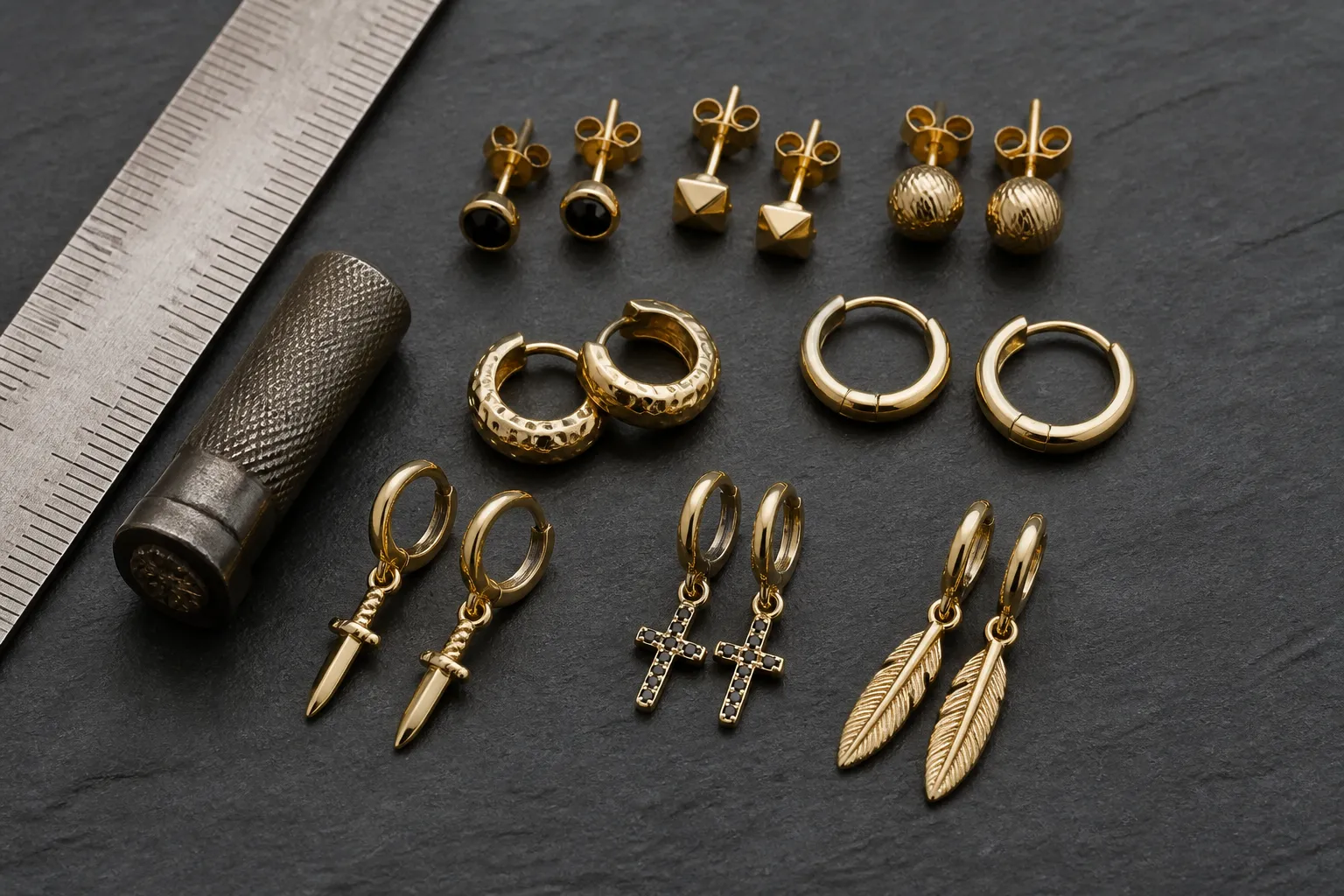
Style vocabulary is narrower but more brand-specific. Men's earring aesthetics cluster around a tighter range — studs, small hoops, geometric drops, chain-link styles — but within that range, the exact dimensions, weight, and finish define whether the product reads as streetwear, high fashion, or heritage luxury. A 6mm stud and an 8mm stud are not interchangeable in a men's DTC assortment the way similar increments might be in a women's earring wall. Generic sourcing agents who lack fluency in men's jewelry aesthetics consistently deliver samples that are slightly off-brief in ways that only become apparent at the photo shoot stage — after tooling costs are sunk.
The target consumer is less forgiving of quality variance. Men who have decided to wear gold earrings have typically made a considered, identity-level decision about their personal style. They are not impulse buyers who will excuse a tarnished plating or a poorly soldered post. Return rates on men's gold earrings correlate strongly with quality consistency issues — particularly post integrity, plating durability, and weight feel. These are manufacturing variables that require upstream QC, not downstream returns management.
Core Use Cases: How Buyers Source and Sell Gold Earrings for Men
1. DTC Store Owners Building a Men's Jewelry Category from Scratch
The problem: A DTC fashion brand with a primarily menswear audience wants to add a jewelry category. Leadership has identified gold earrings for men as a high-margin entry point — small AOV lift, easy gifting SKU, no sizing complexity. But the buying team has no jewelry sourcing experience, no established supplier relationships, and no clear product roadmap beyond "men's gold studs."
How this use case resolves: The brand's first move is finding a supplier who can provide both stock styles and OEM customization within the same workflow. They need a partner who understands men's jewelry aesthetics, can supply gold-finished pieces across multiple karat equivalents (solid gold vs. gold-vermeil vs. high-quality gold-plated), and can produce small initial runs to test the market before committing to volume.
STRAND's model — sourcing directly from vetted Hangzhou workshops with in-house QC before shipping — directly addresses this need. A DTC buyer can start with a curated selection of stud and hoop styles, test conversion rates on their Shopify storefront, and escalate to custom OEM once they understand which silhouettes perform with their specific audience.
What success looks like: Within two to three collection cycles, the brand has a defined men's jewelry assortment (typically 8–15 SKUs), a repeat supplier relationship, and product photography that positions gold earrings as a core category rather than an afterthought. Return rates stay below 3% because in-house QC caught post and plating issues before shipment.
Vignette: A Chicago-based menswear DTC brand ordered a 200-piece mixed stud assortment as a pilot. Six weeks after launch, the two best-selling SKUs — a classic gold ball stud and a geometric square stud — had sold out. They escalated to an OEM request for an engraved version of the square stud with their brand mark. The supplier's sample arrived in three weeks, passed QC, and went into production for Q4.
2. Multi-Brand Importers Balancing SKU Width Against MOQ Constraints
The problem: A jewelry importer supplying independent boutiques across the US and EU maintains a catalog of 300+ SKUs across women's and men's categories. Demand for gold earrings for men is growing, but men's jewelry typically accounts for 20–30% of SKU volume while requiring the same supplier negotiation overhead as women's lines. MOQ requirements from most Chinese workshops make it economically unviable to carry the long tail of men's styles that boutique buyers request.
How this use case resolves: The importer needs a supplier who can consolidate men's gold earring sourcing across multiple style families — studs, hoops, chain-link drops — under a single relationship with low minimum order quantities per style. Multilingual service capability matters here because the importer's procurement team works across English, Spanish, and Arabic depending on which regional office is placing the order.
STRAND's low-MOQ OEM model and multilingual service (English, Arabic, Spanish) make it structurally suited to this workflow. Rather than fragmenting men's earring sourcing across three or four workshops, the importer consolidates under a single supplier who can manage SKU diversity without penalizing low-volume styles.
What success looks like: The importer's men's gold earring category grows from 15 SKUs to 40+ over two buying seasons, with no single style requiring an unsustainable volume commitment. Boutique buyers get the breadth they want; the importer maintains margin by avoiding overstock.
Vignette: A London-based importer serving Scandinavian and Gulf boutiques needed Arabic-language documentation for a Dubai buyer who required Arabic product descriptions and compliant hallmarking certificates. STRAND's multilingual team handled both the documentation and supplier communication, closing a deal that would have stalled in a standard English-only procurement workflow.
3. MENA Market Buyers Navigating Gold Purity and Cultural Preference
The problem: Buyers sourcing gold earrings for men in the MENA market face a consumer base with deeply specific expectations around gold purity. In markets like Saudi Arabia, the UAE, and Egypt, gold jewelry is a value store as much as a fashion item. Buyers need suppliers who can document gold content accurately, provide certification that withstands customs scrutiny, and deliver styles that align with regional aesthetics — which tend toward bolder, heavier pieces than the minimalist studs popular in Western markets.
How this use case resolves: The buyer needs a supplier who understands both the manufacturing variables (actual gold content vs. plating thickness vs. base metal) and the documentation requirements (hallmark certificates, material compliance declarations) needed to clear GCC customs and satisfy end consumers. QC needs to include gold purity verification, not just visual inspection.
What success looks like: Shipments clear customs without holds. End consumers in Dubai and Riyadh stores receive product that matches stated purity and holds its finish over time. Return rates are low. The buyer builds a reputation as a reliable importer of men's gold earrings in a market where trust is the primary commercial currency.
Vignette: A UAE-based jewelry importer needed 18K-equivalent gold earrings for men with Arabic-language hallmark documentation for a retail chain in Abu Dhabi. After two failed attempts with suppliers who couldn't produce compliant documentation, they switched to a supplier with in-house QC and multilingual documentation capability. The shipment cleared customs on first attempt.
4. OEM Buyers Developing Branded Men's Jewelry Collections
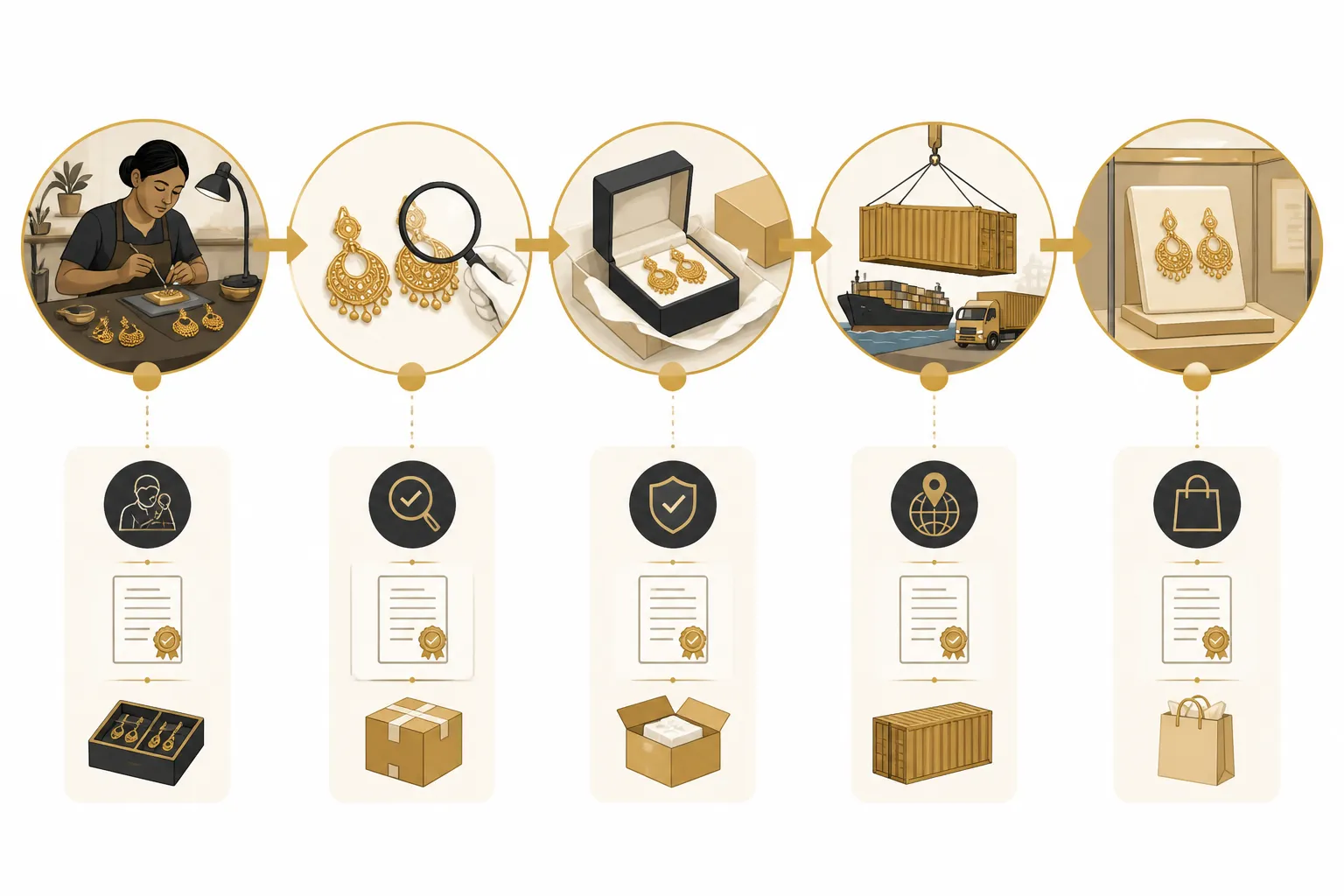
The problem: A fashion brand or celebrity-adjacent lifestyle label wants to launch a proprietary men's earring line under its own branding. The creative brief calls for custom earring designs — specific geometries, mixed materials, proprietary finishes — that can't be sourced off the shelf. The brand needs a manufacturing partner who can execute custom tooling, apply brand markings, and deliver production-quality samples within a timeline that aligns with a marketing launch.
How this use case resolves: OEM procurement for gold earrings for men requires a supplier with actual workshop relationships and tooling capability — not just a trading company reselling standard styles. Key variables are: sample lead time, tooling cost amortization, production MOQ for custom designs, and QC on first production runs (where custom pieces are most likely to carry dimensional or finish defects).
What success looks like: The brand launches its men's earring collection on time with product that matches the creative brief, carries brand markings, passes QC, and photographs well for campaign content. The supplier relationship becomes a recurring one for seasonal drops.
Vignette: A Los Angeles-based streetwear brand wanted custom gold drop earrings with a distinctive chain-link silhouette and a proprietary matte gold finish. The initial sample run of eight designs took four weeks. Six passed QC on the first review; two were revised and resampled within ten days. Production followed at a lead time that met the brand's summer campaign launch window.
5. Seasonal Buyers Managing Q4 and Gift-Season Volume Spikes
The problem: Gift-season demand for gold earrings for men creates sharp volume spikes — particularly in Q4 (November–December in the US/EU/UK) and during Eid shopping seasons in MENA markets. Buyers who don't plan production capacity eight to twelve weeks in advance consistently face stockouts at peak demand, because Chinese manufacturing capacity tightens significantly in the run-up to Chinese New Year and during high-demand export periods.
How this use case resolves: Buyers need suppliers with transparent production capacity data and fast lead times for reorder. The ideal supplier communicates capacity constraints proactively, not reactively — flagging a closing production window before the buyer misses it, not after.
What success looks like: The buyer's Q4 inventory is in-country by late October, leaving buffer for customs clearance and warehouse processing. Gift-season sell-through rates are high because product arrived on time and in the right assortment mix. The buyer enters Q1 with clean inventory rather than a markdown problem.
Vignette: A UK-based jewelry e-tailer learned in September that its gold stud assortment for men was down 60% of planned Q4 units due to a production delay from its previous supplier. A new supplier with available capacity and a 25-day production lead time for standard styles closed the gap, delivering the reorder before the November sales window opened.
6. Multi-Channel Retailers Aligning Online and In-Store Men's Assortments
The problem: A multi-channel jewelry retailer — operating both a DTC website and wholesale accounts with brick-and-mortar stores — needs its men's gold earring assortment to work across two very different merchandising contexts. Online, the priority is photographic impact and product description clarity. In-store, the priority is tactile quality, packaging presentation, and the ability to hold up under try-on conditions. A supplier who optimizes only for one channel's requirements creates friction in the other.
How this use case resolves: The buyer needs consistent quality across both channels — which means in-house QC that catches finish inconsistencies before shipping, not after. Packaging options that work for both DTC polybag-and-card and retail blister-card formats are a secondary but important consideration.
What success looks like: The men's gold earring category performs above the store's jewelry category average for both online conversion rate and in-store sell-through, with return rates under 4% across both channels.
Men's Industry-Specific Considerations
Regulatory and Compliance
Gold content labeling is regulated differently across target markets. In the United States, the Federal Trade Commission (FTC) requires that gold content representations be accurate to within a half-karat tolerance. In the UK and EU, hallmarking requirements apply to gold articles above minimum weight thresholds — importers selling solid gold earrings above these thresholds without assay office certification risk both customs seizure and Trading Standards action. In the UAE and Saudi Arabia, gold purity must be certified and stamped per Gulf Standards Organization (GSO) requirements.
Nickel directive compliance is mandatory for earrings sold in the EU under the EU Nickel Directive (REACH Regulation Annex XVII). Earrings that will contact skin must not exceed 0.05% nickel release per cm²/week. China-sourced gold earrings intended for EU sale require supplier documentation confirming compliance — a test certificate from an accredited laboratory, not a self-declaration.
California Proposition 65 applies to any jewelry sold in California containing lead, cadmium, or other listed chemicals above threshold levels. Importers into the US should require Prop 65 compliance documentation from their supplier's QC package.
Integration with Industry-Standard Procurement Tools
Cross-border jewelry buyers increasingly manage procurement through platforms such as Alibaba Trade Assurance, Faire (for wholesale), and direct ERP integrations (NetSuite, SAP Business One). Suppliers who can provide structured product data — SKU codes, weight, material composition, HS tariff codes — in formats that integrate with these systems reduce the buyer's manual data-entry burden. When evaluating suppliers for men's gold earrings, ask whether they can provide standardized product data exports and whether they have experience with Trade Assurance payment structures.
Data Sensitivity and IP Protection
OEM buyers developing proprietary men's earring designs carry real IP risk when working with Chinese workshops. Custom tooling, design files, and mold specifications should be governed by a Non-Disclosure Agreement (NDA) executed before sharing creative briefs. Reputable suppliers — including those operating through established Hangzhou-area trading hubs — will sign NDAs as standard practice. Verify that the supplier's NDA covers both the manufacturer and any subcontractors used in production.
Scale and Seasonality
Men's gold earring demand in the US and EU peaks sharply in Q4 (holiday gifting) and has a secondary peak in late spring (graduation gifts, Father's Day). MENA buyers see demand peaks aligned with Eid al-Fitr and Eid al-Adha. Chinese manufacturing capacity tightens ahead of Chinese New Year (typically late January–mid February), creating a production window constraint that requires buyers to place Q4 orders no later than early October to ensure on-time delivery.
Implementation Roadmap for Men's Jewelry Buying Teams
Phase 1 — Pilot (Weeks 1–8)
- Define your initial men's gold earring assortment brief: style families (studs, hoops, drops), target price points, and channel (DTC / wholesale / both).
- Identify 2–3 candidate suppliers and request samples across your target styles. Evaluate on: material quality, finish consistency, post integrity, and documentation capability (material certs, compliance declarations).
- Place a pilot order at low volume — typically
12 pcsunits per style — to test the full supply chain: production lead time, QC process, shipping documentation, and customs clearance. - Launch a limited SKU test on your primary sales channel. Track sell-through rate, return rate, and customer reviews specifically related to product quality.
Phase 2 — Pilot Orders & Range Expansion (Weeks 9–20)
- Scale the assortment to 10–20 SKUs based on pilot performance data. Retire underperformers; expand into OEM customization for top-performing silhouettes.
- Negotiate seasonal production commitments with your primary supplier to secure capacity for Q4 or Eid peaks. Confirm lead times and production slot availability in writing.
- Integrate supplier product data into your ERP or inventory management system. Standardize SKU naming, weight documentation, and tariff code classification.
- Complete compliance documentation for all target markets: nickel compliance certs for EU, Prop 65 documentation for US, hallmark certs for UK and MENA as applicable.
Phase 3 — Organization-Wide / Multi-Season Expansion (Months 5–12)
- Establish a preferred supplier relationship with agreed pricing tiers, MOQ structures, and lead time SLAs. Request annual capacity planning conversations.
- Develop a seasonal buying calendar that accounts for Chinese New Year production closures, peak shipping windows, and your own sell-season timeline.
- Explore OEM expansion: custom packaging, branded earring backs, proprietary colorways or finishes that differentiate your men's gold earring assortment from competitors.
- Review compliance documentation annually as regulations evolve — particularly EU REACH updates and FTC enforcement guidance on gold content labeling.
ROI and Business Outcomes for Men's Jewelry Buyers
Concrete metrics that matter in this vertical:
- Gross margin per SKU: Men's gold earrings typically carry 50–70% gross margins at retail when sourced efficiently at the right quality tier. Sourcing through a supplier with direct workshop access (rather than multiple intermediary layers) compresses landed cost without sacrificing quality.
- Return rate: Industry benchmark for online jewelry is 8–12%. Men's gold earrings sourced with consistent QC should achieve return rates under 4%, driven primarily by post integrity and finish durability.
- Sell-through rate at peak season: Buyers who plan production windows correctly and have reliable lead-time commitments consistently achieve 85%+ sell-through rates on men's gold earring assortments in Q4. Buyers who miss production windows typically sell 50–60% of planned inventory before markdowns.
- Customs hold rate: Buyers with complete compliance documentation — nickel certs, gold purity declarations, accurate HS code classification — experience customs hold rates under 1%. Buyers without documentation can see hold rates of 10–15%, creating costly delays.
- Time-to-sample: OEM development cycles for custom men's earring designs typically run 3–6 weeks for first sample. Suppliers with in-house tooling or established workshop relationships can compress this to 2–3 weeks, which matters when working against a launch calendar.
- Supplier consolidation savings: Buyers managing men's gold earrings across three or four suppliers typically spend 20–30% more on supplier management overhead (communication, QC audits, documentation) than buyers consolidated under a single preferred supplier with broad style capability.
Conclusion: What Men's Jewelry Decision-Makers Should Do Next
The market for gold earrings for men is not waiting for legacy sourcing workflows to catch up. The buyers who are winning in this category share three operational characteristics: they work with suppliers who have direct workshop relationships (not trading company intermediaries), they prioritize compliance documentation as a procurement requirement rather than an afterthought, and they plan seasonal production capacity far enough in advance to avoid the Q4 squeeze.
For DTC store owners, the first step is defining your men's gold earring assortment brief clearly enough to evaluate suppliers against it — and then requesting samples before committing to production volume. For importers and wholesale buyers, the priority is finding a supplier who can manage SKU width without punishing low-volume styles with prohibitive MOQs. For OEM buyers, the key question is whether your prospective supplier has real tooling capability or is just a reseller of standard styles with a logo-application service bolted on.
STRAND operates directly from Hangzhou, linking vetted Chinese workshops to overseas buyers in the US, EU, UK, and MENA markets. The company's multilingual service team (English, Arabic, Spanish) handles procurement communication across buyer regions. In-house QC occurs before shipment. OEM customization is available with low MOQ thresholds and fast sample lead times. Transparent trade terms — including clear documentation of material composition, compliance certifications, and production timelines — are standard, not negotiable.
If you are currently evaluating suppliers for men's gold earrings — whether for a DTC pilot, a wholesale assortment expansion, or a custom OEM project — the next step is a direct sourcing conversation.
Request a Quote | Get MOQ & Pricing | Request a Sample →
Bring your assortment brief, target price points, and compliance requirements. STRAND's procurement team will respond with specific style recommendations, sample availability, and production timeline options aligned to your buying calendar.
STRAND — Hangzhou-based cross-border jewelry sourcing. Vetted workshops. In-house QC. Multilingual service. OEM available.